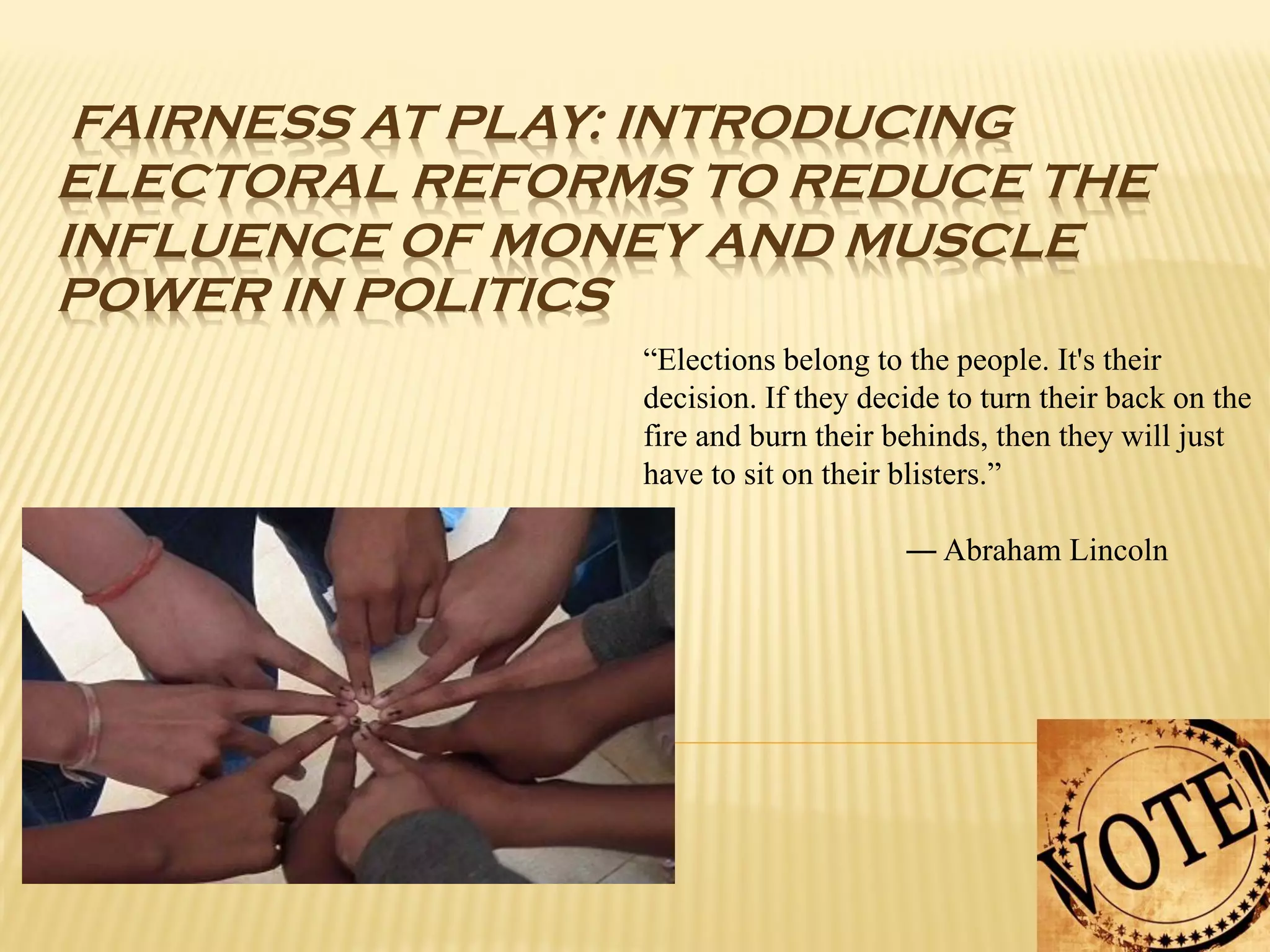
FAIRNESS AT PLAY: INTRODUCING
ELECTORAL REFORMS TO REDUCE THE
INFLUENCE OF MONEY AND MUSCLE
POWER IN POLITICS
“Elections belong to the people. It's their
decision. If they decide to turn their back on the
fire and burn their behinds, then they will just
have to sit on their blisters.”
― Abraham Lincoln
INTRODUCTION
 India is the largest democracy in the world but we feel that due to certain
reasons, democracy is not working properly. There is something wrong in the
electoral process .
 Elections are the most important and integral part of politics in a democratic
system of governance. While politics is the art and practice of dealing with
political power and election is a process of legitimization of such power.
The electoral reform process has been slow since parliamentarians have
an incentive to delay legislation in order to protect corrupt or criminal
benefactors. The introduction of Electronic Voting Machines in the 2004
parliamentary elections was seen as a significant step in reforming the
electoral process. After lengthy deliberations, in July 2013, the Supreme
Court finally ruled that convicted candidates cannot run for elections.
Innovative methods must be devised to create transparency in order to
induct a new breed of leaders into our democracy.
WHY ELECTORAL REFORM ???
 Governance is aimed to ensure the welfare of the People, in India the
constitution was framed to ensure welfare by an equitable distribution of
national wealth and resources.
 Political parties are indispensable in parliamentary democracy. There are 1,200
political parties in India and of these about 150 are active and functioning.
 However a small minority of the population has prospered hugely while the
quality of lives of the majority has deteriorated. This is reflected in massive
rural unemployment, lack of adequate health care and education, a sharp drop
in the purchasing power of the people and a sharp growth in rural indebtedness
We need to ask some basic questions at this stage 
(1) Is the mechanism of election an effective instrument of the democratic will of the
people?
(2)Do the measures, which fructify as outcomes of election, reflect the aspirations of
those who are excluded from their due share of welfare?
 Electoral reform is a change in the electoral system such that genuine public
desires find expression in election results.
 There have been a number of reports and recommendations on what needs to
be done.
 Some of the significant examples are the Indrajit Gupta Report, the Dinesh
Goswami Report, the 170th Report of the Law Commission of India on Review
of the working of political parties and Electoral Reforms and the
Recommendations of the National Commission to Review the Working of the
Constitution (NCRWC)
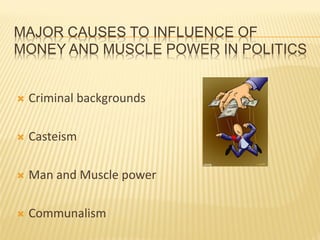
MAJOR CAUSES TO INFLUENCE OF
MONEY AND MUSCLE POWER IN POLITICS
 Criminal backgrounds
 Casteism
 Man and Muscle power
 Communalism
MEASURES TO REDUCE THESE MUSCLE AND
MONEY POWER IN ELECTIONS
 Abolish the first-past-the-post system and make the requirement of 50% + 1 votes as mandatory
to declare a winner.
 Government of India should be dissolved before 1 month of general elections so that we can
control ruling party influence on election.
× All the citizens who are vote eligible must vote in election if any citizen doesn’t vote all the favors
from the government should be cancelled and individual is not eligible for any government
service
 The donation by an individual or company to a candidate must not exceed 5% of the total
expenditure. The total donation made by an individual or a company to all candidates in an
election must not exceed 50% of the total permissible expenditure by one candidate. All
donations given and received must be in public knowledge.
 Election commission of India should introduce fingerprint method in elections
 Government of India must bring an act that introducing people representative selection
commission
 Ban publication of exit opinion poll results till voting in all the phases is complete.
 The candidates selected by various political parties should send the candidates list to this
commission and this will select the candidates by enquiring their background.
 The commission should function under guidelines of Election commission of India
 The commission should consists of 4 members
1.Social worker 2.Civil servant3.Economist 4.Retd supreme court judge
 All candidates must be required to submit audited accounts, with receipts, of election expenditure.
The Election Commission must have adequate auditing manpower to have accounts checked within
30 days after the counting of ballot papers. Over expenditure by 5% or more or discrepancies in the
accounts amounting to over 5% should be grounds for disqualification of a candidate.
 No change of party or change of status of a candidate to an independent member should be permitted
till the announcement of the next elections.
IMPACT OF THE MEASURES :-
If the above electoral reforms implemented good faces can go to
parliament and a best cabinet will form and there will be major
changes in India those are:-
 we can control poverty
 we can control corruption
 There will be no economic disparities
 There will be no - violence
 If poverty disappears we can control naxalism
 There will be no separatist movements
 There will be a good infrastructure
 we can control farmers suicides
 we can eradicate border disputes with pak and china
 There will be no scarcity of electricity
 we can reduce unemployment
 we can control terrorism
 we can gain high literacy rate
 All this happens only when good faces enters into the parliament and
good policies will come so India can develop faster than other
countries if we can solve the above problems currently facing India will
emerge as super power in uni polar world
CONCLUSION
 The dynamics of national and state politics of the last
decade is a mute witness of the clashes and conflicts
between the so called. Secularist and communalist
although a comprehensive constitutional amendment
bill and representation of the people bill 1993 were
introduced to de-link polities from communalism,
casteism and linguicism etc.. By the minority
government, these could not pass through the
parliament .
Thank you…

RJSK555

  • 1.
    FAIRNESS AT PLAY:INTRODUCING ELECTORAL REFORMS TO REDUCE THE INFLUENCE OF MONEY AND MUSCLE POWER IN POLITICS “Elections belong to the people. It's their decision. If they decide to turn their back on the fire and burn their behinds, then they will just have to sit on their blisters.” ― Abraham Lincoln
  • 2.
    INTRODUCTION  India isthe largest democracy in the world but we feel that due to certain reasons, democracy is not working properly. There is something wrong in the electoral process .  Elections are the most important and integral part of politics in a democratic system of governance. While politics is the art and practice of dealing with political power and election is a process of legitimization of such power. The electoral reform process has been slow since parliamentarians have an incentive to delay legislation in order to protect corrupt or criminal benefactors. The introduction of Electronic Voting Machines in the 2004 parliamentary elections was seen as a significant step in reforming the electoral process. After lengthy deliberations, in July 2013, the Supreme Court finally ruled that convicted candidates cannot run for elections. Innovative methods must be devised to create transparency in order to induct a new breed of leaders into our democracy.
  • 3.
    WHY ELECTORAL REFORM???  Governance is aimed to ensure the welfare of the People, in India the constitution was framed to ensure welfare by an equitable distribution of national wealth and resources.  Political parties are indispensable in parliamentary democracy. There are 1,200 political parties in India and of these about 150 are active and functioning.  However a small minority of the population has prospered hugely while the quality of lives of the majority has deteriorated. This is reflected in massive rural unemployment, lack of adequate health care and education, a sharp drop in the purchasing power of the people and a sharp growth in rural indebtedness We need to ask some basic questions at this stage  (1) Is the mechanism of election an effective instrument of the democratic will of the people? (2)Do the measures, which fructify as outcomes of election, reflect the aspirations of those who are excluded from their due share of welfare?
  • 4.
     Electoral reformis a change in the electoral system such that genuine public desires find expression in election results.  There have been a number of reports and recommendations on what needs to be done.  Some of the significant examples are the Indrajit Gupta Report, the Dinesh Goswami Report, the 170th Report of the Law Commission of India on Review of the working of political parties and Electoral Reforms and the Recommendations of the National Commission to Review the Working of the Constitution (NCRWC)
  • 5.
    MAJOR CAUSES TOINFLUENCE OF MONEY AND MUSCLE POWER IN POLITICS  Criminal backgrounds  Casteism  Man and Muscle power  Communalism
  • 6.
    MEASURES TO REDUCETHESE MUSCLE AND MONEY POWER IN ELECTIONS  Abolish the first-past-the-post system and make the requirement of 50% + 1 votes as mandatory to declare a winner.  Government of India should be dissolved before 1 month of general elections so that we can control ruling party influence on election. × All the citizens who are vote eligible must vote in election if any citizen doesn’t vote all the favors from the government should be cancelled and individual is not eligible for any government service  The donation by an individual or company to a candidate must not exceed 5% of the total expenditure. The total donation made by an individual or a company to all candidates in an election must not exceed 50% of the total permissible expenditure by one candidate. All donations given and received must be in public knowledge.  Election commission of India should introduce fingerprint method in elections  Government of India must bring an act that introducing people representative selection commission
  • 7.
     Ban publicationof exit opinion poll results till voting in all the phases is complete.  The candidates selected by various political parties should send the candidates list to this commission and this will select the candidates by enquiring their background.  The commission should function under guidelines of Election commission of India  The commission should consists of 4 members 1.Social worker 2.Civil servant3.Economist 4.Retd supreme court judge  All candidates must be required to submit audited accounts, with receipts, of election expenditure. The Election Commission must have adequate auditing manpower to have accounts checked within 30 days after the counting of ballot papers. Over expenditure by 5% or more or discrepancies in the accounts amounting to over 5% should be grounds for disqualification of a candidate.  No change of party or change of status of a candidate to an independent member should be permitted till the announcement of the next elections.
  • 8.
    IMPACT OF THEMEASURES :- If the above electoral reforms implemented good faces can go to parliament and a best cabinet will form and there will be major changes in India those are:-  we can control poverty  we can control corruption  There will be no economic disparities  There will be no - violence  If poverty disappears we can control naxalism  There will be no separatist movements  There will be a good infrastructure
  • 9.
     we cancontrol farmers suicides  we can eradicate border disputes with pak and china  There will be no scarcity of electricity  we can reduce unemployment  we can control terrorism  we can gain high literacy rate  All this happens only when good faces enters into the parliament and good policies will come so India can develop faster than other countries if we can solve the above problems currently facing India will emerge as super power in uni polar world
  • 10.
    CONCLUSION  The dynamicsof national and state politics of the last decade is a mute witness of the clashes and conflicts between the so called. Secularist and communalist although a comprehensive constitutional amendment bill and representation of the people bill 1993 were introduced to de-link polities from communalism, casteism and linguicism etc.. By the minority government, these could not pass through the parliament .
  • 11.