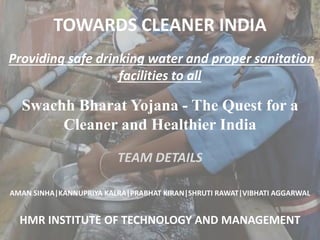
TOWARDS CLEANER INDIA
Providing safe drinking water and proper sanitation
facilities to all
TEAM DETAILS
AMAN SINHA|KANNUPRIYA KALRA|PRABHAT KIRAN|SHRUTI RAWAT|VIBHATI AGGARWAL
HMR INSTITUTE OF TECHNOLOGY AND MANAGEMENT
Swachh Bharat Yojana - The Quest for a
Cleaner and Healthier India
LACK OF CLEAN DRINKING WATER AND POOR SANITATION FACILITIES HAMPER
PRODICTIVITY, DEPRIVING INDIA OF 73 MILLION WORKING DAYS EACH YEAR
66%
0.20%
1%
1%
4%
12%
16%
Health Impact of Inadequate
Sanitation in India
Diarrhea
Malaria
Globally, 2.5 billion people do not have access to a clean, safe
toilet which is 37 % of the global population
. A very low proportion of the rural Indian population in India has
access to improved sanitation which
implies that 70% of the rural Population does not have access to
toilets
“We shall not finally defeat AIDS, tuberculosis, malaria, or any
of
the other infectious diseases that plague the developing world
until we have also won the battle for safe drinking water,
sanitation and basic health care.”
Kofi Annan, United Nations Secretary-General
 GENERAL LACK OF AWARENESS
 INDUSTRIAL WASTE
 WASTAGE OF WATER DURING
TRANSPORTATION
 POOR MAINTAINANCE OF CLEAN WATER
RESOURCES
 SOCIO ECONOMIC FACTORS LIKE POVERTY ,
CASTE AND GENDER DISCRIMINATION
 CURRENT SYSTEM OF FINANCING
SANITATION AND CLEAN DRINKING WATER
IS FRAGMENTED BETWEEN CENTRAL AND
STATE GOVERMENT
 OVERPOPULATION
“Lack of sanitation is detrimental not only to women's
health and their dignity but also to their education,
with one in four girls dropping out of schools as there
are no facilities that they can safely access”
CURRENT SCENARIO...
• Inculcating the necessity of basic sanitation in primary and
secondary education curriculum
• Use of Social, electronic and print Media - free broadcasting of
informatory advertisements for a predefined time span to be made
mandatory for private channels as a part of their CSR initiative.
• To highlight the harmful effects of poor sanitation and drinking
water by organizing street plays in distant locations of the country
Dynamic
awareness
programs
• Provision for subsidy on basic toiletries for BPL
population.
• Provision of ‘green points’ for the industries managing
their industrial waste in a more efficient manner wherein
they will get monitory tax benefits .
• Sanitation loans for individuals and communities.
Economic
reforms
• Including provision for providing clean drinking
water to all under food security bill and hence
ratifying Article 47 of the constitution.
• Transferring the financial management
responsibilities for providing clean drinking water
and sanitation facilities from central government to
state government.
Legislative
reforms
• Funding research to develop waterless , hygienic
toilets that do not require a sewer connection or
electricity
• Ground breaking improvements in toilet designs,
pit emptying , sludge treatment and new ways
to recycle waste
Transformative
technologies
• Construction of well maintained public toilets
• Induction of dual water supply wherein filtered, purified water may
be used for drinking purposes while other sources of water may be
used for other purposes
• Establishing sewer connections and treatment plants that collect
waste , produce fertilizers and generate electricity
• Facility for rain water harvesting and subsequent recharge of
groundwater
Construction
• Defecation in open to be banned in rural as well as urban areas.
• Regular check on TDS level of potable water
• Involvement of women in water-supply activities by identifying women’s
groups and movements at all levels and incorporating their views into
community-level water-harvesting, recycling, saving and purifying, and
supply initiatives.
• Provision of Small reverse osmosis devices, in communities, that regularly
produce 7 litres of water from any type of water
• Increased use of small scale n cost effective ways to filter water such as
solar disinfection method n mud-pot filtering system.
Miscellaneous
A contrast- proposed reforms
and existing policies
Under the R n D Dept. Of Rajiv Gandhi National Drinking Water Mission,
improvements in distribution network of water supply projects for reducing
water losses including unaccounted losses were to be made. However, our
proposed policy suggests introduction of waterless toilets, which will result in
no water loss.
At present, the BPL card holders are only benefited with subsidy on food
supplies. The new reform suggests to cover sanitary products such as toiletries
and sanitary napkins under the subsidy.
As of now,60% of sewage water gets untreated and hence , wasted . It can be
utilized for other purposes like gardening, car washing , coolant in industries
etc. By further advancements in technology , sewage water can be used to
generate electricity also.
MANAGEMENT TEAM
OUTREACH
/MEDIA
FEEDBACK
AND
VIGILANCE
TRAINING AND
MAINTAINANCE
FINANCE
RESEARCH AND
DEVELOPMENT
CONSTRUCTION
ROLE OF MANAGEMENT TEAM
-TO ASSIGN RESPONISBILITES TO ALL DEPARTMENTS
-EVERY DPTT. SHALL REPORT TO THE MANAGEMENT ON MONTHLY BASIS REGARDING THE WORK PROGRESS
-TO MAINTAIN A CORDIAL AND EFFICIENT WORKING ATMOSPHERE.
GENERATE A REPORT FOR THE SAME.
-MANAGEMENT TEAM WILL HAVE REPRESENTATIVES FROM STATE GOVT. WHO WILL BE ACCOUNTABLE TO REPRESENTATIVES
TO CENTRAL GOVT.
• BUILD A LARGE
NETWORK OF
SKILLED
VOLUNTEERS
DRAWN AMONG
STUDENTS,PROFES
SIONALS AND
LOCALS OF THAT
AREA.
• ASSIGNING ROLES
TO VILLAGE
HEADS ,CIVIC
BODIES AND
TRAINED PEOPLE
FOR
MANTAINANCE
PURPOSES
• INCULCATING IN
CURRICULUM,TH
E IMPORTANCE
OF CLEAN
DRINKING
WATER AND
SANITAION
FACILITIES.
• MAKE IT
MANADATORY
FOR PRINT AND
ELECTRONIC
MEDIA TO
BROADCAST
AWARENESS
CLIPPINGS ON
THIS
ISSUE,WHICH
WAS TILL DATE A
RESPONSIBILIY
OF PUBLIC
MEDIA.
• A MECHANISM
FOR FEEDBACK
AND SURVEY
FROM THE
STAKEHOLDERS
AND THE
VOLUNTEERS
THAT SHALL
ENCOURAGE
BETTERMENT OF
REFORMS AND
MAINTAINANCE
OF EXISTING
POLICIES.
• TO REPORT THE
LEGITIMATE
FEEDBACKS TO
THE
MANAGEMENT
DPTT. SO AS
SUITABLE
ACTIONS COULD
BE TAKEN
• NATIONAL
GOVERNMENTS
CAN ALLOCATE
FUNDS TO
SANITATION AND
HYGIENE
EDUCATION AND
ENSURE THEIR
INCLUSION
POVERTY
ALLEVIATION
STRATEGIES AND
BUDGETARY
ALLOCATIONS
• ASSESS THE
EFFECTIVENESS
OF DIFFERENT
PUBLIC SPENDING
PROGRAMMES
ON INCREASING
ACCESS
•ENTREPRENEURS
CAN WORK
TOGETHER AS
PARTNERS TO
DEVELOP
APPROPRIATE
SANITATION AND
HYGIENE
TECHNOLOGIES
AND SERVICES.
•THIS TEAM WILL
ALSO
•IT WILL ALSO
WORK TO
IMPROVE
EXISTING
PRODUCTS
ACCORDING TO
THE
STAKEHOLDERS
DEMANDS.
•K
• ESTABLISHMENT
OF ADEQUATE
AND NECESSARY
INFRASTRUCTURE
TO FACILITATE
PROPER
SANITATION AND
WATER AND
SEWAGE
TREATMENT.
• REVIEW OF THE
REGISTRATION OF
A LICENSED
BUILDER.
• MANAGEMENT
OF THE ELECTRIC
EQUIPMENT
INSPECTION.
TRAINING
AND
MAINTAINAN
CE
OUTREACH
DPTT.
FEEDBACK
AND
VIGILANCE
DPTT.
FINANCE
DPTT.
RESEARCH
AND
DEVELOPEM
ENT DPTT.
CONSTRUCTI
ON DPTT.
ACTION PLAN FOR STAKEHOLDERS
INDIVIDUALS AND
COMMUNITIES
• Water harvesting at home, schools
and community buildings.
• Removal of solids by sedimentation
• Inactivation of microorganisms by UV
radiation and thermal treatment
• Safe Drinking Water: The need, the
problem, solutions, and an action
plan
• Water recycling at the microlevel,
including at homes, buildings and
communities.
• Saving water by ensuring taps and
pipes are not leaky and by using
optimum amounts of water for
washing and toilet flushing.
• Water to be purified by methods
suited to family conditions and needs.
• Maintaining proper levels of
sanitation at home.
GOVERNMENT
Encouragement of political
commitment through effective policy
formulation, support for the
implementation of plans, and improved
budgetary allocations.
• Support of local efforts and
community-based strategies for
addressing the issue. • Facilitation of
access to appropriate technologies.
• Development of legal and regulatory
frameworks for private industry and
NGO participation.
• Devising of mechanisms that enable
governmental agencies to pursue
sanitation as a national priority,
including development of sanitation
policies and guidelines, and the
integration of hygiene education into all
water supply and sanitation projects.
PRIVATE INDUSTRY AND NGO’S
• Exchanging information among and
between industry and
nongovernmental organizations on
relevant and novel methods and
strategies.
• Focusing on sociological factors that
may have an impact on the most
suitable technologies and programmes
for a given region/ community.
• Ensuring equity in both services and
benefits.
• Involving communities in all aspects
of water harvesting, recycling, storage,
purification and supply.
• Coordinating efforts among
governmental and intergovernmental
sectors for the purposes of achieving
harmonious processes and results.
IMPROVED SERVICES WILL LEAD TO LESS
MORBDITY AND MORTALITY FROM WATER-
RELATED DISEASES
BANNING OF OPEN DEFECATION WILL LEAD
TO CLEANER AND HYGEINIC ENVIRONMENT.
CLEAN WATER AND IMPROVED SANITATION
ALLOWS THE MASSES ESPECIALLY WOMEN TO
LEAD A MORE DIGNIFIED LIFE.
EFFICIENT WASTE UTILIZATION WILL LEAD
TO PRODUCTION OF FERTILIZERS AND BIOGAS.
AWARENESS GENERATED IN PEOPLE TODAY
WILL SET A BASE FOR THE GENERATIONS
AHEAD TO ESSENTIALIZE PROPER SANITATION
AND CLEAN DRINKING WATER.
EFFICIENT UTILIZATION OF NON-POTABLE
WATER AS A RESULT OF SEWAGE WATER
TREATMENT.
PUBLIC TOILETS,ONCE SETUP,WILL
SUSTAIN LONG WITH REGULAR
MAINTAINACE CHECKS PROPOSED IN THE
SOLUTION.
CONSTRUCTION WORK WILL GENERATE
EMPLOYEMENT, HENCE WILL ENCOURAGE
MORE PARTICIPATION IN SUSTAINING THE
MAINTAINACE OF OUR TREATMENT PLANTS
AND OTHER CONSTRUCTIONS.
ANNUAL/QUARTERLY HEALTH
REPORTS
SURVEY OF ACCESSIBILITY OF THE
SCHEME AND MAPPING OF AREAS
AFFECTED.
OUTPUT MEASUREMENT OF
TREATMENT PLANTS.
SCALABILITY OF THE
SOLUTIONS
IMPACT OF PROPOSED
SOLUTIONS
SUSTAINABILITY OF
PROPOSED SOLUTION
CHALLENGES AND MITIGATION..
• INADEQUATE EXPOSURE,EXISTING
MINDSET-BELIEFS AND MYTHS.
• COMMUNITY SENSITIZATION AND
PARTICIPATION
• NEED FOR TRAINED AND SKILLED
ANIMATORS.
AWARENESS
AND SOCIAL
CHALLENGES
• AFFORDABILITY OF SANITATION
LOAN
• EXTENT OF “POLITICAL COVER”
FINANCIAL AND
POLICY
CHALLENGES
• LOCAL CLIMATIC CONDITIONS
• TOPOGRAPHIC LIMITATIONS.FOR
INSTANCE,BUILDING OF SEWAGE
TREATMENT PLANTS ON HILLY
TERRAINS.
• WASTE DISPOSAL
ENVIRONMENTAL
AND DESIGN
CHALLENGES
EXPOSURE PROVIDED THROUGH
PRINT AND e-MEDIA
CONDUCTION OF TRAINING
WORKSHOPS TO ENCOURAGE
PARTICIPATION OF THE LOCALS
RAIN WATER HARVESTING IN
REGIONS WITH LOW ANNUAL
RAINFALL.
ADOPT ALTERNATIVE SEWAGE
DRAINAGE SYSTEMS IN HILLY AREAS
WITH CONSULTATION OF LOCALS.
VIGILANCE DPTT. UNDER THE
MANAGEMENT TEAM TO TAKE CARE OF
THE FINANCIAL CORRUPTION
REASONABLE INTEREST RATE ON
LOANS
MITIGATION
FACTORS
References
• Using Innovative, Low-cost Solutions to Provide Safe Drinking Water in India: India
Knowledge@Wharton
• Indira Khurana and Romit Sen, WaterAid Drinking water quality in rural India: Issues
and approaches
• Prof. Subir Paul, Emerging Challenges in ‘Water and Sanitation’ Problems and the
Need for Appropriate Human Resource Development Institute of Town Planners, India
Journal 8 - 1, 73 - 89, January - March 2011
• C.Ramachandraiah, Right to Drinking Water in India - Working Paper No. 56
• May, 2004 CENTRE FOR ECONOMIC AND SOCIAL STUDIES
• Adi Narayan, Extra Food Means Nothing to Stunted Kids With Bad Water: Health Jun
13, 2013
• NATIONAL WATER POLICY (2012) Government of India Ministry of Water Resources
• Pavan Srinath, Think sanitation, not food security May 24, 2013
• National Water Policy - Wikipedia
• Report: The need, the problem, solutions and an action plan – Safe Drinking Water,
The World Academic of Sciences
• Gita Balakrishnan, The Sanitation Challenge, Compilation (Ethos) presented at the
Second FINISH workshop in Ooty, 8-9 April, 2010

YouthChisels

  • 1.
    TOWARDS CLEANER INDIA Providingsafe drinking water and proper sanitation facilities to all TEAM DETAILS AMAN SINHA|KANNUPRIYA KALRA|PRABHAT KIRAN|SHRUTI RAWAT|VIBHATI AGGARWAL HMR INSTITUTE OF TECHNOLOGY AND MANAGEMENT Swachh Bharat Yojana - The Quest for a Cleaner and Healthier India
  • 2.
    LACK OF CLEANDRINKING WATER AND POOR SANITATION FACILITIES HAMPER PRODICTIVITY, DEPRIVING INDIA OF 73 MILLION WORKING DAYS EACH YEAR 66% 0.20% 1% 1% 4% 12% 16% Health Impact of Inadequate Sanitation in India Diarrhea Malaria Globally, 2.5 billion people do not have access to a clean, safe toilet which is 37 % of the global population . A very low proportion of the rural Indian population in India has access to improved sanitation which implies that 70% of the rural Population does not have access to toilets “We shall not finally defeat AIDS, tuberculosis, malaria, or any of the other infectious diseases that plague the developing world until we have also won the battle for safe drinking water, sanitation and basic health care.” Kofi Annan, United Nations Secretary-General
  • 3.
     GENERAL LACKOF AWARENESS  INDUSTRIAL WASTE  WASTAGE OF WATER DURING TRANSPORTATION  POOR MAINTAINANCE OF CLEAN WATER RESOURCES  SOCIO ECONOMIC FACTORS LIKE POVERTY , CASTE AND GENDER DISCRIMINATION  CURRENT SYSTEM OF FINANCING SANITATION AND CLEAN DRINKING WATER IS FRAGMENTED BETWEEN CENTRAL AND STATE GOVERMENT  OVERPOPULATION “Lack of sanitation is detrimental not only to women's health and their dignity but also to their education, with one in four girls dropping out of schools as there are no facilities that they can safely access” CURRENT SCENARIO...
  • 4.
    • Inculcating thenecessity of basic sanitation in primary and secondary education curriculum • Use of Social, electronic and print Media - free broadcasting of informatory advertisements for a predefined time span to be made mandatory for private channels as a part of their CSR initiative. • To highlight the harmful effects of poor sanitation and drinking water by organizing street plays in distant locations of the country Dynamic awareness programs • Provision for subsidy on basic toiletries for BPL population. • Provision of ‘green points’ for the industries managing their industrial waste in a more efficient manner wherein they will get monitory tax benefits . • Sanitation loans for individuals and communities. Economic reforms • Including provision for providing clean drinking water to all under food security bill and hence ratifying Article 47 of the constitution. • Transferring the financial management responsibilities for providing clean drinking water and sanitation facilities from central government to state government. Legislative reforms
  • 5.
    • Funding researchto develop waterless , hygienic toilets that do not require a sewer connection or electricity • Ground breaking improvements in toilet designs, pit emptying , sludge treatment and new ways to recycle waste Transformative technologies • Construction of well maintained public toilets • Induction of dual water supply wherein filtered, purified water may be used for drinking purposes while other sources of water may be used for other purposes • Establishing sewer connections and treatment plants that collect waste , produce fertilizers and generate electricity • Facility for rain water harvesting and subsequent recharge of groundwater Construction • Defecation in open to be banned in rural as well as urban areas. • Regular check on TDS level of potable water • Involvement of women in water-supply activities by identifying women’s groups and movements at all levels and incorporating their views into community-level water-harvesting, recycling, saving and purifying, and supply initiatives. • Provision of Small reverse osmosis devices, in communities, that regularly produce 7 litres of water from any type of water • Increased use of small scale n cost effective ways to filter water such as solar disinfection method n mud-pot filtering system. Miscellaneous
  • 6.
    A contrast- proposedreforms and existing policies Under the R n D Dept. Of Rajiv Gandhi National Drinking Water Mission, improvements in distribution network of water supply projects for reducing water losses including unaccounted losses were to be made. However, our proposed policy suggests introduction of waterless toilets, which will result in no water loss. At present, the BPL card holders are only benefited with subsidy on food supplies. The new reform suggests to cover sanitary products such as toiletries and sanitary napkins under the subsidy. As of now,60% of sewage water gets untreated and hence , wasted . It can be utilized for other purposes like gardening, car washing , coolant in industries etc. By further advancements in technology , sewage water can be used to generate electricity also.
  • 7.
    MANAGEMENT TEAM OUTREACH /MEDIA FEEDBACK AND VIGILANCE TRAINING AND MAINTAINANCE FINANCE RESEARCHAND DEVELOPMENT CONSTRUCTION ROLE OF MANAGEMENT TEAM -TO ASSIGN RESPONISBILITES TO ALL DEPARTMENTS -EVERY DPTT. SHALL REPORT TO THE MANAGEMENT ON MONTHLY BASIS REGARDING THE WORK PROGRESS -TO MAINTAIN A CORDIAL AND EFFICIENT WORKING ATMOSPHERE. GENERATE A REPORT FOR THE SAME. -MANAGEMENT TEAM WILL HAVE REPRESENTATIVES FROM STATE GOVT. WHO WILL BE ACCOUNTABLE TO REPRESENTATIVES TO CENTRAL GOVT.
  • 8.
    • BUILD ALARGE NETWORK OF SKILLED VOLUNTEERS DRAWN AMONG STUDENTS,PROFES SIONALS AND LOCALS OF THAT AREA. • ASSIGNING ROLES TO VILLAGE HEADS ,CIVIC BODIES AND TRAINED PEOPLE FOR MANTAINANCE PURPOSES • INCULCATING IN CURRICULUM,TH E IMPORTANCE OF CLEAN DRINKING WATER AND SANITAION FACILITIES. • MAKE IT MANADATORY FOR PRINT AND ELECTRONIC MEDIA TO BROADCAST AWARENESS CLIPPINGS ON THIS ISSUE,WHICH WAS TILL DATE A RESPONSIBILIY OF PUBLIC MEDIA. • A MECHANISM FOR FEEDBACK AND SURVEY FROM THE STAKEHOLDERS AND THE VOLUNTEERS THAT SHALL ENCOURAGE BETTERMENT OF REFORMS AND MAINTAINANCE OF EXISTING POLICIES. • TO REPORT THE LEGITIMATE FEEDBACKS TO THE MANAGEMENT DPTT. SO AS SUITABLE ACTIONS COULD BE TAKEN • NATIONAL GOVERNMENTS CAN ALLOCATE FUNDS TO SANITATION AND HYGIENE EDUCATION AND ENSURE THEIR INCLUSION POVERTY ALLEVIATION STRATEGIES AND BUDGETARY ALLOCATIONS • ASSESS THE EFFECTIVENESS OF DIFFERENT PUBLIC SPENDING PROGRAMMES ON INCREASING ACCESS •ENTREPRENEURS CAN WORK TOGETHER AS PARTNERS TO DEVELOP APPROPRIATE SANITATION AND HYGIENE TECHNOLOGIES AND SERVICES. •THIS TEAM WILL ALSO •IT WILL ALSO WORK TO IMPROVE EXISTING PRODUCTS ACCORDING TO THE STAKEHOLDERS DEMANDS. •K • ESTABLISHMENT OF ADEQUATE AND NECESSARY INFRASTRUCTURE TO FACILITATE PROPER SANITATION AND WATER AND SEWAGE TREATMENT. • REVIEW OF THE REGISTRATION OF A LICENSED BUILDER. • MANAGEMENT OF THE ELECTRIC EQUIPMENT INSPECTION. TRAINING AND MAINTAINAN CE OUTREACH DPTT. FEEDBACK AND VIGILANCE DPTT. FINANCE DPTT. RESEARCH AND DEVELOPEM ENT DPTT. CONSTRUCTI ON DPTT.
  • 9.
    ACTION PLAN FORSTAKEHOLDERS INDIVIDUALS AND COMMUNITIES • Water harvesting at home, schools and community buildings. • Removal of solids by sedimentation • Inactivation of microorganisms by UV radiation and thermal treatment • Safe Drinking Water: The need, the problem, solutions, and an action plan • Water recycling at the microlevel, including at homes, buildings and communities. • Saving water by ensuring taps and pipes are not leaky and by using optimum amounts of water for washing and toilet flushing. • Water to be purified by methods suited to family conditions and needs. • Maintaining proper levels of sanitation at home. GOVERNMENT Encouragement of political commitment through effective policy formulation, support for the implementation of plans, and improved budgetary allocations. • Support of local efforts and community-based strategies for addressing the issue. • Facilitation of access to appropriate technologies. • Development of legal and regulatory frameworks for private industry and NGO participation. • Devising of mechanisms that enable governmental agencies to pursue sanitation as a national priority, including development of sanitation policies and guidelines, and the integration of hygiene education into all water supply and sanitation projects. PRIVATE INDUSTRY AND NGO’S • Exchanging information among and between industry and nongovernmental organizations on relevant and novel methods and strategies. • Focusing on sociological factors that may have an impact on the most suitable technologies and programmes for a given region/ community. • Ensuring equity in both services and benefits. • Involving communities in all aspects of water harvesting, recycling, storage, purification and supply. • Coordinating efforts among governmental and intergovernmental sectors for the purposes of achieving harmonious processes and results.
  • 10.
    IMPROVED SERVICES WILLLEAD TO LESS MORBDITY AND MORTALITY FROM WATER- RELATED DISEASES BANNING OF OPEN DEFECATION WILL LEAD TO CLEANER AND HYGEINIC ENVIRONMENT. CLEAN WATER AND IMPROVED SANITATION ALLOWS THE MASSES ESPECIALLY WOMEN TO LEAD A MORE DIGNIFIED LIFE. EFFICIENT WASTE UTILIZATION WILL LEAD TO PRODUCTION OF FERTILIZERS AND BIOGAS. AWARENESS GENERATED IN PEOPLE TODAY WILL SET A BASE FOR THE GENERATIONS AHEAD TO ESSENTIALIZE PROPER SANITATION AND CLEAN DRINKING WATER. EFFICIENT UTILIZATION OF NON-POTABLE WATER AS A RESULT OF SEWAGE WATER TREATMENT. PUBLIC TOILETS,ONCE SETUP,WILL SUSTAIN LONG WITH REGULAR MAINTAINACE CHECKS PROPOSED IN THE SOLUTION. CONSTRUCTION WORK WILL GENERATE EMPLOYEMENT, HENCE WILL ENCOURAGE MORE PARTICIPATION IN SUSTAINING THE MAINTAINACE OF OUR TREATMENT PLANTS AND OTHER CONSTRUCTIONS. ANNUAL/QUARTERLY HEALTH REPORTS SURVEY OF ACCESSIBILITY OF THE SCHEME AND MAPPING OF AREAS AFFECTED. OUTPUT MEASUREMENT OF TREATMENT PLANTS. SCALABILITY OF THE SOLUTIONS IMPACT OF PROPOSED SOLUTIONS SUSTAINABILITY OF PROPOSED SOLUTION
  • 11.
    CHALLENGES AND MITIGATION.. •INADEQUATE EXPOSURE,EXISTING MINDSET-BELIEFS AND MYTHS. • COMMUNITY SENSITIZATION AND PARTICIPATION • NEED FOR TRAINED AND SKILLED ANIMATORS. AWARENESS AND SOCIAL CHALLENGES • AFFORDABILITY OF SANITATION LOAN • EXTENT OF “POLITICAL COVER” FINANCIAL AND POLICY CHALLENGES • LOCAL CLIMATIC CONDITIONS • TOPOGRAPHIC LIMITATIONS.FOR INSTANCE,BUILDING OF SEWAGE TREATMENT PLANTS ON HILLY TERRAINS. • WASTE DISPOSAL ENVIRONMENTAL AND DESIGN CHALLENGES EXPOSURE PROVIDED THROUGH PRINT AND e-MEDIA CONDUCTION OF TRAINING WORKSHOPS TO ENCOURAGE PARTICIPATION OF THE LOCALS RAIN WATER HARVESTING IN REGIONS WITH LOW ANNUAL RAINFALL. ADOPT ALTERNATIVE SEWAGE DRAINAGE SYSTEMS IN HILLY AREAS WITH CONSULTATION OF LOCALS. VIGILANCE DPTT. UNDER THE MANAGEMENT TEAM TO TAKE CARE OF THE FINANCIAL CORRUPTION REASONABLE INTEREST RATE ON LOANS MITIGATION FACTORS
  • 12.
    References • Using Innovative,Low-cost Solutions to Provide Safe Drinking Water in India: India Knowledge@Wharton • Indira Khurana and Romit Sen, WaterAid Drinking water quality in rural India: Issues and approaches • Prof. Subir Paul, Emerging Challenges in ‘Water and Sanitation’ Problems and the Need for Appropriate Human Resource Development Institute of Town Planners, India Journal 8 - 1, 73 - 89, January - March 2011 • C.Ramachandraiah, Right to Drinking Water in India - Working Paper No. 56 • May, 2004 CENTRE FOR ECONOMIC AND SOCIAL STUDIES • Adi Narayan, Extra Food Means Nothing to Stunted Kids With Bad Water: Health Jun 13, 2013 • NATIONAL WATER POLICY (2012) Government of India Ministry of Water Resources • Pavan Srinath, Think sanitation, not food security May 24, 2013 • National Water Policy - Wikipedia • Report: The need, the problem, solutions and an action plan – Safe Drinking Water, The World Academic of Sciences • Gita Balakrishnan, The Sanitation Challenge, Compilation (Ethos) presented at the Second FINISH workshop in Ooty, 8-9 April, 2010