Providing Safe Drinking Water and Sanitation facilities to All.
"[The water and sanitation] crisis claims more lives through disease than any
war claims through guns”.
Team Details:
Shweta Samaiya, Hayat Ali, Anchal Rathore, Pooja Bhakoria & Moiz Zaki
Scope
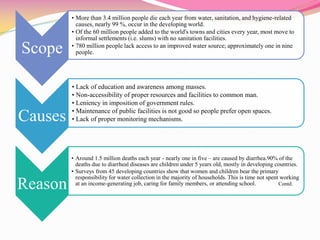
• More than 3.4 million people die each year from water, sanitation, and hygiene-related
causes, nearly 99 %, occur in the developing world.
• Of the 60 million people added to the world's towns and cities every year, most move to
informal settlements (i.e. slums) with no sanitation facilities.
• 780 million people lack access to an improved water source; approximately one in nine
people.
Causes
• Lack of education and awareness among masses.
• Non-accessibility of proper resources and facilities to common man.
• Leniency in imposition of government rules.
• Maintenance of public facilities is not good so people prefer open spaces.
• Lack of proper monitoring mechanisms.
Reason
• Around 1.5 million deaths each year - nearly one in five – are caused by diarrhea.90% of the
deaths due to diarrheal diseases are children under 5 years old, mostly in developing countries.
• Surveys from 45 developing countries show that women and children bear the primary
responsibility for water collection in the majority of households. This is time not spent working
at an income-generating job, caring for family members, or attending school. Contd.
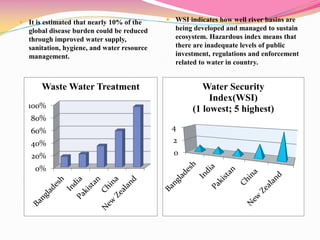
 It is estimated that nearly 10% of the
global disease burden could be reduced
through improved water supply,
sanitation, hygiene, and water resource
management.
0%
20%
40%
60%
80%
100%
Waste Water Treatment
 WSI indicates how well river basins are
being developed and managed to sustain
ecosystem. Hazardous index means that
there are inadequate levels of public
investment, regulations and enforcement
related to water in country.
0
2
4
Water Security
Index(WSI)
(1 lowest; 5 highest)
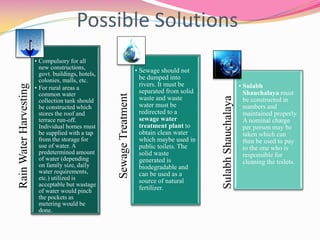
Possible SolutionsRainWaterHarvesting
• Compulsory for all
new constructions,
govt. buildings, hotels,
colonies, malls, etc.
• For rural areas a
common water
collection tank should
be constructed which
stores the roof and
terrace run-off.
Individual homes must
be supplied with a tap
from the storage for
use of water. A
predetermined amount
of water (depending
on family size, daily
water requirements,
etc.) utilized is
acceptable but wastage
of water would pinch
the pockets as
metering would be
done.
SewageTreatment
• Sewage should not
be dumped into
rivers. It must be
separated from solid
waste and waste
water must be
redirected to a
sewage water
treatment plant to
obtain clean water
which maybe used in
public toilets. The
solid waste
generated is
biodegradable and
can be used as a
source of natural
fertilizer.
SulabhShauchalaya
• Sulabh
Shauchalaya must
be constructed in
numbers and
maintained properly.
A nominal charge
per person may be
taken which can
then be used to pay
to the one who is
responsible for
cleaning the toilets.
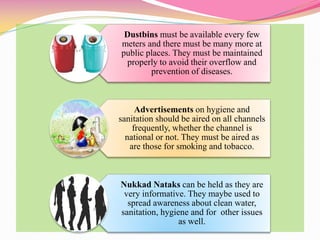
Dustbins must be available every few
meters and there must be many more at
public places. They must be maintained
properly to avoid their overflow and
prevention of diseases.
Advertisements on hygiene and
sanitation should be aired on all channels
frequently, whether the channel is
national or not. They must be aired as
are those for smoking and tobacco.
Nukkad Nataks can be held as they are
very informative. They maybe used to
spread awareness about clean water,
sanitation, hygiene and for other issues
as well.
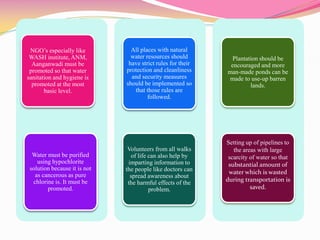
NGO’s especially like
WASH institute, ANM,
Aanganwadi must be
promoted so that water
sanitation and hygiene is
promoted at the most
basic level.
Water must be purified
using hypochlorite
solution because it is not
as cancerous as pure
chlorine is. It must be
promoted.
All places with natural
water resources should
have strict rules for their
protection and cleanliness
and security measures
should be implemented so
that those rules are
followed.
Volunteers from all walks
of life can also help by
imparting information to
the people like doctors can
spread awareness about
the harmful effects of the
problem.
Plantation should be
encouraged and more
man-made ponds can be
made to use-up barren
lands.
Setting up of pipelines to
the areas with large
scarcity of water so that
substantial amount of
water which is wasted
during transportation is
saved.
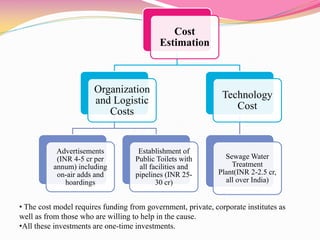
Cost
Estimation
Organization
and Logistic
Costs
Advertisements
(INR 4-5 cr per
annum) including
on-air adds and
hoardings
Establishment of
Public Toilets with
all facilities and
pipelines (INR 25-
30 cr)
Technology
Cost
Sewage Water
Treatment
Plant(INR 2-2.5 cr,
all over India)
• The cost model requires funding from government, private, corporate institutes as
well as from those who are willing to help in the cause.
•All these investments are one-time investments.
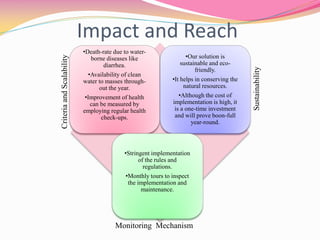
Impact and Reach
•Death-rate due to water-
borne diseases like
diarrhea.
•Availability of clean
water to masses through-
out the year.
•Improvement of health
can be measured by
employing regular health
check-ups.
•Our solution is
sustainable and eco-
friendly.
•It helps in conserving the
natural resources.
•Although the cost of
implementation is high, it
is a one-time investment
and will prove boon-full
year-round.
•Stringent implementation
of the rules and
regulations.
•Monthly tours to inspect
the implementation and
maintenance.
CriteriaandScalability
Sustainability
Monitoring Mechanism
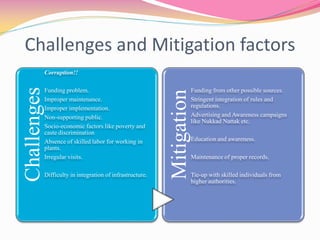
Challenges and Mitigation factors
Challenges
Corruption!!
Funding problem.
Improper maintenance.
Improper implementation.
Non-supporting public.
Socio-economic factors like poverty and
caste discrimination
Absence of skilled labor for working in
plants.
Irregular visits.
Difficulty in integration of infrastructure.
Mitigation
Funding from other possible sources.
Stringent integration of rules and
regulations.
Advertising and Awareness campaigns
like Nukkad Nattak etc.
Education and awareness.
Maintenance of proper records.
Tie-up with skilled individuals from
higher authorities.
References
 Google search.
 Wikipedia.
 Wash community an initiative of water.org.
 Live mint and wall street journal.
 www.wsp.org.
 Water is life. Retrieved from http://www.newstalk.ie/Water-Is-Life:-How-
India-is-tackling-its-climate-change-crisis.
 Water. (n.d.). India. Retrieved from http://water.org/country/india/ .
 UNICEF. (n.d.). Water, Environment and Sanitation. Retrieved from
http://www.unicef.org/india/wes.html
 Water. (n.d.). India. Retrieved from http://water.org/country/india/ .
 Center for Economic and Social Studies. (2004). Right to Drinking Water in
India. Retrieved from http://www.cess.ac.in/cesshome/wp%5CWater.pdf .
Hi5Engineers

Hi5Engineers

  • 1.
    Providing Safe DrinkingWater and Sanitation facilities to All. "[The water and sanitation] crisis claims more lives through disease than any war claims through guns”. Team Details: Shweta Samaiya, Hayat Ali, Anchal Rathore, Pooja Bhakoria & Moiz Zaki
  • 2.
    Scope • More than3.4 million people die each year from water, sanitation, and hygiene-related causes, nearly 99 %, occur in the developing world. • Of the 60 million people added to the world's towns and cities every year, most move to informal settlements (i.e. slums) with no sanitation facilities. • 780 million people lack access to an improved water source; approximately one in nine people. Causes • Lack of education and awareness among masses. • Non-accessibility of proper resources and facilities to common man. • Leniency in imposition of government rules. • Maintenance of public facilities is not good so people prefer open spaces. • Lack of proper monitoring mechanisms. Reason • Around 1.5 million deaths each year - nearly one in five – are caused by diarrhea.90% of the deaths due to diarrheal diseases are children under 5 years old, mostly in developing countries. • Surveys from 45 developing countries show that women and children bear the primary responsibility for water collection in the majority of households. This is time not spent working at an income-generating job, caring for family members, or attending school. Contd.
  • 3.
     It isestimated that nearly 10% of the global disease burden could be reduced through improved water supply, sanitation, hygiene, and water resource management. 0% 20% 40% 60% 80% 100% Waste Water Treatment  WSI indicates how well river basins are being developed and managed to sustain ecosystem. Hazardous index means that there are inadequate levels of public investment, regulations and enforcement related to water in country. 0 2 4 Water Security Index(WSI) (1 lowest; 5 highest)
  • 4.
    Possible SolutionsRainWaterHarvesting • Compulsoryfor all new constructions, govt. buildings, hotels, colonies, malls, etc. • For rural areas a common water collection tank should be constructed which stores the roof and terrace run-off. Individual homes must be supplied with a tap from the storage for use of water. A predetermined amount of water (depending on family size, daily water requirements, etc.) utilized is acceptable but wastage of water would pinch the pockets as metering would be done. SewageTreatment • Sewage should not be dumped into rivers. It must be separated from solid waste and waste water must be redirected to a sewage water treatment plant to obtain clean water which maybe used in public toilets. The solid waste generated is biodegradable and can be used as a source of natural fertilizer. SulabhShauchalaya • Sulabh Shauchalaya must be constructed in numbers and maintained properly. A nominal charge per person may be taken which can then be used to pay to the one who is responsible for cleaning the toilets.
  • 5.
    Dustbins must beavailable every few meters and there must be many more at public places. They must be maintained properly to avoid their overflow and prevention of diseases. Advertisements on hygiene and sanitation should be aired on all channels frequently, whether the channel is national or not. They must be aired as are those for smoking and tobacco. Nukkad Nataks can be held as they are very informative. They maybe used to spread awareness about clean water, sanitation, hygiene and for other issues as well.
  • 6.
    NGO’s especially like WASHinstitute, ANM, Aanganwadi must be promoted so that water sanitation and hygiene is promoted at the most basic level. Water must be purified using hypochlorite solution because it is not as cancerous as pure chlorine is. It must be promoted. All places with natural water resources should have strict rules for their protection and cleanliness and security measures should be implemented so that those rules are followed. Volunteers from all walks of life can also help by imparting information to the people like doctors can spread awareness about the harmful effects of the problem. Plantation should be encouraged and more man-made ponds can be made to use-up barren lands. Setting up of pipelines to the areas with large scarcity of water so that substantial amount of water which is wasted during transportation is saved.
  • 7.
    Cost Estimation Organization and Logistic Costs Advertisements (INR 4-5cr per annum) including on-air adds and hoardings Establishment of Public Toilets with all facilities and pipelines (INR 25- 30 cr) Technology Cost Sewage Water Treatment Plant(INR 2-2.5 cr, all over India) • The cost model requires funding from government, private, corporate institutes as well as from those who are willing to help in the cause. •All these investments are one-time investments.
  • 8.
    Impact and Reach •Death-ratedue to water- borne diseases like diarrhea. •Availability of clean water to masses through- out the year. •Improvement of health can be measured by employing regular health check-ups. •Our solution is sustainable and eco- friendly. •It helps in conserving the natural resources. •Although the cost of implementation is high, it is a one-time investment and will prove boon-full year-round. •Stringent implementation of the rules and regulations. •Monthly tours to inspect the implementation and maintenance. CriteriaandScalability Sustainability Monitoring Mechanism
  • 9.
    Challenges and Mitigationfactors Challenges Corruption!! Funding problem. Improper maintenance. Improper implementation. Non-supporting public. Socio-economic factors like poverty and caste discrimination Absence of skilled labor for working in plants. Irregular visits. Difficulty in integration of infrastructure. Mitigation Funding from other possible sources. Stringent integration of rules and regulations. Advertising and Awareness campaigns like Nukkad Nattak etc. Education and awareness. Maintenance of proper records. Tie-up with skilled individuals from higher authorities.
  • 10.
    References  Google search. Wikipedia.  Wash community an initiative of water.org.  Live mint and wall street journal.  www.wsp.org.  Water is life. Retrieved from http://www.newstalk.ie/Water-Is-Life:-How- India-is-tackling-its-climate-change-crisis.  Water. (n.d.). India. Retrieved from http://water.org/country/india/ .  UNICEF. (n.d.). Water, Environment and Sanitation. Retrieved from http://www.unicef.org/india/wes.html  Water. (n.d.). India. Retrieved from http://water.org/country/india/ .  Center for Economic and Social Studies. (2004). Right to Drinking Water in India. Retrieved from http://www.cess.ac.in/cesshome/wp%5CWater.pdf .