A Preschool Daily Routine &Effective TransitionsBy: WasheaSpence-Jackson
ObjectivesIdentify the elements of the daily routine.Plan for effective transitions that are an integral part of the day.
Daily RoutineGreeting TimePlanning TimeWork TimeCleanup TimeRecall TimeSnack TimeSmall-Group TimeLarge-Group TimeOutside Time
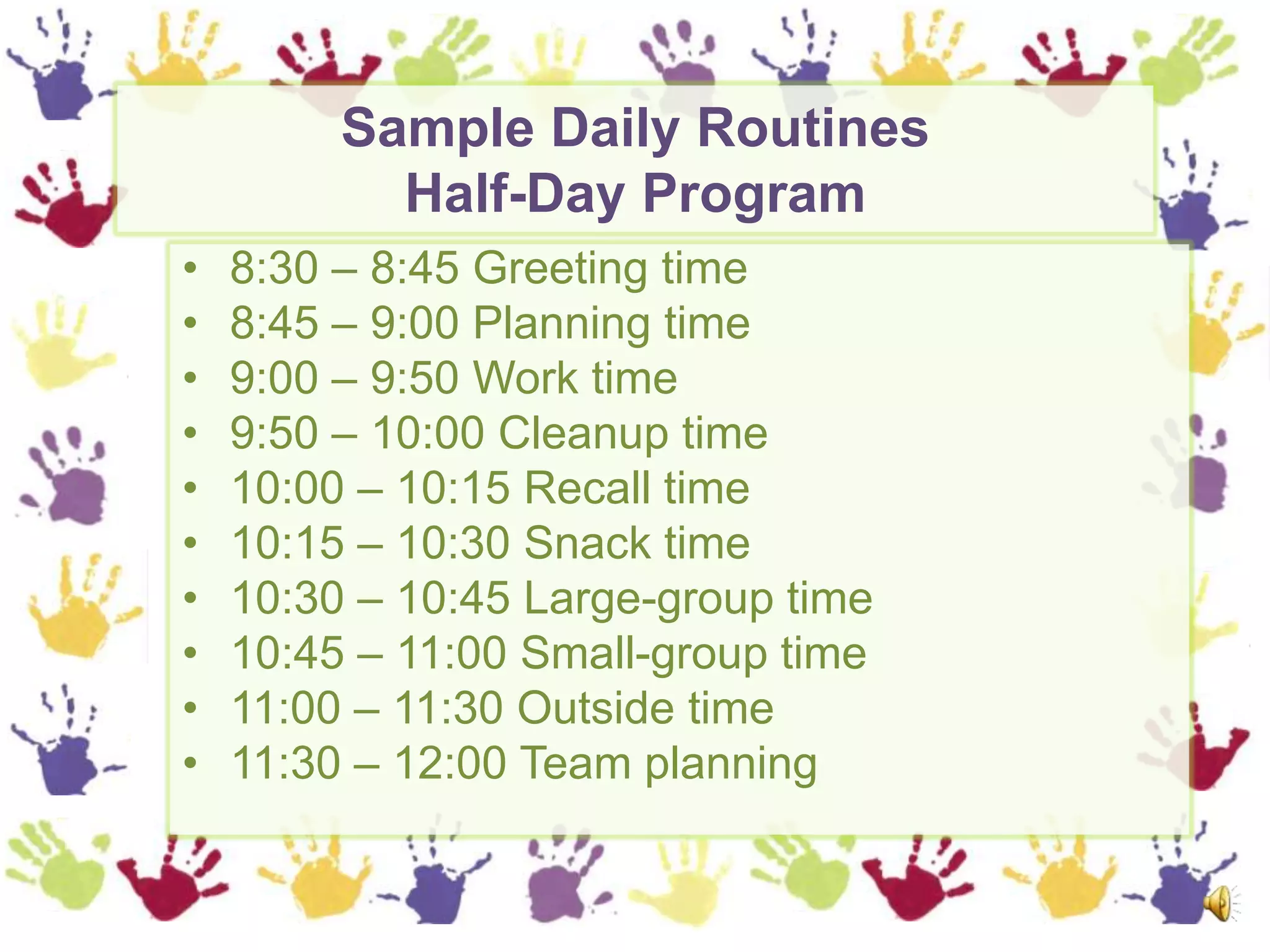
Sample Daily RoutinesHalf-Day Program8:30 – 8:45 Greeting time8:45 – 9:00 Planning time9:00 – 9:50 Work time9:50 – 10:00 Cleanup time10:00 – 10:15 Recall time10:15 – 10:30 Snack time10:30 – 10:45 Large-group time10:45 – 11:00 Small-group time11:00 – 11:30 Outside time11:30 – 12:00 Team planning
Full-Day Program6:30 – 8:30 Arrival/Breakfast/Group Time8:30 – 8:40 Cleanup time8:40 – 9:00 Large-group time9:00 – 9:15 Planning time9:15 – 10:00 Work time10:00 – 10:10 Cleanup time10:10 – 10:20 Recall time10:20 – 10:40 Small-group time10:40 – 11:30 Outside time11:30 – 11:45 Bathroom/Wash hands/Prepare for lunch11:45 – 12:30 Lunch/Brush teeth12:30 – 1:00 Quiet activities/Prepare for naps1:00 – 2:30 Nap time & team planning2:30 – 3:00 Wake/Bathroom/Snack3:00 – 4:00 Plan-do-review time4:00 – 5:30 Outside time
Daily Routine ChartsA daily routine chart is a concrete way of helping children learn the classroom schedule. A daily routine chart lists the time periods of the day in sequence.Next to the name of each time period is a photo, picture, or drawing that illustrates that segment of the routine. Daily routine charts helps children recognize the transitions and distinctive activity periods that make up the routine.
Transitions?Plan and maintain a consistent daily routine.Post a daily routine chart.Give warning signals as needed.Plan fun ways to move from one space or activity to another.Understand and plan for various kinds of transitions.
Turn-Taking Strategies and ActivitiesAvoid number limits in play areasActivitiesClothespin listSong bookTurn-taking cardsSign –up list
What do children learn from a daily routine and effective transitions?MathScienceCreative RepresentationLanguage and LiteracyInitiative and Social RelationsMovementMusicNumberSpaceTime
Thank You for WatchingA Preschool Daily Routine & Effective TransitionsbyWasheaJackson
ReferencesBailey, D.B., & Clifford, R.M. (1993)  Matching         	changes in preschool environments to desired 	changes in child behavior.Journal of Division for 	Early Childhood, 7, 61-68.Bredekamp, S., & Copple, C. (1997). Developmentally 	appropriate practice in early childhood programs (Revised ed.), Washington, DC: National Association 	for the Education of Young Children.Evans, B. (2007). “I know what’s next!” Preschool 	transitions without tears and turmoil. Ypsilanti, MI: 	High/Scope Press.

A Preschool Daily Routine & Effective Transitions

  • 1.
    A Preschool DailyRoutine &Effective TransitionsBy: WasheaSpence-Jackson
  • 2.
    ObjectivesIdentify the elementsof the daily routine.Plan for effective transitions that are an integral part of the day.
  • 3.
    Daily RoutineGreeting TimePlanningTimeWork TimeCleanup TimeRecall TimeSnack TimeSmall-Group TimeLarge-Group TimeOutside Time
  • 4.
    Sample Daily RoutinesHalf-DayProgram8:30 – 8:45 Greeting time8:45 – 9:00 Planning time9:00 – 9:50 Work time9:50 – 10:00 Cleanup time10:00 – 10:15 Recall time10:15 – 10:30 Snack time10:30 – 10:45 Large-group time10:45 – 11:00 Small-group time11:00 – 11:30 Outside time11:30 – 12:00 Team planning
  • 5.
    Full-Day Program6:30 –8:30 Arrival/Breakfast/Group Time8:30 – 8:40 Cleanup time8:40 – 9:00 Large-group time9:00 – 9:15 Planning time9:15 – 10:00 Work time10:00 – 10:10 Cleanup time10:10 – 10:20 Recall time10:20 – 10:40 Small-group time10:40 – 11:30 Outside time11:30 – 11:45 Bathroom/Wash hands/Prepare for lunch11:45 – 12:30 Lunch/Brush teeth12:30 – 1:00 Quiet activities/Prepare for naps1:00 – 2:30 Nap time & team planning2:30 – 3:00 Wake/Bathroom/Snack3:00 – 4:00 Plan-do-review time4:00 – 5:30 Outside time
  • 6.
    Daily Routine ChartsAdaily routine chart is a concrete way of helping children learn the classroom schedule. A daily routine chart lists the time periods of the day in sequence.Next to the name of each time period is a photo, picture, or drawing that illustrates that segment of the routine. Daily routine charts helps children recognize the transitions and distinctive activity periods that make up the routine.
  • 7.
    Transitions?Plan and maintaina consistent daily routine.Post a daily routine chart.Give warning signals as needed.Plan fun ways to move from one space or activity to another.Understand and plan for various kinds of transitions.
  • 8.
    Turn-Taking Strategies andActivitiesAvoid number limits in play areasActivitiesClothespin listSong bookTurn-taking cardsSign –up list
  • 9.
    What do childrenlearn from a daily routine and effective transitions?MathScienceCreative RepresentationLanguage and LiteracyInitiative and Social RelationsMovementMusicNumberSpaceTime
  • 10.
    Thank You forWatchingA Preschool Daily Routine & Effective TransitionsbyWasheaJackson
  • 11.
    ReferencesBailey, D.B., &Clifford, R.M. (1993) Matching changes in preschool environments to desired changes in child behavior.Journal of Division for Early Childhood, 7, 61-68.Bredekamp, S., & Copple, C. (1997). Developmentally appropriate practice in early childhood programs (Revised ed.), Washington, DC: National Association for the Education of Young Children.Evans, B. (2007). “I know what’s next!” Preschool transitions without tears and turmoil. Ypsilanti, MI: High/Scope Press.