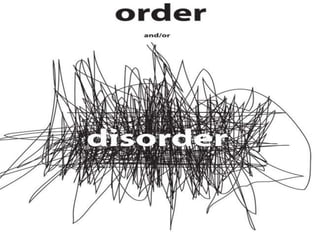
There are many different
meanings of the words
Order and Disorder and
how they can be
interpreted in Art.
Today we will:
THINK about what the different meanings of the word
LOOK at many starting points for this question
DISCOVER artists and designers who could inspire us
on this topic

SHARE ideas with each other
EXAM = 40%
Everybody knows... the four
AOs
For the exam you have to show evidence of:
ALL 4 of the AOs (Assessment Objectives)

AO1: Looking at other artists = 10%
AO2: Experimenting with media = 10%
AO3: Recording your ideas = 10%
AO4: Making a final piece = 10%
It is important that you begin working on the EXAM
Paper straight away.
START TODAY!

Exam dates….
Tuesday 6th May and
Wednesday 7th May
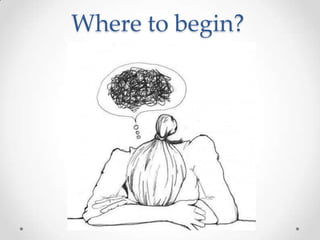
Where to begin?
method
There are 6 main starting points.
PEOPLE
PLACES
NATURAL WORLD
OBJECTS
ACTIVITIES
IMAGINATION
Contextual references
The artists on the next few pages
are suggestions to help you think
about possible ideas. You may
already have ideas of your own.
Keep an open mind at this point...
There is also a Beaumont Pinterest
Album of Artists and ideas to
support you with your project
PEOPLE
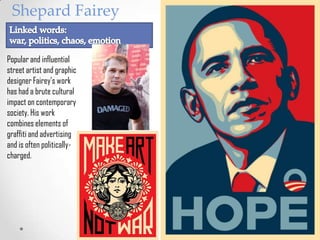
Shepard Fairey
Popular and influential
street artist and graphic
designer Fairey’s work
has had a brute cultural
impact on contemporary
society. His work
combines elements of
graffiti and advertising
and is often politicallycharged.
Pablo Picasso
Picasso created this piece in response to the bombing of Guernica, a country village in Spain during the
Spanish Civil War. Guernica shows the tragedies of war and it’s effect on innocent people.
The painting helped bring the world’s attention to the Spanish Civil War and was displayed around the world
as a symbol of peace.

‘Guernice’ 1937
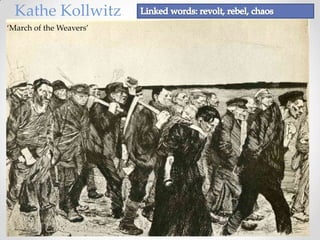
Kathe Kollwitz
‘March of the Weavers’
Francis Bacon
-Explores the “Human Condition”
-Graphic and emotionally raw style of
painting.
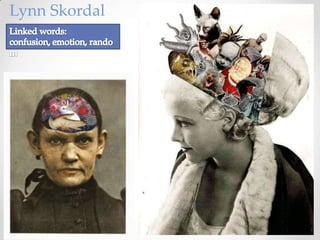
Lynn Skordal
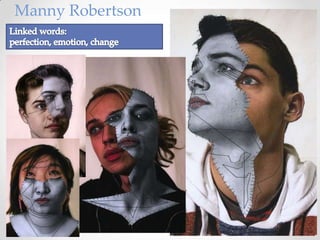
Manny Robertson
Chuck Close
Georges Braque
Lisa Nilsson
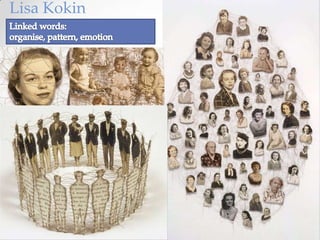
Lisa Kokin
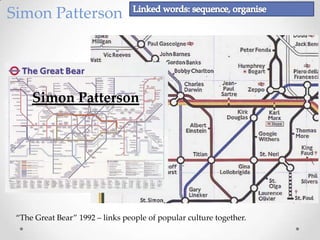
Simon Patterson

Simon Patterson

‚The Great Bear‛ 1992 – links people of popular culture together.
PLACES
Salvador Dali
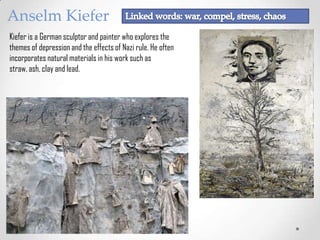
Anselm Kiefer
Kiefer is a German sculptor and painter who explores the
themes of depression and the effects of Nazi rule. He often
incorporates natural materials in his work such as
straw, ash, clay and lead.
Walter Martin & Paloma
Muñoz
Snow globes are designed to be
turned upside down. Martin and
Muñoz, though, really turned them
upside down. Where traditional
snow globes are intended to evoke a
pleasant memory, the snow globes of
Martin and Muñoz seem to portend
an anxious future event.
These orbs seem to anticipate
terrible events that might happen, or
might be happening right now to
somebody else.
Where traditional snow globes
depict cheerful scenes, Martin and
Muñoz give us eerie scenes, scenes
rife with anxiety and
uncertainty, scenes that reside in the
darker parts of the human psyche.
Mimmo Rotella
Rotella was an Italian
artist and poet, best
known for his works of
decollage and
psychogeographics, made
from torn advertising
posters
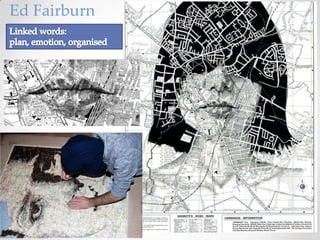
Ed Fairburn
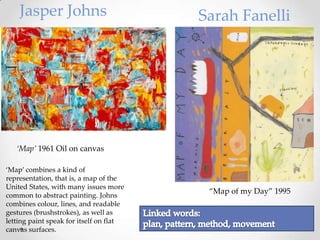
Jasper Johns

Sarah Fanelli

‘Map’ 1961 Oil on canvas
‘Map’ combines a kind of
representation, that is, a map of the
United States, with many issues more
common to abstract painting. Johns
combines colour, lines, and readable
gestures (brushstrokes), as well as
letting paint speak for itself on flat
canvas surfaces.

‚Map of my Day‛ 1995
Amy Casey
Doris Salcedo
This is a
contemporary
installation and
sculpture. The artist
uses familiar objects
in ways that become
strange and
unsettling.
The wardrobe and
the clothing inside
were filled with
concrete so they
became sealed up
and unable to be
used.
The space between
two buildings was
filled with
chairs, with a
startling effect.
NATURAL
WORLD
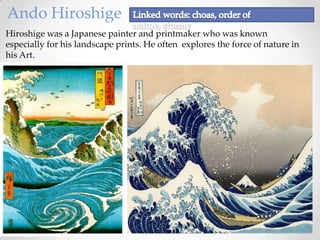
Ando Hiroshige
Hiroshige was a Japanese painter and printmaker who was known
especially for his landscape prints. He often explores the force of nature in
his Art.
Doris Salcedo

Doris Salcedo
is a
Colombian
born Sculptor
who addresses
the question of
forgetting and
memory in her
installation
artwork.
Laura Katherine McMillan

Embroidered Cells
Andy Goldsworthy
William Morris
Tessa Horrocks

Collagraph
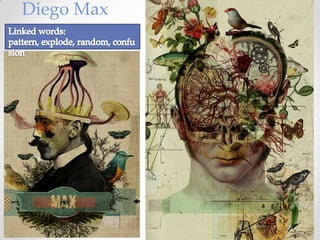
Diego Max
Natalie Ratcliffe
Natalie Ratcliffe is a Surface
Pattern Designer and Printmaker
Her design work combines
traditional printmaking
techniques with contemporary
practices
She takes inspiration from
nature, particularly the springtime
Damien Hirst
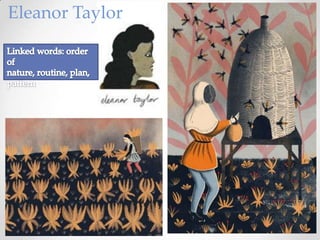
Eleanor Taylor
OBJECTS
Todd Mclellan
Things Come Apart
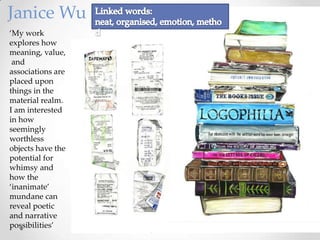
Janice Wu
‘My work
explores how
meaning, value,
and
associations are
placed upon
things in the
material realm.
I am interested
in how
seemingly
worthless
objects have the
potential for
whimsy and
how the
‘inanimate’
mundane can
reveal poetic
and narrative
possibilities’
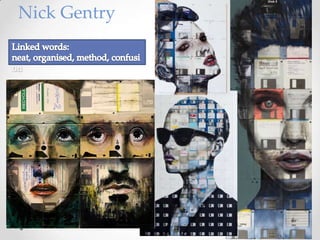
Nick Gentry
James Hopkins
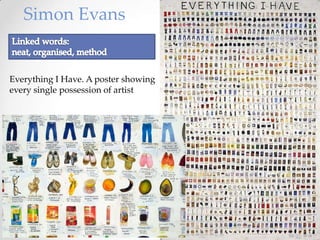
Simon Evans

Everything I Have. A poster showing
every single possession of artist
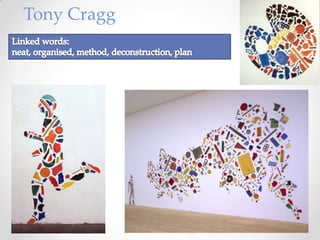
Tony Cragg
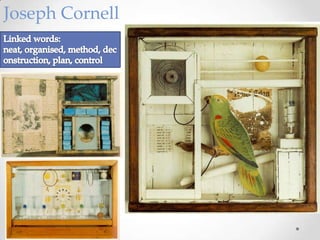
Joseph Cornell
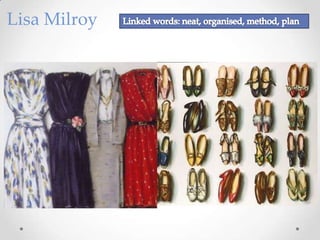
Lisa Milroy
Bill Woodrow

Woodrow is an English sculptor. In
1980 he first devised his characteristic
method of making sculpture, forming
a new object or objects from the skin of
found domestic appliances.
Woodrow worked in such a way as to
leave evident the original identities of
the constituent items as well as the
mode of transformation.
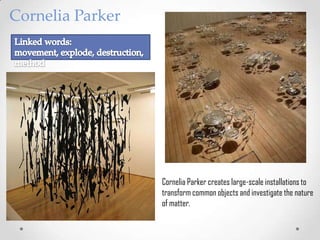
Cornelia Parker

Cornelia Parker creates large-scale installations to
transform common objects and investigate the nature
of matter.
ACTIVITIES
Felicita Sala
Claudia Pearson
Edgar Degas

"Three Studies of A Dancer," by Edgar Degas,

The Little Fourteen-Year-Old
Dancer - (Bronze) cast in 1922
Lois Greenfield

‚I’ve spent the last 25 years of
my photographic career
investigating movement and its
expressive potential. My
inspiration has always been
photography’s ability to stop
time and reveal what the naked
eye cannot see. My interest in
photography is not to capture an
image I see or even have in my
mind, but to explore the
potential of moments

http://www.loisgreenfield.com/
galleries/index.html
Jackson Pollock
Pollock was an American painter, the
chief pioneer of Abstract
Expressionism.

He created enormous drip paintings.
He painted in a tool shed where he
could lay his canvas on the floor, and
drip and splatter paint across it
without worrying about ruining the
walls or floor.
Rather than paint a landscape or a
portrait, Pollock wanted to paint
action. When you look at one of his
drip paintings, your eye wanders
across the entire canvas in constant
motion.
Brice Marden
Yukinori Yanagi
Yukinori Yanagi's work explores
themes relating to his position
as a Japanese artist living and
working in an international
context, as well as broader
issues about identity within
social or national constructs.
Eadweard Muybridge

Eadweard
Muybridge was an
English
photographer
important for his
pioneering work in
photographic
studies of motion
and in motion –
picture projection.
Wassily Kandinsky
Kandinsky used colour in a highly
theoretical way associating tone
with timbre (the sound's
character), hue with pitch, and
saturation with the volume of
sound. He even claimed that when
he saw colour he heard music.
Roy Lichtenstein

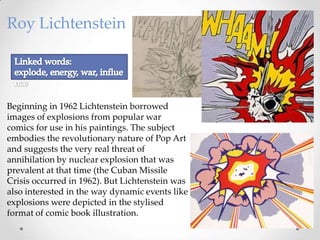
Beginning in 1962 Lichtenstein borrowed
images of explosions from popular war
comics for use in his paintings. The subject
embodies the revolutionary nature of Pop Art
and suggests the very real threat of
annihilation by nuclear explosion that was
prevalent at that time (the Cuban Missile
Crisis occurred in 1962). But Lichtenstein was
also interested in the way dynamic events like
explosions were depicted in the stylised
format of comic book illustration.
IMAGINATION
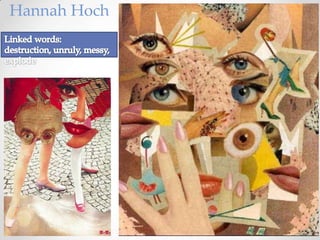
Hannah Hoch
Robert Rauschenberg
Gregory Crewdson
Gregory Crewdson
is an American
photographer who
is best known for
elaborately staged
scenes of American
homes and
neighborhoods
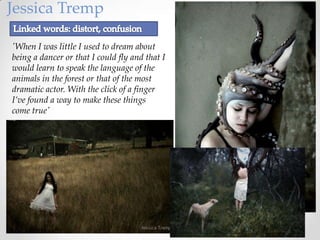
Jessica Tremp
'When I was little I used to dream about
being a dancer or that I could fly and that I
would learn to speak the language of the
animals in the forest or that of the most
dramatic actor. With the click of a finger
I’ve found a way to make these things
come true'
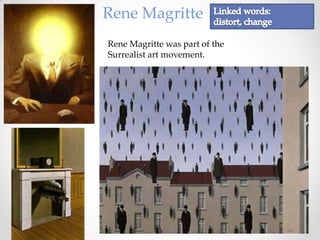
Rene Magritte
Rene Magritte was part of the
Surrealist art movement.
M C Escher

Graphic artist
who made
repeating
patterns into
artwork and
impossible
structures.

Order and/or Disorder

  • 2.
    There are manydifferent meanings of the words Order and Disorder and how they can be interpreted in Art.
  • 3.
    Today we will: THINKabout what the different meanings of the word LOOK at many starting points for this question DISCOVER artists and designers who could inspire us on this topic SHARE ideas with each other
  • 4.
  • 5.
    Everybody knows... thefour AOs For the exam you have to show evidence of: ALL 4 of the AOs (Assessment Objectives) AO1: Looking at other artists = 10% AO2: Experimenting with media = 10% AO3: Recording your ideas = 10% AO4: Making a final piece = 10%
  • 6.
    It is importantthat you begin working on the EXAM Paper straight away. START TODAY! Exam dates…. Tuesday 6th May and Wednesday 7th May
  • 7.
  • 8.
  • 9.
    There are 6main starting points. PEOPLE PLACES NATURAL WORLD OBJECTS ACTIVITIES IMAGINATION
  • 10.
    Contextual references The artistson the next few pages are suggestions to help you think about possible ideas. You may already have ideas of your own. Keep an open mind at this point... There is also a Beaumont Pinterest Album of Artists and ideas to support you with your project
  • 11.
  • 12.
    Shepard Fairey Popular andinfluential street artist and graphic designer Fairey’s work has had a brute cultural impact on contemporary society. His work combines elements of graffiti and advertising and is often politicallycharged.
  • 13.
    Pablo Picasso Picasso createdthis piece in response to the bombing of Guernica, a country village in Spain during the Spanish Civil War. Guernica shows the tragedies of war and it’s effect on innocent people. The painting helped bring the world’s attention to the Spanish Civil War and was displayed around the world as a symbol of peace. ‘Guernice’ 1937
  • 14.
  • 15.
    Francis Bacon -Explores the“Human Condition” -Graphic and emotionally raw style of painting.
  • 16.
  • 17.
  • 18.
  • 19.
  • 20.
  • 21.
  • 22.
    Simon Patterson Simon Patterson ‚TheGreat Bear‛ 1992 – links people of popular culture together.
  • 23.
  • 24.
  • 25.
    Anselm Kiefer Kiefer isa German sculptor and painter who explores the themes of depression and the effects of Nazi rule. He often incorporates natural materials in his work such as straw, ash, clay and lead.
  • 26.
    Walter Martin &Paloma Muñoz Snow globes are designed to be turned upside down. Martin and Muñoz, though, really turned them upside down. Where traditional snow globes are intended to evoke a pleasant memory, the snow globes of Martin and Muñoz seem to portend an anxious future event. These orbs seem to anticipate terrible events that might happen, or might be happening right now to somebody else. Where traditional snow globes depict cheerful scenes, Martin and Muñoz give us eerie scenes, scenes rife with anxiety and uncertainty, scenes that reside in the darker parts of the human psyche.
  • 27.
    Mimmo Rotella Rotella wasan Italian artist and poet, best known for his works of decollage and psychogeographics, made from torn advertising posters
  • 28.
  • 29.
    Jasper Johns Sarah Fanelli ‘Map’1961 Oil on canvas ‘Map’ combines a kind of representation, that is, a map of the United States, with many issues more common to abstract painting. Johns combines colour, lines, and readable gestures (brushstrokes), as well as letting paint speak for itself on flat canvas surfaces. ‚Map of my Day‛ 1995
  • 30.
  • 31.
    Doris Salcedo This isa contemporary installation and sculpture. The artist uses familiar objects in ways that become strange and unsettling. The wardrobe and the clothing inside were filled with concrete so they became sealed up and unable to be used. The space between two buildings was filled with chairs, with a startling effect.
  • 32.
  • 33.
    Ando Hiroshige Hiroshige wasa Japanese painter and printmaker who was known especially for his landscape prints. He often explores the force of nature in his Art.
  • 34.
    Doris Salcedo Doris Salcedo isa Colombian born Sculptor who addresses the question of forgetting and memory in her installation artwork.
  • 35.
  • 36.
  • 37.
  • 38.
  • 39.
  • 40.
    Natalie Ratcliffe Natalie Ratcliffeis a Surface Pattern Designer and Printmaker Her design work combines traditional printmaking techniques with contemporary practices She takes inspiration from nature, particularly the springtime
  • 41.
  • 42.
  • 43.
  • 44.
  • 45.
    Janice Wu ‘My work exploreshow meaning, value, and associations are placed upon things in the material realm. I am interested in how seemingly worthless objects have the potential for whimsy and how the ‘inanimate’ mundane can reveal poetic and narrative possibilities’
  • 46.
  • 47.
  • 48.
    Simon Evans Everything IHave. A poster showing every single possession of artist
  • 49.
  • 50.
  • 51.
  • 52.
    Bill Woodrow Woodrow isan English sculptor. In 1980 he first devised his characteristic method of making sculpture, forming a new object or objects from the skin of found domestic appliances. Woodrow worked in such a way as to leave evident the original identities of the constituent items as well as the mode of transformation.
  • 53.
    Cornelia Parker Cornelia Parkercreates large-scale installations to transform common objects and investigate the nature of matter.
  • 54.
  • 55.
  • 56.
    Edgar Degas "Three Studiesof A Dancer," by Edgar Degas, The Little Fourteen-Year-Old Dancer - (Bronze) cast in 1922
  • 57.
    Lois Greenfield ‚I’ve spentthe last 25 years of my photographic career investigating movement and its expressive potential. My inspiration has always been photography’s ability to stop time and reveal what the naked eye cannot see. My interest in photography is not to capture an image I see or even have in my mind, but to explore the potential of moments http://www.loisgreenfield.com/ galleries/index.html
  • 58.
    Jackson Pollock Pollock wasan American painter, the chief pioneer of Abstract Expressionism. He created enormous drip paintings. He painted in a tool shed where he could lay his canvas on the floor, and drip and splatter paint across it without worrying about ruining the walls or floor. Rather than paint a landscape or a portrait, Pollock wanted to paint action. When you look at one of his drip paintings, your eye wanders across the entire canvas in constant motion.
  • 59.
  • 60.
    Yukinori Yanagi Yukinori Yanagi'swork explores themes relating to his position as a Japanese artist living and working in an international context, as well as broader issues about identity within social or national constructs.
  • 61.
    Eadweard Muybridge Eadweard Muybridge wasan English photographer important for his pioneering work in photographic studies of motion and in motion – picture projection.
  • 62.
    Wassily Kandinsky Kandinsky usedcolour in a highly theoretical way associating tone with timbre (the sound's character), hue with pitch, and saturation with the volume of sound. He even claimed that when he saw colour he heard music.
  • 63.
    Roy Lichtenstein Beginning in1962 Lichtenstein borrowed images of explosions from popular war comics for use in his paintings. The subject embodies the revolutionary nature of Pop Art and suggests the very real threat of annihilation by nuclear explosion that was prevalent at that time (the Cuban Missile Crisis occurred in 1962). But Lichtenstein was also interested in the way dynamic events like explosions were depicted in the stylised format of comic book illustration.
  • 64.
  • 65.
  • 66.
  • 67.
    Gregory Crewdson Gregory Crewdson isan American photographer who is best known for elaborately staged scenes of American homes and neighborhoods
  • 68.
    Jessica Tremp 'When Iwas little I used to dream about being a dancer or that I could fly and that I would learn to speak the language of the animals in the forest or that of the most dramatic actor. With the click of a finger I’ve found a way to make these things come true'
  • 69.
    Rene Magritte Rene Magrittewas part of the Surrealist art movement.
  • 70.
    M C Escher Graphicartist who made repeating patterns into artwork and impossible structures.