What do Art History students do?
• Verbally and/or in writing, they describe visual
elements, referencing actual, physical aspects of the
work of art and observed design relationships to
support their description.
• They utilize resources to back up assertions about
materials and technique and to investigate function,
content, and context.
• In doing so, students continue to seek, evaluate, and
apply evidence to test and strengthen their analyses.
• Description is transformed into explanation: “this is
how it looks” becomes “this is why it looks that way.”
AP Art History as a Process of Inquiry
What is it?
What does it look like?
What is it made of?
How was it made?
Who made it?
Who commissioned it?
When and where was it made?
What was happening in the artist’s world when it was made?
Who used it? How was it used?
Who were its audiences? How did they respond to it?
How long does it last? Is it long lasting or ephemeral?
What does it mean?
What does it resemble?
How is it distinctive?
Who and what influenced it?
Who and what did it influence?
Why (to all of the previous questions)?
How do we know (to all of the previous questions)?
Form, Function, Content, and Context
Form
• the shape, visual appearance, constitution, or configuration
of an object
• the way something is or happens
*What type of art form?: painting, sculpture or architecture
(other forms we need to add to this list?)
*how its is created/ formed?: media/materials, floor plan
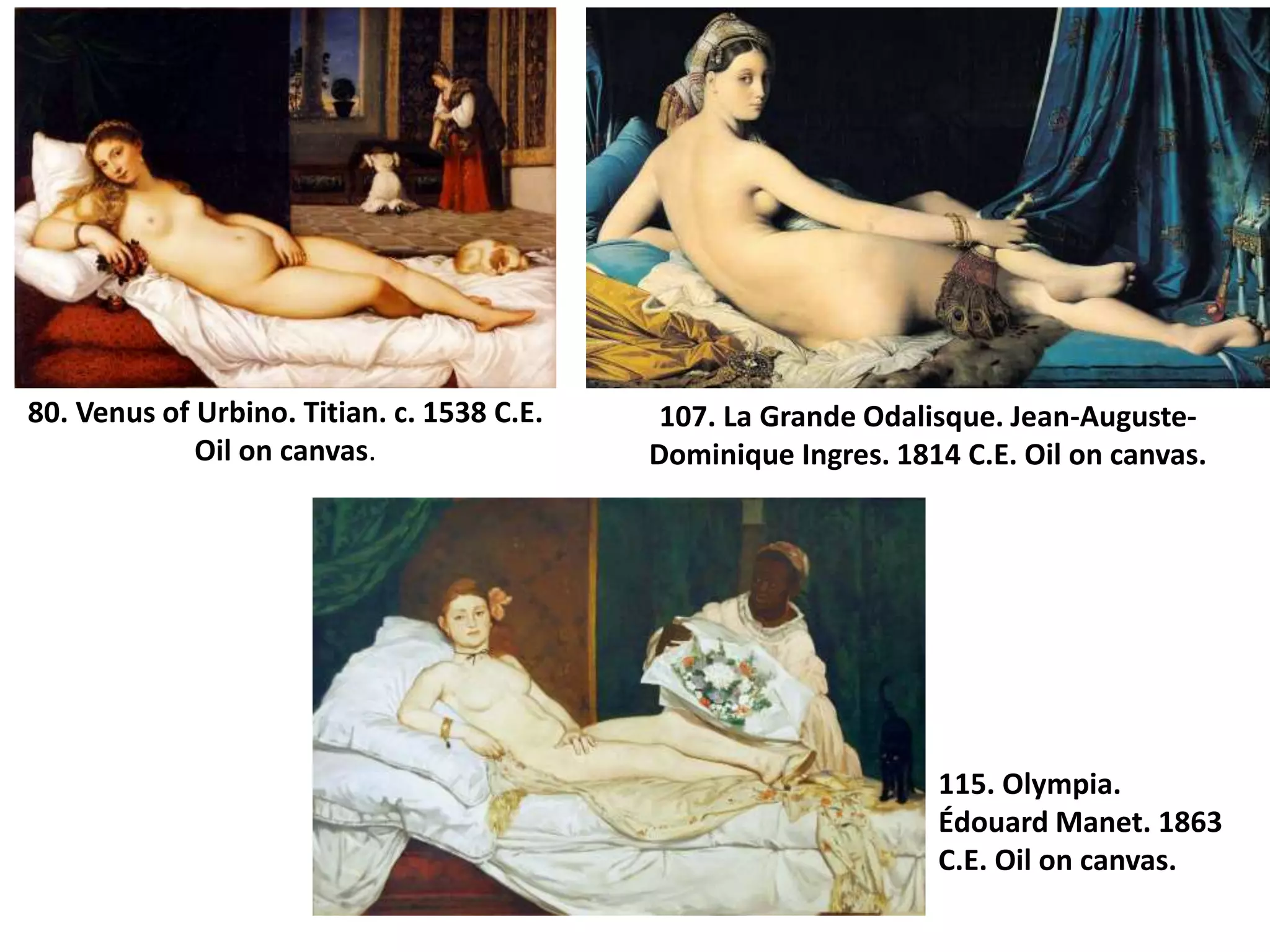
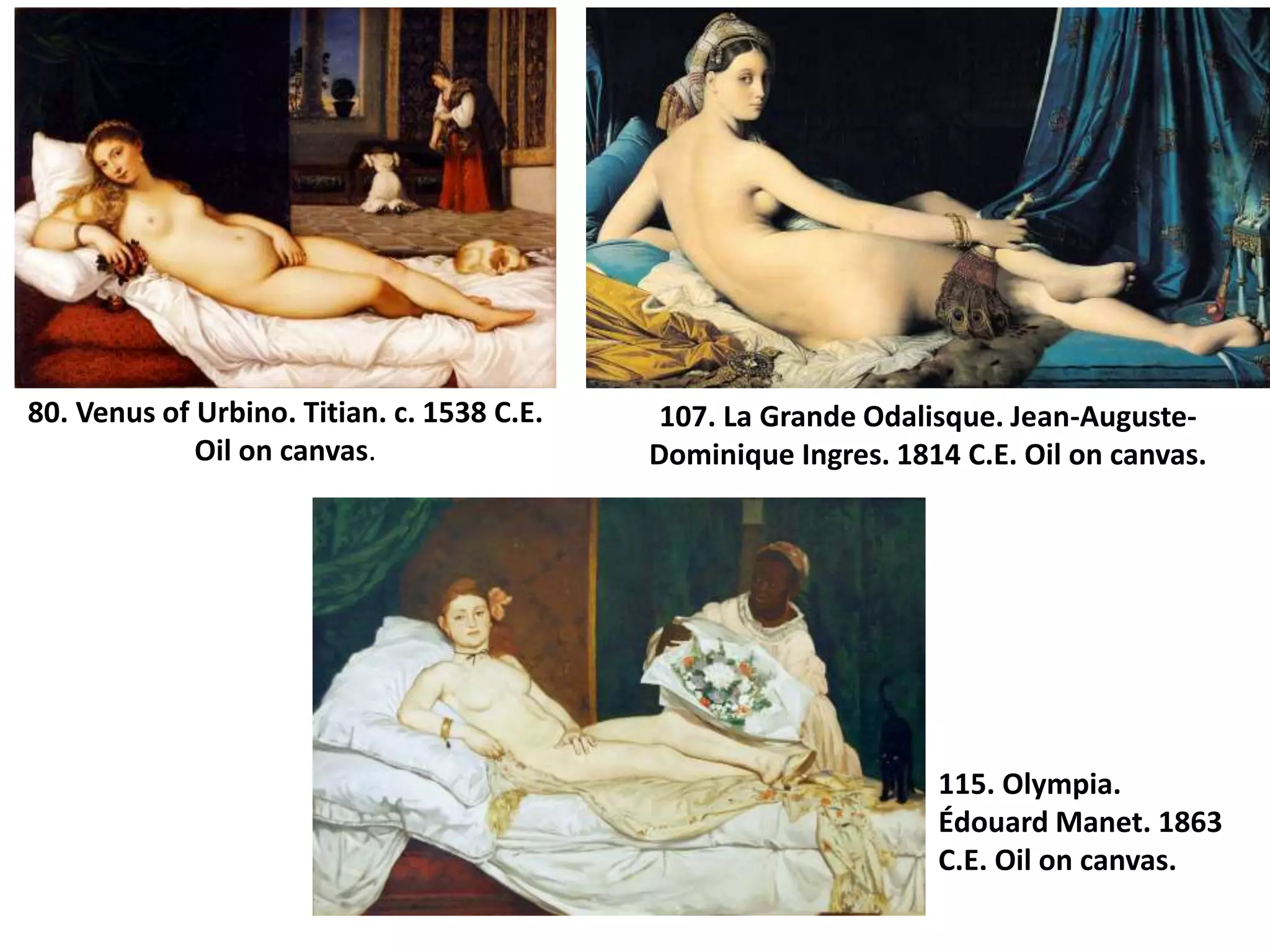
80. Venus of Urbino. Titian. c. 1538 C.E.
Oil on canvas.
107. La Grande Odalisque. Jean-Auguste-
Dominique Ingres. 1814 C.E. Oil on canvas.
115. Olympia.
Édouard Manet. 1863
C.E. Oil on canvas.
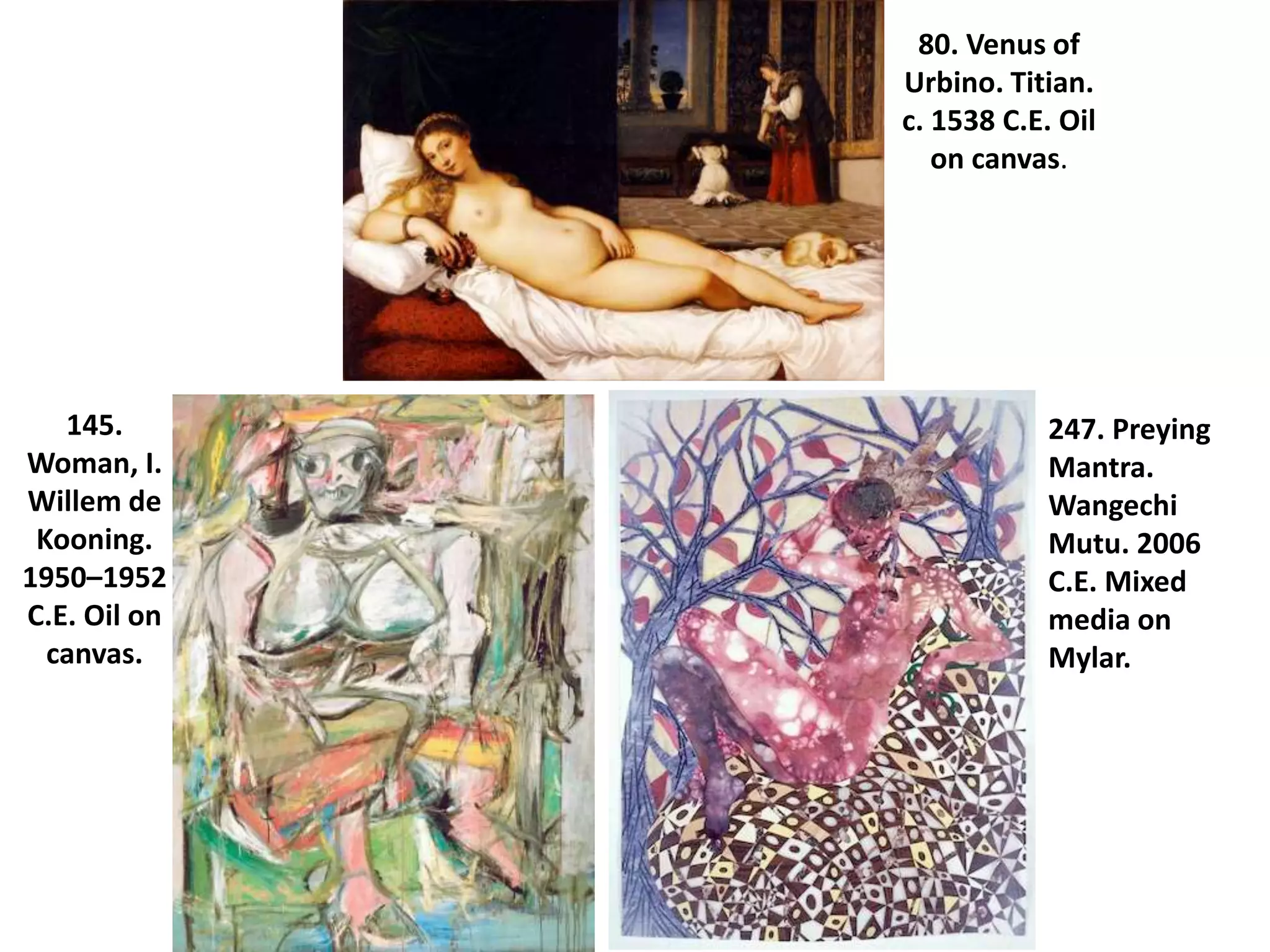
80. Venus of
Urbino. Titian.
c. 1538 C.E. Oil
on canvas.
145.
Woman, I.
Willem de
Kooning.
1950–1952
C.E. Oil on
canvas.
247. Preying
Mantra.
Wangechi
Mutu. 2006
C.E. Mixed
media on
Mylar.
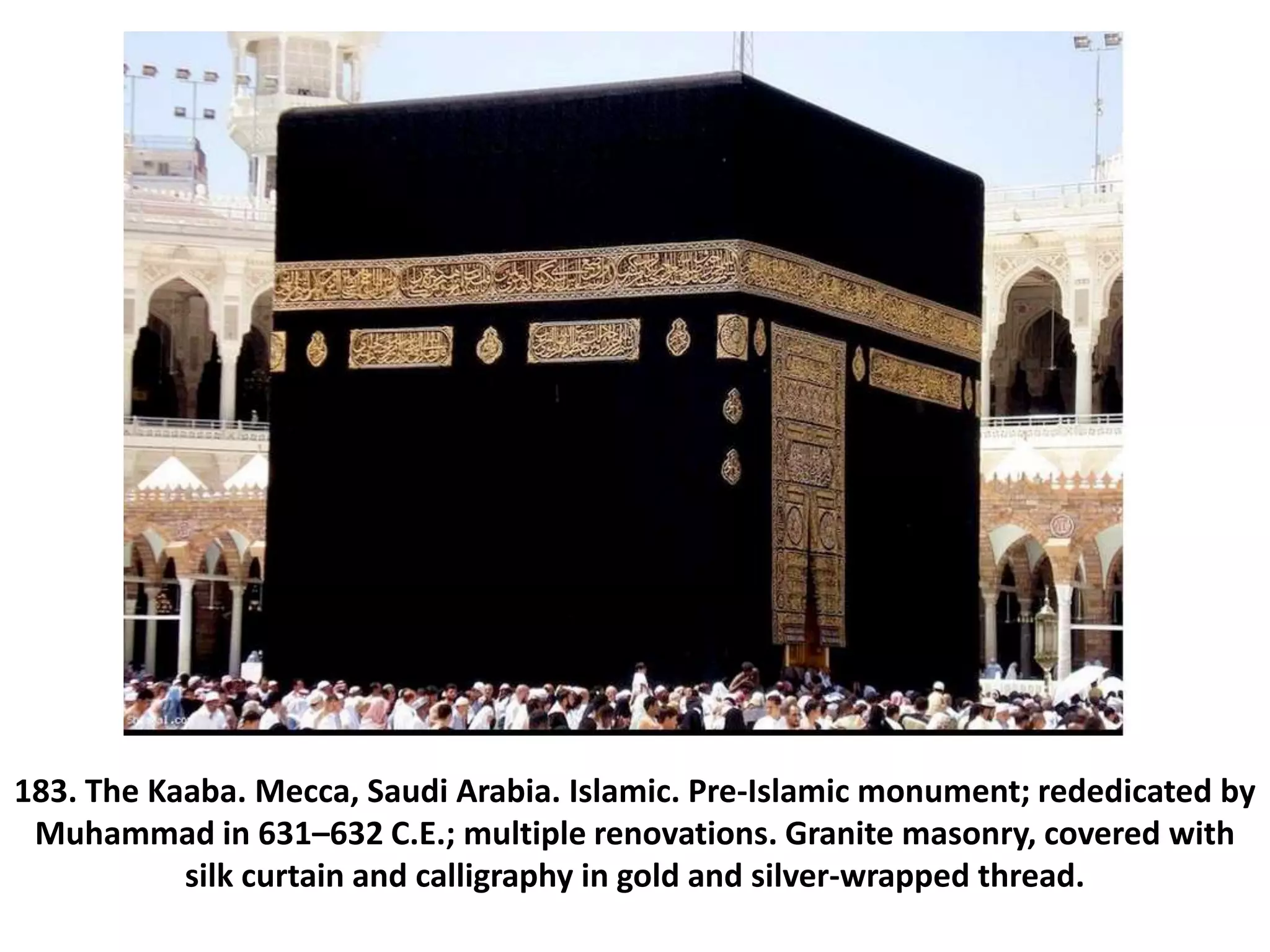
183. The Kaaba. Mecca, Saudi Arabia. Islamic. Pre-Islamic monument; rededicated by
Muhammad in 631–632 C.E.; multiple renovations. Granite masonry, covered with
silk curtain and calligraphy in gold and silver-wrapped thread.
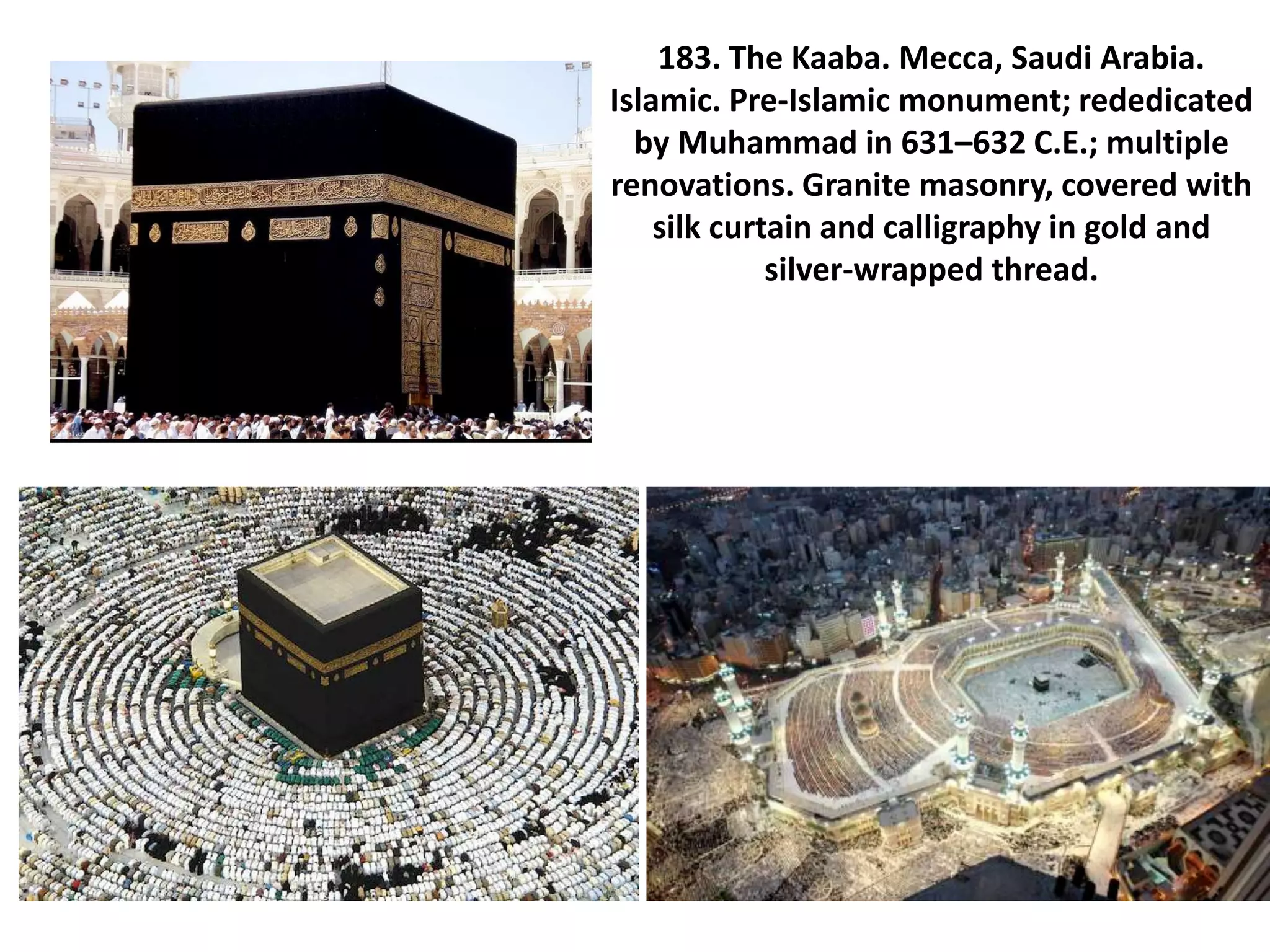
183. The Kaaba. Mecca, Saudi Arabia.
Islamic. Pre-Islamic monument; rededicated
by Muhammad in 631–632 C.E.; multiple
renovations. Granite masonry, covered with
silk curtain and calligraphy in gold and
silver-wrapped thread.
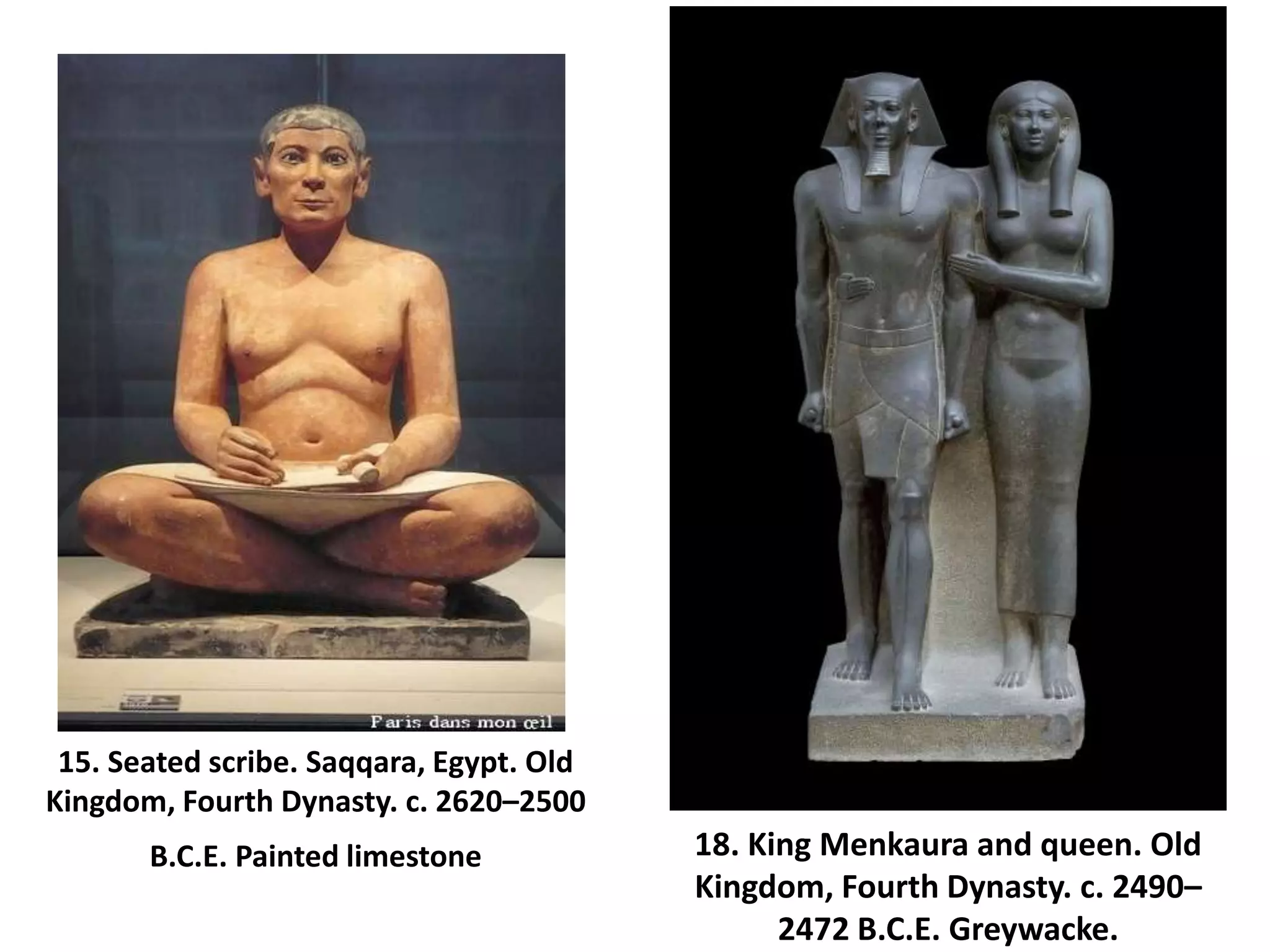
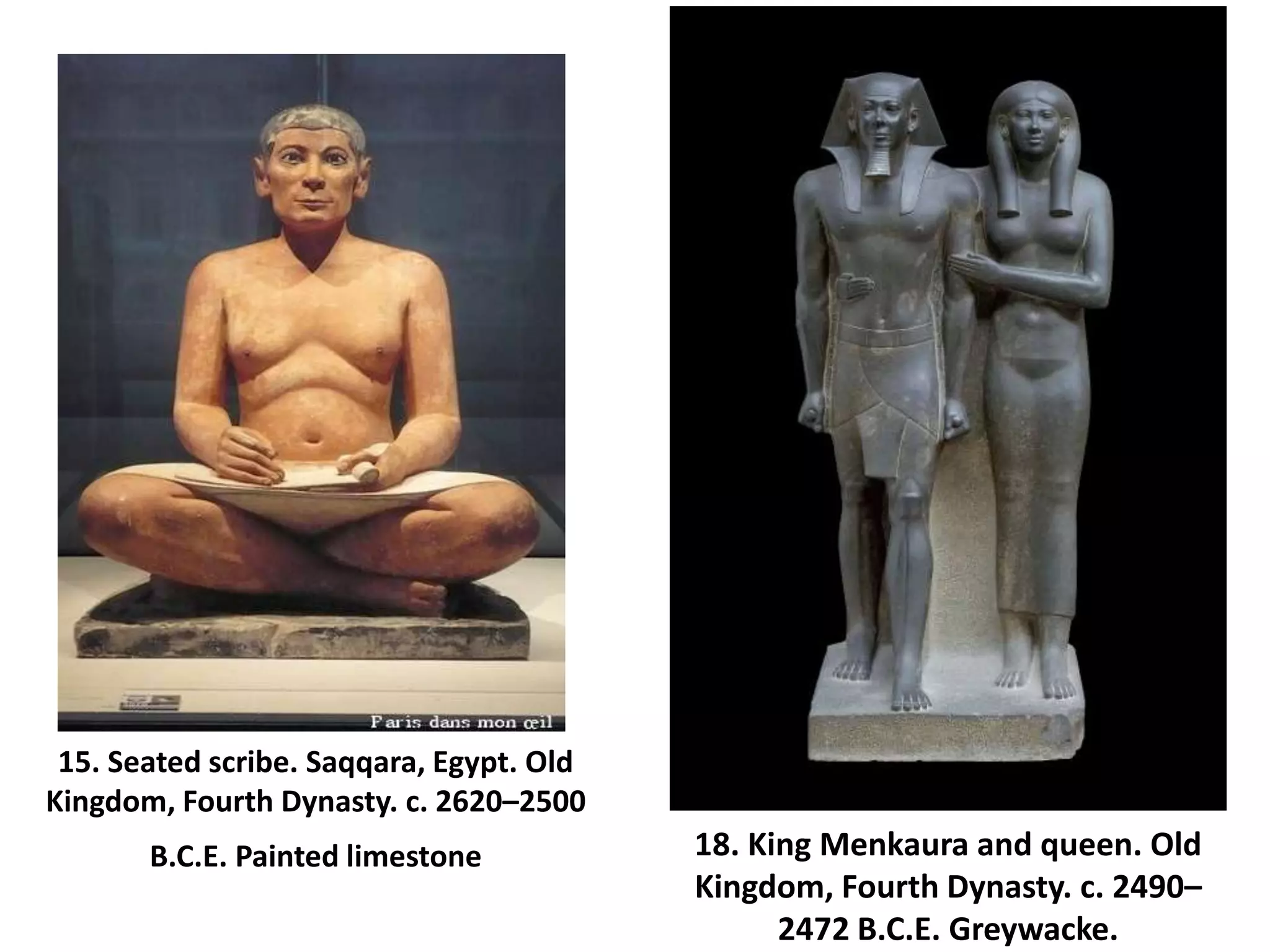
15. Seated scribe. Saqqara, Egypt. Old
Kingdom, Fourth Dynasty. c. 2620–2500
B.C.E. Painted limestone 18. King Menkaura and queen. Old
Kingdom, Fourth Dynasty. c. 2490–
2472 B.C.E. Greywacke.
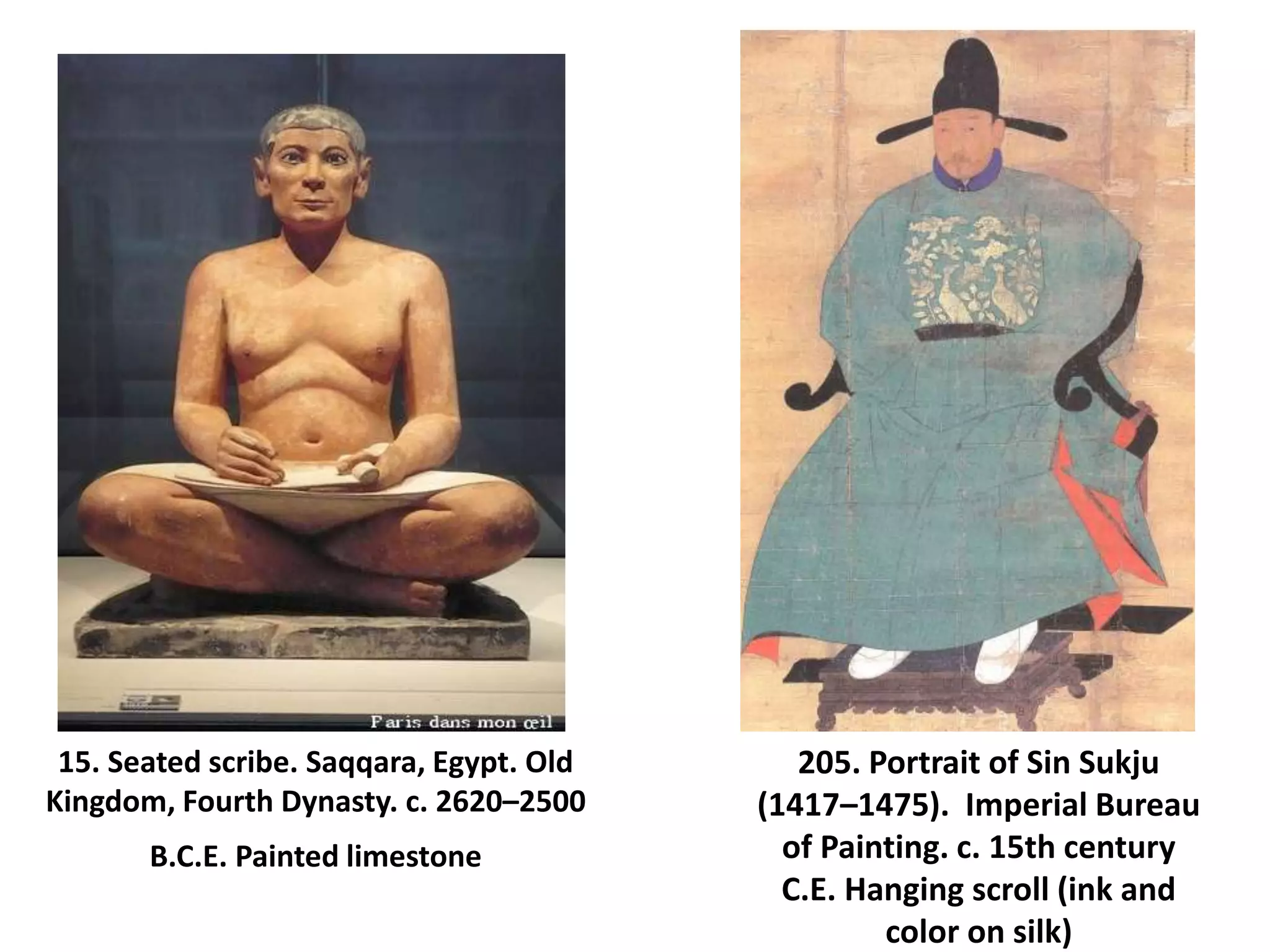
15. Seated scribe. Saqqara, Egypt. Old
Kingdom, Fourth Dynasty. c. 2620–2500
B.C.E. Painted limestone
205. Portrait of Sin Sukju
(1417–1475). Imperial Bureau
of Painting. c. 15th century
C.E. Hanging scroll (ink and
color on silk)
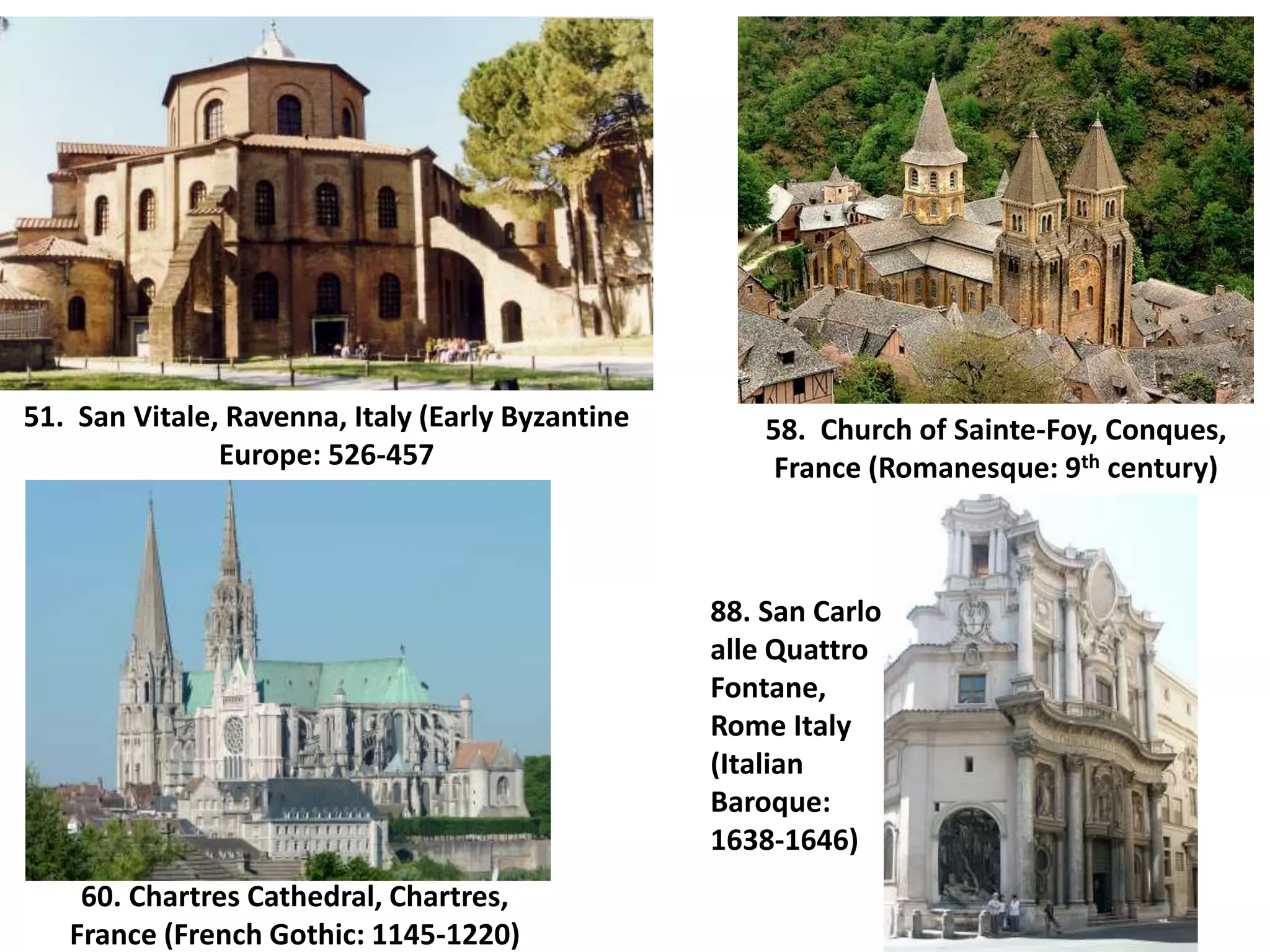
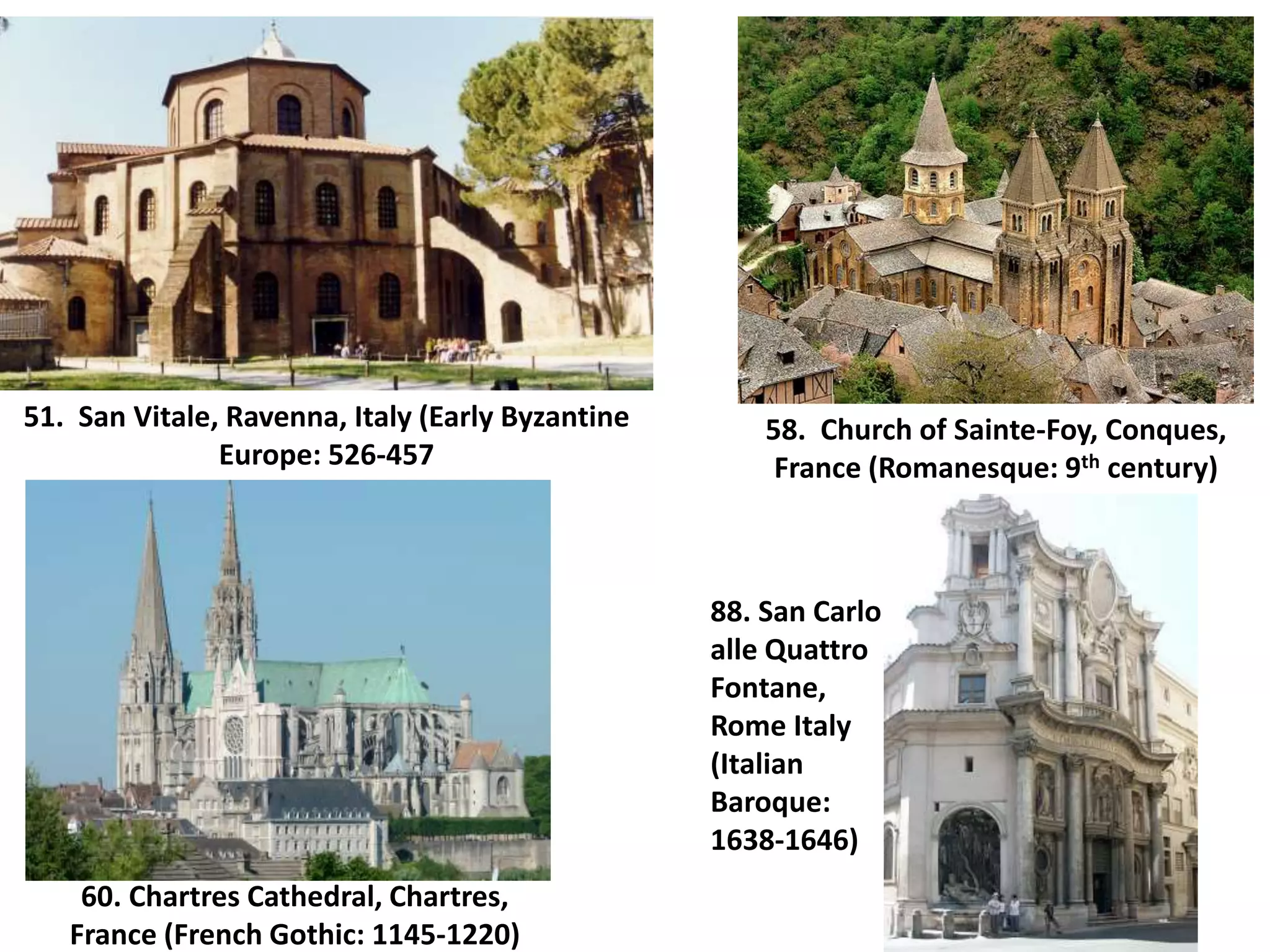
60. Chartres Cathedral, Chartres,
France (French Gothic: 1145-1220)
51. San Vitale, Ravenna, Italy (Early Byzantine
Europe: 526-457
88. San Carlo
alle Quattro
Fontane,
Rome Italy
(Italian
Baroque:
1638-1646)
58. Church of Sainte-Foy, Conques,
France (Romanesque: 9th century)
Function
• the special purpose or activity for which a thing exists or is
used
*what is the function?
*how does it function?
*how does the viewer interact with it?
*is patronage a factor?
60. Chartres Cathedral, Chartres,
France (French Gothic: 1145-1220)
51. San Vitale, Ravenna, Italy (Early Byzantine
Europe: 526-457
88. San Carlo
alle Quattro
Fontane,
Rome Italy
(Italian
Baroque:
1638-1646)
58. Church of Sainte-Foy, Conques,
France (Romanesque: 9th century)
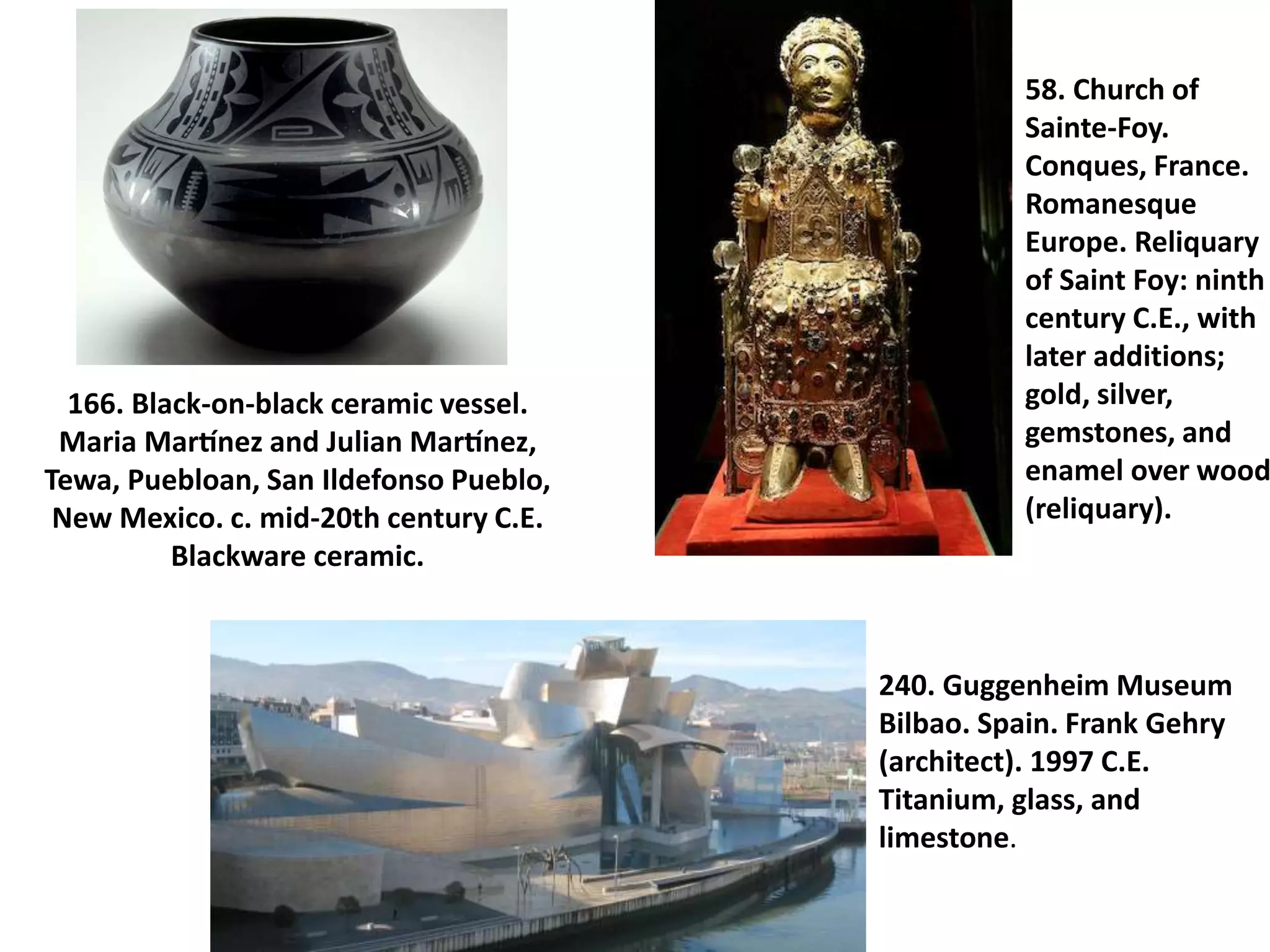
166. Black-on-black ceramic vessel.
Maria Martínez and Julian Martínez,
Tewa, Puebloan, San Ildefonso Pueblo,
New Mexico. c. mid-20th century C.E.
Blackware ceramic.
58. Church of
Sainte-Foy.
Conques, France.
Romanesque
Europe. Reliquary
of Saint Foy: ninth
century C.E., with
later additions;
gold, silver,
gemstones, and
enamel over wood
(reliquary).
240. Guggenheim Museum
Bilbao. Spain. Frank Gehry
(architect). 1997 C.E.
Titanium, glass, and
limestone.
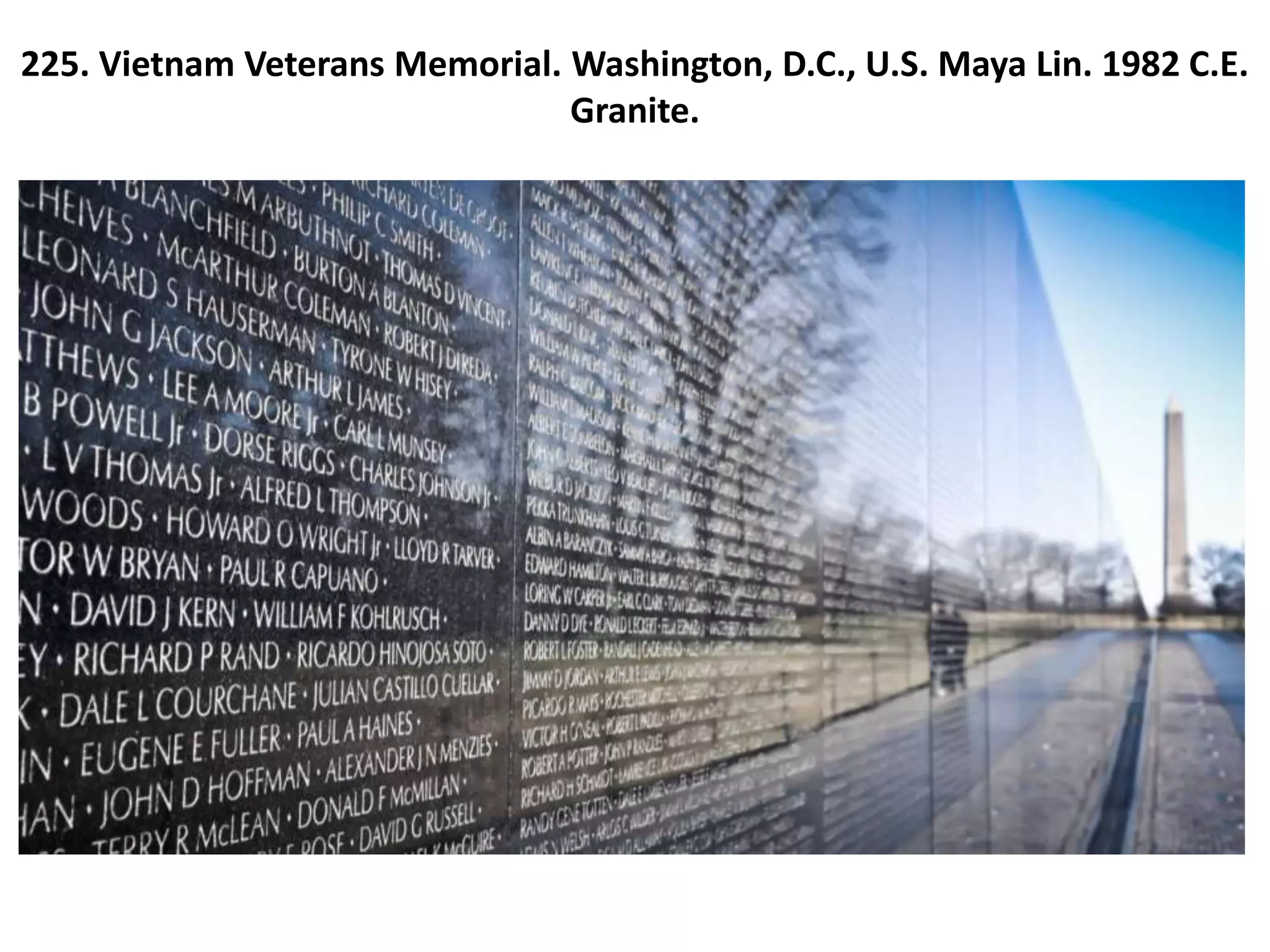
225. Vietnam Veterans Memorial. Washington, D.C., U.S. Maya Lin. 1982 C.E.
Granite.
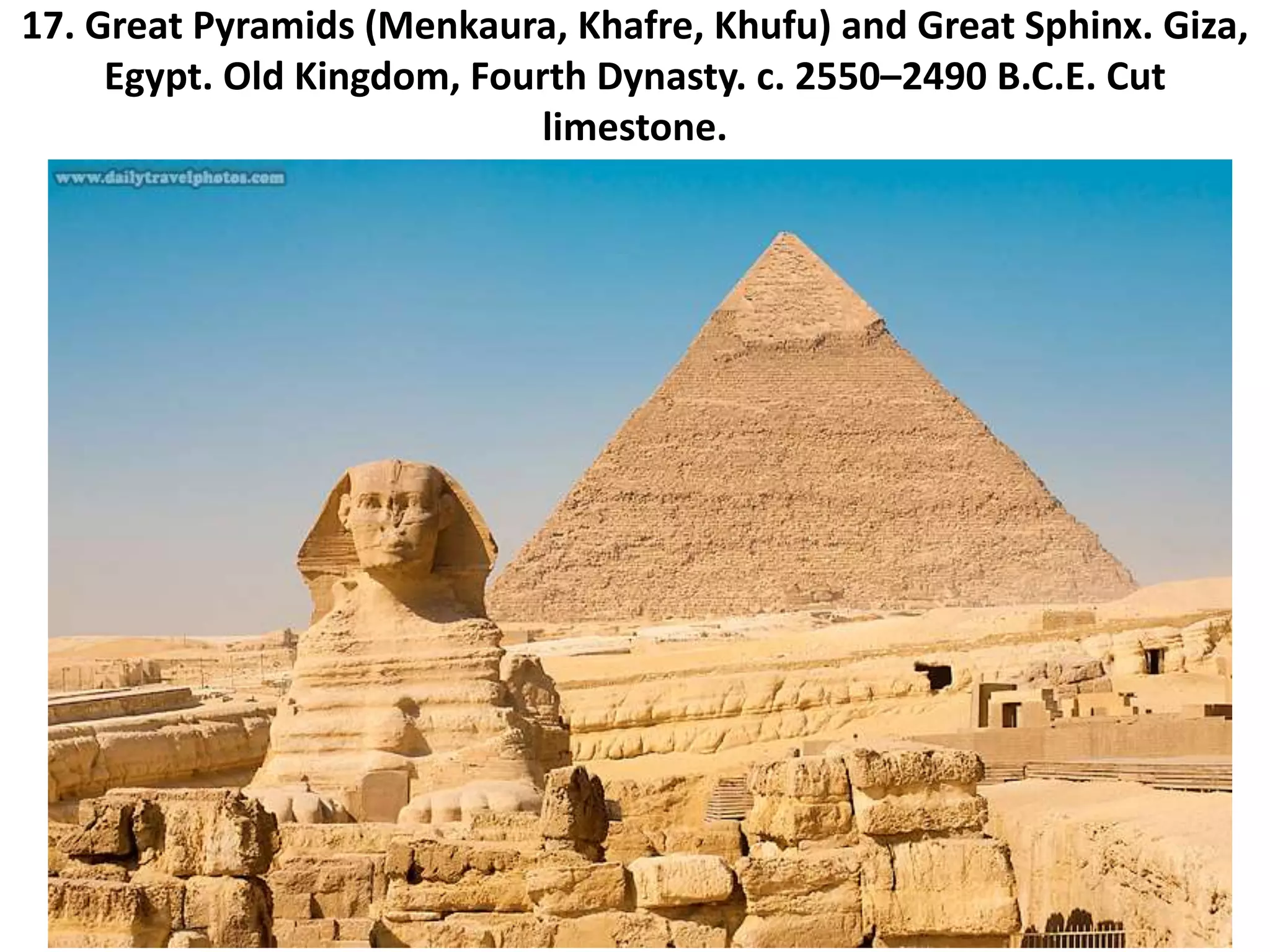
17. Great Pyramids (Menkaura, Khafre, Khufu) and Great Sphinx. Giza,
Egypt. Old Kingdom, Fourth Dynasty. c. 2550–2490 B.C.E. Cut
limestone.
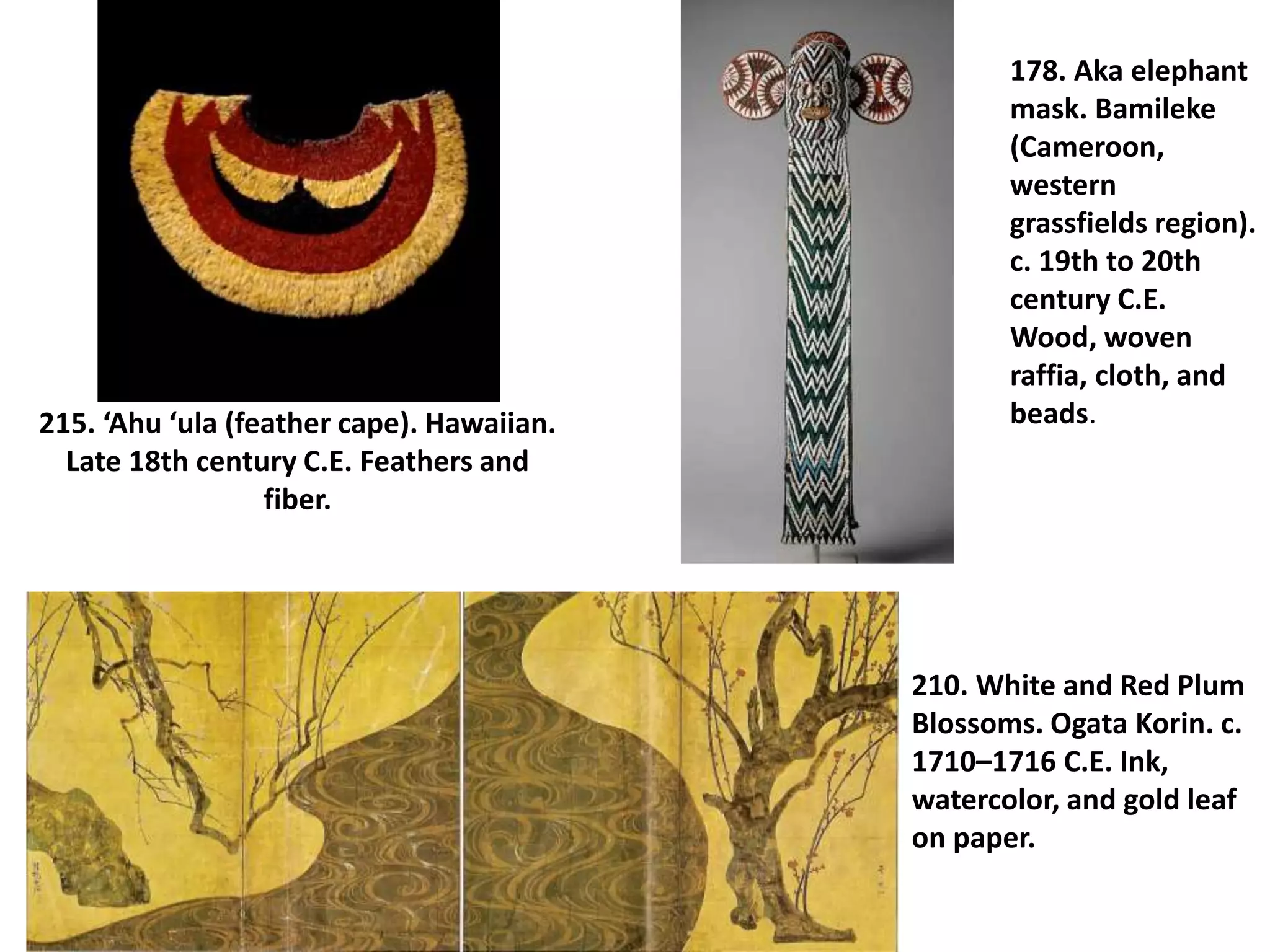
215. ‘Ahu ‘ula (feather cape). Hawaiian.
Late 18th century C.E. Feathers and
fiber.
178. Aka elephant
mask. Bamileke
(Cameroon,
western
grassfields region).
c. 19th to 20th
century C.E.
Wood, woven
raffia, cloth, and
beads.
210. White and Red Plum
Blossoms. Ogata Korin. c.
1710–1716 C.E. Ink,
watercolor, and gold leaf
on paper.
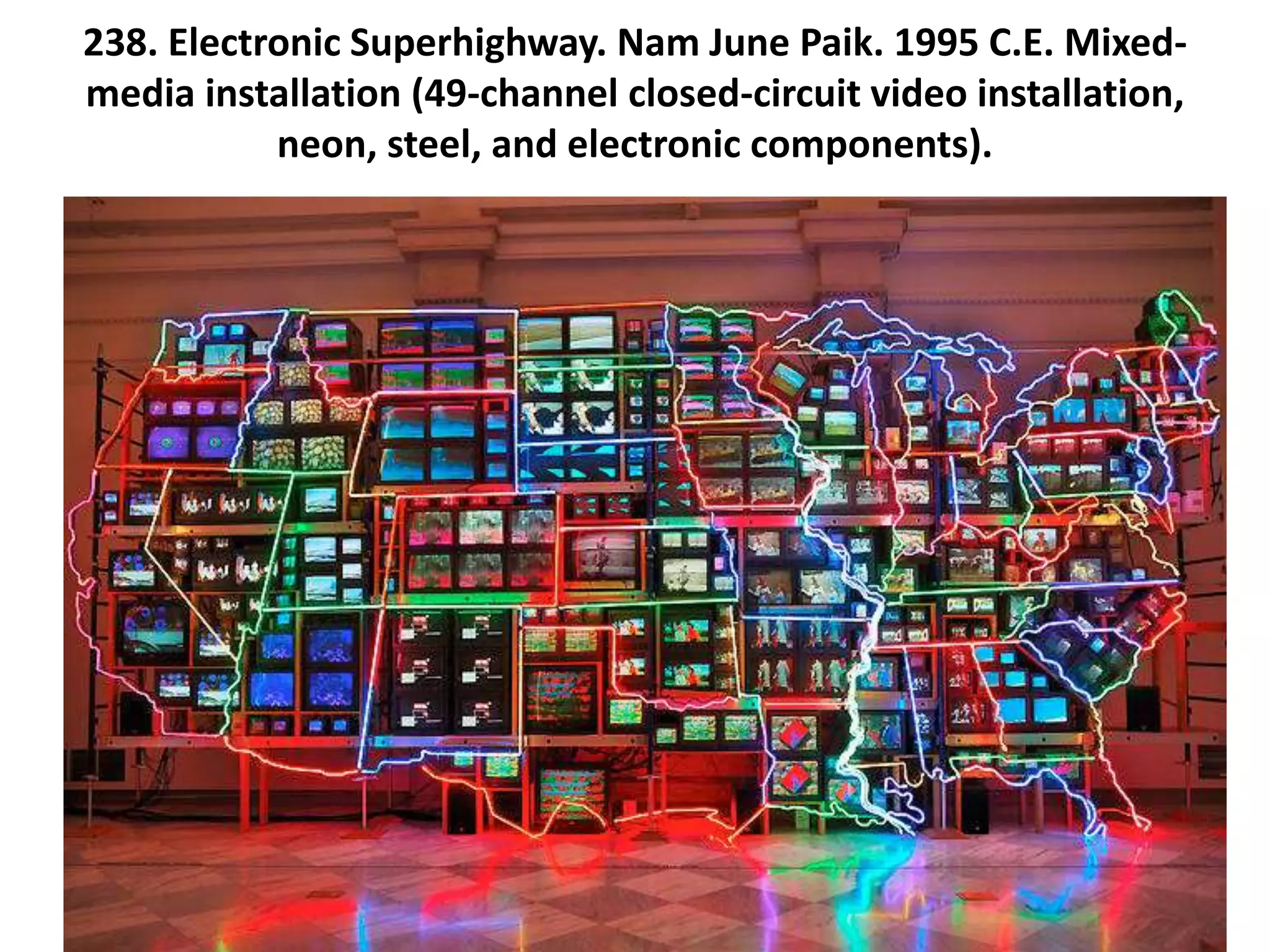
238. Electronic Superhighway. Nam June Paik. 1995 C.E. Mixed-
media installation (49-channel closed-circuit video installation,
neon, steel, and electronic components).
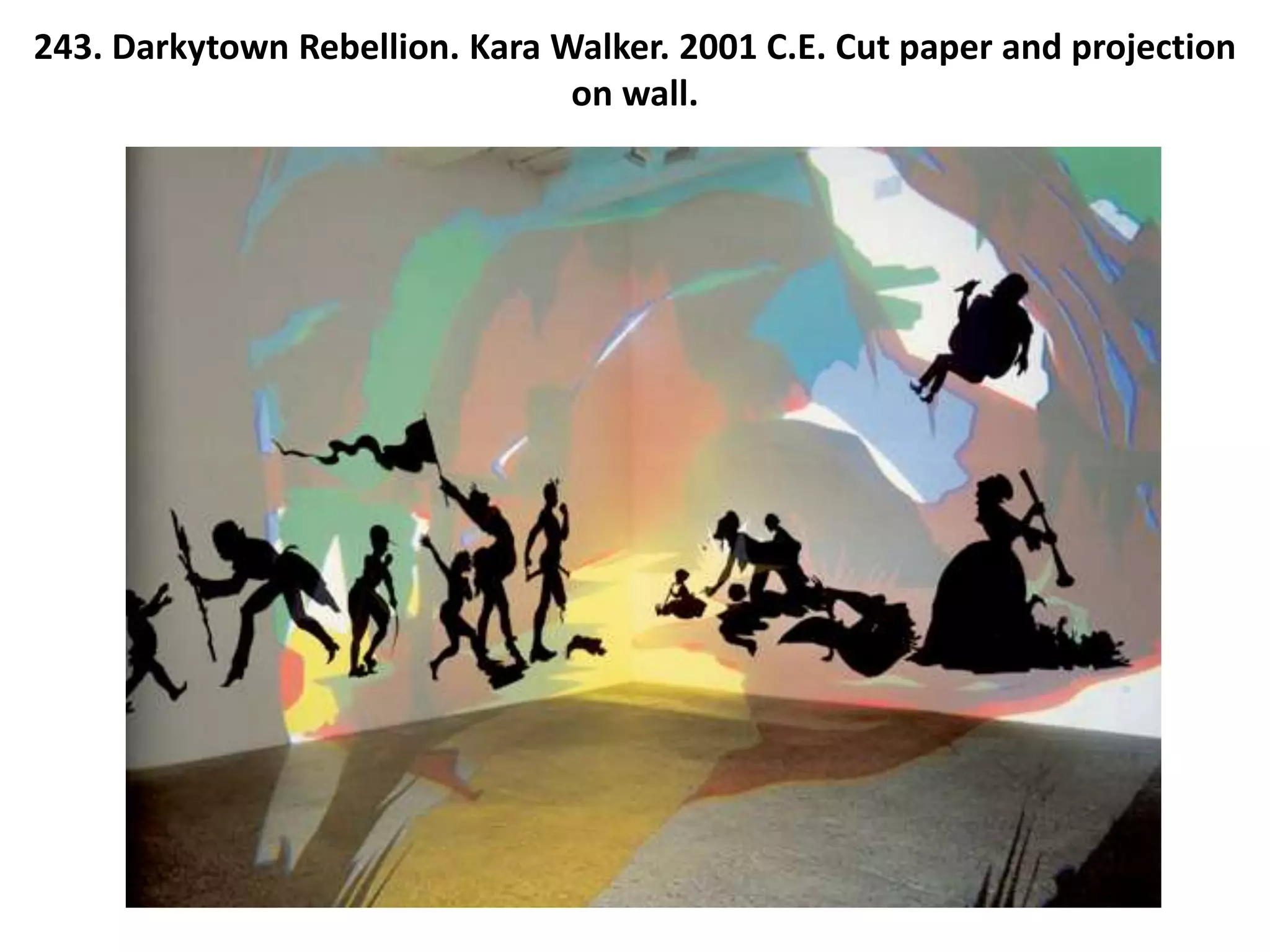
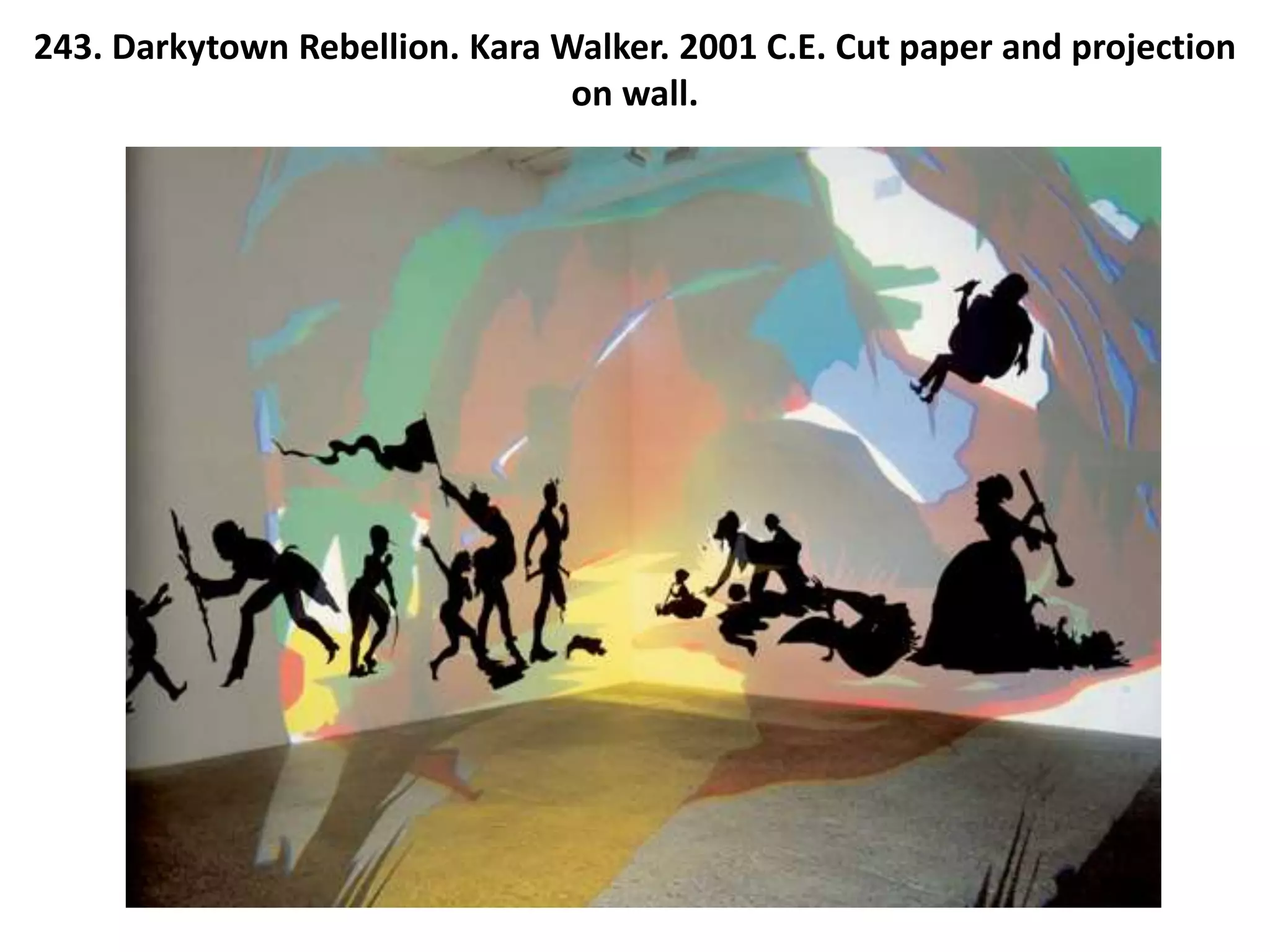
243. Darkytown Rebellion. Kara Walker. 2001 C.E. Cut paper and projection
on wall.
Content
• the ​subject or ​ideas ​contained in something written,
said, ​created, or ​represented
• the things ​represented or ​suggested in something written
or ​created as ​art, or the ​ideas it ​communicates.
*What is the subject matter?
*Is there symbolism? If so, what are the symbols and what do
they mean? How do they affect the overall content of the
work?
*Does the work have a message? If so, what is it?
243. Darkytown Rebellion. Kara Walker. 2001 C.E. Cut paper and projection
on wall.
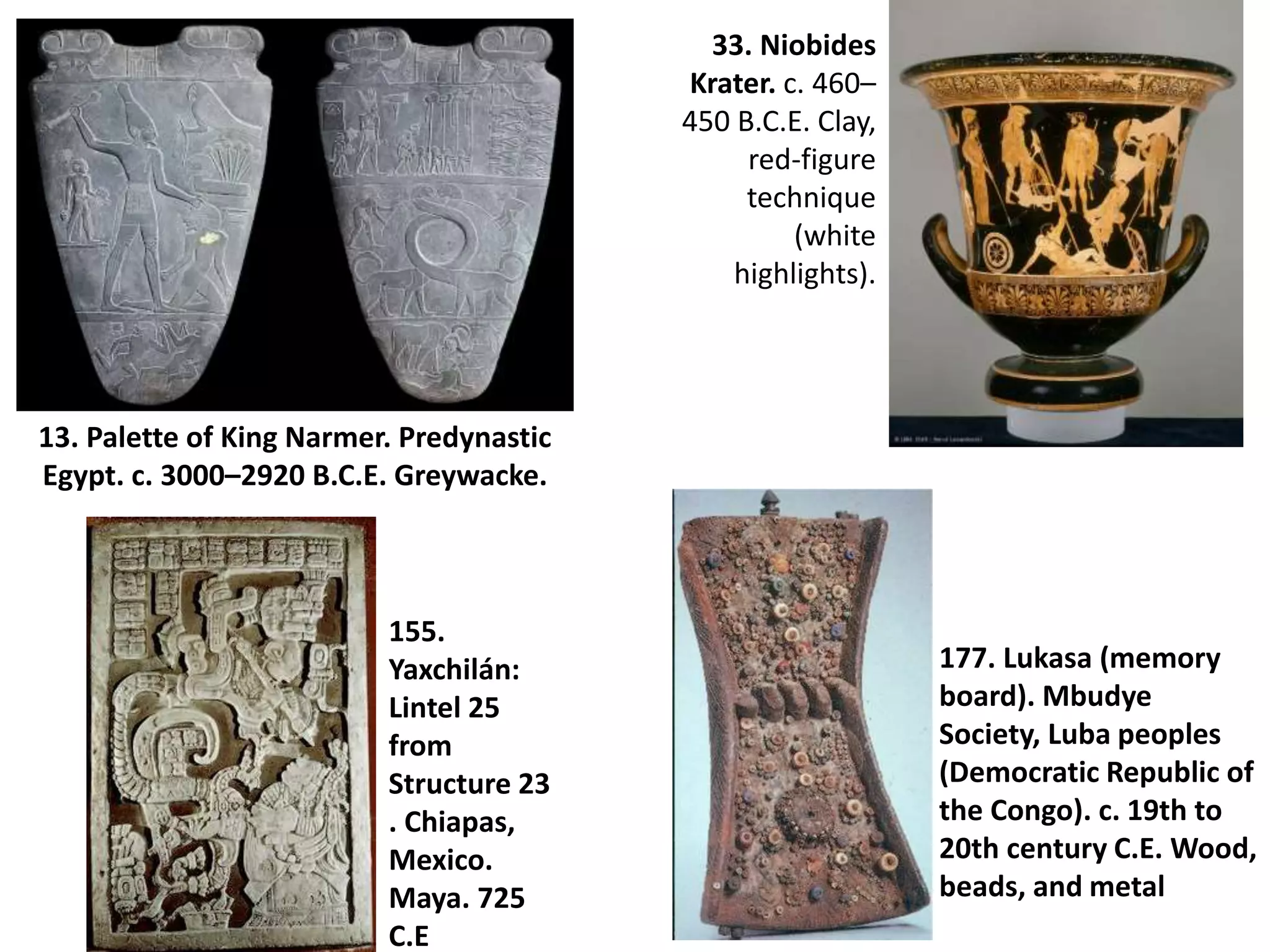
13. Palette of King Narmer. Predynastic
Egypt. c. 3000–2920 B.C.E. Greywacke.
33. Niobides
Krater. c. 460–
450 B.C.E. Clay,
red-figure
technique
(white
highlights).
155.
Yaxchilán:
Lintel 25
from
Structure 23
. Chiapas,
Mexico.
Maya. 725
C.E
177. Lukasa (memory
board). Mbudye
Society, Luba peoples
(Democratic Republic of
the Congo). c. 19th to
20th century C.E. Wood,
beads, and metal
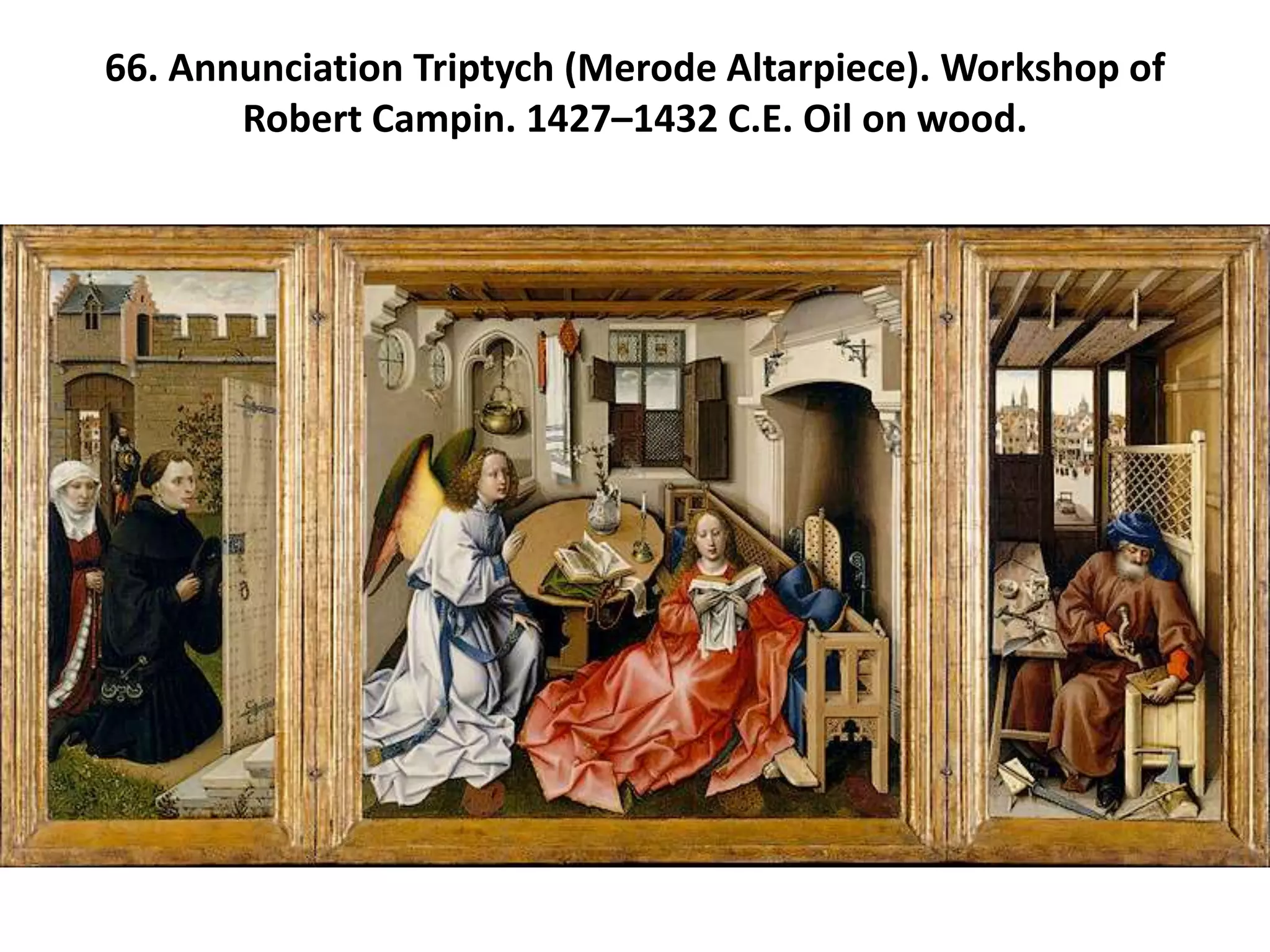
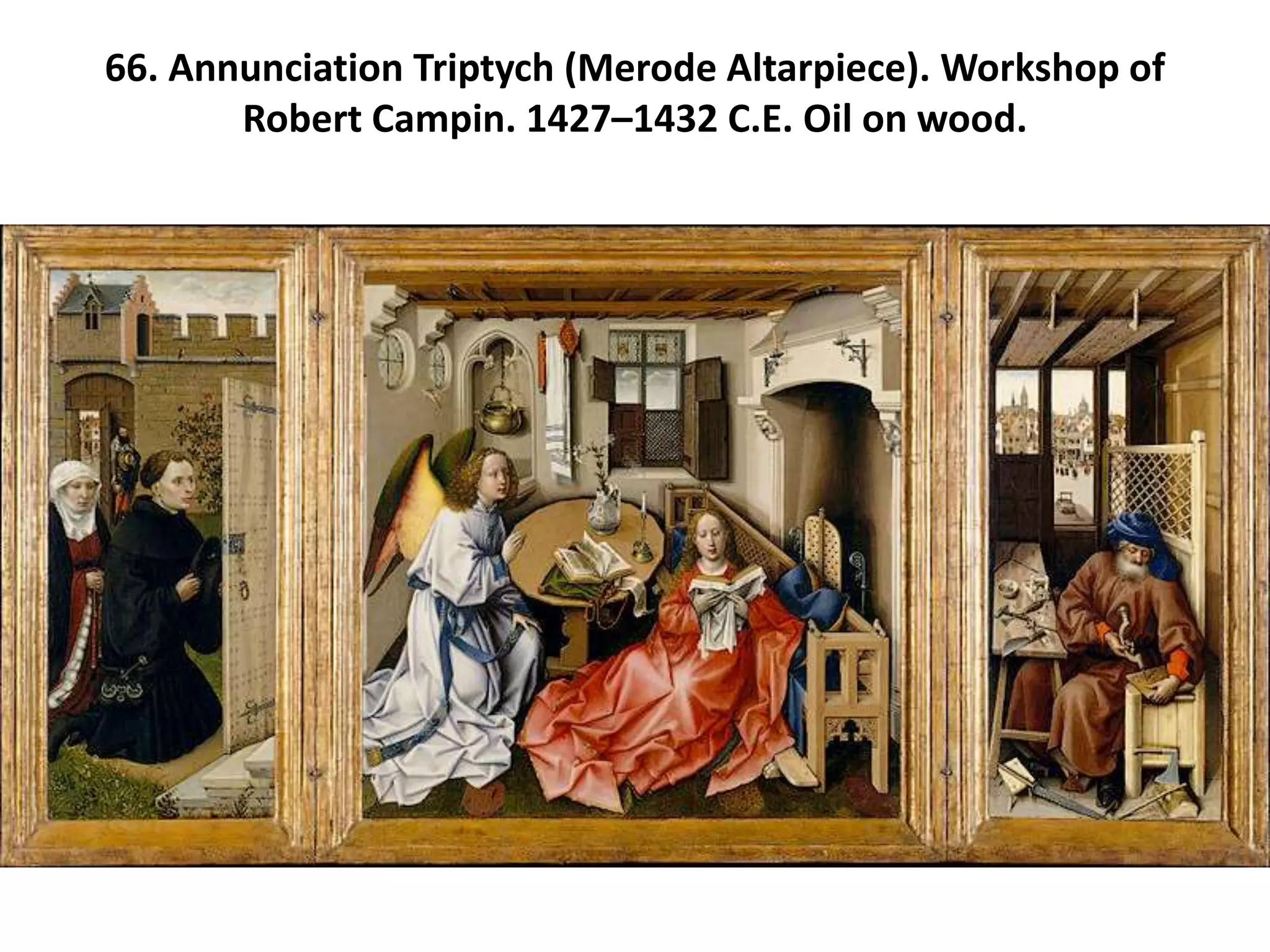
66. Annunciation Triptych (Merode Altarpiece). Workshop of
Robert Campin. 1427–1432 C.E. Oil on wood.
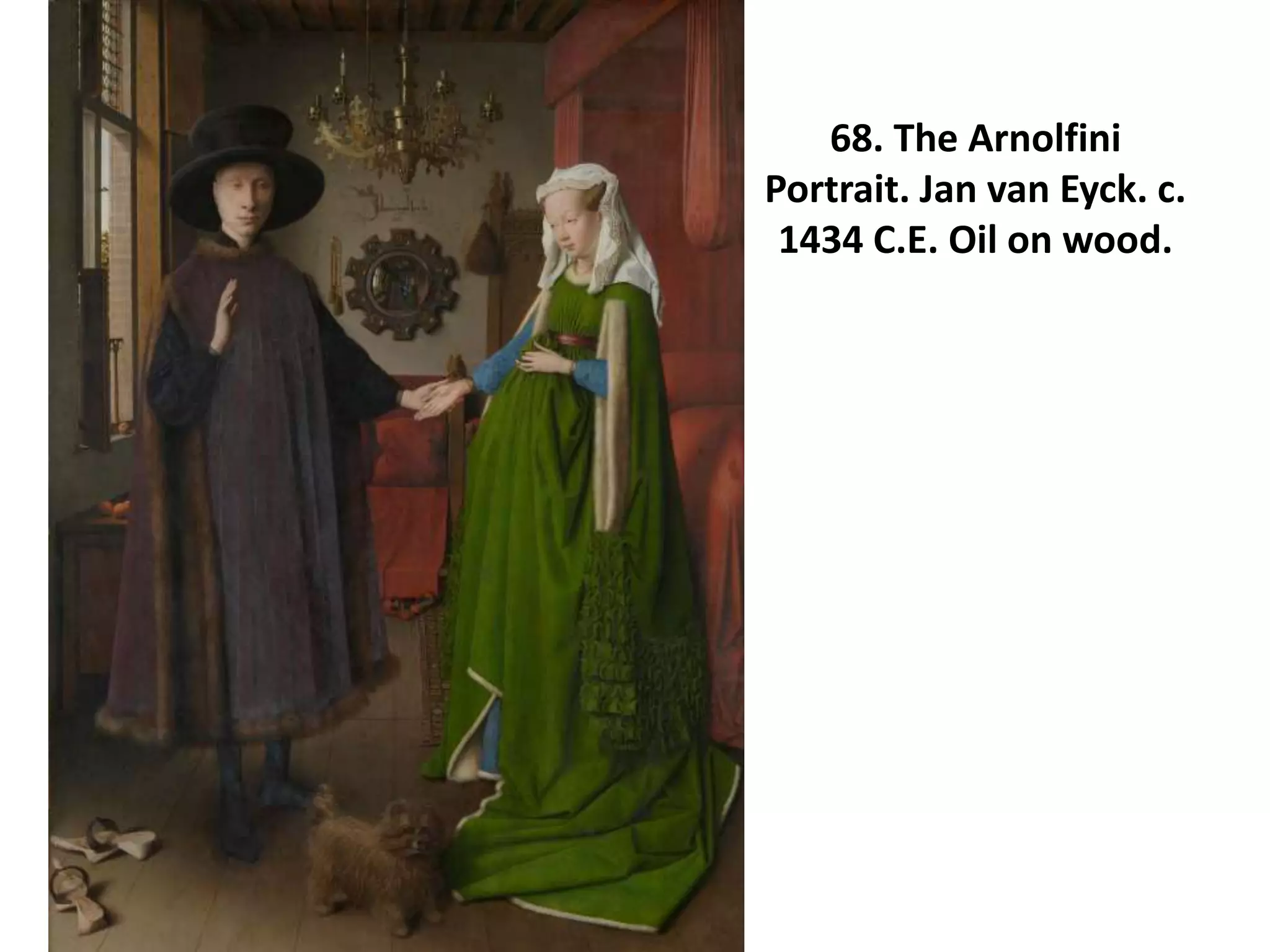
68. The Arnolfini
Portrait. Jan van Eyck. c.
1434 C.E. Oil on wood.
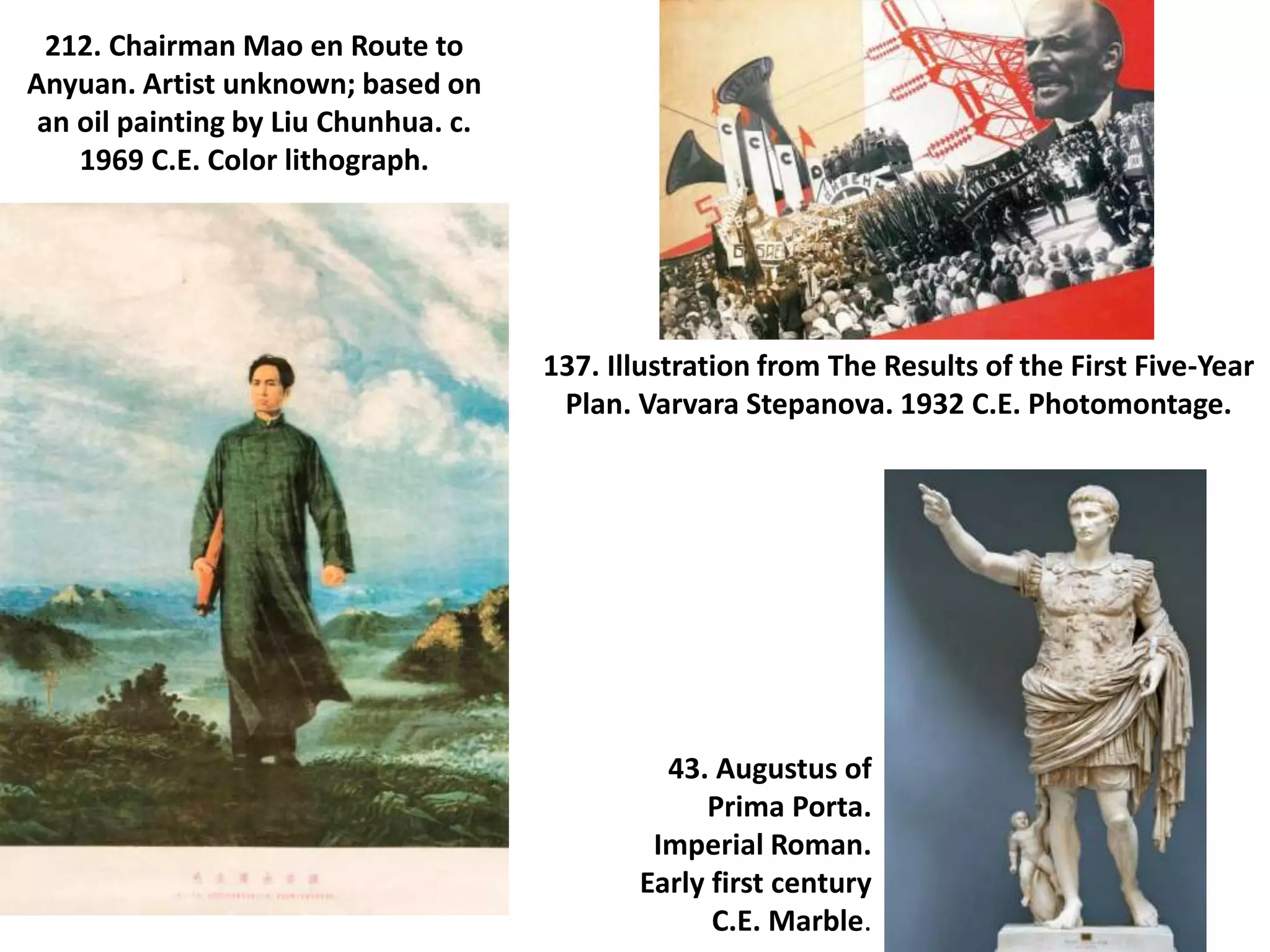
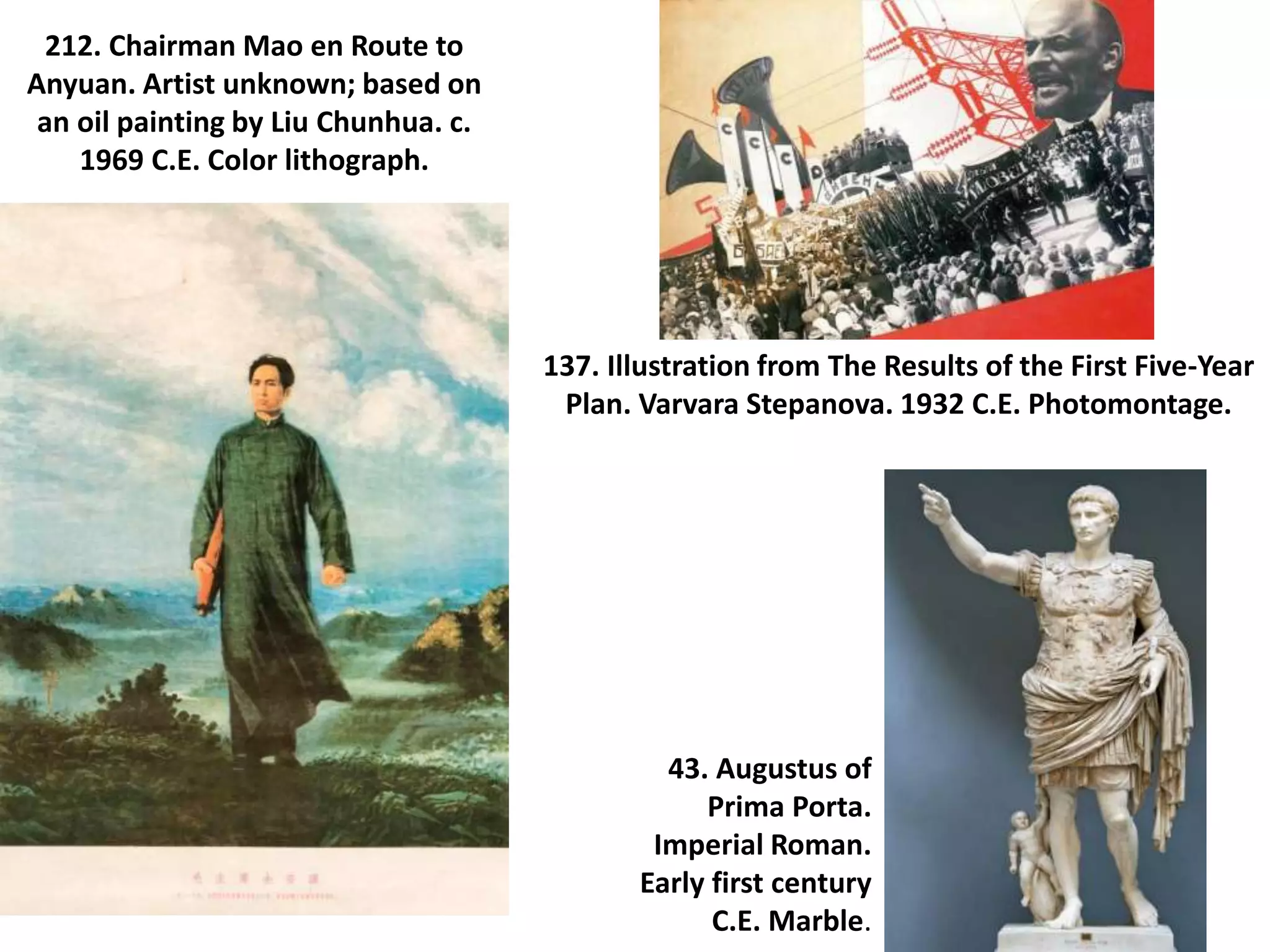
212. Chairman Mao en Route to
Anyuan. Artist unknown; based on
an oil painting by Liu Chunhua. c.
1969 C.E. Color lithograph.
137. Illustration from The Results of the First Five-Year
Plan. Varvara Stepanova. 1932 C.E. Photomontage.
43. Augustus of
Prima Porta.
Imperial Roman.
Early first century
C.E. Marble.
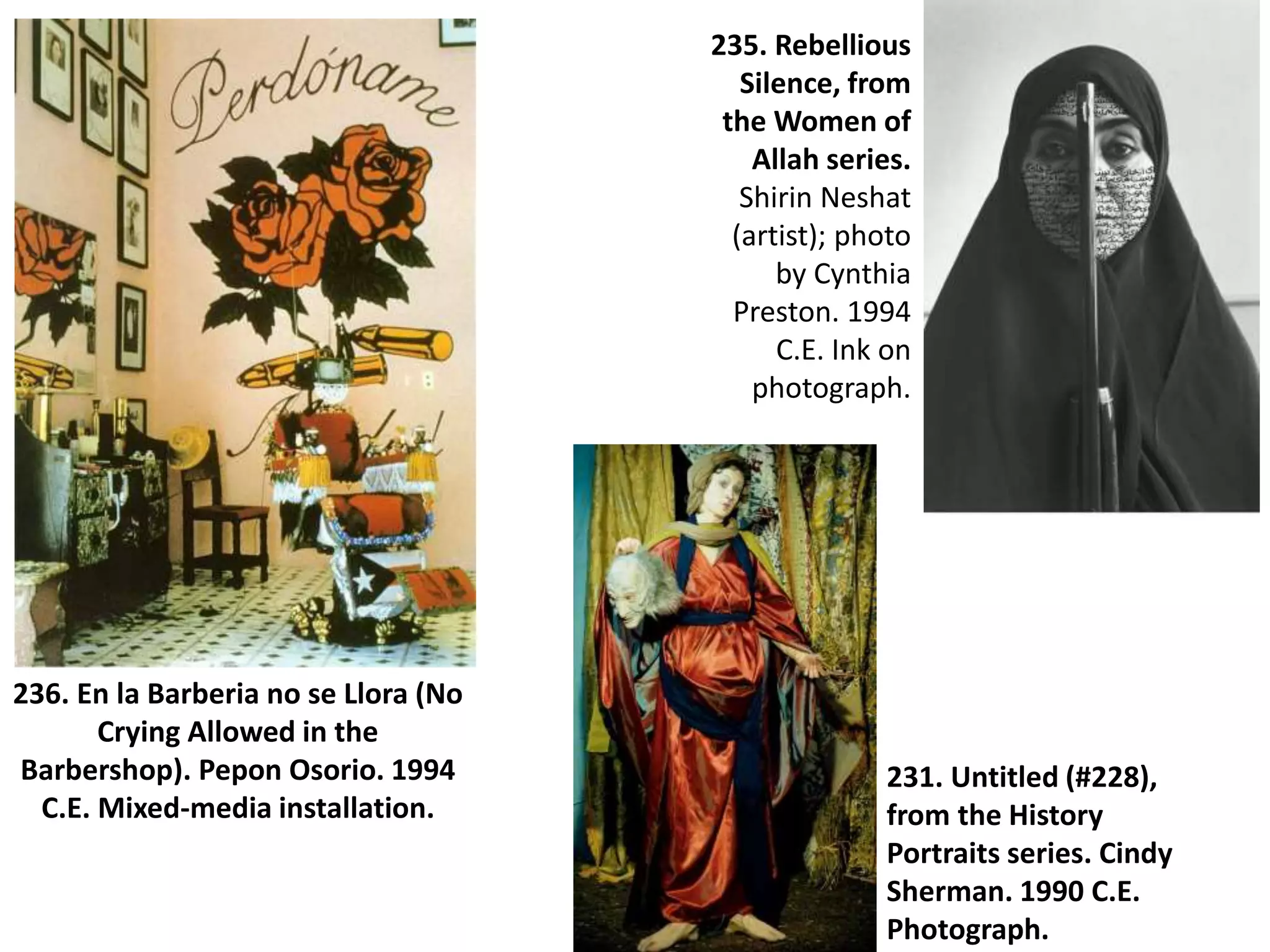
236. En la Barberia no se Llora (No
Crying Allowed in the
Barbershop). Pepon Osorio. 1994
C.E. Mixed-media installation.
235. Rebellious
Silence, from
the Women of
Allah series.
Shirin Neshat
(artist); photo
by Cynthia
Preston. 1994
C.E. Ink on
photograph.
231. Untitled (#228),
from the History
Portraits series. Cindy
Sherman. 1990 C.E.
Photograph.
Context
• the situation in which something happens : the group of
conditions that exist where and when something happens
• the interrelated conditions, environment, or setting in
which something exists or occurs (ex. the historical context
of the war)
*What was happening in the culture’s religion, social
structure, history, etc? How does these events and factors
affect what we see in the work?
*What is the artist’s personal history? How does this affect
what we see in the work?
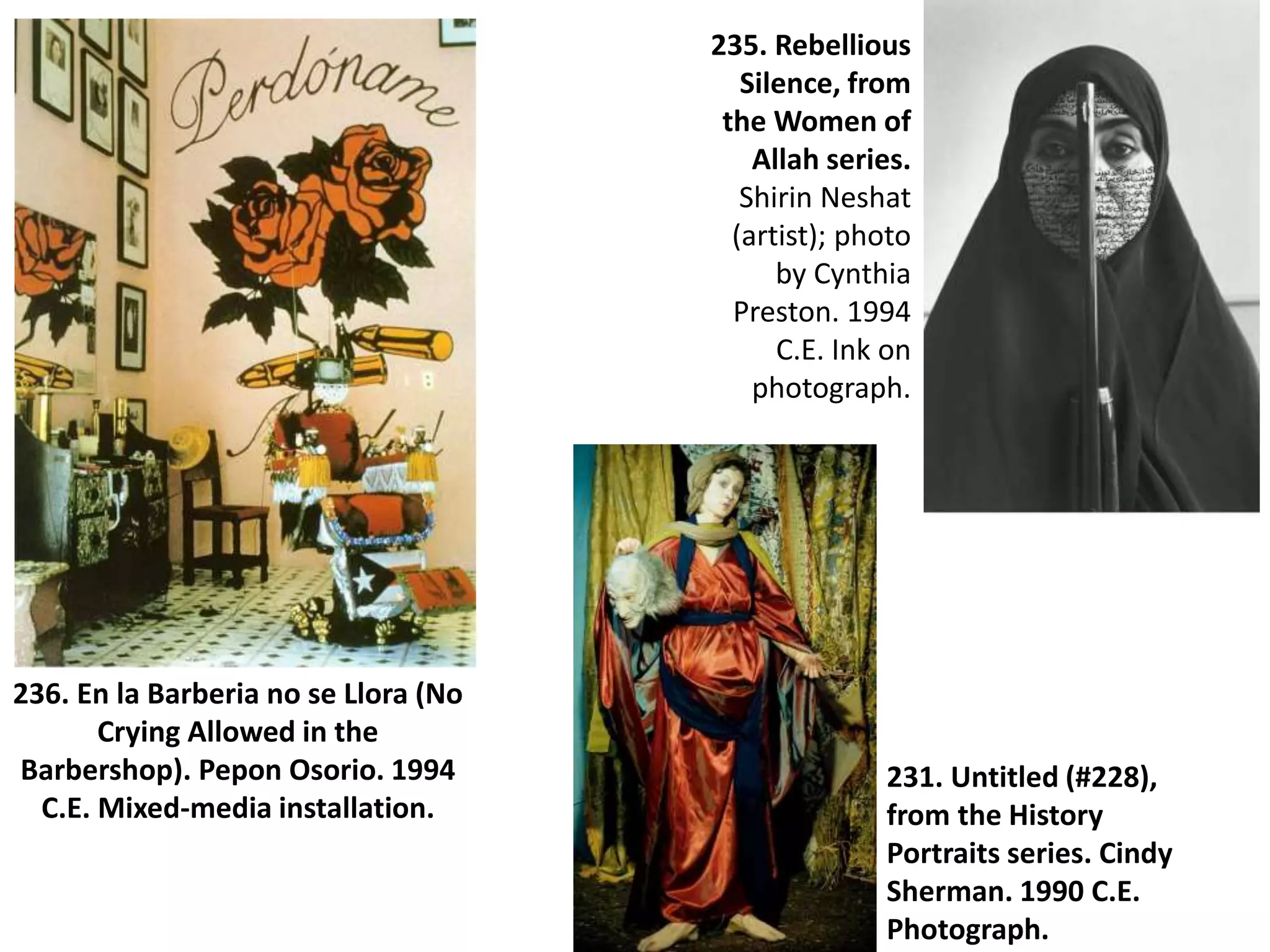
236. En la Barberia no se Llora (No
Crying Allowed in the
Barbershop). Pepon Osorio. 1994
C.E. Mixed-media installation.
235. Rebellious
Silence, from
the Women of
Allah series.
Shirin Neshat
(artist); photo
by Cynthia
Preston. 1994
C.E. Ink on
photograph.
231. Untitled (#228),
from the History
Portraits series. Cindy
Sherman. 1990 C.E.
Photograph.
212. Chairman Mao en Route to
Anyuan. Artist unknown; based on
an oil painting by Liu Chunhua. c.
1969 C.E. Color lithograph.
137. Illustration from The Results of the First Five-Year
Plan. Varvara Stepanova. 1932 C.E. Photomontage.
43. Augustus of
Prima Porta.
Imperial Roman.
Early first century
C.E. Marble.
15. Seated scribe. Saqqara, Egypt. Old
Kingdom, Fourth Dynasty. c. 2620–2500
B.C.E. Painted limestone 18. King Menkaura and queen. Old
Kingdom, Fourth Dynasty. c. 2490–
2472 B.C.E. Greywacke.
80. Venus of Urbino. Titian. c. 1538 C.E.
Oil on canvas.
107. La Grande Odalisque. Jean-Auguste-
Dominique Ingres. 1814 C.E. Oil on canvas.
115. Olympia.
Édouard Manet. 1863
C.E. Oil on canvas.
66. Annunciation Triptych (Merode Altarpiece). Workshop of
Robert Campin. 1427–1432 C.E. Oil on wood.
Citing Specific Visual Evidence
• When discussing the form, function, content, or context of
a work of art, you must always cite an element of the work
you are discussing to support your ideas.
• Think of these as “visual quotations” or “visual citations”-
compare these to the quotations you pull out of a text to
support your ideas in an English paper. Instead of written
passages from a book to support your argument/ ideas, you
are quoting something you see in the work, such as a pose
or stance, the use of a particular material, the location of a
work, etc.

Form, function, content, context powerpoint by alison napier

  • 1.
    What do ArtHistory students do? • Verbally and/or in writing, they describe visual elements, referencing actual, physical aspects of the work of art and observed design relationships to support their description. • They utilize resources to back up assertions about materials and technique and to investigate function, content, and context. • In doing so, students continue to seek, evaluate, and apply evidence to test and strengthen their analyses. • Description is transformed into explanation: “this is how it looks” becomes “this is why it looks that way.”
  • 2.
    AP Art Historyas a Process of Inquiry What is it? What does it look like? What is it made of? How was it made? Who made it? Who commissioned it? When and where was it made? What was happening in the artist’s world when it was made? Who used it? How was it used? Who were its audiences? How did they respond to it? How long does it last? Is it long lasting or ephemeral? What does it mean? What does it resemble? How is it distinctive? Who and what influenced it? Who and what did it influence? Why (to all of the previous questions)? How do we know (to all of the previous questions)?
  • 3.
  • 4.
    Form • the shape,visual appearance, constitution, or configuration of an object • the way something is or happens *What type of art form?: painting, sculpture or architecture (other forms we need to add to this list?) *how its is created/ formed?: media/materials, floor plan
  • 5.
    80. Venus ofUrbino. Titian. c. 1538 C.E. Oil on canvas. 107. La Grande Odalisque. Jean-Auguste- Dominique Ingres. 1814 C.E. Oil on canvas. 115. Olympia. Édouard Manet. 1863 C.E. Oil on canvas.
  • 6.
    80. Venus of Urbino.Titian. c. 1538 C.E. Oil on canvas. 145. Woman, I. Willem de Kooning. 1950–1952 C.E. Oil on canvas. 247. Preying Mantra. Wangechi Mutu. 2006 C.E. Mixed media on Mylar.
  • 7.
    183. The Kaaba.Mecca, Saudi Arabia. Islamic. Pre-Islamic monument; rededicated by Muhammad in 631–632 C.E.; multiple renovations. Granite masonry, covered with silk curtain and calligraphy in gold and silver-wrapped thread.
  • 8.
    183. The Kaaba.Mecca, Saudi Arabia. Islamic. Pre-Islamic monument; rededicated by Muhammad in 631–632 C.E.; multiple renovations. Granite masonry, covered with silk curtain and calligraphy in gold and silver-wrapped thread.
  • 9.
    15. Seated scribe.Saqqara, Egypt. Old Kingdom, Fourth Dynasty. c. 2620–2500 B.C.E. Painted limestone 18. King Menkaura and queen. Old Kingdom, Fourth Dynasty. c. 2490– 2472 B.C.E. Greywacke.
  • 10.
    15. Seated scribe.Saqqara, Egypt. Old Kingdom, Fourth Dynasty. c. 2620–2500 B.C.E. Painted limestone 205. Portrait of Sin Sukju (1417–1475). Imperial Bureau of Painting. c. 15th century C.E. Hanging scroll (ink and color on silk)
  • 11.
    60. Chartres Cathedral,Chartres, France (French Gothic: 1145-1220) 51. San Vitale, Ravenna, Italy (Early Byzantine Europe: 526-457 88. San Carlo alle Quattro Fontane, Rome Italy (Italian Baroque: 1638-1646) 58. Church of Sainte-Foy, Conques, France (Romanesque: 9th century)
  • 12.
    Function • the specialpurpose or activity for which a thing exists or is used *what is the function? *how does it function? *how does the viewer interact with it? *is patronage a factor?
  • 13.
    60. Chartres Cathedral,Chartres, France (French Gothic: 1145-1220) 51. San Vitale, Ravenna, Italy (Early Byzantine Europe: 526-457 88. San Carlo alle Quattro Fontane, Rome Italy (Italian Baroque: 1638-1646) 58. Church of Sainte-Foy, Conques, France (Romanesque: 9th century)
  • 14.
    166. Black-on-black ceramicvessel. Maria Martínez and Julian Martínez, Tewa, Puebloan, San Ildefonso Pueblo, New Mexico. c. mid-20th century C.E. Blackware ceramic. 58. Church of Sainte-Foy. Conques, France. Romanesque Europe. Reliquary of Saint Foy: ninth century C.E., with later additions; gold, silver, gemstones, and enamel over wood (reliquary). 240. Guggenheim Museum Bilbao. Spain. Frank Gehry (architect). 1997 C.E. Titanium, glass, and limestone.
  • 15.
    225. Vietnam VeteransMemorial. Washington, D.C., U.S. Maya Lin. 1982 C.E. Granite.
  • 16.
    17. Great Pyramids(Menkaura, Khafre, Khufu) and Great Sphinx. Giza, Egypt. Old Kingdom, Fourth Dynasty. c. 2550–2490 B.C.E. Cut limestone.
  • 17.
    215. ‘Ahu ‘ula(feather cape). Hawaiian. Late 18th century C.E. Feathers and fiber. 178. Aka elephant mask. Bamileke (Cameroon, western grassfields region). c. 19th to 20th century C.E. Wood, woven raffia, cloth, and beads. 210. White and Red Plum Blossoms. Ogata Korin. c. 1710–1716 C.E. Ink, watercolor, and gold leaf on paper.
  • 18.
    238. Electronic Superhighway.Nam June Paik. 1995 C.E. Mixed- media installation (49-channel closed-circuit video installation, neon, steel, and electronic components).
  • 19.
    243. Darkytown Rebellion.Kara Walker. 2001 C.E. Cut paper and projection on wall.
  • 20.
    Content • the ​subjector ​ideas ​contained in something written, said, ​created, or ​represented • the things ​represented or ​suggested in something written or ​created as ​art, or the ​ideas it ​communicates. *What is the subject matter? *Is there symbolism? If so, what are the symbols and what do they mean? How do they affect the overall content of the work? *Does the work have a message? If so, what is it?
  • 21.
    243. Darkytown Rebellion.Kara Walker. 2001 C.E. Cut paper and projection on wall.
  • 22.
    13. Palette ofKing Narmer. Predynastic Egypt. c. 3000–2920 B.C.E. Greywacke. 33. Niobides Krater. c. 460– 450 B.C.E. Clay, red-figure technique (white highlights). 155. Yaxchilán: Lintel 25 from Structure 23 . Chiapas, Mexico. Maya. 725 C.E 177. Lukasa (memory board). Mbudye Society, Luba peoples (Democratic Republic of the Congo). c. 19th to 20th century C.E. Wood, beads, and metal
  • 23.
    66. Annunciation Triptych(Merode Altarpiece). Workshop of Robert Campin. 1427–1432 C.E. Oil on wood.
  • 24.
    68. The Arnolfini Portrait.Jan van Eyck. c. 1434 C.E. Oil on wood.
  • 25.
    212. Chairman Maoen Route to Anyuan. Artist unknown; based on an oil painting by Liu Chunhua. c. 1969 C.E. Color lithograph. 137. Illustration from The Results of the First Five-Year Plan. Varvara Stepanova. 1932 C.E. Photomontage. 43. Augustus of Prima Porta. Imperial Roman. Early first century C.E. Marble.
  • 26.
    236. En laBarberia no se Llora (No Crying Allowed in the Barbershop). Pepon Osorio. 1994 C.E. Mixed-media installation. 235. Rebellious Silence, from the Women of Allah series. Shirin Neshat (artist); photo by Cynthia Preston. 1994 C.E. Ink on photograph. 231. Untitled (#228), from the History Portraits series. Cindy Sherman. 1990 C.E. Photograph.
  • 27.
    Context • the situationin which something happens : the group of conditions that exist where and when something happens • the interrelated conditions, environment, or setting in which something exists or occurs (ex. the historical context of the war) *What was happening in the culture’s religion, social structure, history, etc? How does these events and factors affect what we see in the work? *What is the artist’s personal history? How does this affect what we see in the work?
  • 28.
    236. En laBarberia no se Llora (No Crying Allowed in the Barbershop). Pepon Osorio. 1994 C.E. Mixed-media installation. 235. Rebellious Silence, from the Women of Allah series. Shirin Neshat (artist); photo by Cynthia Preston. 1994 C.E. Ink on photograph. 231. Untitled (#228), from the History Portraits series. Cindy Sherman. 1990 C.E. Photograph.
  • 29.
    212. Chairman Maoen Route to Anyuan. Artist unknown; based on an oil painting by Liu Chunhua. c. 1969 C.E. Color lithograph. 137. Illustration from The Results of the First Five-Year Plan. Varvara Stepanova. 1932 C.E. Photomontage. 43. Augustus of Prima Porta. Imperial Roman. Early first century C.E. Marble.
  • 30.
    15. Seated scribe.Saqqara, Egypt. Old Kingdom, Fourth Dynasty. c. 2620–2500 B.C.E. Painted limestone 18. King Menkaura and queen. Old Kingdom, Fourth Dynasty. c. 2490– 2472 B.C.E. Greywacke.
  • 31.
    80. Venus ofUrbino. Titian. c. 1538 C.E. Oil on canvas. 107. La Grande Odalisque. Jean-Auguste- Dominique Ingres. 1814 C.E. Oil on canvas. 115. Olympia. Édouard Manet. 1863 C.E. Oil on canvas.
  • 32.
    66. Annunciation Triptych(Merode Altarpiece). Workshop of Robert Campin. 1427–1432 C.E. Oil on wood.
  • 33.
    Citing Specific VisualEvidence • When discussing the form, function, content, or context of a work of art, you must always cite an element of the work you are discussing to support your ideas. • Think of these as “visual quotations” or “visual citations”- compare these to the quotations you pull out of a text to support your ideas in an English paper. Instead of written passages from a book to support your argument/ ideas, you are quoting something you see in the work, such as a pose or stance, the use of a particular material, the location of a work, etc.