Your Data-Driven
Social Media Strategy
     Alaina Wiens
     @alainawiens
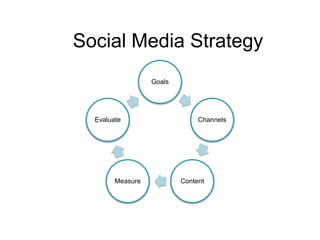
Social Media Strategy
                  Goals


  Evaluate                     Channels


        Measure           Content
Goal-Setting
Measurable
                                 goals set the
                                 foundation for a
                                 strong social
                                 media strategy.

Image Source:
http://2wheelsdown.wordpress.com/2010/02/27/my-first-brick/
Goal-Setting
• What do you hope to accomplish?
• What audience to you hope to reach?
• What kind of community do you want to
  build?
• What results can you hope to achieve?
• Can these results be quantified?
• How will you know when you’ve been
  successful?
“   We want UM-Flint’s social networks
    to be online communities, where not
    only the content—but the experience
    itself—reinforces our brand. At the
    University of Michigan-Flint,
    everyone matters.
UM-Flint’s Goals
1. Grow the university’s online communities
   within in-use and new social networks.

2. Increase engagement and participation
   within these communities.
Choosing
Channels
Choosing Channels
• Which social networks will best help you
  reach your goals?
• Which is preferred or most-used among your
  target audience?
• Which networks will best allow you to
  connect with your potential community?
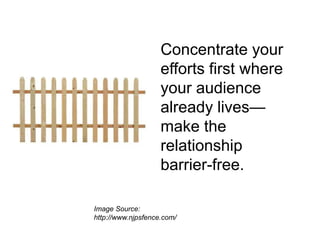
Concentrate your
                    efforts first where
                    your audience
                    already lives—
                    make the
                    relationship
                    barrier-free.

Image Source:
http://www.njpsfence.com/
Concentrate on
what you can
do well.


   Image Source:
   http://www.matsugov.us/planning/index.php
“   Because the university is already
    engaged on Facebook, Twitter,
    YouTube, Flickr, and Foursquare, we
    are not in a position to choose
    channels from scratch. Instead, our
    choices concern the channels on
    which to focus our energy.
Find Your Data
•   Published research
•   Your own research
•   Your own experience
•   Your established communities
•   Your colleagues
Content
Content
• How will you communicate?
• What matters to your audience?
• What content is the most engaging?
• How can you best be part of your
  community?
• What messaging will help you reach your
  goals?
“   People like to know what’s
    happening on campus, they want to
    be able to provide feedback to the
    university, and they like to see
    themselves and their peers featured
    in photos and videos.
Find Your Data
•   Published research
•   Your own research
•   Your own experience
•   Your established communities
•   Your colleagues
Find Your Content
•   Editorial meetings
•   Contacts across your campus
•   Content calendar
•   Student newspaper
•   Other social channels
Evaluation
Evaluation
•   What metrics will measure your success?
•   Is your content reaching your audience?
•   Is your messaging effective?
•   Is your community engaged?
•   Have your goals been reached?
“   Our goal is to identify trends for what
    works (or doesn’t) over time.
    Comparative reports will be compiled
    on a quarterly basis.
Some Examples
Facebook
• Percentage of growth per quarter in: total likes,
  people talking about this, and total reach
• Most and least successful content per quarter using
  post-level data categorized by content type

Twitter
• Percentage of growth per quarter in: total followers,
  interactions (mentions and retweets)
• Most consumed content per quarter using click-
  through and share rates
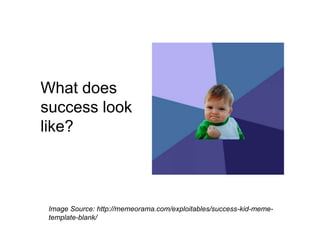
What does
success look
like?


 Image Source: http://memeorama.com/exploitables/success-kid-meme-
 template-blank/
Find Your Metrics
•   Insights         •   Growth
•   Reach            •   Followers
•   Impressions      •   Likes
•   Click-throughs   •   Conversation
•   Influencers      •   Trends
•   Interactions     •   Spikes
Adaptation
Adaptation
•   What is most successful?
•   Are you making progress toward your goal?
•   Is your goal still relevant to your community?
•   Is your community still the same?
•   Where can/should you adjust your methods?
Your Communities
•   Communities build themselves.
•   Communities change over time.
•   Demographics may change.
•   Behavior may change.
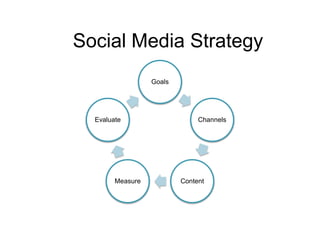
Social Media Strategy
                  Goals


  Evaluate                     Channels


        Measure           Content
Resources
•   Noel-Levitz            Higher Education
•   Meet Content           Web Professionals
•   EDUniverse           • uwebd
•   FollowEDU            • .eduGuru
•   BlogHighEd           • “The community <3”
•   Higher Ed Live
•   Link: The Journal of
Questions?

Your Data-Driven Social Media Strategy

  • 1.
    Your Data-Driven Social MediaStrategy Alaina Wiens @alainawiens
  • 2.
    Social Media Strategy Goals Evaluate Channels Measure Content
  • 3.
  • 4.
    Measurable goals set the foundation for a strong social media strategy. Image Source: http://2wheelsdown.wordpress.com/2010/02/27/my-first-brick/
  • 5.
    Goal-Setting • What doyou hope to accomplish? • What audience to you hope to reach? • What kind of community do you want to build? • What results can you hope to achieve? • Can these results be quantified? • How will you know when you’ve been successful?
  • 6.
    We want UM-Flint’s social networks to be online communities, where not only the content—but the experience itself—reinforces our brand. At the University of Michigan-Flint, everyone matters.
  • 7.
    UM-Flint’s Goals 1. Growthe university’s online communities within in-use and new social networks. 2. Increase engagement and participation within these communities.
  • 8.
  • 9.
    Choosing Channels • Whichsocial networks will best help you reach your goals? • Which is preferred or most-used among your target audience? • Which networks will best allow you to connect with your potential community?
  • 10.
    Concentrate your efforts first where your audience already lives— make the relationship barrier-free. Image Source: http://www.njpsfence.com/
  • 11.
    Concentrate on what youcan do well. Image Source: http://www.matsugov.us/planning/index.php
  • 12.
    Because the university is already engaged on Facebook, Twitter, YouTube, Flickr, and Foursquare, we are not in a position to choose channels from scratch. Instead, our choices concern the channels on which to focus our energy.
  • 13.
    Find Your Data • Published research • Your own research • Your own experience • Your established communities • Your colleagues
  • 14.
  • 15.
    Content • How willyou communicate? • What matters to your audience? • What content is the most engaging? • How can you best be part of your community? • What messaging will help you reach your goals?
  • 16.
    People like to know what’s happening on campus, they want to be able to provide feedback to the university, and they like to see themselves and their peers featured in photos and videos.
  • 17.
    Find Your Data • Published research • Your own research • Your own experience • Your established communities • Your colleagues
  • 18.
    Find Your Content • Editorial meetings • Contacts across your campus • Content calendar • Student newspaper • Other social channels
  • 19.
  • 20.
    Evaluation • What metrics will measure your success? • Is your content reaching your audience? • Is your messaging effective? • Is your community engaged? • Have your goals been reached?
  • 21.
    Our goal is to identify trends for what works (or doesn’t) over time. Comparative reports will be compiled on a quarterly basis.
  • 22.
    Some Examples Facebook • Percentageof growth per quarter in: total likes, people talking about this, and total reach • Most and least successful content per quarter using post-level data categorized by content type Twitter • Percentage of growth per quarter in: total followers, interactions (mentions and retweets) • Most consumed content per quarter using click- through and share rates
  • 23.
    What does success look like? Image Source: http://memeorama.com/exploitables/success-kid-meme- template-blank/
  • 24.
    Find Your Metrics • Insights • Growth • Reach • Followers • Impressions • Likes • Click-throughs • Conversation • Influencers • Trends • Interactions • Spikes
  • 25.
  • 26.
    Adaptation • What is most successful? • Are you making progress toward your goal? • Is your goal still relevant to your community? • Is your community still the same? • Where can/should you adjust your methods?
  • 27.
    Your Communities • Communities build themselves. • Communities change over time. • Demographics may change. • Behavior may change.
  • 28.
    Social Media Strategy Goals Evaluate Channels Measure Content
  • 29.
    Resources • Noel-Levitz Higher Education • Meet Content Web Professionals • EDUniverse • uwebd • FollowEDU • .eduGuru • BlogHighEd • “The community <3” • Higher Ed Live • Link: The Journal of
  • 30.

Editor's Notes

  • #2 About MeHow I ended up in my positionHow I landed on this topic I will not be giving you a one-size-fits-all social media strategy. There is no such thing.What I hope to give you today are the tools to build your own strategy based on data and measurable goals.As an example:University of Michigan-Flint.
  • #7 These quotes are taken from blog posts.
  • #8 Other ExamplesIncrease attendance at college visit events.Grow alumni ambassador program.
  • #14 80% of prospective students have a Facebook account (Noel Levitz 2011 E-expectations Report - www.noellevitz.com)9% of prospective students and 5% of parents have Twitter accounts(Noel Levitz 2011 E-expectations Report - www.noellevitz.com)Hypotheticals:Increase attendance at college visit eventsFacebook ad campaign?Twitter? Probably not.Grow alumni ambassador programFacebook page?Facebook group?LinkedIn?
  • #19 Back to our hypotheticals:Increase attendance at college visit eventsCapture the experience – photos, videosStorify past successesGrow alumni ambassador programShare volunteer opportunitiesCapture the experience – photos, videosInclude them in university community with upatesAlumni profilesMemories
  • #24 How do you know when you get there?Measure THAT.