Our vision is for young people who are:
 Creative, energetic and enterprising
 Confident
 Connected
 Actively involved
 Lifelong learners
eLearning may
 Assist the making of connections
 Facilitate shared learning
 Assist in the creation and use of supportive
learning environments
 Enhance opportunities to learn
 Open up different ways of learning
 Personalised learning (the system is built around the
learner, rather than the learner being required to fit with the system)
 Diversity needs to be recognised as a strength and 21st century
citizens need to be educated for diversity
 Knowledge involves creating and using new knowledge to solve
problems and find solutions to challenges as they arise on a “just-in-
time” basis.
 Rethinking learners’ and teachers’ roles
 A culture of continuous learning for teachers
and educational leaders
What is the purpose of your
class blog?
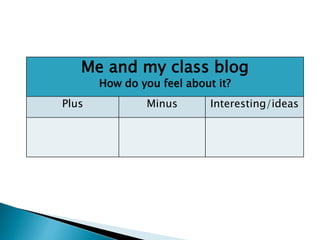
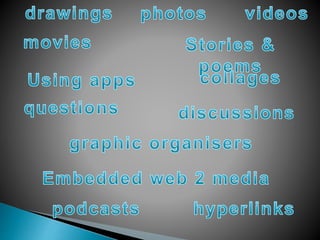
Me and my class blog
How do you feel about it?
Plus Minus Interesting/ideas
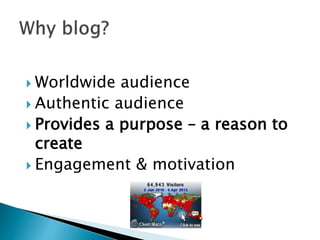
 Worldwide audience
 Authentic audience
 Provides a purpose – a reason to
create
 Engagement & motivation
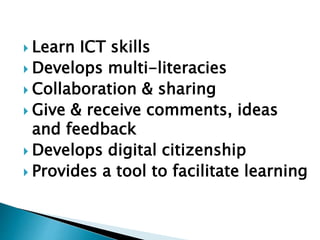
 Learn ICT skills
 Develops multi-literacies
 Collaboration & sharing
 Give & receive comments, ideas
and feedback
 Develops digital citizenship
 Provides a tool to facilitate learning
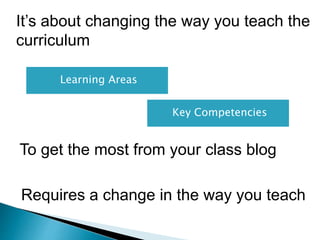
Learning Areas
Key Competencies
Requires a change in the way you teach
It’s about changing the way you teach the
curriculum
To get the most from your class blog
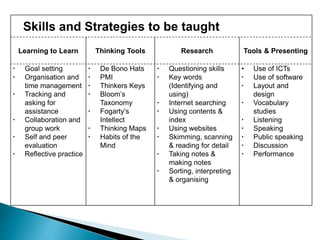
Skills and Strategies to be taught
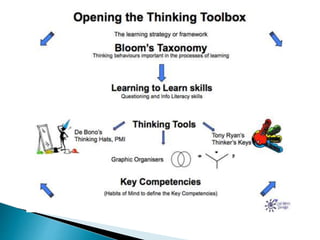
Learning to Learn Thinking Tools Research Tools & Presenting
 Goal setting
 Organisation and
time management
 Tracking and
asking for
assistance
 Collaboration and
group work
 Self and peer
evaluation
 Reflective practice
 De Bono Hats
 PMI
 Thinkers Keys
 Bloom’s
Taxonomy
 Fogarty’s
Intellect
 Thinking Maps
 Habits of the
Mind
 Questioning skills
 Key words
(Identifying and
using)
 Internet searching
 Using contents &
index
 Using websites
 Skimming, scanning
& reading for detail
 Taking notes &
making notes
 Sorting, interpreting
& organising
• Use of ICTs
 Use of software
 Layout and
design
 Vocabulary
studies
 Listening
 Speaking
 Public speaking
 Discussion
 Performance
Blog platforms
 Edublogs
 Blogger (Blogspot)
 Wordpress
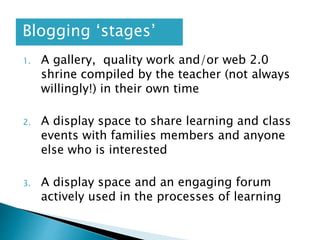
1. A gallery, quality work and/or web 2.0
shrine compiled by the teacher (not always
willingly!) in their own time
2. A display space to share learning and class
events with families members and anyone
else who is interested
3. A display space and an engaging forum
actively used in the processes of learning
Blogging ‘stages’
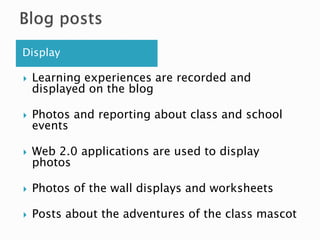
Display
 Learning experiences are recorded and
displayed on the blog
 Photos and reporting about class and school
events
 Web 2.0 applications are used to display
photos
 Photos of the wall displays and worksheets
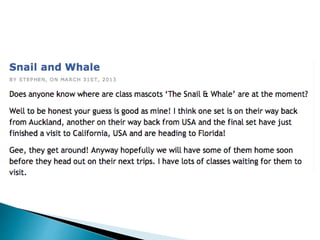
 Posts about the adventures of the class mascot
Learn
A world-wide audience is a very powerful
motivator
 The blog is used as a catalyst and a learning
tool
 Learning happens on the blog in real time
 Students collaborate in groups and
co-construct posts
 Global collaborative projects
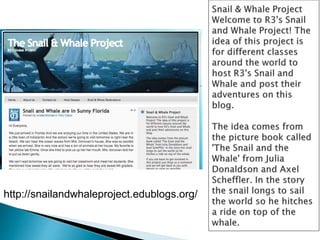
http://snailandwhaleproject.edublogs.org/
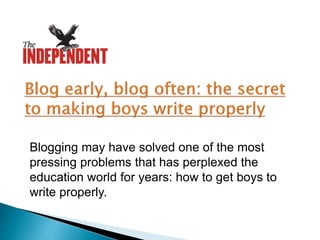
Blogging may have solved one of the most
pressing problems that has perplexed the
education world for years: how to get boys to
write properly.
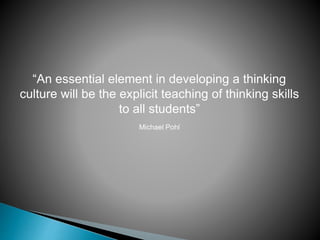
“An essential element in developing a thinking
culture will be the explicit teaching of thinking skills
to all students”
Michael Pohl
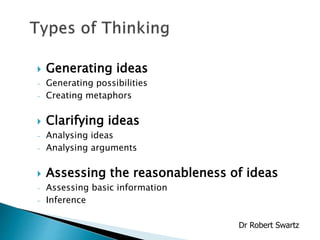
 Generating ideas
- Generating possibilities
- Creating metaphors
 Clarifying ideas
- Analysing ideas
- Analysing arguments
 Assessing the reasonableness of ideas
- Assessing basic information
- Inference
Dr Robert Swartz
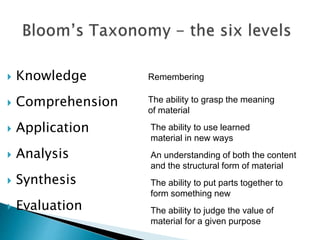
 Knowledge
 Comprehension
 Application
 Analysis
 Synthesis
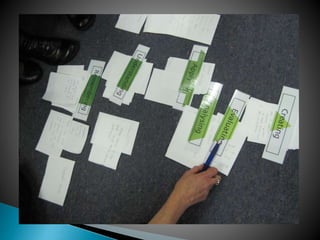
 Evaluation
Remembering
The ability to grasp the meaning
of material
The ability to use learned
material in new ways
An understanding of both the content
and the structural form of material
The ability to put parts together to
form something new
The ability to judge the value of
material for a given purpose
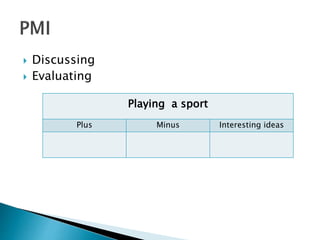
 Discussing
 Evaluating
Playing a sport
Plus Minus Interesting ideas
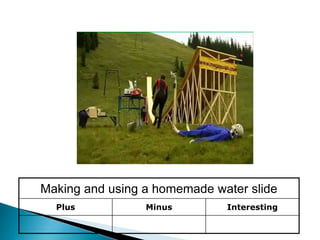
Making and using a homemade water slide
Plus Minus Interesting
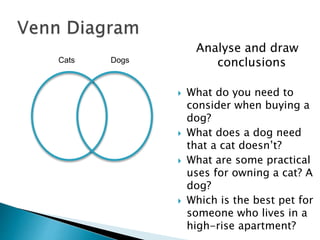
Analyse and draw
conclusions
 What do you need to
consider when buying a
dog?
 What does a dog need
that a cat doesn’t?
 What are some practical
uses for owning a cat? A
dog?
 Which is the best pet for
someone who lives in a
high-rise apartment?
DogsCats
Whole class
Groups
Pairs
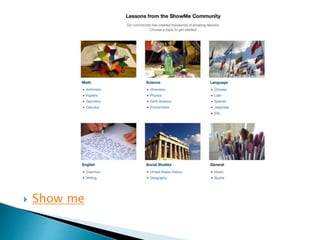
 Show me
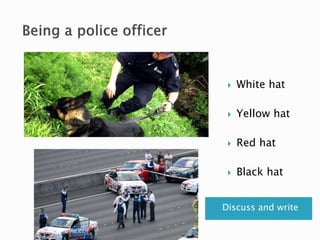
Discuss and write
 White hat
 Yellow hat
 Red hat
 Black hat
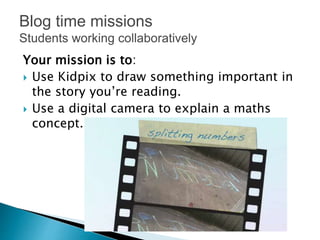
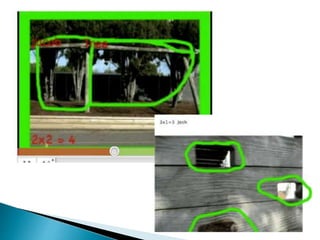
Your mission is to:
 Use Kidpix to draw something important in
the story you’re reading.
 Use a digital camera to explain a maths
concept.
Blog time missions
Students working collaboratively
Your mission is to:
 Take a photo and retell a story
 Take a photo of some group work, upload
to Fotobabble and explain what you were
learning
 Take photos to illustrate a word (patterns,
people, lines, shoes etc)
 Investigate and share ‘which class has the
tidiest cloak bay?’
 Take photos which show learning in our
room today
More blog time missions
 Take photos showing ‘how to skip’,
‘how to shoot a goal’, how to do a
forward roll’ etc.
 Draw 3 things important to the main
character in the book you’re reading
 Use a flow chart to show a sequence
(reading or maths)
 Create a book trailer using PuppetPals
and iMovie apps
 Create some QR codes with clues for a
location for others to solve
 What?
 So what?
 Now what?
Co-create
 Personalised learning (the system is built around the
learner, rather than the learner being required to fit with the system)
 Diversity needs to be recognised as a strength and 21st century
citizens need to be educated for diversity
 Knowledge involves creating and using new knowledge to solve
problems and find solutions to challenges as they arise on a “just-in-
time” basis.
 Rethinking learners’ and teachers’ roles
 A culture of continuous learning for teachers
and educational leaders
Part of your classroom community 24/7
Used daily to motivate and enhance learning
 theinsandouts.co.nz
(year 3 & 4)
 http://room6halcombeschool2013.blogspot.co.nz/
Year 7 & 8
 http://www.easternhutt.school.nz/Website/Syndicates.
html (http://slaterg4.blogspot.co.nz/)

Your Class Blog

  • 1.
    Our vision isfor young people who are:  Creative, energetic and enterprising  Confident  Connected  Actively involved  Lifelong learners
  • 2.
    eLearning may  Assistthe making of connections  Facilitate shared learning  Assist in the creation and use of supportive learning environments  Enhance opportunities to learn  Open up different ways of learning
  • 3.
     Personalised learning(the system is built around the learner, rather than the learner being required to fit with the system)  Diversity needs to be recognised as a strength and 21st century citizens need to be educated for diversity  Knowledge involves creating and using new knowledge to solve problems and find solutions to challenges as they arise on a “just-in- time” basis.  Rethinking learners’ and teachers’ roles  A culture of continuous learning for teachers and educational leaders
  • 5.
    What is thepurpose of your class blog?
  • 6.
    Me and myclass blog How do you feel about it? Plus Minus Interesting/ideas
  • 8.
     Worldwide audience Authentic audience  Provides a purpose – a reason to create  Engagement & motivation
  • 9.
     Learn ICTskills  Develops multi-literacies  Collaboration & sharing  Give & receive comments, ideas and feedback  Develops digital citizenship  Provides a tool to facilitate learning
  • 12.
    Learning Areas Key Competencies Requiresa change in the way you teach It’s about changing the way you teach the curriculum To get the most from your class blog
  • 13.
    Skills and Strategiesto be taught Learning to Learn Thinking Tools Research Tools & Presenting  Goal setting  Organisation and time management  Tracking and asking for assistance  Collaboration and group work  Self and peer evaluation  Reflective practice  De Bono Hats  PMI  Thinkers Keys  Bloom’s Taxonomy  Fogarty’s Intellect  Thinking Maps  Habits of the Mind  Questioning skills  Key words (Identifying and using)  Internet searching  Using contents & index  Using websites  Skimming, scanning & reading for detail  Taking notes & making notes  Sorting, interpreting & organising • Use of ICTs  Use of software  Layout and design  Vocabulary studies  Listening  Speaking  Public speaking  Discussion  Performance
  • 14.
    Blog platforms  Edublogs Blogger (Blogspot)  Wordpress
  • 15.
    1. A gallery,quality work and/or web 2.0 shrine compiled by the teacher (not always willingly!) in their own time 2. A display space to share learning and class events with families members and anyone else who is interested 3. A display space and an engaging forum actively used in the processes of learning Blogging ‘stages’
  • 16.
    Display  Learning experiencesare recorded and displayed on the blog  Photos and reporting about class and school events  Web 2.0 applications are used to display photos  Photos of the wall displays and worksheets  Posts about the adventures of the class mascot
  • 17.
    Learn A world-wide audienceis a very powerful motivator  The blog is used as a catalyst and a learning tool  Learning happens on the blog in real time  Students collaborate in groups and co-construct posts  Global collaborative projects
  • 18.
  • 21.
    Blogging may havesolved one of the most pressing problems that has perplexed the education world for years: how to get boys to write properly.
  • 22.
    “An essential elementin developing a thinking culture will be the explicit teaching of thinking skills to all students” Michael Pohl
  • 23.
     Generating ideas -Generating possibilities - Creating metaphors  Clarifying ideas - Analysing ideas - Analysing arguments  Assessing the reasonableness of ideas - Assessing basic information - Inference Dr Robert Swartz
  • 25.
     Knowledge  Comprehension Application  Analysis  Synthesis  Evaluation Remembering The ability to grasp the meaning of material The ability to use learned material in new ways An understanding of both the content and the structural form of material The ability to put parts together to form something new The ability to judge the value of material for a given purpose
  • 27.
     Discussing  Evaluating Playinga sport Plus Minus Interesting ideas
  • 28.
    Making and usinga homemade water slide Plus Minus Interesting
  • 29.
    Analyse and draw conclusions What do you need to consider when buying a dog?  What does a dog need that a cat doesn’t?  What are some practical uses for owning a cat? A dog?  Which is the best pet for someone who lives in a high-rise apartment? DogsCats
  • 30.
  • 31.
  • 32.
    Discuss and write White hat  Yellow hat  Red hat  Black hat
  • 37.
    Your mission isto:  Use Kidpix to draw something important in the story you’re reading.  Use a digital camera to explain a maths concept. Blog time missions Students working collaboratively
  • 39.
    Your mission isto:  Take a photo and retell a story  Take a photo of some group work, upload to Fotobabble and explain what you were learning  Take photos to illustrate a word (patterns, people, lines, shoes etc)  Investigate and share ‘which class has the tidiest cloak bay?’  Take photos which show learning in our room today More blog time missions
  • 40.
     Take photosshowing ‘how to skip’, ‘how to shoot a goal’, how to do a forward roll’ etc.  Draw 3 things important to the main character in the book you’re reading  Use a flow chart to show a sequence (reading or maths)  Create a book trailer using PuppetPals and iMovie apps  Create some QR codes with clues for a location for others to solve
  • 41.
     What?  Sowhat?  Now what?
  • 42.
  • 43.
     Personalised learning(the system is built around the learner, rather than the learner being required to fit with the system)  Diversity needs to be recognised as a strength and 21st century citizens need to be educated for diversity  Knowledge involves creating and using new knowledge to solve problems and find solutions to challenges as they arise on a “just-in- time” basis.  Rethinking learners’ and teachers’ roles  A culture of continuous learning for teachers and educational leaders
  • 44.
    Part of yourclassroom community 24/7 Used daily to motivate and enhance learning  theinsandouts.co.nz (year 3 & 4)  http://room6halcombeschool2013.blogspot.co.nz/ Year 7 & 8  http://www.easternhutt.school.nz/Website/Syndicates. html (http://slaterg4.blogspot.co.nz/)