Stress and Yoga
- Sandeep Dongre
M.C.M, M.A (Yoga)
Pursuing Ph.D
Jan 2017
What is Stress
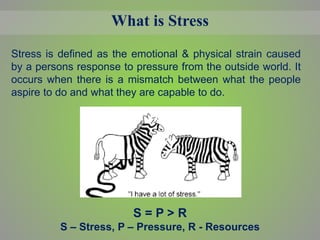
Stress is defined as the emotional & physical strain caused
by a persons response to pressure from the outside world. It
occurs when there is a mismatch between what the people
aspire to do and what they are capable to do.
S = P > R
S – Stress, P – Pressure, R - Resources
What is Stress
• In a medical or biological context stress is a physical, mental, or
emotional factor that causes bodily or mental tension
• Stresses can be external (from the environment, psychological,
or social situations) or internal (illness, or from a medical
procedure)
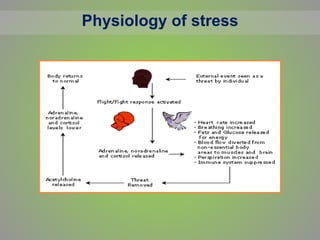
• Stress can initiate the "fight or flight" response, a complex
reaction of neurologic and endocrinology systems
• It can alter, health and emotions as well, it can effect cognitive
functions impairs concentration, attention, decision making
ability and creativity
Types of stress
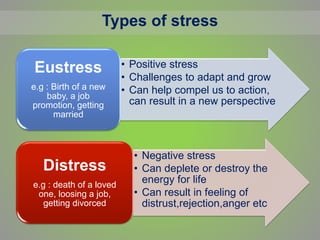
• Positive stress
• Challenges to adapt and grow
• Can help compel us to action,
can result in a new perspective
Eustress
e.g : Birth of a new
baby, a job
promotion, getting
married
• Negative stress
• Can deplete or destroy the
energy for life
• Can result in feeling of
distrust,rejection,anger etc
Distress
e.g : death of a loved
one, loosing a job,
getting divorced
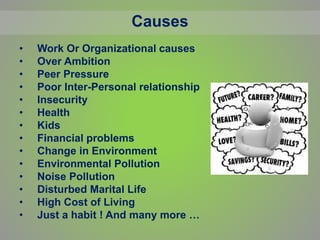
Causes
• Work Or Organizational causes
• Over Ambition
• Peer Pressure
• Poor Inter-Personal relationship
• Insecurity
• Health
• Kids
• Financial problems
• Change in Environment
• Environmental Pollution
• Noise Pollution
• Disturbed Marital Life
• High Cost of Living
• Just a habit ! And many more …
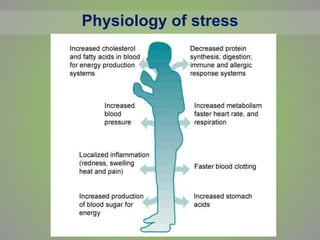
Physiology of stress
Symptoms
• Physical
• Emotional / Mental
• Behavioral
Physical
• Muscle tension
• Raising voice
• Irritation
• Inability to sleep
• Excessive tiredness
• Dry mouth
• Breathing difficulty
• Sweaty palms
• Cold hands
• Stomach upset
Emotional / Mental symptoms
• Anxiety, worry, guilt, nervousness
• Anger, frustration
• Moodiness
• Depression
• Suicidal thinking
• Appetite varies
• Loneliness
• Nightmares
• Diminished concentration
• Impaired memory or forgetfulness
Behavioral
• Change in productivity
• Sleep disorders
• Change in eating habits
• Serious appearance
• Nervous behavior
• Increased frustration
• overreacting
• Increased consumption of alcohol
And many more…
Health Problems with Excessive Stress
• CHD* and stroke
• Gastrointestinal problems such as ulcers
• Impaired immune system
• Insomnia, headache
• Backache
• Drug & alcohol use
* Coronary heart disease (CHD)
Let’s De-stress !!
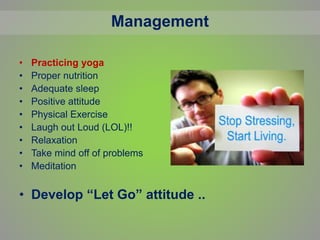
Management
• Practicing yoga
• Proper nutrition
• Adequate sleep
• Positive attitude
• Physical Exercise
• Laugh out Loud (LOL)!!
• Relaxation
• Take mind off of problems
• Meditation
• Develop “Let Go” attitude ..
Steps for Stress Management
• Identify causes and symptoms of stress
• Use measures to reduce stress
• Seek solutions for avoiding stressors
• Maintain fitness and health
Yoga for Stress Management
Yoga
• Yoga is a mind body practice that combines
stretching exercises, controlled breathing
relaxation.
• According to yogsutra of patanjali yoga is:
“Yoga is restraint of the activities of the mind.”
According to Bhagvad Gita yog is:
“Evenness of mind is yog”
“Yoga is skillfulness in action”
Stages of Yoga
• Yam : Restraints
• Niyam : Observances
• Asan : Body Postures
• Pranayama : Regulations of Breath
• Pratyahar : Abstractions of Senses
• Dharna : Concentration
• Dhyan : Meditation
• Samadhi : Self Realizations
How yoga works on stress
• In yoga breathing using the diaphragm, as you breath
can stimulate the Vagus nerve and help reduce stress.
• Vagus nerve is the main nerve of parasympathetic
nervous system, extends from the medulla through the
diaphragm to abdomen, and responsible for:
i. Slowing respiration
ii. Reducing heart rate
iii. Lowering blood pressure,
iv. Stimulating digestive activity
Yoga & H-P-O axis
YOGA
Hypothalamus
Pituitory
Organs
Emotions
How Yoga helps !
Asanas :
• Musculo-skeletal flexibility and joint range of motion
increases
• Posture improves
• Energy level increases
• Respiratory and Cardio vascular efficiency increases
• Endurance and immunity increases
• Endocrine functions and weight normalizes
• Digestion improves
Pranayama
• Anxiety and Depression decreases
• Concentration, Attention and Memory improves
• Stable Autonomic Nervous system equilibrium
• Pulse rate, Respiratory rate and blood pressure decreases
• Alpha waves in brain increase
• Strength and resiliency increase
• Breath holding time and Lung capacity increases
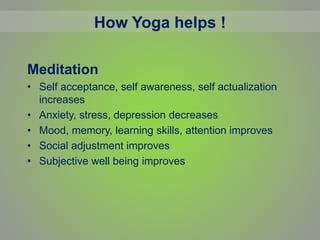
How Yoga helps !
Meditation
• Self acceptance, self awareness, self actualization
increases
• Anxiety, stress, depression decreases
• Mood, memory, learning skills, attention improves
• Social adjustment improves
• Subjective well being improves
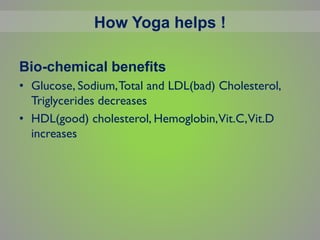
How Yoga helps !
Bio-chemical benefits
• Glucose, Sodium,Total and LDL(bad) Cholesterol,
Triglycerides decreases
• HDL(good) cholesterol, Hemoglobin,Vit.C,Vit.D
increases
How Yoga helps !
Conclusion
Yoga appears to blunt the harmful effects of
heightened stress by influencing the body’s response
to stress. There is also evidence that yoga helps
increase heart rate variability, an indicator of the
body’s flexibility in responding to stress.
• Yoga helps to relax and decreases anxiety and stress.
• The way we breathe reflects the quality of the mind.
There is a connection between mental, emotional, and
psychological states and the quickness of breath. The
mental state influences our breathing pattern therefore,
one can choose to change the breathing pattern and
thus change mental state. When you relax and slow the
pace of your breath, the pace of the mind is calmed and
quieted..
Conclusion
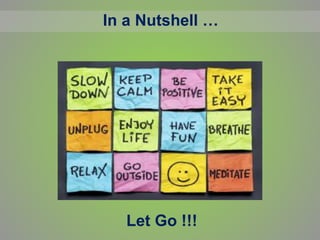
In a Nutshell …
Let Go !!!
Thank You !!
Mumbai, India
Facebook : Ashtanga Institute Or Sandeep Dongre

Stress management through yoga

  • 1.
    Stress and Yoga -Sandeep Dongre M.C.M, M.A (Yoga) Pursuing Ph.D Jan 2017
  • 2.
    What is Stress Stressis defined as the emotional & physical strain caused by a persons response to pressure from the outside world. It occurs when there is a mismatch between what the people aspire to do and what they are capable to do. S = P > R S – Stress, P – Pressure, R - Resources
  • 3.
    What is Stress •In a medical or biological context stress is a physical, mental, or emotional factor that causes bodily or mental tension • Stresses can be external (from the environment, psychological, or social situations) or internal (illness, or from a medical procedure) • Stress can initiate the "fight or flight" response, a complex reaction of neurologic and endocrinology systems • It can alter, health and emotions as well, it can effect cognitive functions impairs concentration, attention, decision making ability and creativity
  • 4.
    Types of stress •Positive stress • Challenges to adapt and grow • Can help compel us to action, can result in a new perspective Eustress e.g : Birth of a new baby, a job promotion, getting married • Negative stress • Can deplete or destroy the energy for life • Can result in feeling of distrust,rejection,anger etc Distress e.g : death of a loved one, loosing a job, getting divorced
  • 5.
    Causes • Work OrOrganizational causes • Over Ambition • Peer Pressure • Poor Inter-Personal relationship • Insecurity • Health • Kids • Financial problems • Change in Environment • Environmental Pollution • Noise Pollution • Disturbed Marital Life • High Cost of Living • Just a habit ! And many more …
  • 6.
  • 7.
  • 8.
  • 9.
    Symptoms • Physical • Emotional/ Mental • Behavioral
  • 10.
    Physical • Muscle tension •Raising voice • Irritation • Inability to sleep • Excessive tiredness • Dry mouth • Breathing difficulty • Sweaty palms • Cold hands • Stomach upset
  • 11.
    Emotional / Mentalsymptoms • Anxiety, worry, guilt, nervousness • Anger, frustration • Moodiness • Depression • Suicidal thinking • Appetite varies • Loneliness • Nightmares • Diminished concentration • Impaired memory or forgetfulness
  • 12.
    Behavioral • Change inproductivity • Sleep disorders • Change in eating habits • Serious appearance • Nervous behavior • Increased frustration • overreacting • Increased consumption of alcohol And many more…
  • 13.
    Health Problems withExcessive Stress • CHD* and stroke • Gastrointestinal problems such as ulcers • Impaired immune system • Insomnia, headache • Backache • Drug & alcohol use * Coronary heart disease (CHD)
  • 14.
  • 15.
    Management • Practicing yoga •Proper nutrition • Adequate sleep • Positive attitude • Physical Exercise • Laugh out Loud (LOL)!! • Relaxation • Take mind off of problems • Meditation • Develop “Let Go” attitude ..
  • 16.
    Steps for StressManagement • Identify causes and symptoms of stress • Use measures to reduce stress • Seek solutions for avoiding stressors • Maintain fitness and health
  • 17.
    Yoga for StressManagement
  • 18.
    Yoga • Yoga isa mind body practice that combines stretching exercises, controlled breathing relaxation. • According to yogsutra of patanjali yoga is: “Yoga is restraint of the activities of the mind.” According to Bhagvad Gita yog is: “Evenness of mind is yog” “Yoga is skillfulness in action”
  • 19.
    Stages of Yoga •Yam : Restraints • Niyam : Observances • Asan : Body Postures • Pranayama : Regulations of Breath • Pratyahar : Abstractions of Senses • Dharna : Concentration • Dhyan : Meditation • Samadhi : Self Realizations
  • 20.
    How yoga workson stress • In yoga breathing using the diaphragm, as you breath can stimulate the Vagus nerve and help reduce stress. • Vagus nerve is the main nerve of parasympathetic nervous system, extends from the medulla through the diaphragm to abdomen, and responsible for: i. Slowing respiration ii. Reducing heart rate iii. Lowering blood pressure, iv. Stimulating digestive activity
  • 21.
    Yoga & H-P-Oaxis YOGA Hypothalamus Pituitory Organs Emotions
  • 22.
    How Yoga helps! Asanas : • Musculo-skeletal flexibility and joint range of motion increases • Posture improves • Energy level increases • Respiratory and Cardio vascular efficiency increases • Endurance and immunity increases • Endocrine functions and weight normalizes • Digestion improves
  • 23.
    Pranayama • Anxiety andDepression decreases • Concentration, Attention and Memory improves • Stable Autonomic Nervous system equilibrium • Pulse rate, Respiratory rate and blood pressure decreases • Alpha waves in brain increase • Strength and resiliency increase • Breath holding time and Lung capacity increases How Yoga helps !
  • 24.
    Meditation • Self acceptance,self awareness, self actualization increases • Anxiety, stress, depression decreases • Mood, memory, learning skills, attention improves • Social adjustment improves • Subjective well being improves How Yoga helps !
  • 25.
    Bio-chemical benefits • Glucose,Sodium,Total and LDL(bad) Cholesterol, Triglycerides decreases • HDL(good) cholesterol, Hemoglobin,Vit.C,Vit.D increases How Yoga helps !
  • 26.
    Conclusion Yoga appears toblunt the harmful effects of heightened stress by influencing the body’s response to stress. There is also evidence that yoga helps increase heart rate variability, an indicator of the body’s flexibility in responding to stress.
  • 27.
    • Yoga helpsto relax and decreases anxiety and stress. • The way we breathe reflects the quality of the mind. There is a connection between mental, emotional, and psychological states and the quickness of breath. The mental state influences our breathing pattern therefore, one can choose to change the breathing pattern and thus change mental state. When you relax and slow the pace of your breath, the pace of the mind is calmed and quieted.. Conclusion
  • 28.
    In a Nutshell… Let Go !!!
  • 29.
    Thank You !! Mumbai,India Facebook : Ashtanga Institute Or Sandeep Dongre