Submitted By
Mrs.R.CHINTHAMANI,
ASSISTANT PROFESSOR,
Department of Computer Science
E.M.G.Yadava Women’s College,
Madurai-14.

 A color model is a specification of a 3D color co-
ordinate system and a visible subset in co-ordinate
system within all colors in particular color range.
Four types are,
 RGB,
 CMY,
 YIQ,
 CMYK.
COLOR MODEL

 YIQ model is used for NTSC(NATIONAL
TELEVISION SYSTEM COMMITTEE)broadcast.
 This model was designed to separate chrominance( I
and Q ) from luminance Y.
 This was the requirements in early televisions when
black and white set still were expected to pick up
and display what were originally color pictures
DEFINITION

YIQ MODEL

Y - luminance
I - in phase
Q - quadrature
YIQ STANDS FOR:

 The Y –channels contains the luminous
information(sufficient for black and white TV) while
the I and Q channels carried the color information.
 The color TV would take three channels Y,I and Q
and map the information back to R,G and B levels for
display on a screen.
YIQ MODEL

 The more bandwidth can be assigned to Y –
component because the human visual system is more
sensitive to changes in luminance than to changes in
hue or saturation.
 The YIQ is the recoding of RGB color model.
 It is used in television broadcasting using one
composite signal.
ADVANTAGE

 The ability of separation gray scale information from
color data property enables to represent the same
signal for both color and (black and white) sets,
using luminance component .
 Used in video system for determining color
components because of its human visual system
characteristic.
 The component Y might represent noise in
processing, transferring, and storage at shallow level.

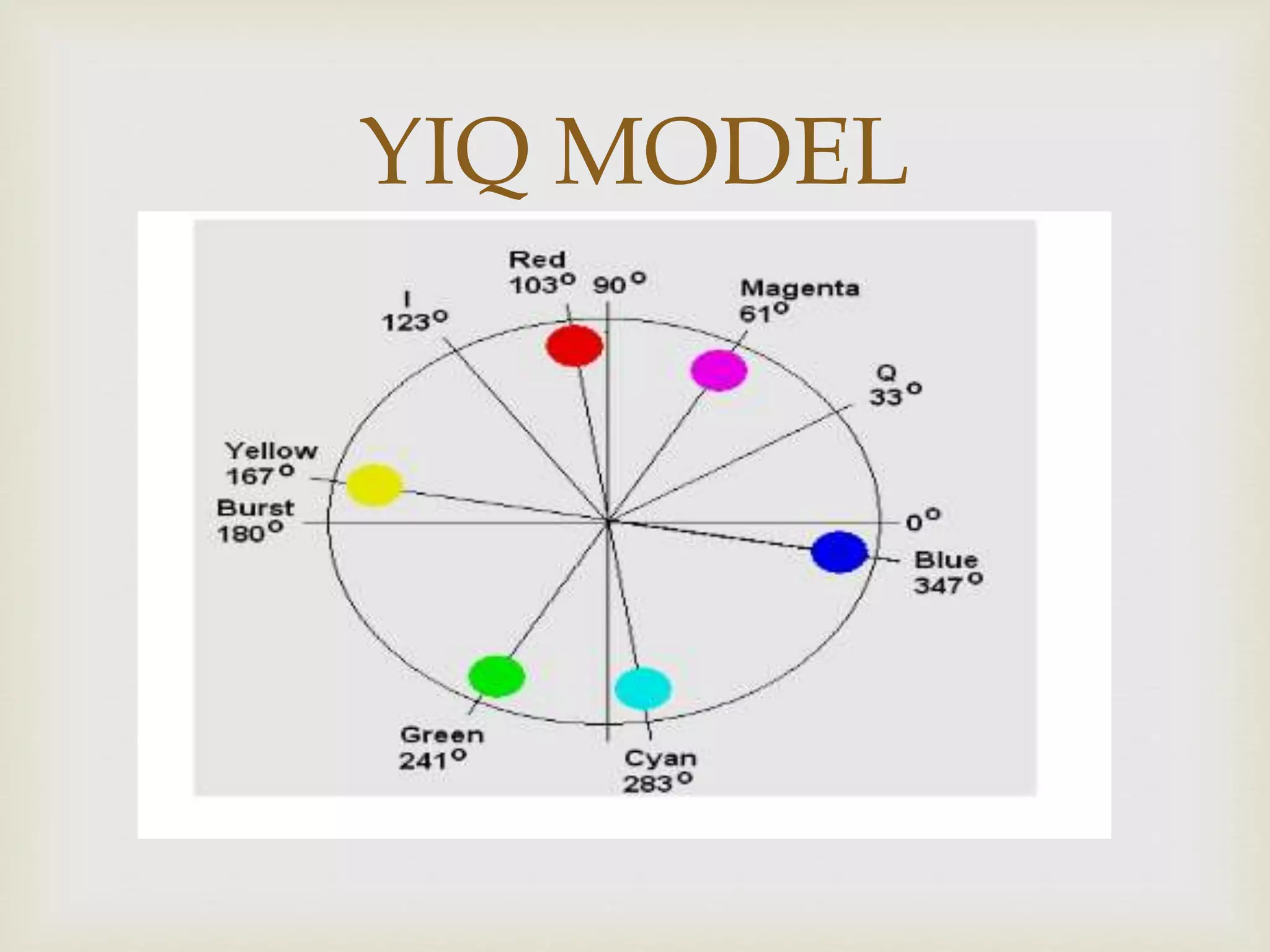
 INPHASE =RED-YELLOW
 QUADRATURE =BLUE-YELLOW
 It is based on the CIE and XYZ color model.
 Broadcast NTSC limits I to 1.3 MHz and Q to
0.4 MHz . I and Q are frequency interleaved into the
4 MHz Y signal, which keeps the bandwidth of the
overall signal down to 4.2 MHz .

DEGREE OF YIQ
COLORS

The YIQ representation is sometimes
employed in color image processing
transformations.
For example, applying a histogram
equalization directly to the channels in an
RGB image would alter the color balance of
the Image.
Histogram equalization -method in image
processing for contrast adjustment.
IMAGE PROCESSING


NTSC encoding of YIQ:
4 MHz = Y (eye most sensitive to
luminance)
1.5 MHz = I (small images need 1 color
dimension)
0.6 MHz = Q
ENCODING

The primary goals of the system were to
provide a signal that could be directly
displayed by black and white TVs, while also
providing easy coding and decoding of RGB
signals.
GOAL OF YIQ

TAXONOMY OF COLORS

 The color range is restricted in the color TV images
because of the information compression required for
the displayed image.
 Due to the limitation of the YIQ standard the image
displayed in computer cannot be recreate in TV
screen.
DISADVANTAGES
YIQ by R.Chinthamani.pptx

YIQ by R.Chinthamani.pptx

  • 1.
    Submitted By Mrs.R.CHINTHAMANI, ASSISTANT PROFESSOR, Departmentof Computer Science E.M.G.Yadava Women’s College, Madurai-14.
  • 2.
      A colormodel is a specification of a 3D color co- ordinate system and a visible subset in co-ordinate system within all colors in particular color range. Four types are,  RGB,  CMY,  YIQ,  CMYK. COLOR MODEL
  • 3.
      YIQ modelis used for NTSC(NATIONAL TELEVISION SYSTEM COMMITTEE)broadcast.  This model was designed to separate chrominance( I and Q ) from luminance Y.  This was the requirements in early televisions when black and white set still were expected to pick up and display what were originally color pictures DEFINITION
  • 4.
  • 5.
     Y - luminance I- in phase Q - quadrature YIQ STANDS FOR:
  • 6.
      The Y–channels contains the luminous information(sufficient for black and white TV) while the I and Q channels carried the color information.  The color TV would take three channels Y,I and Q and map the information back to R,G and B levels for display on a screen. YIQ MODEL
  • 7.
      The morebandwidth can be assigned to Y – component because the human visual system is more sensitive to changes in luminance than to changes in hue or saturation.  The YIQ is the recoding of RGB color model.  It is used in television broadcasting using one composite signal. ADVANTAGE
  • 8.
      The abilityof separation gray scale information from color data property enables to represent the same signal for both color and (black and white) sets, using luminance component .  Used in video system for determining color components because of its human visual system characteristic.  The component Y might represent noise in processing, transferring, and storage at shallow level.
  • 9.
      INPHASE =RED-YELLOW QUADRATURE =BLUE-YELLOW  It is based on the CIE and XYZ color model.  Broadcast NTSC limits I to 1.3 MHz and Q to 0.4 MHz . I and Q are frequency interleaved into the 4 MHz Y signal, which keeps the bandwidth of the overall signal down to 4.2 MHz .
  • 10.
  • 11.
     The YIQ representationis sometimes employed in color image processing transformations. For example, applying a histogram equalization directly to the channels in an RGB image would alter the color balance of the Image. Histogram equalization -method in image processing for contrast adjustment. IMAGE PROCESSING
  • 12.
  • 13.
     NTSC encoding ofYIQ: 4 MHz = Y (eye most sensitive to luminance) 1.5 MHz = I (small images need 1 color dimension) 0.6 MHz = Q ENCODING
  • 14.
     The primary goalsof the system were to provide a signal that could be directly displayed by black and white TVs, while also providing easy coding and decoding of RGB signals. GOAL OF YIQ
  • 15.
  • 16.
      The colorrange is restricted in the color TV images because of the information compression required for the displayed image.  Due to the limitation of the YIQ standard the image displayed in computer cannot be recreate in TV screen. DISADVANTAGES