SPELLING STRATEGIES Year 7
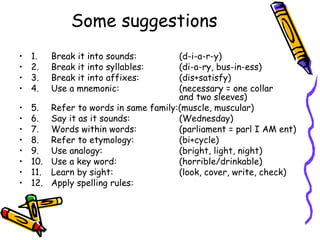
Some suggestions 1. Break it into sounds:  (d-i-a-r-y) 2. Break it into syllables: (di-a-ry, bus-in-ess) 3. Break it into affixes: (dis+satisfy) 4. Use a mnemonic: (necessary = one collar  and two sleeves) 5. Refer to words in same family:(muscle, muscular) 6. Say it as it sounds: (Wednesday) 7. Words within words: (parliament = parl I AM ent) 8. Refer to etymology: (bi+cycle) 9. Use analogy: (bright, light, night) 10. Use a key word: (horrible/drinkable) 11. Learn by sight: (look, cover, write, check) 12. Apply spelling rules:
COMMON SPELLING RULES
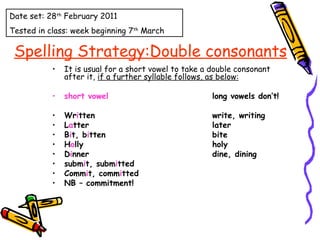
Spelling Strategy:Double consonants It is usual for a short vowel to take a double consonant after it,  if a further syllable follows, as below: short vowel long vowels don’t!  Wr i tten write, writing L a tter later B i t, b i tten bite H o lly holy D i nner dine, dining subm i t, subm i tted Comm i t, comm i tted  NB – commitment! Date set: 28 th  February 2011 Tested in class: week beginning 7 th  March
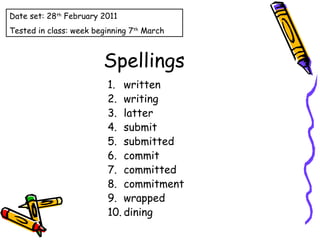
Spellings written writing latter submit submitted commit committed commitment wrapped dining Date set: 28 th  February 2011 Tested in class: week beginning 7 th  March
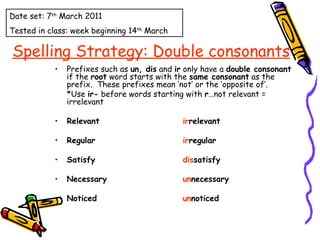
Spelling Strategy: Double consonants Prefixes such as  un, dis  and  ir  only have a  double consonant  if the  root  word starts with the  same consonant  as the prefix.  These prefixes mean ‘not’ or the ‘opposite of’. *Use  ir-  before words starting with  r …not relevant = irrelevant Relevant ir relevant Regular ir regular Satisfy dis satisfy Necessary un necessary Noticed un noticed Date set: 7 th  March 2011 Tested in class: week beginning 14 th  March
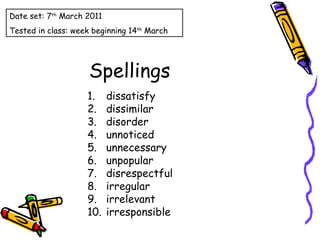
Spellings dissatisfy dissimilar disorder unnoticed unnecessary unpopular disrespectful irregular irrelevant irresponsible Date set: 7 th  March 2011 Tested in class: week beginning 14 th  March
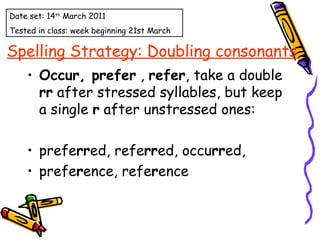
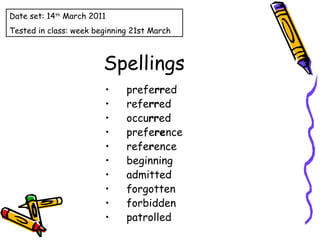
Spelling Strategy: Doubling consonants Occur, prefer  ,  refer , take a double  rr  after stressed syllables, but keep a single  r  after unstressed ones: prefe rr ed, refe rr ed, occu rr ed,  prefe r ence, refe r ence Date set: 14 th  March 2011 Tested in class: week beginning 21st March
Spellings prefe rr ed  refe rr ed  occu rr ed prefe re nce  refe r ence beginning admitted forgotten forbidden patrolled Date set: 14 th  March 2011 Tested in class: week beginning 21st March
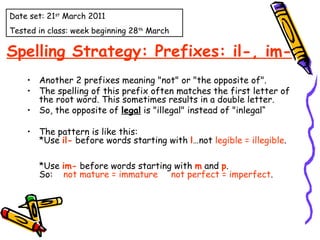
Spelling Strategy: Prefixes: il-, im- Another 2 prefixes meaning "not" or "the opposite of". The spelling of this prefix often matches the first letter of the root word. This sometimes results in a double letter. So, the opposite of  legal  is "illegal" instead of "inlegal“ The pattern is like this:  *Use  il-  before words starting with  l …not  legible = illegible .      *Use  im-  before words starting with  m  and  p .  So:     not mature = immature       not perfect = imperfect . Date set: 21 st  March 2011 Tested in class: week beginning 28 th  March
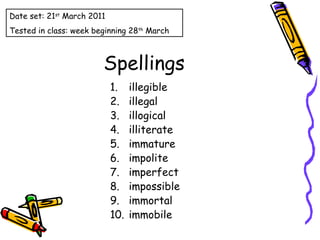
Spellings illegible illegal illogical illiterate immature impolite imperfect impossible immortal immobile Date set: 21 st  March 2011 Tested in class: week beginning 28 th  March
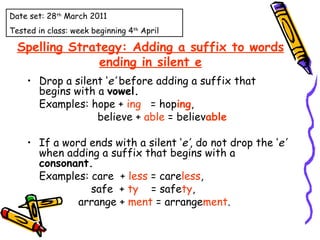
Spelling Strategy: Adding a suffix to words ending in silent e Drop a silent ‘ e’  before adding a suffix that begins with a  vowel.  Examples: hope +  ing   = hop ing ,    believe +  able  = believ able If a word ends with a silent ‘ e’ , do not drop the ‘ e’  when adding a suffix that begins with a  consonant.  Examples: care  +  less  = care less ,  safe  +  ty   = safe ty ,    arrange +  ment  = arrange ment .  Date set: 28 th  March 2011 Tested in class: week beginning 4 th  April
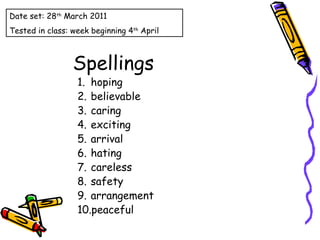
Spellings hoping believable caring exciting arrival hating careless safety arrangement peaceful Date set: 28 th  March 2011 Tested in class: week beginning 4 th  April
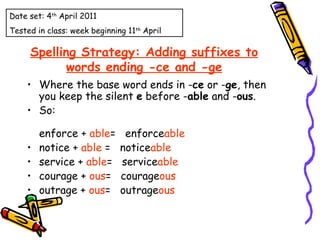
Spelling Strategy: Adding suffixes to words ending -ce and -ge Where the base word ends in - ce  or - ge , then  you keep the silent  e  before - able  and - ous .     So: enforce +  able =   enforce able notice +  able  =   notice able service +  able =   service able courage +  ous =   courage ous outrage +  ous =   outrage ous Date set: 4 th  April 2011 Tested in class: week beginning 11 th  April
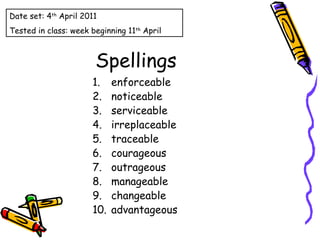
Spellings enforceable noticeable serviceable irreplaceable traceable courageous outrageous manageable changeable advantageous Date set: 4 th  April 2011 Tested in class: week beginning 11 th  April

Year 7 ila spring term 2 spellings

  • 1.
  • 2.
    Some suggestions 1.Break it into sounds: (d-i-a-r-y) 2. Break it into syllables: (di-a-ry, bus-in-ess) 3. Break it into affixes: (dis+satisfy) 4. Use a mnemonic: (necessary = one collar and two sleeves) 5. Refer to words in same family:(muscle, muscular) 6. Say it as it sounds: (Wednesday) 7. Words within words: (parliament = parl I AM ent) 8. Refer to etymology: (bi+cycle) 9. Use analogy: (bright, light, night) 10. Use a key word: (horrible/drinkable) 11. Learn by sight: (look, cover, write, check) 12. Apply spelling rules:
  • 3.
  • 4.
    Spelling Strategy:Double consonantsIt is usual for a short vowel to take a double consonant after it, if a further syllable follows, as below: short vowel long vowels don’t! Wr i tten write, writing L a tter later B i t, b i tten bite H o lly holy D i nner dine, dining subm i t, subm i tted Comm i t, comm i tted NB – commitment! Date set: 28 th February 2011 Tested in class: week beginning 7 th March
  • 5.
    Spellings written writinglatter submit submitted commit committed commitment wrapped dining Date set: 28 th February 2011 Tested in class: week beginning 7 th March
  • 6.
    Spelling Strategy: Doubleconsonants Prefixes such as un, dis and ir only have a double consonant if the root word starts with the same consonant as the prefix. These prefixes mean ‘not’ or the ‘opposite of’. *Use ir- before words starting with r …not relevant = irrelevant Relevant ir relevant Regular ir regular Satisfy dis satisfy Necessary un necessary Noticed un noticed Date set: 7 th March 2011 Tested in class: week beginning 14 th March
  • 7.
    Spellings dissatisfy dissimilardisorder unnoticed unnecessary unpopular disrespectful irregular irrelevant irresponsible Date set: 7 th March 2011 Tested in class: week beginning 14 th March
  • 8.
    Spelling Strategy: Doublingconsonants Occur, prefer , refer , take a double rr after stressed syllables, but keep a single r after unstressed ones: prefe rr ed, refe rr ed, occu rr ed, prefe r ence, refe r ence Date set: 14 th March 2011 Tested in class: week beginning 21st March
  • 9.
    Spellings prefe rred refe rr ed occu rr ed prefe re nce refe r ence beginning admitted forgotten forbidden patrolled Date set: 14 th March 2011 Tested in class: week beginning 21st March
  • 10.
    Spelling Strategy: Prefixes:il-, im- Another 2 prefixes meaning "not" or "the opposite of". The spelling of this prefix often matches the first letter of the root word. This sometimes results in a double letter. So, the opposite of legal is "illegal" instead of "inlegal“ The pattern is like this: *Use il- before words starting with l …not legible = illegible .    *Use im- before words starting with m and p .  So:    not mature = immature      not perfect = imperfect . Date set: 21 st March 2011 Tested in class: week beginning 28 th March
  • 11.
    Spellings illegible illegalillogical illiterate immature impolite imperfect impossible immortal immobile Date set: 21 st March 2011 Tested in class: week beginning 28 th March
  • 12.
    Spelling Strategy: Addinga suffix to words ending in silent e Drop a silent ‘ e’ before adding a suffix that begins with a vowel. Examples: hope + ing = hop ing , believe + able = believ able If a word ends with a silent ‘ e’ , do not drop the ‘ e’ when adding a suffix that begins with a consonant.  Examples: care + less = care less , safe + ty = safe ty , arrange + ment = arrange ment .  Date set: 28 th March 2011 Tested in class: week beginning 4 th April
  • 13.
    Spellings hoping believablecaring exciting arrival hating careless safety arrangement peaceful Date set: 28 th March 2011 Tested in class: week beginning 4 th April
  • 14.
    Spelling Strategy: Addingsuffixes to words ending -ce and -ge Where the base word ends in - ce or - ge , then you keep the silent e before - able and - ous .    So: enforce + able =   enforce able notice + able =   notice able service + able =   service able courage + ous =   courage ous outrage + ous =   outrage ous Date set: 4 th April 2011 Tested in class: week beginning 11 th April
  • 15.
    Spellings enforceable noticeableserviceable irreplaceable traceable courageous outrageous manageable changeable advantageous Date set: 4 th April 2011 Tested in class: week beginning 11 th April