I have enough time to make a real difference I CAN do it I WILL do it
THERE IS NO SUCH THING AS A BAD MEMORY
How often should  I revise?
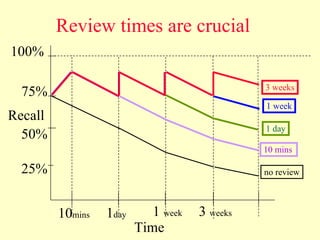
10 mins 1 day 1  week 3  weeks Time Recall 100% 75% 50% 25% Review times are crucial no review 10 mins 1 day 1 week 3 weeks
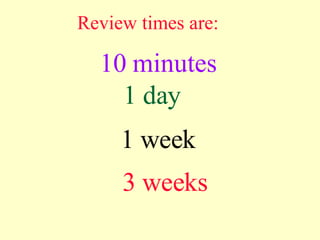
Review times are: 10 minutes 1 day 1 week 3 weeks
The most important points about  revision are that it must: OCCUR OFTEN BE REPEATED AT THE  RIGHT INTERVALS
Methods of revision Actually  DO  something  ACTIVELY
Eight methods: Find the one(s) that work for you
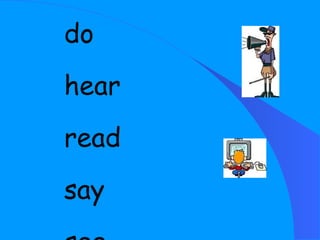
do hear read say see
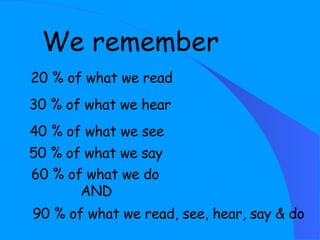
We remember 20 % of what we read 30 % of what we hear 40 % of what we see 50 % of what we say 60 % of what we do AND 90 % of what we read, see, hear, say & do
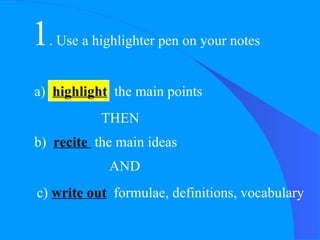
1 . Use a highlighter pen on your notes THEN b)  recite  the main ideas AND c)  write out   formulae, definitions, vocabulary a)  highlight   the main points
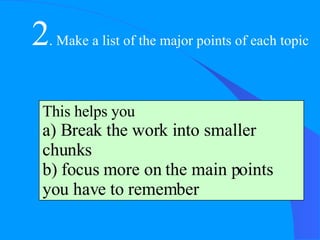
2 . Make a list of the major points of each topic This helps you a) Break the work into smaller chunks b) focus more on the main points you have to remember
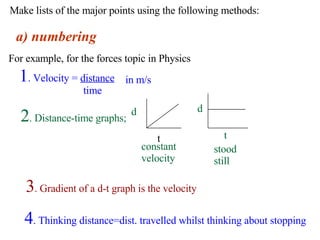
Make lists of the major points using the following methods: a) numbering For example, for the forces topic in Physics 3 . Gradient of a d-t graph is the velocity 4 . Thinking distance=dist. travelled whilst thinking about stopping 1 . Velocity =  distance time in m/s 2 . Distance-time graphs; t d constant velocity stood  still t d
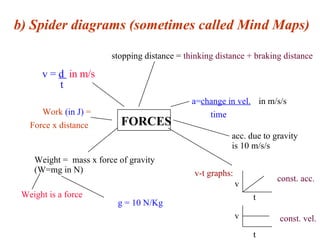
b) Spider diagrams (sometimes called Mind Maps) FORCES stopping distance =  thinking distance + braking distance a= change in vel. time in m/s/s acc. due to gravity is 10 m/s/s v-t graphs: t v const. acc. v t const. vel. v =  d  in m/s t Work  (in J)  = Force x distance Weight =  mass x force of gravity (W=mg in N) Weight is a force g = 10 N/Kg
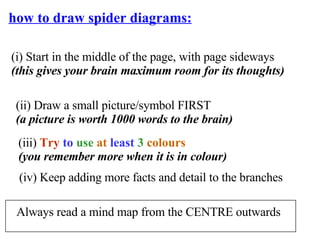
how to draw spider diagrams: (i) Start in the middle of the page, with page sideways (this gives your brain maximum room for its thoughts) (ii) Draw a small picture/symbol FIRST (a picture is worth 1000 words to the brain) (iii)  Try   to   use   at   least   3   colours (you remember more when it is in colour) (iv) Keep adding more facts and detail to the branches Always read a mind map from the CENTRE outwards
you should use mind maps for: Taking notes from books Brainstorming   (when you are recalling info.) Planning essays   ( then number the branches so you know the order you will use them in) Solving problems   ( it helps you recall, when your   mind goes blank)
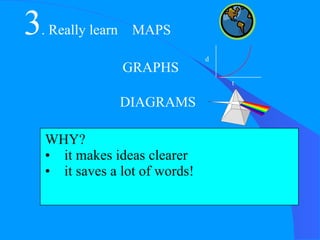
3 . Really learn  MAPS GRAPHS t d DIAGRAMS WHY? it makes ideas clearer it saves a lot of words!
The most important points about   revision are that it must: OCCUR OFTEN BE REPEATED AT THE  RIGHT INTERVALS
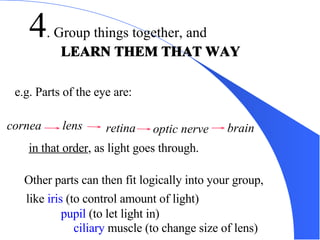
4 . Group things together, and  LEARN THEM THAT WAY LEARN THEM THAT WAY e.g. Parts of the eye are: in that order , as light goes through. Other parts can then fit logically into your group, like  iris  (to control amount of light) pupil  (to let light in) ciliary  muscle (to change size of lens) cornea lens retina optic nerve brain
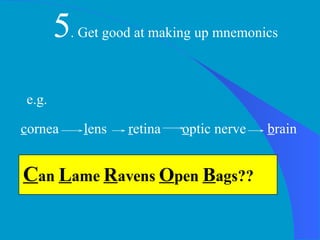
5 . Get good at making up mnemonics e.g.  c ornea  l ens  r etina  o ptic nerve  b rain C an  L ame  R avens  O pen  B ags??
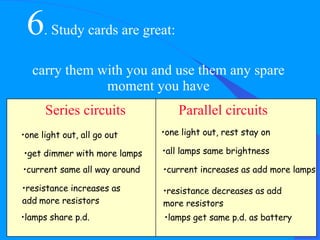
6 . Study cards are great: carry them with you and use them any spare moment you have Series circuits Parallel circuits one light out, rest stay on all lamps same brightness current increases as add more lamps resistance decreases as add more resistors one light out, all go out get dimmer with more lamps current same all way around resistance increases as add   more resistors lamps share p.d. lamps get same p.d. as battery
You can put questions on the front of study cards, with answers on the back!
The most important points about   revision are that it must: OCCUR OFTEN BE REPEATED AT THE  RIGHT INTERVALS
THERE IS NO SUCH THING AS A BAD MEMORY
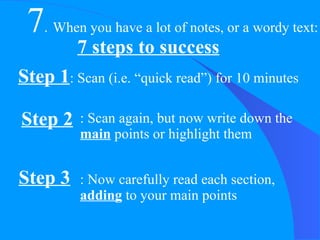
7 . When you have a lot of notes, or a wordy text: 7 steps to success Step 1 : Scan (i.e. “quick read”) for 10 minutes Step 2 : Scan again, but now write down the  main  points or highlight them Step 3 : Now carefully read each section,  adding  to your main points
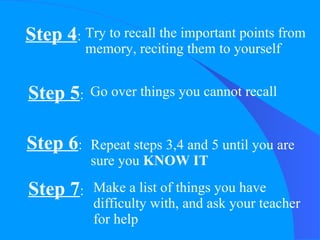
Step 4 : Try to recall the important points from memory, reciting them to yourself Step 5 : Go over things you cannot recall Step 6 : Repeat steps 3,4 and 5 until you are sure you  KNOW IT Step 7 : Make a list of things you have difficulty with, and ask your teacher for help
IF YOU CANNOT RECALL THE IMPORTANT POINTS  YOU HAVE NOT   LEARNED THE   MATERIAL
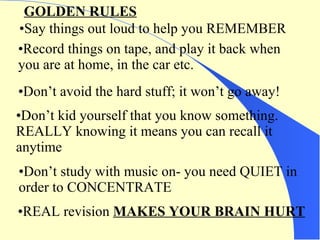
Say things out loud to help you REMEMBER Record things on tape, and play it back when  you are at home, in the car etc. Don’t avoid the hard stuff; it won’t go away! Don’t kid yourself that you know something.  REALLY knowing it means you can recall it anytime GOLDEN RULES Don’t study with music on- you need QUIET in order to CONCENTRATE REAL revision  MAKES YOUR BRAIN HURT
THERE IS NO SUCH THING AS A BAD MEMORY
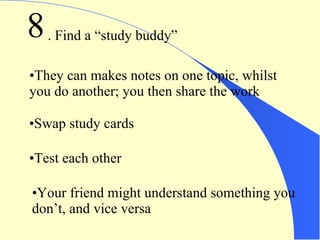
8 . Find a “study buddy” They can makes notes on one topic, whilst you do another; you then share the work Swap study cards Test each other Your friend might understand something you don’t, and vice versa
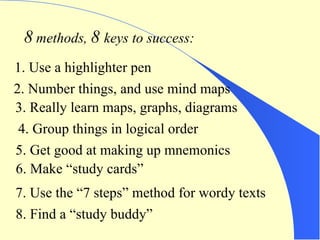
8  methods,  8  keys to success: 1. Use a highlighter pen 2. Number things, and use mind maps 3. Really learn maps, graphs, diagrams 4. Group things in logical order 5. Get good at making up mnemonics 6. Make “study cards” 7. Use the “7 steps” method for wordy texts 8. Find a “study buddy”
I have enough time to make a real difference I CAN do it I WILL do it

Study Skills

  • 1.
    I have enoughtime to make a real difference I CAN do it I WILL do it
  • 2.
    THERE IS NOSUCH THING AS A BAD MEMORY
  • 3.
    How often should I revise?
  • 4.
    10 mins 1day 1 week 3 weeks Time Recall 100% 75% 50% 25% Review times are crucial no review 10 mins 1 day 1 week 3 weeks
  • 5.
    Review times are:10 minutes 1 day 1 week 3 weeks
  • 6.
    The most importantpoints about revision are that it must: OCCUR OFTEN BE REPEATED AT THE RIGHT INTERVALS
  • 7.
    Methods of revisionActually DO something ACTIVELY
  • 8.
    Eight methods: Findthe one(s) that work for you
  • 9.
    do hear readsay see
  • 10.
    We remember 20% of what we read 30 % of what we hear 40 % of what we see 50 % of what we say 60 % of what we do AND 90 % of what we read, see, hear, say & do
  • 11.
    1 . Usea highlighter pen on your notes THEN b) recite the main ideas AND c) write out formulae, definitions, vocabulary a) highlight the main points
  • 12.
    2 . Makea list of the major points of each topic This helps you a) Break the work into smaller chunks b) focus more on the main points you have to remember
  • 13.
    Make lists ofthe major points using the following methods: a) numbering For example, for the forces topic in Physics 3 . Gradient of a d-t graph is the velocity 4 . Thinking distance=dist. travelled whilst thinking about stopping 1 . Velocity = distance time in m/s 2 . Distance-time graphs; t d constant velocity stood still t d
  • 14.
    b) Spider diagrams(sometimes called Mind Maps) FORCES stopping distance = thinking distance + braking distance a= change in vel. time in m/s/s acc. due to gravity is 10 m/s/s v-t graphs: t v const. acc. v t const. vel. v = d in m/s t Work (in J) = Force x distance Weight = mass x force of gravity (W=mg in N) Weight is a force g = 10 N/Kg
  • 15.
    how to drawspider diagrams: (i) Start in the middle of the page, with page sideways (this gives your brain maximum room for its thoughts) (ii) Draw a small picture/symbol FIRST (a picture is worth 1000 words to the brain) (iii) Try to use at least 3 colours (you remember more when it is in colour) (iv) Keep adding more facts and detail to the branches Always read a mind map from the CENTRE outwards
  • 16.
    you should usemind maps for: Taking notes from books Brainstorming (when you are recalling info.) Planning essays ( then number the branches so you know the order you will use them in) Solving problems ( it helps you recall, when your mind goes blank)
  • 17.
    3 . Reallylearn MAPS GRAPHS t d DIAGRAMS WHY? it makes ideas clearer it saves a lot of words!
  • 18.
    The most importantpoints about revision are that it must: OCCUR OFTEN BE REPEATED AT THE RIGHT INTERVALS
  • 19.
    4 . Groupthings together, and LEARN THEM THAT WAY LEARN THEM THAT WAY e.g. Parts of the eye are: in that order , as light goes through. Other parts can then fit logically into your group, like iris (to control amount of light) pupil (to let light in) ciliary muscle (to change size of lens) cornea lens retina optic nerve brain
  • 20.
    5 . Getgood at making up mnemonics e.g. c ornea l ens r etina o ptic nerve b rain C an L ame R avens O pen B ags??
  • 21.
    6 . Studycards are great: carry them with you and use them any spare moment you have Series circuits Parallel circuits one light out, rest stay on all lamps same brightness current increases as add more lamps resistance decreases as add more resistors one light out, all go out get dimmer with more lamps current same all way around resistance increases as add more resistors lamps share p.d. lamps get same p.d. as battery
  • 22.
    You can putquestions on the front of study cards, with answers on the back!
  • 23.
    The most importantpoints about revision are that it must: OCCUR OFTEN BE REPEATED AT THE RIGHT INTERVALS
  • 24.
    THERE IS NOSUCH THING AS A BAD MEMORY
  • 25.
    7 . Whenyou have a lot of notes, or a wordy text: 7 steps to success Step 1 : Scan (i.e. “quick read”) for 10 minutes Step 2 : Scan again, but now write down the main points or highlight them Step 3 : Now carefully read each section, adding to your main points
  • 26.
    Step 4 :Try to recall the important points from memory, reciting them to yourself Step 5 : Go over things you cannot recall Step 6 : Repeat steps 3,4 and 5 until you are sure you KNOW IT Step 7 : Make a list of things you have difficulty with, and ask your teacher for help
  • 27.
    IF YOU CANNOTRECALL THE IMPORTANT POINTS YOU HAVE NOT LEARNED THE MATERIAL
  • 28.
    Say things outloud to help you REMEMBER Record things on tape, and play it back when you are at home, in the car etc. Don’t avoid the hard stuff; it won’t go away! Don’t kid yourself that you know something. REALLY knowing it means you can recall it anytime GOLDEN RULES Don’t study with music on- you need QUIET in order to CONCENTRATE REAL revision MAKES YOUR BRAIN HURT
  • 29.
    THERE IS NOSUCH THING AS A BAD MEMORY
  • 30.
    8 . Finda “study buddy” They can makes notes on one topic, whilst you do another; you then share the work Swap study cards Test each other Your friend might understand something you don’t, and vice versa
  • 31.
    8 methods, 8 keys to success: 1. Use a highlighter pen 2. Number things, and use mind maps 3. Really learn maps, graphs, diagrams 4. Group things in logical order 5. Get good at making up mnemonics 6. Make “study cards” 7. Use the “7 steps” method for wordy texts 8. Find a “study buddy”
  • 32.
    I have enoughtime to make a real difference I CAN do it I WILL do it