RHS Level 2 Certificate Year 2 Week 21 – Review of Garden Chemicals and modes of action; Risk Assessment; Botanical names and Weed identification.
Learning Objectives By the end of the session, learners will be able to: state the principle modes of action for pesticides and fungicides – contact and systemic – and describe each state the principle modes of action for herbicides – contact, systemic, selective and residual – and describe each identify the active ingredients of examples of contact, residual and systemic herbicides identify the active ingredients of an example of a systemic pesticide and a systemic fungicide state the five steps of a simple risk assessment and apply them to a scenario State the life cycle types of weeds and name two of each of perennial, annual and ephemeral weeds Botanically name and identify four common weeds from specimens
Garden Chemicals – a quick reminder of types Pesticides – toxic to pests, that is insects, molluscs or mites that damage or destroy cultivated plants. Fungicides – toxic to or preventative of invasion by fungal diseases that damage or destroy cultivated plants. Herbicides – kill or prevent the growth of weeds or unwanted vegetation.
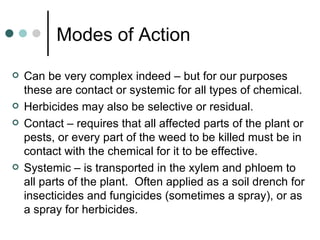
Modes of Action Can be very complex indeed – but for our purposes these are contact or systemic for all types of chemical. Herbicides may also be selective or residual. Contact – requires that all affected parts of the plant or pests, or every part of the weed to be killed must be in contact with the chemical for it to be effective. Systemic – is transported in the xylem and phloem to all parts of the plant.  Often applied as a soil drench for insecticides and fungicides (sometimes a spray), or as a spray for herbicides.
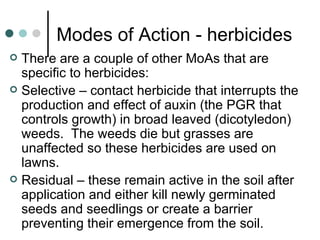
Modes of Action - herbicides There are a couple of other MoAs that are specific to herbicides: Selective – contact herbicide that interrupts the production and effect of auxin (the PGR that controls growth) in broad leaved (dicotyledon) weeds.  The weeds die but grasses are unaffected so these herbicides are used on lawns. Residual – these remain active in the soil after application and either kill newly germinated seeds and seedlings or create a barrier preventing their emergence from the soil.
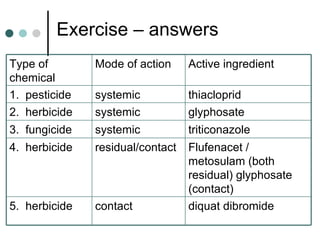
Exercise – answers  diquat dibromide contact 5.  herbicide Flufenacet / metosulam (both residual) glyphosate (contact)  residual/contact 4.  herbicide  triticonazole systemic 3.  fungicide glyphosate systemic 2.  herbicide thiacloprid systemic 1.  pesticide Active ingredient Mode of action Type of chemical
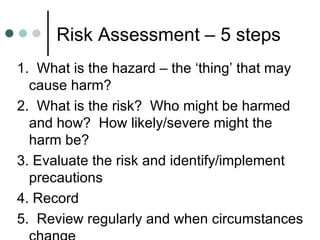
Risk Assessment – 5 steps 1.  What is the hazard – the ‘thing’ that may cause harm? 2.  What is the risk?  Who might be harmed and how?  How likely/severe might the harm be? 3. Evaluate the risk and identify/implement precautions 4. Record  5.  Review regularly and when circumstances change
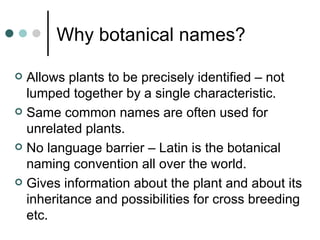
Why botanical names? Allows plants to be precisely identified – not lumped together by a single characteristic. Same common names are often used for unrelated plants. No language barrier – Latin is the botanical naming convention all over the world. Gives information about the plant and about its inheritance and possibilities for cross breeding etc.
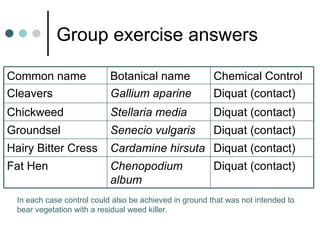
Group exercise answers  In each case control could also be achieved in ground that was not intended to bear vegetation with a residual weed killer. Diquat (contact) Chenopodium album Fat Hen Diquat (contact) Cardamine hirsuta Hairy Bitter Cress Diquat (contact) Senecio vulgaris Groundsel Diquat (contact) Stellaria media Chickweed  Diquat (contact) Gallium aparine   Cleavers Chemical Control Botanical name Common name
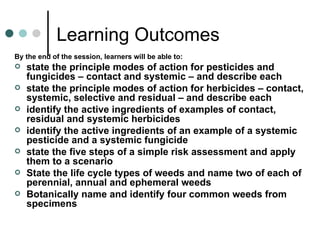
Learning Outcomes By the end of the session, learners will be able to: state the principle modes of action for pesticides and fungicides – contact and systemic – and describe each state the principle modes of action for herbicides – contact, systemic, selective and residual – and describe each identify the active ingredients of examples of contact, residual and systemic herbicides identify the active ingredients of an example of a systemic pesticide and a systemic fungicide state the five steps of a simple risk assessment and apply them to a scenario State the life cycle types of weeds and name two of each of perennial, annual and ephemeral weeds Botanically name and identify four common weeds from specimens

Year 2 week 21 presentation

  • 1.
    RHS Level 2Certificate Year 2 Week 21 – Review of Garden Chemicals and modes of action; Risk Assessment; Botanical names and Weed identification.
  • 2.
    Learning Objectives Bythe end of the session, learners will be able to: state the principle modes of action for pesticides and fungicides – contact and systemic – and describe each state the principle modes of action for herbicides – contact, systemic, selective and residual – and describe each identify the active ingredients of examples of contact, residual and systemic herbicides identify the active ingredients of an example of a systemic pesticide and a systemic fungicide state the five steps of a simple risk assessment and apply them to a scenario State the life cycle types of weeds and name two of each of perennial, annual and ephemeral weeds Botanically name and identify four common weeds from specimens
  • 3.
    Garden Chemicals –a quick reminder of types Pesticides – toxic to pests, that is insects, molluscs or mites that damage or destroy cultivated plants. Fungicides – toxic to or preventative of invasion by fungal diseases that damage or destroy cultivated plants. Herbicides – kill or prevent the growth of weeds or unwanted vegetation.
  • 4.
    Modes of ActionCan be very complex indeed – but for our purposes these are contact or systemic for all types of chemical. Herbicides may also be selective or residual. Contact – requires that all affected parts of the plant or pests, or every part of the weed to be killed must be in contact with the chemical for it to be effective. Systemic – is transported in the xylem and phloem to all parts of the plant. Often applied as a soil drench for insecticides and fungicides (sometimes a spray), or as a spray for herbicides.
  • 5.
    Modes of Action- herbicides There are a couple of other MoAs that are specific to herbicides: Selective – contact herbicide that interrupts the production and effect of auxin (the PGR that controls growth) in broad leaved (dicotyledon) weeds. The weeds die but grasses are unaffected so these herbicides are used on lawns. Residual – these remain active in the soil after application and either kill newly germinated seeds and seedlings or create a barrier preventing their emergence from the soil.
  • 6.
    Exercise – answers diquat dibromide contact 5. herbicide Flufenacet / metosulam (both residual) glyphosate (contact) residual/contact 4. herbicide triticonazole systemic 3. fungicide glyphosate systemic 2. herbicide thiacloprid systemic 1. pesticide Active ingredient Mode of action Type of chemical
  • 7.
    Risk Assessment –5 steps 1. What is the hazard – the ‘thing’ that may cause harm? 2. What is the risk? Who might be harmed and how? How likely/severe might the harm be? 3. Evaluate the risk and identify/implement precautions 4. Record 5. Review regularly and when circumstances change
  • 8.
    Why botanical names?Allows plants to be precisely identified – not lumped together by a single characteristic. Same common names are often used for unrelated plants. No language barrier – Latin is the botanical naming convention all over the world. Gives information about the plant and about its inheritance and possibilities for cross breeding etc.
  • 9.
    Group exercise answers In each case control could also be achieved in ground that was not intended to bear vegetation with a residual weed killer. Diquat (contact) Chenopodium album Fat Hen Diquat (contact) Cardamine hirsuta Hairy Bitter Cress Diquat (contact) Senecio vulgaris Groundsel Diquat (contact) Stellaria media Chickweed Diquat (contact) Gallium aparine Cleavers Chemical Control Botanical name Common name
  • 10.
    Learning Outcomes Bythe end of the session, learners will be able to: state the principle modes of action for pesticides and fungicides – contact and systemic – and describe each state the principle modes of action for herbicides – contact, systemic, selective and residual – and describe each identify the active ingredients of examples of contact, residual and systemic herbicides identify the active ingredients of an example of a systemic pesticide and a systemic fungicide state the five steps of a simple risk assessment and apply them to a scenario State the life cycle types of weeds and name two of each of perennial, annual and ephemeral weeds Botanically name and identify four common weeds from specimens