Statewide Integrated Pest Management Program August 2013 
PEST NOTES Publication 74164 
Integrated Pest Management for Home Gardeners and Landscape Professionals 
Eye Gnats 
Eye gnats, including Hippelates and Liohippelates species, can be severe nuisance pests that potentially transmit disease. Liohippelates collusor is the most abundant species found naturally in California, and it occurs in parts of the southwestern United States, northern Mexico, and other tropical and subtropical regions of the world. In Southern California, it’s found in many desert areas but isn’t a severe pest, except when occasional heavy rains result in large increases in the insect’s population. 
Eye gnats have become more of a problem for humans and our domesticated animals as a result of increased agricultural activities, particularly those activities where plant waste is tilled into the soil prior to replanting of fields. Eye gnats dispersing in high numbers from crop production fields into nearby residential communities, schools, parks, and golf courses may cause a nuisance. 
IDENTIFICATION 
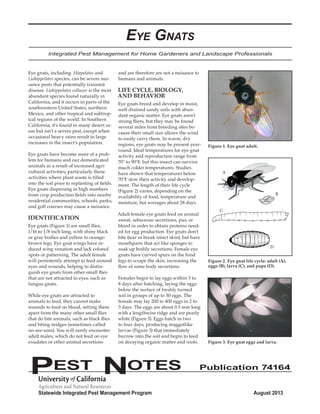
Eye gnats (Figure 1) are small flies, 1/16 to 1/8 inch long, with shiny black or gray bodies and yellow to orange- brown legs. Eye gnat wings have reduced wing venation and lack colored spots or patterning. The adult female will persistently attempt to feed around eyes and wounds, helping to distinguish eye gnats from other small flies that are not attracted to eyes, such as fungus gnats. 
While eye gnats are attracted to animals to feed, they cannot make wounds to feed on blood, setting them apart from the many other small flies that do bite animals, such as black flies and biting midges (sometimes called no-see-ums). You will rarely encounter adult males, which do not feed on eye exudates or other animal secretions and are therefore are not a nuisance to humans and animals. 
LIFE CYCLE, BIOLOGY, 
AND BEHAVIOR 
Eye gnats breed and develop in moist, well-drained sandy soils with abundant organic matter. Eye gnats aren’t strong fliers, but they may be found several miles from breeding sites because their small size allows the wind to easily carry them. In warm, dry regions, eye gnats may be present year- round. Ideal temperatures for eye gnat activity and reproduction range from 70° to 90°F, but this insect can survive much colder temperatures. Studies have shown that temperatures below 70°F slow their activity and development. The length of their life cycle (Figure 2) varies, depending on the availability of food, temperature and moisture, but averages about 28 days. 
Adult female eye gnats feed on animal sweat, sebaceous secretions, pus, or blood in order to obtain proteins needed for egg production. Eye gnats don’t bite (tear or break intact skin), but have mouthparts that act like sponges to soak up bodily secretions. Female eye gnats have curved spurs on the hind legs to scrape the skin, increasing the flow of some body secretions. 
Females begin to lay eggs within 5 to 8 days after hatching, laying the eggs below the surface of freshly turned soil in groups of up to 50 eggs. The female may lay 200 to 400 eggs in 2 to 3 days. The eggs are about 0.5 mm long with a lengthwise ridge and are pearly white (Figure 3). Eggs hatch in two to four days, producing maggotlike larvae (Figure 3) that immediately burrow into the soil and begin to feed on decaying organic matter and roots. 
Figure 1. Eye gnat adult. 
Figure 3. Eye gnat eggs and larva. 
Figure 2. Eye gnat life cycle: adult (A), eggs (B), larva (C), and pupa (D).
August 2013 Eye Gnats 
◆ 2 of 3 ◆ 
After 5 to 20 days, the larvae pupate 
(Figure 4) close to the soil surface, 
where they remain for 5 to 10 days 
before emerging as adults. 
PROBLEMS FOR HUMANS 
AND ANIMALS 
The primary importance of the eye gnat 
as a pest results from the female’s feed-ing 
habits. Although they don’t bite or 
pierce the skin, females crawl over the 
skin and feed at the eyes, nose, and 
mouth, or at open wounds. The females 
are very persistent, so brushing them 
away is ineffective. The resulting an-noyance 
can discourage outdoor rec-reation 
and affect the quality of life for 
residents who live near breeding sites. 
Eye gnats can have an economic impact 
by reducing tourism, discouraging de-velopment, 
and reducing worker pro-ductivity. 
Eye gnats also can potentially 
spread organisms that cause diseases. 
MANAGEMENT 
Control of eye gnats requires an all-encompassing 
approach targeting pri-marily 
larval development sites while 
also monitoring and in some cases 
managing adults. Temporary relief 
from eye gnats can be achieved by us-ing 
the same repellents used for other 
nuisance pests such as mosquitoes 
(e.g., products containing the chemical 
DEET or picaridin). The most effec-tive 
control measures are cultural and 
physical, but mass trapping to remove 
large numbers of flies has also been 
used by vector control districts. 
Chemical control of eye gnats has been 
relatively ineffective in agricultural 
settings, due to insecticide resistance 
and the difficulty of reaching larvae 
beneath the soil with pesticide applica-tions. 
If populations of eye gnats are 
very high around the home, applica-tions 
of insecticides to turf, or to the 
surrounding landscape where adult 
eye gnats settle, may be effective in 
temporarily reducing the number of 
adult flies. Although there are benefi-cial 
parasites and predators of larvae 
and pupae, they are not effective in re-ducing 
eye gnat populations, and there 
are no commercially available biologi-cal 
control agents for this pest. 
Cultural and Physical Control 
The most effective control has been cul-tural 
and mechanical control at breed-ing 
sites, often on farms located some 
distance from homes, schools, and rec-reational 
areas where flies are bother-ing 
people. However, homeowners can 
use some cultural and physical meth-ods 
to reduce an eye gnat nuisance. 
For instance, eye gnats are attracted to, 
and reproduce in, fresh organic matter 
turned into the soil. Therefore, reduce 
the incorporation of organic matter into 
your soils and flowerbeds. In addition, 
the soil needs to be moist, so reducing 
the amount of moisture or irrigation, 
especially to the soil surface, will help 
reduce egg laying and larval survival. 
Physical exclusion includes the use of 
insect exclusion screens or netting as a 
barrier or enclosure, which can be used 
as an option if eye gnats become un-manageable. 
Research has shown that 
more than 90% of the eye gnats can be 
excluded from an area using a screen 
fence or barrier that is 8 feet high, be-cause 
eye gnats tend to fly close to the 
ground. 
Trapping 
Trapping can provide some relief from 
eye gnats when coupled with the 
use of repellents. Traps also can help 
determine the presence and relative 
population levels of eye gnats in the 
surrounding environment. An eye gnat 
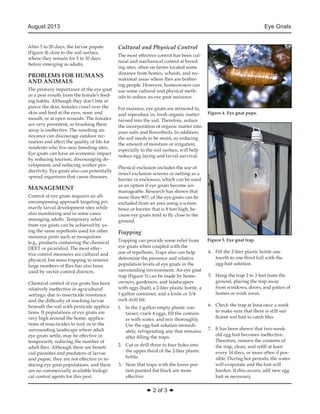
trap (Figure 5) can be made by home-owners, 
gardeners, and landscapers 
with eggs (bait), a 2-liter plastic bottle, a 
1-gallon container, and a knife or 3/4- 
inch drill bit: 
1. In the 1-gallon empty plastic con-tainer, 
crack 4 eggs, fill the contain-er 
with water, and mix thoroughly. 
Use the egg-bait solution immedi-ately, 
refrigerating any that remains 
after filling the traps. 
2. Cut or drill three to four holes into 
the upper third of the 2-liter plastic 
bottle. 
3. Note that traps with the lower por-tion 
painted flat black are more 
effective. 
4. Fill the 2-liter plastic bottle one 
fourth to one third full with the 
egg-bait solution. 
5. Hang the trap 2 to 3 feet from the 
ground, placing the trap away 
from windows, doors, and patios of 
homes or work areas. 
6. Check the trap at least once a week 
to make sure that there is still suf-ficient 
wet bait to catch files. 
7. It has been shown that two-week-old 
egg bait becomes ineffective. 
Therefore, remove the contents of 
the trap, clean, and refill at least 
every 14 days, or more often if pos-sible. 
During hot periods, the water 
will evaporate and the bait will 
harden. If this occurs, add new egg 
bait as necessary. 
Figure 4. Eye gnat pupa. 
Figure 5. Eye gnat trap.
August 2013 Eye Gnats 
◆ 3 of 3 ◆ 
AUTHORS: J. A. Bethke, UC Cooperative 
Extension San Diego Co; B. Vander Mey, 
UC Cooperative Extension San Diego Co; 
and L. M. Bates, UC Cooperative Extension 
San Diego Co 
TECHNICAL EDITOR: M. L. Flint 
EDITOR: M. L. Fayard 
ILLUSTRATIONS: Figs. 1 and 3–5, 
B. Vander Mey; and Fig. 2, R. Krason. 
This and other Pest Notes are available at 
www.ipm.ucanr.edu. 
For more information, contact the University of 
California Cooperative Extension office in your 
county. See your telephone directory for addresses 
and phone numbers, or visit http://ucanr.org/ce.cfm. 
WARNING ON THE USE OF CHEMICALS 
Pesticides are poisonous. Always read and carefully follow all precautions and safety recommendations 
given on the container label. Store all chemicals in the original, labeled containers in a locked cabinet or shed, 
away from food or feeds, and out of the reach of children, unauthorized persons, pets, and livestock. 
Pesticides applied in your home and landscape can move and contaminate creeks, rivers, and oceans. 
Confine chemicals to the property being treated. Avoid drift onto neighboring properties, especially gardens 
containing fruits or vegetables ready to be picked. 
Do not place containers containing pesticide in the trash or pour pesticides down the sink or toilet. Either use 
the pesticide according to the label, or take unwanted pesticides to a Household Hazardous Waste Collection 
site. Contact your county agricultural commissioner for additional information on safe container disposal and 
for the location of the Household Hazardous Waste Collection site nearest you. Dispose of empty containers 
by following label directions. Never reuse or burn the containers or dispose of them in such a manner that 
they may contaminate water supplies or natural waterways. 
ANR NONDISCRIMINATION AND AFFIRMATIVE ACTION POLICY STATEMENT 
The University of California prohibits discrimination or harassment of any person in any of its programs 
or activities. The complete nondiscrimination policy statement can be found at http://ucanr.org/sites/anrstaff/ 
files/107734.doc. Inquiries regarding the university’s equal employment opportunity policies may be directed 
to Linda Marie Manton, Affirmative Action Contact, University of California, Davis, Agriculture and Natural 
Resources, One Shields Avenue, Davis, CA 95616, (530) 752-0495. 
Produced by UC Statewide 
Integrated Pest Management Program 
University of California, Davis, CA 95616 
University of California scientists and other 
qualified professionals have anonymously peer 
reviewed this publication for technical accuracy. 
The ANR Associate Editor for Pest Management 
managed this process. 
To simplify information, trade names of products 
have been used. No endorsement of named products 
is intended, nor is criticism implied of similar products 
that are not mentioned. 
This material is partially based upon work 
supported by the Extension Service, U.S. Department 
of Agriculture, under special project Section 3(d), 
Integrated Pest Management. 
Mulla, M. S., and Axelrod H. 1977. 
Attractancy of putrefied animal and 
plant proteins to the eye gnat Hippelates 
collusor (Diptera: Chloropidae). J. Med. 
Entomol. 133(4-5):497–500. 
Mulla, M. S., and March R. B. 1959. 
Flight range, dispersal patterns and 
population density of the eye gnats, 
Hippelates collusor. Ann. Ent. Soc. Amer. 
52(6):641–6. 
Chemical Control 
Insecticides are rarely, if ever, warrant-ed 
to control these flies around homes. 
However, if you do apply an insecticide 
for eye gnats, consider using pyre-thrins 
or spinosad, which research has 
shown are effective against adult eye 
gnats. Eye gnat adults tend to spend 
most of their time in turf and flower-beds 
when the populations are high, so 
treating these plants may reduce adult 
populations on site. 
Insecticide treatments to kill larval 
populations in the soil are ineffective, 
but drying soils out will reduce egg 
laying and adult emergence. If popula-tions 
of eye gnats on your property are 
very high, call your local county vector 
control district. 
REFERENCES 
Bethke, J. A., B. Vander Mey, and I. 
DeBonis. 2009. Biology and Control of 
the Eye Gnat Liohippelates collusor. 
Final Report: San Diego County Eye 
Gnat Research and Education Project 
2009. County Contract No. 532716. Also 
available online: http://cesandiego. 
ucanr.edu/Floriculture_-_Nursery/ 
San_Diego_County_Eye_Gnat_Re-search_ 
and_Education_Project/. 
Bethke, J. A., B. Vander Mey, and I. 
DeBonis. 2010. Biology and Control of 
the Eye Gnat Liohippelates collusor. 
Final Report: San Diego County Eye 
Gnat Research and Education Proj-ect 
2010. County Contract No. 532716 
Amendment No. 1. Also available 
online: http://cesandiego.ucanr.edu/ 
Floriculture_-_Nursery/San_Diego_ 
County_Eye_Gnat_Research_and_Edu-cation_ 
Project/. 
Burgess, R. W. 1951. The life history and 
breeding habits of the eye gnat, Hippe-lates 
pusio Loew, in the Coachella Valley, 
Riverside County, California. Am. J. 
Hyg. 53:164–177. 
Mulla, M. S. 1962. The breeding niches 
of Hippelates gnats. Ann. Ent. Soc. Amer. 
55(4):389–393.

Eye Gnats Integrated Pest Management

  • 1.
    Statewide Integrated PestManagement Program August 2013 PEST NOTES Publication 74164 Integrated Pest Management for Home Gardeners and Landscape Professionals Eye Gnats Eye gnats, including Hippelates and Liohippelates species, can be severe nuisance pests that potentially transmit disease. Liohippelates collusor is the most abundant species found naturally in California, and it occurs in parts of the southwestern United States, northern Mexico, and other tropical and subtropical regions of the world. In Southern California, it’s found in many desert areas but isn’t a severe pest, except when occasional heavy rains result in large increases in the insect’s population. Eye gnats have become more of a problem for humans and our domesticated animals as a result of increased agricultural activities, particularly those activities where plant waste is tilled into the soil prior to replanting of fields. Eye gnats dispersing in high numbers from crop production fields into nearby residential communities, schools, parks, and golf courses may cause a nuisance. IDENTIFICATION Eye gnats (Figure 1) are small flies, 1/16 to 1/8 inch long, with shiny black or gray bodies and yellow to orange- brown legs. Eye gnat wings have reduced wing venation and lack colored spots or patterning. The adult female will persistently attempt to feed around eyes and wounds, helping to distinguish eye gnats from other small flies that are not attracted to eyes, such as fungus gnats. While eye gnats are attracted to animals to feed, they cannot make wounds to feed on blood, setting them apart from the many other small flies that do bite animals, such as black flies and biting midges (sometimes called no-see-ums). You will rarely encounter adult males, which do not feed on eye exudates or other animal secretions and are therefore are not a nuisance to humans and animals. LIFE CYCLE, BIOLOGY, AND BEHAVIOR Eye gnats breed and develop in moist, well-drained sandy soils with abundant organic matter. Eye gnats aren’t strong fliers, but they may be found several miles from breeding sites because their small size allows the wind to easily carry them. In warm, dry regions, eye gnats may be present year- round. Ideal temperatures for eye gnat activity and reproduction range from 70° to 90°F, but this insect can survive much colder temperatures. Studies have shown that temperatures below 70°F slow their activity and development. The length of their life cycle (Figure 2) varies, depending on the availability of food, temperature and moisture, but averages about 28 days. Adult female eye gnats feed on animal sweat, sebaceous secretions, pus, or blood in order to obtain proteins needed for egg production. Eye gnats don’t bite (tear or break intact skin), but have mouthparts that act like sponges to soak up bodily secretions. Female eye gnats have curved spurs on the hind legs to scrape the skin, increasing the flow of some body secretions. Females begin to lay eggs within 5 to 8 days after hatching, laying the eggs below the surface of freshly turned soil in groups of up to 50 eggs. The female may lay 200 to 400 eggs in 2 to 3 days. The eggs are about 0.5 mm long with a lengthwise ridge and are pearly white (Figure 3). Eggs hatch in two to four days, producing maggotlike larvae (Figure 3) that immediately burrow into the soil and begin to feed on decaying organic matter and roots. Figure 1. Eye gnat adult. Figure 3. Eye gnat eggs and larva. Figure 2. Eye gnat life cycle: adult (A), eggs (B), larva (C), and pupa (D).
  • 2.
    August 2013 EyeGnats ◆ 2 of 3 ◆ After 5 to 20 days, the larvae pupate (Figure 4) close to the soil surface, where they remain for 5 to 10 days before emerging as adults. PROBLEMS FOR HUMANS AND ANIMALS The primary importance of the eye gnat as a pest results from the female’s feed-ing habits. Although they don’t bite or pierce the skin, females crawl over the skin and feed at the eyes, nose, and mouth, or at open wounds. The females are very persistent, so brushing them away is ineffective. The resulting an-noyance can discourage outdoor rec-reation and affect the quality of life for residents who live near breeding sites. Eye gnats can have an economic impact by reducing tourism, discouraging de-velopment, and reducing worker pro-ductivity. Eye gnats also can potentially spread organisms that cause diseases. MANAGEMENT Control of eye gnats requires an all-encompassing approach targeting pri-marily larval development sites while also monitoring and in some cases managing adults. Temporary relief from eye gnats can be achieved by us-ing the same repellents used for other nuisance pests such as mosquitoes (e.g., products containing the chemical DEET or picaridin). The most effec-tive control measures are cultural and physical, but mass trapping to remove large numbers of flies has also been used by vector control districts. Chemical control of eye gnats has been relatively ineffective in agricultural settings, due to insecticide resistance and the difficulty of reaching larvae beneath the soil with pesticide applica-tions. If populations of eye gnats are very high around the home, applica-tions of insecticides to turf, or to the surrounding landscape where adult eye gnats settle, may be effective in temporarily reducing the number of adult flies. Although there are benefi-cial parasites and predators of larvae and pupae, they are not effective in re-ducing eye gnat populations, and there are no commercially available biologi-cal control agents for this pest. Cultural and Physical Control The most effective control has been cul-tural and mechanical control at breed-ing sites, often on farms located some distance from homes, schools, and rec-reational areas where flies are bother-ing people. However, homeowners can use some cultural and physical meth-ods to reduce an eye gnat nuisance. For instance, eye gnats are attracted to, and reproduce in, fresh organic matter turned into the soil. Therefore, reduce the incorporation of organic matter into your soils and flowerbeds. In addition, the soil needs to be moist, so reducing the amount of moisture or irrigation, especially to the soil surface, will help reduce egg laying and larval survival. Physical exclusion includes the use of insect exclusion screens or netting as a barrier or enclosure, which can be used as an option if eye gnats become un-manageable. Research has shown that more than 90% of the eye gnats can be excluded from an area using a screen fence or barrier that is 8 feet high, be-cause eye gnats tend to fly close to the ground. Trapping Trapping can provide some relief from eye gnats when coupled with the use of repellents. Traps also can help determine the presence and relative population levels of eye gnats in the surrounding environment. An eye gnat trap (Figure 5) can be made by home-owners, gardeners, and landscapers with eggs (bait), a 2-liter plastic bottle, a 1-gallon container, and a knife or 3/4- inch drill bit: 1. In the 1-gallon empty plastic con-tainer, crack 4 eggs, fill the contain-er with water, and mix thoroughly. Use the egg-bait solution immedi-ately, refrigerating any that remains after filling the traps. 2. Cut or drill three to four holes into the upper third of the 2-liter plastic bottle. 3. Note that traps with the lower por-tion painted flat black are more effective. 4. Fill the 2-liter plastic bottle one fourth to one third full with the egg-bait solution. 5. Hang the trap 2 to 3 feet from the ground, placing the trap away from windows, doors, and patios of homes or work areas. 6. Check the trap at least once a week to make sure that there is still suf-ficient wet bait to catch files. 7. It has been shown that two-week-old egg bait becomes ineffective. Therefore, remove the contents of the trap, clean, and refill at least every 14 days, or more often if pos-sible. During hot periods, the water will evaporate and the bait will harden. If this occurs, add new egg bait as necessary. Figure 4. Eye gnat pupa. Figure 5. Eye gnat trap.
  • 3.
    August 2013 EyeGnats ◆ 3 of 3 ◆ AUTHORS: J. A. Bethke, UC Cooperative Extension San Diego Co; B. Vander Mey, UC Cooperative Extension San Diego Co; and L. M. Bates, UC Cooperative Extension San Diego Co TECHNICAL EDITOR: M. L. Flint EDITOR: M. L. Fayard ILLUSTRATIONS: Figs. 1 and 3–5, B. Vander Mey; and Fig. 2, R. Krason. This and other Pest Notes are available at www.ipm.ucanr.edu. For more information, contact the University of California Cooperative Extension office in your county. See your telephone directory for addresses and phone numbers, or visit http://ucanr.org/ce.cfm. WARNING ON THE USE OF CHEMICALS Pesticides are poisonous. Always read and carefully follow all precautions and safety recommendations given on the container label. Store all chemicals in the original, labeled containers in a locked cabinet or shed, away from food or feeds, and out of the reach of children, unauthorized persons, pets, and livestock. Pesticides applied in your home and landscape can move and contaminate creeks, rivers, and oceans. Confine chemicals to the property being treated. Avoid drift onto neighboring properties, especially gardens containing fruits or vegetables ready to be picked. Do not place containers containing pesticide in the trash or pour pesticides down the sink or toilet. Either use the pesticide according to the label, or take unwanted pesticides to a Household Hazardous Waste Collection site. Contact your county agricultural commissioner for additional information on safe container disposal and for the location of the Household Hazardous Waste Collection site nearest you. Dispose of empty containers by following label directions. Never reuse or burn the containers or dispose of them in such a manner that they may contaminate water supplies or natural waterways. ANR NONDISCRIMINATION AND AFFIRMATIVE ACTION POLICY STATEMENT The University of California prohibits discrimination or harassment of any person in any of its programs or activities. The complete nondiscrimination policy statement can be found at http://ucanr.org/sites/anrstaff/ files/107734.doc. Inquiries regarding the university’s equal employment opportunity policies may be directed to Linda Marie Manton, Affirmative Action Contact, University of California, Davis, Agriculture and Natural Resources, One Shields Avenue, Davis, CA 95616, (530) 752-0495. Produced by UC Statewide Integrated Pest Management Program University of California, Davis, CA 95616 University of California scientists and other qualified professionals have anonymously peer reviewed this publication for technical accuracy. The ANR Associate Editor for Pest Management managed this process. To simplify information, trade names of products have been used. No endorsement of named products is intended, nor is criticism implied of similar products that are not mentioned. This material is partially based upon work supported by the Extension Service, U.S. Department of Agriculture, under special project Section 3(d), Integrated Pest Management. Mulla, M. S., and Axelrod H. 1977. Attractancy of putrefied animal and plant proteins to the eye gnat Hippelates collusor (Diptera: Chloropidae). J. Med. Entomol. 133(4-5):497–500. Mulla, M. S., and March R. B. 1959. Flight range, dispersal patterns and population density of the eye gnats, Hippelates collusor. Ann. Ent. Soc. Amer. 52(6):641–6. Chemical Control Insecticides are rarely, if ever, warrant-ed to control these flies around homes. However, if you do apply an insecticide for eye gnats, consider using pyre-thrins or spinosad, which research has shown are effective against adult eye gnats. Eye gnat adults tend to spend most of their time in turf and flower-beds when the populations are high, so treating these plants may reduce adult populations on site. Insecticide treatments to kill larval populations in the soil are ineffective, but drying soils out will reduce egg laying and adult emergence. If popula-tions of eye gnats on your property are very high, call your local county vector control district. REFERENCES Bethke, J. A., B. Vander Mey, and I. DeBonis. 2009. Biology and Control of the Eye Gnat Liohippelates collusor. Final Report: San Diego County Eye Gnat Research and Education Project 2009. County Contract No. 532716. Also available online: http://cesandiego. ucanr.edu/Floriculture_-_Nursery/ San_Diego_County_Eye_Gnat_Re-search_ and_Education_Project/. Bethke, J. A., B. Vander Mey, and I. DeBonis. 2010. Biology and Control of the Eye Gnat Liohippelates collusor. Final Report: San Diego County Eye Gnat Research and Education Proj-ect 2010. County Contract No. 532716 Amendment No. 1. Also available online: http://cesandiego.ucanr.edu/ Floriculture_-_Nursery/San_Diego_ County_Eye_Gnat_Research_and_Edu-cation_ Project/. Burgess, R. W. 1951. The life history and breeding habits of the eye gnat, Hippe-lates pusio Loew, in the Coachella Valley, Riverside County, California. Am. J. Hyg. 53:164–177. Mulla, M. S. 1962. The breeding niches of Hippelates gnats. Ann. Ent. Soc. Amer. 55(4):389–393.