Statewide Integrated Pest Management Program August 2013 
PEST NOTES Publication 7448 
Integrated Pest Management in the Home, Garden and Landscape 
Fungus Gnats 
Fungus gnats are small flies that infest soil, potting mix, other container media, and other sources of organic decomposition. Their larvae primarily feed on fungi and organic matter in soil, but also chew roots and can be a problem in greenhouses, nurseries, potted plants and interior plantscapes. Adult fungus gnats may emerge from houseplants indoors and become 
a nuisance. 
IDENTIFICATION 
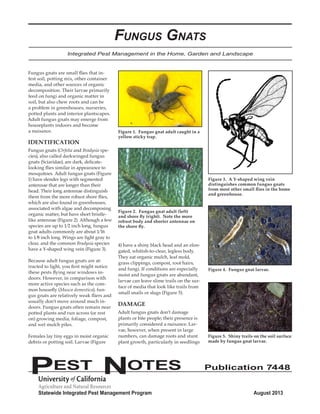
Fungus gnats (Orfelia and Bradysia species), also called darkwinged fungus gnats (Sciaridae), are dark, delicate- looking flies similar in appearance to mosquitoes. Adult fungus gnats (Figure 1) have slender legs with segmented antennae that are longer than their head. Their long antennae distinguish them from the more robust shore flies, which are also found in greenhouses, associated with algae and decomposing organic matter, but have short bristle- like antennae (Figure 2). Although a few species are up to 1⁄2 inch long, fungus gnat adults commonly are about 1⁄16 to 1⁄8 inch long. Wings are light gray to clear, and the common Bradysia species have a Y-shaped wing vein (Figure 3). 
Because adult fungus gnats are attracted to light, you first might notice these pests flying near windows indoors. However, in comparison with more active species such as the common housefly (Musca domestica), fungus gnats are relatively weak fliers and usually don’t move around much indoors. Fungus gnats often remain near potted plants and run across (or rest on) growing media, foliage, compost, and wet mulch piles. 
Females lay tiny eggs in moist organic debris or potting soil. Larvae (Figure 4) have a shiny black head and an elongated, whitish-to-clear, legless body. They eat organic mulch, leaf mold, grass clippings, compost, root hairs, and fungi. If conditions are especially moist and fungus gnats are abundant, larvae can leave slime trails on the surface of media that look like trails from small snails or slugs (Figure 5). 
DAMAGE 
Adult fungus gnats don’t damage plants or bite people; their presence is primarily considered a nuisance. Larvae, however, when present in large numbers, can damage roots and stunt plant growth, particularly in seedlings 
Figure 1. Fungus gnat adult caught in a yellow sticky trap. 
Figure 2. Fungus gnat adult (left) 
and shore fly (right). Note the more robust body and shorter antennae on the shore fly. 
Figure 3. A Y-shaped wing vein 
distinguishes common fungus gnats from most other small flies in the home and greenhouse. 
Figure 4. Fungus gnat larvae. 
Figure 5. Shiny trails on the soil surface made by fungus gnat larvae.
August 2013 Fungus Gnats 
◆ 2 of 4 ◆ 
and young plants. Significant root dam-age 
and even plant death have been 
observed in interior plantscapes and 
in houseplants when high populations 
were associated with moist, organical-ly- 
rich soil. Thus, a houseplant that is 
wilting may not indicate a lack of wa-ter, 
but rather root damage by fungus 
gnat larvae or (more commonly) other 
causes of unhealthy roots. However, 
too much or too little water, root decay 
fungi, and improper soil conditions 
(e.g., poor drainage, or waterlogging) 
are much more common causes of 
wilted plants. 
Serious fungus gnat damage is more 
common in greenhouses, nurseries, 
and sod farms. Although larvae also 
feed on plant roots outdoors, they don’t 
usually cause serious damage. 
LIFE CYCLE 
Fungus gnats develop through four 
stages—egg, larva (with four larval 
stages or instars), pupa, and adult. The 
tiny eggs and oblong pupae occur in 
damp organic media where females 
lay eggs and larvae feed. At 75ºF, eggs 
hatch in about 3 days, the larvae take 
approximately 10 days to develop 
into pupae, and about 4 days later the 
adults emerge. A generation of fungus 
gnats (from female to female) can be 
produced in about 17 days depending 
upon temperature. The warmer it is, 
the faster they will develop and the 
more generations will be produced 
in a year. 
Fungus gnats have many overlapping 
generations each year. Outdoors, they 
are most common during winter and 
spring in interior areas of California, 
when water is more available and cool-er 
temperatures prevail. They can occur 
during any time of the year in moist 
coastal regions and indoors. 
MANAGEMENT 
Most of the fungus gnat’s life is spent 
as a larva and pupa in organic matter 
or soil, so the most effective control 
methods target these immature stages 
rather than attempting to directly 
control the mobile, short-lived adults. 
Physical and cultural management 
tactics—primarily the reductions of ex-cess 
moisture and organic debris—are 
key to reducing fungus gnat problems. 
Commercially-available and naturally-occurring 
biological control agents can 
also control this pest. Insecticides are 
considered an important control option 
in some commercial plant production 
but generally aren’t recommended 
for fungus gnat management in and 
around the home. 
Monitoring 
Visual inspection for adults usually 
is adequate for determining whether 
a problem exists. You will see adults 
resting on plants, soil, windows, or 
walls, or you might see them in flight. 
Besides looking for adults, check plant 
pots for excessively moist conditions 
and organic debris where larvae feed. 
Yellow sticky traps can be used to trap 
adults. Chunks of raw potato placed in 
pots with the cut sides down (not the 
peels) are sometimes used to monitor 
for larvae. 
Water and Soil Management 
Because fungus gnats thrive in moist 
conditions, especially where there is an 
abundance of decaying vegetation and 
fungi, avoid overwatering and provide 
good drainage. Allow the surface of 
container soil to dry between water-ings. 
Clean up standing water, and 
eliminate any plumbing or irrigation 
system leaks. Moist and decomposing 
grass clippings, compost, organic fer-tilizers, 
and mulches are also favorite 
breeding spots. Avoid using incom-pletely- 
composted organic matter in 
potting media unless it is pasteurized 
first, because it will often be infested 
with fungus gnats. Improve the drain-age 
of the potting mix (e.g., increase 
the proportion of perlite or sand in the 
mix). Minimize organic debris around 
buildings and crops. Avoid fertilizing 
with excessive amounts of manure, 
blood meal, or similar organic materi-als. 
Screen and caulk leaky windows 
and doors to help prevent pests from 
coming indoors. 
If you have infested plants, don’t move 
them to new areas where flies can 
emerge to infest other pots. In some 
cases you may wish to toss out severely 
infested plants. 
Purchase and use only pasteurized 
container mix or potting mix. Com-mercial 
growers often treat potting soil 
with heat or steam before using it; this 
will kill flies and the algae and micro-organisms 
they feed on. Home garden-ers 
can solarize soil: 
1. Moisten it. 
2. Place it in a bag of transparent 
plastic or black plastic. 
3. Make the pile no deeper than 
about 8 inches. 
4. Place the bagged soil on a slightly 
elevated surface, such as a pallet 
in a sunny location, for about 4 to 
6 weeks. 
See the Pest Note: Soil Solarization listed 
in the references for details. Store pas-teurized 
potting soil off the ground 
and in closed containers to prevent it 
from becoming infested before use. 
Trapping 
In home situations where fungus gnat 
adults are a nuisance, it may be pos-sible 
to reduce the problem by using 
sticky traps available at retail nursery 
and garden centers. Yellow sticky traps 
can be cut into smaller squares, at-tached 
to wooden skewers or sticks 
and placed in pots to trap adults. Also, 
raw potato chunks placed in the soil 
are very attractive to fungus gnat 
larvae. These may be used not only to 
check pots for larvae but also to trap 
them away from plant roots. After a 
few days in a pot, remove infested 
chunks, dispose of them, and replace 
with fresh ones. 
Biological Control 
Three commercially available biological 
control agents can be purchased to con-trol 
fungus gnats in pots or container 
media (Table 1). These include Steiner-nema 
nematodes, Hypoaspis predatory 
mites, and the biological insecticide 
Bacillus thuringiensis subspecies israelen-sis 
(Bti). Several Bti products (Mosquito
August 2013 Fungus Gnats 
◆ 3 of 4 ◆ 
Table 1. Commercially Available Biological Pesticides and Natural Enemies for Controlling Fungus Gnat Larvae. 
Biological Comments 
Bacillus thuringiensis subspecies israelensis 
(Bti) (Gnatrol) 
A naturally occurring, spore-forming bacterium produced commercially by fermentation. Bti 
applied at labeled rates provides temporary control and is toxic only to fly larvae, such as 
mosquitoes, black flies, and fungus gnats. Repeat applications commonly are needed for 
long-term control. This Bt is a different subspecies from that applied to foliage to control 
caterpillars. Bt labeled for caterpillars is not effective against fly larvae. 
Hypoaspis (=Geolaelaps or Stratiolaelaps) 
miles 
A light-brownish predaceous mite adapted to feeding in the upper layers of moist soil. Preys on 
fungus gnat larvae and pupae, thrips pupae, springtails, and other tiny invertebrates. Commercial 
mites commonly are shipped in a shaker-type container used to apply them. Recommended rates 
in commercial nurseries are about 1/2 to several dozen mites per container or square foot of 
media. Make applications before pests become abundant. Hypoaspis probably won’t perform very 
well in individual houseplants and probably isn’t a good choice for use in homes. 
Steinernema feltiae This nematode is effective when temperatures are between 60° to 90°F and conditions are 
moist. You can apply it as a soil drench and to media using conventional spray equipment. 
Nematodes reproduce and actively search for hosts, so under moist conditions they can provide 
season-long control after several initial applications to establish populations. 
Note: These materials are essentially nontoxic to people and are compatible for application in combination. Bt is available from many well-stocked nurseries 
and garden supply stores. Predaceous mites, Bti, and nematodes, are commercially available through mail order from special suppliers, 
Bits, Gnatrol) are readily available in 
retail nurseries and garden centers, so 
these products may be the most con-venient 
for home gardeners to use. Bti 
does not reproduce or persist indoors, 
so infestations in potting media might 
require repeated applications at about 
five-day intervals to provide control. 
Nematodes and Hypoaspis mites must 
be mail-ordered and are live and per-ishable 
products, requiring immediate 
application. Nematodes can provide 
relatively long-term control of fungus 
gnat larvae, and they can be self-repro-ducing 
after several inoculative appli-cations 
to establish their populations. 
Steinernema feltiae is more effective 
against fungus gnats than other com-mercially 
available nematode species. 
Mix Bti or nematodes with water, and 
apply as a soil drench, or spray onto 
media using a hand-pump spray bottle 
or other spray equipment, following 
label directions. 
Several natural enemies help to man-age 
fungus gnat populations in out-door 
systems, such as landscapes and 
gardens, and indoors in greenhouses 
and conservatories, including the 
predatory hunter flies, Coenosia spp. 
These flies catch and consume adult 
fungus gnats in mid-air, and prey on 
fungus gnat larvae in soil while devel-oping 
as larvae themselves. Conserve 
these and other natural enemies by 
avoiding broad-spectrum insecticide 
applications. 
Chemical Control 
Insecticides are rarely warranted to 
control these flies in and around homes. 
However, if you do apply an insecticide 
for fungus gnats, consider using Bti or 
Steinernema feltiae nematodes to control 
the larvae; see the section Biological 
Control for more information. 
If Bti or nematodes aren’t available and 
high populations are intolerable, pyre-thrins 
or a pyrethroid insecticide may 
provide temporary, fast-acting control. 
Spray the surface of potting soil and 
plant parts where adults typically 
rest. Do not aerially fog indoors or at-tempt 
to spray adult gnats in flight. 
Be sure the product is labeled for 
your particular use (e.g., for “house 
plants”) and read and follow the 
product’s directions. 
Pyrethrins have low toxicity to people 
and pets and are the active ingredients 
in the botanical pyrethrum, which is 
derived from flowers of certain chry-santhemums. 
Many products include a 
petroleum-derived synergist (piperonyl 
butoxide, or PBO) to increase pyre-thrum 
effectiveness. Pyrethroids (e.g., 
bifenthrin, permethrin) are synthe-sized 
from petroleum to be chemically 
similar to pyrethrins; they often are 
more effective and persistent but are 
more toxic to beneficial insects. When 
using these products on houseplants 
or interiorscape containers, if possible 
move plants outdoors for treatment as 
a precaution, and wait about a day after 
applying the chemical before bringing 
them back inside. 
For information on managing fungus 
gnats in commercial flower, nursery 
or greenhouse operations, see the 
UC IPM Pest Management Guidelines: 
Floriculture and Ornamental Nurseries 
and the book Integrated Pest Manage-ment 
for Floriculture and Nurseries listed 
in the references. 
ADAPTED FROM 
Dreistadt, S. H. 2001 Pest Note: Fungus 
Gnats, Shore Flies, Moth Flies and March 
Flies. Oakland: Univ. Calif. Div. Agric. 
Nat. Res. Publ. 7448. 
REFERENCES 
Cloyd, R. A. 2010. Fungus gnat man-agement 
in greenhouses and nurseries. 
Kansas State University Agricultural 
Experiment Station and Cooperative 
Extension Service. Publication MF-2937: 
http://www.ksre.ksu.edu/bookstore/ 
pubs/MF2937.pdf 
Dreistadt, S. H. rev. 1986. Fungus Gnats 
and March Flies. Oakland: Univ. Calif. 
Div. Agric. Nat. Res. Publ. 7051.
August 2013 Fungus Gnats 
◆ 4 of 4 ◆ 
AUTHORS: J.A. Bethke, UC Cooperative 
Extension, San Diego Co and S. H. 
Dreistadt, UC Statewide IPM Program, 
Davis. 
TECHNICAL EDITOR: M.L. Flint 
EDITORS: M.L. Fayard and C. Laning 
ILLUSTRATIONS: Figs. 1-2 and 4-5, J.K. 
Clark; Fig 3., C. Feller. 
This and other Pest Notes are available at 
www.ipm.ucanr.edu. 
For more information, contact the University of 
California Cooperative Extension office in your 
county. See your telephone directory for addresses 
and phone numbers, or visit http://ucanr.org/ce.cfm. 
WARNING ON THE USE OF CHEMICALS 
Pesticides are poisonous. Always read and carefully follow all precautions and safety recommendations 
given on the container label. Store all chemicals in the original, labeled containers in a locked cabinet or shed, 
away from food or feeds, and out of the reach of children, unauthorized persons, pets, and livestock. 
Pesticides applied in your home and landscape can move and contaminate creeks, rivers, and oceans. 
Confine chemicals to the property being treated. Avoid drift onto neighboring properties, especially gardens 
containing fruits or vegetables ready to be picked. 
Do not place containers containing pesticide in the trash or pour pesticides down the sink or toilet. Either use 
the pesticide according to the label, or take unwanted pesticides to a Household Hazardous Waste Collection 
site. Contact your county agricultural commissioner for additional information on safe container disposal and 
for the location of the Household Hazardous Waste Collection site nearest you. Dispose of empty containers 
by following label directions. Never reuse or burn the containers or dispose of them in such a manner that 
they may contaminate water supplies or natural waterways. 
ANR NONDISCRIMINATION AND AFFIRMATIVE ACTION POLICY STATEMENT 
The University of California prohibits discrimination or harassment of any person in any of its programs 
or activities. The complete nondiscrimination policy statement can be found at http://ucanr.org/sites/anrstaff/ 
files/107734.doc. Inquiries regarding the university’s equal employment opportunity policies may be directed 
to Linda Marie Manton, Affirmative Action Contact, University of California, Davis, Agriculture and Natural 
Resources, One Shields Avenue, Davis, CA 95616, (530) 752-0495. 
Produced by UC Statewide 
Integrated Pest Management Program 
University of California, Davis, CA 95616 
University of California scientists and other 
qualified professionals have anonymously peer 
reviewed this publication for technical accuracy. 
The ANR Associate Editor for Pest Management 
managed this process. 
To simplify information, trade names of products 
have been used. No endorsement of named products 
is intended, nor is criticism implied of similar products 
that are not mentioned. 
This material is partially based upon work 
supported by the Extension Service, U.S. Department 
of Agriculture, under special project Section 3(d), 
Integrated Pest Management. 
Dreistadt, S. H., J. K. Clark, and M. L. 
Flint. 2001. Integrated Pest Management 
for Floriculture and Nurseries. Oakland: 
Univ. Calif. Agric. Nat. Res. Publ. 3402. 
Harris, M. A., R. D. Oetting, and W. A. 
Gardner. 1995. Use of entomopatho-genic 
nematodes and a new monitoring 
technique for control of fungus gnats, 
Bradysia coprophila (Dipt.: Sciaridae), in 
floriculture. Biological Control 5:412-418. 
UC IPM Pest Management Guidelines: 
Floriculture and Ornamental Nurseries. 
Oakland: Univ. Calif. Agric. Nat. Res. 
Publ. 3392. Also available online at 
http://www.ipm.ucdavis.edu/PMG/ 
selectnewpest.floriculture.html 
Nielsen, G. R. 1997. Fungus Gnats. 
Department of Plant and Soil Science, 
University of Vermont Extension. Pub-lication 
EL 50: http://pss.uvm.edu/ppp/ 
pubs/el50.htm 
Stapleton, J.J.; C.A. Wilen, and R.H. Mo-linar. 
2008. Pest Notes: Soil Solarization. 
Oakland: Univ. Calif. Agric. Nat. Res. 
Publ. 7441. http://www.ipm.ucdavis. 
edu/PMG/PESTNOTES/pn74145.html 
Wright, E. M., and R. J. Chambers. 
1994. The biology of the predatory mite 
Hypoaspis miles (Acari: Laelapidae), a 
potential biological control agent of 
Bradysia paupera (Dipt.: Sciaridae). Ento-mophaga 
39:225-235. v

Fungus Gnats Integrated Pest Management

  • 1.
    Statewide Integrated PestManagement Program August 2013 PEST NOTES Publication 7448 Integrated Pest Management in the Home, Garden and Landscape Fungus Gnats Fungus gnats are small flies that infest soil, potting mix, other container media, and other sources of organic decomposition. Their larvae primarily feed on fungi and organic matter in soil, but also chew roots and can be a problem in greenhouses, nurseries, potted plants and interior plantscapes. Adult fungus gnats may emerge from houseplants indoors and become a nuisance. IDENTIFICATION Fungus gnats (Orfelia and Bradysia species), also called darkwinged fungus gnats (Sciaridae), are dark, delicate- looking flies similar in appearance to mosquitoes. Adult fungus gnats (Figure 1) have slender legs with segmented antennae that are longer than their head. Their long antennae distinguish them from the more robust shore flies, which are also found in greenhouses, associated with algae and decomposing organic matter, but have short bristle- like antennae (Figure 2). Although a few species are up to 1⁄2 inch long, fungus gnat adults commonly are about 1⁄16 to 1⁄8 inch long. Wings are light gray to clear, and the common Bradysia species have a Y-shaped wing vein (Figure 3). Because adult fungus gnats are attracted to light, you first might notice these pests flying near windows indoors. However, in comparison with more active species such as the common housefly (Musca domestica), fungus gnats are relatively weak fliers and usually don’t move around much indoors. Fungus gnats often remain near potted plants and run across (or rest on) growing media, foliage, compost, and wet mulch piles. Females lay tiny eggs in moist organic debris or potting soil. Larvae (Figure 4) have a shiny black head and an elongated, whitish-to-clear, legless body. They eat organic mulch, leaf mold, grass clippings, compost, root hairs, and fungi. If conditions are especially moist and fungus gnats are abundant, larvae can leave slime trails on the surface of media that look like trails from small snails or slugs (Figure 5). DAMAGE Adult fungus gnats don’t damage plants or bite people; their presence is primarily considered a nuisance. Larvae, however, when present in large numbers, can damage roots and stunt plant growth, particularly in seedlings Figure 1. Fungus gnat adult caught in a yellow sticky trap. Figure 2. Fungus gnat adult (left) and shore fly (right). Note the more robust body and shorter antennae on the shore fly. Figure 3. A Y-shaped wing vein distinguishes common fungus gnats from most other small flies in the home and greenhouse. Figure 4. Fungus gnat larvae. Figure 5. Shiny trails on the soil surface made by fungus gnat larvae.
  • 2.
    August 2013 FungusGnats ◆ 2 of 4 ◆ and young plants. Significant root dam-age and even plant death have been observed in interior plantscapes and in houseplants when high populations were associated with moist, organical-ly- rich soil. Thus, a houseplant that is wilting may not indicate a lack of wa-ter, but rather root damage by fungus gnat larvae or (more commonly) other causes of unhealthy roots. However, too much or too little water, root decay fungi, and improper soil conditions (e.g., poor drainage, or waterlogging) are much more common causes of wilted plants. Serious fungus gnat damage is more common in greenhouses, nurseries, and sod farms. Although larvae also feed on plant roots outdoors, they don’t usually cause serious damage. LIFE CYCLE Fungus gnats develop through four stages—egg, larva (with four larval stages or instars), pupa, and adult. The tiny eggs and oblong pupae occur in damp organic media where females lay eggs and larvae feed. At 75ºF, eggs hatch in about 3 days, the larvae take approximately 10 days to develop into pupae, and about 4 days later the adults emerge. A generation of fungus gnats (from female to female) can be produced in about 17 days depending upon temperature. The warmer it is, the faster they will develop and the more generations will be produced in a year. Fungus gnats have many overlapping generations each year. Outdoors, they are most common during winter and spring in interior areas of California, when water is more available and cool-er temperatures prevail. They can occur during any time of the year in moist coastal regions and indoors. MANAGEMENT Most of the fungus gnat’s life is spent as a larva and pupa in organic matter or soil, so the most effective control methods target these immature stages rather than attempting to directly control the mobile, short-lived adults. Physical and cultural management tactics—primarily the reductions of ex-cess moisture and organic debris—are key to reducing fungus gnat problems. Commercially-available and naturally-occurring biological control agents can also control this pest. Insecticides are considered an important control option in some commercial plant production but generally aren’t recommended for fungus gnat management in and around the home. Monitoring Visual inspection for adults usually is adequate for determining whether a problem exists. You will see adults resting on plants, soil, windows, or walls, or you might see them in flight. Besides looking for adults, check plant pots for excessively moist conditions and organic debris where larvae feed. Yellow sticky traps can be used to trap adults. Chunks of raw potato placed in pots with the cut sides down (not the peels) are sometimes used to monitor for larvae. Water and Soil Management Because fungus gnats thrive in moist conditions, especially where there is an abundance of decaying vegetation and fungi, avoid overwatering and provide good drainage. Allow the surface of container soil to dry between water-ings. Clean up standing water, and eliminate any plumbing or irrigation system leaks. Moist and decomposing grass clippings, compost, organic fer-tilizers, and mulches are also favorite breeding spots. Avoid using incom-pletely- composted organic matter in potting media unless it is pasteurized first, because it will often be infested with fungus gnats. Improve the drain-age of the potting mix (e.g., increase the proportion of perlite or sand in the mix). Minimize organic debris around buildings and crops. Avoid fertilizing with excessive amounts of manure, blood meal, or similar organic materi-als. Screen and caulk leaky windows and doors to help prevent pests from coming indoors. If you have infested plants, don’t move them to new areas where flies can emerge to infest other pots. In some cases you may wish to toss out severely infested plants. Purchase and use only pasteurized container mix or potting mix. Com-mercial growers often treat potting soil with heat or steam before using it; this will kill flies and the algae and micro-organisms they feed on. Home garden-ers can solarize soil: 1. Moisten it. 2. Place it in a bag of transparent plastic or black plastic. 3. Make the pile no deeper than about 8 inches. 4. Place the bagged soil on a slightly elevated surface, such as a pallet in a sunny location, for about 4 to 6 weeks. See the Pest Note: Soil Solarization listed in the references for details. Store pas-teurized potting soil off the ground and in closed containers to prevent it from becoming infested before use. Trapping In home situations where fungus gnat adults are a nuisance, it may be pos-sible to reduce the problem by using sticky traps available at retail nursery and garden centers. Yellow sticky traps can be cut into smaller squares, at-tached to wooden skewers or sticks and placed in pots to trap adults. Also, raw potato chunks placed in the soil are very attractive to fungus gnat larvae. These may be used not only to check pots for larvae but also to trap them away from plant roots. After a few days in a pot, remove infested chunks, dispose of them, and replace with fresh ones. Biological Control Three commercially available biological control agents can be purchased to con-trol fungus gnats in pots or container media (Table 1). These include Steiner-nema nematodes, Hypoaspis predatory mites, and the biological insecticide Bacillus thuringiensis subspecies israelen-sis (Bti). Several Bti products (Mosquito
  • 3.
    August 2013 FungusGnats ◆ 3 of 4 ◆ Table 1. Commercially Available Biological Pesticides and Natural Enemies for Controlling Fungus Gnat Larvae. Biological Comments Bacillus thuringiensis subspecies israelensis (Bti) (Gnatrol) A naturally occurring, spore-forming bacterium produced commercially by fermentation. Bti applied at labeled rates provides temporary control and is toxic only to fly larvae, such as mosquitoes, black flies, and fungus gnats. Repeat applications commonly are needed for long-term control. This Bt is a different subspecies from that applied to foliage to control caterpillars. Bt labeled for caterpillars is not effective against fly larvae. Hypoaspis (=Geolaelaps or Stratiolaelaps) miles A light-brownish predaceous mite adapted to feeding in the upper layers of moist soil. Preys on fungus gnat larvae and pupae, thrips pupae, springtails, and other tiny invertebrates. Commercial mites commonly are shipped in a shaker-type container used to apply them. Recommended rates in commercial nurseries are about 1/2 to several dozen mites per container or square foot of media. Make applications before pests become abundant. Hypoaspis probably won’t perform very well in individual houseplants and probably isn’t a good choice for use in homes. Steinernema feltiae This nematode is effective when temperatures are between 60° to 90°F and conditions are moist. You can apply it as a soil drench and to media using conventional spray equipment. Nematodes reproduce and actively search for hosts, so under moist conditions they can provide season-long control after several initial applications to establish populations. Note: These materials are essentially nontoxic to people and are compatible for application in combination. Bt is available from many well-stocked nurseries and garden supply stores. Predaceous mites, Bti, and nematodes, are commercially available through mail order from special suppliers, Bits, Gnatrol) are readily available in retail nurseries and garden centers, so these products may be the most con-venient for home gardeners to use. Bti does not reproduce or persist indoors, so infestations in potting media might require repeated applications at about five-day intervals to provide control. Nematodes and Hypoaspis mites must be mail-ordered and are live and per-ishable products, requiring immediate application. Nematodes can provide relatively long-term control of fungus gnat larvae, and they can be self-repro-ducing after several inoculative appli-cations to establish their populations. Steinernema feltiae is more effective against fungus gnats than other com-mercially available nematode species. Mix Bti or nematodes with water, and apply as a soil drench, or spray onto media using a hand-pump spray bottle or other spray equipment, following label directions. Several natural enemies help to man-age fungus gnat populations in out-door systems, such as landscapes and gardens, and indoors in greenhouses and conservatories, including the predatory hunter flies, Coenosia spp. These flies catch and consume adult fungus gnats in mid-air, and prey on fungus gnat larvae in soil while devel-oping as larvae themselves. Conserve these and other natural enemies by avoiding broad-spectrum insecticide applications. Chemical Control Insecticides are rarely warranted to control these flies in and around homes. However, if you do apply an insecticide for fungus gnats, consider using Bti or Steinernema feltiae nematodes to control the larvae; see the section Biological Control for more information. If Bti or nematodes aren’t available and high populations are intolerable, pyre-thrins or a pyrethroid insecticide may provide temporary, fast-acting control. Spray the surface of potting soil and plant parts where adults typically rest. Do not aerially fog indoors or at-tempt to spray adult gnats in flight. Be sure the product is labeled for your particular use (e.g., for “house plants”) and read and follow the product’s directions. Pyrethrins have low toxicity to people and pets and are the active ingredients in the botanical pyrethrum, which is derived from flowers of certain chry-santhemums. Many products include a petroleum-derived synergist (piperonyl butoxide, or PBO) to increase pyre-thrum effectiveness. Pyrethroids (e.g., bifenthrin, permethrin) are synthe-sized from petroleum to be chemically similar to pyrethrins; they often are more effective and persistent but are more toxic to beneficial insects. When using these products on houseplants or interiorscape containers, if possible move plants outdoors for treatment as a precaution, and wait about a day after applying the chemical before bringing them back inside. For information on managing fungus gnats in commercial flower, nursery or greenhouse operations, see the UC IPM Pest Management Guidelines: Floriculture and Ornamental Nurseries and the book Integrated Pest Manage-ment for Floriculture and Nurseries listed in the references. ADAPTED FROM Dreistadt, S. H. 2001 Pest Note: Fungus Gnats, Shore Flies, Moth Flies and March Flies. Oakland: Univ. Calif. Div. Agric. Nat. Res. Publ. 7448. REFERENCES Cloyd, R. A. 2010. Fungus gnat man-agement in greenhouses and nurseries. Kansas State University Agricultural Experiment Station and Cooperative Extension Service. Publication MF-2937: http://www.ksre.ksu.edu/bookstore/ pubs/MF2937.pdf Dreistadt, S. H. rev. 1986. Fungus Gnats and March Flies. Oakland: Univ. Calif. Div. Agric. Nat. Res. Publ. 7051.
  • 4.
    August 2013 FungusGnats ◆ 4 of 4 ◆ AUTHORS: J.A. Bethke, UC Cooperative Extension, San Diego Co and S. H. Dreistadt, UC Statewide IPM Program, Davis. TECHNICAL EDITOR: M.L. Flint EDITORS: M.L. Fayard and C. Laning ILLUSTRATIONS: Figs. 1-2 and 4-5, J.K. Clark; Fig 3., C. Feller. This and other Pest Notes are available at www.ipm.ucanr.edu. For more information, contact the University of California Cooperative Extension office in your county. See your telephone directory for addresses and phone numbers, or visit http://ucanr.org/ce.cfm. WARNING ON THE USE OF CHEMICALS Pesticides are poisonous. Always read and carefully follow all precautions and safety recommendations given on the container label. Store all chemicals in the original, labeled containers in a locked cabinet or shed, away from food or feeds, and out of the reach of children, unauthorized persons, pets, and livestock. Pesticides applied in your home and landscape can move and contaminate creeks, rivers, and oceans. Confine chemicals to the property being treated. Avoid drift onto neighboring properties, especially gardens containing fruits or vegetables ready to be picked. Do not place containers containing pesticide in the trash or pour pesticides down the sink or toilet. Either use the pesticide according to the label, or take unwanted pesticides to a Household Hazardous Waste Collection site. Contact your county agricultural commissioner for additional information on safe container disposal and for the location of the Household Hazardous Waste Collection site nearest you. Dispose of empty containers by following label directions. Never reuse or burn the containers or dispose of them in such a manner that they may contaminate water supplies or natural waterways. ANR NONDISCRIMINATION AND AFFIRMATIVE ACTION POLICY STATEMENT The University of California prohibits discrimination or harassment of any person in any of its programs or activities. The complete nondiscrimination policy statement can be found at http://ucanr.org/sites/anrstaff/ files/107734.doc. Inquiries regarding the university’s equal employment opportunity policies may be directed to Linda Marie Manton, Affirmative Action Contact, University of California, Davis, Agriculture and Natural Resources, One Shields Avenue, Davis, CA 95616, (530) 752-0495. Produced by UC Statewide Integrated Pest Management Program University of California, Davis, CA 95616 University of California scientists and other qualified professionals have anonymously peer reviewed this publication for technical accuracy. The ANR Associate Editor for Pest Management managed this process. To simplify information, trade names of products have been used. No endorsement of named products is intended, nor is criticism implied of similar products that are not mentioned. This material is partially based upon work supported by the Extension Service, U.S. Department of Agriculture, under special project Section 3(d), Integrated Pest Management. Dreistadt, S. H., J. K. Clark, and M. L. Flint. 2001. Integrated Pest Management for Floriculture and Nurseries. Oakland: Univ. Calif. Agric. Nat. Res. Publ. 3402. Harris, M. A., R. D. Oetting, and W. A. Gardner. 1995. Use of entomopatho-genic nematodes and a new monitoring technique for control of fungus gnats, Bradysia coprophila (Dipt.: Sciaridae), in floriculture. Biological Control 5:412-418. UC IPM Pest Management Guidelines: Floriculture and Ornamental Nurseries. Oakland: Univ. Calif. Agric. Nat. Res. Publ. 3392. Also available online at http://www.ipm.ucdavis.edu/PMG/ selectnewpest.floriculture.html Nielsen, G. R. 1997. Fungus Gnats. Department of Plant and Soil Science, University of Vermont Extension. Pub-lication EL 50: http://pss.uvm.edu/ppp/ pubs/el50.htm Stapleton, J.J.; C.A. Wilen, and R.H. Mo-linar. 2008. Pest Notes: Soil Solarization. Oakland: Univ. Calif. Agric. Nat. Res. Publ. 7441. http://www.ipm.ucdavis. edu/PMG/PESTNOTES/pn74145.html Wright, E. M., and R. J. Chambers. 1994. The biology of the predatory mite Hypoaspis miles (Acari: Laelapidae), a potential biological control agent of Bradysia paupera (Dipt.: Sciaridae). Ento-mophaga 39:225-235. v