Xiaomi
ALWAYS BELIEVE THAT SOMETHING WONDERFUL IS ABOUT TO HAPPEN
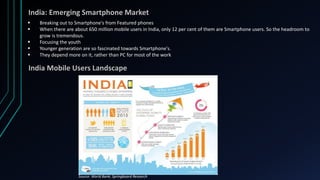
India Mobile Users Landscape
Source: World Bank; Springboard Research
India: Emerging Smartphone Market
 Breaking out to Smartphone's from Featured phones
 When there are about 650 million mobile users in India, only 12 per cent of them are Smartphone users. So the headroom to
grow is tremendous.
 Focusing the youth
 Younger generation are so fascinated towards Smartphone's.
 They depend more on it, rather than PC for most of the work
The "MI" in our logo stands for “Mobile Internet”. It also has other
meanings, including "Mission Impossible", because Xiaomi faced
many challenges that had seemed impossible to defy in our early
days.
Lei Jun
CEO of Xiaomi Inc.
Xiaomi was founded in 2010 by serial entrepreneur Lei Jun, who
believes that high-quality technology doesn't need to cost a
fortune. MI create remarkable hardware, software, and internet. MI
have sold more than 70 million handsets in 2015 by incorporating
the feedback of it’s users. MI have launched it’s products in Taiwan,
Hong Kong, Singapore, Malaysia, Philippines, India, Indonesia and
Brazil. Xiaomi is now expanding its footprint across the world to
become a global brand.
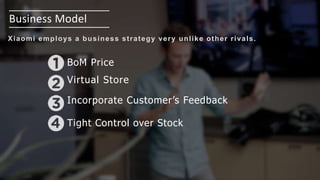
Business Model
BoM Price
Virtual Store
Incorporate Customer’s Feedback
Tight Control over Stock
Xiaomi employs a business strategy very unlike other rivals.
Business Model
Lie Jun, Xiaomi CEO said that the company prices the
phone almost at bill-of-material (BoM) prices without
compromising the component quality and performance
compared to other premium smartphones
Xiaomi does not own any physical stores and sell
exclusively from its online store/virtual store. It also
relies on social networking for marketing.
Business Model
Xiaomi listen closely to customer feedback, having them
test out and incorporate those features in upcoming
phones.
Xiaomi is able to place cheaper batch orders as demand
dictates. Xiaomi’s Limited availability online flash sales
ensure that supply never outstrips demand and helps
create promote its products.
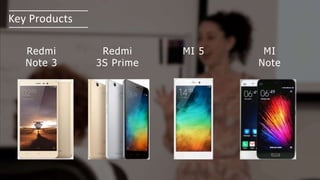
Key Products
Redmi
Note 3
Redmi
Note 3
Redmi
3S Prime
MI 5 MI
Note
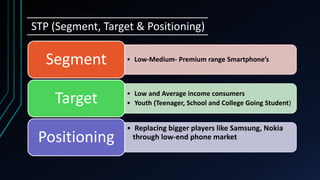
STP (Segment, Target & Positioning)
• Low-Medium- Premium range Smartphone’sSegment
• Low and Average income consumers
• Youth (Teenager, School and College Going Student)Target
• Replacing bigger players like Samsung, Nokia
through low-end phone marketPositioning
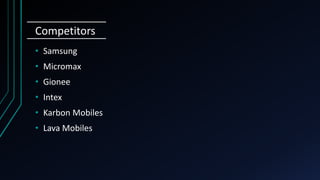
Competitors
• Samsung
• Micromax
• Gionee
• Intex
• Karbon Mobiles
• Lava Mobiles
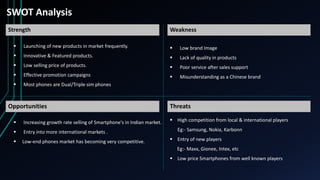
SWOT Analysis
Strength
 Launching of new products in market frequently.
 Innovative & Featured products.
 Low selling price of products.
 Effective promotion campaigns
 Most phones are Dual/Triple sim phones
Weakness
 Low brand Image
 Lack of quality in products
 Poor service after sales support
 Misunderstanding as a Chinese brand
Opportunities
 Increasing growth rate selling of Smartphone's in Indian market.
 Entry into more international markets .
 Low-end phones market has becoming very competitive.
Threats
 High competition from local & international players
Eg:- Samsung, Nokia, Karbonn
 Entry of new players
Eg:- Maxx, Gionee, Intex, etc
 Low price Smartphones from well known players
Conclusion
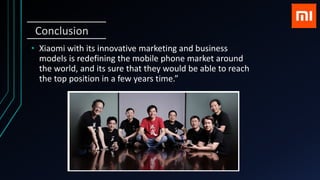
• Xiaomi with its innovative marketing and business
models is redefining the mobile phone market around
the world, and its sure that they would be able to reach
the top position in a few years time.”
Thank You

Xiaomi

  • 1.
    Xiaomi ALWAYS BELIEVE THATSOMETHING WONDERFUL IS ABOUT TO HAPPEN
  • 2.
    India Mobile UsersLandscape Source: World Bank; Springboard Research India: Emerging Smartphone Market  Breaking out to Smartphone's from Featured phones  When there are about 650 million mobile users in India, only 12 per cent of them are Smartphone users. So the headroom to grow is tremendous.  Focusing the youth  Younger generation are so fascinated towards Smartphone's.  They depend more on it, rather than PC for most of the work
  • 3.
    The "MI" inour logo stands for “Mobile Internet”. It also has other meanings, including "Mission Impossible", because Xiaomi faced many challenges that had seemed impossible to defy in our early days. Lei Jun CEO of Xiaomi Inc.
  • 4.
    Xiaomi was foundedin 2010 by serial entrepreneur Lei Jun, who believes that high-quality technology doesn't need to cost a fortune. MI create remarkable hardware, software, and internet. MI have sold more than 70 million handsets in 2015 by incorporating the feedback of it’s users. MI have launched it’s products in Taiwan, Hong Kong, Singapore, Malaysia, Philippines, India, Indonesia and Brazil. Xiaomi is now expanding its footprint across the world to become a global brand.
  • 5.
    Business Model BoM Price VirtualStore Incorporate Customer’s Feedback Tight Control over Stock Xiaomi employs a business strategy very unlike other rivals.
  • 6.
    Business Model Lie Jun,Xiaomi CEO said that the company prices the phone almost at bill-of-material (BoM) prices without compromising the component quality and performance compared to other premium smartphones Xiaomi does not own any physical stores and sell exclusively from its online store/virtual store. It also relies on social networking for marketing.
  • 7.
    Business Model Xiaomi listenclosely to customer feedback, having them test out and incorporate those features in upcoming phones. Xiaomi is able to place cheaper batch orders as demand dictates. Xiaomi’s Limited availability online flash sales ensure that supply never outstrips demand and helps create promote its products.
  • 8.
    Key Products Redmi Note 3 Redmi Note3 Redmi 3S Prime MI 5 MI Note
  • 9.
    STP (Segment, Target& Positioning) • Low-Medium- Premium range Smartphone’sSegment • Low and Average income consumers • Youth (Teenager, School and College Going Student)Target • Replacing bigger players like Samsung, Nokia through low-end phone marketPositioning
  • 10.
    Competitors • Samsung • Micromax •Gionee • Intex • Karbon Mobiles • Lava Mobiles
  • 11.
    SWOT Analysis Strength  Launchingof new products in market frequently.  Innovative & Featured products.  Low selling price of products.  Effective promotion campaigns  Most phones are Dual/Triple sim phones Weakness  Low brand Image  Lack of quality in products  Poor service after sales support  Misunderstanding as a Chinese brand Opportunities  Increasing growth rate selling of Smartphone's in Indian market.  Entry into more international markets .  Low-end phones market has becoming very competitive. Threats  High competition from local & international players Eg:- Samsung, Nokia, Karbonn  Entry of new players Eg:- Maxx, Gionee, Intex, etc  Low price Smartphones from well known players
  • 12.
    Conclusion • Xiaomi withits innovative marketing and business models is redefining the mobile phone market around the world, and its sure that they would be able to reach the top position in a few years time.”
  • 13.