Introduction
• Founded in 1991 by Rajesh Agarwal
• 2008 Micromax joined the mobile handset market.
• Micromax is currently the 2nd largest smartphone
company in India.
• Micromax sells around 2.3 million Mobility Devices every
month.
• It had revenue of around Rs 10,000 crore in the year
2014-15.
MISSION
• To successfully overcome the technological barriers and
constantly engender “life enhancing solutions”.
VISION
• To develop path breaking technologies and efficient processes
that incubate newer markets, enliven customer aspirations and
continue to make Micromax a trusted market leader amongst
people.
• Ideology stems from its rooted belief in “ Innovation” and
delivering “nothing short of the best”
BUSINESS MODEL
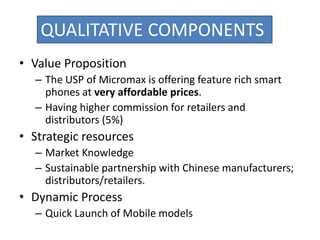
• Value Proposition
– The USP of Micromax is offering feature rich smart
phones at very affordable prices.
– Having higher commission for retailers and
distributors (5%)
• Strategic resources
– Market Knowledge
– Sustainable partnership with Chinese manufacturers;
distributors/retailers.
• Dynamic Process
– Quick Launch of Mobile models
QUALITATIVE COMPONENTS
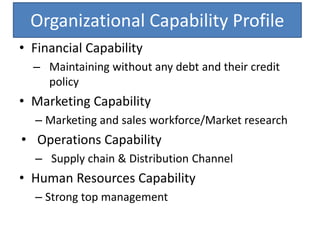
Organizational Capability Profile
• Financial Capability
– Maintaining without any debt and their credit
policy
• Marketing Capability
– Marketing and sales workforce/Market research
• Operations Capability
– Supply chain & Distribution Channel
• Human Resources Capability
– Strong top management
CORE COMPETENCY
• Cost Control
• Outsourcing
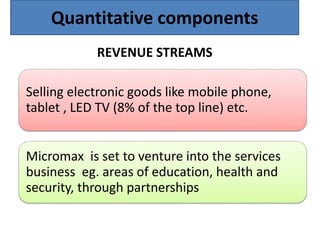
REVENUE STREAMS
Selling electronic goods like mobile phone,
tablet , LED TV (8% of the top line) etc.
Micromax is set to venture into the services
business eg. areas of education, health and
security, through partnerships
Quantitative components
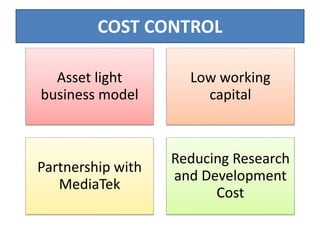
COST CONTROL
Asset light
business model
Low working
capital
Partnership with
MediaTek
Reducing Research
and Development
Cost
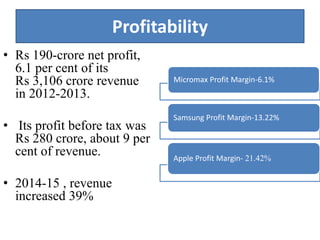
Profitability
• Rs 190-crore net profit,
6.1 per cent of its
Rs 3,106 crore revenue
in 2012-2013.
• Its profit before tax was
Rs 280 crore, about 9 per
cent of revenue.
• 2014-15 , revenue
increased 39%
Micromax Profit Margin-6.1%
Samsung Profit Margin-13.22%
Apple Profit Margin- 21.42%
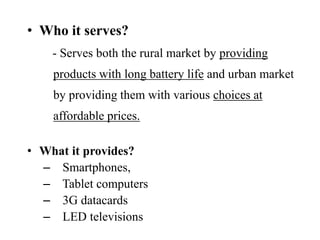
• Who it serves?
- Serves both the rural market by providing
products with long battery life and urban market
by providing them with various choices at
affordable prices.
• What it provides?
– Smartphones,
– Tablet computers
– 3G datacards
– LED televisions
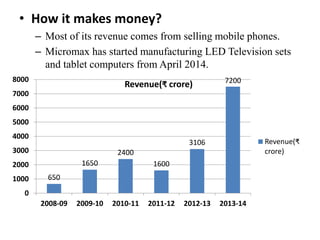
• How it makes money?
– Most of its revenue comes from selling mobile phones.
– Micromax has started manufacturing LED Television sets
and tablet computers from April 2014.
650
1650
2400
1600
3106
7200
0
1000
2000
3000
4000
5000
6000
7000
8000
2008-09 2009-10 2010-11 2011-12 2012-13 2013-14
Revenue(₹ crore)
Revenue(₹
crore)
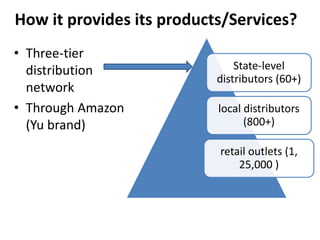
How it provides its products/Services?
• Three-tier
distribution
network
• Through Amazon
(Yu brand)
State-level
distributors (60+)
local distributors
(800+)
retail outlets (1,
25,000 )
Environmental Scanning
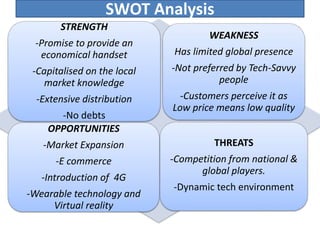
SWOT Analysis
STRENGTH
-Promise to provide an
economical handset
-Capitalised on the local
market knowledge
-Extensive distribution
-No debts
WEAKNESS
Has limited global presence
-Not preferred by Tech-Savvy
people
-Customers perceive it as
Low price means low quality
OPPORTUNITIES
-Market Expansion
-E commerce
-Introduction of 4G
-Wearable technology and
Virtual reality
THREATS
-Competition from national &
global players.
-Dynamic tech environment
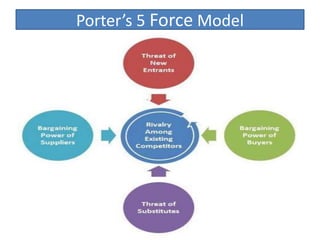
Porter’s 5 Force Model
Bargaining power of Buyers-Low to
medium
• Diverse customers
• Switching cost-Low
• The increasing number of choices and very
little differentiation of products
• Availability of information aids buyer’s
bargaining ability
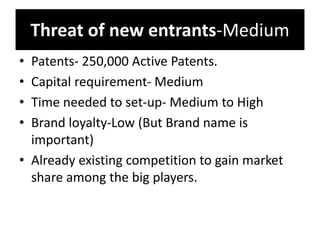
Threat of new entrants-Medium
• Patents- 250,000 Active Patents.
• Capital requirement- Medium
• Time needed to set-up- Medium to High
• Brand loyalty-Low (But Brand name is
important)
• Already existing competition to gain market
share among the big players.
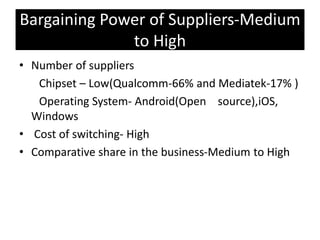
Bargaining Power of Suppliers-Medium
to High
• Number of suppliers
Chipset – Low(Qualcomm-66% and Mediatek-17% )
Operating System- Android(Open source),iOS,
Windows
• Cost of switching- High
• Comparative share in the business-Medium to High
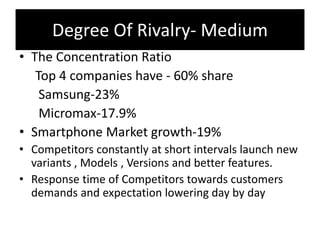
Degree Of Rivalry- Medium
• The Concentration Ratio
Top 4 companies have - 60% share
Samsung-23%
Micromax-17.9%
• Smartphone Market growth-19%
• Competitors constantly at short intervals launch new
variants , Models , Versions and better features.
• Response time of Competitors towards customers
demands and expectation lowering day by day
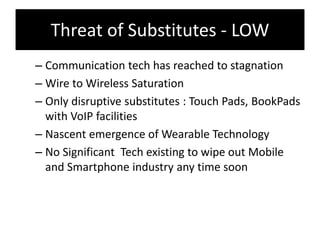
Threat of Substitutes - LOW
– Communication tech has reached to stagnation
– Wire to Wireless Saturation
– Only disruptive substitutes : Touch Pads, BookPads
with VoIP facilities
– Nascent emergence of Wearable Technology
– No Significant Tech existing to wipe out Mobile
and Smartphone industry any time soon
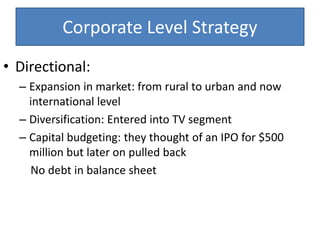
Corporate Level Strategy
• Directional:
– Expansion in market: from rural to urban and now
international level
– Diversification: Entered into TV segment
– Capital budgeting: they thought of an IPO for $500
million but later on pulled back
No debt in balance sheet
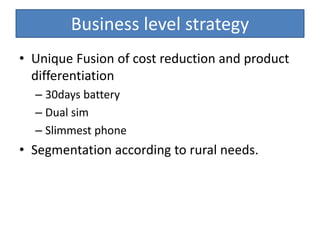
Business level strategy
• Unique Fusion of cost reduction and product
differentiation
– 30days battery
– Dual sim
– Slimmest phone
• Segmentation according to rural needs.
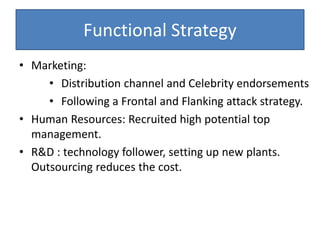
Functional Strategy
• Marketing:
• Distribution channel and Celebrity endorsements
• Following a Frontal and Flanking attack strategy.
• Human Resources: Recruited high potential top
management.
• R&D : technology follower, setting up new plants.
Outsourcing reduces the cost.
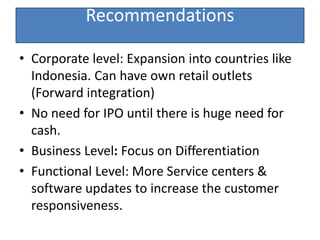
Recommendations
• Corporate level: Expansion into countries like
Indonesia. Can have own retail outlets
(Forward integration)
• No need for IPO until there is huge need for
cash.
• Business Level: Focus on Differentiation
• Functional Level: More Service centers &
software updates to increase the customer
responsiveness.
Micromax Business Model and Strategy

Micromax Business Model and Strategy

  • 2.
    Introduction • Founded in1991 by Rajesh Agarwal • 2008 Micromax joined the mobile handset market. • Micromax is currently the 2nd largest smartphone company in India. • Micromax sells around 2.3 million Mobility Devices every month. • It had revenue of around Rs 10,000 crore in the year 2014-15.
  • 3.
    MISSION • To successfullyovercome the technological barriers and constantly engender “life enhancing solutions”. VISION • To develop path breaking technologies and efficient processes that incubate newer markets, enliven customer aspirations and continue to make Micromax a trusted market leader amongst people. • Ideology stems from its rooted belief in “ Innovation” and delivering “nothing short of the best”
  • 4.
  • 5.
    • Value Proposition –The USP of Micromax is offering feature rich smart phones at very affordable prices. – Having higher commission for retailers and distributors (5%) • Strategic resources – Market Knowledge – Sustainable partnership with Chinese manufacturers; distributors/retailers. • Dynamic Process – Quick Launch of Mobile models QUALITATIVE COMPONENTS
  • 6.
    Organizational Capability Profile •Financial Capability – Maintaining without any debt and their credit policy • Marketing Capability – Marketing and sales workforce/Market research • Operations Capability – Supply chain & Distribution Channel • Human Resources Capability – Strong top management
  • 7.
    CORE COMPETENCY • CostControl • Outsourcing
  • 8.
    REVENUE STREAMS Selling electronicgoods like mobile phone, tablet , LED TV (8% of the top line) etc. Micromax is set to venture into the services business eg. areas of education, health and security, through partnerships Quantitative components
  • 9.
    COST CONTROL Asset light businessmodel Low working capital Partnership with MediaTek Reducing Research and Development Cost
  • 10.
    Profitability • Rs 190-crorenet profit, 6.1 per cent of its Rs 3,106 crore revenue in 2012-2013. • Its profit before tax was Rs 280 crore, about 9 per cent of revenue. • 2014-15 , revenue increased 39% Micromax Profit Margin-6.1% Samsung Profit Margin-13.22% Apple Profit Margin- 21.42%
  • 11.
    • Who itserves? - Serves both the rural market by providing products with long battery life and urban market by providing them with various choices at affordable prices. • What it provides? – Smartphones, – Tablet computers – 3G datacards – LED televisions
  • 12.
    • How itmakes money? – Most of its revenue comes from selling mobile phones. – Micromax has started manufacturing LED Television sets and tablet computers from April 2014. 650 1650 2400 1600 3106 7200 0 1000 2000 3000 4000 5000 6000 7000 8000 2008-09 2009-10 2010-11 2011-12 2012-13 2013-14 Revenue(₹ crore) Revenue(₹ crore)
  • 13.
    How it providesits products/Services? • Three-tier distribution network • Through Amazon (Yu brand) State-level distributors (60+) local distributors (800+) retail outlets (1, 25,000 )
  • 14.
  • 15.
    SWOT Analysis STRENGTH -Promise toprovide an economical handset -Capitalised on the local market knowledge -Extensive distribution -No debts WEAKNESS Has limited global presence -Not preferred by Tech-Savvy people -Customers perceive it as Low price means low quality OPPORTUNITIES -Market Expansion -E commerce -Introduction of 4G -Wearable technology and Virtual reality THREATS -Competition from national & global players. -Dynamic tech environment
  • 16.
  • 17.
    Bargaining power ofBuyers-Low to medium • Diverse customers • Switching cost-Low • The increasing number of choices and very little differentiation of products • Availability of information aids buyer’s bargaining ability
  • 18.
    Threat of newentrants-Medium • Patents- 250,000 Active Patents. • Capital requirement- Medium • Time needed to set-up- Medium to High • Brand loyalty-Low (But Brand name is important) • Already existing competition to gain market share among the big players.
  • 19.
    Bargaining Power ofSuppliers-Medium to High • Number of suppliers Chipset – Low(Qualcomm-66% and Mediatek-17% ) Operating System- Android(Open source),iOS, Windows • Cost of switching- High • Comparative share in the business-Medium to High
  • 20.
    Degree Of Rivalry-Medium • The Concentration Ratio Top 4 companies have - 60% share Samsung-23% Micromax-17.9% • Smartphone Market growth-19% • Competitors constantly at short intervals launch new variants , Models , Versions and better features. • Response time of Competitors towards customers demands and expectation lowering day by day
  • 21.
    Threat of Substitutes- LOW – Communication tech has reached to stagnation – Wire to Wireless Saturation – Only disruptive substitutes : Touch Pads, BookPads with VoIP facilities – Nascent emergence of Wearable Technology – No Significant Tech existing to wipe out Mobile and Smartphone industry any time soon
  • 22.
    Corporate Level Strategy •Directional: – Expansion in market: from rural to urban and now international level – Diversification: Entered into TV segment – Capital budgeting: they thought of an IPO for $500 million but later on pulled back No debt in balance sheet
  • 23.
    Business level strategy •Unique Fusion of cost reduction and product differentiation – 30days battery – Dual sim – Slimmest phone • Segmentation according to rural needs.
  • 24.
    Functional Strategy • Marketing: •Distribution channel and Celebrity endorsements • Following a Frontal and Flanking attack strategy. • Human Resources: Recruited high potential top management. • R&D : technology follower, setting up new plants. Outsourcing reduces the cost.
  • 25.
    Recommendations • Corporate level:Expansion into countries like Indonesia. Can have own retail outlets (Forward integration) • No need for IPO until there is huge need for cash. • Business Level: Focus on Differentiation • Functional Level: More Service centers & software updates to increase the customer responsiveness.