EXECUTIVE SUMMARY
Xiaomi Inc. is a privately owned electronics and
software company founded in 2010 by serial
entrepreneur Lei Jun, along with seven other co-
founders. The mobile internet company has
established its presence in 70 countries and regions
and it is among the top 5 in 16 markets. Xiaomi
currently employs about 18,000 people. In 2017
Xiaomi generated more than RMB 100 billion
revenues and expected to get listed in the Fortune
Global 500 list in foreseeable future.1 Xiaomi
business strategy is based on cost advantage.
Moreover, the company gathers and utilizes its large
fan base in an efficient manner with positive
implications on customer loyalty and the bottom line
for the business. An aggressive expansion of
ecosystem of products and services is also placed at
the core of Xiaomi business strategy. The mobile
internet company has matrix and flat organizational
structure. According to framework of Ansoff Growth
Matrix, Xiaomi uses all for strategies - market
penetration, product development, market
development and diversification, in an integrated
manner. Efficient leadership by founder and CEO Lei
Jun, impressive rate of growth and cost advantages
compared to competition are considered as major
strengths associated with Xiaomi. At the same time,
the company has noteworthy weaknesses such as
low profit margin, lower smartphone capabilities and
functionalities compared to major competitors and
difficulties of sustaining competitive advantage
Chapter-1(Company profile)
1. History
2. Vision
3. Mission
4. Organization structure
5. Swot analysis
6. Product
Chapter-2(Research Methodology)
1. Objective of research
2. Sample size
3. Survey method
4. Limitation
Chapter-3(Distribution strategy)
1. Data analysis and interpretation
2. Finding
3. Suggestion
4. Conclusion
5. Bibliography
HISTORY
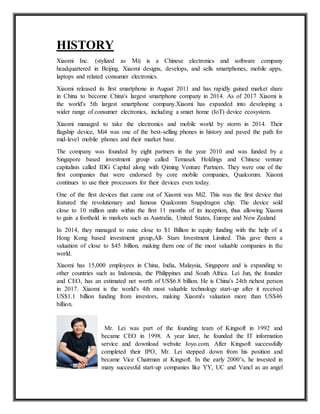
Xiaomi Inc. (stylized as Mi) is a Chinese electronics and software company
headquartered in Beijing. Xiaomi designs, develops, and sells smartphones, mobile apps,
laptops and related consumer electronics.
Xiaomi released its first smartphone in August 2011 and has rapidly gained market share
in China to become China's largest smartphone company in 2014. As of 2017 Xiaomi is
the world's 5th largest smartphone company.Xiaomi has expanded into developing a
wider range of consumer electronics, including a smart home (IoT) device ecosystem.
Xiaomi managed to take the electronics and mobile world by storm in 2014. Their
flagship device, Mi4 was one of the best-selling phones in history and paved the path for
mid-level mobile phones and their market base.
The company was founded by eight partners in the year 2010 and was funded by a
Singapore based investment group called Temasek Holdings and Chinese venture
capitalists called IDG Capital along with Qiming Venture Partners. They were one of the
first companies that were endorsed by core mobile companies, Qualcomm. Xiaomi
continues to use their processors for their devices even today.
One of the first devices that came out of Xiaomi was Mi2. This was the first device that
featured the revolutionary and famous Qualcomm Snapdragon chip. The device sold
close to 10 million units within the first 11 months of its inception, thus allowing Xiaomi
to gain a foothold in markets such as Australia, United States, Europe and New Zealand
In 2014, they managed to raise close to $1 Billion in equity funding with the help of a
Hong Kong based investment group,All- Stars Investment Limited. This gave them a
valuation of close to $45 billion, making them one of the most valuable companies in the
world.
Xiaomi has 15,000 employees in China, India, Malaysia, Singapore and is expanding to
other countries such as Indonesia, the Philippines and South Africa. Lei Jun, the founder
and CEO, has an estimated net worth of US$6.8 billion. He is China's 24th richest person
in 2017. Xiaomi is the world's 4th most valuable technology start-up after it received
US$1.1 billion funding from investors, making Xiaomi's valuation more than US$46
billion.
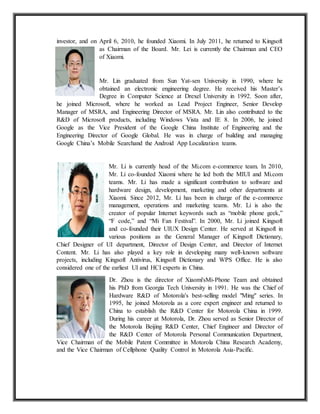
Mr. Lei was part of the founding team of Kingsoft in 1992 and
became CEO in 1998. A year later, he founded the IT information
service and download website Joyo.com. After Kingsoft successfully
completed their IPO, Mr. Lei stepped down from his position and
became Vice Chairman at Kingsoft. In the early 2000’s, he invested in
many successful start-up companies like YY, UC and Vancl as an angel
investor, and on April 6, 2010, he founded Xiaomi. In July 2011, he returned to Kingsoft
as Chairman of the Board. Mr. Lei is currently the Chairman and CEO
of Xiaomi.
Mr. Lin graduated from Sun Yat-sen University in 1990, where he
obtained an electronic engineering degree. He received his Master’s
Degree in Computer Science at Drexel University in 1992. Soon after,
he joined Microsoft, where he worked as Lead Project Engineer, Senior Develop
Manager of MSRA, and Engineering Director of MSRA. Mr. Lin also contributed to the
R&D of Microsoft products, including Windows Vista and IE 8. In 2006, he joined
Google as the Vice President of the Google China Institute of Engineering and the
Engineering Director of Google Global. He was in charge of building and managing
Google China’s Mobile Searchand the Android App Localization teams.
Mr. Li is currently head of the Mi.com e-commerce team. In 2010,
Mr. Li co-founded Xiaomi where he led both the MIUI and Mi.com
teams. Mr. Li has made a significant contribution to software and
hardware design, development, marketing and other departments at
Xiaomi. Since 2012, Mr. Li has been in charge of the e-commerce
management, operations and marketing teams. Mr. Li is also the
creator of popular Internet keywords such as “mobile phone geek,”
“F code,” and “Mi Fan Festival”. In 2000, Mr. Li joined Kingsoft
and co-founded their UIUX Design Center. He served at Kingsoft in
various positions as the General Manager of Kingsoft Dictionary,
Chief Designer of UI department, Director of Design Center, and Director of Internet
Content. Mr. Li has also played a key role in developing many well-known software
projects, including Kingsoft Antivirus, Kingsoft Dictionary and WPS Office. He is also
considered one of the earliest UI and HCI experts in China.
Dr. Zhou is the director of Xiaomi'sMi-Phone Team and obtained
his PhD from Georgia Tech University in 1991. He was the Chief of
Hardware R&D of Motorola's best-selling model "Ming" series. In
1995, he joined Motorola as a core expert engineer and returned to
China to establish the R&D Center for Motorola China in 1999.
During his career at Motorola, Dr. Zhou served as Senior Director of
the Motorola Beijing R&D Center, Chief Engineer and Director of
the R&D Center of Motorola Personal Communication Department,
Vice Chairman of the Mobile Patent Committee in Motorola China Research Academy,
and the Vice Chairman of Cellphone Quality Control in Motorola Asia-Pacific.
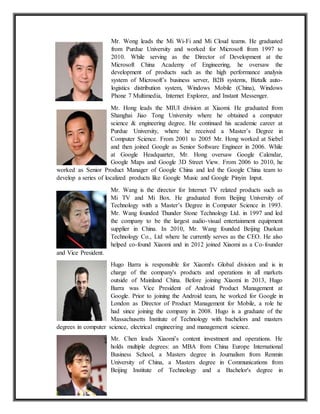
Mr. Wong leads the Mi Wi-Fi and Mi Cloud teams. He graduated
from Purdue University and worked for Microsoft from 1997 to
2010. While serving as the Director of Development at the
Microsoft China Academy of Engineering, he oversaw the
development of products such as the high performance analysis
system of Microsoft’s business server, B2B systems, Biztalk auto-
logistics distribution system, Windows Mobile (China), Windows
Phone 7 Multimedia, Internet Explorer, and Instant Messenger.
Mr. Hong leads the MIUI division at Xiaomi. He graduated from
Shanghai Jiao Tong University where he obtained a computer
science & engineering degree. He continued his academic career at
Purdue University, where he received a Master’s Degree in
Computer Science. From 2001 to 2005 Mr. Hong worked at Siebel
and then joined Google as Senior Software Engineer in 2006. While
at Google Headquarter, Mr. Hong oversaw Google Calendar,
Google Maps and Google 3D Street View. From 2006 to 2010, he
worked as Senior Product Manager of Google China and led the Google China team to
develop a series of localized products like Google Music and Google Pinyin Input.
Mr. Wang is the director for Internet TV related products such as
Mi TV and Mi Box. He graduated from Beijing University of
Technology with a Master’s Degree in Computer Science in 1993.
Mr. Wang founded Thunder Stone Technology Ltd. in 1997 and led
the company to be the largest audio-visual entertainment equipment
supplier in China. In 2010, Mr. Wang founded Beijing Duokan
Technology Co., Ltd where he currently serves as the CEO. He also
helped co-found Xiaomi and in 2012 joined Xiaomi as a Co-founder
and Vice President.
Hugo Barra is responsible for Xiaomi's Global division and is in
charge of the company's products and operations in all markets
outside of Mainland China. Before joining Xiaomi in 2013, Hugo
Barra was Vice President of Android Product Management at
Google. Prior to joining the Android team, he worked for Google in
London as Director of Product Management for Mobile, a role he
had since joining the company in 2008. Hugo is a graduate of the
Massachusetts Institute of Technology with bachelors and masters
degrees in computer science, electrical engineering and management science.
Mr. Chen leads Xiaomi’s content investment and operations. He
holds multiple degrees: an MBA from China Europe International
Business School, a Masters degree in Journalism from Renmin
University of China, a Masters degree in Communications from
Beijing Institute of Technology and a Bachelor's degree in
Electrical Engineering from Beijing University of Technology. Mr. Chen participated in
the founding of a Sina subsidiary company in 1997 before joining Sina in 1998 fulfilling
the positions of Executive Vice-President of Sinacorp and Chief Editor of sina.com
Mission statement:
"MAKING QUALITY TECHNOLOGY ACCESSIBLE TO EVERYONE".
"At Xiaomi, we strive to create the highest quality products in lowest possible prices in
order to provide people access to the necessary tools and services that connect them to
the world, and ultimately, to their dreams.
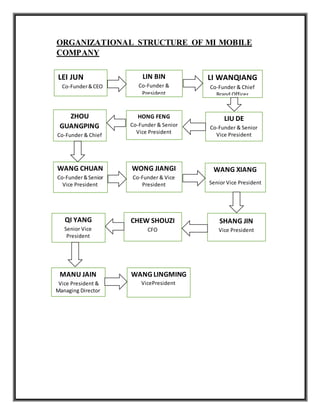
ORGANIZATIONAL STRUCTURE OF MI MOBILE
COMPANY
LEI JUN
Co-Funder&CEO
LIN BIN
Co-Funder &
President
LI WANQIANG
Co-Funder & Chief
Brand Officer
ZHOU
GUANGPING
Co-Funder & Chief
Scientist
HONG FENG
Co-Funder & Senior
Vice President
LIU DE
Co-Funder & Senior
Vice President
WANG CHUAN
Co-Funder&Senior
Vice President
WONG JIANGI
Co-Funder & Vice
President
WANG XIANG
Senior Vice President
QI YANG
Senior Vice
President
CHEW SHOUZI
CFO
SHANG JIN
Vice President
MANU JAIN
Vice President &
Managing Director
WANG LINGMING
VicePresident
XIAOMI MOBILE PHONE PROFILE AND ITS
SWOT ANALYSIS
Xiaomi mobile phone profile:-
Xiaomi Inc. is a privately owned Chinese electronics company headquartered in
Beijing. It is the world's 4th largest smartphone maker. Xiaomi designs, develops, and
sells smart phones, mobile apps, laptops, and related consumer electronics.
On August 16, 2010, Xiaomi officially launched its first Android-based firmware MIUI.
The Xiaomi Mi1 smart phone was announced in August 2011. It was shipped with
Xiaomi's MIUI firmware which is based on Android and resembles Samsung's TouchWiz
and Apple's iOS. The device could also be equipped with stock Android. Mi 1 appears
immediately caused a sensation in the hasbeen choppy mobile phone market. And this is
not only because of its powerful configuration, but also because of its attractive price, so
that the popularity of Xiaomi rapidly rising. Almost overnight, "Xiaomi" has become a
hot topic on concern mobile phone enthusiasts. Followed by a series of listed M2, M3
and Redmi pushed Xiaomi phone on the front of the domestic mobile phone.
Mitalk:-
Mitalk is Xiaomi production of a mobile phone terminal free instant messaging tool, it
can not only cross iPhone, Android, Symbian mobile phone platform, can also cross
China Mobile, China Unicom, Telecom so on different operators. As long as through the
mobile phone network (WiFi, 3G, GPRS),can communicate with the relevant contacts for
real-time information communication, send and receive pictures and audio, it is important
to consume only network traffic.
MIUI:-
MIUI officially released on June 1, 2010, it is Xiaomi company depth customization of
an Android mobile phone operating system, MIUI aim at native Android system for a
number of improvements to optimize, its user covers in 23 countries, by the majority of
mobile enthusiasts highly sought after. MIUI original features MIUI interface system, is
committed to providing smart phones in the most extreme calls and text messages
comfortable experience ,for Chinese users use habits are perfect match, Xiaomi
technology is China's first use of Internet development model for mobile phone operating
system development team , reference MIUI Community enthusiasts feedback to improve,
weekly updates iterations, always give users the latest experience. And MIUI has the
world's largest mobile phone wallpaper theme library, personalized themes and lock
screen mode, as well as a wealth of custom methods.
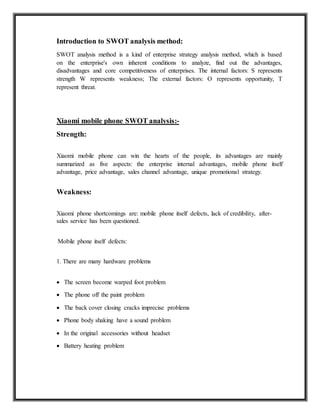
Introduction to SWOT analysis method:
SWOT analysis method is a kind of enterprise strategy analysis method, which is based
on the enterprise's own inherent conditions to analyze, find out the advantages,
disadvantages and core competitiveness of enterprises. The internal factors: S represents
strength W represents weakness; The external factors: O represents opportunity, T
represent threat.
Xiaomi mobile phone SWOT analysis:-
Strength:
Xiaomi mobile phone can win the hearts of the people, its advantages are mainly
summarized as five aspects: the enterprise internal advantages, mobile phone itself
advantage, price advantage, sales channel advantage, unique promotional strategy.
Weakness:
Xiaomi phone shortcomings are: mobile phone itself defects, lack of credibility, after-
sales service has been questioned.
Mobile phone itself defects:
1. There are many hardware problems
 The screen become warped foot problem

 The phone off the paint problem

 The back cover closing cracks imprecise problems

 Phone body shaking have a sound problem

 In the original accessories without headset

 Battery heating problem
2.Lack of credibility
3.After-sales service has been questioned
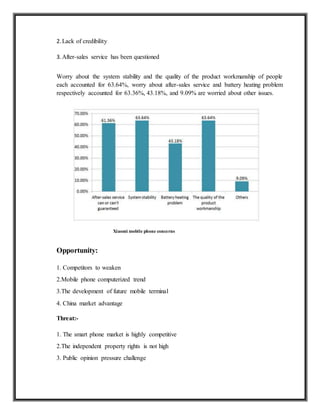
Worry about the system stability and the quality of the product workmanship of people
each accounted for 63.64%, worry about after-sales service and battery heating problem
respectively accounted for 63.36%, 43.18%, and 9.09% are worried about other issues.
Xiaomi mobile phone concerns
Opportunity:
1. Competitors to weaken
2.Mobile phone computerized trend
3.The development of future mobile terminal
4. China market advantage
Threat:-
1. The smart phone market is highly competitive
2.The independent property rights is not high
3. Public opinion pressure challenge
Mi PRODUCT’S
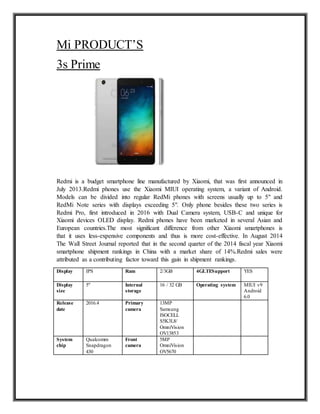
3s Prime
Redmi is a budget smartphone line manufactured by Xiaomi, that was first announced in
July 2013.Redmi phones use the Xiaomi MIUI operating system, a variant of Android.
Models can be divided into regular RedMi phones with screens usually up to 5" and
RedMi Note series with displays exceeding 5". Only phone besides these two series is
Redmi Pro, first introduced in 2016 with Dual Camera system, USB-C and unique for
Xiaomi devices OLED display. Redmi phones have been marketed in several Asian and
European countries.The most significant difference from other Xiaomi smartphones is
that it uses less-expensive components and thus is more cost-effective. In August 2014
The Wall Street Journal reported that in the second quarter of the 2014 fiscal year Xiaomi
smartphone shipment rankings in China with a market share of 14%.Redmi sales were
attributed as a contributing factor toward this gain in shipment rankings.
Display IPS Ram 2/3GB 4GLTESupport YES
Display
size
5" Internal
storage
16 / 32 GB Operating system MIUI v9
Android
6.0
Release
date
2016.4 Primary
camera
13MP
Samsung
ISOCELL
S5K3L8/
OmniVision
OV13853
System
chip
Qualcomm
Snapdragon
430
Front
camera
5MP
OmniVision
OV5670
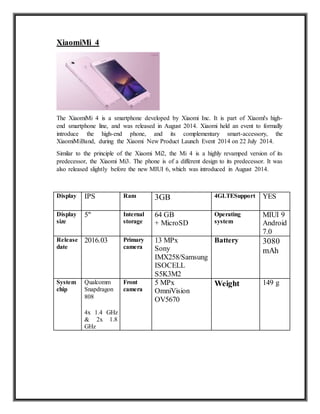
XiaomiMi 4
The XiaomiMi 4 is a smartphone developed by Xiaomi Inc. It is part of Xiaomi's high-
end smartphone line, and was released in August 2014. Xiaomi held an event to formally
introduce the high-end phone, and its complementary smart-accessory, the
XiaomiMiBand, during the Xiaomi New Product Launch Event 2014 on 22 July 2014.
Similar to the principle of the Xiaomi Mi2, the Mi 4 is a highly revamped version of its
predecessor, the Xiaomi Mi3. The phone is of a different design to its predecessor. It was
also released slightly before the new MIUI 6, which was introduced in August 2014.
Display IPS Ram 3GB 4GLTESupport YES
Display
size
5" Internal
storage
64 GB
+ MicroSD
Operating
system
MIUI 9
Android
7.0
Release
date
2016.03 Primary
camera
13 MPx
Sony
IMX258/Samsung
ISOCELL
S5K3M2
Battery 3080
mAh
System
chip
Qualcomm
Snapdragon
808
4x 1.4 GHz
& 2x 1.8
GHz
Front
camera
5 MPx
OmniVision
OV5670
Weight 149 g
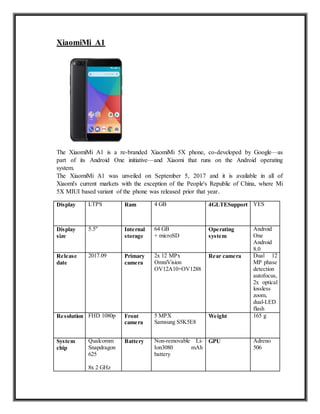
XiaomiMi A1
The XiaomiMi A1 is a re-branded XiaomiMi 5X phone, co-developed by Google—as
part of its Android One initiative—and Xiaomi that runs on the Android operating
system.
The XiaomiMi A1 was unveiled on September 5, 2017 and it is available in all of
Xiaomi's current markets with the exception of the People's Republic of China, where Mi
5X MIUI based variant of the phone was released prior that year.
Display LTPS Ram 4 GB 4GLTESupport YES
Display
size
5.5" Internal
storage
64 GB
+ microSD
Operating
system
Android
One
Android
8.0
Release
date
2017.09 Primary
camera
2x 12 MPx
OmniVision
OV12A10+OV1288
Rear camera Dual 12
MP phase
detection
autofocus,
2x optical
lossless
zoom,
dual-LED
flash
Resolution FHD 1080p Front
camera
5 MPX
Samsung S5K5E8
Weight 165 g
System
chip
Qualcomm
Snapdragon
625
8x 2 GHz
Battery Non-removable Li-
Ion3080 mAh
battery
GPU Adreno
506
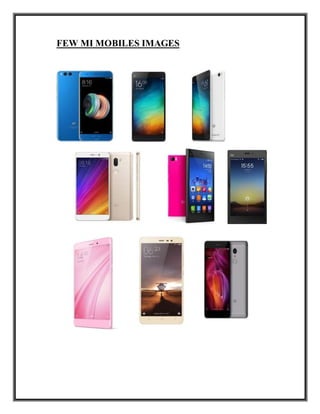
FEW MI MOBILES IMAGES
OBJECTIVES
August 16, 2011, when the Xiaomi Technology CEO Lei Jun appeared on the stage of
the 798 Art District, Beijing Clubhouse, the presence of the Xiaomi fans shouted "Lei
Busi" name, this is no doubt that, in the minds of Xiaomi fans and look forward to Lei
Jun as the next Steve Jobs, hope Xiaomi become to "China's Apple phone".
TechCrunchDisruprt conference held in Beijing on November 1, 2011, the Xiaomi
Technology CEO Lei Jun said, the Xiaomi technology goal is to become a "world-class"
mobile Internet company and successfully broke into the top 500 list of "Fortune" "Apple
iPhone" redefined the smart phone, and other smart phone products in the past five years,
could not keep up with the iPhone for the same reason I launched Xiaomi mobile phone.
OBJECTIVES OF RESERCH
 To find out the features, that makes Mi brand more attractive to its customers.
 To find out more easy way to make visible the brand in eyes of customers.
 To attract more customer towards the brand.
 To increase awareness in the market.
SAMPLE SIZE
As there was a certain limitation (like time and others resources) my research is done
based on 100 sample size.
SURVEY METHOD
A field of applied statistics of human research surveys, survey methodology studies the
sampling of individual unites from a population and associated survey data collection
techniques , such as questionnaire construction and methods for improving the number
and accuracy of responses to surveys.
It contains two parts:-
According to instrumentation
1. Questionnaires
2. Interviews
According to the time of span involved
1. Cross sectional surveys
2. Longitudinal surveys
Data analysisand interpretation
Q1.Have you used internet during past 12 month?
Yes 84%
No 16%
Analysis
 As we can see on the survey data we find that out of 100 people 84% people are
stated that the using internet service and 16% people said they are not using
internet.
Note – We could see that 16% customer’s still not using internet service so that
the government take action to educated 16% people.
84%
16%
yes
no
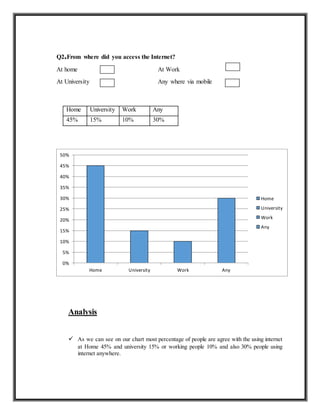
Q2.From where did you access the Internet?
At home At Work
At University Any where via mobile
Home University Work Any
45% 15% 10% 30%
Analysis
 As we can see on our chart most percentage of people are agree with the using internet
at Home 45% and university 15% or working people 10% and also 30% people using
internet anywhere.
0%
5%
10%
15%
20%
25%
30%
35%
40%
45%
50%
Home University Work Any
Home
University
Work
Any
Q3.Have you purchase anything from online during the last 12 months?
Yes No
Yes No
60 40
Analysis
 As we seen the graph people are online purchasing 60% that’s show’s online
service.
 And also other customer still not purchases any thing by online service.
60
40
Yes No
Q4.Do you have Mi Mobiles Phone?
Yes No
Analysis
 According to our above chart 39% people using Mi phone.
 In other hand 61% people competitor’s cell phone.
0%
10%
20%
30%
40%
50%
60%
70%
Yes
No
Yes No
39% 61%
Q.5How many phones do You have?
0 1
2 More then 2
0 1 2 More then
2
0% 45% 35% 20%
Analysis
 As you can see the graph 45 % customer are use only one handset.
 Another graph shows that 35% customer has one and more then handset or 20%
customer have more than two handset.
0%
5%
10%
15%
20%
25%
30%
35%
40%
45%
0 1 2 More then 2
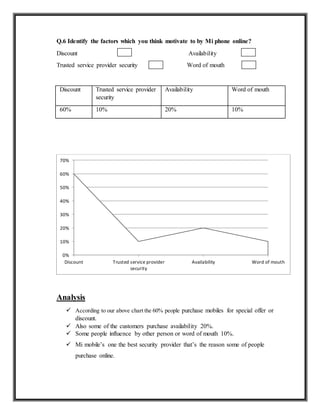
Q.6 Identify the factors which you think motivate to by Mi phone online?
Discount Availability
Trusted service provider security Word of mouth
Discount Trusted service provider
security
Availability Word of mouth
60% 10% 20% 10%
Analysis
 According to our above chart the 60% people purchase mobiles for special offer or
discount.
 Also some of the customers purchase availability 20%.
 Some people influence by other person or word of mouth 10%.
 Mi mobile’s one the best security provider that’s the reason some of people
purchase online.
0%
10%
20%
30%
40%
50%
60%
70%
Discount Trusted service provider
security
Availability Word of mouth
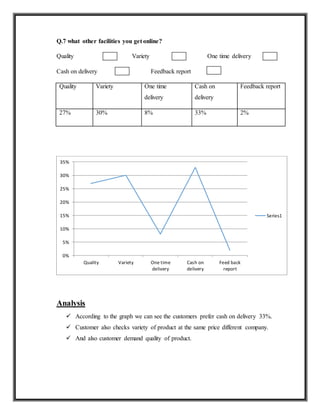
Q.7 what other facilities you get online?
Quality Variety One time delivery
Cash on delivery Feedback report
Quality Variety One time
delivery
Cash on
delivery
Feedback report
27% 30% 8% 33% 2%
Analysis
 According to the graph we can see the customers prefer cash on delivery 33%.
 Customer also checks variety of product at the same price different company.
 And also customer demand quality of product.
0%
5%
10%
15%
20%
25%
30%
35%
Quality Variety One time
delivery
Cash on
delivery
Feed back
report
Series1
Q.8 Is sufficient information about MI phone available online?
Strongly agree Agree Neutral
Disagree Strongly disagree
Strongly
agree
Agree Neutral Disagree Strongly disagree
50% 40% 5% 5% 0%
Analysis
 As we can see the graph most of the people strongly agree50%.
 Some of people agree 40% they can satisfy with the information in online.
Note- Most of the people satisfies information of Mi mobiles but 5% are not satisfied so
Mi Company must update they are information.
Strongly agree
50%
Agree
40%
Neutral
5%
Disagree
5%
Strongly disagree
0%
Chart Title
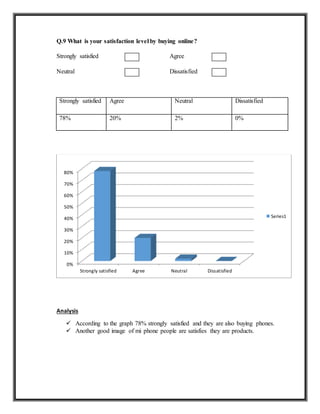
Q.9 What is your satisfaction level by buying online?
Strongly satisfied Agree
Neutral Dissatisfied
Analysis
 According to the graph 78% strongly satisfied and they are also buying phones.
 Another good image of mi phone people are satisfies they are products.
0%
10%
20%
30%
40%
50%
60%
70%
80%
Strongly satisfied Agree Neutral Dissatisfied
Series1
Strongly satisfied Agree Neutral Dissatisfied
78% 20% 2% 0%
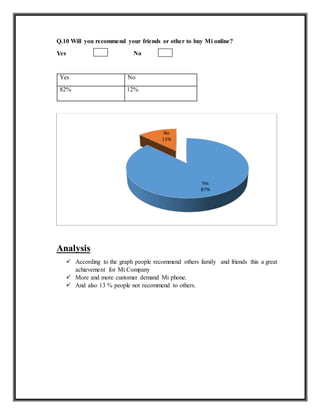
Q.10 Will you recommend your friends or other to buy Mi online?
Yes No
Yes No
82% 12%
Analysis
 According to the graph people recommend others family and friends this a great
achievement for Mi Company
 More and more customer demand Mi phone.
 And also 13 % people not recommend to others.
Yes
87%
No
13%
Findings
After doing survey and data analysis some finding has been highlighted. Those findings are
described below:
 We can say people prefer the Mi products because they believe it’s durable and
sustainable.
 Company was successful in positioning its target audience.
 Quality of Mi mobiles has been good products and people trust on that products. Mi
should sustain it and try to be better in the quality part.
 The products of the Mi have also some flaws like some of the people said that the price of
the product could be little bit less, experienced of people while shopping online of Mi
was not good etc., which should be corrected
 Mi Company needs to work on their advertisement and make it more attractive.
Suggestions
1. Mi mobiles should introduce a low price.
2. The company should give more concentrate on the advertisement.
3. Mi mobiles is available online only but to have more market share they can open
for offline store.
4. More service centre should be set up, so that it create better relationship with
customer.
5. Mi company cannot satisfy to the customer by providing after sale service.
6. Mi mobiles different web site at different prices so that company should fixed a
same rate for all website.
LIMITATIONS
1. Time was less
2. Resources was limited (cost)
3. In this huge population reaching each customer is not possible
4. The respondents might have given wrong information regarding the survey
5. Uncooperative behaviour of the people
Conclusion
The study reveals that the market of Mi is higher than the other company. The
market is very competitive. Advertisement and Promotional campaigns act as a major
role in creating awareness and preference. The Company should extended better service
and maintain a good rapport with customers. Relationship marketing plays a vital role in
this industry. So it can be concluded that a company, which provides attractive schemes
and goods service, will flourish.
Bibliography
Websites
 Google.com
 Wikipedia.com
 Mi.com
Books
 Philip Kotler – Marketing Management
 Naresh K Malhotra- Marketing Management
 Al Ries- Positioning- The battle for your mind
 Jack trout- The new positioning
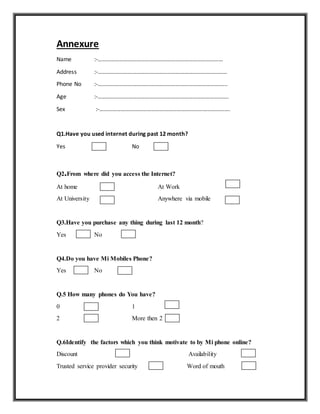
Annexure
Name :-……………………………………………………………………………
Address :-………………………………………………………………………………
Phone No :-……………………………………………………………………………...
Age :-……………………………………………………………………………….
Sex :-……………………………………………………………………………….
Q1.Have you used internet during past 12 month?
Yes No
Q2.From where did you access the Internet?
At home At Work
At University Anywhere via mobile
Q3.Have you purchase any thing during last 12 month?
Yes No
Q4.Do you have Mi Mobiles Phone?
Yes No
Q.5 How many phones do You have?
0 1
2 More then 2
Q.6Identify the factors which you think motivate to by Mi phone online?
Discount Availability
Trusted service provider security Word of mouth
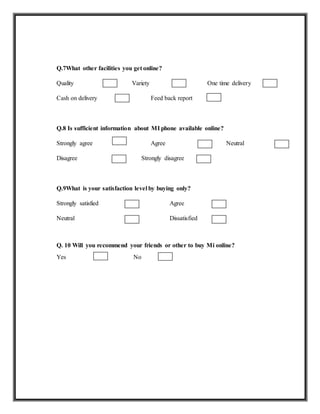
Q.7What other facilities you get online?
Quality Variety One time delivery
Cash on delivery Feed back report
Q.8 Is sufficient information about MI phone available online?
Strongly agree Agree Neutral
Disagree Strongly disagree
Q.9What is your satisfaction level by buying only?
Strongly satisfied Agree
Neutral Dissatisfied
Q. 10 Will you recommend your friends or other to buy Mi online?
Yes No

411927784 bba-project-report-on-mi-company

  • 1.
    EXECUTIVE SUMMARY Xiaomi Inc.is a privately owned electronics and software company founded in 2010 by serial entrepreneur Lei Jun, along with seven other co- founders. The mobile internet company has established its presence in 70 countries and regions and it is among the top 5 in 16 markets. Xiaomi currently employs about 18,000 people. In 2017 Xiaomi generated more than RMB 100 billion revenues and expected to get listed in the Fortune Global 500 list in foreseeable future.1 Xiaomi business strategy is based on cost advantage. Moreover, the company gathers and utilizes its large fan base in an efficient manner with positive implications on customer loyalty and the bottom line for the business. An aggressive expansion of ecosystem of products and services is also placed at the core of Xiaomi business strategy. The mobile internet company has matrix and flat organizational structure. According to framework of Ansoff Growth Matrix, Xiaomi uses all for strategies - market penetration, product development, market development and diversification, in an integrated manner. Efficient leadership by founder and CEO Lei
  • 2.
    Jun, impressive rateof growth and cost advantages compared to competition are considered as major strengths associated with Xiaomi. At the same time, the company has noteworthy weaknesses such as low profit margin, lower smartphone capabilities and functionalities compared to major competitors and difficulties of sustaining competitive advantage
  • 4.
    Chapter-1(Company profile) 1. History 2.Vision 3. Mission 4. Organization structure 5. Swot analysis 6. Product Chapter-2(Research Methodology) 1. Objective of research 2. Sample size 3. Survey method 4. Limitation Chapter-3(Distribution strategy) 1. Data analysis and interpretation 2. Finding 3. Suggestion 4. Conclusion 5. Bibliography
  • 5.
    HISTORY Xiaomi Inc. (stylizedas Mi) is a Chinese electronics and software company headquartered in Beijing. Xiaomi designs, develops, and sells smartphones, mobile apps, laptops and related consumer electronics. Xiaomi released its first smartphone in August 2011 and has rapidly gained market share in China to become China's largest smartphone company in 2014. As of 2017 Xiaomi is the world's 5th largest smartphone company.Xiaomi has expanded into developing a wider range of consumer electronics, including a smart home (IoT) device ecosystem. Xiaomi managed to take the electronics and mobile world by storm in 2014. Their flagship device, Mi4 was one of the best-selling phones in history and paved the path for mid-level mobile phones and their market base. The company was founded by eight partners in the year 2010 and was funded by a Singapore based investment group called Temasek Holdings and Chinese venture capitalists called IDG Capital along with Qiming Venture Partners. They were one of the first companies that were endorsed by core mobile companies, Qualcomm. Xiaomi continues to use their processors for their devices even today. One of the first devices that came out of Xiaomi was Mi2. This was the first device that featured the revolutionary and famous Qualcomm Snapdragon chip. The device sold close to 10 million units within the first 11 months of its inception, thus allowing Xiaomi to gain a foothold in markets such as Australia, United States, Europe and New Zealand In 2014, they managed to raise close to $1 Billion in equity funding with the help of a Hong Kong based investment group,All- Stars Investment Limited. This gave them a valuation of close to $45 billion, making them one of the most valuable companies in the world. Xiaomi has 15,000 employees in China, India, Malaysia, Singapore and is expanding to other countries such as Indonesia, the Philippines and South Africa. Lei Jun, the founder and CEO, has an estimated net worth of US$6.8 billion. He is China's 24th richest person in 2017. Xiaomi is the world's 4th most valuable technology start-up after it received US$1.1 billion funding from investors, making Xiaomi's valuation more than US$46 billion. Mr. Lei was part of the founding team of Kingsoft in 1992 and became CEO in 1998. A year later, he founded the IT information service and download website Joyo.com. After Kingsoft successfully completed their IPO, Mr. Lei stepped down from his position and became Vice Chairman at Kingsoft. In the early 2000’s, he invested in many successful start-up companies like YY, UC and Vancl as an angel
  • 6.
    investor, and onApril 6, 2010, he founded Xiaomi. In July 2011, he returned to Kingsoft as Chairman of the Board. Mr. Lei is currently the Chairman and CEO of Xiaomi. Mr. Lin graduated from Sun Yat-sen University in 1990, where he obtained an electronic engineering degree. He received his Master’s Degree in Computer Science at Drexel University in 1992. Soon after, he joined Microsoft, where he worked as Lead Project Engineer, Senior Develop Manager of MSRA, and Engineering Director of MSRA. Mr. Lin also contributed to the R&D of Microsoft products, including Windows Vista and IE 8. In 2006, he joined Google as the Vice President of the Google China Institute of Engineering and the Engineering Director of Google Global. He was in charge of building and managing Google China’s Mobile Searchand the Android App Localization teams. Mr. Li is currently head of the Mi.com e-commerce team. In 2010, Mr. Li co-founded Xiaomi where he led both the MIUI and Mi.com teams. Mr. Li has made a significant contribution to software and hardware design, development, marketing and other departments at Xiaomi. Since 2012, Mr. Li has been in charge of the e-commerce management, operations and marketing teams. Mr. Li is also the creator of popular Internet keywords such as “mobile phone geek,” “F code,” and “Mi Fan Festival”. In 2000, Mr. Li joined Kingsoft and co-founded their UIUX Design Center. He served at Kingsoft in various positions as the General Manager of Kingsoft Dictionary, Chief Designer of UI department, Director of Design Center, and Director of Internet Content. Mr. Li has also played a key role in developing many well-known software projects, including Kingsoft Antivirus, Kingsoft Dictionary and WPS Office. He is also considered one of the earliest UI and HCI experts in China. Dr. Zhou is the director of Xiaomi'sMi-Phone Team and obtained his PhD from Georgia Tech University in 1991. He was the Chief of Hardware R&D of Motorola's best-selling model "Ming" series. In 1995, he joined Motorola as a core expert engineer and returned to China to establish the R&D Center for Motorola China in 1999. During his career at Motorola, Dr. Zhou served as Senior Director of the Motorola Beijing R&D Center, Chief Engineer and Director of the R&D Center of Motorola Personal Communication Department, Vice Chairman of the Mobile Patent Committee in Motorola China Research Academy, and the Vice Chairman of Cellphone Quality Control in Motorola Asia-Pacific.
  • 7.
    Mr. Wong leadsthe Mi Wi-Fi and Mi Cloud teams. He graduated from Purdue University and worked for Microsoft from 1997 to 2010. While serving as the Director of Development at the Microsoft China Academy of Engineering, he oversaw the development of products such as the high performance analysis system of Microsoft’s business server, B2B systems, Biztalk auto- logistics distribution system, Windows Mobile (China), Windows Phone 7 Multimedia, Internet Explorer, and Instant Messenger. Mr. Hong leads the MIUI division at Xiaomi. He graduated from Shanghai Jiao Tong University where he obtained a computer science & engineering degree. He continued his academic career at Purdue University, where he received a Master’s Degree in Computer Science. From 2001 to 2005 Mr. Hong worked at Siebel and then joined Google as Senior Software Engineer in 2006. While at Google Headquarter, Mr. Hong oversaw Google Calendar, Google Maps and Google 3D Street View. From 2006 to 2010, he worked as Senior Product Manager of Google China and led the Google China team to develop a series of localized products like Google Music and Google Pinyin Input. Mr. Wang is the director for Internet TV related products such as Mi TV and Mi Box. He graduated from Beijing University of Technology with a Master’s Degree in Computer Science in 1993. Mr. Wang founded Thunder Stone Technology Ltd. in 1997 and led the company to be the largest audio-visual entertainment equipment supplier in China. In 2010, Mr. Wang founded Beijing Duokan Technology Co., Ltd where he currently serves as the CEO. He also helped co-found Xiaomi and in 2012 joined Xiaomi as a Co-founder and Vice President. Hugo Barra is responsible for Xiaomi's Global division and is in charge of the company's products and operations in all markets outside of Mainland China. Before joining Xiaomi in 2013, Hugo Barra was Vice President of Android Product Management at Google. Prior to joining the Android team, he worked for Google in London as Director of Product Management for Mobile, a role he had since joining the company in 2008. Hugo is a graduate of the Massachusetts Institute of Technology with bachelors and masters degrees in computer science, electrical engineering and management science. Mr. Chen leads Xiaomi’s content investment and operations. He holds multiple degrees: an MBA from China Europe International Business School, a Masters degree in Journalism from Renmin University of China, a Masters degree in Communications from Beijing Institute of Technology and a Bachelor's degree in
  • 8.
    Electrical Engineering fromBeijing University of Technology. Mr. Chen participated in the founding of a Sina subsidiary company in 1997 before joining Sina in 1998 fulfilling the positions of Executive Vice-President of Sinacorp and Chief Editor of sina.com
  • 9.
    Mission statement: "MAKING QUALITYTECHNOLOGY ACCESSIBLE TO EVERYONE". "At Xiaomi, we strive to create the highest quality products in lowest possible prices in order to provide people access to the necessary tools and services that connect them to the world, and ultimately, to their dreams.
  • 10.
    ORGANIZATIONAL STRUCTURE OFMI MOBILE COMPANY LEI JUN Co-Funder&CEO LIN BIN Co-Funder & President LI WANQIANG Co-Funder & Chief Brand Officer ZHOU GUANGPING Co-Funder & Chief Scientist HONG FENG Co-Funder & Senior Vice President LIU DE Co-Funder & Senior Vice President WANG CHUAN Co-Funder&Senior Vice President WONG JIANGI Co-Funder & Vice President WANG XIANG Senior Vice President QI YANG Senior Vice President CHEW SHOUZI CFO SHANG JIN Vice President MANU JAIN Vice President & Managing Director WANG LINGMING VicePresident
  • 11.
    XIAOMI MOBILE PHONEPROFILE AND ITS SWOT ANALYSIS Xiaomi mobile phone profile:- Xiaomi Inc. is a privately owned Chinese electronics company headquartered in Beijing. It is the world's 4th largest smartphone maker. Xiaomi designs, develops, and sells smart phones, mobile apps, laptops, and related consumer electronics. On August 16, 2010, Xiaomi officially launched its first Android-based firmware MIUI. The Xiaomi Mi1 smart phone was announced in August 2011. It was shipped with Xiaomi's MIUI firmware which is based on Android and resembles Samsung's TouchWiz and Apple's iOS. The device could also be equipped with stock Android. Mi 1 appears immediately caused a sensation in the hasbeen choppy mobile phone market. And this is not only because of its powerful configuration, but also because of its attractive price, so that the popularity of Xiaomi rapidly rising. Almost overnight, "Xiaomi" has become a hot topic on concern mobile phone enthusiasts. Followed by a series of listed M2, M3 and Redmi pushed Xiaomi phone on the front of the domestic mobile phone. Mitalk:- Mitalk is Xiaomi production of a mobile phone terminal free instant messaging tool, it can not only cross iPhone, Android, Symbian mobile phone platform, can also cross China Mobile, China Unicom, Telecom so on different operators. As long as through the mobile phone network (WiFi, 3G, GPRS),can communicate with the relevant contacts for real-time information communication, send and receive pictures and audio, it is important to consume only network traffic. MIUI:- MIUI officially released on June 1, 2010, it is Xiaomi company depth customization of an Android mobile phone operating system, MIUI aim at native Android system for a number of improvements to optimize, its user covers in 23 countries, by the majority of mobile enthusiasts highly sought after. MIUI original features MIUI interface system, is committed to providing smart phones in the most extreme calls and text messages comfortable experience ,for Chinese users use habits are perfect match, Xiaomi technology is China's first use of Internet development model for mobile phone operating system development team , reference MIUI Community enthusiasts feedback to improve, weekly updates iterations, always give users the latest experience. And MIUI has the world's largest mobile phone wallpaper theme library, personalized themes and lock screen mode, as well as a wealth of custom methods.
  • 12.
    Introduction to SWOTanalysis method: SWOT analysis method is a kind of enterprise strategy analysis method, which is based on the enterprise's own inherent conditions to analyze, find out the advantages, disadvantages and core competitiveness of enterprises. The internal factors: S represents strength W represents weakness; The external factors: O represents opportunity, T represent threat. Xiaomi mobile phone SWOT analysis:- Strength: Xiaomi mobile phone can win the hearts of the people, its advantages are mainly summarized as five aspects: the enterprise internal advantages, mobile phone itself advantage, price advantage, sales channel advantage, unique promotional strategy. Weakness: Xiaomi phone shortcomings are: mobile phone itself defects, lack of credibility, after- sales service has been questioned. Mobile phone itself defects: 1. There are many hardware problems  The screen become warped foot problem   The phone off the paint problem   The back cover closing cracks imprecise problems   Phone body shaking have a sound problem   In the original accessories without headset   Battery heating problem
  • 13.
    2.Lack of credibility 3.After-salesservice has been questioned Worry about the system stability and the quality of the product workmanship of people each accounted for 63.64%, worry about after-sales service and battery heating problem respectively accounted for 63.36%, 43.18%, and 9.09% are worried about other issues. Xiaomi mobile phone concerns Opportunity: 1. Competitors to weaken 2.Mobile phone computerized trend 3.The development of future mobile terminal 4. China market advantage Threat:- 1. The smart phone market is highly competitive 2.The independent property rights is not high 3. Public opinion pressure challenge
  • 14.
    Mi PRODUCT’S 3s Prime Redmiis a budget smartphone line manufactured by Xiaomi, that was first announced in July 2013.Redmi phones use the Xiaomi MIUI operating system, a variant of Android. Models can be divided into regular RedMi phones with screens usually up to 5" and RedMi Note series with displays exceeding 5". Only phone besides these two series is Redmi Pro, first introduced in 2016 with Dual Camera system, USB-C and unique for Xiaomi devices OLED display. Redmi phones have been marketed in several Asian and European countries.The most significant difference from other Xiaomi smartphones is that it uses less-expensive components and thus is more cost-effective. In August 2014 The Wall Street Journal reported that in the second quarter of the 2014 fiscal year Xiaomi smartphone shipment rankings in China with a market share of 14%.Redmi sales were attributed as a contributing factor toward this gain in shipment rankings. Display IPS Ram 2/3GB 4GLTESupport YES Display size 5" Internal storage 16 / 32 GB Operating system MIUI v9 Android 6.0 Release date 2016.4 Primary camera 13MP Samsung ISOCELL S5K3L8/ OmniVision OV13853 System chip Qualcomm Snapdragon 430 Front camera 5MP OmniVision OV5670
  • 15.
    XiaomiMi 4 The XiaomiMi4 is a smartphone developed by Xiaomi Inc. It is part of Xiaomi's high- end smartphone line, and was released in August 2014. Xiaomi held an event to formally introduce the high-end phone, and its complementary smart-accessory, the XiaomiMiBand, during the Xiaomi New Product Launch Event 2014 on 22 July 2014. Similar to the principle of the Xiaomi Mi2, the Mi 4 is a highly revamped version of its predecessor, the Xiaomi Mi3. The phone is of a different design to its predecessor. It was also released slightly before the new MIUI 6, which was introduced in August 2014. Display IPS Ram 3GB 4GLTESupport YES Display size 5" Internal storage 64 GB + MicroSD Operating system MIUI 9 Android 7.0 Release date 2016.03 Primary camera 13 MPx Sony IMX258/Samsung ISOCELL S5K3M2 Battery 3080 mAh System chip Qualcomm Snapdragon 808 4x 1.4 GHz & 2x 1.8 GHz Front camera 5 MPx OmniVision OV5670 Weight 149 g
  • 16.
    XiaomiMi A1 The XiaomiMiA1 is a re-branded XiaomiMi 5X phone, co-developed by Google—as part of its Android One initiative—and Xiaomi that runs on the Android operating system. The XiaomiMi A1 was unveiled on September 5, 2017 and it is available in all of Xiaomi's current markets with the exception of the People's Republic of China, where Mi 5X MIUI based variant of the phone was released prior that year. Display LTPS Ram 4 GB 4GLTESupport YES Display size 5.5" Internal storage 64 GB + microSD Operating system Android One Android 8.0 Release date 2017.09 Primary camera 2x 12 MPx OmniVision OV12A10+OV1288 Rear camera Dual 12 MP phase detection autofocus, 2x optical lossless zoom, dual-LED flash Resolution FHD 1080p Front camera 5 MPX Samsung S5K5E8 Weight 165 g System chip Qualcomm Snapdragon 625 8x 2 GHz Battery Non-removable Li- Ion3080 mAh battery GPU Adreno 506
  • 17.
  • 18.
    OBJECTIVES August 16, 2011,when the Xiaomi Technology CEO Lei Jun appeared on the stage of the 798 Art District, Beijing Clubhouse, the presence of the Xiaomi fans shouted "Lei Busi" name, this is no doubt that, in the minds of Xiaomi fans and look forward to Lei Jun as the next Steve Jobs, hope Xiaomi become to "China's Apple phone". TechCrunchDisruprt conference held in Beijing on November 1, 2011, the Xiaomi Technology CEO Lei Jun said, the Xiaomi technology goal is to become a "world-class" mobile Internet company and successfully broke into the top 500 list of "Fortune" "Apple iPhone" redefined the smart phone, and other smart phone products in the past five years, could not keep up with the iPhone for the same reason I launched Xiaomi mobile phone. OBJECTIVES OF RESERCH  To find out the features, that makes Mi brand more attractive to its customers.  To find out more easy way to make visible the brand in eyes of customers.  To attract more customer towards the brand.  To increase awareness in the market. SAMPLE SIZE As there was a certain limitation (like time and others resources) my research is done based on 100 sample size.
  • 19.
    SURVEY METHOD A fieldof applied statistics of human research surveys, survey methodology studies the sampling of individual unites from a population and associated survey data collection techniques , such as questionnaire construction and methods for improving the number and accuracy of responses to surveys. It contains two parts:- According to instrumentation 1. Questionnaires 2. Interviews According to the time of span involved 1. Cross sectional surveys 2. Longitudinal surveys
  • 20.
    Data analysisand interpretation Q1.Haveyou used internet during past 12 month? Yes 84% No 16% Analysis  As we can see on the survey data we find that out of 100 people 84% people are stated that the using internet service and 16% people said they are not using internet. Note – We could see that 16% customer’s still not using internet service so that the government take action to educated 16% people. 84% 16% yes no
  • 21.
    Q2.From where didyou access the Internet? At home At Work At University Any where via mobile Home University Work Any 45% 15% 10% 30% Analysis  As we can see on our chart most percentage of people are agree with the using internet at Home 45% and university 15% or working people 10% and also 30% people using internet anywhere. 0% 5% 10% 15% 20% 25% 30% 35% 40% 45% 50% Home University Work Any Home University Work Any
  • 22.
    Q3.Have you purchaseanything from online during the last 12 months? Yes No Yes No 60 40 Analysis  As we seen the graph people are online purchasing 60% that’s show’s online service.  And also other customer still not purchases any thing by online service. 60 40 Yes No
  • 23.
    Q4.Do you haveMi Mobiles Phone? Yes No Analysis  According to our above chart 39% people using Mi phone.  In other hand 61% people competitor’s cell phone. 0% 10% 20% 30% 40% 50% 60% 70% Yes No Yes No 39% 61%
  • 24.
    Q.5How many phonesdo You have? 0 1 2 More then 2 0 1 2 More then 2 0% 45% 35% 20% Analysis  As you can see the graph 45 % customer are use only one handset.  Another graph shows that 35% customer has one and more then handset or 20% customer have more than two handset. 0% 5% 10% 15% 20% 25% 30% 35% 40% 45% 0 1 2 More then 2
  • 25.
    Q.6 Identify thefactors which you think motivate to by Mi phone online? Discount Availability Trusted service provider security Word of mouth Discount Trusted service provider security Availability Word of mouth 60% 10% 20% 10% Analysis  According to our above chart the 60% people purchase mobiles for special offer or discount.  Also some of the customers purchase availability 20%.  Some people influence by other person or word of mouth 10%.  Mi mobile’s one the best security provider that’s the reason some of people purchase online. 0% 10% 20% 30% 40% 50% 60% 70% Discount Trusted service provider security Availability Word of mouth
  • 26.
    Q.7 what otherfacilities you get online? Quality Variety One time delivery Cash on delivery Feedback report Quality Variety One time delivery Cash on delivery Feedback report 27% 30% 8% 33% 2% Analysis  According to the graph we can see the customers prefer cash on delivery 33%.  Customer also checks variety of product at the same price different company.  And also customer demand quality of product. 0% 5% 10% 15% 20% 25% 30% 35% Quality Variety One time delivery Cash on delivery Feed back report Series1
  • 27.
    Q.8 Is sufficientinformation about MI phone available online? Strongly agree Agree Neutral Disagree Strongly disagree Strongly agree Agree Neutral Disagree Strongly disagree 50% 40% 5% 5% 0% Analysis  As we can see the graph most of the people strongly agree50%.  Some of people agree 40% they can satisfy with the information in online. Note- Most of the people satisfies information of Mi mobiles but 5% are not satisfied so Mi Company must update they are information. Strongly agree 50% Agree 40% Neutral 5% Disagree 5% Strongly disagree 0% Chart Title
  • 28.
    Q.9 What isyour satisfaction level by buying online? Strongly satisfied Agree Neutral Dissatisfied Analysis  According to the graph 78% strongly satisfied and they are also buying phones.  Another good image of mi phone people are satisfies they are products. 0% 10% 20% 30% 40% 50% 60% 70% 80% Strongly satisfied Agree Neutral Dissatisfied Series1 Strongly satisfied Agree Neutral Dissatisfied 78% 20% 2% 0%
  • 29.
    Q.10 Will yourecommend your friends or other to buy Mi online? Yes No Yes No 82% 12% Analysis  According to the graph people recommend others family and friends this a great achievement for Mi Company  More and more customer demand Mi phone.  And also 13 % people not recommend to others. Yes 87% No 13%
  • 30.
    Findings After doing surveyand data analysis some finding has been highlighted. Those findings are described below:  We can say people prefer the Mi products because they believe it’s durable and sustainable.  Company was successful in positioning its target audience.  Quality of Mi mobiles has been good products and people trust on that products. Mi should sustain it and try to be better in the quality part.  The products of the Mi have also some flaws like some of the people said that the price of the product could be little bit less, experienced of people while shopping online of Mi was not good etc., which should be corrected  Mi Company needs to work on their advertisement and make it more attractive.
  • 31.
    Suggestions 1. Mi mobilesshould introduce a low price. 2. The company should give more concentrate on the advertisement. 3. Mi mobiles is available online only but to have more market share they can open for offline store. 4. More service centre should be set up, so that it create better relationship with customer. 5. Mi company cannot satisfy to the customer by providing after sale service. 6. Mi mobiles different web site at different prices so that company should fixed a same rate for all website.
  • 32.
    LIMITATIONS 1. Time wasless 2. Resources was limited (cost) 3. In this huge population reaching each customer is not possible 4. The respondents might have given wrong information regarding the survey 5. Uncooperative behaviour of the people
  • 33.
    Conclusion The study revealsthat the market of Mi is higher than the other company. The market is very competitive. Advertisement and Promotional campaigns act as a major role in creating awareness and preference. The Company should extended better service and maintain a good rapport with customers. Relationship marketing plays a vital role in this industry. So it can be concluded that a company, which provides attractive schemes and goods service, will flourish.
  • 34.
    Bibliography Websites  Google.com  Wikipedia.com Mi.com Books  Philip Kotler – Marketing Management  Naresh K Malhotra- Marketing Management  Al Ries- Positioning- The battle for your mind  Jack trout- The new positioning
  • 35.
    Annexure Name :-…………………………………………………………………………… Address :-……………………………………………………………………………… PhoneNo :-……………………………………………………………………………... Age :-………………………………………………………………………………. Sex :-………………………………………………………………………………. Q1.Have you used internet during past 12 month? Yes No Q2.From where did you access the Internet? At home At Work At University Anywhere via mobile Q3.Have you purchase any thing during last 12 month? Yes No Q4.Do you have Mi Mobiles Phone? Yes No Q.5 How many phones do You have? 0 1 2 More then 2 Q.6Identify the factors which you think motivate to by Mi phone online? Discount Availability Trusted service provider security Word of mouth
  • 36.
    Q.7What other facilitiesyou get online? Quality Variety One time delivery Cash on delivery Feed back report Q.8 Is sufficient information about MI phone available online? Strongly agree Agree Neutral Disagree Strongly disagree Q.9What is your satisfaction level by buying only? Strongly satisfied Agree Neutral Dissatisfied Q. 10 Will you recommend your friends or other to buy Mi online? Yes No