Summer School
 Open Innovation & User eXperience Design & Assessment

                           Day 1, 10th September 2012


Session:          Introduction


Presenter:        Roberto Santoro


     Milan, 10th – 14th Sep. 2012
1st Summer School on “Open Innovation and
User eXperience Design & Assessment”

Hands on UX Design Summer School - Milan, 10th –
14th September 2012
• To raise awareness on design innovation, based
on the Integration of Design methodologies within
Living Labs’ environments
• To apply UX design concepts to specific cases
including Smart Conference
• To develop a roadmap for the UX based design
framework
User Experience


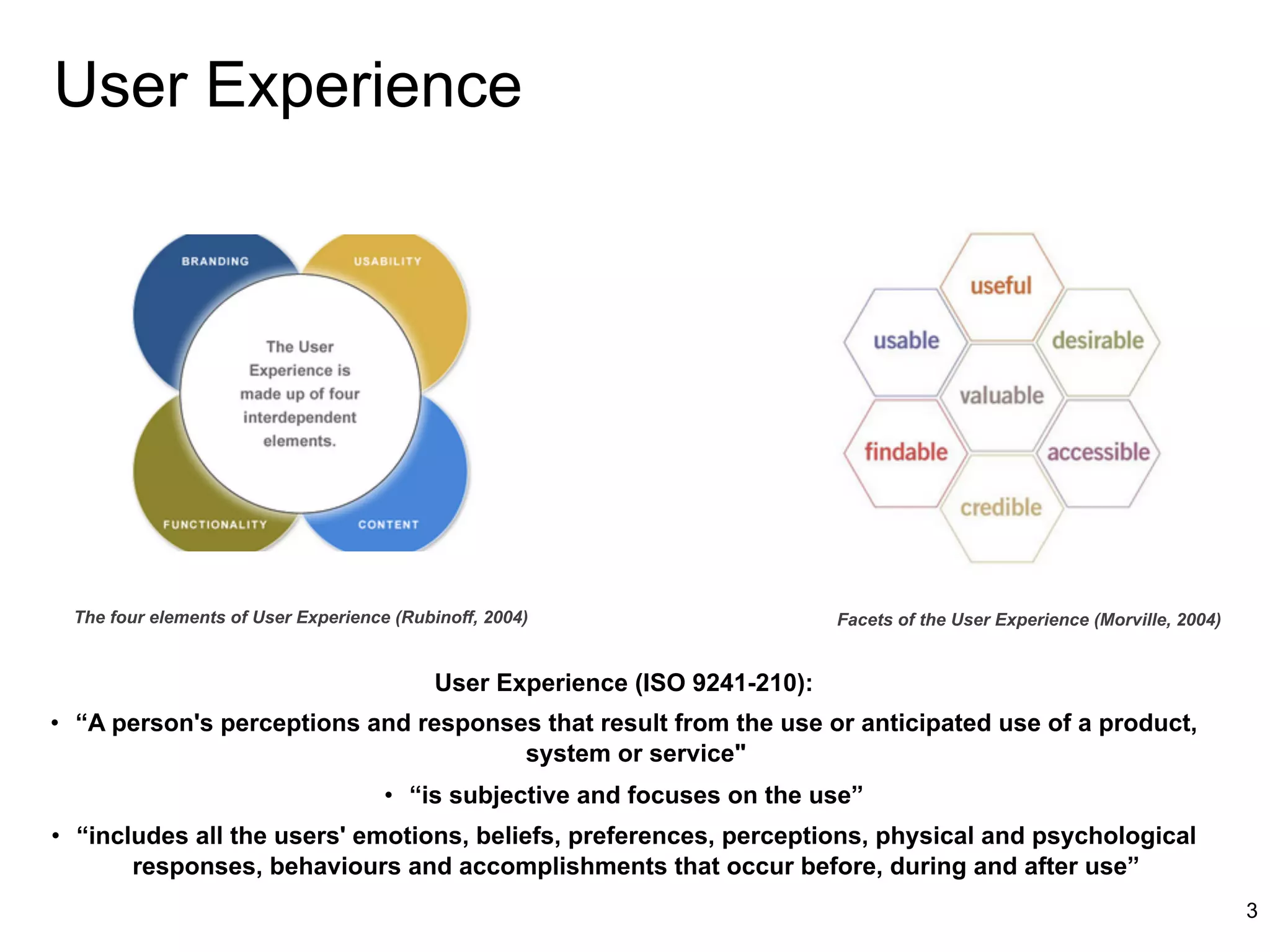
 The four elements of User Experience (Rubinoff, 2004)                       Facets of the User Experience (Morville, 2004)


                                           User Experience (ISO 9241-210):
•  “A person's perceptions and responses that result from the use or anticipated use of a product,
                                       system or service"
                                     •  “is subjective and focuses on the use”
•  “includes all the users' emotions, beliefs, preferences, perceptions, physical and psychological
        responses, behaviours and accomplishments that occur before, during and after use”
                                                                                                                              3
Experience Design
Experience Design is the practice of designing products, processes, services,
events, and environments with a focus placed on the quality of the user
experience and culturally relevant solutions, with less emphasis placed on
increasing and improving functionality of the design (Aarts & Marzano, 2003).

Many disciplines are involved in Experience Design, such as cognitive and
perceptual psychology, cognitive science, architecture and environmental
design, interaction design (ergonomics & haptics), product design,
ethnography, service design, heuristics, technical communication and
design thinking.


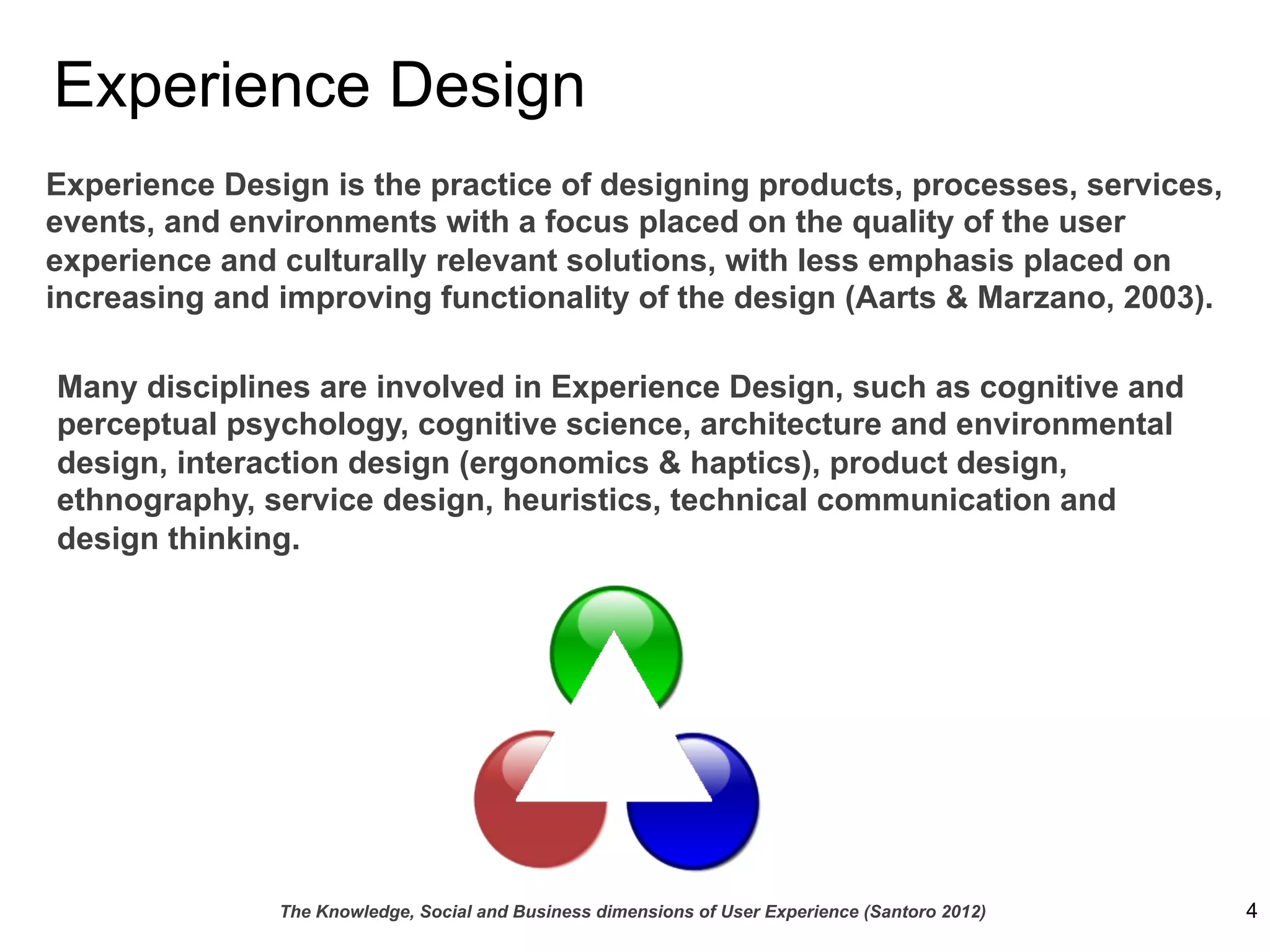
               The Knowledge, Social and Business dimensions of User Experience (Santoro 2012)   4
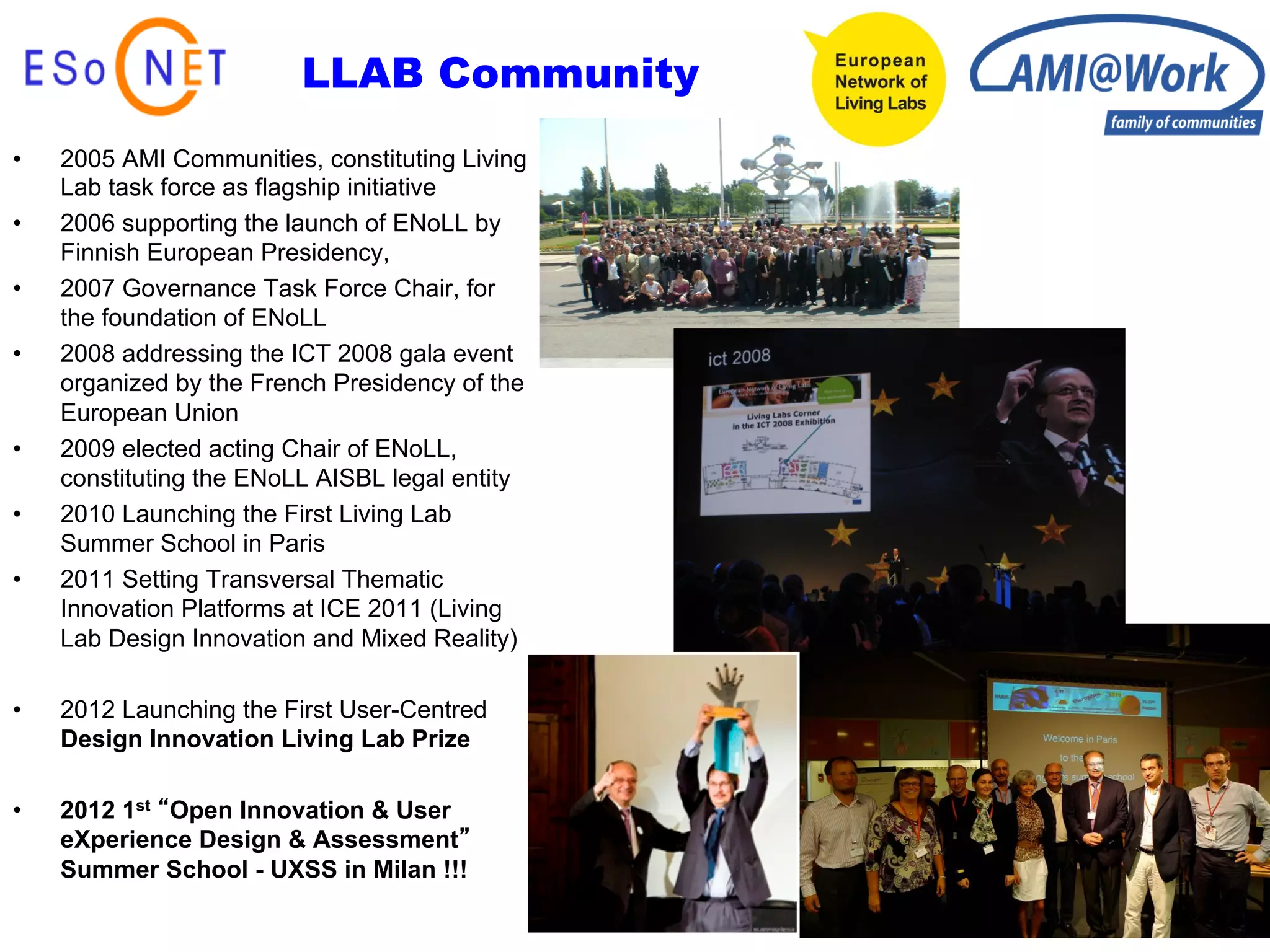
LLAB Community
•    2005 AMI Communities, constituting Living
     Lab task force as flagship initiative
•    2006 supporting the launch of ENoLL by
     Finnish European Presidency,
•    2007 Governance Task Force Chair, for
     the foundation of ENoLL
•    2008 addressing the ICT 2008 gala event
     organized by the French Presidency of the
     European Union
•    2009 elected acting Chair of ENoLL,
     constituting the ENoLL AISBL legal entity
•    2010 Launching the First Living Lab
     Summer School in Paris
•    2011 Setting Transversal Thematic
     Innovation Platforms at ICE 2011 (Living
     Lab Design Innovation and Mixed Reality)

•    2012 Launching the First User-Centred
     Design Innovation Living Lab Prize

•    2012 1st Open Innovation & User
     eXperience Design & Assessment
     Summer School - UXSS in Milan !!!
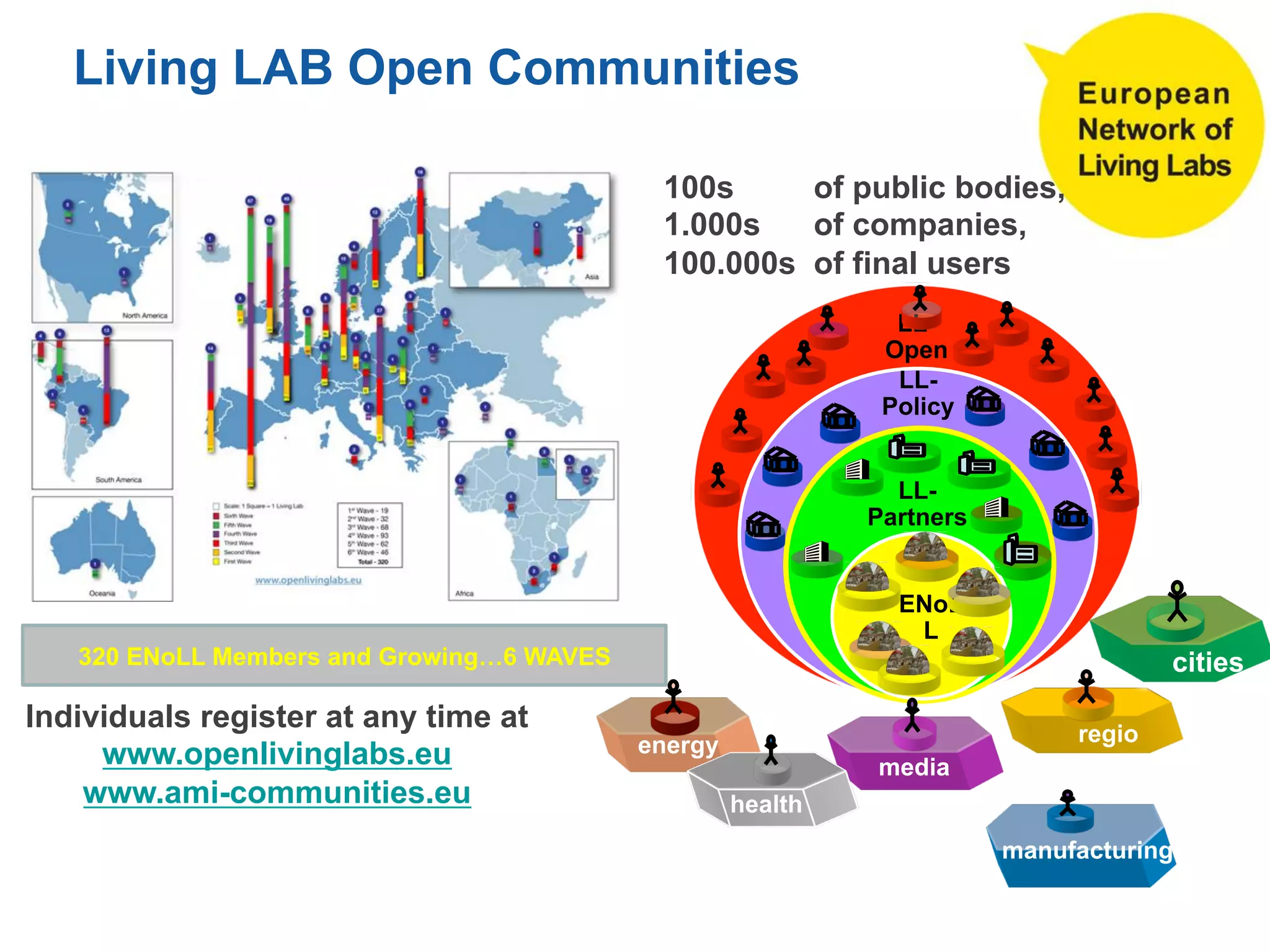
Living LAB Open Communities

                                            100s     of public bodies,
                                            1.000s   of companies,
                                            100.000s of final users
                                                                     LL-
                                                                   Open
                                                                     LL-
                                                               LL- Policy
                                                             Partner
                                                                s
                                                                     LL-
                                                                  Partners


                                                                    ENoL
                                                                     L
   320 ENoLL Members and Growing…6 WAVES                                                  cities
Individuals register at any time at                                               regio
     www.openlivinglabs.eu                 energy
                                                                  media
    www.ami-communities.eu                          health
                                                                             manufacturing
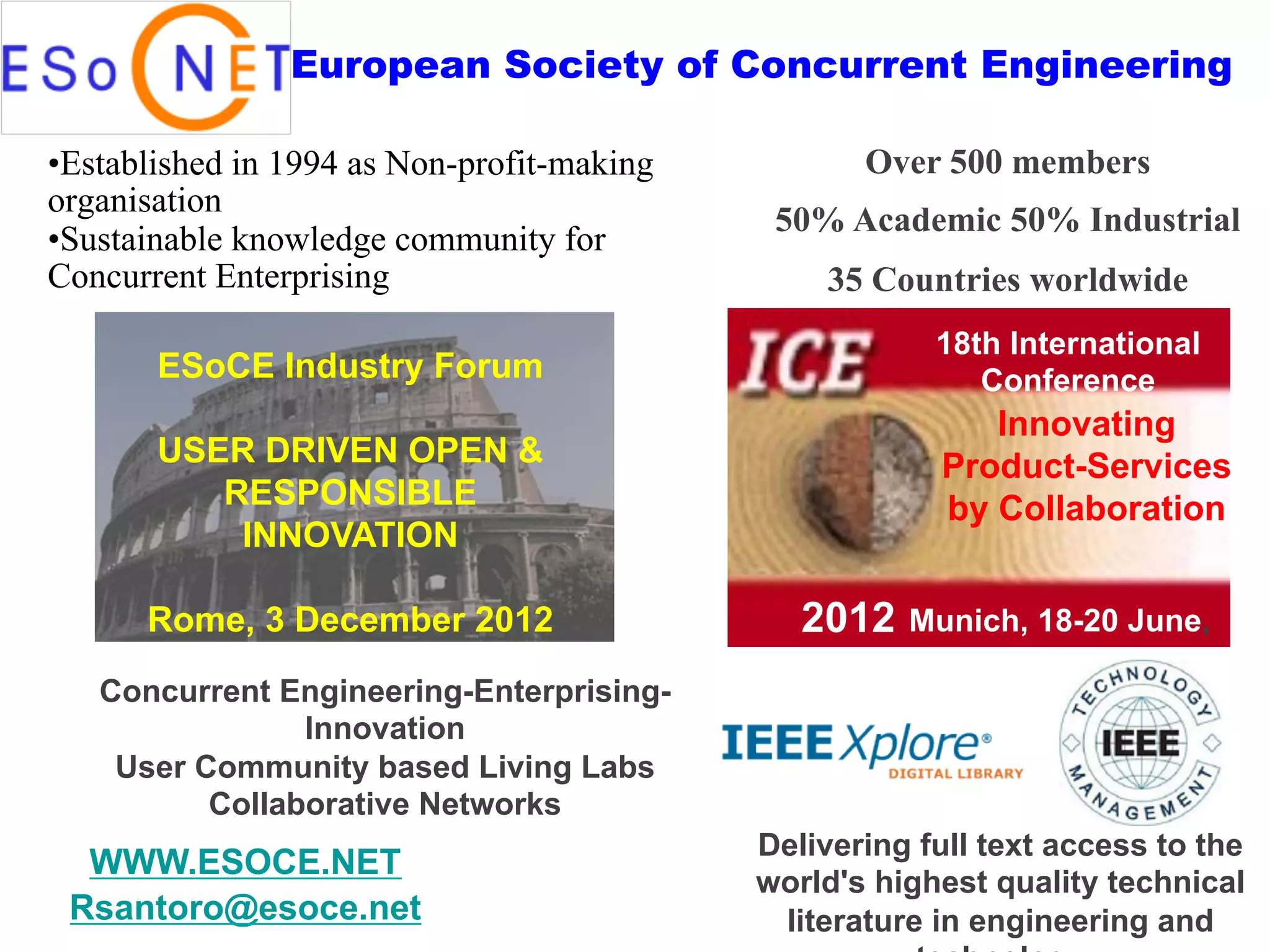
European Society of Concurrent Engineering

• Established in 1994 as Non-profit-making          Over 500 members
organisation
                                              50% Academic 50% Industrial
• Sustainable knowledge community for
Concurrent Enterprising                          35 Countries worldwide
                                                         18th International
       ESoCE Industry Forum                                 Conference
                                                            Innovating
       USER DRIVEN OPEN &                                Product-Services
          RESPONSIBLE                                    by Collaboration
           INNOVATION

      Rome, 3 December 2012                     2012   Munich, 18-20 June,

   Concurrent Engineering-Enterprising-
                Innovation
    User Community based Living Labs
          Collaborative Networks
                                             Delivering full text access to the
  WWW.ESOCE.NET
                                             world's highest quality technical
 Rsantoro@esoce.net                           literature in engineering and
“IDeALL: Integrating Design for All in
Living Labs”
•     “How to Improve User-Centered Innovation
     with Design for all Methodologies and
     Experimentations with Users in Living Labs?
     Example of IDeALL Project.”
      http://www.ami-communities.eu/wiki/IDeALL
•    The goal of the IDeALL project is to connect
     designers and innovative eco-systems in order
     to create a common platform. Furthermore, its
     purpose is to link two innovative and user-
     centered communities: Living labs and the
     Design for All community.
•    This project banks on the fact that the
     connection of Living Labs and Design for All
     communities will favour innovation through joint
     approach toward non-technological innovation,
     putting the human being at the heart of the
     concerns.


                                                        8
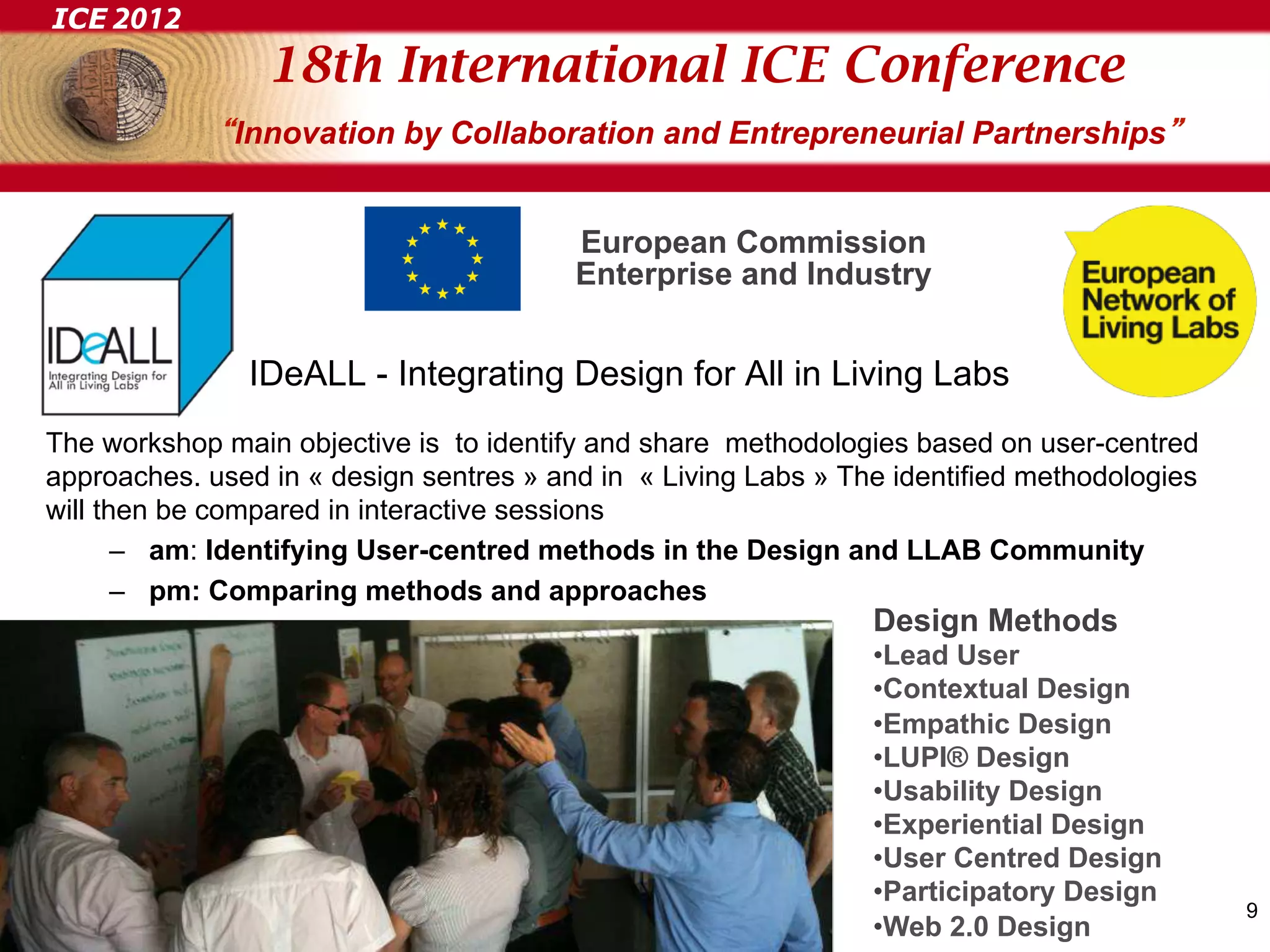
ICE 2012
                 18th International ICE Conference
              Innovation by Collaboration and Entrepreneurial Partnerships


                                         European Commission
                                         Enterprise and Industry


               IDeALL - Integrating Design for All in Living Labs
The workshop main objective is to identify and share methodologies based on user-centred
approaches. used in « design sentres » and in « Living Labs » The identified methodologies
will then be compared in interactive sessions
       –  am: Identifying User-centred methods in the Design and LLAB Community
       –  pm: Comparing methods and approaches
                                                                Design Methods
                                                                • Lead User
                                                                • Contextual Design
                                                                • Empathic Design
                                                                • LUPI® Design
                                                                • Usability Design
                                                                • Experiential Design
                                                                • User Centred Design
                                                                • Participatory Design
                                                                                             9
                                                                • Web 2.0 Design
The final list of 16 criteria for
Design Methods assessment
•    Cost Effectiveness (includes Cost Process and Cost)
•    Decision Power (who has the power of deciding? Legitimacy? Designers?
     Users? Policymakers? Degree of hierarchy?
•    Empirical Evidence (the degree to which a method was previously successful: it means that
     empirical studies of this method are available)
•     Expertise (type and level of expertise needed)
•     Impact Measurement (the degree to which the method has an impact on the design
     successfulness)
•     Immersive Experience (the degree of interaction within the innovative scenario)
•     Product Evaluation (users and companies perspectives)
•     Nature of Deliverables (e.g. prototypes, products, services, scenarios)
•     Observations (needs & expectations, capacities, users behaviours & feelings)
•     Physical Support (the material used to play the innovative scenario)
•     Privacy Issues (e.g. digital identity, confidential information, anonymous characteristics)
•     Public/Private (the degree to which the method is compatible with either PP partnership or just
     Public dev. or just Private dev.)
•     Time (Project planning)
•     User Feedback (e.g. surveys, Focus Group Interview)
•     User Contribution (the degree of involvement as observed subject or as co-creating value)
•     User Involvement (individual user, group of users)
•     Visual (the degree of concretisation of the concepts)
                                                                                                        10
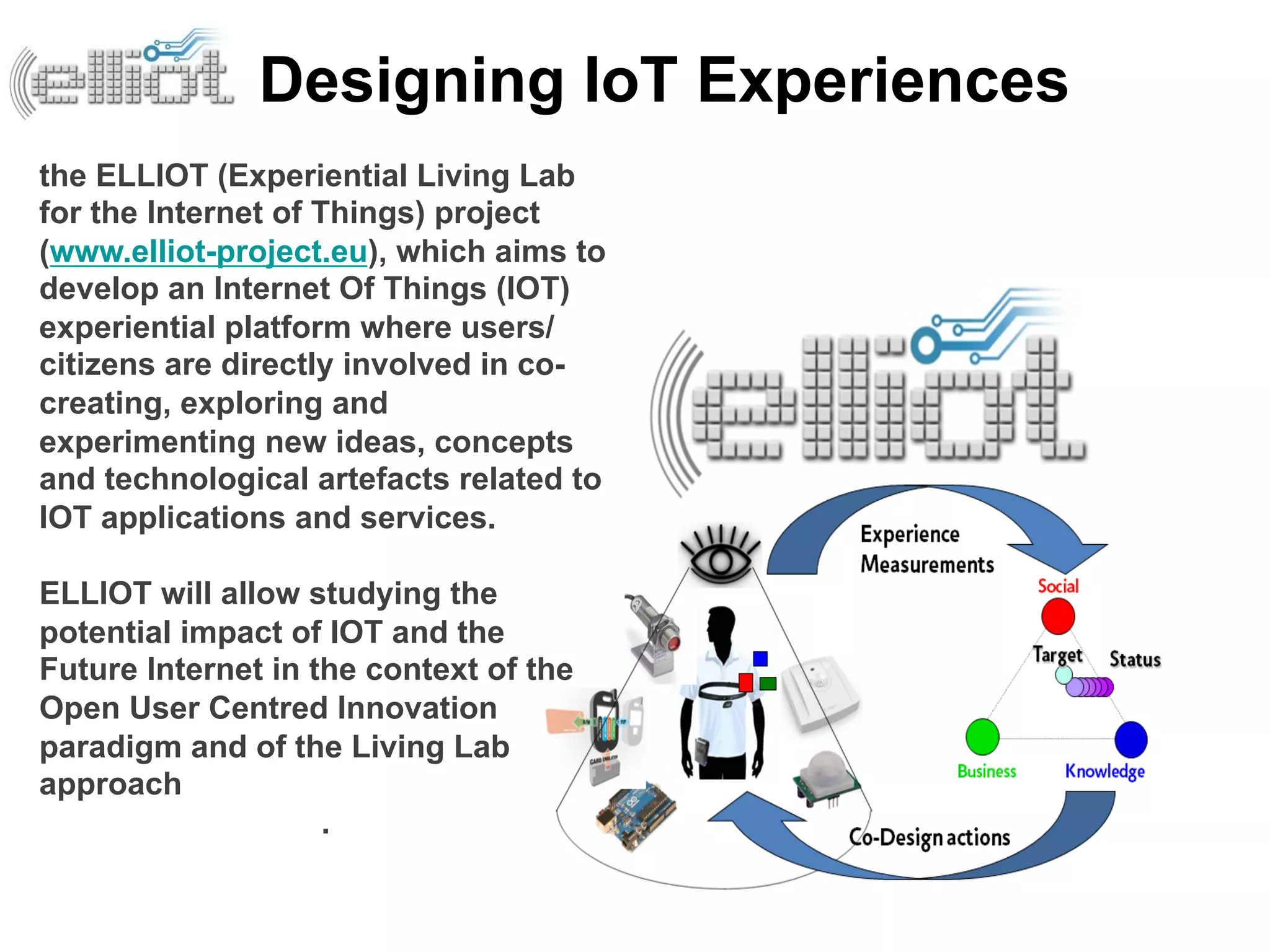
Designing IoT Experiences
the ELLIOT (Experiential Living Lab
for the Internet of Things) project
(www.elliot-project.eu), which aims to
develop an Internet Of Things (IOT)
experiential platform where users/
citizens are directly involved in co-
creating, exploring and
experimenting new ideas, concepts
and technological artefacts related to
IOT applications and services.

ELLIOT will allow studying the
potential impact of IOT and the
Future Internet in the context of the
Open User Centred Innovation
paradigm and of the Living Lab
approach
                    .
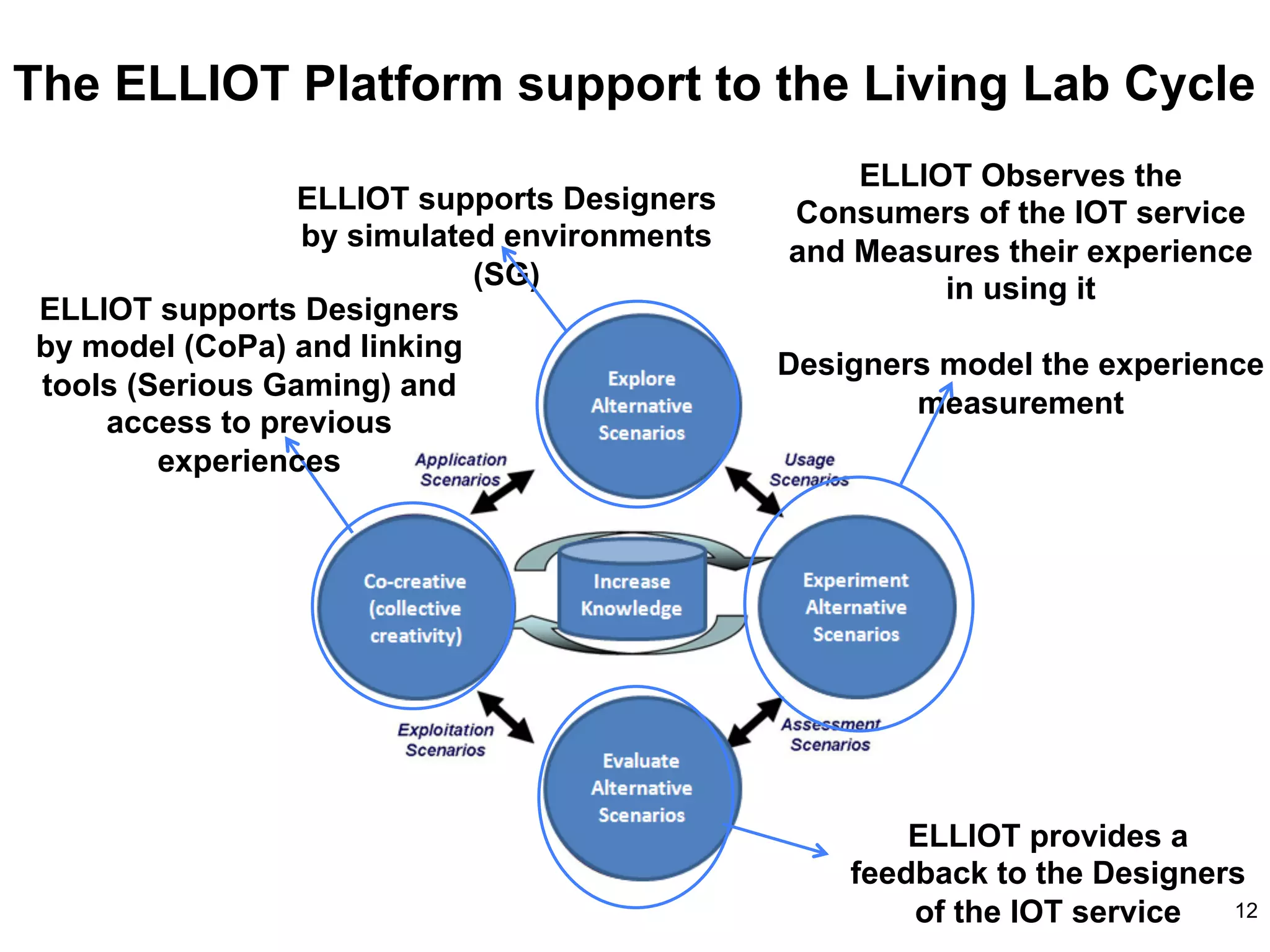
The ELLIOT Platform support to the Living Lab Cycle
                                                 ELLIOT Observes the
                 ELLIOT supports Designers   Consumers of the IOT service
                 by simulated environments   and Measures their experience
                            (SG)                      in using it
ELLIOT supports Designers
by model (CoPa) and linking
                                             Designers model the experience
tools (Serious Gaming) and
                                                     measurement
    access to previous
        experiences


                                                     ELLIOT provides a
                                                 feedback to the Designers
                                                     of the IOT service  12
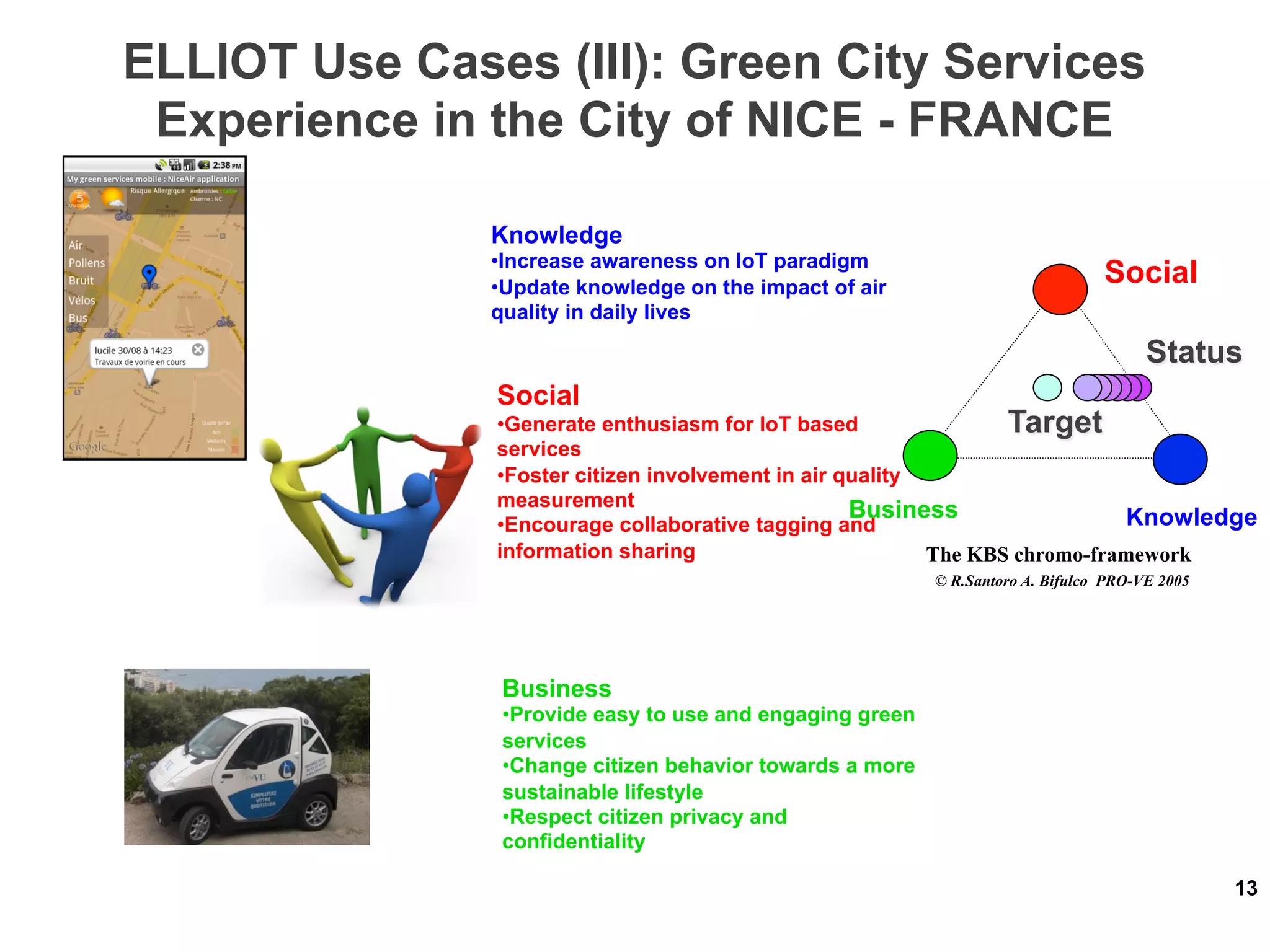
ELLIOT Use Cases (III): Green City Services
 Experience in the City of NICE - FRANCE

               Knowledge
               • Increase awareness on IoT paradigm
               • Update knowledge on the impact of air
                                                                                 Social
               quality in daily lives

                                                                                       Status
               Social
               • Generate enthusiasm for IoT based                Target
               services
               • Foster citizen involvement in air quality
               measurement                          Business
               • Encourage collaborative tagging and                         Knowledge
               information sharing                         The KBS chromo-framework
                                                           © R.Santoro A. Bifulco PRO-VE 2005


                Business
                • Provide easy to use and engaging green
                services
                • Change citizen behavior towards a more
                sustainable lifestyle
                • Respect citizen privacy and
                confidentiality

                                                                                                13
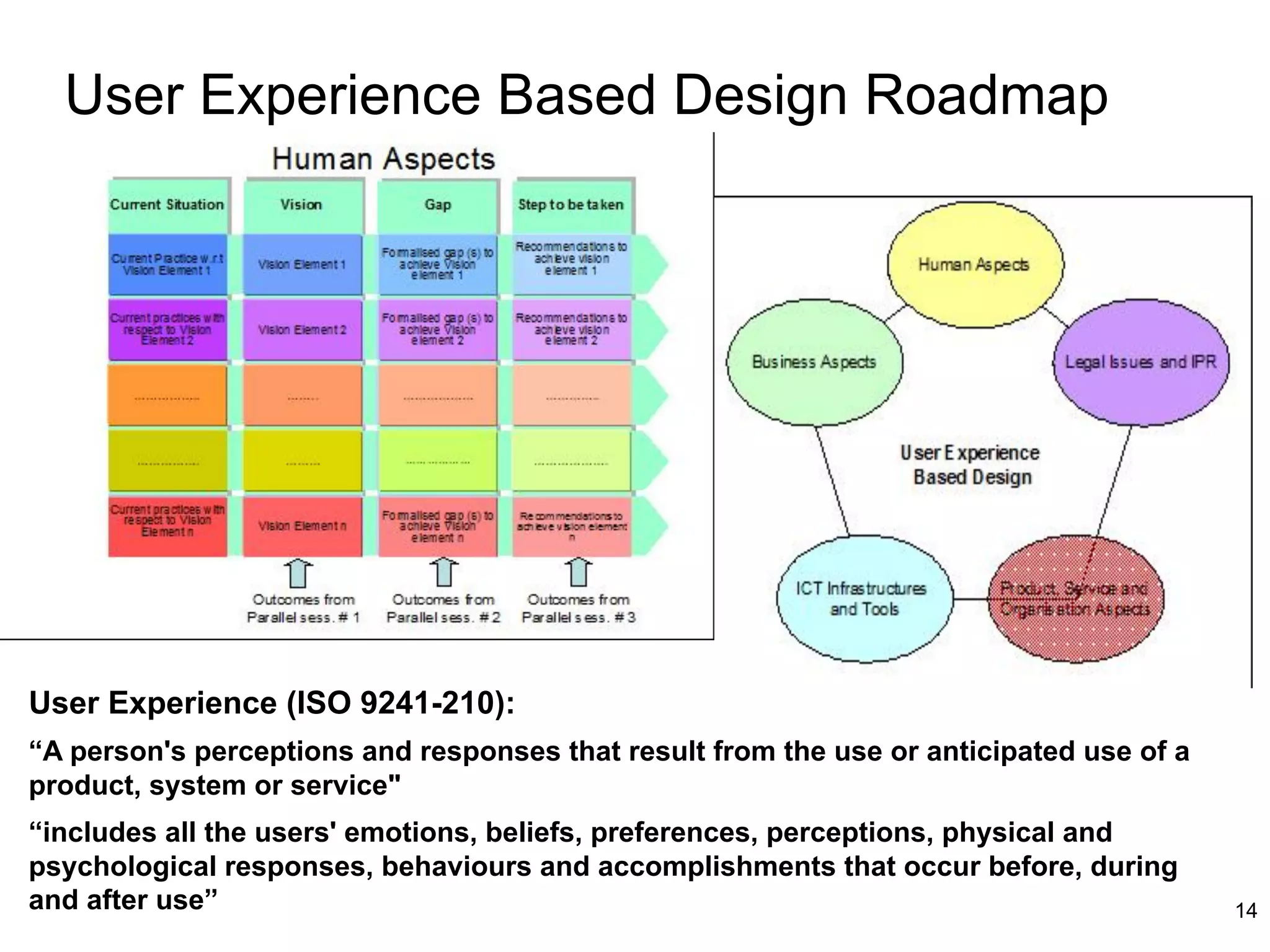
User Experience Based Design Roadmap


User Experience (ISO 9241-210):
“A person's perceptions and responses that result from the use or anticipated use of a
product, system or service"
“includes all the users' emotions, beliefs, preferences, perceptions, physical and
psychological responses, behaviours and accomplishments that occur before, during
and after use”                                                                           14
Summer School
Open Innovation & User eXperience Design & Assessment

 Download	
  the	
  Summer	
  School	
  
 	
  Networking	
  App	
  	
  
 “SmartUXSS”                   Join The Co-creation
                           Team for the Best
                           Summer School
                           Networking App Ever


                                                        15

Santoro uxss-introduction

  • 1.
    Summer School OpenInnovation & User eXperience Design & Assessment Day 1, 10th September 2012 Session: Introduction Presenter: Roberto Santoro Milan, 10th – 14th Sep. 2012
  • 2.
    1st Summer Schoolon “Open Innovation and User eXperience Design & Assessment” Hands on UX Design Summer School - Milan, 10th – 14th September 2012 • To raise awareness on design innovation, based on the Integration of Design methodologies within Living Labs’ environments • To apply UX design concepts to specific cases including Smart Conference • To develop a roadmap for the UX based design framework
  • 3.
    User Experience Thefour elements of User Experience (Rubinoff, 2004) Facets of the User Experience (Morville, 2004) User Experience (ISO 9241-210): •  “A person's perceptions and responses that result from the use or anticipated use of a product, system or service" •  “is subjective and focuses on the use” •  “includes all the users' emotions, beliefs, preferences, perceptions, physical and psychological responses, behaviours and accomplishments that occur before, during and after use” 3
  • 4.
    Experience Design Experience Designis the practice of designing products, processes, services, events, and environments with a focus placed on the quality of the user experience and culturally relevant solutions, with less emphasis placed on increasing and improving functionality of the design (Aarts & Marzano, 2003). Many disciplines are involved in Experience Design, such as cognitive and perceptual psychology, cognitive science, architecture and environmental design, interaction design (ergonomics & haptics), product design, ethnography, service design, heuristics, technical communication and design thinking. The Knowledge, Social and Business dimensions of User Experience (Santoro 2012) 4
  • 5.
    LLAB Community •  2005 AMI Communities, constituting Living Lab task force as flagship initiative •  2006 supporting the launch of ENoLL by Finnish European Presidency, •  2007 Governance Task Force Chair, for the foundation of ENoLL •  2008 addressing the ICT 2008 gala event organized by the French Presidency of the European Union •  2009 elected acting Chair of ENoLL, constituting the ENoLL AISBL legal entity •  2010 Launching the First Living Lab Summer School in Paris •  2011 Setting Transversal Thematic Innovation Platforms at ICE 2011 (Living Lab Design Innovation and Mixed Reality) •  2012 Launching the First User-Centred Design Innovation Living Lab Prize •  2012 1st Open Innovation & User eXperience Design & Assessment Summer School - UXSS in Milan !!!
  • 6.
    Living LAB OpenCommunities 100s of public bodies, 1.000s of companies, 100.000s of final users LL- Open LL- LL- Policy Partner s LL- Partners ENoL L 320 ENoLL Members and Growing…6 WAVES cities Individuals register at any time at regio www.openlivinglabs.eu energy media www.ami-communities.eu health manufacturing
  • 7.
    European Society ofConcurrent Engineering • Established in 1994 as Non-profit-making Over 500 members organisation 50% Academic 50% Industrial • Sustainable knowledge community for Concurrent Enterprising 35 Countries worldwide 18th International ESoCE Industry Forum Conference Innovating USER DRIVEN OPEN & Product-Services RESPONSIBLE by Collaboration INNOVATION Rome, 3 December 2012 2012 Munich, 18-20 June, Concurrent Engineering-Enterprising- Innovation User Community based Living Labs Collaborative Networks Delivering full text access to the WWW.ESOCE.NET world's highest quality technical Rsantoro@esoce.net literature in engineering and
  • 8.
    “IDeALL: Integrating Designfor All in Living Labs” •  “How to Improve User-Centered Innovation with Design for all Methodologies and Experimentations with Users in Living Labs? Example of IDeALL Project.” http://www.ami-communities.eu/wiki/IDeALL •  The goal of the IDeALL project is to connect designers and innovative eco-systems in order to create a common platform. Furthermore, its purpose is to link two innovative and user- centered communities: Living labs and the Design for All community. •  This project banks on the fact that the connection of Living Labs and Design for All communities will favour innovation through joint approach toward non-technological innovation, putting the human being at the heart of the concerns. 8
  • 9.
    ICE 2012 18th International ICE Conference Innovation by Collaboration and Entrepreneurial Partnerships European Commission Enterprise and Industry IDeALL - Integrating Design for All in Living Labs The workshop main objective is to identify and share methodologies based on user-centred approaches. used in « design sentres » and in « Living Labs » The identified methodologies will then be compared in interactive sessions –  am: Identifying User-centred methods in the Design and LLAB Community –  pm: Comparing methods and approaches Design Methods • Lead User • Contextual Design • Empathic Design • LUPI® Design • Usability Design • Experiential Design • User Centred Design • Participatory Design 9 • Web 2.0 Design
  • 10.
    The final listof 16 criteria for Design Methods assessment •  Cost Effectiveness (includes Cost Process and Cost) •  Decision Power (who has the power of deciding? Legitimacy? Designers? Users? Policymakers? Degree of hierarchy? •  Empirical Evidence (the degree to which a method was previously successful: it means that empirical studies of this method are available) •  Expertise (type and level of expertise needed) •  Impact Measurement (the degree to which the method has an impact on the design successfulness) •  Immersive Experience (the degree of interaction within the innovative scenario) •  Product Evaluation (users and companies perspectives) •  Nature of Deliverables (e.g. prototypes, products, services, scenarios) •  Observations (needs & expectations, capacities, users behaviours & feelings) •  Physical Support (the material used to play the innovative scenario) •  Privacy Issues (e.g. digital identity, confidential information, anonymous characteristics) •  Public/Private (the degree to which the method is compatible with either PP partnership or just Public dev. or just Private dev.) •  Time (Project planning) •  User Feedback (e.g. surveys, Focus Group Interview) •  User Contribution (the degree of involvement as observed subject or as co-creating value) •  User Involvement (individual user, group of users) •  Visual (the degree of concretisation of the concepts) 10
  • 11.
    Designing IoT Experiences theELLIOT (Experiential Living Lab for the Internet of Things) project (www.elliot-project.eu), which aims to develop an Internet Of Things (IOT) experiential platform where users/ citizens are directly involved in co- creating, exploring and experimenting new ideas, concepts and technological artefacts related to IOT applications and services. ELLIOT will allow studying the potential impact of IOT and the Future Internet in the context of the Open User Centred Innovation paradigm and of the Living Lab approach .
  • 12.
    The ELLIOT Platformsupport to the Living Lab Cycle ELLIOT Observes the ELLIOT supports Designers Consumers of the IOT service by simulated environments and Measures their experience (SG) in using it ELLIOT supports Designers by model (CoPa) and linking Designers model the experience tools (Serious Gaming) and measurement access to previous experiences ELLIOT provides a feedback to the Designers of the IOT service 12
  • 13.
    ELLIOT Use Cases(III): Green City Services Experience in the City of NICE - FRANCE Knowledge • Increase awareness on IoT paradigm • Update knowledge on the impact of air Social quality in daily lives Status Social • Generate enthusiasm for IoT based Target services • Foster citizen involvement in air quality measurement Business • Encourage collaborative tagging and Knowledge information sharing The KBS chromo-framework © R.Santoro A. Bifulco PRO-VE 2005 Business • Provide easy to use and engaging green services • Change citizen behavior towards a more sustainable lifestyle • Respect citizen privacy and confidentiality 13
  • 14.
    User Experience BasedDesign Roadmap User Experience (ISO 9241-210): “A person's perceptions and responses that result from the use or anticipated use of a product, system or service" “includes all the users' emotions, beliefs, preferences, perceptions, physical and psychological responses, behaviours and accomplishments that occur before, during and after use” 14
  • 15.
    Summer School Open Innovation& User eXperience Design & Assessment Download  the  Summer  School    Networking  App     “SmartUXSS” Join The Co-creation Team for the Best Summer School Networking App Ever 15