
© 2012 IBM Corporation
IBM Security Systems
1© 2015 IBM Corporation
IBM X-Force:
Insights from the 2Q 2015 X-Force
Threat Intelligence Quarterly
© 2015 IBM Corporation
IBM Security
2
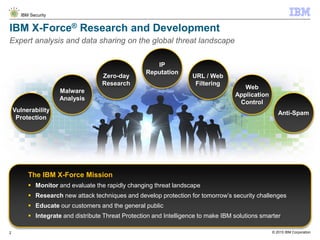
IBM X-Force® Research and Development
Vulnerability
Protection
IP
Reputation
Anti-Spam
Malware
Analysis
Web
Application
Control
URL / Web
Filtering
The IBM X-Force Mission
 Monitor and evaluate the rapidly changing threat landscape
 Research new attack techniques and develop protection for tomorrow’s security challenges
 Educate our customers and the general public
 Integrate and distribute Threat Protection and Intelligence to make IBM solutions smarter
Expert analysis and data sharing on the global threat landscape
Zero-day
Research
© 2015 IBM Corporation
IBM Security
3
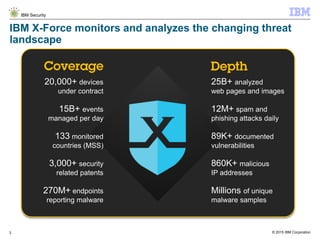
IBM X-Force monitors and analyzes the changing threat
landscape
20,000+ devices
under contract
15B+ events
managed per day
133 monitored
countries (MSS)
3,000+ security
related patents
270M+ endpoints
reporting malware
25B+ analyzed
web pages and images
12M+ spam and
phishing attacks daily
89K+ documented
vulnerabilities
860K+ malicious
IP addresses
Millions of unique
malware samples
© 2015 IBM Corporation
IBM Security
44 Source: IBM X-Force Threat Intelligence Quarterly – 1Q 2015 and 2014 IBM Chief Information Security Officer Assessment
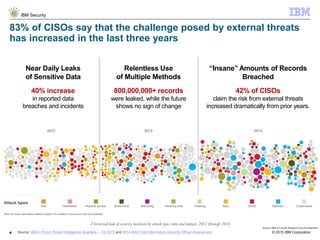
83% of CISOs say that the challenge posed by external threats
has increased in the last three years
Near Daily Leaks
of Sensitive Data
40% increase
in reported data
breaches and incidents
Relentless Use
of Multiple Methods
800,000,000+ records
were leaked, while the future
shows no sign of change
“Insane” Amounts of Records
Breached
42% of CISOs
claim the risk from external threats
increased dramatically from prior years.
© 2015 IBM Corporation
IBM Security
5
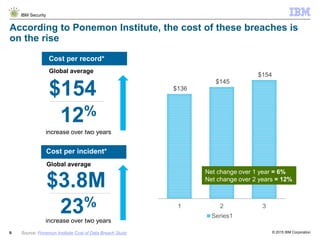
According to Ponemon Institute, the cost of these breaches is
on the rise
Source: Ponemon Institute Cost of Data Breach Study
$136
$145
$154
1 2 3
Series1
Net change over 1 year = 6%
Net change over 2 years = 12%
Cost per record*
$136$154
$136$3.8M
23%
Global average
12%
Global average
increase over two years
5
Cost per incident*
© 2015 IBM Corporation
IBM Security
6
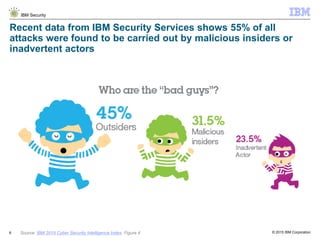
Recent data from IBM Security Services shows 55% of all
attacks were found to be carried out by malicious insiders or
inadvertent actors
Source: IBM 2015 Cyber Security Intelligence Index, Figure 4
© 2015 IBM Corporation
IBM Security
7
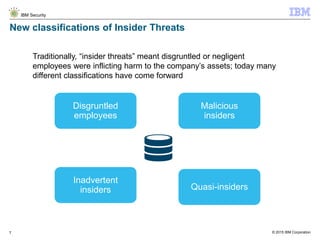
New classifications of Insider Threats
Disgruntled
employees
Malicious
insiders
Inadvertent
insiders Quasi-insiders
Traditionally, “insider threats” meant disgruntled or negligent
employees were inflicting harm to the company’s assets; today many
different classifications have come forward
© 2015 IBM Corporation
IBM Security
8
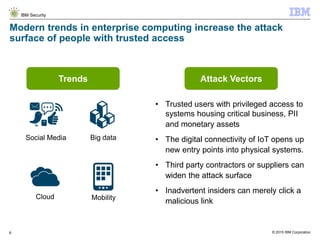
Modern trends in enterprise computing increase the attack
surface of people with trusted access
• Trusted users with privileged access to
systems housing critical business, PII
and monetary assets
• The digital connectivity of IoT opens up
new entry points into physical systems.
• Third party contractors or suppliers can
widen the attack surface
• Inadvertent insiders can merely click a
malicious link
Social Media
Trends Attack Vectors
Big data
MobilityCloud
© 2015 IBM Corporation
IBM Security
9
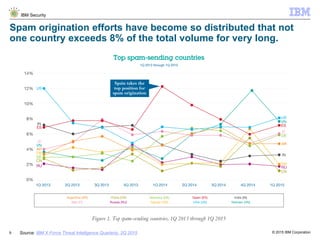
Spam origination efforts have become so distributed that not
one country exceeds 8% of the total volume for very long.
Source: IBM X-Force Threat Intelligence Quarterly, 2Q 2015
© 2015 IBM Corporation
IBM Security
10
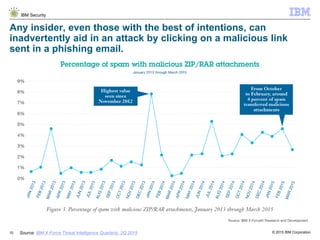
Any insider, even those with the best of intentions, can
inadvertently aid in an attack by clicking on a malicious link
sent in a phishing email.
Source: IBM X-Force Threat Intelligence Quarterly, 2Q 2015
© 2015 IBM Corporation
IBM Security
11
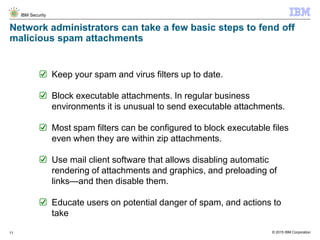
Network administrators can take a few basic steps to fend off
malicious spam attachments
Keep your spam and virus filters up to date.
Block executable attachments. In regular business
environments it is unusual to send executable attachments.
Most spam filters can be configured to block executable files
even when they are within zip attachments.
Use mail client software that allows disabling automatic
rendering of attachments and graphics, and preloading of
links—and then disable them.
Educate users on potential danger of spam, and actions to
take
© 2015 IBM Corporation
IBM Security
12
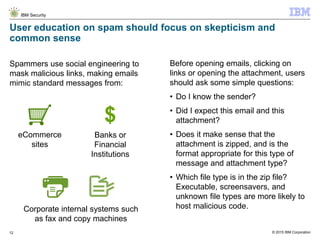
User education on spam should focus on skepticism and
common sense
Before opening emails, clicking on
links or opening the attachment, users
should ask some simple questions:
• Do I know the sender?
• Did I expect this email and this
attachment?
• Does it make sense that the
attachment is zipped, and is the
format appropriate for this type of
message and attachment type?
• Which file type is in the zip file?
Executable, screensavers, and
unknown file types are more likely to
host malicious code.
Spammers use social engineering to
mask malicious links, making emails
mimic standard messages from:
eCommerce
sites
$
Banks or
Financial
Institutions
Corporate internal systems such
as fax and copy machines
© 2015 IBM Corporation
IBM Security
13
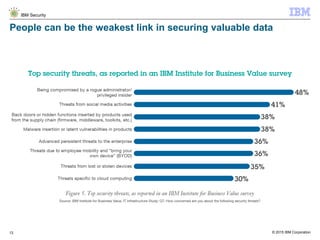
People can be the weakest link in securing valuable data
© 2015 IBM Corporation
IBM Security
14
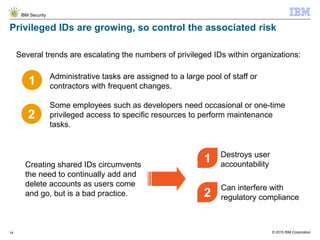
Privileged IDs are growing, so control the associated risk
Administrative tasks are assigned to a large pool of staff or
contractors with frequent changes.
Some employees such as developers need occasional or one-time
privileged access to specific resources to perform maintenance
tasks.
Destroys user
accountability
Can interfere with
regulatory compliance
1
2
Several trends are escalating the numbers of privileged IDs within organizations:
Creating shared IDs circumvents
the need to continually add and
delete accounts as users come
and go, but is a bad practice.
1
2
© 2015 IBM Corporation
IBM Security
15
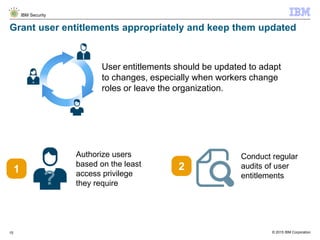
Grant user entitlements appropriately and keep them updated
User entitlements should be updated to adapt
to changes, especially when workers change
roles or leave the organization.
Conduct regular
audits of user
entitlements
2
Authorize users
based on the least
access privilege
they require?
1
© 2015 IBM Corporation
IBM Security
16
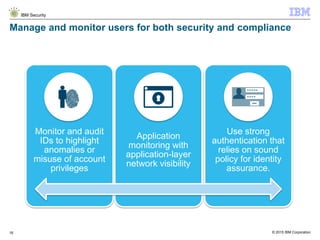
Manage and monitor users for both security and compliance
Monitor and audit
IDs to highlight
anomalies or
misuse of account
privileges
Application
monitoring with
application-layer
network visibility
Use strong
authentication that
relies on sound
policy for identity
assurance.
© 2015 IBM Corporation
IBM Security
17
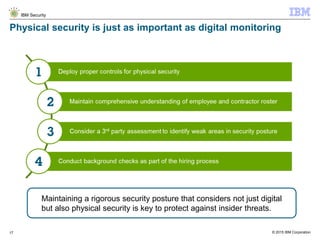
Physical security is just as important as digital monitoring
Maintaining a rigorous security posture that considers not just digital
but also physical security is key to protect against insider threats.
© 2015 IBM Corporation
IBM Security
18
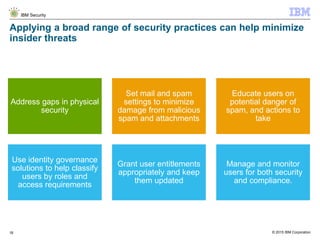
Applying a broad range of security practices can help minimize
insider threats
Address gaps in physical
security
Set mail and spam
settings to minimize
damage from malicious
spam and attachments
Educate users on
potential danger of
spam, and actions to
take
Use identity governance
solutions to help classify
users by roles and
access requirements
Grant user entitlements
appropriately and keep
them updated
Manage and monitor
users for both security
and compliance.
© 2015 IBM Corporation
IBM Security
19
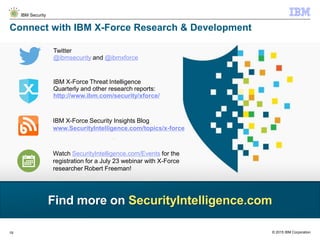
Connect with IBM X-Force Research & Development
Find more on SecurityIntelligence.com
IBM X-Force Threat Intelligence
Quarterly and other research reports:
http://www.ibm.com/security/xforce/
Twitter
@ibmsecurity and @ibmxforce
IBM X-Force Security Insights Blog
www.SecurityIntelligence.com/topics/x-force
Watch SecurityIntelligence.com/Events for the
registration for a July 23 webinar with X-Force
researcher Robert Freeman!
© 2015 IBM Corporation
IBM Security
20
www.ibm.com/security
© Copyright IBM Corporation 2013. All rights reserved. The information contained in these materials is provided for informational purposes
only, and is provided AS IS without warranty of any kind, express or implied. IBM shall not be responsible for any damages arising out of the use
of, or otherwise related to, these materials. Nothing contained in these materials is intended to, nor shall have the effect of, creating any
warranties or representations from IBM or its suppliers or licensors, or altering the terms and conditions of the applicable license agreement
governing the use of IBM software. References in these materials to IBM products, programs, or services do not imply that they will be available in
all countries in which IBM operates. Product release dates and/or capabilities referenced in these materials may change at any time at IBM’s sole
discretion based on market opportunities or other factors, and are not intended to be a commitment to future product or feature availability in any
way. IBM, the IBM logo, and other IBM products and services are trademarks of the International Business Machines Corporation, in the United
States, other countries or both. Other company, product, or service names may be trademarks or service marks of others.
Statement of Good Security Practices: IT system security involves protecting systems and information through prevention, detection and response
to improper access from within and outside your enterprise. Improper access can result in information being altered, destroyed or misappropriated
or can result in damage to or misuse of your systems, including to attack others. No IT system or product should be considered completely secure
and no single product or security measure can be completely effective in preventing improper access. IBM systems and products are designed to
be part of a comprehensive security approach, which will necessarily involve additional operational procedures, and may require other systems,
products or services to be most effective. IBM DOES NOT WARRANT THAT SYSTEMS AND PRODUCTS ARE IMMUNE FROM THE
MALICIOUS OR ILLEGAL CONDUCT OF ANY PARTY.
www.ibm.com/security
© Copyright IBM Corporation 2015. All rights reserved. The information contained in these materials is provided for informational purposes
only, and is provided AS IS without warranty of any kind, express or implied. IBM shall not be responsible for any damages arising out of the use
of, or otherwise related to, these materials. Nothing contained in these materials is intended to, nor shall have the effect of, creating any
warranties or representations from IBM or its suppliers or licensors, or altering the terms and conditions of the applicable license agreement
governing the use of IBM software. References in these materials to IBM products, programs, or services do not imply that they will be available in
all countries in which IBM operates. Product release dates and/or capabilities referenced in these materials may change at any time at IBM’s sole
discretion based on market opportunities or other factors, and are not intended to be a commitment to future product or feature availability in any
way. IBM, the IBM logo, and other IBM products and services are trademarks of the International Business Machines Corporation, in the United
States, other countries or both. Other company, product, or service names may be trademarks or service marks of others.
Statement of Good Security Practices: IT system security involves protecting systems and information through prevention, detection and response
to improper access from within and outside your enterprise. Improper access can result in information being altered, destroyed or misappropriated
or can result in damage to or misuse of your systems, including to attack others. No IT system or product should be considered completely secure
and no single product or security measure can be completely effective in preventing improper access. IBM systems and products are designed to
be part of a comprehensive security approach, which will necessarily involve additional operational procedures, and may require other systems,
products or services to be most effective. IBM DOES NOT WARRANT THAT SYSTEMS AND PRODUCTS ARE IMMUNE FROM THE
MALICIOUS OR ILLEGAL CONDUCT OF ANY PARTY.

IBM X-Force Threat Intelligence: Why Insider Threats Challenge Critical Business Processes

  • 1.
    © 2012 IBMCorporation IBM Security Systems 1© 2015 IBM Corporation IBM X-Force: Insights from the 2Q 2015 X-Force Threat Intelligence Quarterly
  • 2.
    © 2015 IBMCorporation IBM Security 2 IBM X-Force® Research and Development Vulnerability Protection IP Reputation Anti-Spam Malware Analysis Web Application Control URL / Web Filtering The IBM X-Force Mission  Monitor and evaluate the rapidly changing threat landscape  Research new attack techniques and develop protection for tomorrow’s security challenges  Educate our customers and the general public  Integrate and distribute Threat Protection and Intelligence to make IBM solutions smarter Expert analysis and data sharing on the global threat landscape Zero-day Research
  • 3.
    © 2015 IBMCorporation IBM Security 3 IBM X-Force monitors and analyzes the changing threat landscape 20,000+ devices under contract 15B+ events managed per day 133 monitored countries (MSS) 3,000+ security related patents 270M+ endpoints reporting malware 25B+ analyzed web pages and images 12M+ spam and phishing attacks daily 89K+ documented vulnerabilities 860K+ malicious IP addresses Millions of unique malware samples
  • 4.
    © 2015 IBMCorporation IBM Security 44 Source: IBM X-Force Threat Intelligence Quarterly – 1Q 2015 and 2014 IBM Chief Information Security Officer Assessment 83% of CISOs say that the challenge posed by external threats has increased in the last three years Near Daily Leaks of Sensitive Data 40% increase in reported data breaches and incidents Relentless Use of Multiple Methods 800,000,000+ records were leaked, while the future shows no sign of change “Insane” Amounts of Records Breached 42% of CISOs claim the risk from external threats increased dramatically from prior years.
  • 5.
    © 2015 IBMCorporation IBM Security 5 According to Ponemon Institute, the cost of these breaches is on the rise Source: Ponemon Institute Cost of Data Breach Study $136 $145 $154 1 2 3 Series1 Net change over 1 year = 6% Net change over 2 years = 12% Cost per record* $136$154 $136$3.8M 23% Global average 12% Global average increase over two years increase over two years 5 Cost per incident*
  • 6.
    © 2015 IBMCorporation IBM Security 6 Recent data from IBM Security Services shows 55% of all attacks were found to be carried out by malicious insiders or inadvertent actors Source: IBM 2015 Cyber Security Intelligence Index, Figure 4
  • 7.
    © 2015 IBMCorporation IBM Security 7 New classifications of Insider Threats Disgruntled employees Malicious insiders Inadvertent insiders Quasi-insiders Traditionally, “insider threats” meant disgruntled or negligent employees were inflicting harm to the company’s assets; today many different classifications have come forward
  • 8.
    © 2015 IBMCorporation IBM Security 8 Modern trends in enterprise computing increase the attack surface of people with trusted access • Trusted users with privileged access to systems housing critical business, PII and monetary assets • The digital connectivity of IoT opens up new entry points into physical systems. • Third party contractors or suppliers can widen the attack surface • Inadvertent insiders can merely click a malicious link Social Media Trends Attack Vectors Big data MobilityCloud
  • 9.
    © 2015 IBMCorporation IBM Security 9 Spam origination efforts have become so distributed that not one country exceeds 8% of the total volume for very long. Source: IBM X-Force Threat Intelligence Quarterly, 2Q 2015
  • 10.
    © 2015 IBMCorporation IBM Security 10 Any insider, even those with the best of intentions, can inadvertently aid in an attack by clicking on a malicious link sent in a phishing email. Source: IBM X-Force Threat Intelligence Quarterly, 2Q 2015
  • 11.
    © 2015 IBMCorporation IBM Security 11 Network administrators can take a few basic steps to fend off malicious spam attachments Keep your spam and virus filters up to date. Block executable attachments. In regular business environments it is unusual to send executable attachments. Most spam filters can be configured to block executable files even when they are within zip attachments. Use mail client software that allows disabling automatic rendering of attachments and graphics, and preloading of links—and then disable them. Educate users on potential danger of spam, and actions to take
  • 12.
    © 2015 IBMCorporation IBM Security 12 User education on spam should focus on skepticism and common sense Before opening emails, clicking on links or opening the attachment, users should ask some simple questions: • Do I know the sender? • Did I expect this email and this attachment? • Does it make sense that the attachment is zipped, and is the format appropriate for this type of message and attachment type? • Which file type is in the zip file? Executable, screensavers, and unknown file types are more likely to host malicious code. Spammers use social engineering to mask malicious links, making emails mimic standard messages from: eCommerce sites $ Banks or Financial Institutions Corporate internal systems such as fax and copy machines
  • 13.
    © 2015 IBMCorporation IBM Security 13 People can be the weakest link in securing valuable data
  • 14.
    © 2015 IBMCorporation IBM Security 14 Privileged IDs are growing, so control the associated risk Administrative tasks are assigned to a large pool of staff or contractors with frequent changes. Some employees such as developers need occasional or one-time privileged access to specific resources to perform maintenance tasks. Destroys user accountability Can interfere with regulatory compliance 1 2 Several trends are escalating the numbers of privileged IDs within organizations: Creating shared IDs circumvents the need to continually add and delete accounts as users come and go, but is a bad practice. 1 2
  • 15.
    © 2015 IBMCorporation IBM Security 15 Grant user entitlements appropriately and keep them updated User entitlements should be updated to adapt to changes, especially when workers change roles or leave the organization. Conduct regular audits of user entitlements 2 Authorize users based on the least access privilege they require? 1
  • 16.
    © 2015 IBMCorporation IBM Security 16 Manage and monitor users for both security and compliance Monitor and audit IDs to highlight anomalies or misuse of account privileges Application monitoring with application-layer network visibility Use strong authentication that relies on sound policy for identity assurance.
  • 17.
    © 2015 IBMCorporation IBM Security 17 Physical security is just as important as digital monitoring Maintaining a rigorous security posture that considers not just digital but also physical security is key to protect against insider threats.
  • 18.
    © 2015 IBMCorporation IBM Security 18 Applying a broad range of security practices can help minimize insider threats Address gaps in physical security Set mail and spam settings to minimize damage from malicious spam and attachments Educate users on potential danger of spam, and actions to take Use identity governance solutions to help classify users by roles and access requirements Grant user entitlements appropriately and keep them updated Manage and monitor users for both security and compliance.
  • 19.
    © 2015 IBMCorporation IBM Security 19 Connect with IBM X-Force Research & Development Find more on SecurityIntelligence.com IBM X-Force Threat Intelligence Quarterly and other research reports: http://www.ibm.com/security/xforce/ Twitter @ibmsecurity and @ibmxforce IBM X-Force Security Insights Blog www.SecurityIntelligence.com/topics/x-force Watch SecurityIntelligence.com/Events for the registration for a July 23 webinar with X-Force researcher Robert Freeman!
  • 20.
    © 2015 IBMCorporation IBM Security 20 www.ibm.com/security © Copyright IBM Corporation 2013. All rights reserved. The information contained in these materials is provided for informational purposes only, and is provided AS IS without warranty of any kind, express or implied. IBM shall not be responsible for any damages arising out of the use of, or otherwise related to, these materials. Nothing contained in these materials is intended to, nor shall have the effect of, creating any warranties or representations from IBM or its suppliers or licensors, or altering the terms and conditions of the applicable license agreement governing the use of IBM software. References in these materials to IBM products, programs, or services do not imply that they will be available in all countries in which IBM operates. Product release dates and/or capabilities referenced in these materials may change at any time at IBM’s sole discretion based on market opportunities or other factors, and are not intended to be a commitment to future product or feature availability in any way. IBM, the IBM logo, and other IBM products and services are trademarks of the International Business Machines Corporation, in the United States, other countries or both. Other company, product, or service names may be trademarks or service marks of others. Statement of Good Security Practices: IT system security involves protecting systems and information through prevention, detection and response to improper access from within and outside your enterprise. Improper access can result in information being altered, destroyed or misappropriated or can result in damage to or misuse of your systems, including to attack others. No IT system or product should be considered completely secure and no single product or security measure can be completely effective in preventing improper access. IBM systems and products are designed to be part of a comprehensive security approach, which will necessarily involve additional operational procedures, and may require other systems, products or services to be most effective. IBM DOES NOT WARRANT THAT SYSTEMS AND PRODUCTS ARE IMMUNE FROM THE MALICIOUS OR ILLEGAL CONDUCT OF ANY PARTY. www.ibm.com/security © Copyright IBM Corporation 2015. All rights reserved. The information contained in these materials is provided for informational purposes only, and is provided AS IS without warranty of any kind, express or implied. IBM shall not be responsible for any damages arising out of the use of, or otherwise related to, these materials. Nothing contained in these materials is intended to, nor shall have the effect of, creating any warranties or representations from IBM or its suppliers or licensors, or altering the terms and conditions of the applicable license agreement governing the use of IBM software. References in these materials to IBM products, programs, or services do not imply that they will be available in all countries in which IBM operates. Product release dates and/or capabilities referenced in these materials may change at any time at IBM’s sole discretion based on market opportunities or other factors, and are not intended to be a commitment to future product or feature availability in any way. IBM, the IBM logo, and other IBM products and services are trademarks of the International Business Machines Corporation, in the United States, other countries or both. Other company, product, or service names may be trademarks or service marks of others. Statement of Good Security Practices: IT system security involves protecting systems and information through prevention, detection and response to improper access from within and outside your enterprise. Improper access can result in information being altered, destroyed or misappropriated or can result in damage to or misuse of your systems, including to attack others. No IT system or product should be considered completely secure and no single product or security measure can be completely effective in preventing improper access. IBM systems and products are designed to be part of a comprehensive security approach, which will necessarily involve additional operational procedures, and may require other systems, products or services to be most effective. IBM DOES NOT WARRANT THAT SYSTEMS AND PRODUCTS ARE IMMUNE FROM THE MALICIOUS OR ILLEGAL CONDUCT OF ANY PARTY.