Market Sizing & Competitive Analysis 
17th September 2014 
Dwight Gunning - @dwightgunning
Market Sizing & Competitive Analysis 
17th September 2014 
Dwight Gunning - @dwightgunning
TOPICS 
• Market Sizing 
• Why is market sizing important? 
• Sizing approaches 
• Competitive Analysis 
• Understanding the entire competitive landscape 
• Evaluating competition and answering the right questions 
@dwightgunning
MARKET SIZING 
@dwightgunning
6 
@dwightgunning
MARKET SIZING FOR YOUR INVESTORS 
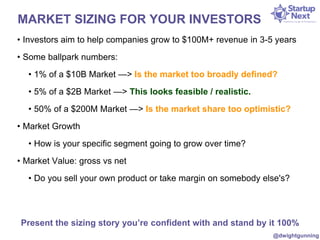
• Investors aim to help companies grow to $100M+ revenue in 3-5 years 
• Some ballpark numbers: 
• 1% of a $10B Market —> Is the market too broadly defined? 
• 5% of a $2B Market —> This looks feasible / realistic. 
• 50% of a $200M Market —> Is the market share too optimistic? 
• Market Growth 
• How is your specific segment going to grow over time? 
• Market Value: gross vs net 
• Do you sell your own product or take margin on somebody else's? 
Present the sizing story you’re confident with and stand by it 100% 
@dwightgunning
TOP DOWN ANALYSIS 
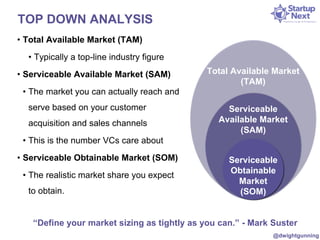
• Total Available Market (TAM) 
• Typically a top-line industry figure 
• Serviceable Available Market (SAM) 
• The market you can actually reach and 
serve based on your customer 
acquisition and sales channels 
• This is the number VCs care about 
• Serviceable Obtainable Market (SOM) 
• The realistic market share you expect 
to obtain. 
Total Available Market 
(TAM) 
Serviceable 
Available Market 
(SAM) 
Serviceable 
Obtainable 
Market 
(SOM) 
“Define your market sizing as tightly as you can.” - Mark Suster 
@dwightgunning
BOTTOM UP ANALYSIS 
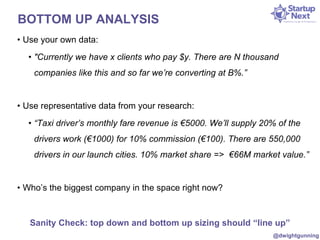
• Use your own data: 
• "Currently we have x clients who pay $y. There are N thousand 
companies like this and so far we’re converting at B%.” 
• Use representative data from your research: 
• “Taxi driver’s monthly fare revenue is €5000. We’ll supply 20% of the 
drivers work (€1000) for 10% commission (€100). There are 550,000 
drivers in our launch cities. 10% market share => €66M market value.” 
• Who’s the biggest company in the space right now? 
Sanity Check: top down and bottom up sizing should “line up” 
@dwightgunning
10 
@dwightgunning
COMPETITIVE 
ANALYSIS 
@dwightgunning
"Explain your startup in the context of the 
environment in which you operate including those 
who you partner with, those who you compete against and 
things that keep you up at night” 
Stephanie Palmeri - Venture Capitalist 
@dwightgunning
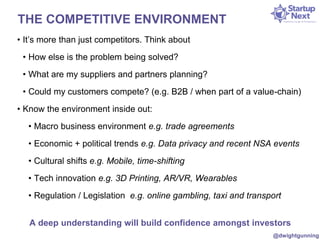
THE COMPETITIVE ENVIRONMENT 
• It’s more than just competitors. Think about 
• How else is the problem being solved? 
• What are my suppliers and partners planning? 
• Could my customers compete? (e.g. B2B / when part of a value-chain) 
• Know the environment inside out: 
• Macro business environment e.g. trade agreements 
• Economic + political trends e.g. Data privacy and recent NSA events 
• Cultural shifts e.g. Mobile, time-shifting 
• Tech innovation e.g. 3D Printing, AR/VR, Wearables 
• Regulation / Legislation e.g. online gambling, taxi and transport 
A deep understanding will build confidence amongst investors 
@dwightgunning
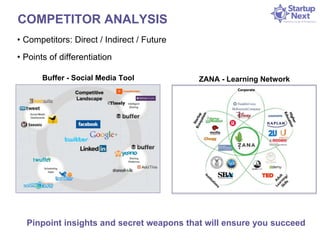
COMPETITOR ANALYSIS 
• Competitors: Direct / Indirect / Future 
• Points of differentiation 
Buffer - Social Media Tool ZANA - Learning Network 
Pinpoint insights and secret weapons that will ensure you succeed
15 
@dwightgunning
Tweet me: @dwightgunning

Startup Next - Market Sizing & Competitive Analysis

  • 2.
    Market Sizing &Competitive Analysis 17th September 2014 Dwight Gunning - @dwightgunning
  • 3.
    Market Sizing &Competitive Analysis 17th September 2014 Dwight Gunning - @dwightgunning
  • 4.
    TOPICS • MarketSizing • Why is market sizing important? • Sizing approaches • Competitive Analysis • Understanding the entire competitive landscape • Evaluating competition and answering the right questions @dwightgunning
  • 5.
  • 6.
  • 7.
    MARKET SIZING FORYOUR INVESTORS • Investors aim to help companies grow to $100M+ revenue in 3-5 years • Some ballpark numbers: • 1% of a $10B Market —> Is the market too broadly defined? • 5% of a $2B Market —> This looks feasible / realistic. • 50% of a $200M Market —> Is the market share too optimistic? • Market Growth • How is your specific segment going to grow over time? • Market Value: gross vs net • Do you sell your own product or take margin on somebody else's? Present the sizing story you’re confident with and stand by it 100% @dwightgunning
  • 8.
    TOP DOWN ANALYSIS • Total Available Market (TAM) • Typically a top-line industry figure • Serviceable Available Market (SAM) • The market you can actually reach and serve based on your customer acquisition and sales channels • This is the number VCs care about • Serviceable Obtainable Market (SOM) • The realistic market share you expect to obtain. Total Available Market (TAM) Serviceable Available Market (SAM) Serviceable Obtainable Market (SOM) “Define your market sizing as tightly as you can.” - Mark Suster @dwightgunning
  • 9.
    BOTTOM UP ANALYSIS • Use your own data: • "Currently we have x clients who pay $y. There are N thousand companies like this and so far we’re converting at B%.” • Use representative data from your research: • “Taxi driver’s monthly fare revenue is €5000. We’ll supply 20% of the drivers work (€1000) for 10% commission (€100). There are 550,000 drivers in our launch cities. 10% market share => €66M market value.” • Who’s the biggest company in the space right now? Sanity Check: top down and bottom up sizing should “line up” @dwightgunning
  • 10.
  • 11.
  • 12.
    "Explain your startupin the context of the environment in which you operate including those who you partner with, those who you compete against and things that keep you up at night” Stephanie Palmeri - Venture Capitalist @dwightgunning
  • 13.
    THE COMPETITIVE ENVIRONMENT • It’s more than just competitors. Think about • How else is the problem being solved? • What are my suppliers and partners planning? • Could my customers compete? (e.g. B2B / when part of a value-chain) • Know the environment inside out: • Macro business environment e.g. trade agreements • Economic + political trends e.g. Data privacy and recent NSA events • Cultural shifts e.g. Mobile, time-shifting • Tech innovation e.g. 3D Printing, AR/VR, Wearables • Regulation / Legislation e.g. online gambling, taxi and transport A deep understanding will build confidence amongst investors @dwightgunning
  • 14.
    COMPETITOR ANALYSIS •Competitors: Direct / Indirect / Future • Points of differentiation Buffer - Social Media Tool ZANA - Learning Network Pinpoint insights and secret weapons that will ensure you succeed
  • 15.
  • 16.
  • 17.

Editor's Notes

  • #10 Who’s done bottom up analysis? More difficult than Top-Down. If you don’t explain it, investors do it themselves based whatever equivalents Be careful not to signal too early with customer pricing/revenues that may not be representative of the market.