Š 2016 IBM Corporation
Nick Bradley
Sr. Manager and Practice Lead, MSS Threat Research
IBM Security
Michelle Alvarez
Researcher and Editor, MSS Threat Research
IBM Security
Security Trends in the
Retail Industry
2Š 2016 IBM Corporation
Today’s panelists
Nick Bradley
Practice Leader
Threat Research Group
IBM Security
https://securityintelligence.com/author/nick-bradley/
https://www.linkedin.com/in/nick-bradley-3406442
Michelle Alvarez
Threat Researcher, Publisher and Editor
Managed Security Services
IBM Security
securityintelligence.com/author/michelle-alvarez/
linkedin.com/pub/michelle-alvarez/65/867/445
3Š 2016 IBM Corporation
!  2014 review
!  2015 findings
–  Attack types targeting retailers
–  Black Friday/Cyber Monday trends
!  A look at Data Breaches: Attackers are shifting their focus
!  POS Malware
!  Potential actions for defense
!  Addressing fraud
Agenda
4Š 2016 IBM Corporation
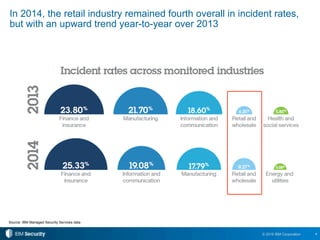
In 2014, the retail industry remained fourth overall in incident rates,
but with an upward trend year-to-year over 2013
Source: IBM Managed Security Services data
5Š 2016 IBM Corporation
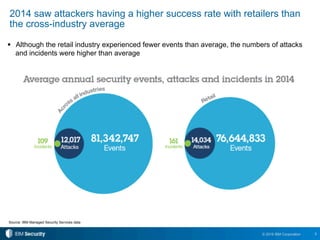
!  Although the retail industry experienced fewer events than average, the numbers of attacks
and incidents were higher than average
2014 saw attackers having a higher success rate with retailers than
the cross-industry average
Source: IBM Managed Security Services data
6Š 2016 IBM Corporation
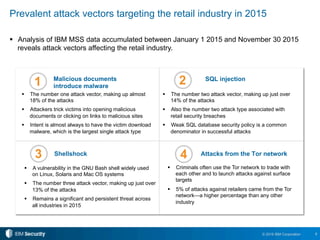
Prevalent attack vectors targeting the retail industry in 2015
!  Analysis of IBM MSS data accumulated between January 1 2015 and November 30 2015
reveals attack vectors affecting the retail industry.
Attacks from the Tor network
Malicious documents
introduce malware
Shellshock
!  Criminals often use the Tor network to trade with
each other and to launch attacks against surface
targets
!  5% of attacks against retailers came from the Tor
network—a higher percentage than any other
industry
2
!  A vulnerability in the GNU Bash shell widely used
on Linux, Solaris and Mac OS systems
!  The number three attack vector, making up just over
13% of the attacks
!  Remains a significant and persistent threat across
all industries in 2015
3 4
!  The number one attack vector, making up almost
18% of the attacks
!  Attackers trick victims into opening malicious
documents or clicking on links to malicious sites
!  Intent is almost always to have the victim download
malware, which is the largest single attack type
!  The number two attack vector, making up just over
14% of the attacks
!  Also the number two attack type associated with
retail security breaches
!  Weak SQL database security policy is a common
denominator in successful attacks
SQL injection
1
7Š 2016 IBM Corporation
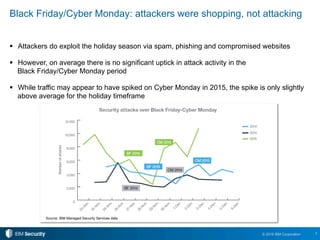
!  Attackers do exploit the holiday season via spam, phishing and compromised websites
!  However, on average there is no significant uptick in attack activity in the
Black Friday/Cyber Monday period
!  While traffic may appear to have spiked on Cyber Monday in 2015, the spike is only slightly
above average for the holiday timeframe
Black Friday/Cyber Monday: attackers were shopping, not attacking
Source: IBM Managed Security Services data
8Š 2016 IBM Corporation
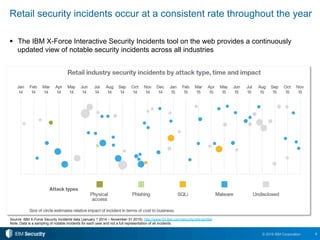
!  The IBM X-Force Interactive Security Incidents tool on the web provides a continuously
updated view of notable security incidents across all industries
Retail security incidents occur at a consistent rate throughout the year
Source: IBM X-Force Security Incidents data (January 1 2014 – November 31 2015). http://www-03.ibm.com/security/xforce/xfisi/
Note: Data is a sampling of notable incidents for each year and not a full representation of all incidents.
9Š 2016 IBM Corporation
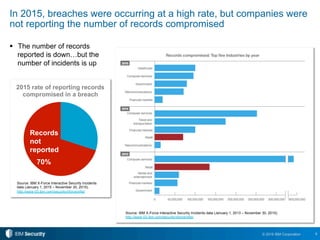
!  The number of records
reported is down…but the
number of incidents is up
In 2015, breaches were occurring at a high rate, but companies were
not reporting the number of records compromised
Records
not
reported
70%
2015 rate of reporting records
compromised in a breach
Source: IBM X-Force Interactive Security Incidents data (January 1, 2013 – November 30, 2015).
http://www-03.ibm.com/security/xforce/xfisi/
Source: IBM X-Force Interactive Security Incidents
data (January 1, 2015 – November 30, 2015).
http://www-03.ibm.com/security/xforce/xfisi/
10Š 2016 IBM Corporation
!  Attackers are shifting from targeting a few large organizations to targeting a large number of
smaller businesses
!  A lot of little payoffs can add up to the same $$$ as a few big ones
–  Payment card records sell for between $1 and $25 on the black market
!  Large breaches can be less effective because compromised credit cards get cancelled faster
when the target is a large company that reports all affected credit cards to banks
!  Smaller companies may also lack the resources to discover compromises quickly
Attackers are shifting their focus to smaller businesses
11Š 2016 IBM Corporation
Source: IBM X-Force Security Incidents data (January 1 2011 – November 31 2015).
http://www-03.ibm.com/security/xforce/xfisi/
Note: Data is a sampling of notable incidents for each year and not a full
representation of all incidents.
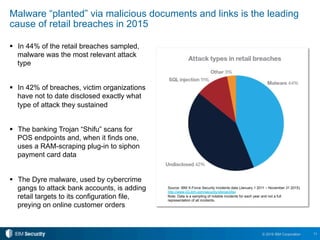
!  In 44% of the retail breaches sampled,
malware was the most relevant attack
type
!  In 42% of breaches, victim organizations
have not to date disclosed exactly what
type of attack they sustained
!  The banking Trojan “Shifu” scans for
POS endpoints and, when it finds one,
uses a RAM-scraping plug-in to siphon
payment card data
!  The Dyre malware, used by cybercrime
gangs to attack bank accounts, is adding
retail targets to its configuration file,
preying on online customer orders
Malware “planted” via malicious documents and links is the leading
cause of retail breaches in 2015
12Š 2016 IBM Corporation
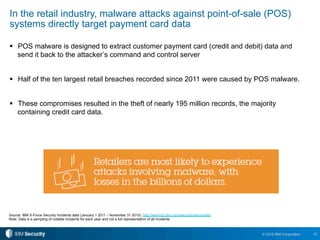
!  POS malware is designed to extract customer payment card (credit and debit) data and
send it back to the attacker’s command and control server
!  Half of the ten largest retail breaches recorded since 2011 were caused by POS malware.
!  These compromises resulted in the theft of nearly 195 million records, the majority
containing credit card data.
In the retail industry, malware attacks against point-of-sale (POS)
systems directly target payment card data
Source: IBM X-Force Security Incidents data (January 1 2011 – November 31 2015). http://www-03.ibm.com/security/xforce/xfisi/
Note: Data is a sampling of notable incidents for each year and not a full representation of all incidents.
13Š 2016 IBM Corporation
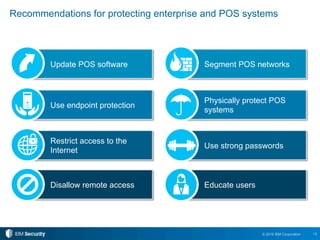
Recommendations for protecting enterprise and POS systems
Update POS software
Use endpoint protection
Restrict access to the
Internet
Disallow remote access
Segment POS networks
Physically protect POS
systems
Use strong passwords
Educate users
14Š 2016 IBM Corporation
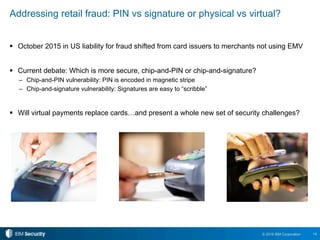
!  October 2015 in US liability for fraud shifted from card issuers to merchants not using EMV
!  Current debate: Which is more secure, chip-and-PIN or chip-and-signature?
–  Chip-and-PIN vulnerability: PIN is encoded in magnetic stripe
–  Chip-and-signature vulnerability: Signatures are easy to “scribble”
!  Will virtual payments replace cards…and present a whole new set of security challenges?
Addressing retail fraud: PIN vs signature or physical vs virtual?
15Š 2016 IBM Corporation
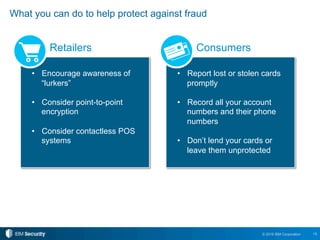
What you can do to help protect against fraud
•  Encourage awareness of
“lurkers”
•  Consider point-to-point
encryption
•  Consider contactless POS
systems
•  Report lost or stolen cards
promptly
•  Record all your account
numbers and their phone
numbers
•  Don’t lend your cards or
leave them unprotected
Retailers Consumers
16Š 2016 IBM Corporation
!  This and other IBM® X-Force® threat research reports can be downloaded here
Get the complete picture
About this report
This IBM X-Force report was created by the IBM
Managed Security Services Threat Research group, a
team of experienced and skilled security analysts working
diligently to keep IBM clients informed and prepared for
the latest cybersecurity threats. This research team
analyzes security data from many internal and external
sources including event data, activity, and trends sourced
from thousands of endpoints managed and monitored by
IBM for Managed Security Services accounts around the
globe.
17Š 2016 IBM Corporation
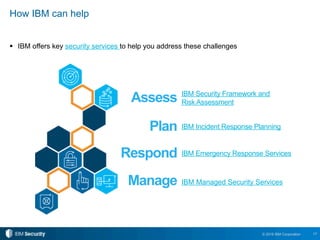
!  IBM offers key security services to help you address these challenges
How IBM can help
IBM Security Framework and
Risk Assessment
IBM Incident Response Planning
IBM Managed Security Services
IBM Emergency Response Services
Assess
Plan
Respond
Manage
18Š 2016 IBM Corporation
Learn more about IBM Security
V2015-11-23
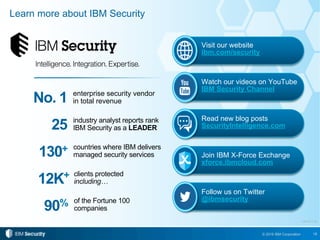
countries where IBM delivers
managed security services
industry analyst reports rank
IBM Security as a LEADER
enterprise security vendor
in total revenue
clients protected
including…
130+
25
No. 1
12K+
90% of the Fortune 100
companies
Join IBM X-Force Exchange
xforce.ibmcloud.com
Visit our website
ibm.com/security
Watch our videos on YouTube
IBM Security Channel
Read new blog posts
SecurityIntelligence.com
Follow us on Twitter
@ibmsecurity
Š Copyright IBM Corporation 2016. All rights reserved. The information contained in these materials is provided for informational purposes only, and is provided AS IS without warranty of any
kind, express or implied. IBM shall not be responsible for any damages arising out of the use of, or otherwise related to, these materials. Nothing contained in these materials is intended to, nor
shall have the effect of, creating any warranties or representations from IBM or its suppliers or licensors, or altering the terms and conditions of the applicable license agreement governing the use
of IBM software. References in these materials to IBM products, programs, or services do not imply that they will be available in all countries in which IBM operates. Product release dates and / or
capabilities referenced in these materials may change at any time at IBM’s sole discretion based on market opportunities or other factors, and are not intended to be a commitment to future product
or feature availability in any way. IBM, the IBM logo, and other IBM products and services are trademarks of the International Business Machines Corporation, in the United States, other countries or
both. Other company, product, or service names may be trademarks or service marks of others.
Statement of Good Security Practices: IT system security involves protecting systems and information through prevention, detection and response to improper access from within and outside your
enterprise. Improper access can result in information being altered, destroyed, misappropriated or misused or can result in damage to or misuse of your systems, including for use in attacks on
others. No IT system or product should be considered completely secure and no single product, service or security measure can be completely effective in preventing improper use or access. IBM
systems, products and services are designed to be part of a lawful, comprehensive security approach, which will necessarily involve additional operational procedures, and may require other
systems, products or services to be most effective. IBM DOES NOT WARRANT THAT ANY SYSTEMS, PRODUCTS OR SERVICES ARE IMMUNE FROM, OR WILL MAKE YOUR ENTERPRISE
IMMUNE FROM, THE MALICIOUS OR ILLEGAL CONDUCT OF ANY PARTY.
THANK YOUwww.ibm.com/security
Š 2016 IBM Corporation
Information concerning non-IBM products was obtained from the suppliers of
those products, their published announcements or other publicly available
sources. IBM has not tested those products in connection with this publication
and cannot confirm the accuracy of performance, compatibility or any other
claims related to non-IBM products. Questions on the capabilities of non-IBM
products should be addressed to the suppliers of those products. IBM does not
warrant the quality of any third-party products, or the ability of any such third-
party products to interoperate with IBM’s products. IBM EXPRESSLY
DISCLAIMS ALL WARRANTIES, EXPRESSED OR IMPLIED,
INCLUDING BUT NOT LIMITED TO, THE IMPLIED WARRANTIES OF
MERCHANTABILITY AND FITNESS FOR A PARTICULAR PURPOSE.
The provision of the information contained herein is not intended to, and does
not, grant any right or license under any IBM patents, copyrights, trademarks or
other intellectual property right.
Other company, product, or service names may be trademarks or service marks
of others. A current list of IBM trademarks is available at “Copyright and
trademark information” www.ibm.com/legal/copytrade.shtml
Copyright Š 2016 by International Business Machines Corporation (IBM). No
part of this document may be reproduced or transmitted in any form without
written permission from IBM.
U.S. Government Users Restricted Rights – Use, duplication or disclosure
restricted by GSA ADP Schedule Contract with IBM.
Information in these presentations (including information relating to products
that have not yet been announced by IBM) has been reviewed for accuracy as
of the date of initial publication and could include unintentional technical or
typographical errors. IBM shall have no responsibility to update this information.
THIS document is distributed "AS IS" without any warranty, either express or
implied. In no event shall IBM be liable for any damage arising from the use of
this information, including but not limited to, loss of data, business interruption,
loss of profit or loss of opportunity.
IBM products and services are warranted according to the terms and conditions
of the agreements under which they are provided.
Any statements regarding IBM’s future direction, intent or product plans are
subject to change or withdrawal without notice. Performance data contained
herein was generally obtained in a controlled, isolated environments. Customer
examples are presented as illustrations of how those customers have used IBM
products and the results they may have achieved. Actual performance, cost,
savings or other results in other operating environments may vary. References
in this document to IBM products, programs, or services does not imply that
IBM intends to make such products, programs or services available in all
countries in which IBM operates or does business.
Workshops, sessions and associated materials may have been prepared by
independent session speakers, and do not necessarily reflect the views of IBM.
All materials and discussions are provided for informational purposes only, and
are neither intended to, nor shall constitute legal or other guidance or advice to
any individual participant or their specific situation.
It is the customer’s responsibility to insure its own compliance with legal
requirements and to obtain advice of competent legal counsel as to the
identification and interpretation of any relevant laws and regulatory
requirements that may affect the customer’s business and any actions the
customer may need to take to comply with such laws. IBM does not provide
legal advice or represent or warrant that its services or products will ensure that
the customer is in compliance with any law.
Legal notices and disclaimers

Security Trends in the Retail Industry

  • 1.
    Š 2016 IBMCorporation Nick Bradley Sr. Manager and Practice Lead, MSS Threat Research IBM Security Michelle Alvarez Researcher and Editor, MSS Threat Research IBM Security Security Trends in the Retail Industry
  • 2.
    2© 2016 IBMCorporation Today’s panelists Nick Bradley Practice Leader Threat Research Group IBM Security https://securityintelligence.com/author/nick-bradley/ https://www.linkedin.com/in/nick-bradley-3406442 Michelle Alvarez Threat Researcher, Publisher and Editor Managed Security Services IBM Security securityintelligence.com/author/michelle-alvarez/ linkedin.com/pub/michelle-alvarez/65/867/445
  • 3.
    3© 2016 IBMCorporation !  2014 review !  2015 findings –  Attack types targeting retailers –  Black Friday/Cyber Monday trends !  A look at Data Breaches: Attackers are shifting their focus !  POS Malware !  Potential actions for defense !  Addressing fraud Agenda
  • 4.
    4Š 2016 IBMCorporation In 2014, the retail industry remained fourth overall in incident rates, but with an upward trend year-to-year over 2013 Source: IBM Managed Security Services data
  • 5.
    5© 2016 IBMCorporation !  Although the retail industry experienced fewer events than average, the numbers of attacks and incidents were higher than average 2014 saw attackers having a higher success rate with retailers than the cross-industry average Source: IBM Managed Security Services data
  • 6.
    6© 2016 IBMCorporation Prevalent attack vectors targeting the retail industry in 2015 !  Analysis of IBM MSS data accumulated between January 1 2015 and November 30 2015 reveals attack vectors affecting the retail industry. Attacks from the Tor network Malicious documents introduce malware Shellshock !  Criminals often use the Tor network to trade with each other and to launch attacks against surface targets !  5% of attacks against retailers came from the Tor network—a higher percentage than any other industry 2 !  A vulnerability in the GNU Bash shell widely used on Linux, Solaris and Mac OS systems !  The number three attack vector, making up just over 13% of the attacks !  Remains a significant and persistent threat across all industries in 2015 3 4 !  The number one attack vector, making up almost 18% of the attacks !  Attackers trick victims into opening malicious documents or clicking on links to malicious sites !  Intent is almost always to have the victim download malware, which is the largest single attack type !  The number two attack vector, making up just over 14% of the attacks !  Also the number two attack type associated with retail security breaches !  Weak SQL database security policy is a common denominator in successful attacks SQL injection 1
  • 7.
    7© 2016 IBMCorporation !  Attackers do exploit the holiday season via spam, phishing and compromised websites !  However, on average there is no significant uptick in attack activity in the Black Friday/Cyber Monday period !  While traffic may appear to have spiked on Cyber Monday in 2015, the spike is only slightly above average for the holiday timeframe Black Friday/Cyber Monday: attackers were shopping, not attacking Source: IBM Managed Security Services data
  • 8.
    8© 2016 IBMCorporation !  The IBM X-Force Interactive Security Incidents tool on the web provides a continuously updated view of notable security incidents across all industries Retail security incidents occur at a consistent rate throughout the year Source: IBM X-Force Security Incidents data (January 1 2014 – November 31 2015). http://www-03.ibm.com/security/xforce/xfisi/ Note: Data is a sampling of notable incidents for each year and not a full representation of all incidents.
  • 9.
    9© 2016 IBMCorporation !  The number of records reported is down…but the number of incidents is up In 2015, breaches were occurring at a high rate, but companies were not reporting the number of records compromised Records not reported 70% 2015 rate of reporting records compromised in a breach Source: IBM X-Force Interactive Security Incidents data (January 1, 2013 – November 30, 2015). http://www-03.ibm.com/security/xforce/xfisi/ Source: IBM X-Force Interactive Security Incidents data (January 1, 2015 – November 30, 2015). http://www-03.ibm.com/security/xforce/xfisi/
  • 10.
    10© 2016 IBMCorporation !  Attackers are shifting from targeting a few large organizations to targeting a large number of smaller businesses !  A lot of little payoffs can add up to the same $$$ as a few big ones –  Payment card records sell for between $1 and $25 on the black market !  Large breaches can be less effective because compromised credit cards get cancelled faster when the target is a large company that reports all affected credit cards to banks !  Smaller companies may also lack the resources to discover compromises quickly Attackers are shifting their focus to smaller businesses
  • 11.
    11© 2016 IBMCorporation Source: IBM X-Force Security Incidents data (January 1 2011 – November 31 2015). http://www-03.ibm.com/security/xforce/xfisi/ Note: Data is a sampling of notable incidents for each year and not a full representation of all incidents. !  In 44% of the retail breaches sampled, malware was the most relevant attack type !  In 42% of breaches, victim organizations have not to date disclosed exactly what type of attack they sustained !  The banking Trojan “Shifu” scans for POS endpoints and, when it finds one, uses a RAM-scraping plug-in to siphon payment card data !  The Dyre malware, used by cybercrime gangs to attack bank accounts, is adding retail targets to its configuration file, preying on online customer orders Malware “planted” via malicious documents and links is the leading cause of retail breaches in 2015
  • 12.
    12© 2016 IBMCorporation !  POS malware is designed to extract customer payment card (credit and debit) data and send it back to the attacker’s command and control server !  Half of the ten largest retail breaches recorded since 2011 were caused by POS malware. !  These compromises resulted in the theft of nearly 195 million records, the majority containing credit card data. In the retail industry, malware attacks against point-of-sale (POS) systems directly target payment card data Source: IBM X-Force Security Incidents data (January 1 2011 – November 31 2015). http://www-03.ibm.com/security/xforce/xfisi/ Note: Data is a sampling of notable incidents for each year and not a full representation of all incidents.
  • 13.
    13Š 2016 IBMCorporation Recommendations for protecting enterprise and POS systems Update POS software Use endpoint protection Restrict access to the Internet Disallow remote access Segment POS networks Physically protect POS systems Use strong passwords Educate users
  • 14.
    14© 2016 IBMCorporation !  October 2015 in US liability for fraud shifted from card issuers to merchants not using EMV !  Current debate: Which is more secure, chip-and-PIN or chip-and-signature? –  Chip-and-PIN vulnerability: PIN is encoded in magnetic stripe –  Chip-and-signature vulnerability: Signatures are easy to “scribble” !  Will virtual payments replace cards…and present a whole new set of security challenges? Addressing retail fraud: PIN vs signature or physical vs virtual?
  • 15.
    15© 2016 IBMCorporation What you can do to help protect against fraud •  Encourage awareness of “lurkers” •  Consider point-to-point encryption •  Consider contactless POS systems •  Report lost or stolen cards promptly •  Record all your account numbers and their phone numbers •  Don’t lend your cards or leave them unprotected Retailers Consumers
  • 16.
    16© 2016 IBMCorporation !  This and other IBM® X-Force® threat research reports can be downloaded here Get the complete picture About this report This IBM X-Force report was created by the IBM Managed Security Services Threat Research group, a team of experienced and skilled security analysts working diligently to keep IBM clients informed and prepared for the latest cybersecurity threats. This research team analyzes security data from many internal and external sources including event data, activity, and trends sourced from thousands of endpoints managed and monitored by IBM for Managed Security Services accounts around the globe.
  • 17.
    17© 2016 IBMCorporation !  IBM offers key security services to help you address these challenges How IBM can help IBM Security Framework and Risk Assessment IBM Incident Response Planning IBM Managed Security Services IBM Emergency Response Services Assess Plan Respond Manage
  • 18.
    18© 2016 IBMCorporation Learn more about IBM Security V2015-11-23 countries where IBM delivers managed security services industry analyst reports rank IBM Security as a LEADER enterprise security vendor in total revenue clients protected including… 130+ 25 No. 1 12K+ 90% of the Fortune 100 companies Join IBM X-Force Exchange xforce.ibmcloud.com Visit our website ibm.com/security Watch our videos on YouTube IBM Security Channel Read new blog posts SecurityIntelligence.com Follow us on Twitter @ibmsecurity
  • 19.
    © Copyright IBMCorporation 2016. All rights reserved. The information contained in these materials is provided for informational purposes only, and is provided AS IS without warranty of any kind, express or implied. IBM shall not be responsible for any damages arising out of the use of, or otherwise related to, these materials. Nothing contained in these materials is intended to, nor shall have the effect of, creating any warranties or representations from IBM or its suppliers or licensors, or altering the terms and conditions of the applicable license agreement governing the use of IBM software. References in these materials to IBM products, programs, or services do not imply that they will be available in all countries in which IBM operates. Product release dates and / or capabilities referenced in these materials may change at any time at IBM’s sole discretion based on market opportunities or other factors, and are not intended to be a commitment to future product or feature availability in any way. IBM, the IBM logo, and other IBM products and services are trademarks of the International Business Machines Corporation, in the United States, other countries or both. Other company, product, or service names may be trademarks or service marks of others. Statement of Good Security Practices: IT system security involves protecting systems and information through prevention, detection and response to improper access from within and outside your enterprise. Improper access can result in information being altered, destroyed, misappropriated or misused or can result in damage to or misuse of your systems, including for use in attacks on others. No IT system or product should be considered completely secure and no single product, service or security measure can be completely effective in preventing improper use or access. IBM systems, products and services are designed to be part of a lawful, comprehensive security approach, which will necessarily involve additional operational procedures, and may require other systems, products or services to be most effective. IBM DOES NOT WARRANT THAT ANY SYSTEMS, PRODUCTS OR SERVICES ARE IMMUNE FROM, OR WILL MAKE YOUR ENTERPRISE IMMUNE FROM, THE MALICIOUS OR ILLEGAL CONDUCT OF ANY PARTY. THANK YOUwww.ibm.com/security
  • 20.
    © 2016 IBMCorporation Information concerning non-IBM products was obtained from the suppliers of those products, their published announcements or other publicly available sources. IBM has not tested those products in connection with this publication and cannot confirm the accuracy of performance, compatibility or any other claims related to non-IBM products. Questions on the capabilities of non-IBM products should be addressed to the suppliers of those products. IBM does not warrant the quality of any third-party products, or the ability of any such third- party products to interoperate with IBM’s products. IBM EXPRESSLY DISCLAIMS ALL WARRANTIES, EXPRESSED OR IMPLIED, INCLUDING BUT NOT LIMITED TO, THE IMPLIED WARRANTIES OF MERCHANTABILITY AND FITNESS FOR A PARTICULAR PURPOSE. The provision of the information contained herein is not intended to, and does not, grant any right or license under any IBM patents, copyrights, trademarks or other intellectual property right. Other company, product, or service names may be trademarks or service marks of others. A current list of IBM trademarks is available at “Copyright and trademark information” www.ibm.com/legal/copytrade.shtml Copyright © 2016 by International Business Machines Corporation (IBM). No part of this document may be reproduced or transmitted in any form without written permission from IBM. U.S. Government Users Restricted Rights – Use, duplication or disclosure restricted by GSA ADP Schedule Contract with IBM. Information in these presentations (including information relating to products that have not yet been announced by IBM) has been reviewed for accuracy as of the date of initial publication and could include unintentional technical or typographical errors. IBM shall have no responsibility to update this information. THIS document is distributed "AS IS" without any warranty, either express or implied. In no event shall IBM be liable for any damage arising from the use of this information, including but not limited to, loss of data, business interruption, loss of profit or loss of opportunity. IBM products and services are warranted according to the terms and conditions of the agreements under which they are provided. Any statements regarding IBM’s future direction, intent or product plans are subject to change or withdrawal without notice. Performance data contained herein was generally obtained in a controlled, isolated environments. Customer examples are presented as illustrations of how those customers have used IBM products and the results they may have achieved. Actual performance, cost, savings or other results in other operating environments may vary. References in this document to IBM products, programs, or services does not imply that IBM intends to make such products, programs or services available in all countries in which IBM operates or does business. Workshops, sessions and associated materials may have been prepared by independent session speakers, and do not necessarily reflect the views of IBM. All materials and discussions are provided for informational purposes only, and are neither intended to, nor shall constitute legal or other guidance or advice to any individual participant or their specific situation. It is the customer’s responsibility to insure its own compliance with legal requirements and to obtain advice of competent legal counsel as to the identification and interpretation of any relevant laws and regulatory requirements that may affect the customer’s business and any actions the customer may need to take to comply with such laws. IBM does not provide legal advice or represent or warrant that its services or products will ensure that the customer is in compliance with any law. Legal notices and disclaimers