

WT4603Wood Processing Safety & PracticeAutumn Semester 2011Lecture Unit 3 (Week 4)PLANING MACHINES, HAND ROUTERS & COMPONENT B
 Lecturer: Mr. Joseph Lyster
joseph.lyster@ul.ie
 Notes prepared by: Mr. Joseph Lyster
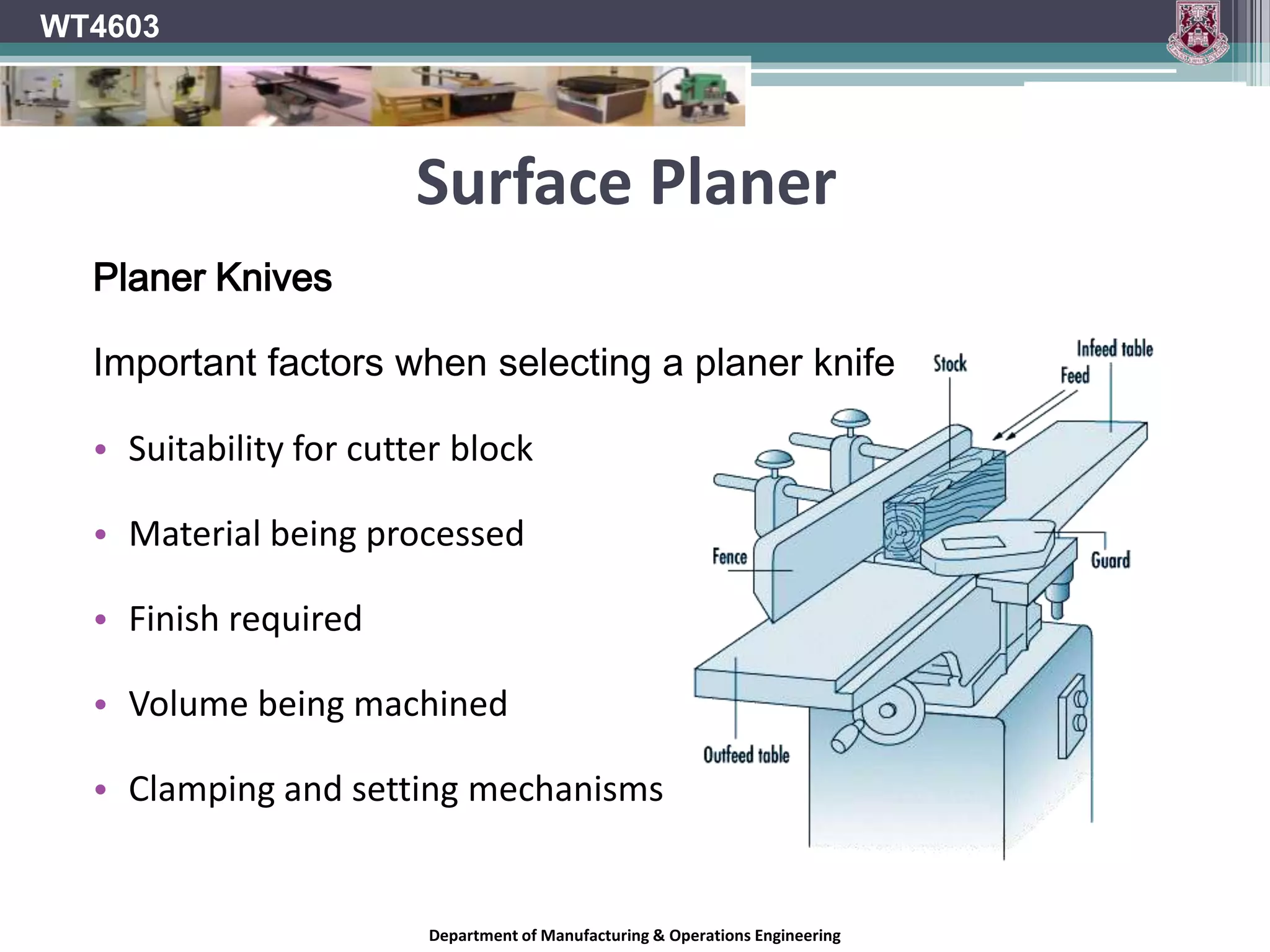
 Notes available on www.slideshare.net/WT4603WT4603Surface PlanerPlaner Knives Important factors when selecting a planer knife Suitability for cutter blockMaterial being processedFinish requiredVolume being machinedClamping and setting mechanismsDepartment of Manufacturing & Operations Engineering
Surface PlanerWT4603Planers can have 2,3,4,6……. Cutter knives.Most smaller machines such as those found in schools will have 2,3 or 4 knives.Department of Manufacturing & Operations Engineering
Surface PlanerWT4603Knives can be made from Chrome Vanadium steel alloy. This is suitable for machining softwoods and non abrasive hardwoods. However with advances in machining technology better materials have been developed to machine wood and wood composites. Chrome Vanadium knives dull quickly on harder more dense material. This requires more sharpening, setting up and leads to a lot of time wastage.Department of Manufacturing & Operations Engineering
Surface PlanerWT4603High Speed Steel (HSS) is a cobalt steel alloy with a small percentage of Tungsten added. It is more suitable for machining all types of wood than the chrome steel compounds.Department of Manufacturing & Operations Engineering
Surface PlanerWT4603Abrasive stock should be machined using solid or tipped cutters.Tungsten Carbide (TC) is the best tool compound for machining manufactured boards.For general work HSS cutters are preferred to TC Cutters can be re-sharpened easily.A keener edge can be achieved on HSS giving a better finishDepartment of Manufacturing & Operations Engineering
Surface PlanerWT4603The reason for this is that steel compounds are smelted and shaped by rolling and forging while the metal is close to melting point.The molecules of the compound flow and align themselves in response to this pressure giving the material maximum strength and edge holding capabilitiesDepartment of Manufacturing & Operations Engineering
WT4603Surface PlanerTungsten carbide is a sintered compound. The fine grain powder from which the cutter will eventually will be made is compressed into a mould ( the ‘blank’ un-edged cutter required) under extremely high temperature (1500C) and pressure to form a solid block.Tungsten does not flow – it retains a granular structure and will chip rather than deform if abused.Department of Manufacturing & Operations Engineering
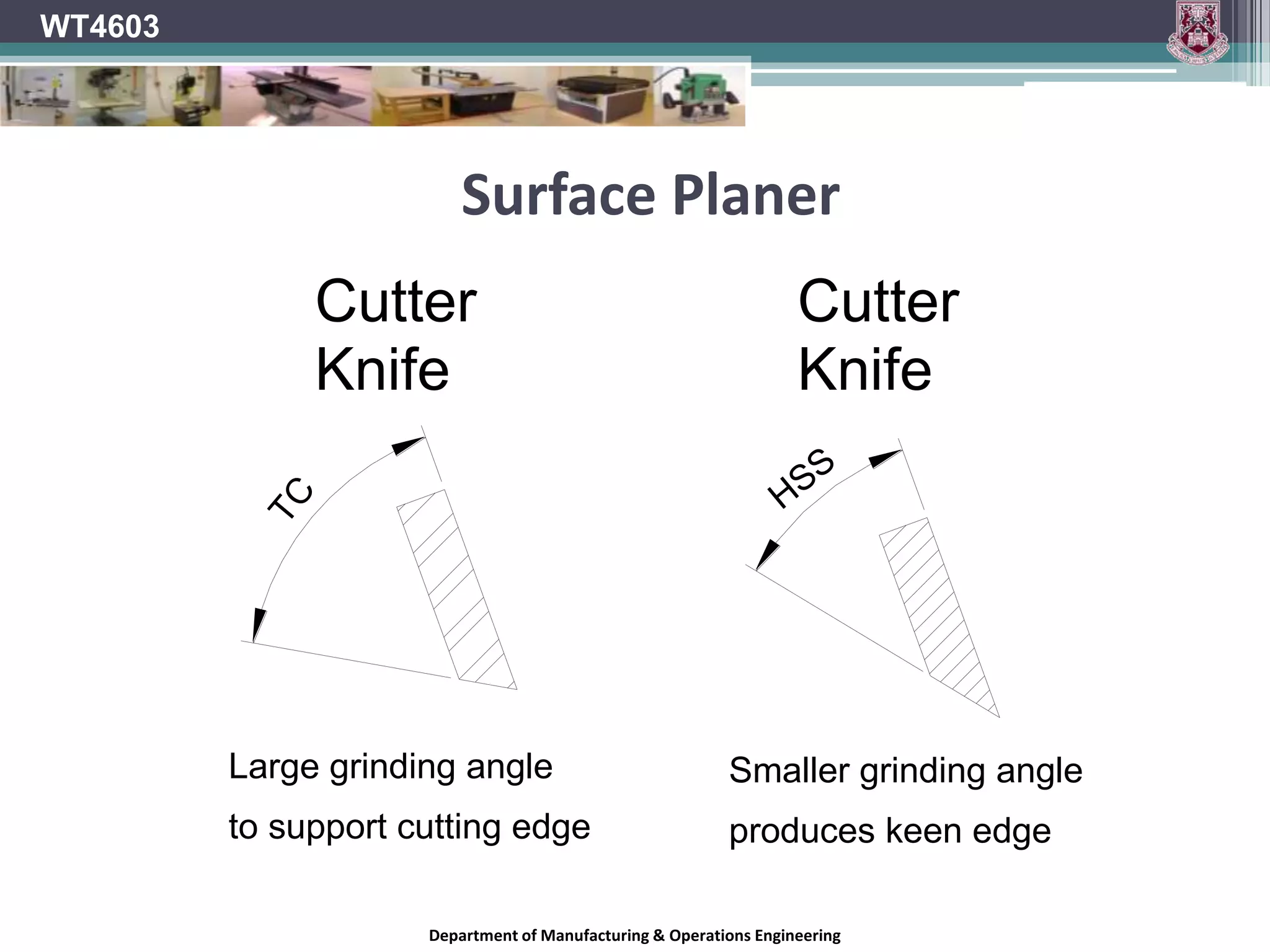
Surface PlanerWT4603Because if its brittle nature TC cutters require a more obtuse sharpness angle than the HSS cutters (more support for the cutting edge). This makes it less satisfactory for cutting softwoods than HSS knives which can be ground to a more acute cutting angle.Department of Manufacturing & Operations Engineering
WT4603Surface PlanerDepartment of Manufacturing & Operations Engineering
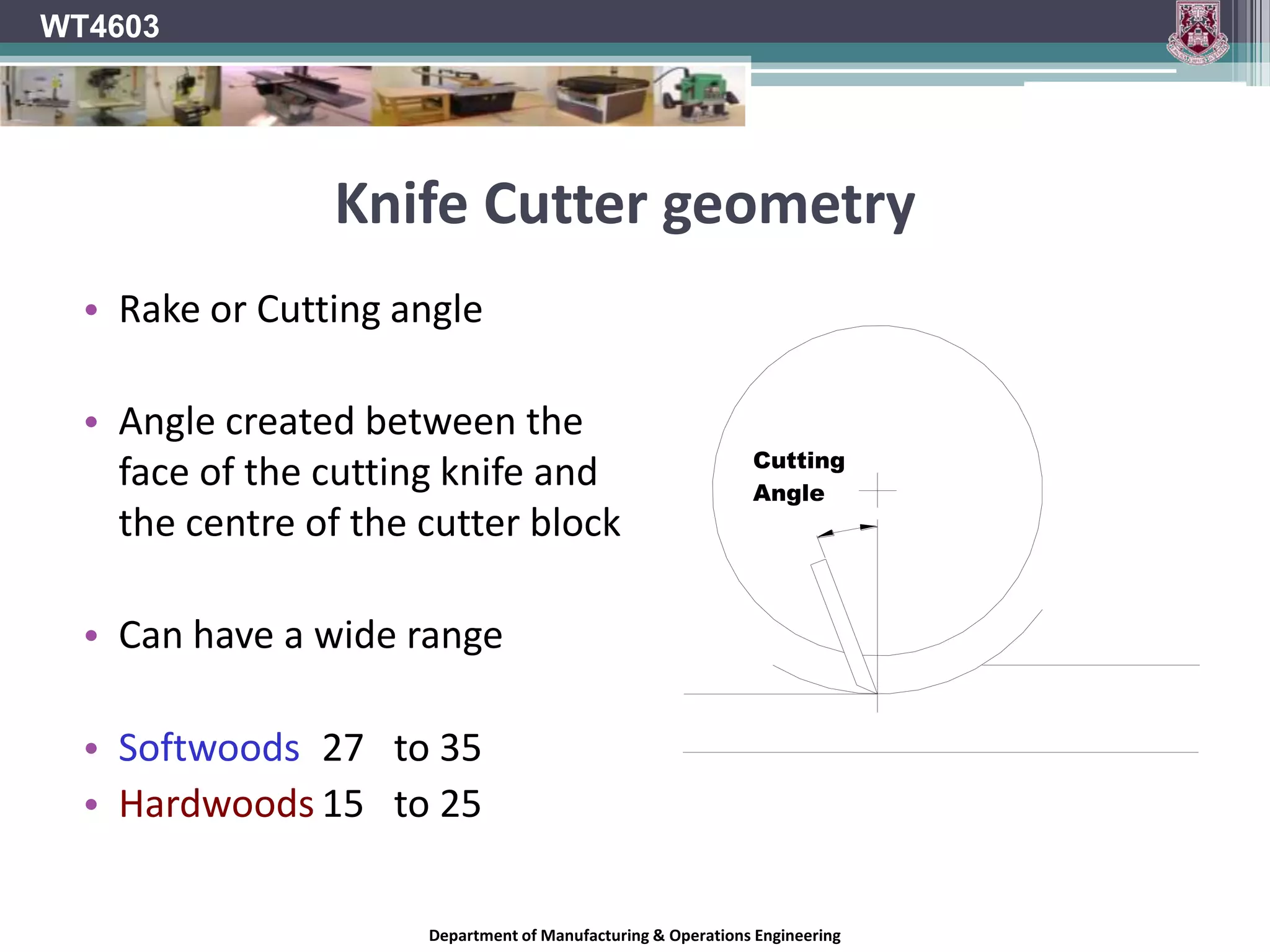
WT4603Knife Cutter geometryRake or Cutting angleAngle created between the face of the cutting knife and the centre of the cutter blockCan have a wide rangeSoftwoods	27° to 35 °Hardwoods	15° to 25 °Department of Manufacturing & Operations Engineering
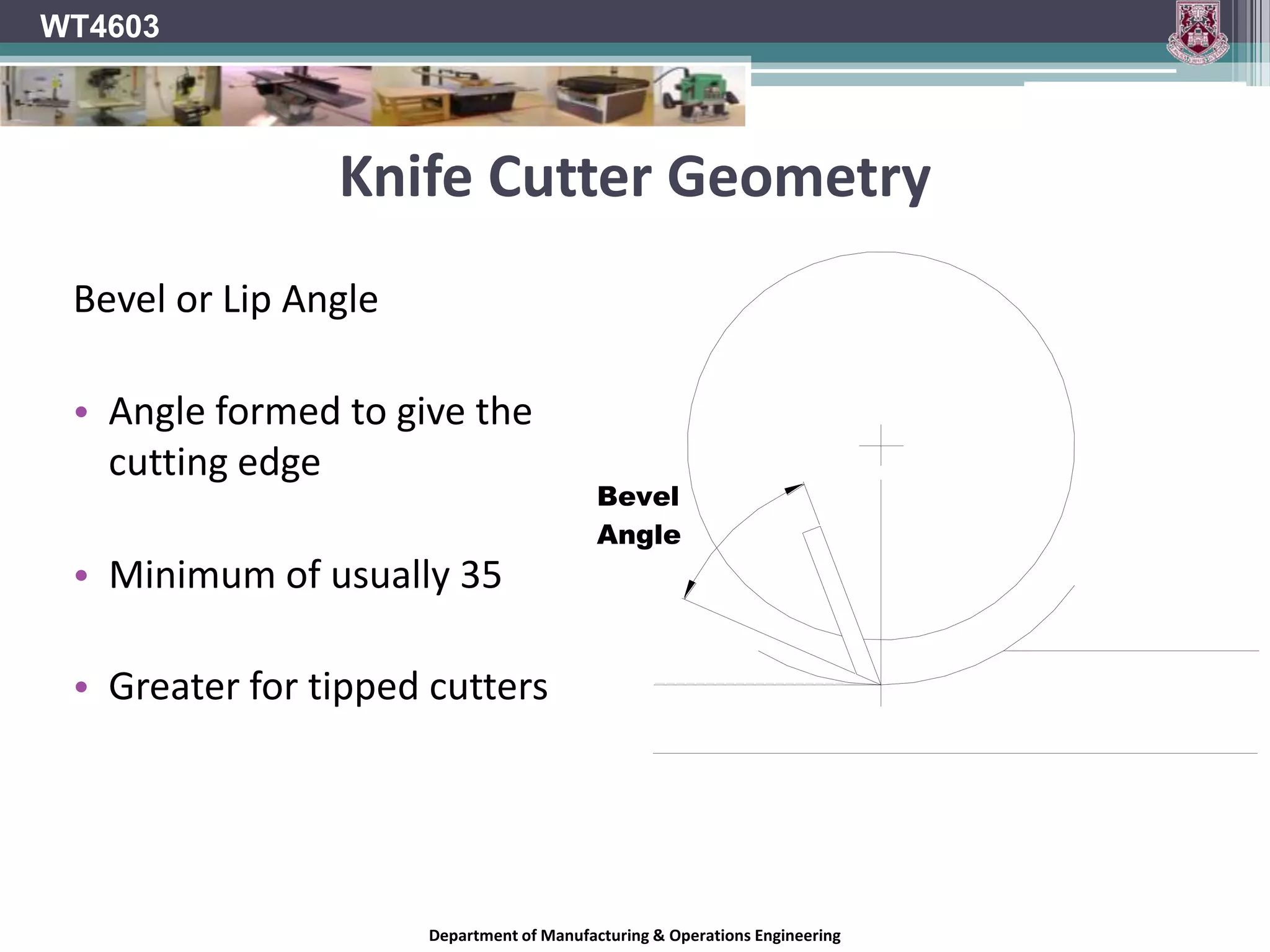
WT4603Knife Cutter GeometryBevel or Lip AngleAngle formed to give the cutting edgeMinimum of usually 35°Greater for tipped cuttersDepartment of Manufacturing & Operations Engineering
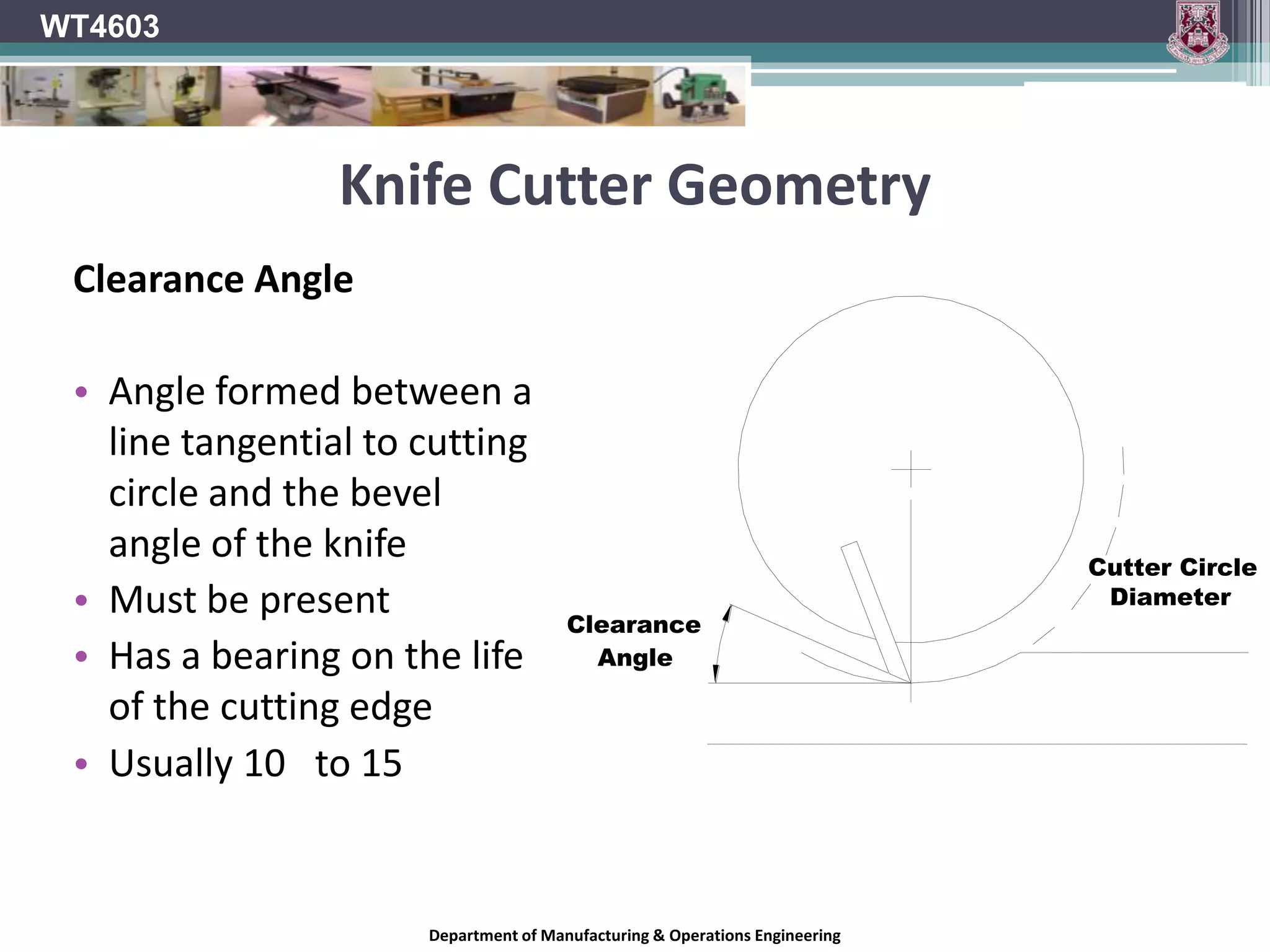
WT4603Knife Cutter GeometryClearance AngleAngle formed between a line tangential to cutting circle and the bevel angle of the knifeMust be presentHas a bearing on the life of the cutting edgeUsually 10° to 15°Department of Manufacturing & Operations Engineering
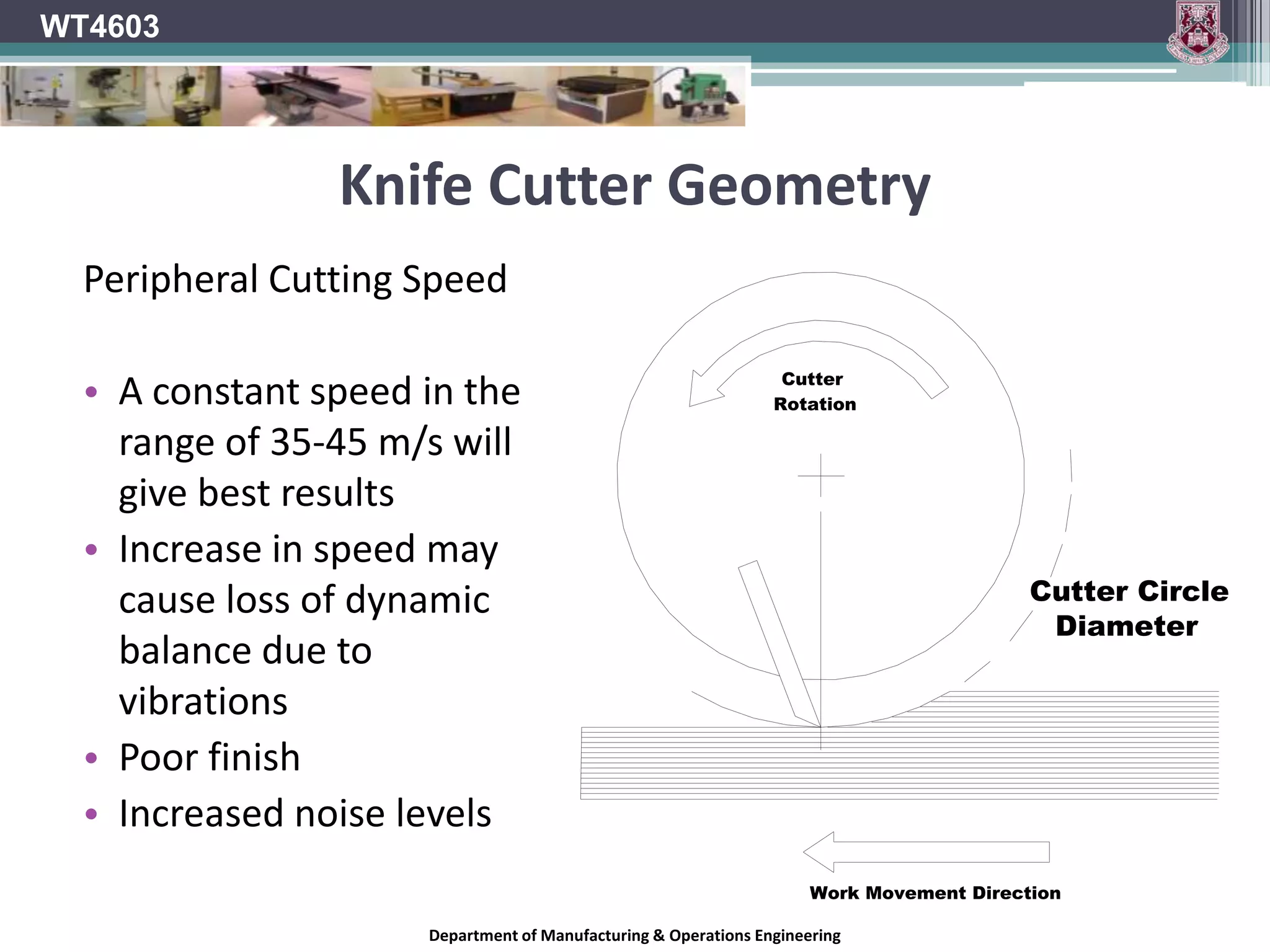
WT4603Knife Cutter GeometryPeripheral Cutting SpeedA constant speed in the range of 35-45 m/s will give best resultsIncrease in speed may cause loss of dynamic balance due to vibrationsPoor finishIncreased noise levelsDepartment of Manufacturing & Operations Engineering
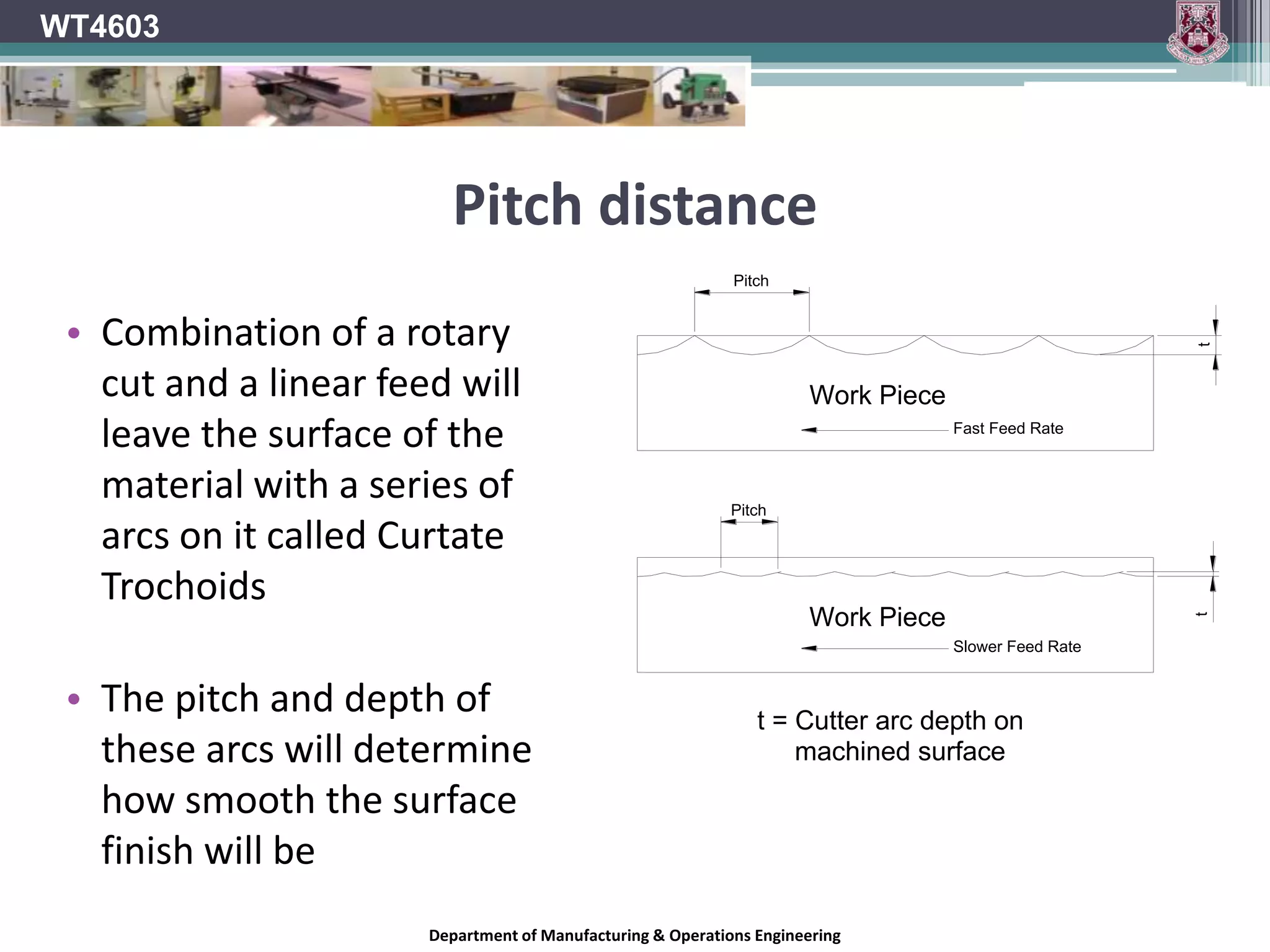
WT4603Pitch distanceCombination of a rotary cut and a linear feed will leave the surface of the material with a series of arcs on it called Curtate TrochoidsThe pitch and depth of these arcs will determine how smooth the surface finish will beDepartment of Manufacturing & Operations Engineering
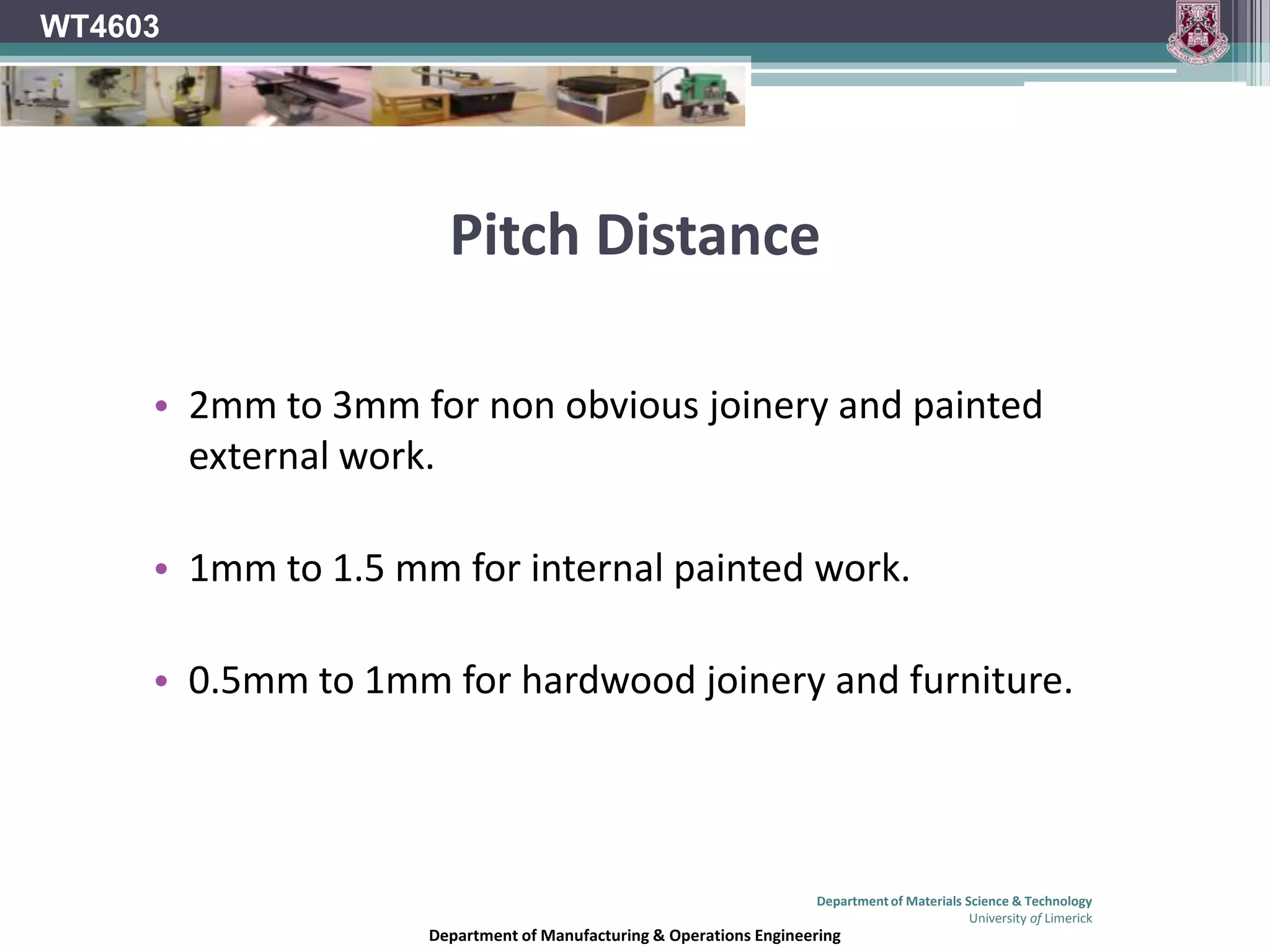
Department of Materials Science & TechnologyUniversity of LimerickWT4603Pitch Distance2mm to 3mm for non obvious joinery and painted external work.  1mm to 1.5 mm for internal painted work.0.5mm to 1mm for hardwood joinery and furniture.Department of Manufacturing & Operations Engineering
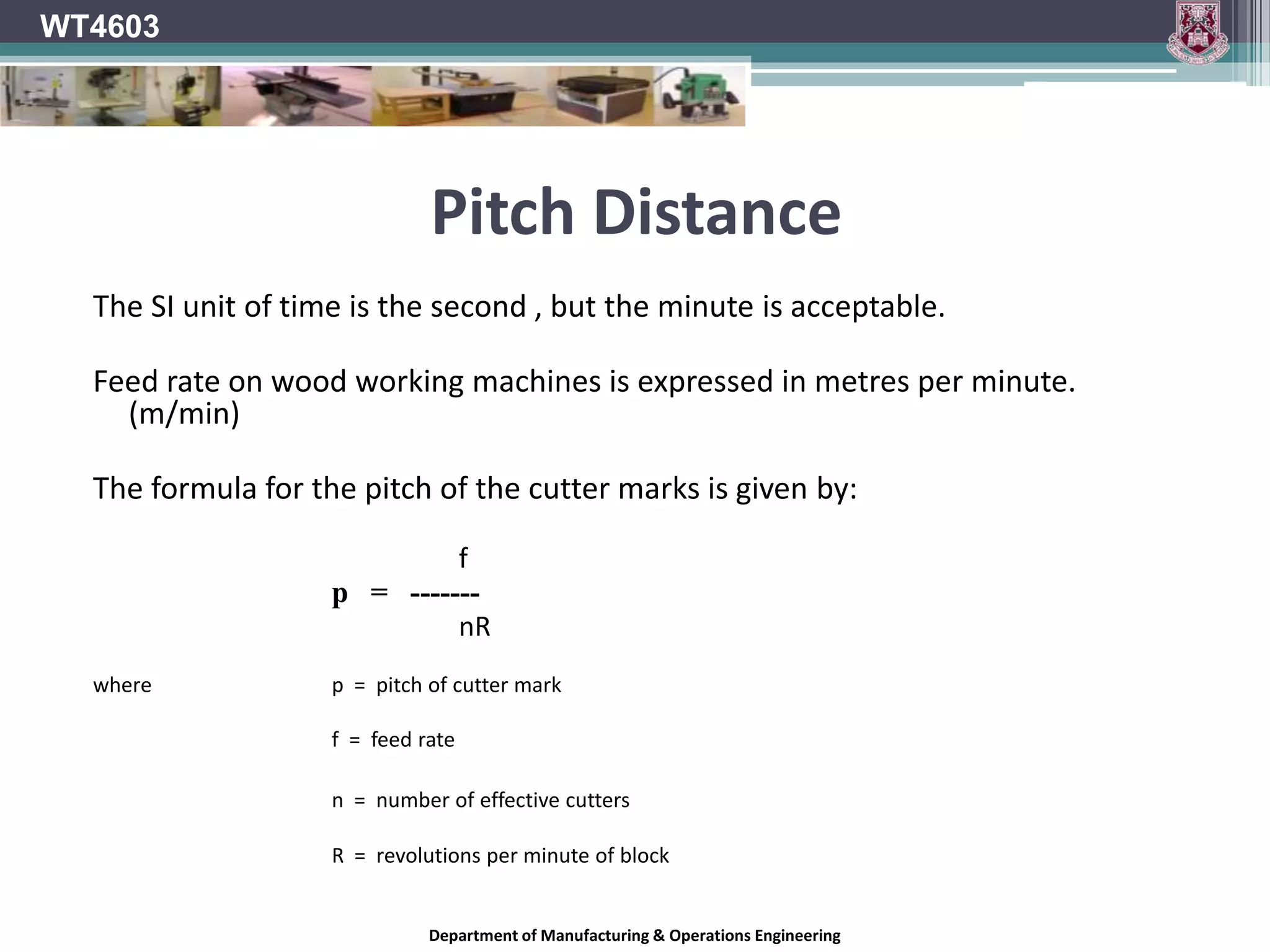
WT4603Pitch DistanceThe SI unit of time is the second , but the minute is acceptable. Feed rate on wood working machines is expressed in metres per minute. (m/min) The formula for the pitch of the cutter marks is given by: 	       			f			p   =   -------nR where 		p  =  pitch of cutter mark			f  =  feed rate n  =  number of effective cutters 			R  =  revolutions per minute of blockDepartment of Manufacturing & Operations Engineering
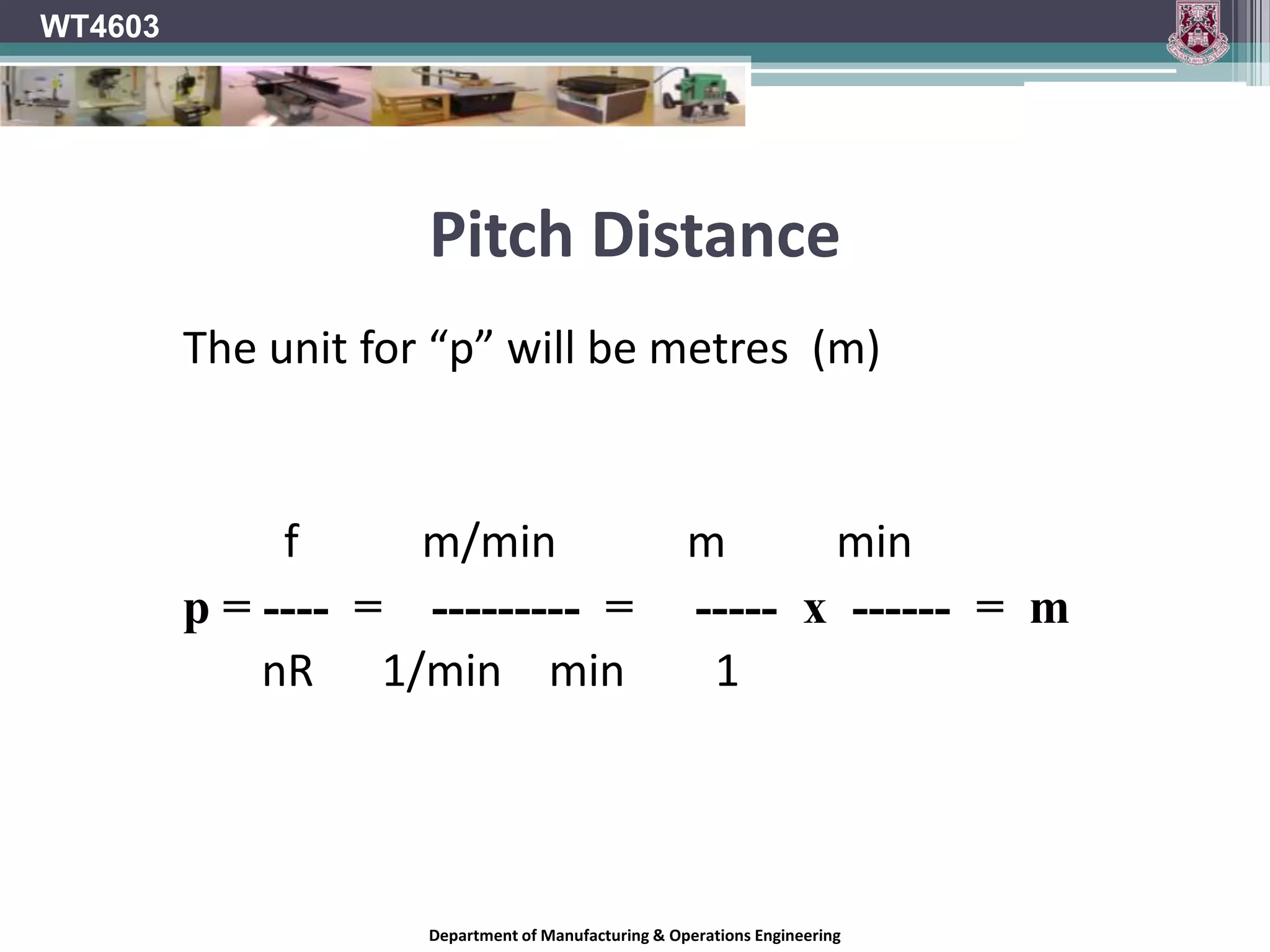
Pitch DistanceWT4603The unit for “p” will be metres  (m)     f 	m/min	 m	   minp = ----  =    ---------  =     -----  x  ------  =  m       nR      1/min 	min        1Department of Manufacturing & Operations Engineering
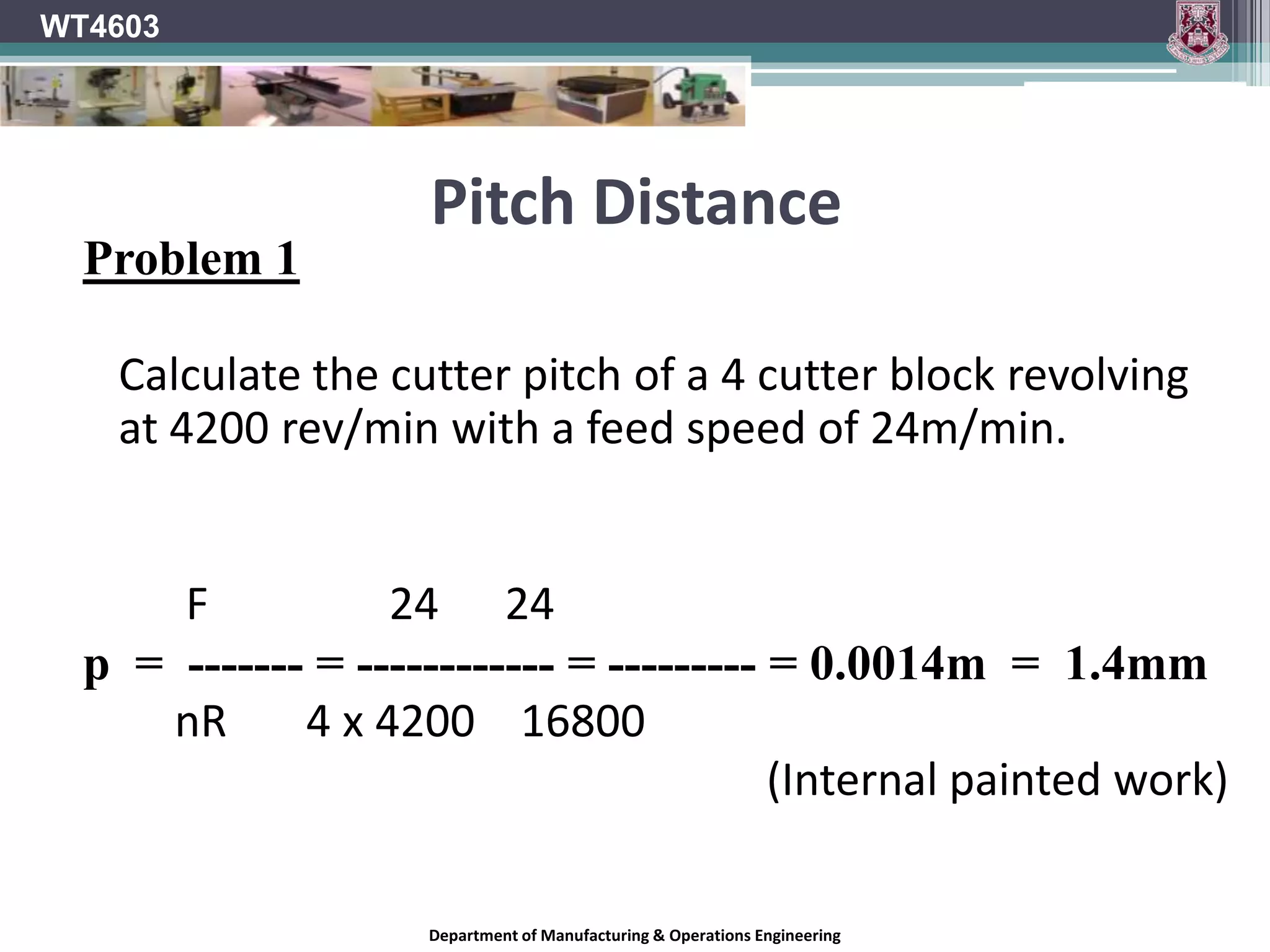
WT4603Pitch DistanceProblem 1	Calculate the cutter pitch of a 4 cutter block revolving at 4200 rev/min with a feed speed of 24m/min.  	      F	      24	     24p  =  ------- = ------------ = --------- = 0.0014m  =  1.4mmnR       4 x 4200    16800(Internal painted work)Department of Manufacturing & Operations Engineering
Pitch DistanceWT4603	If a graded surface is specified and the machine has a multi-speed feed gearbox, the same formula is used but “f” is expressed in terms of n ,p, and R.  	       	    f                  		p   =   -------     f  =  nRpnRDepartment of Manufacturing & Operations Engineering
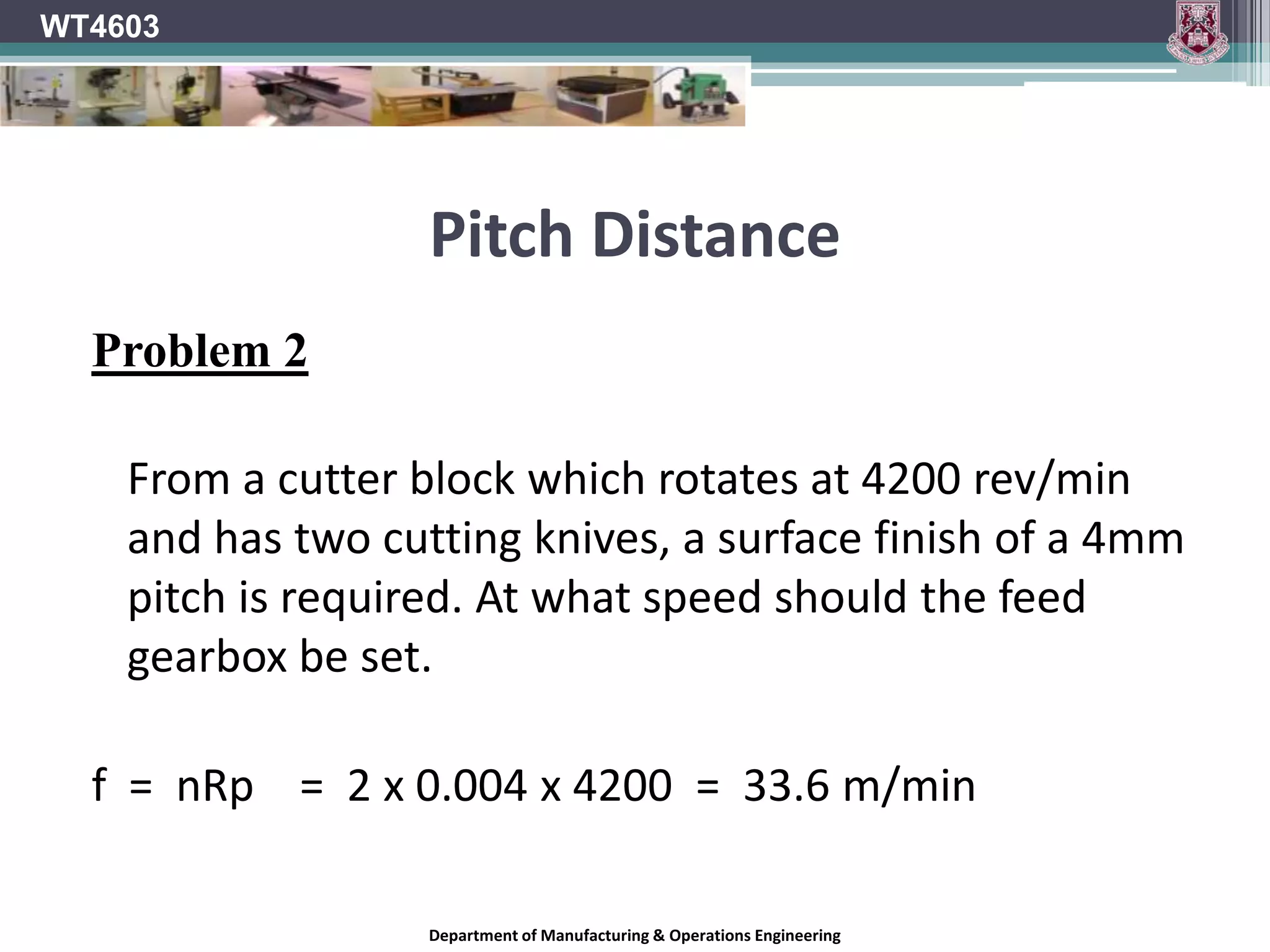
Pitch DistanceProblem 2 	From a cutter block which rotates at 4200 rev/min and has two cutting knives, a surface finish of a 4mm pitch is required. At what speed should the feed gearbox be set. f  =  nRp    =  2 x 0.004 x 4200  =  33.6 m/min WT4603Department of Manufacturing & Operations Engineering
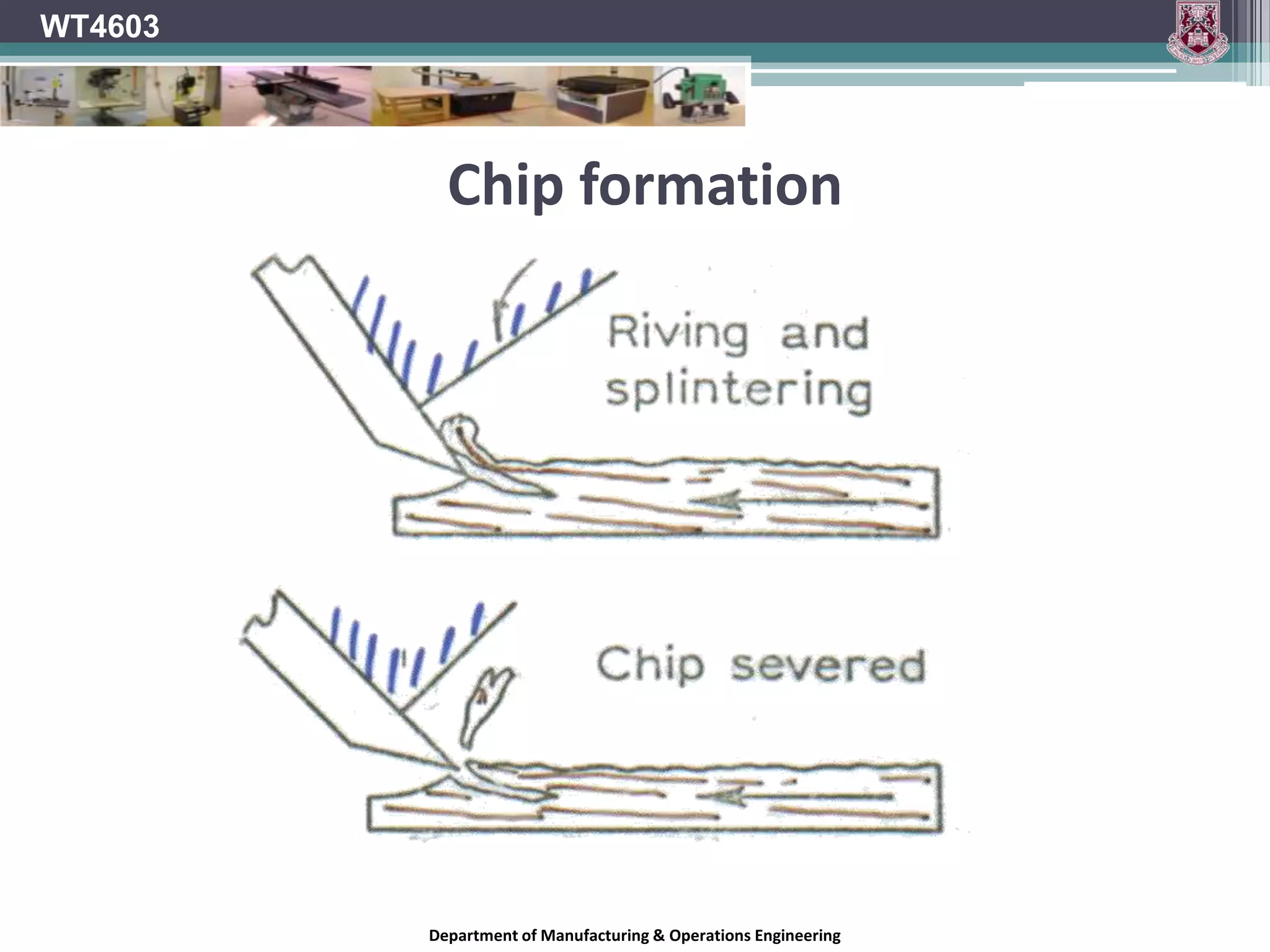
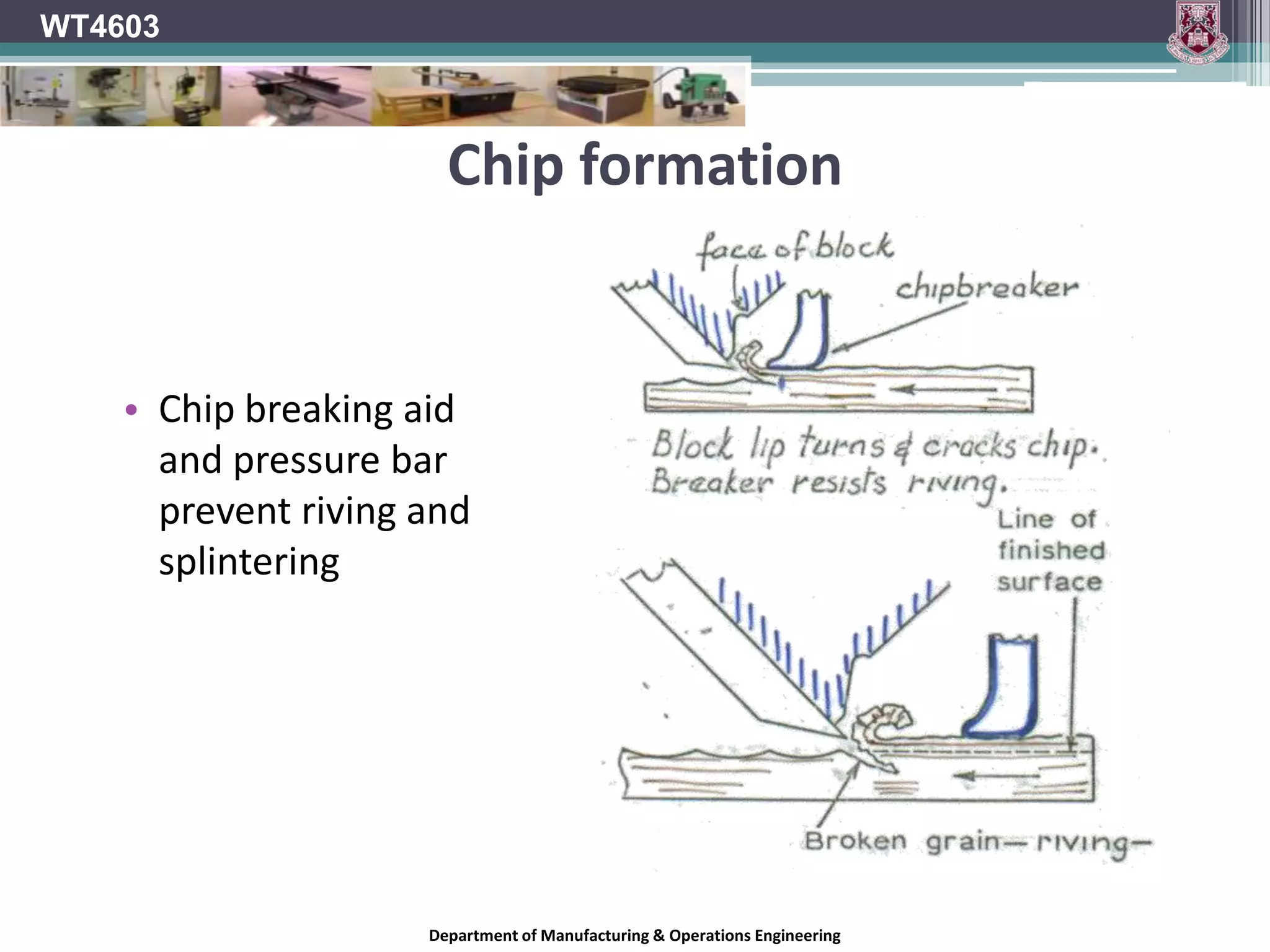
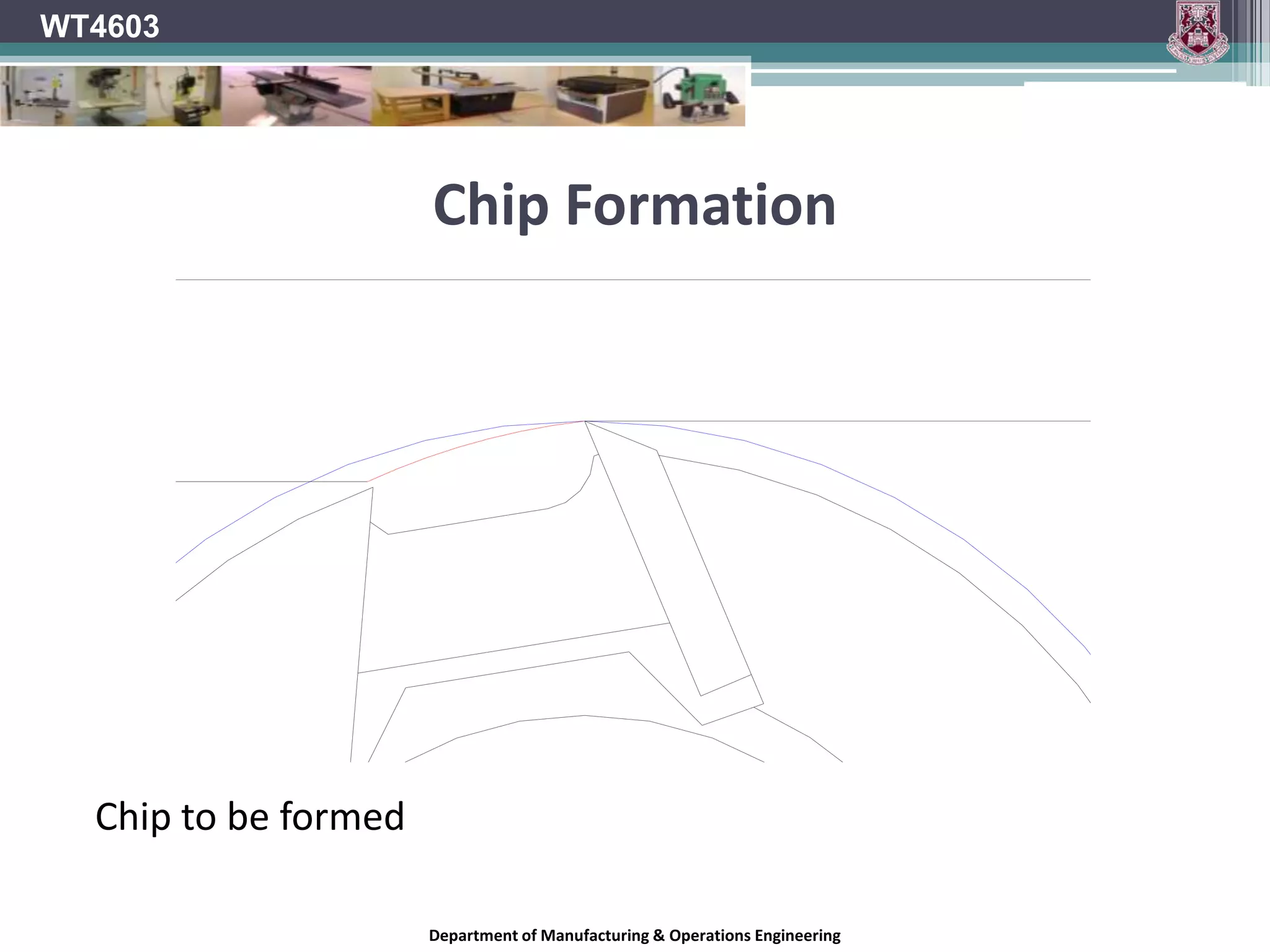
WT4603Chip formationDepartment of Manufacturing & Operations Engineering
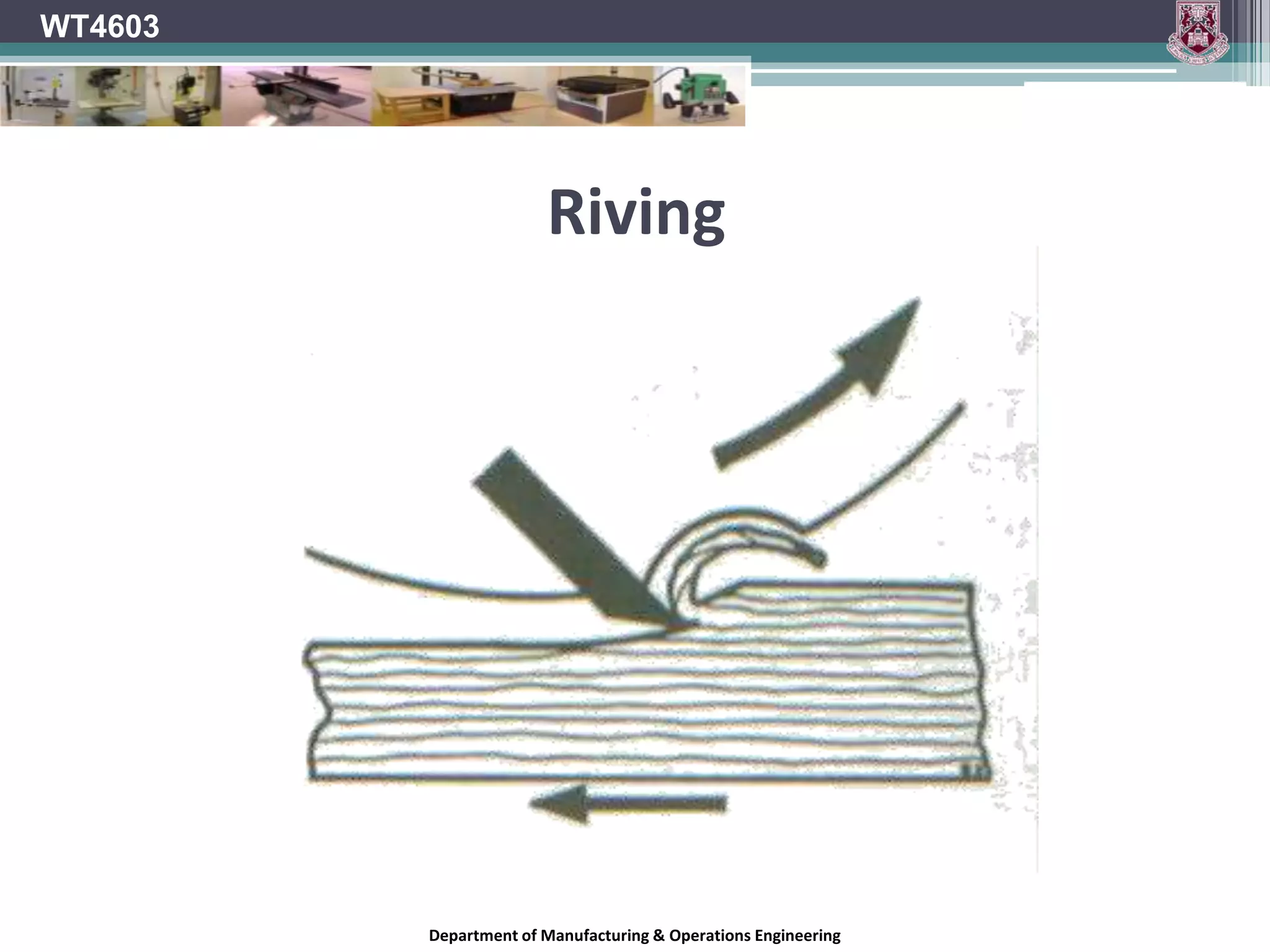
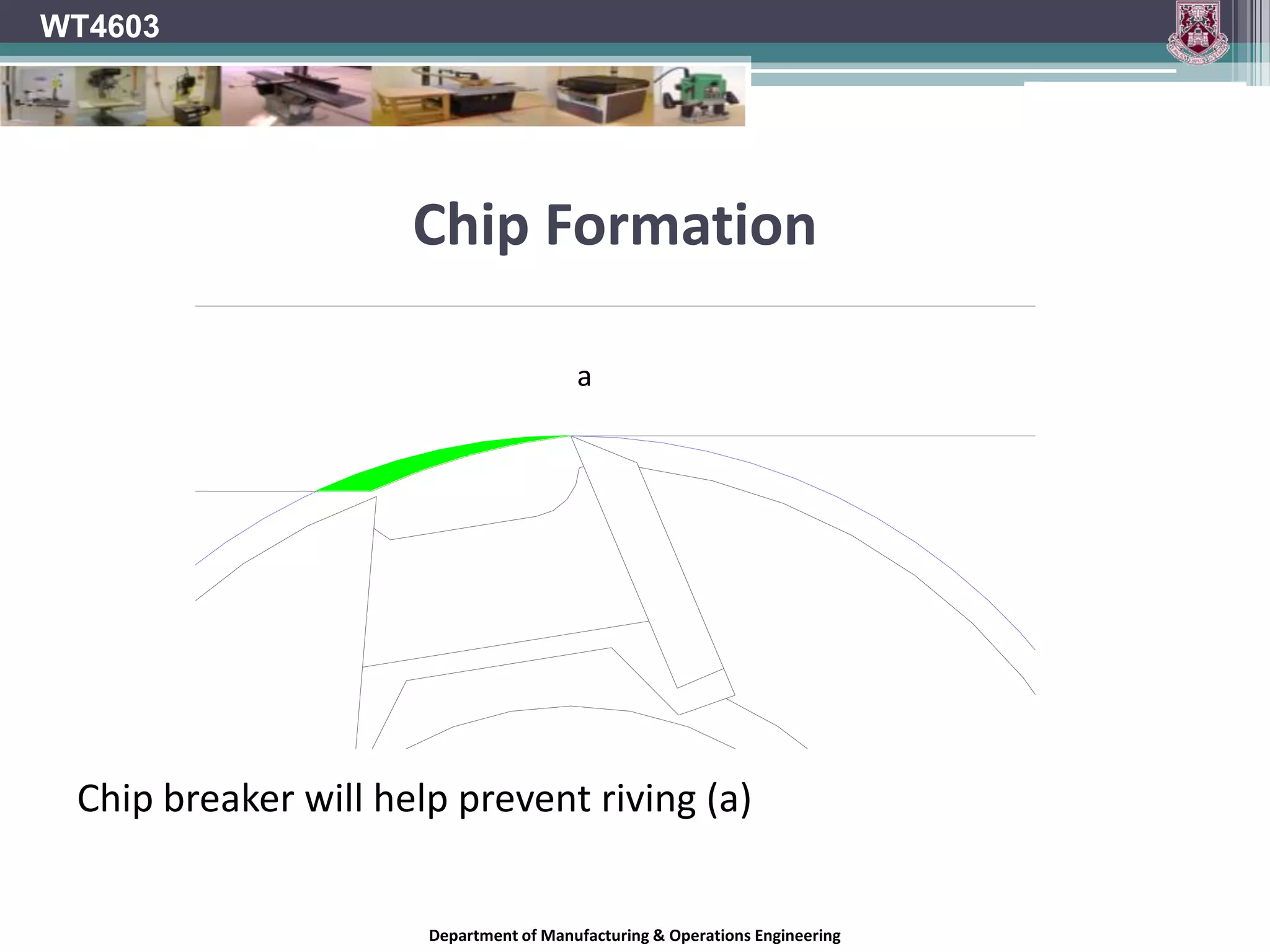
WT4603RivingDepartment of Manufacturing & Operations Engineering
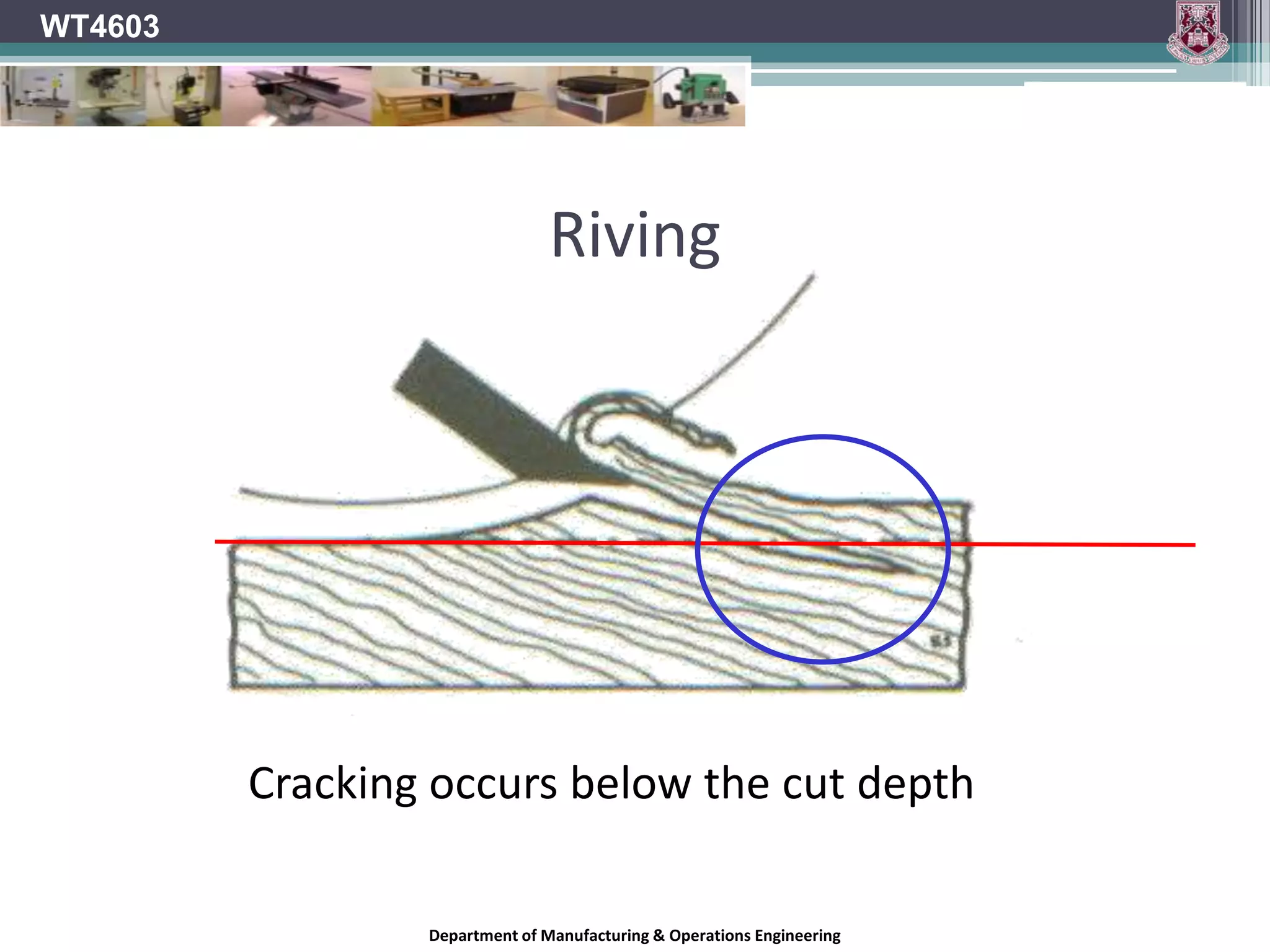
RivingWT4603Cracking occurs below the cut depthDepartment of Manufacturing & Operations Engineering
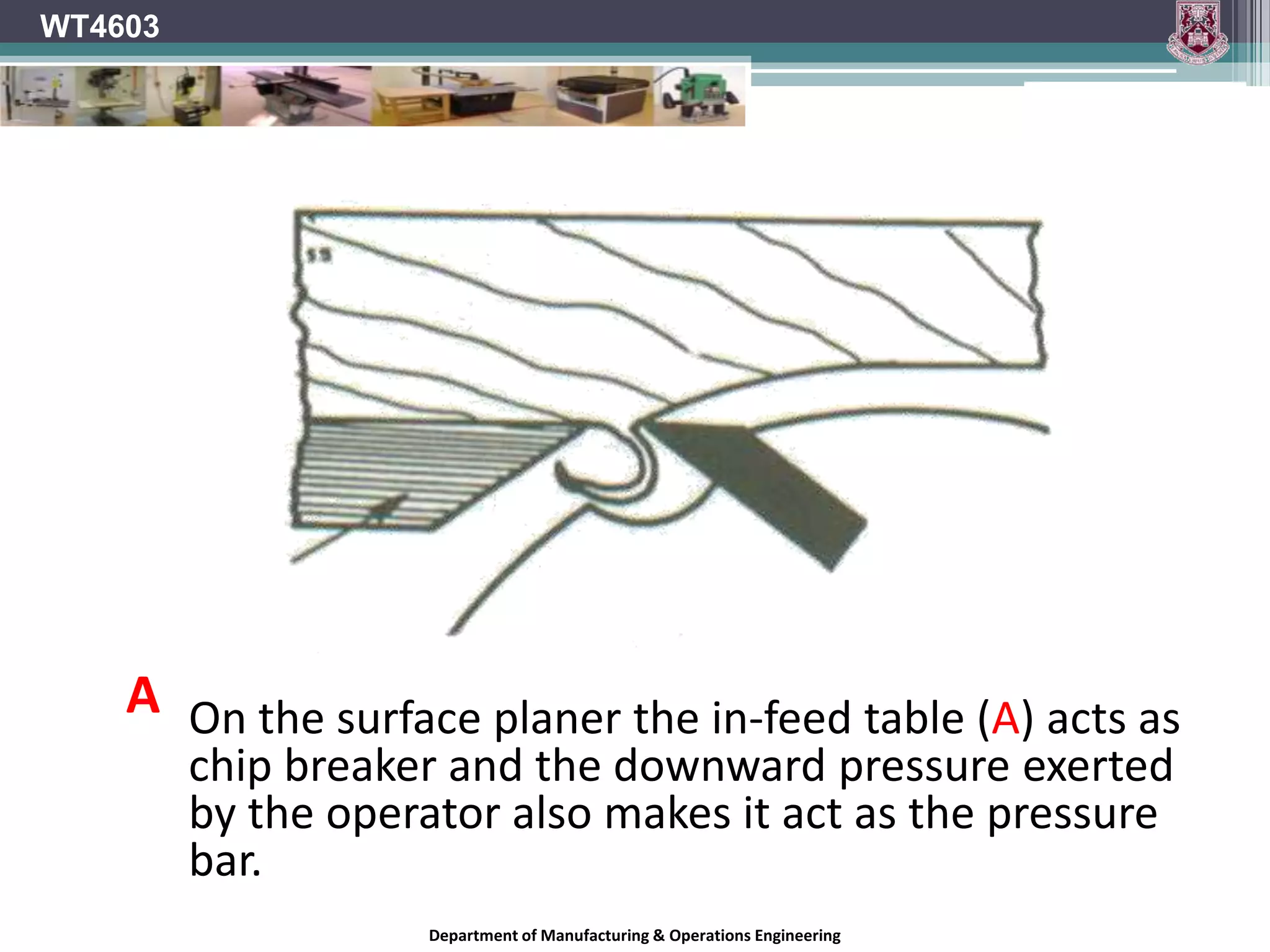
WT4603AOn the surface planer the in-feed table (A) acts as chip breaker and the downward pressure exerted by the operator also makes it act as the pressure bar.Department of Manufacturing & Operations Engineering
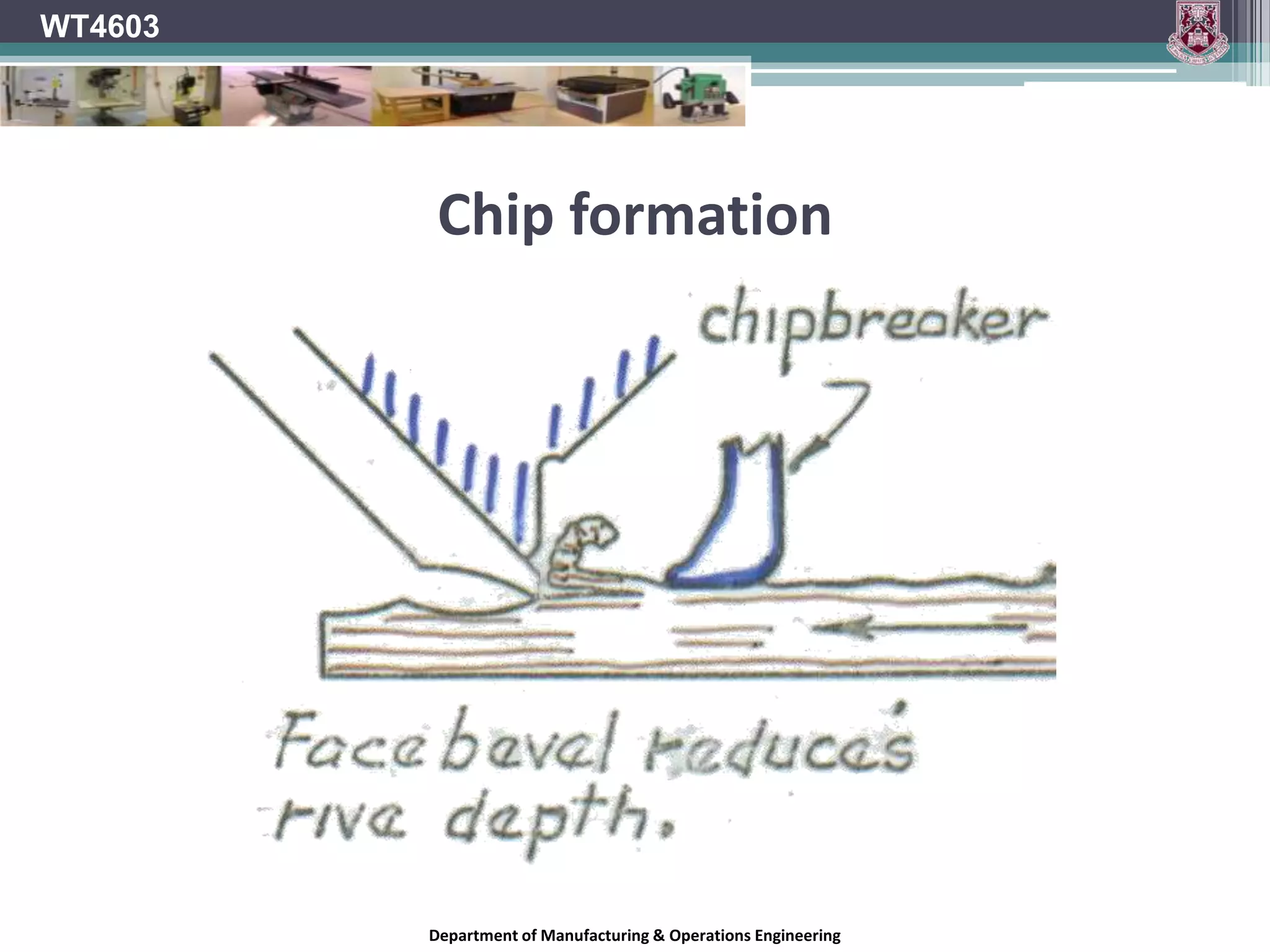
WT4603Chip formationDepartment of Manufacturing & Operations Engineering
WT4603Chip formationChip breaking aid and pressure bar prevent riving and splinteringDepartment of Manufacturing & Operations Engineering
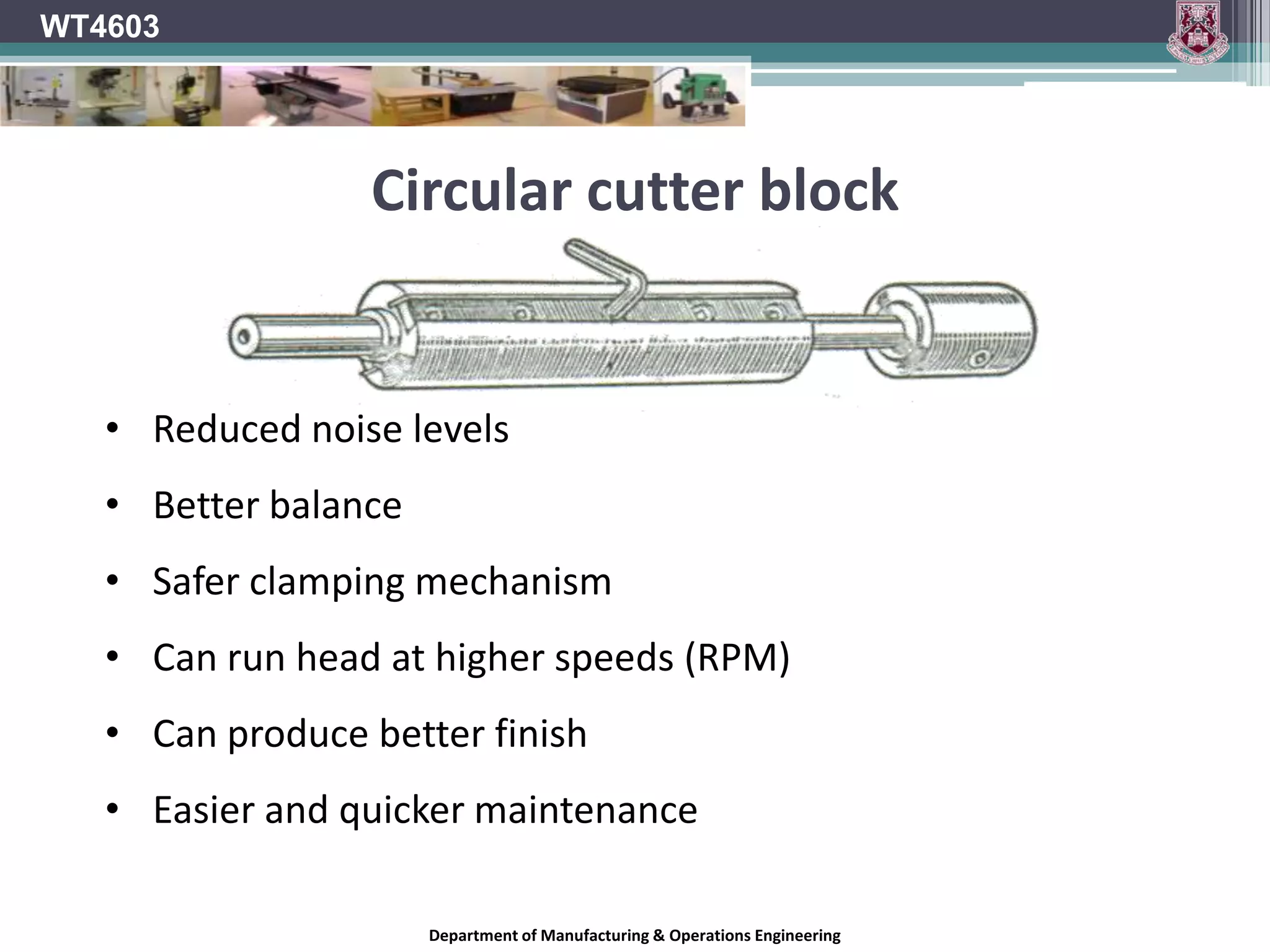
WT4603Circular cutter blockReduced noise levels
Better balance
Safer clamping mechanism
Can run head at higher speeds (RPM)
Can produce better finish
Easier and quicker maintenanceDepartment of Manufacturing & Operations Engineering
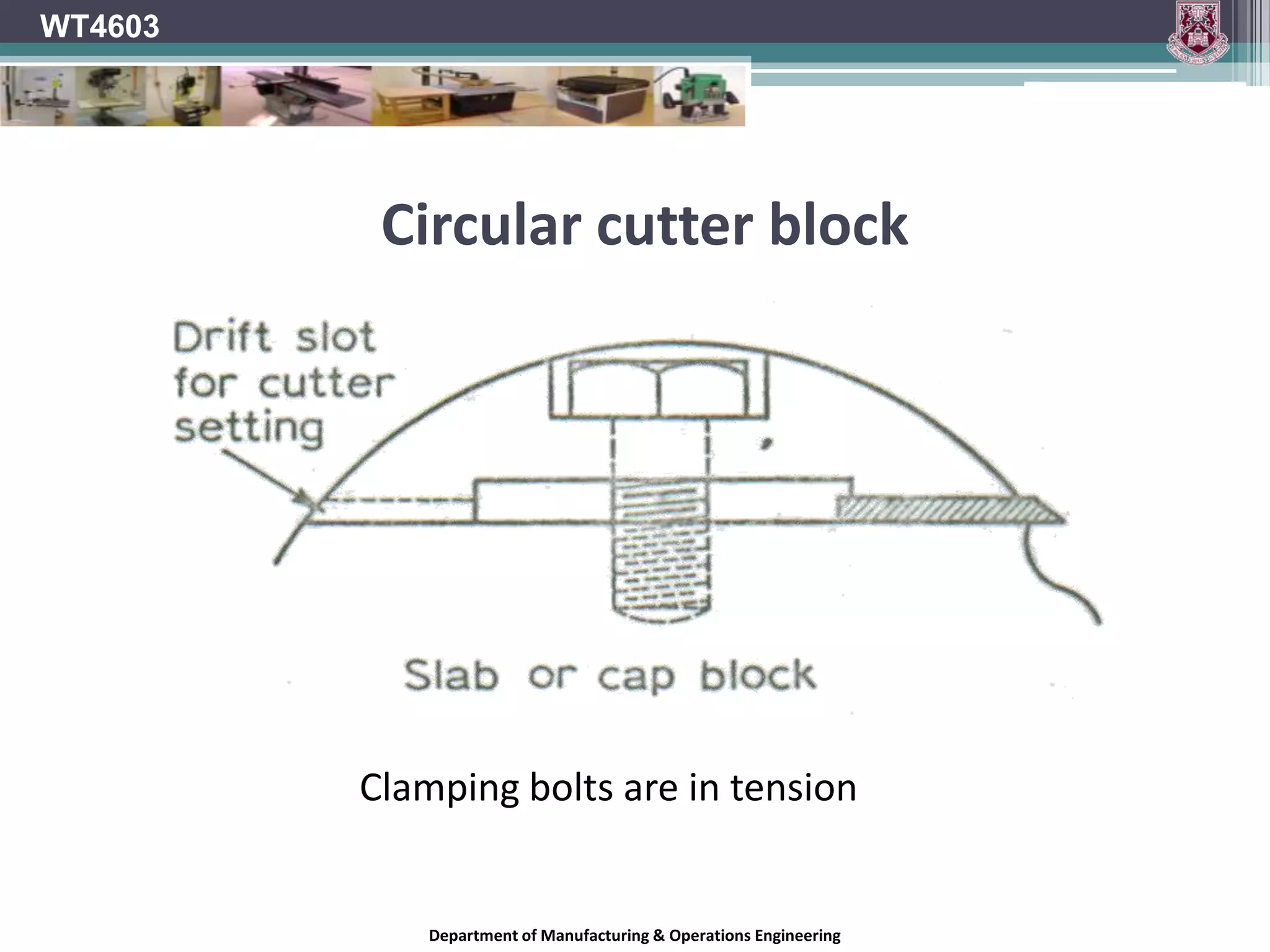
WT4603Circular cutter blockClamping bolts are in tensionDepartment of Manufacturing & Operations Engineering
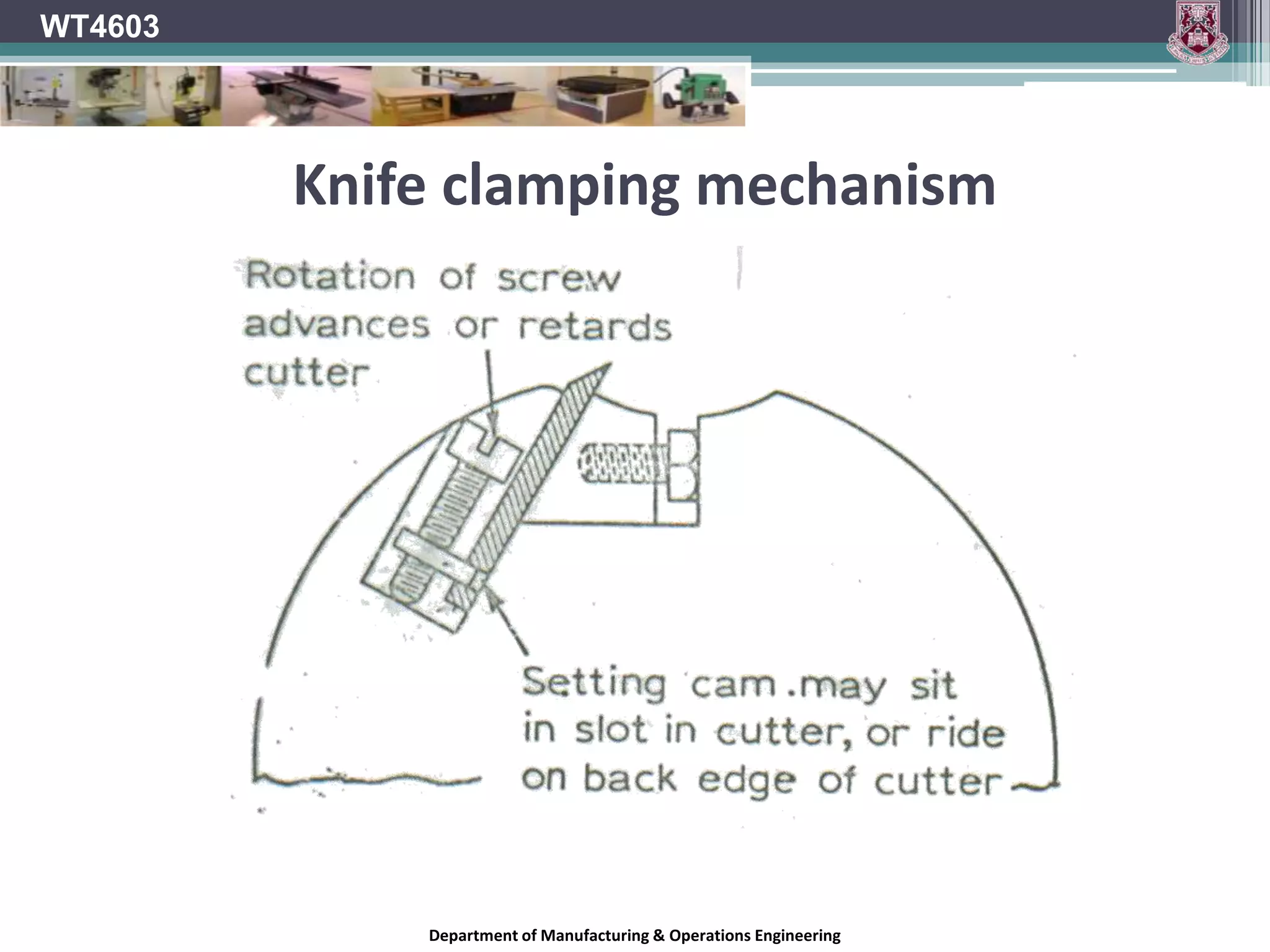
WT4603Knife clamping mechanismDepartment of Manufacturing & Operations Engineering
Cutter projectionWT4603Use of a limiter to achieve limited cutter projectionDepartment of Manufacturing & Operations Engineering
Cutter designWT4603Cutters should preferably be designed to be used in dimensionally similar pairs, formed to the same profile. Pairs should be mounted directly opposite one another. The manufacturer should ensure that instructions on balancing the pairs of cutters after grinding are given to the user.Department of Manufacturing & Operations Engineering
Cutter projectionWT4603The design of cutter blocks should, as far as is practicable, be such as to prevent excessive cutter projection. Where the mounting arrangement permits projection which could subject the cutter to unsafe stresses, the maximum permissible projection for given cutter types should be specified in the user’s instructions.Department of Manufacturing & Operations Engineering
Hand-fed machinesWT4603For machines designed for hand-fed operations, where cutters are necessarily exposed, the use of chip limiting cutters should be recommended For other hand and semi-mechanical feed operations, cutter blocks should have as little cutter projection as is practicable.Department of Manufacturing & Operations Engineering
WT4603Surface PlanerCutter and Machine Maintenance Involves: Grinding and setting of knives Roller and pressure bar setting Prevention of resin build up on table and rollers. Attention to:	bearing wear
feed complex adjustments
rise and fall tableDepartment of Manufacturing & Operations Engineering
Surface PlanerWT4603The grinding angle of a cutter can vary between 30 to 35This is increased to 40 for hardwoods (cutting edge lasts longer)Department of Manufacturing & Operations Engineering
WT4603Surface PlanerOverheating May produce micro cracks in the cutting edge which can run into gaps when the cutter is used.May cause the cutter to bow due to expansion.Department of Manufacturing & Operations Engineering
WT4603Surface PlanerOverheating can be avoidedBy taking light cuts.By ensuring that the grind wheel is ‘dressed’ when required to ensure that the face is open and not glazed when grinding the knives.By using a ‘soft’ grinding wheel on HSS cutters – the soft structure of the wheel allows its grains to break away as soon as they are blunt revealing sharper ones.By wet grinding – this is the grinding of cutters while partially submerged in a mixture of water and soluble oil. The water is a coolant to prevent frictional heat developing and to disperse it should it occur. The oil prevents rust in the cutters and it provides a degree of cutting lubrication.Department of Manufacturing & Operations Engineering
WT4603Surface PlanerSetting Cutters in Block Before setting the following points should be checked. The out feed table and cutter block must be clean and free from dust resin. Method of adjusting cutters.Area where setting device is used from should be free from resin and damage.Straightness of cutters.Cutters correctly balanced both in weight and end for end.Department of Manufacturing & Operations Engineering
WT4603Surface PlanerSetting devicesThere are a number of cutter setting devices.This device and procedure will often be supplied with the machine.They can be loosely placed into the following four categories: Bridge device Precision cutter setter device Pin locater device Wooden straight edge device Cutters require accurate setting in the block because if the knives are not revolving in the same cutting circle a poor finish will be produced.Department of Manufacturing & Operations Engineering
WT4603Setting Cutter KnivesSetting of knives will greatly depend on the type of cutter blockKnife cutter projectionChip breakerKnife parallel to tableAll knives in the same peripheral cutting circle(Refer to machine manual for setting)Department of Manufacturing & Operations Engineering
WT4603Setting Planer KnivesWhen planing wooden material a number of factors combine to generate the flat surface.Number of cutting knives in the blockSpeed of the revolving blockFeed speed of the materialKnife cutter designChip breaking aidsNature and species of the materialDepartment of Manufacturing & Operations Engineering
Knife cutter design & Chip breaking aidsThese factors combine to produce an acceptable surface finishTip of the cutter splits away the chipThe chip is forced away from the stock and up along the face of the cutter which is exerting a tearing effect on the grain fibreAs the knife exits the stock the chip is either cut or will “rive” or tear deeply along the grain line and lift as a long heavy splinterWT4603Department of Manufacturing & Operations Engineering
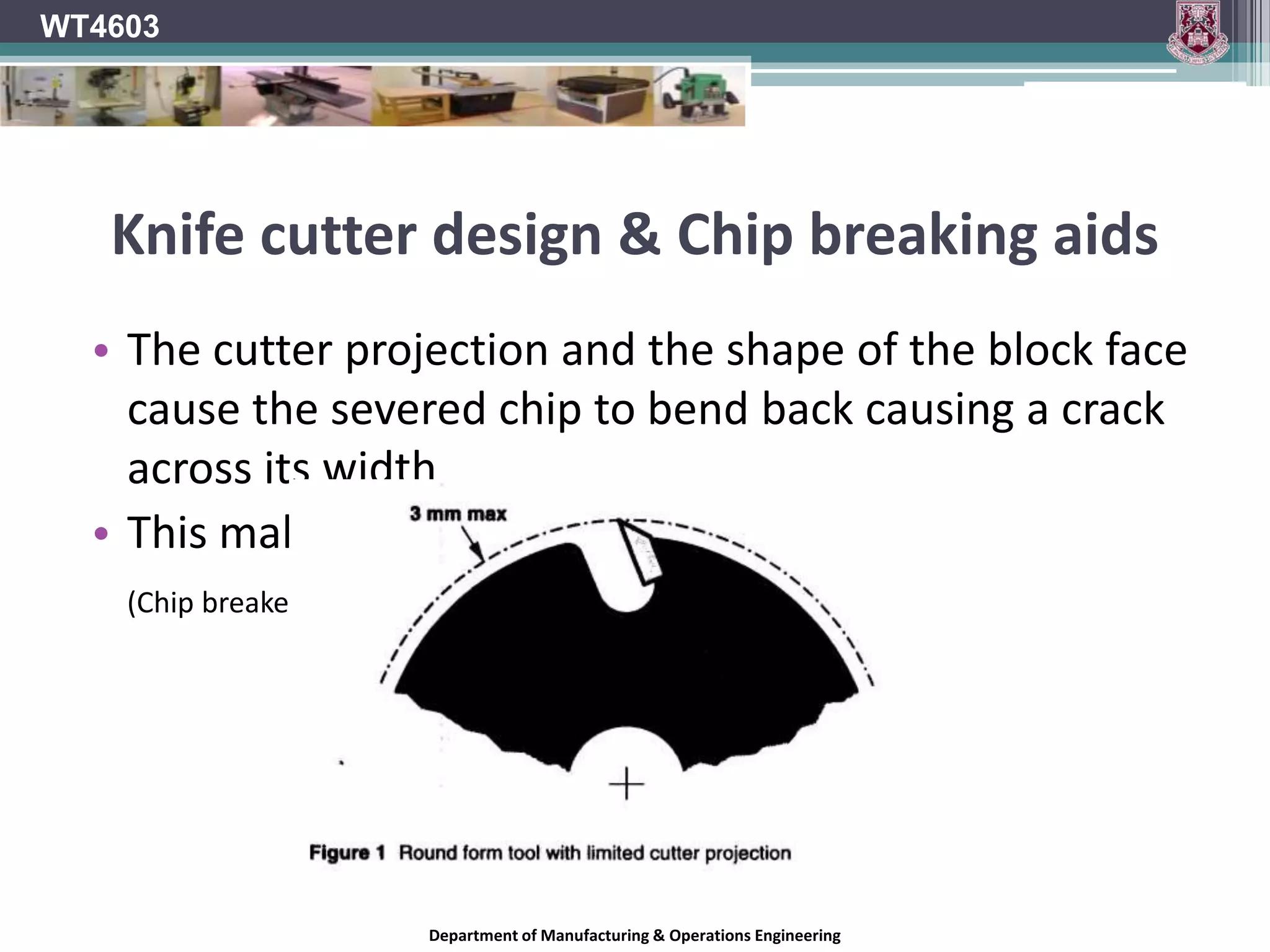
Knife cutter design & Chip breaking aidsThe cutter projection and the shape of the block face cause the severed chip to bend back causing a crack across its widthThis makes long grain riving less likely(Chip breaker not shown)WT4603Department of Manufacturing & Operations Engineering
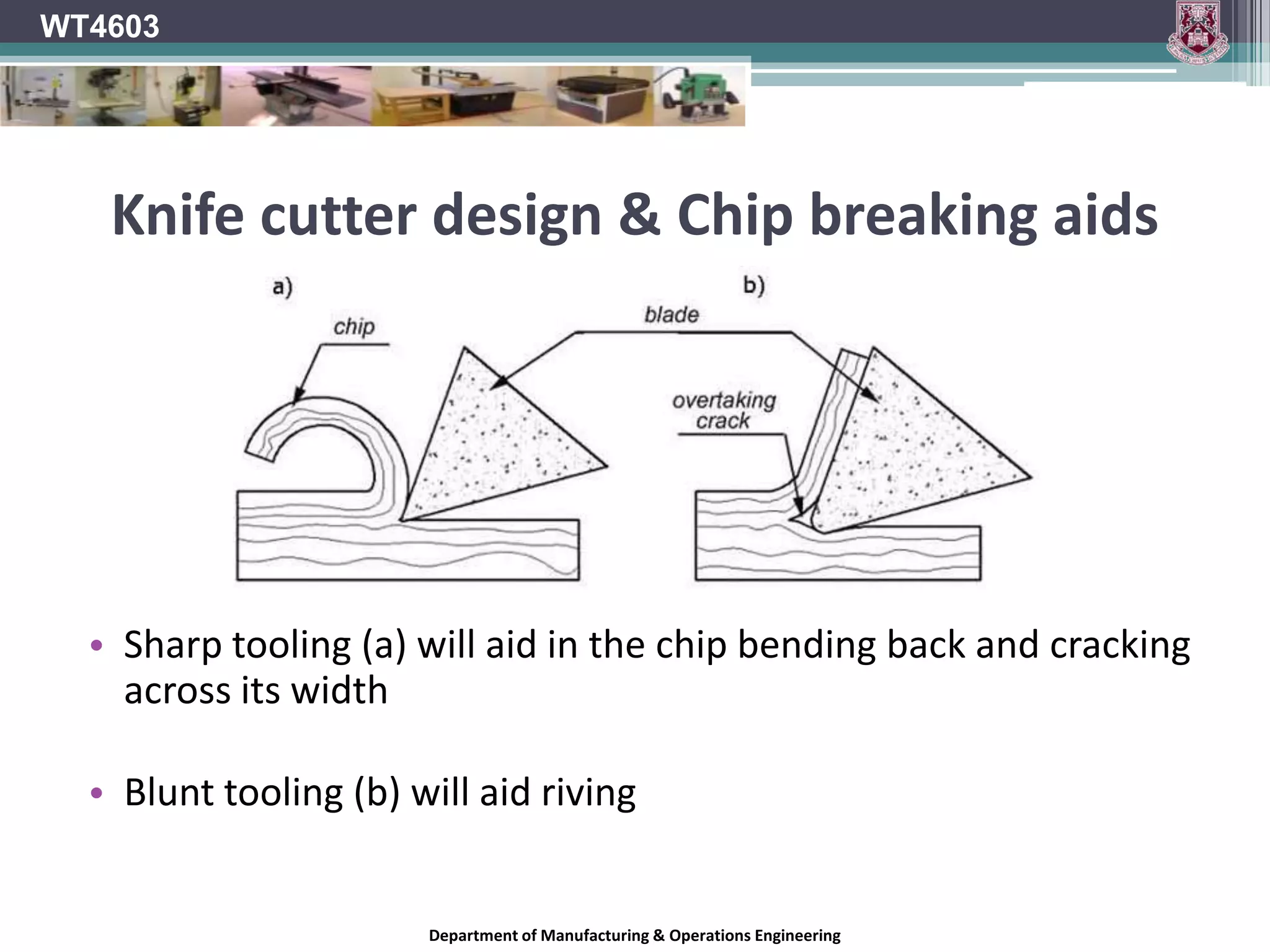
WT4603Knife cutter design & Chip breaking aidsSharp tooling (a) will aid in the chip bending back and cracking across its widthBlunt tooling (b) will aid rivingDepartment of Manufacturing & Operations Engineering
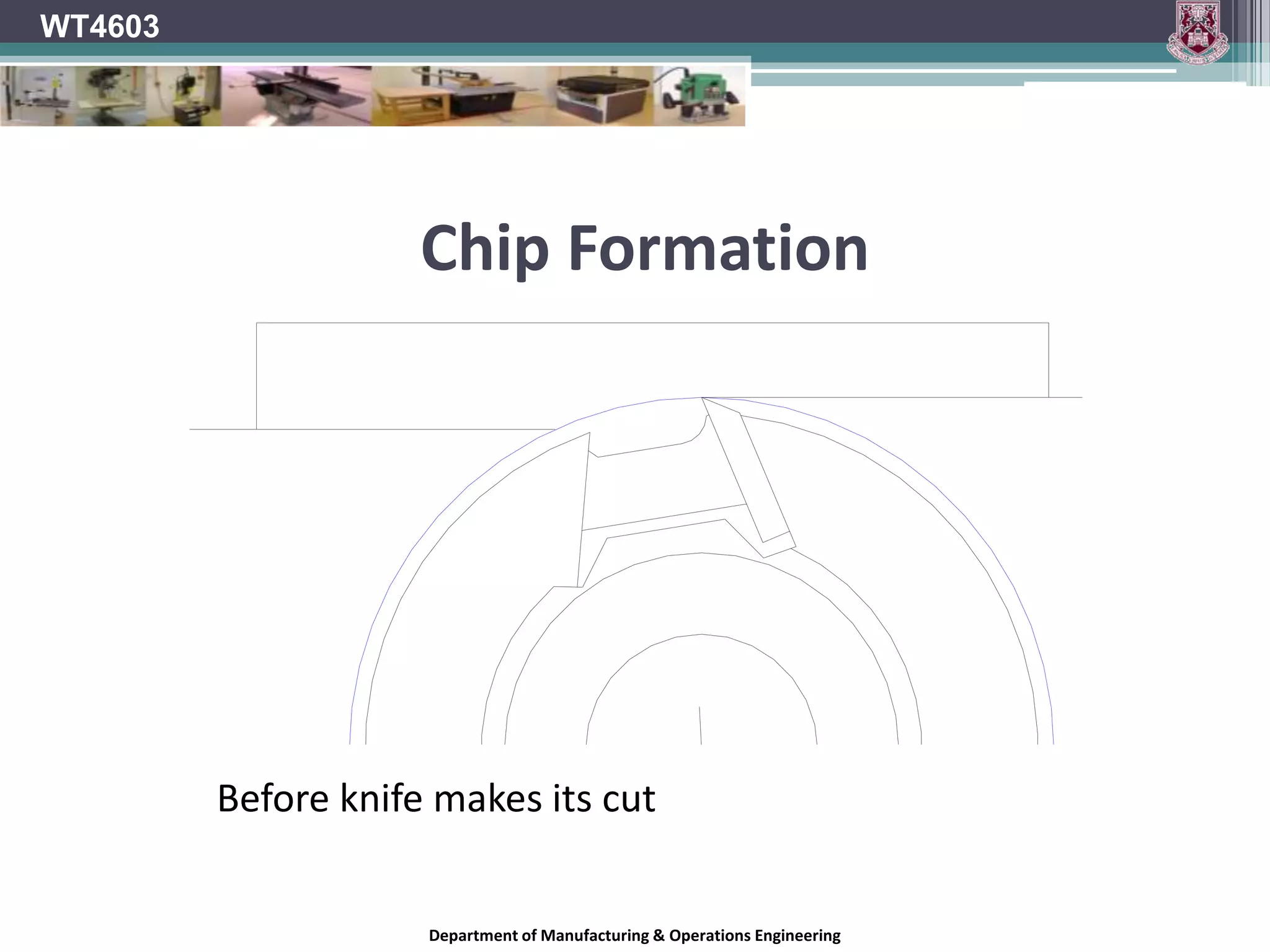
WT4603Chip FormationBefore knife makes its cutDepartment of Manufacturing & Operations Engineering
WT4603Chip FormationChip to be formedDepartment of Manufacturing & Operations Engineering
WT4603Chip FormationaChip breaker will help prevent riving (a)Department of Manufacturing & Operations Engineering
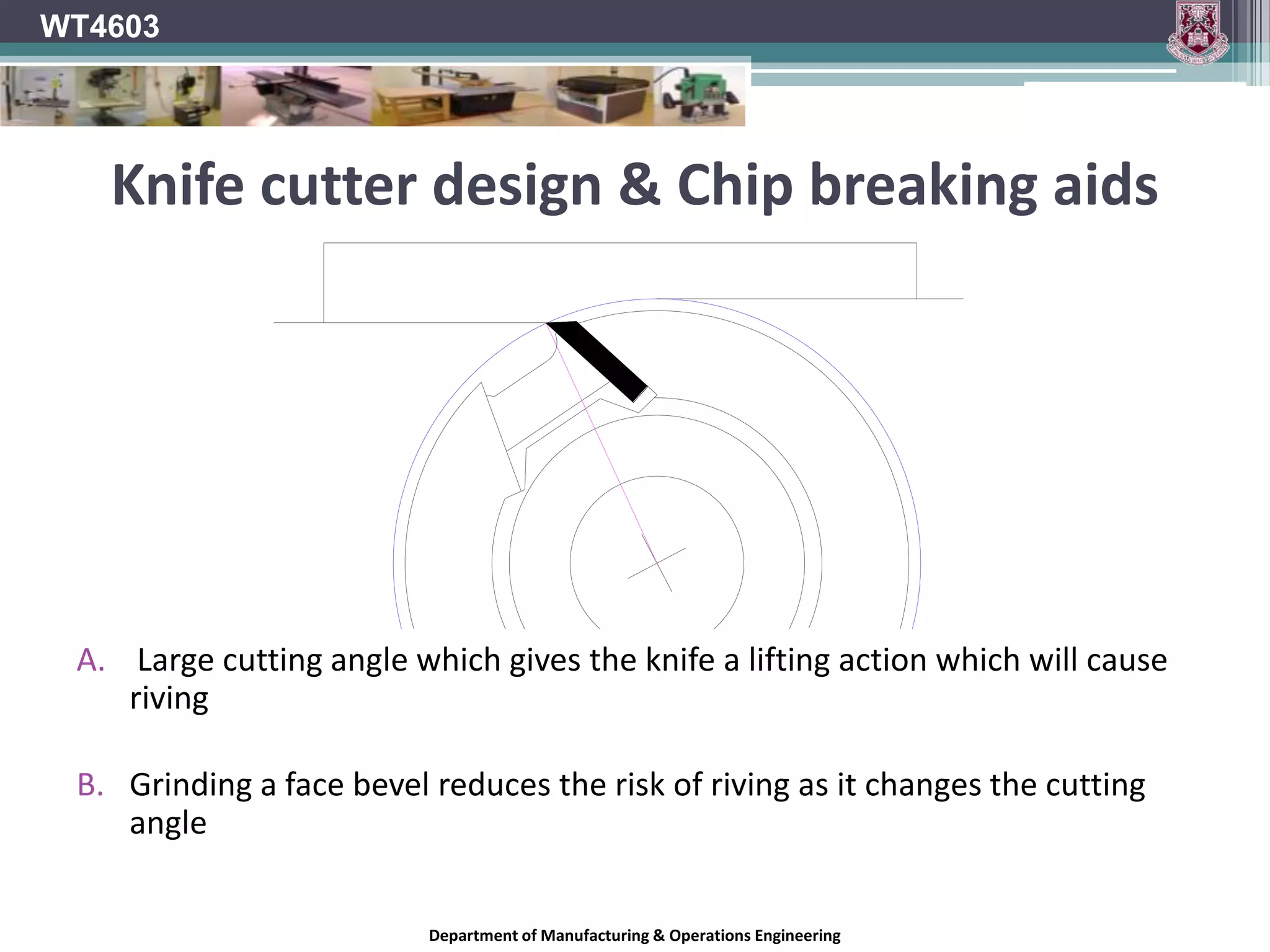
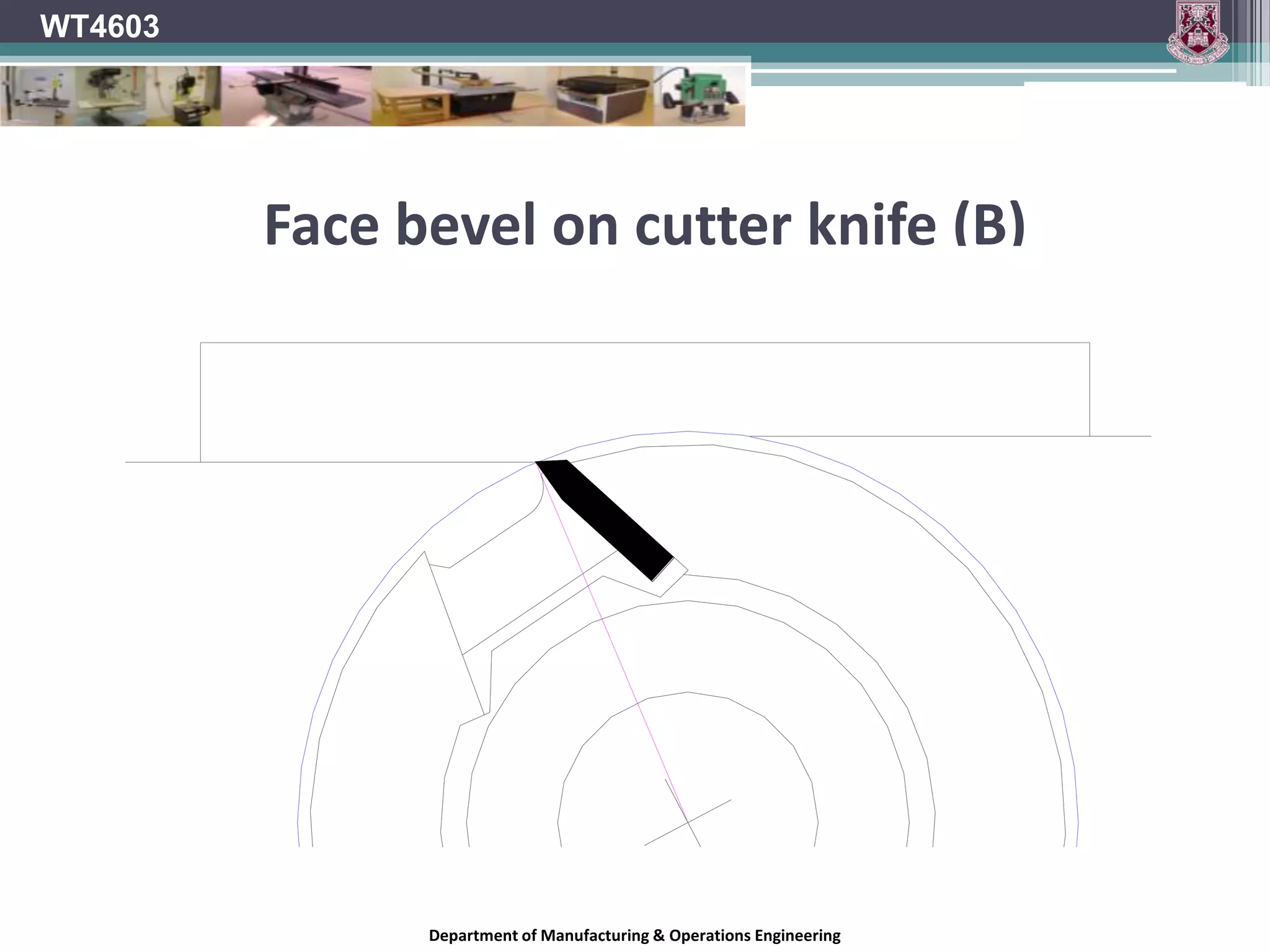
WT4603Knife cutter design & Chip breaking aids Large cutting angle which gives the knife a lifting action which will cause rivingGrinding a face bevel reduces the risk of riving as it changes the cutting angleDepartment of Manufacturing & Operations Engineering
WT4603Face bevel on cutter knife (B)Department of Manufacturing & Operations Engineering
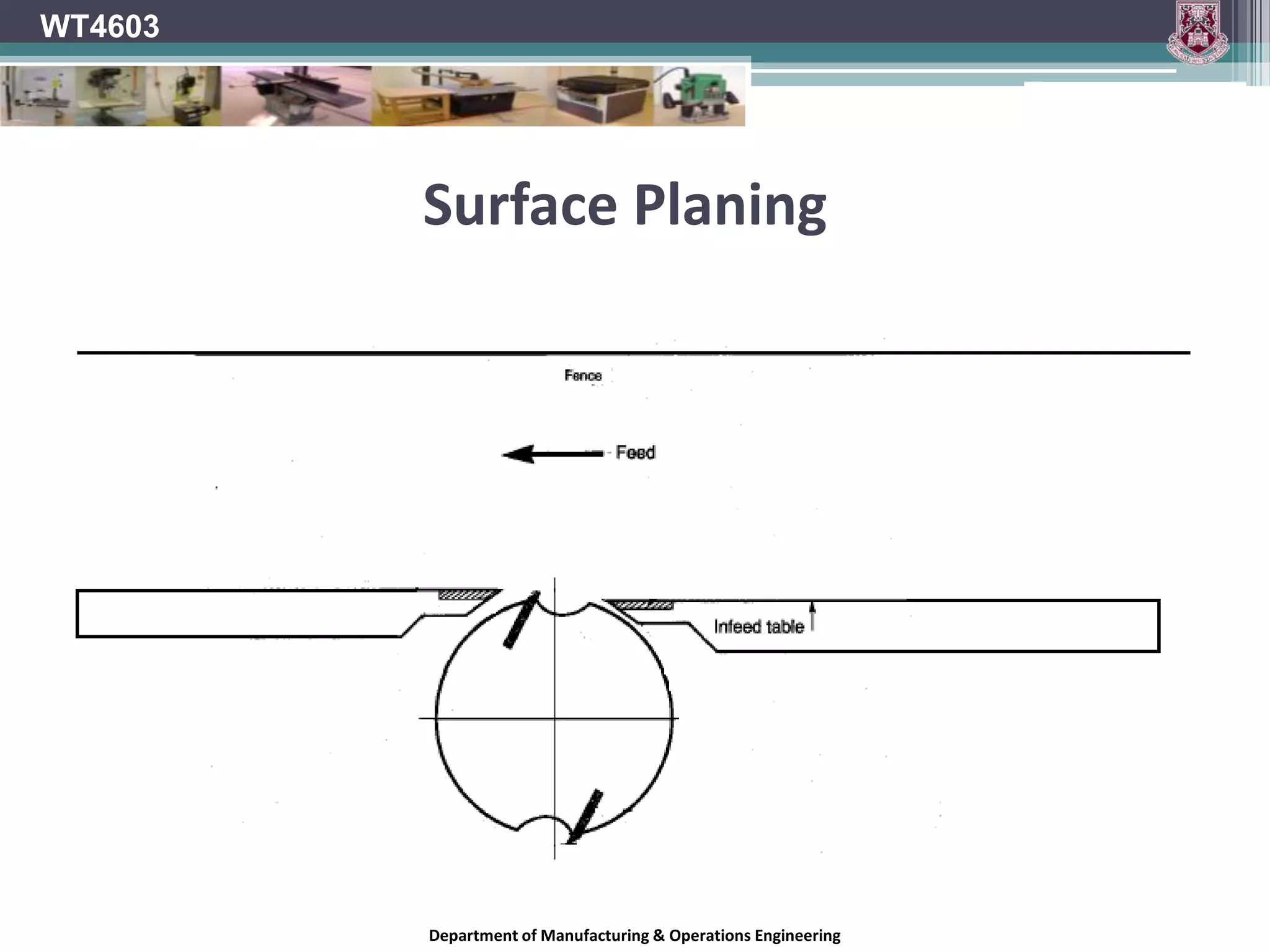
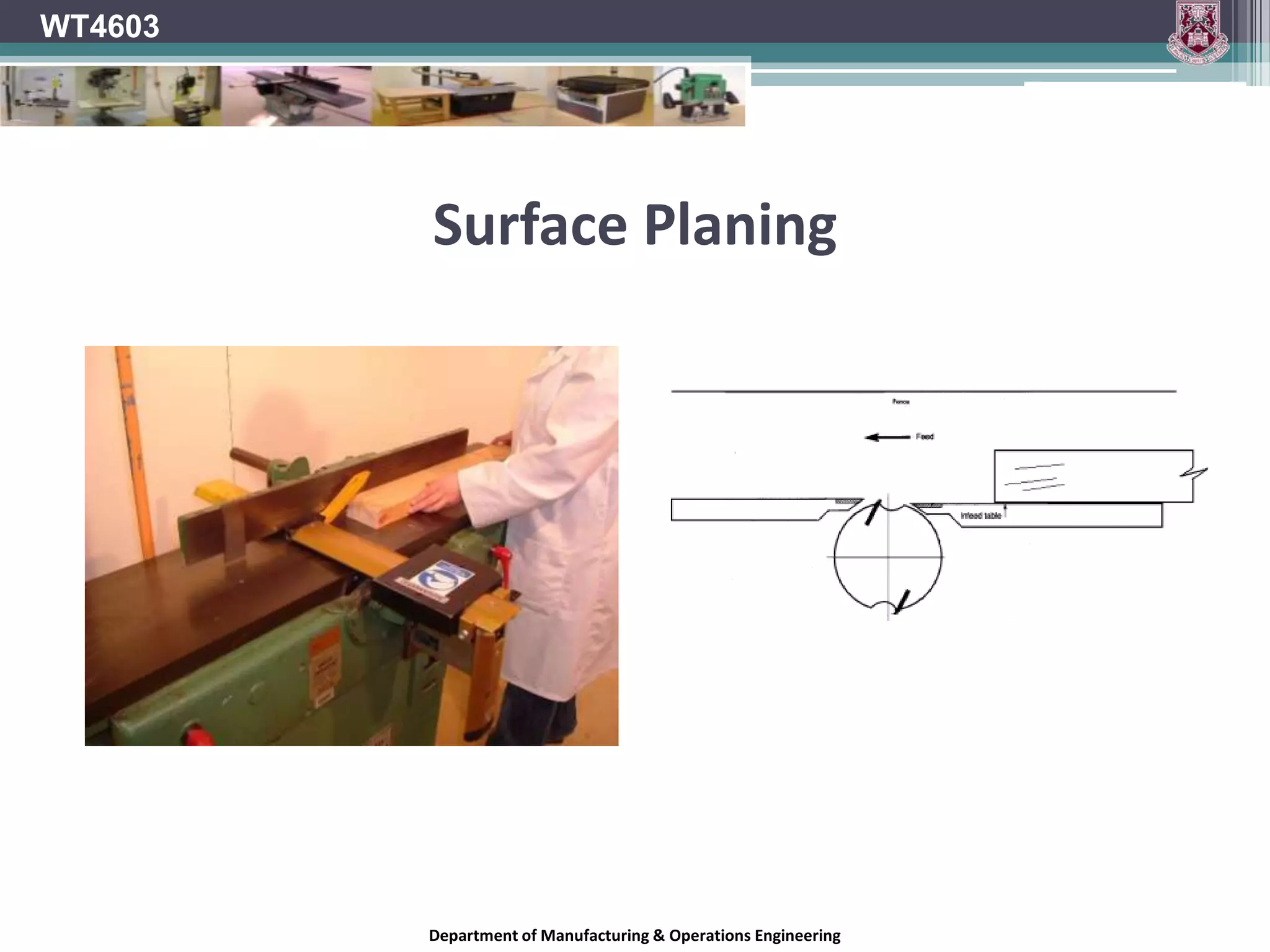
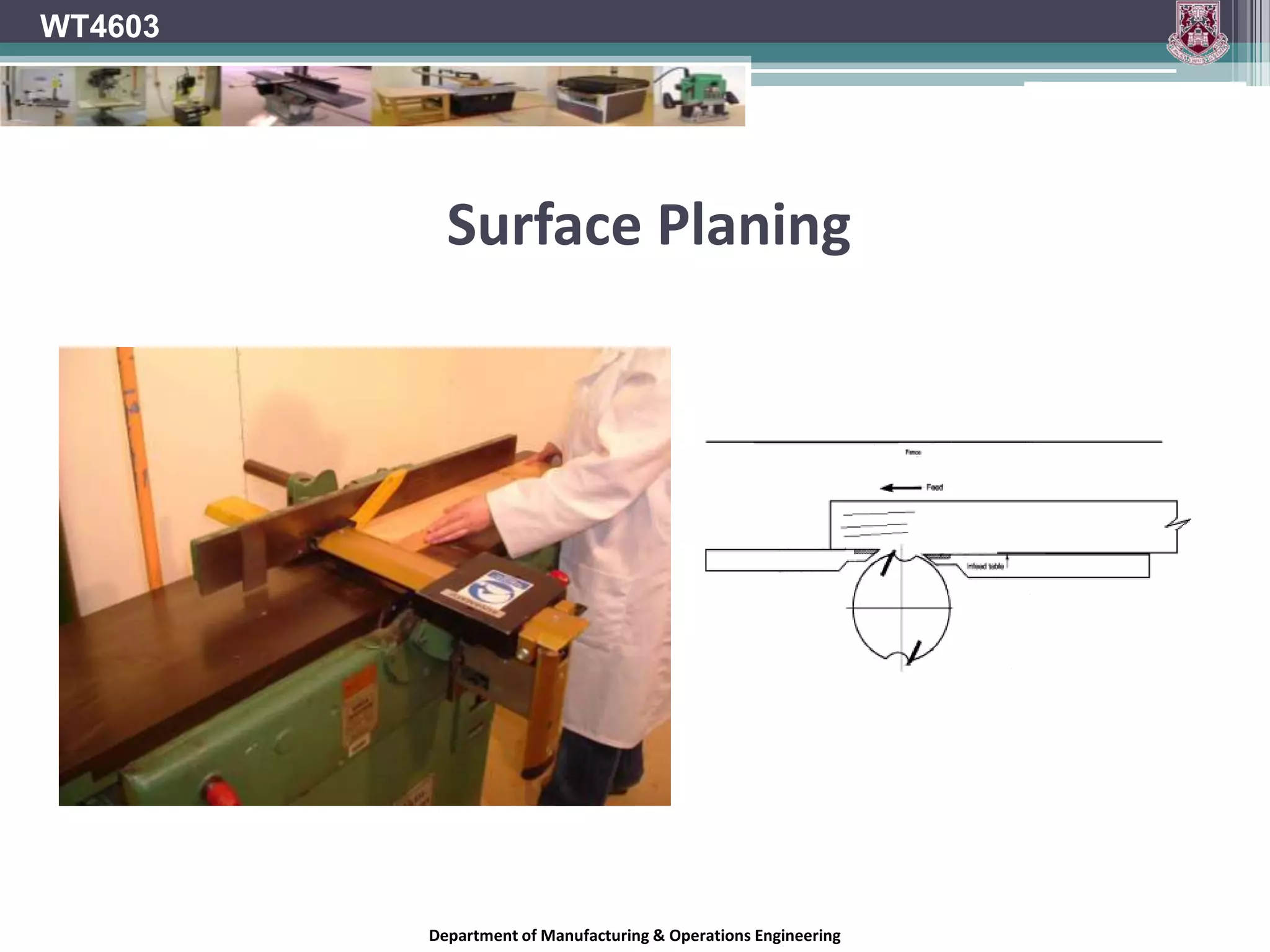
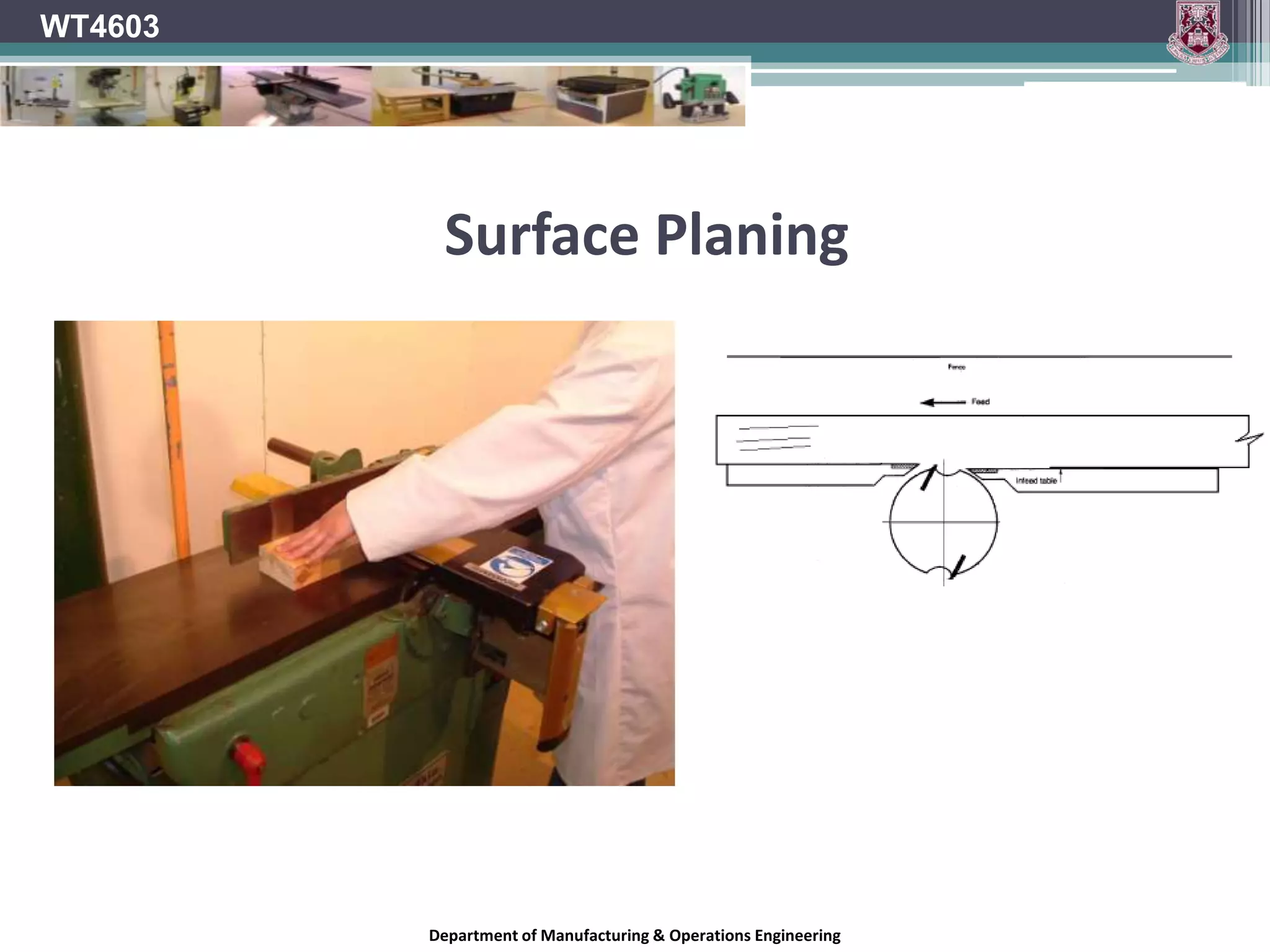
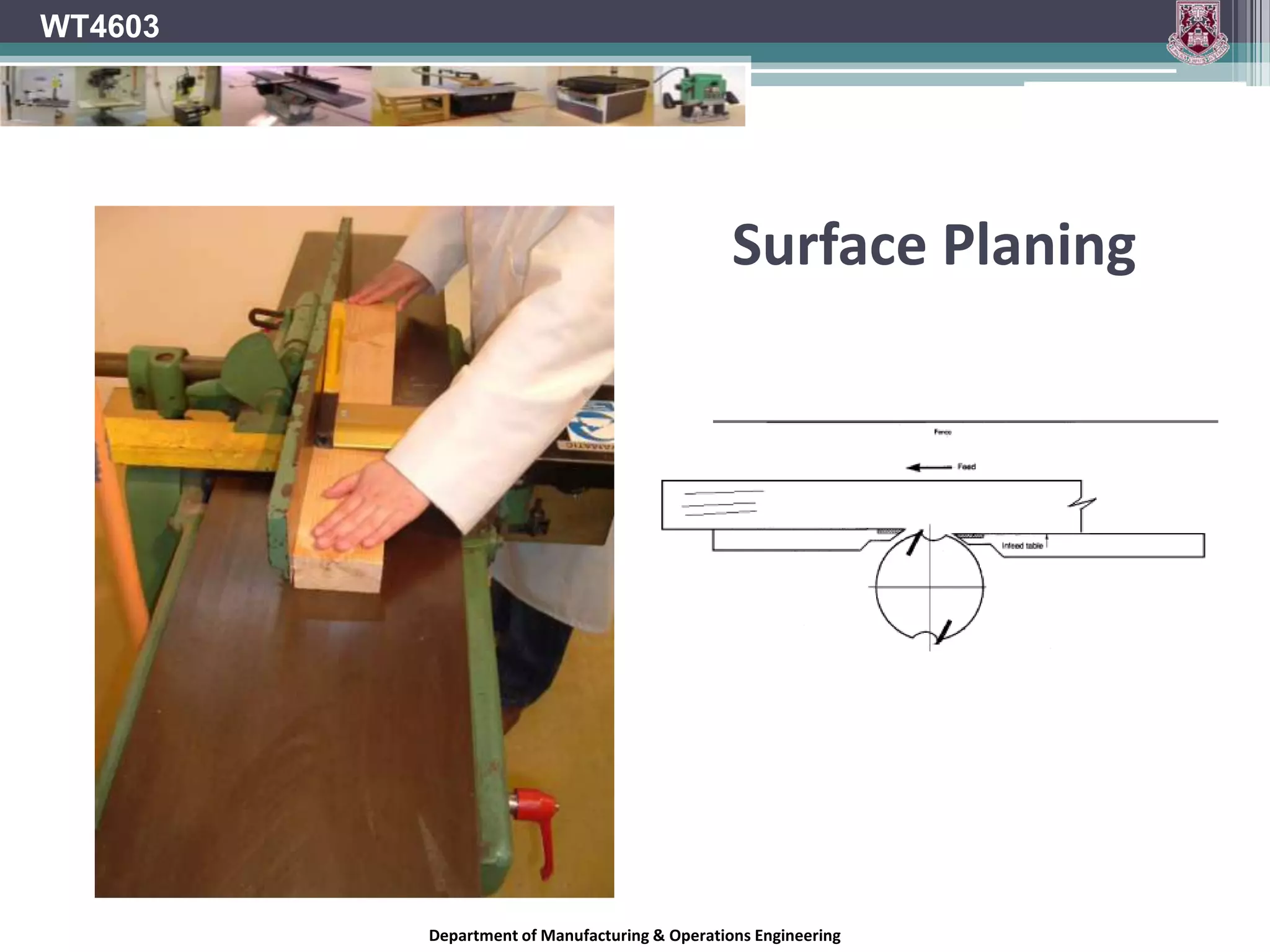
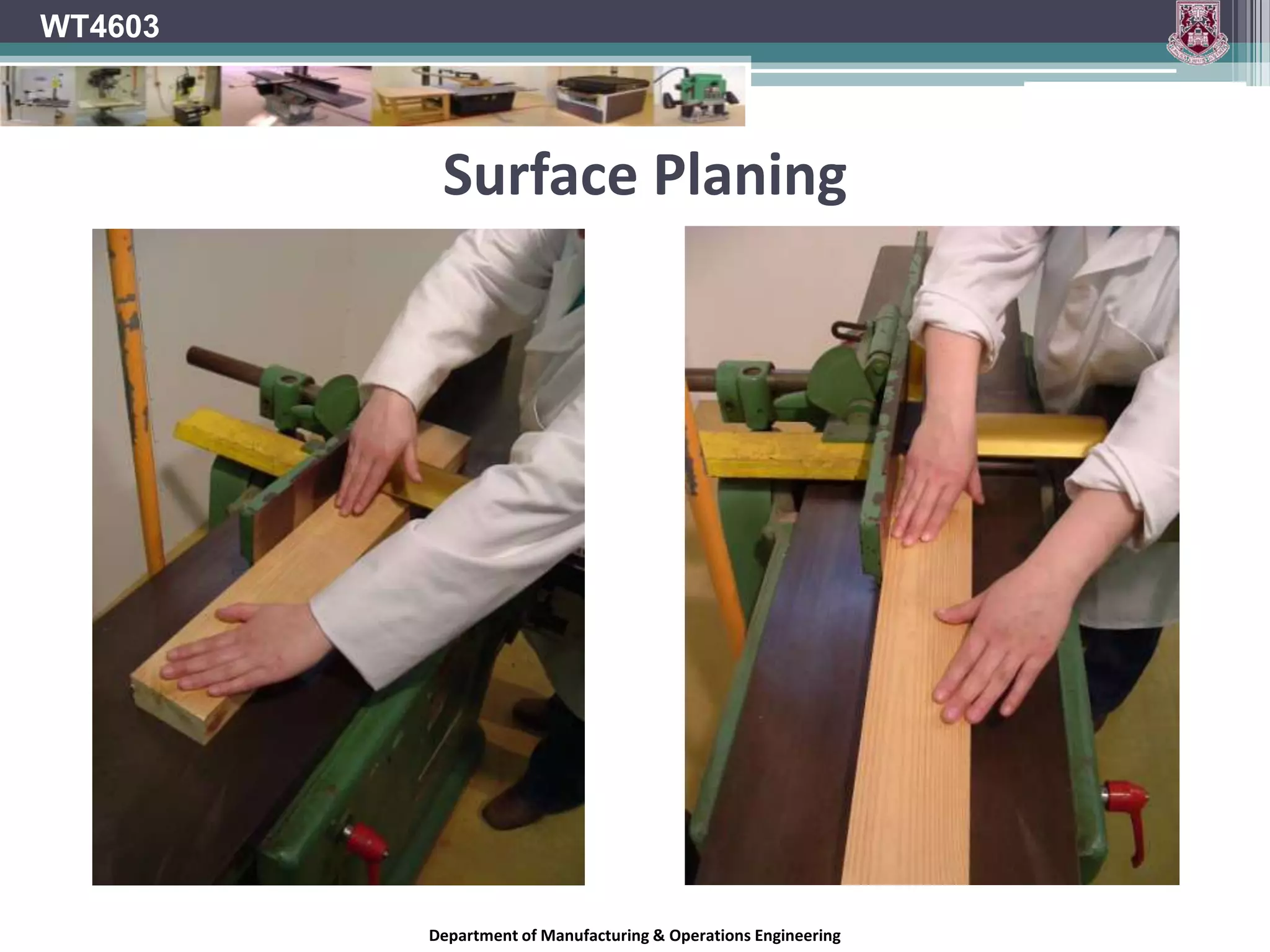
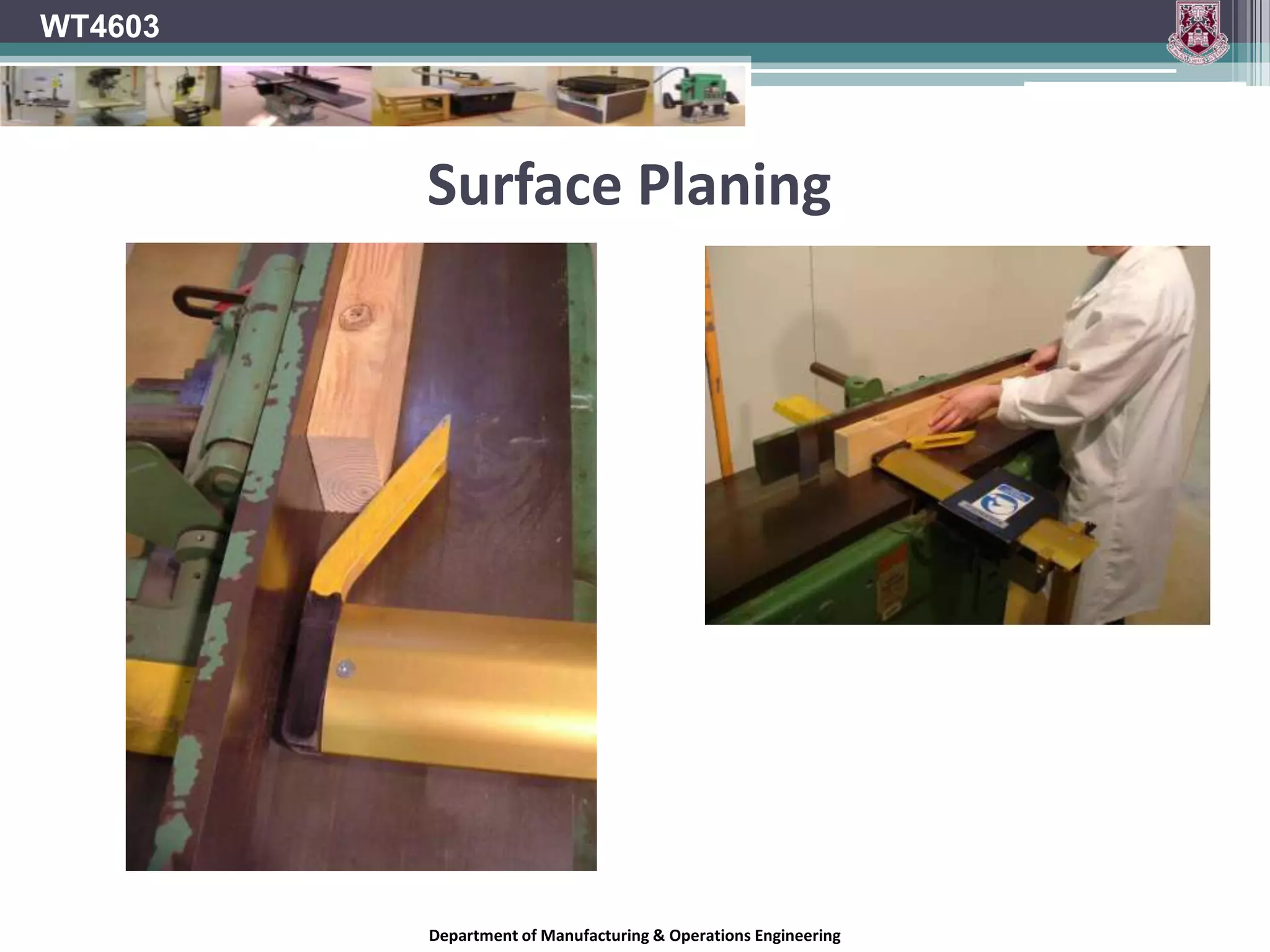
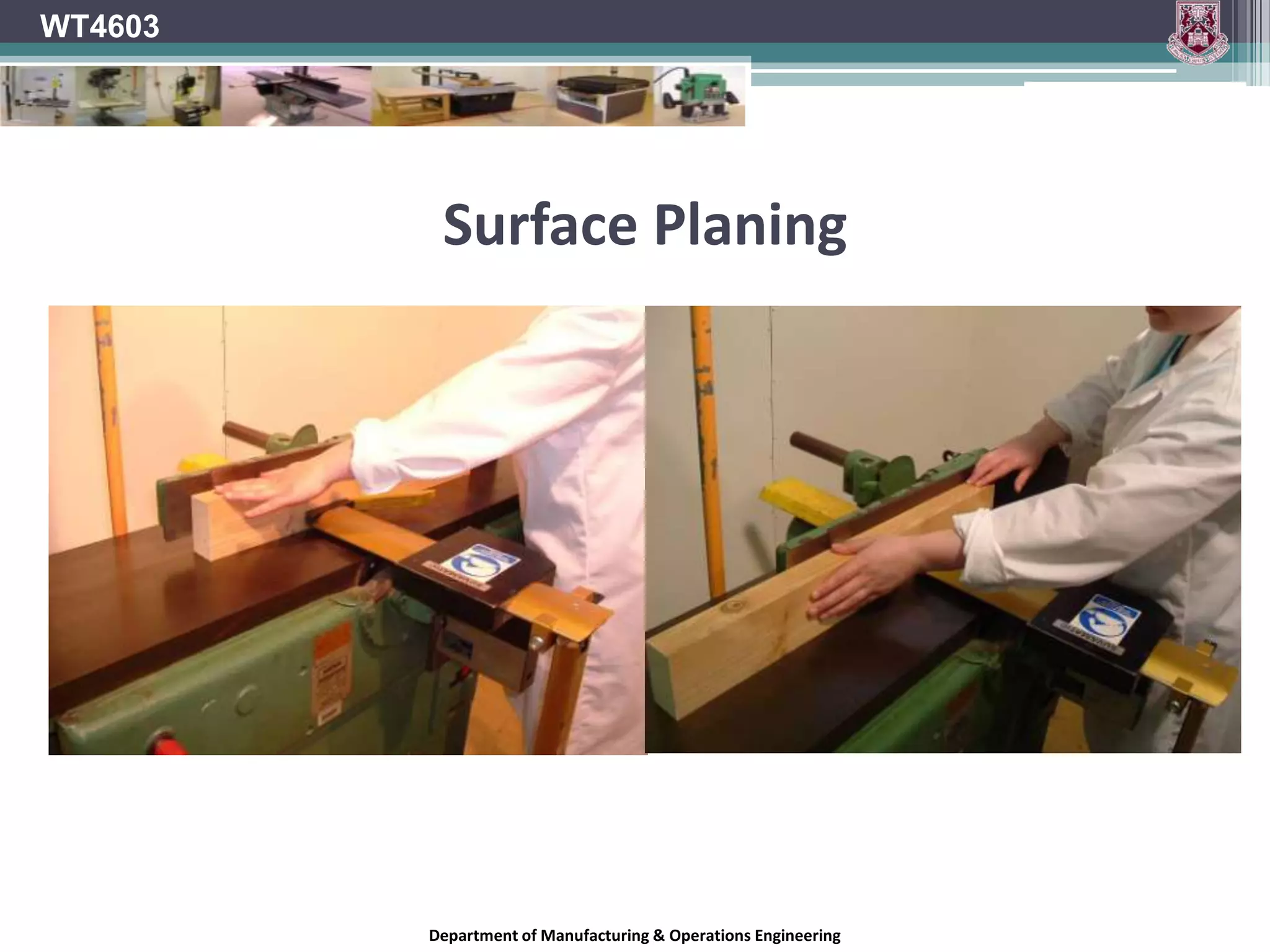
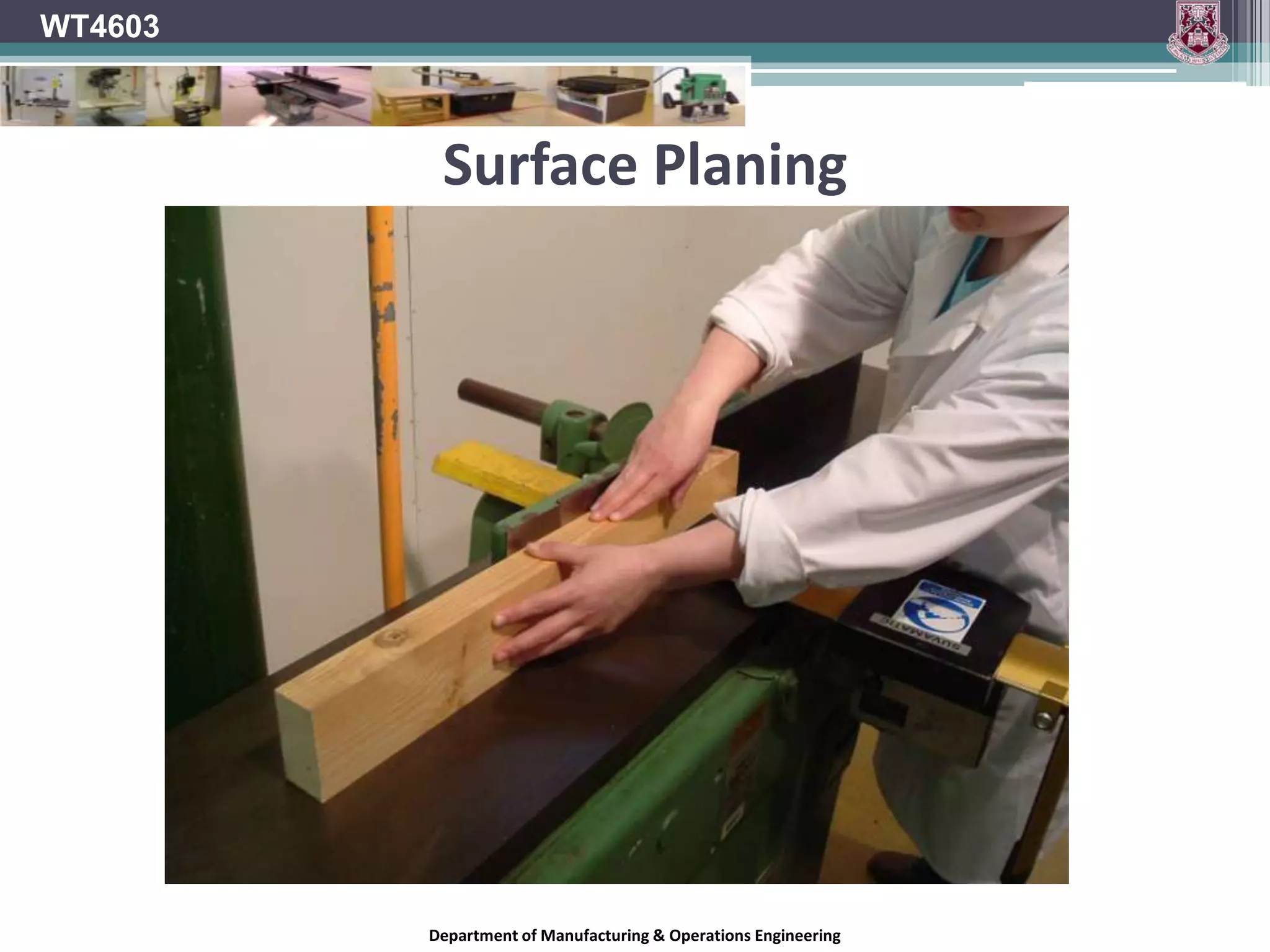
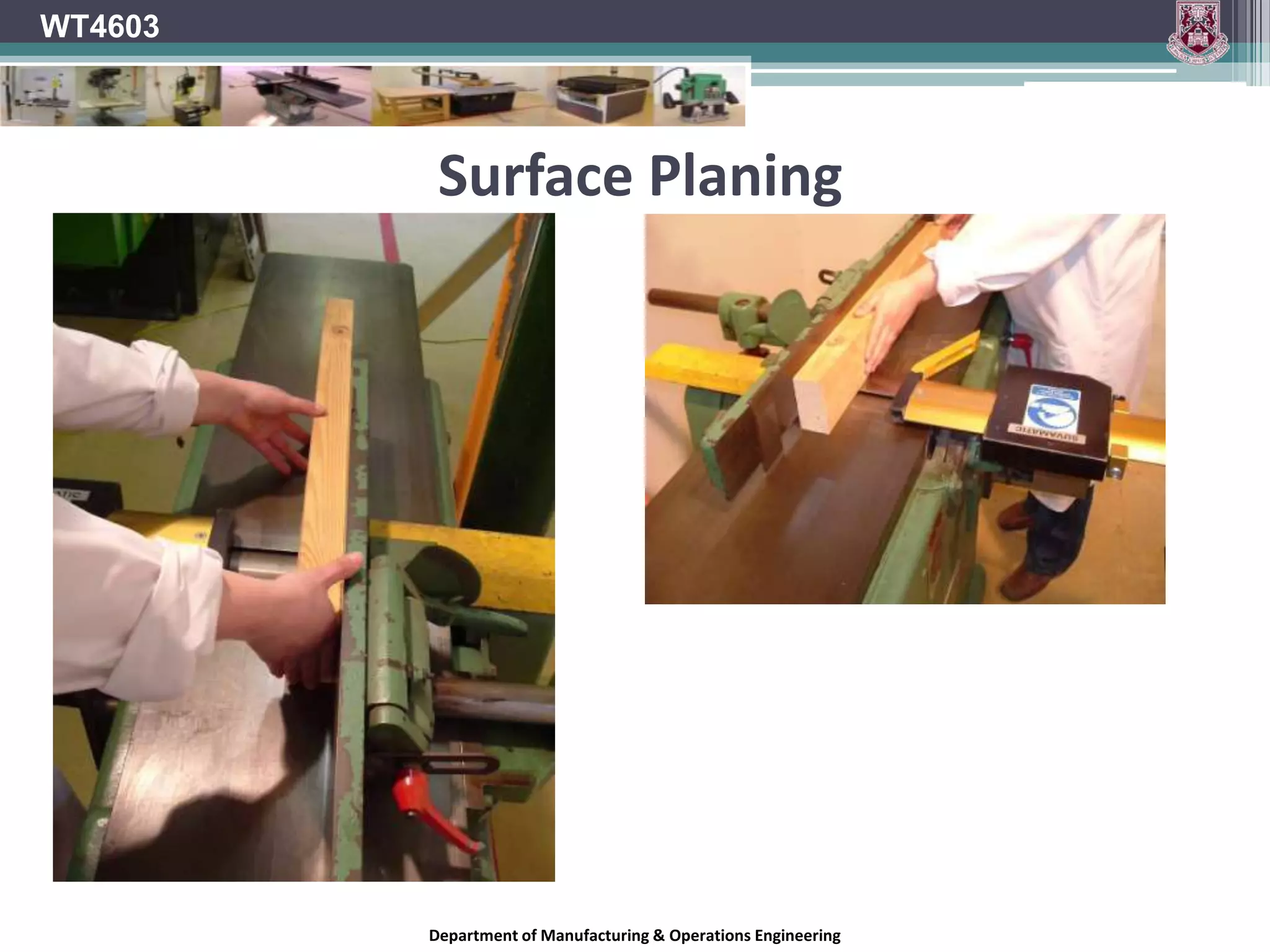
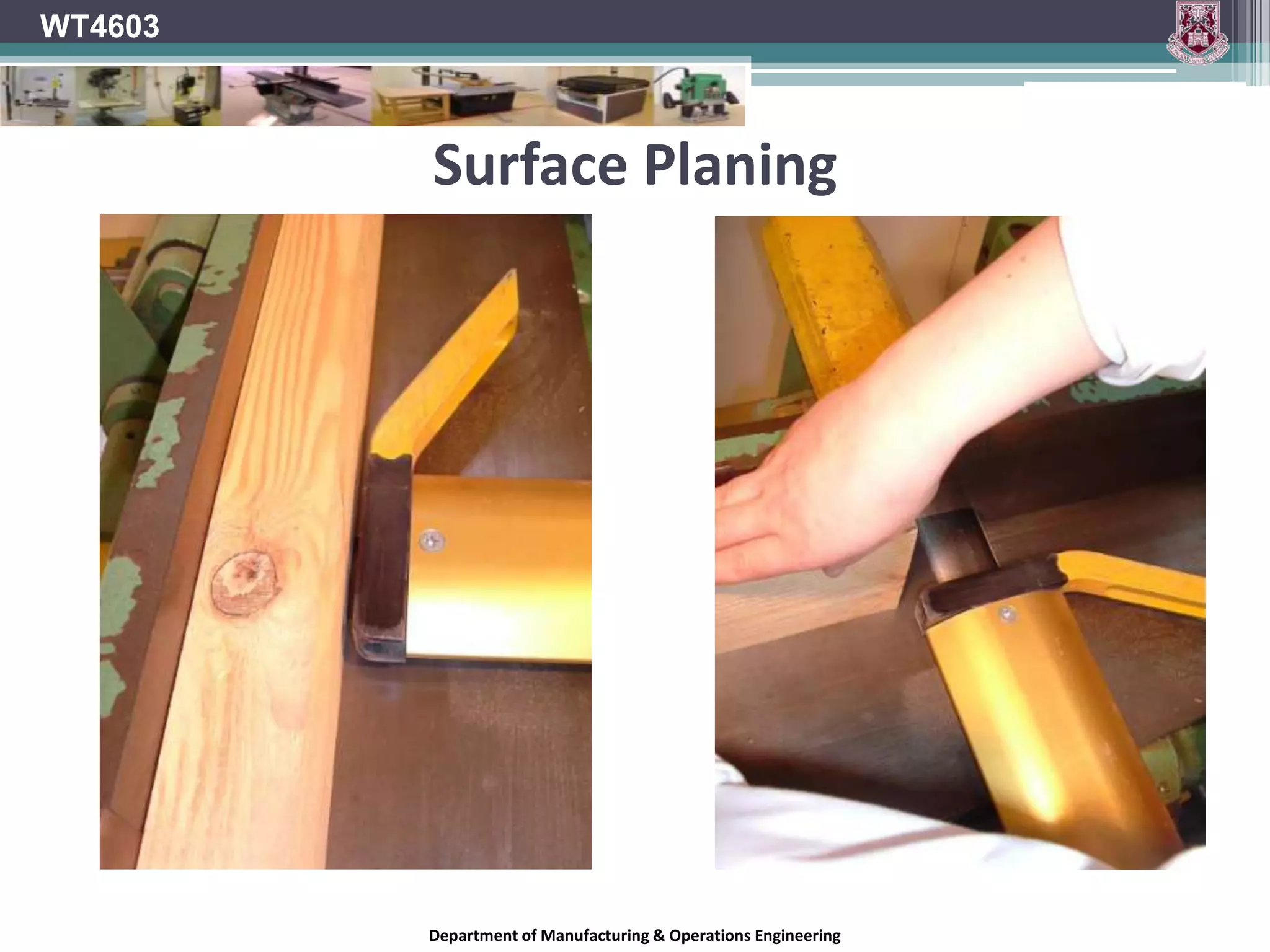
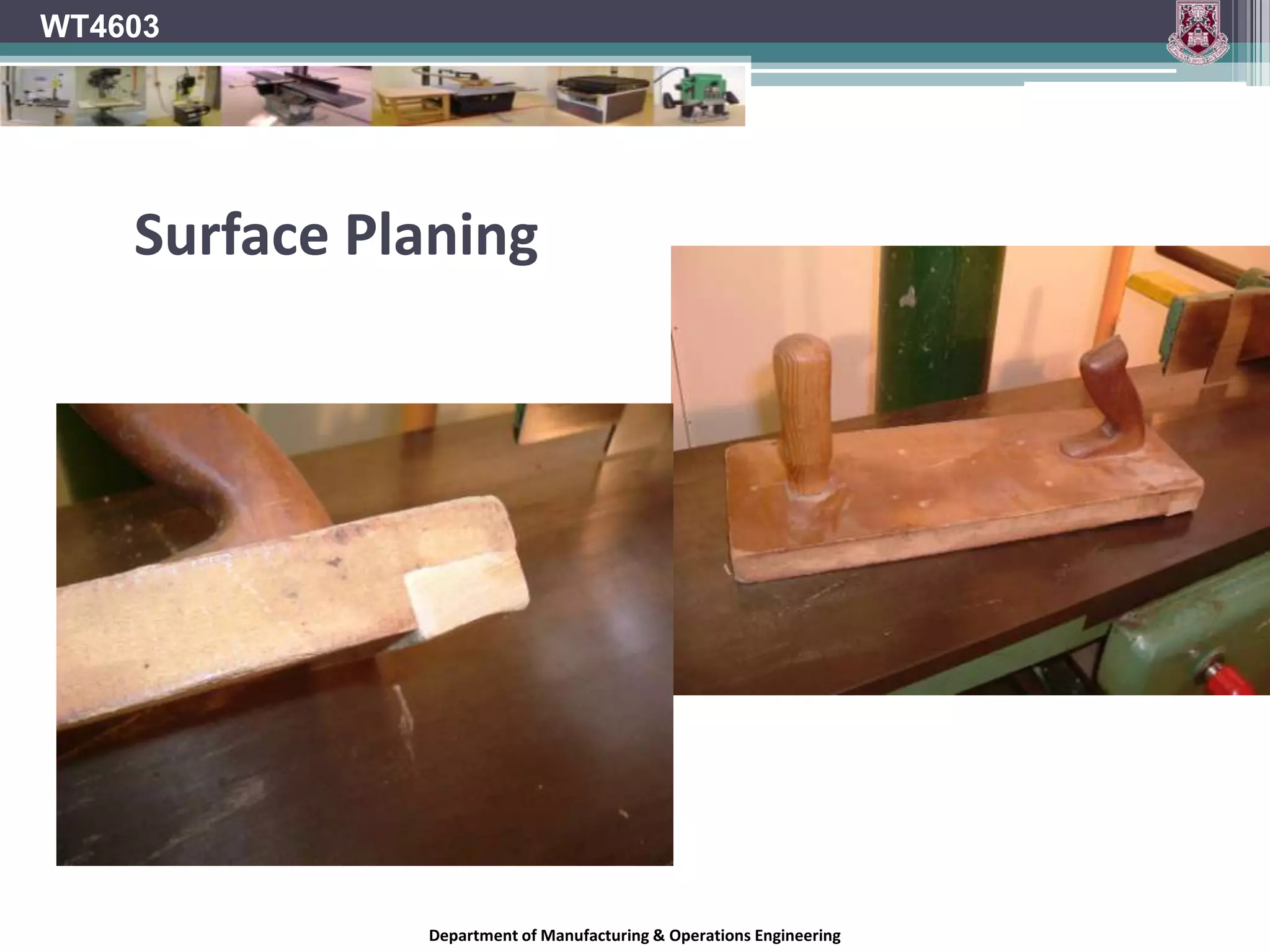
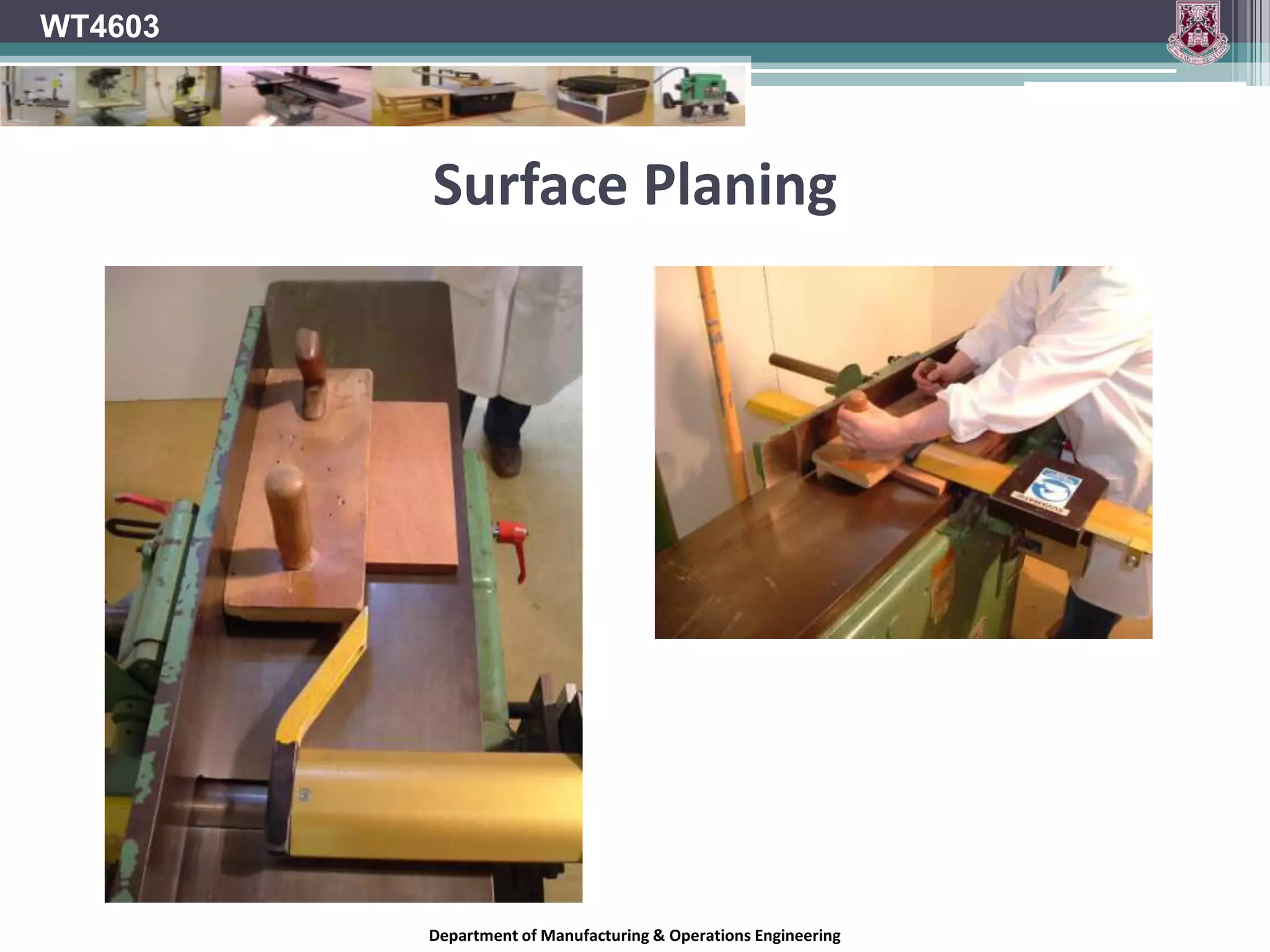
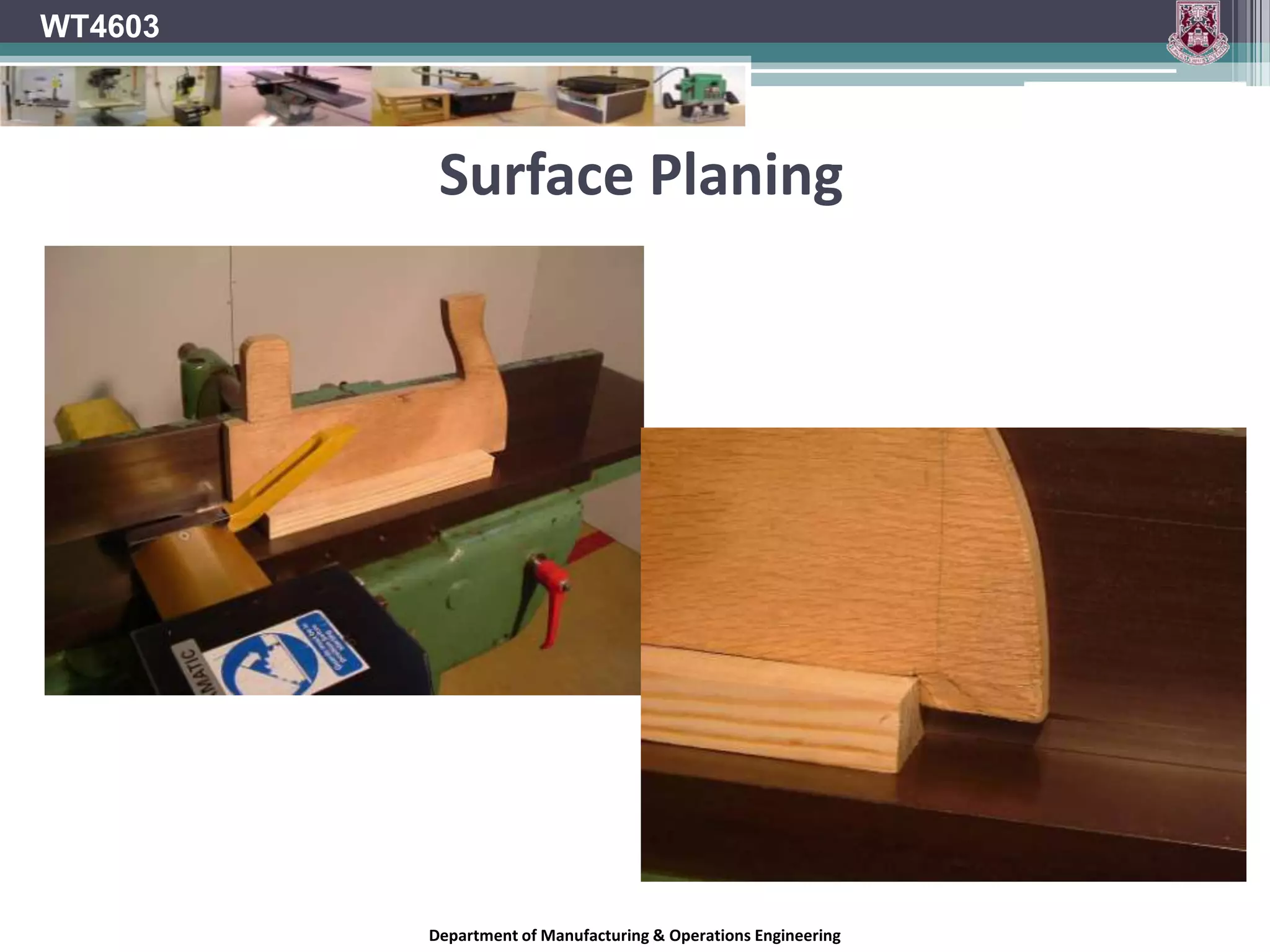
WT4603Surface PlaningDepartment of Manufacturing & Operations Engineering
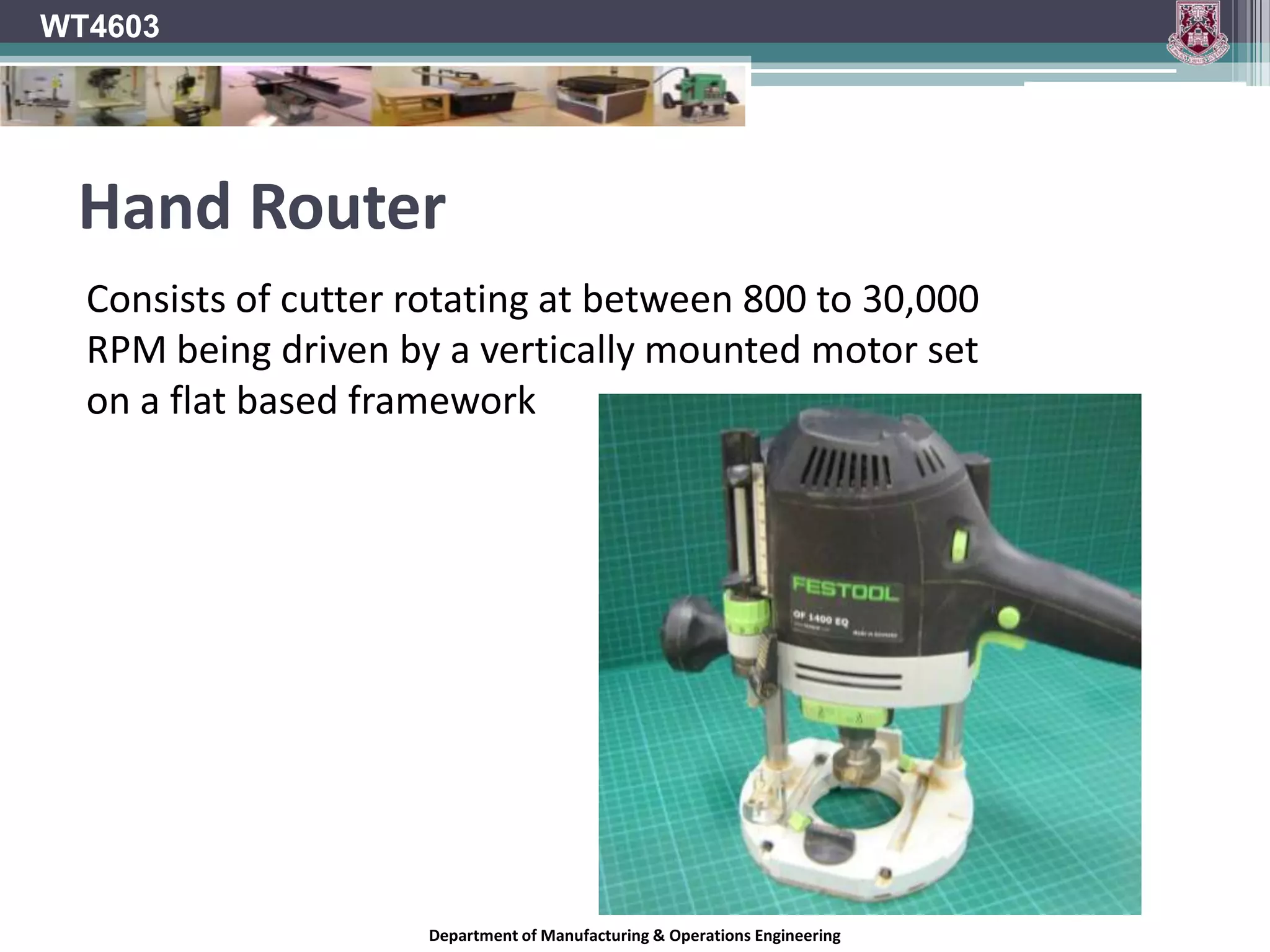
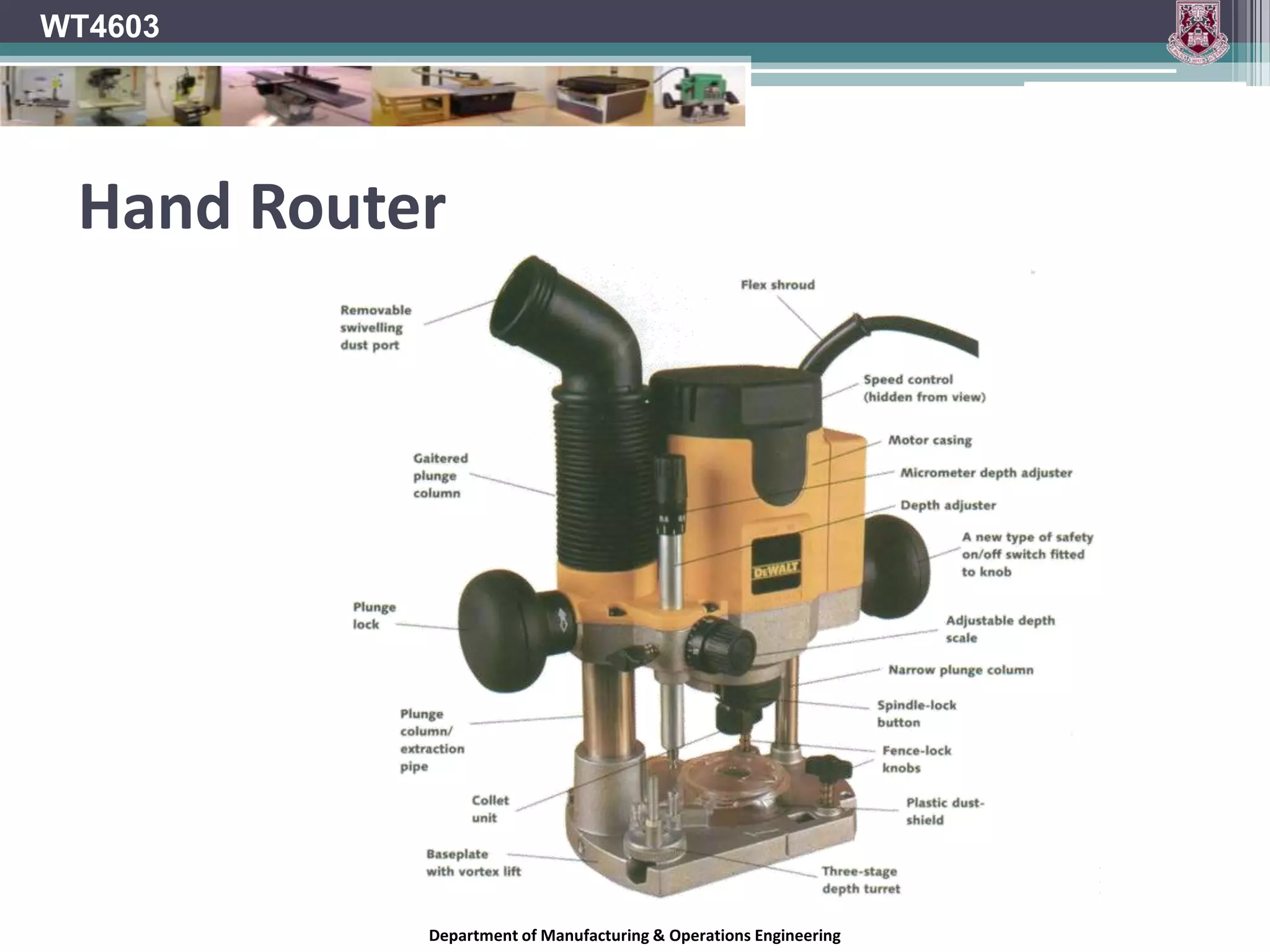
WT4603Hand Router	Consists of cutter rotating at between 800 to 30,000 RPM being driven by a vertically mounted motor set on a flat based frameworkDepartment of Manufacturing & Operations Engineering
WT4603Hand RouterDepartment of Manufacturing & Operations Engineering
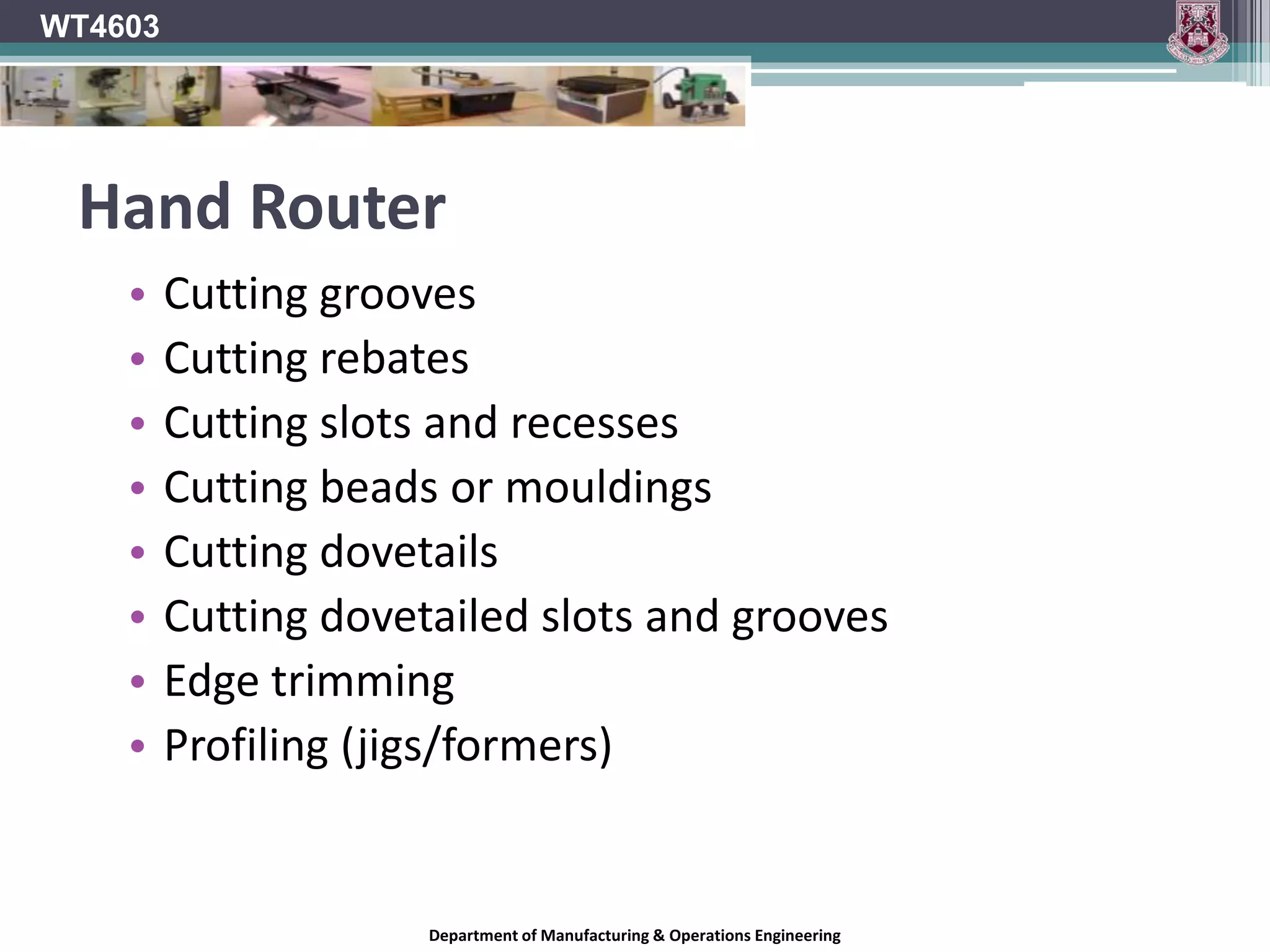
WT4603Hand RouterCutting groovesCutting rebatesCutting slots and recessesCutting beads or mouldingsCutting dovetailsCutting dovetailed slots and groovesEdge trimmingProfiling (jigs/formers)Department of Manufacturing & Operations Engineering
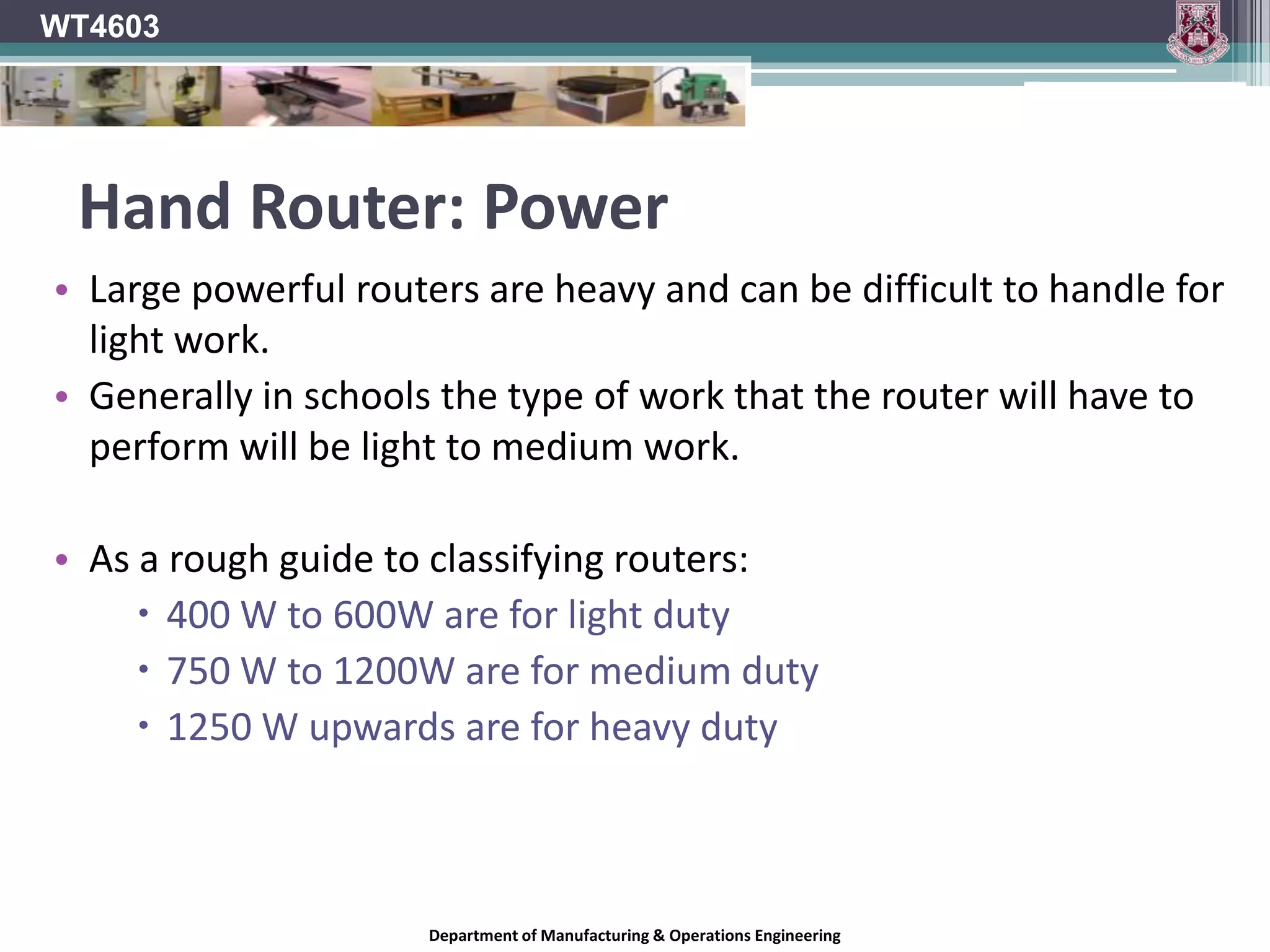
WT4603Hand Router: PowerLarge powerful routers are heavy and can be difficult to handle for light work.Generally in schools the type of work that the router will have to perform will be light to medium work.As a rough guide to classifying routers:400 W to 600W are for light duty 750 W to 1200W are for medium duty 1250 W upwards are for heavy dutyDepartment of Manufacturing & Operations Engineering
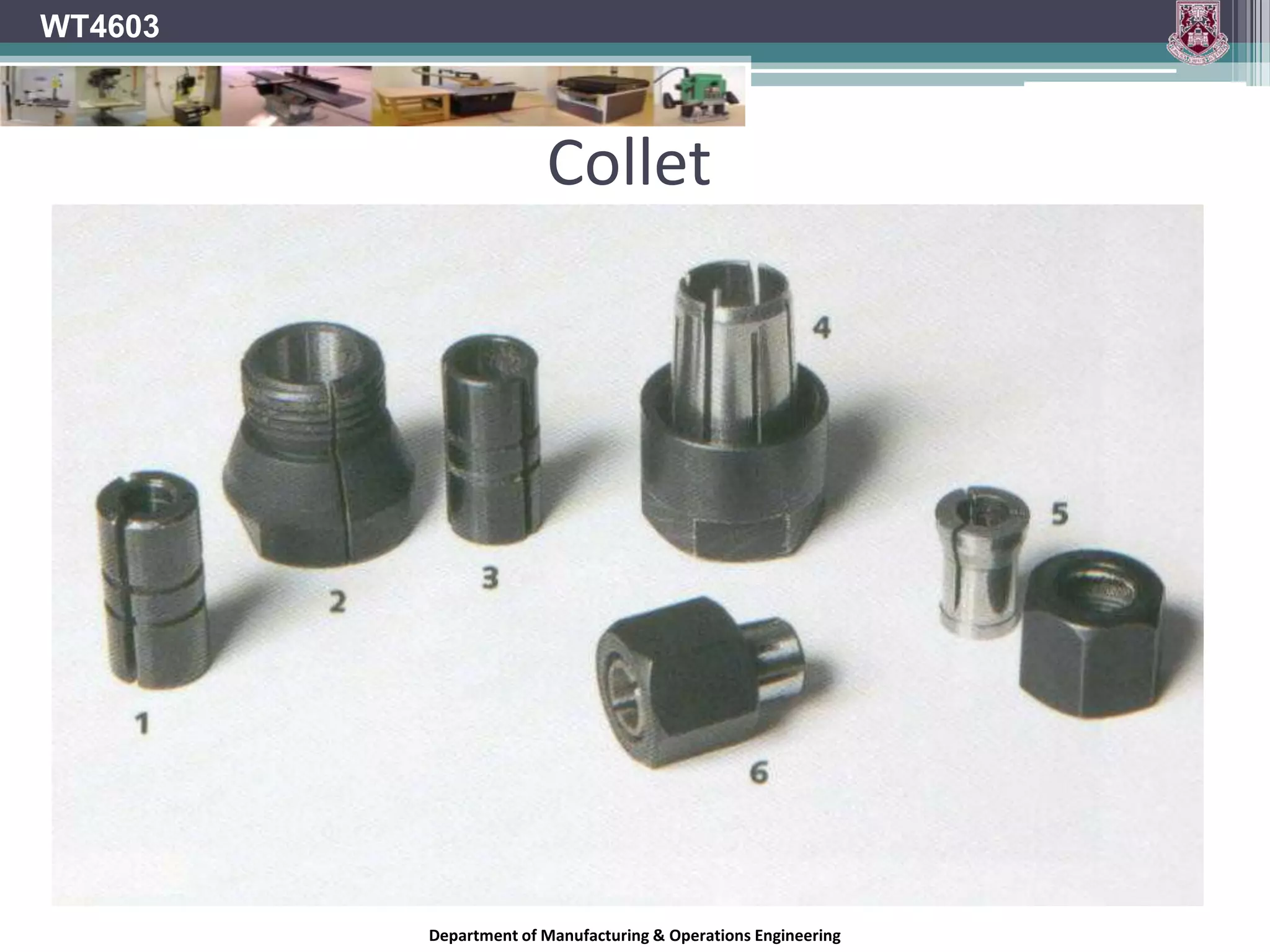
WT4603ColletDepartment of Manufacturing & Operations Engineering
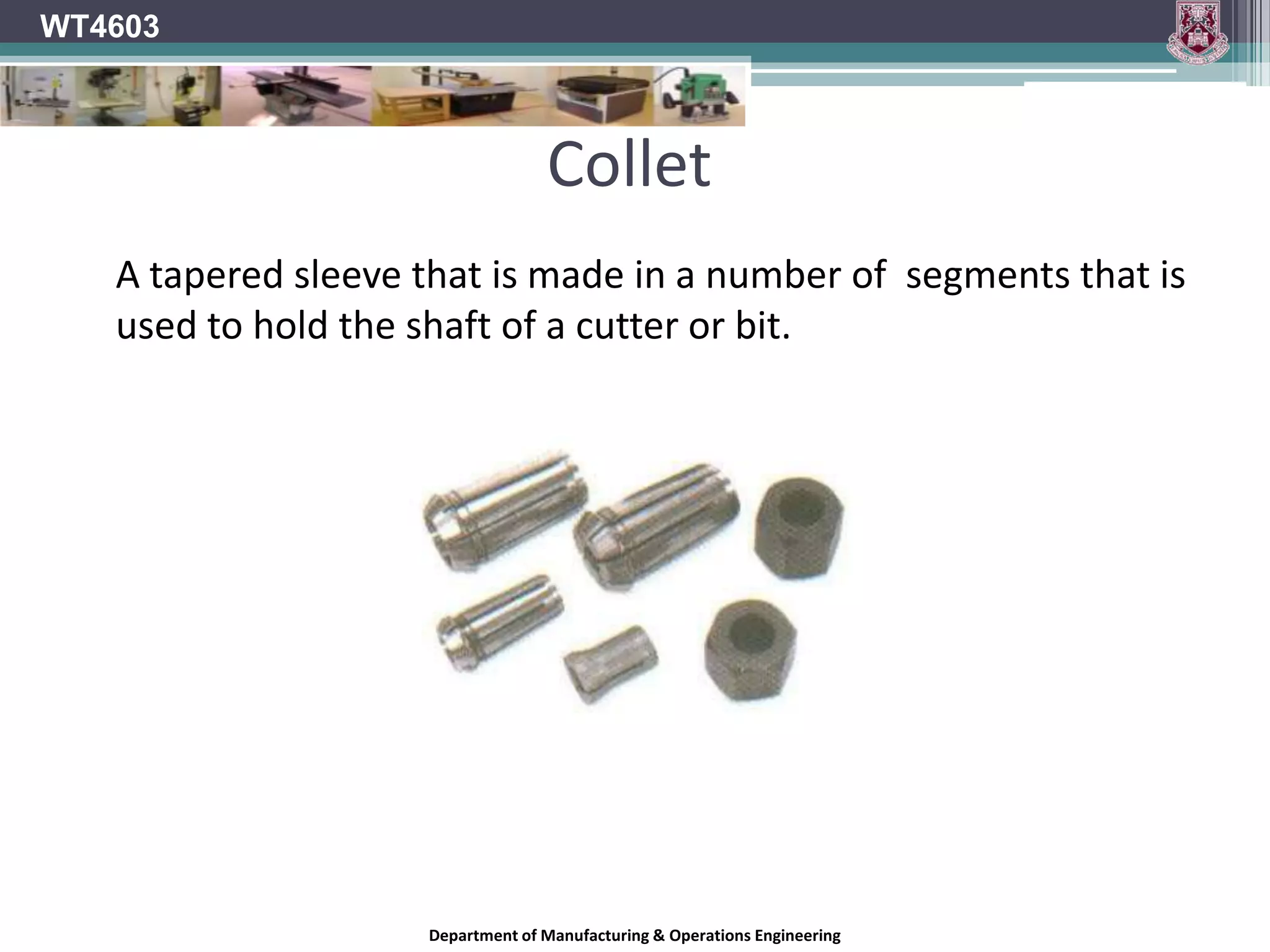
WT4603Collet	A tapered sleeve that is made in a number of  segments that is used to hold the shaft of a cutter or bit.Department of Manufacturing & Operations Engineering
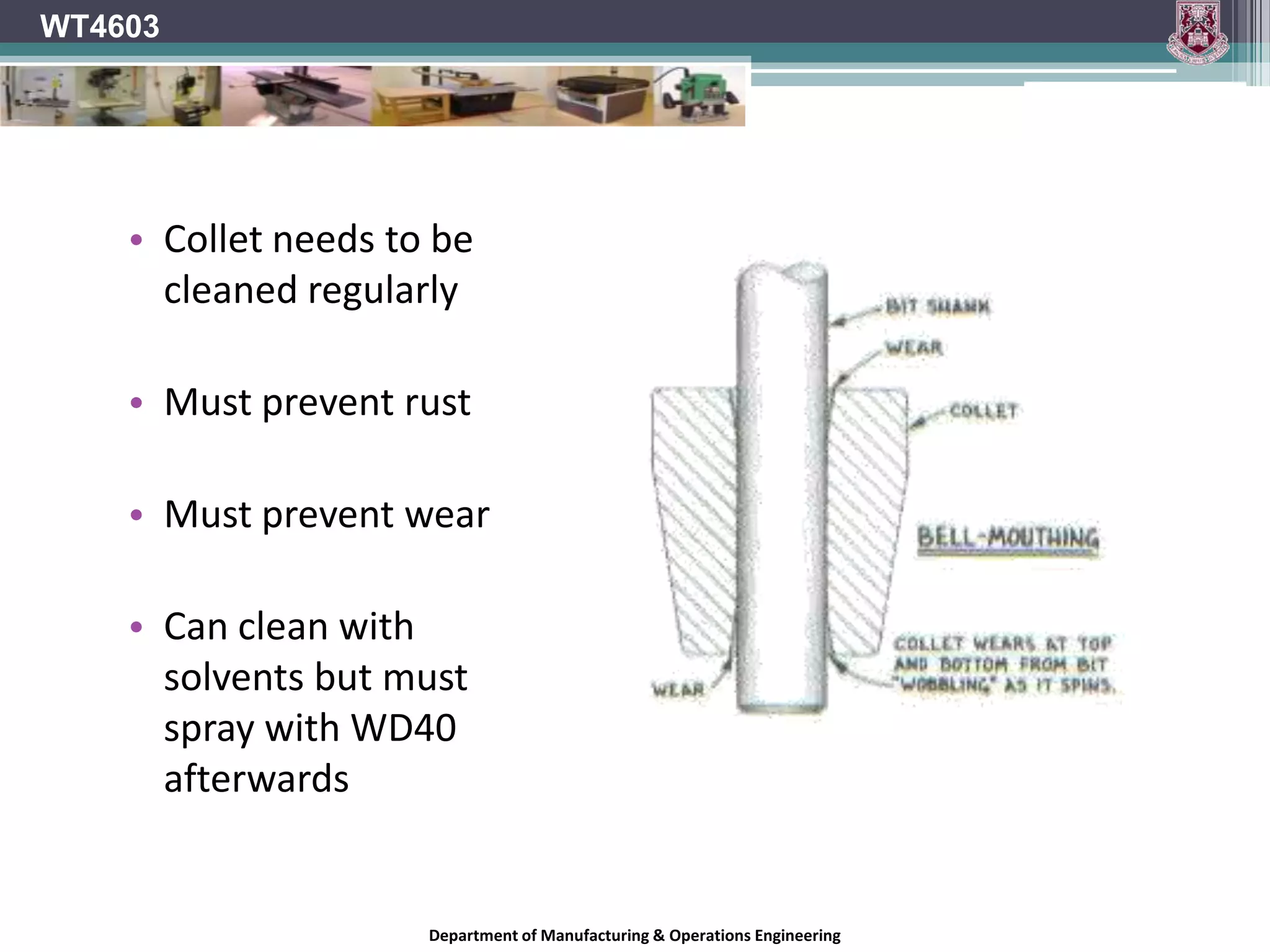
WT4603Collet needs to be cleaned regularlyMust prevent rustMust prevent wearCan clean with solvents but must spray with WD40 afterwardsDepartment of Manufacturing & Operations Engineering
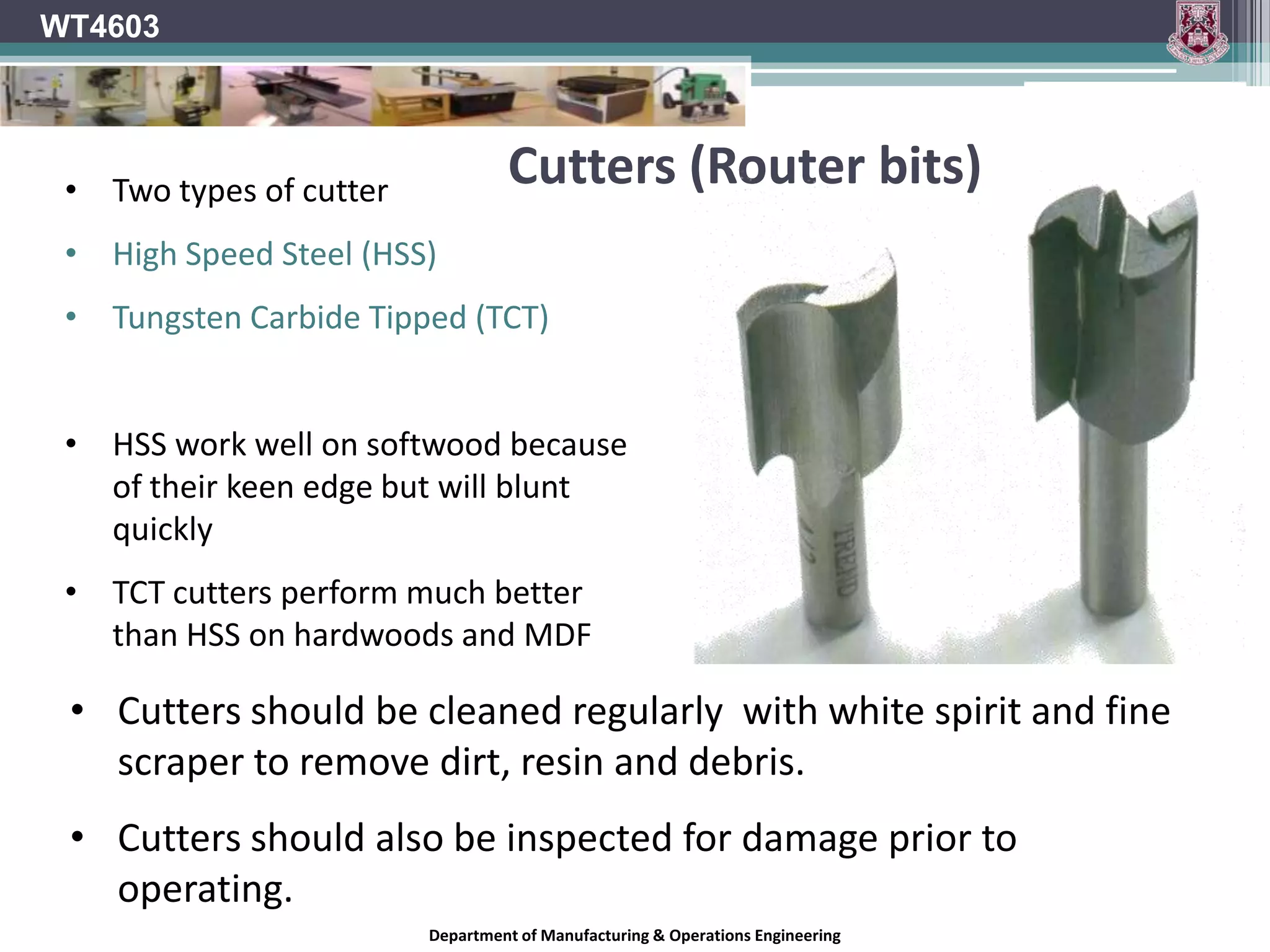
WT4603Cutters (Router bits)Two types of cutter
High Speed Steel (HSS)
Tungsten Carbide Tipped (TCT)
HSS work well on softwood because of their keen edge but will blunt quickly
TCT cutters perform much better than HSS on hardwoods and MDF
Cutters should be cleaned regularly  with white spirit and fine scraper to remove dirt, resin and debris.
Cutters should also be inspected for damage prior to operating.Department of Manufacturing & Operations Engineering
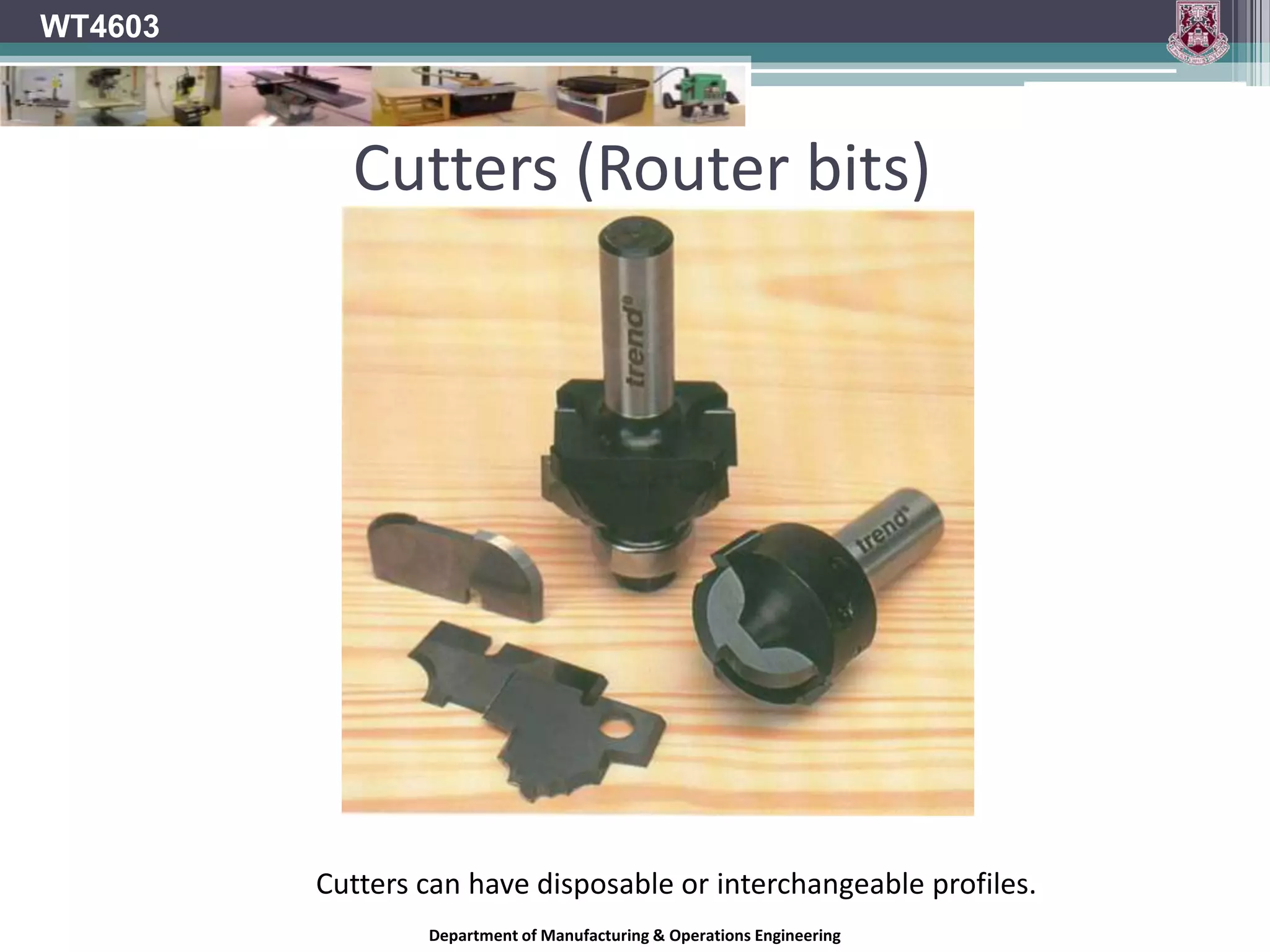
WT4603Cutters (Router bits)	A router bit is a tool for woodworking giving a quality finish to the material. It cuts wood providing a way to give a clean and even a decorative edge to woodwork. 	The following is some basic information about router bits to get you started in your woodworking efforts. 	Here are the there main parts of a router bit:The shank- the part of the router bit that is inserted into the collet (the sleeve of the router).The cutting edge- this part cuts and removes the wood. They are available in several sizes and shapes. The pilot- the guide for the router in order to make a correct cut. It can be an extension of the shank or a ball bearing attachment.Department of Manufacturing & Operations Engineering
WT4603Cutters (Router bits)Cutters can have disposable or interchangeable profiles.Department of Manufacturing & Operations Engineering
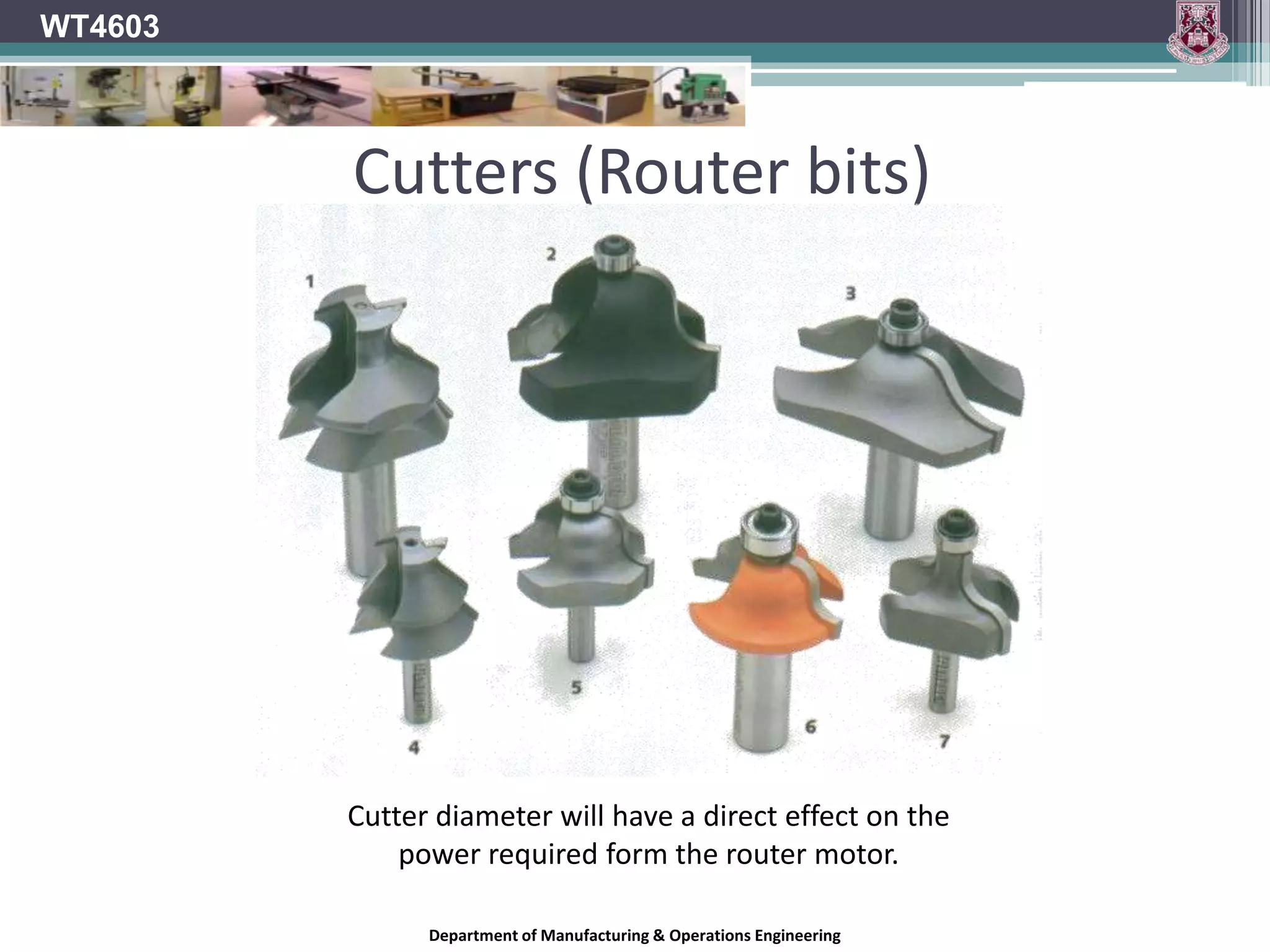
WT4603Cutters (Router bits)Cutter diameter will have a direct effect on the power required form the router motor.Department of Manufacturing & Operations Engineering
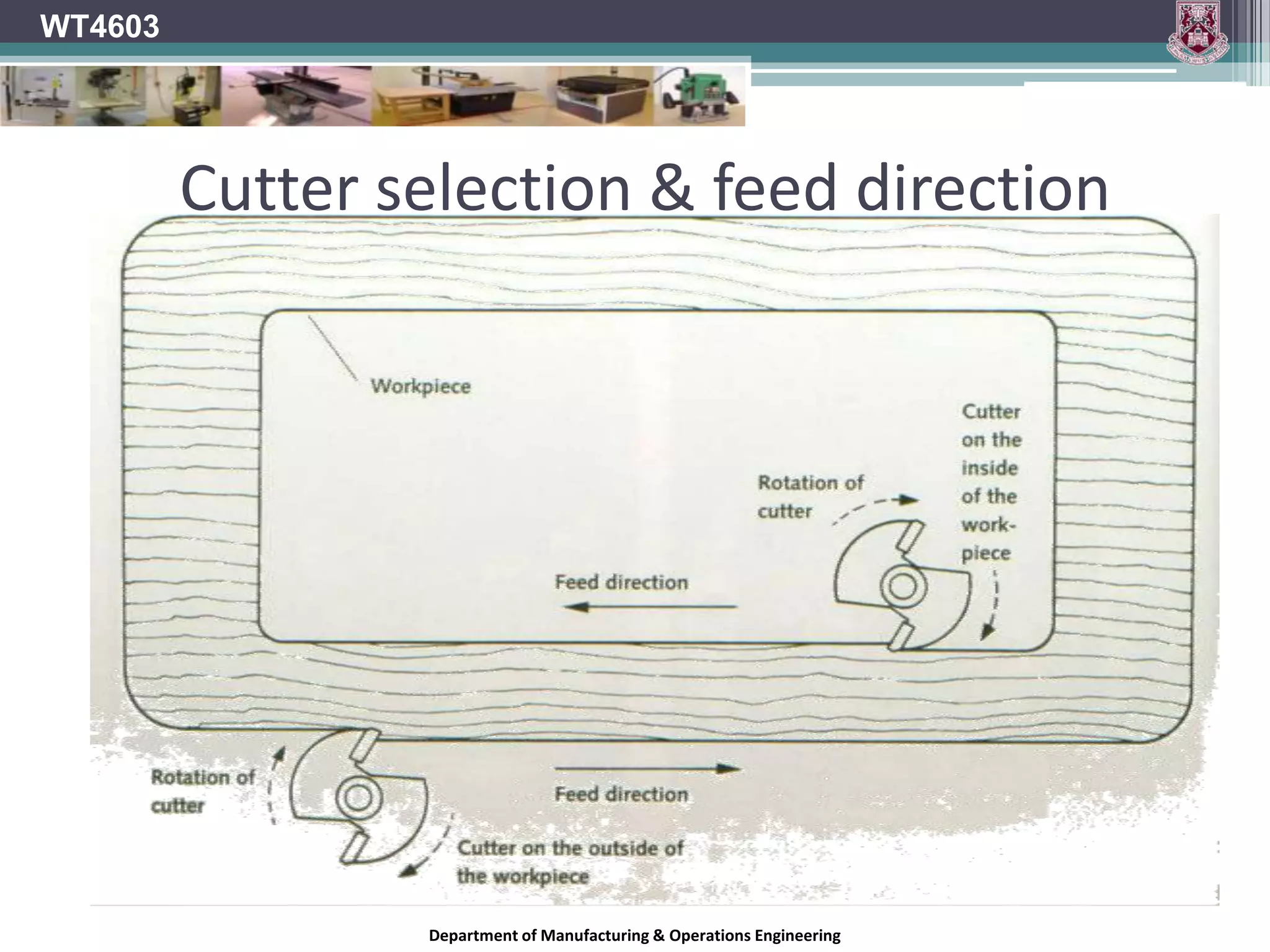
WT4603Cutter selection & feed directionDepartment of Manufacturing & Operations Engineering
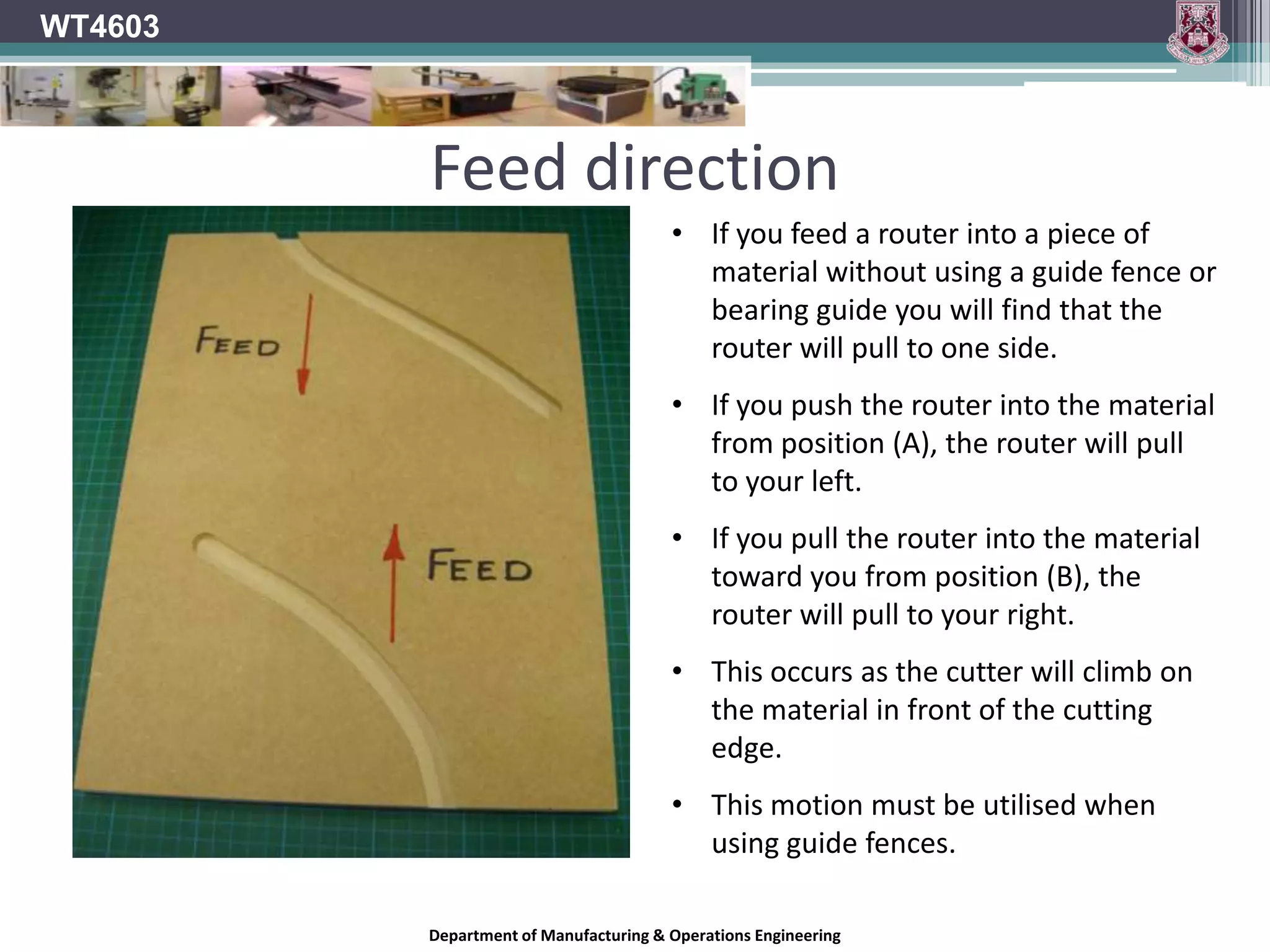
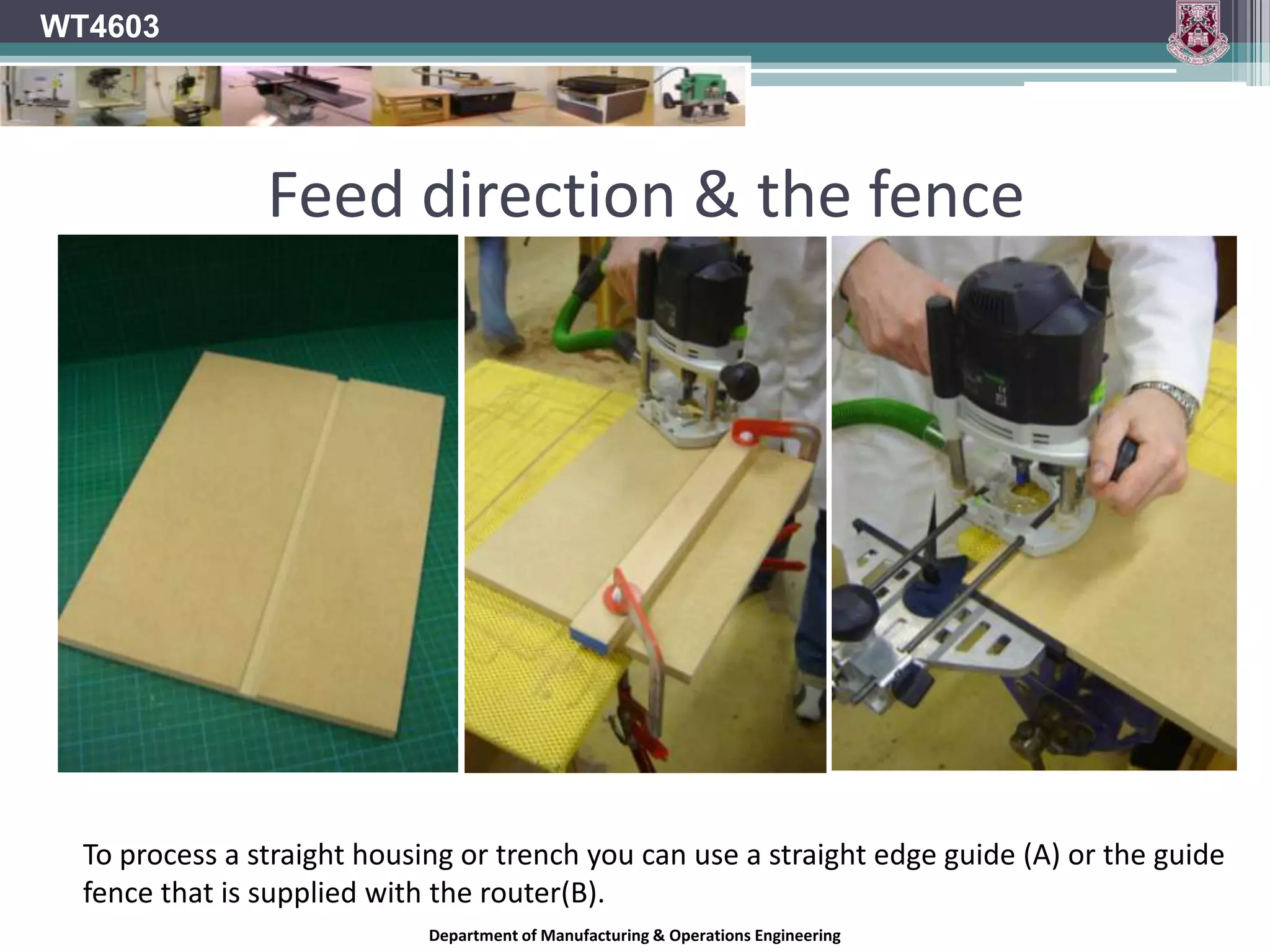
WT4603Feed directionIf you feed a router into a piece of material without using a guide fence or bearing guide you will find that the router will pull to one side.
If you push the router into the material from position (A), the router will pull to your left.
If you pull the router into the material toward you from position (B), the router will pull to your right.

Wt4603 unit3 week4-26-09-2011

  • 1.
    WT4603Wood Processing Safety& PracticeAutumn Semester 2011Lecture Unit 3 (Week 4)PLANING MACHINES, HAND ROUTERS & COMPONENT B
  • 2.
    Lecturer: Mr.Joseph Lyster
  • 3.
  • 4.
    Notes preparedby: Mr. Joseph Lyster
  • 5.
    Notes availableon www.slideshare.net/WT4603WT4603Surface PlanerPlaner Knives Important factors when selecting a planer knife Suitability for cutter blockMaterial being processedFinish requiredVolume being machinedClamping and setting mechanismsDepartment of Manufacturing & Operations Engineering
  • 6.
    Surface PlanerWT4603Planers canhave 2,3,4,6……. Cutter knives.Most smaller machines such as those found in schools will have 2,3 or 4 knives.Department of Manufacturing & Operations Engineering
  • 7.
    Surface PlanerWT4603Knives canbe made from Chrome Vanadium steel alloy. This is suitable for machining softwoods and non abrasive hardwoods. However with advances in machining technology better materials have been developed to machine wood and wood composites. Chrome Vanadium knives dull quickly on harder more dense material. This requires more sharpening, setting up and leads to a lot of time wastage.Department of Manufacturing & Operations Engineering
  • 8.
    Surface PlanerWT4603High SpeedSteel (HSS) is a cobalt steel alloy with a small percentage of Tungsten added. It is more suitable for machining all types of wood than the chrome steel compounds.Department of Manufacturing & Operations Engineering
  • 9.
    Surface PlanerWT4603Abrasive stockshould be machined using solid or tipped cutters.Tungsten Carbide (TC) is the best tool compound for machining manufactured boards.For general work HSS cutters are preferred to TC Cutters can be re-sharpened easily.A keener edge can be achieved on HSS giving a better finishDepartment of Manufacturing & Operations Engineering
  • 10.
    Surface PlanerWT4603The reasonfor this is that steel compounds are smelted and shaped by rolling and forging while the metal is close to melting point.The molecules of the compound flow and align themselves in response to this pressure giving the material maximum strength and edge holding capabilitiesDepartment of Manufacturing & Operations Engineering
  • 11.
    WT4603Surface PlanerTungsten carbideis a sintered compound. The fine grain powder from which the cutter will eventually will be made is compressed into a mould ( the ‘blank’ un-edged cutter required) under extremely high temperature (1500C) and pressure to form a solid block.Tungsten does not flow – it retains a granular structure and will chip rather than deform if abused.Department of Manufacturing & Operations Engineering
  • 12.
    Surface PlanerWT4603Because ifits brittle nature TC cutters require a more obtuse sharpness angle than the HSS cutters (more support for the cutting edge). This makes it less satisfactory for cutting softwoods than HSS knives which can be ground to a more acute cutting angle.Department of Manufacturing & Operations Engineering
  • 13.
    WT4603Surface PlanerDepartment ofManufacturing & Operations Engineering
  • 14.
    WT4603Knife Cutter geometryRakeor Cutting angleAngle created between the face of the cutting knife and the centre of the cutter blockCan have a wide rangeSoftwoods 27° to 35 °Hardwoods 15° to 25 °Department of Manufacturing & Operations Engineering
  • 15.
    WT4603Knife Cutter GeometryBevelor Lip AngleAngle formed to give the cutting edgeMinimum of usually 35°Greater for tipped cuttersDepartment of Manufacturing & Operations Engineering
  • 16.
    WT4603Knife Cutter GeometryClearanceAngleAngle formed between a line tangential to cutting circle and the bevel angle of the knifeMust be presentHas a bearing on the life of the cutting edgeUsually 10° to 15°Department of Manufacturing & Operations Engineering
  • 17.
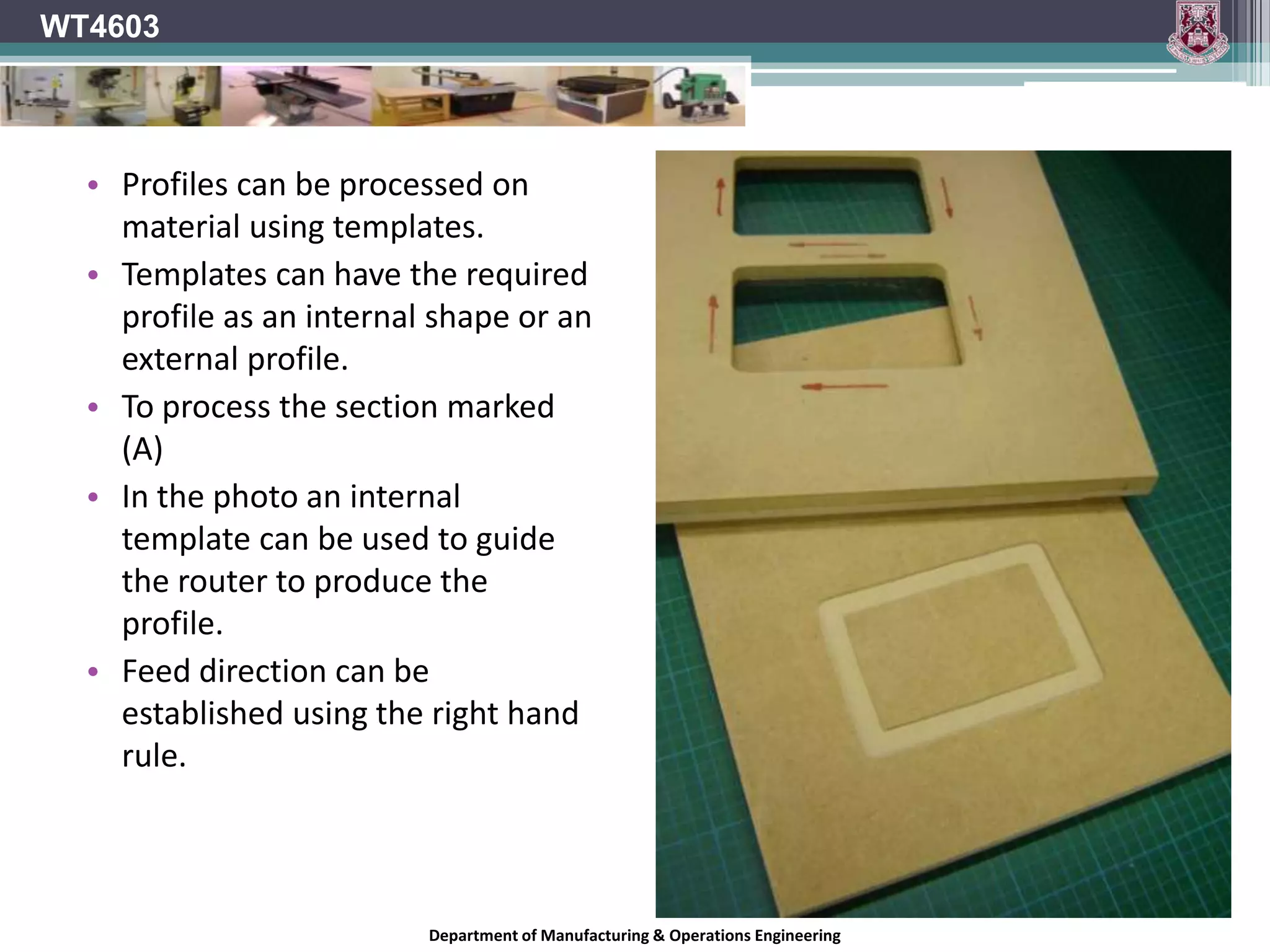
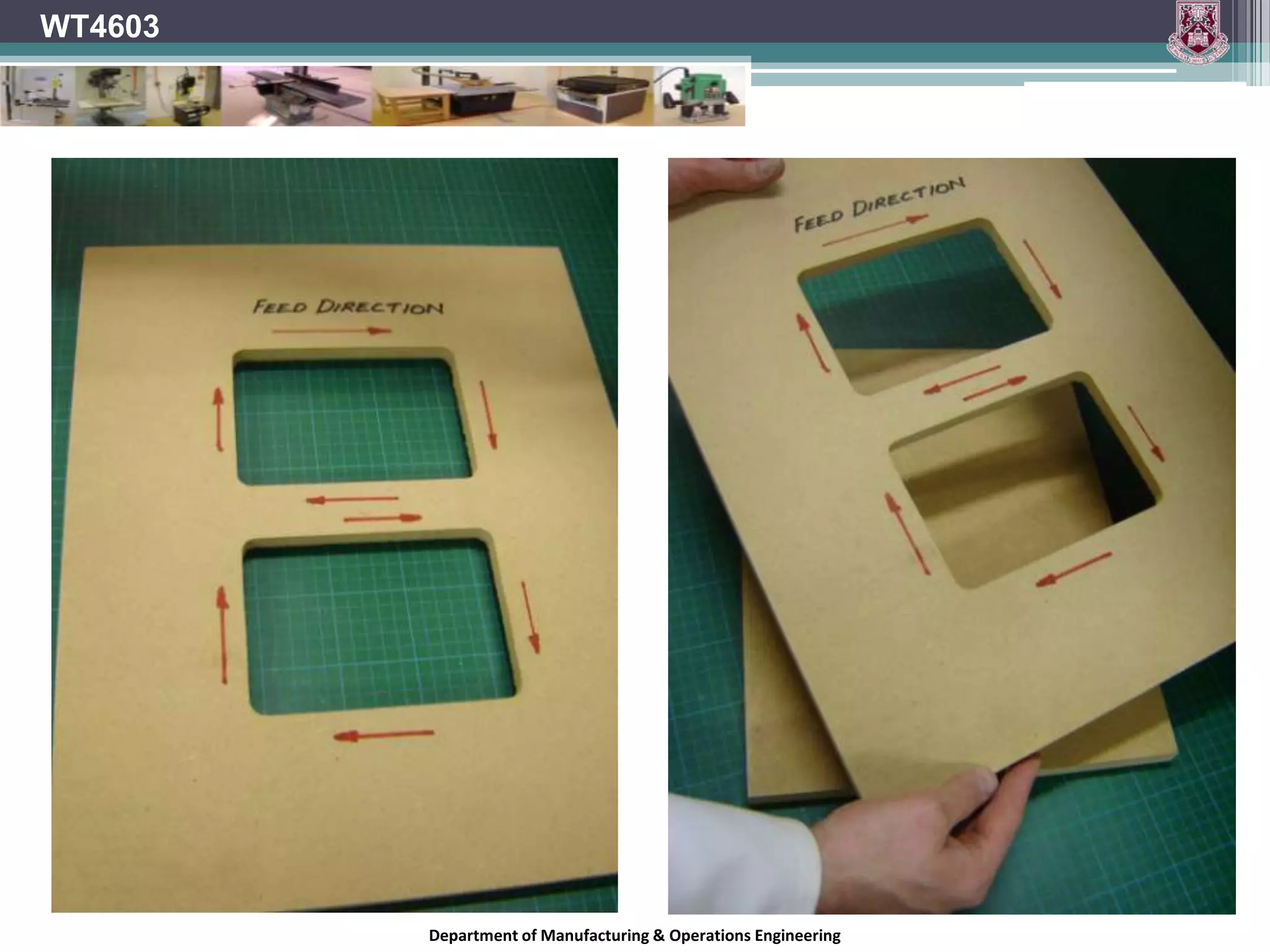
    WT4603Knife Cutter GeometryPeripheralCutting SpeedA constant speed in the range of 35-45 m/s will give best resultsIncrease in speed may cause loss of dynamic balance due to vibrationsPoor finishIncreased noise levelsDepartment of Manufacturing & Operations Engineering
  • 18.
    WT4603Pitch distanceCombination ofa rotary cut and a linear feed will leave the surface of the material with a series of arcs on it called Curtate TrochoidsThe pitch and depth of these arcs will determine how smooth the surface finish will beDepartment of Manufacturing & Operations Engineering
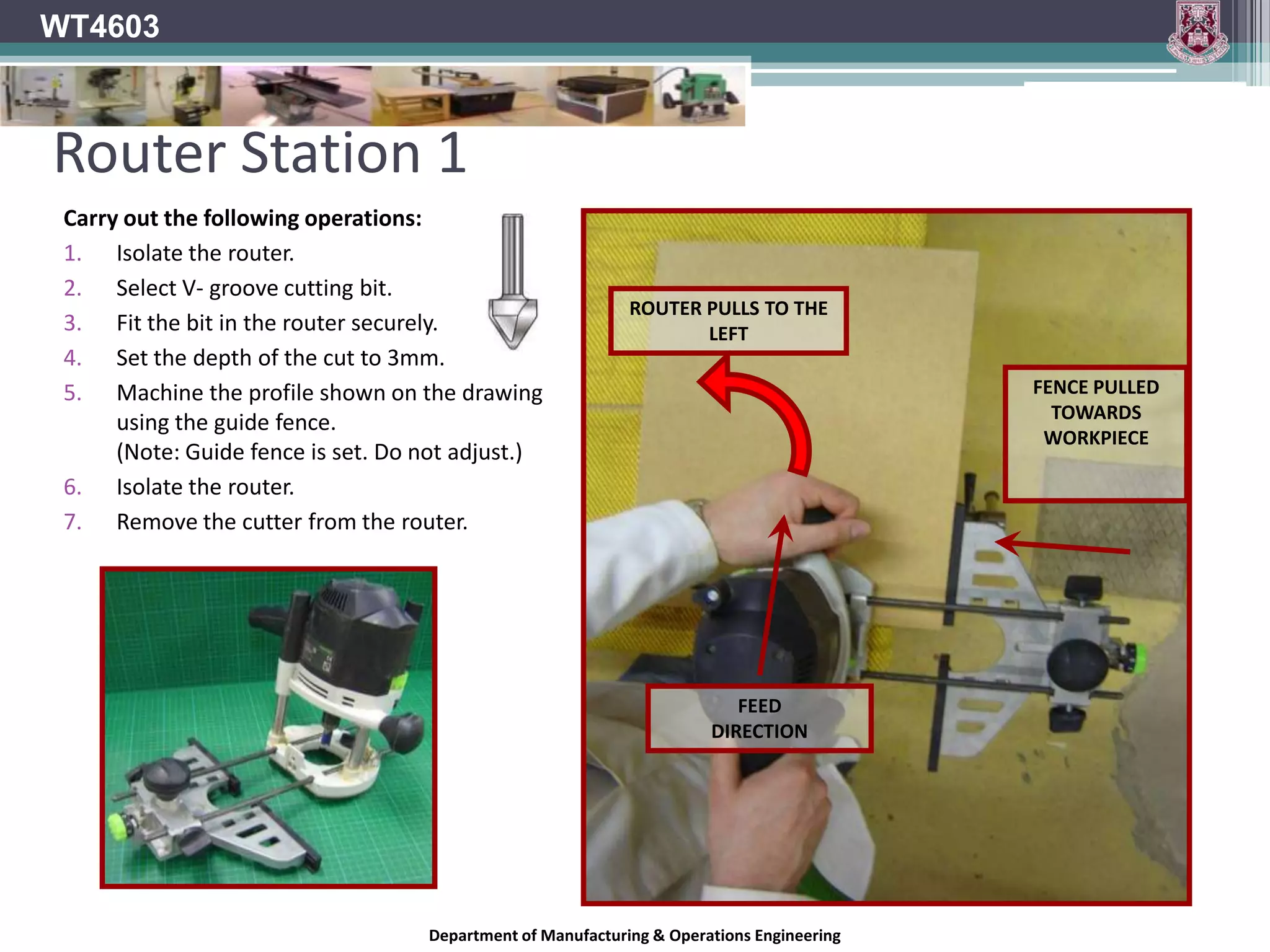
  • 19.
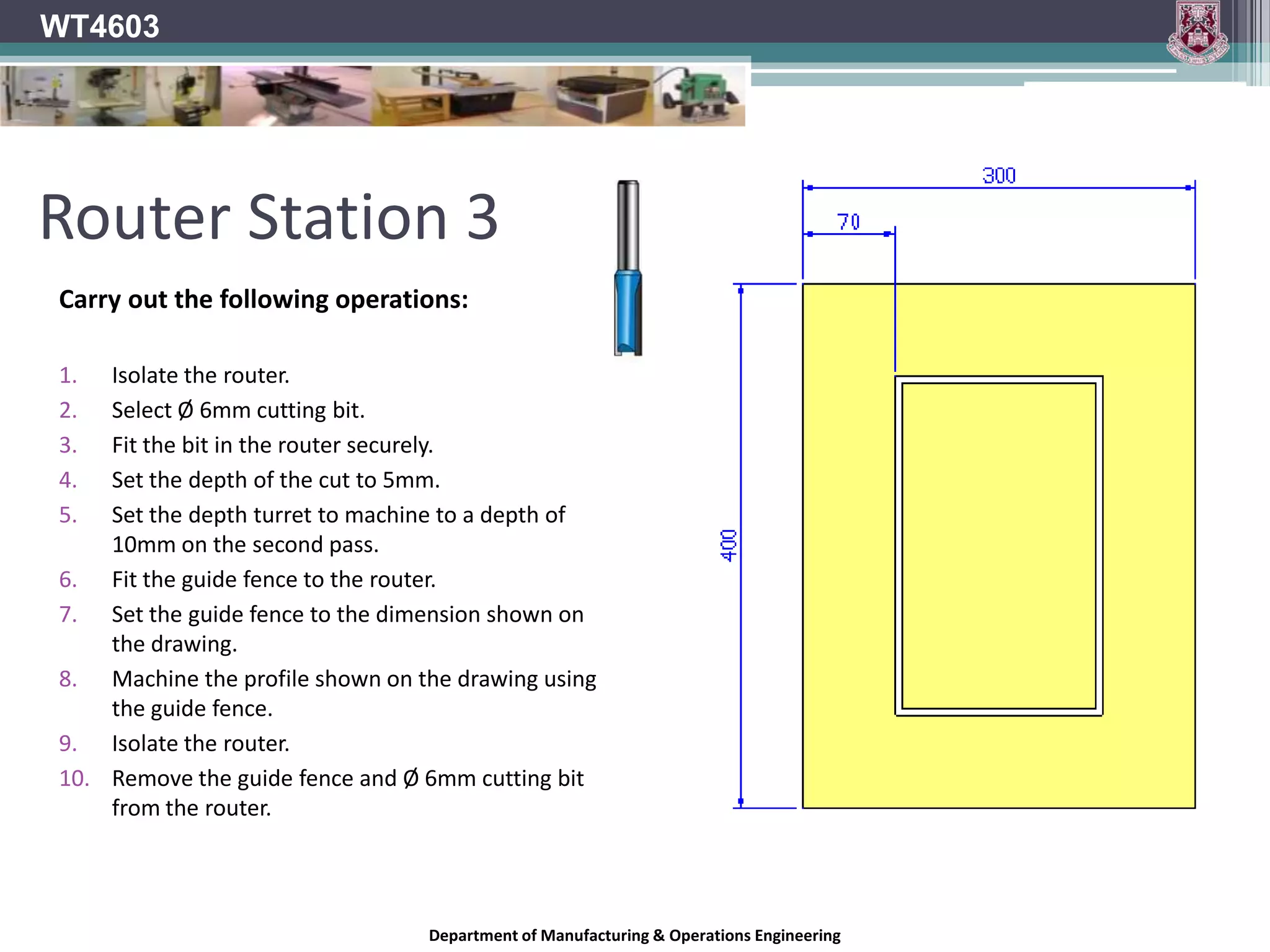
    Department of MaterialsScience & TechnologyUniversity of LimerickWT4603Pitch Distance2mm to 3mm for non obvious joinery and painted external work.  1mm to 1.5 mm for internal painted work.0.5mm to 1mm for hardwood joinery and furniture.Department of Manufacturing & Operations Engineering
  • 20.
    WT4603Pitch DistanceThe SIunit of time is the second , but the minute is acceptable. Feed rate on wood working machines is expressed in metres per minute. (m/min) The formula for the pitch of the cutter marks is given by:  f p = -------nR where p = pitch of cutter mark f = feed rate n = number of effective cutters  R = revolutions per minute of blockDepartment of Manufacturing & Operations Engineering
  • 21.
    Pitch DistanceWT4603The unitfor “p” will be metres (m)   f m/min m minp = ---- = --------- = ----- x ------ = m nR 1/min min 1Department of Manufacturing & Operations Engineering
  • 22.
    WT4603Pitch DistanceProblem 1 Calculatethe cutter pitch of a 4 cutter block revolving at 4200 rev/min with a feed speed of 24m/min.   F 24 24p = ------- = ------------ = --------- = 0.0014m = 1.4mmnR 4 x 4200 16800(Internal painted work)Department of Manufacturing & Operations Engineering
  • 23.
    Pitch DistanceWT4603 If agraded surface is specified and the machine has a multi-speed feed gearbox, the same formula is used but “f” is expressed in terms of n ,p, and R.   f p = -------  f = nRpnRDepartment of Manufacturing & Operations Engineering
  • 24.
    Pitch DistanceProblem 2  Froma cutter block which rotates at 4200 rev/min and has two cutting knives, a surface finish of a 4mm pitch is required. At what speed should the feed gearbox be set. f = nRp = 2 x 0.004 x 4200 = 33.6 m/min WT4603Department of Manufacturing & Operations Engineering
  • 25.
    WT4603Chip formationDepartment ofManufacturing & Operations Engineering
  • 26.
  • 27.
    RivingWT4603Cracking occurs belowthe cut depthDepartment of Manufacturing & Operations Engineering
  • 28.
    WT4603AOn the surfaceplaner the in-feed table (A) acts as chip breaker and the downward pressure exerted by the operator also makes it act as the pressure bar.Department of Manufacturing & Operations Engineering
  • 29.
    WT4603Chip formationDepartment ofManufacturing & Operations Engineering
  • 30.
    WT4603Chip formationChip breakingaid and pressure bar prevent riving and splinteringDepartment of Manufacturing & Operations Engineering
  • 31.
  • 32.
  • 33.
  • 34.
    Can run headat higher speeds (RPM)
  • 35.
  • 36.
    Easier and quickermaintenanceDepartment of Manufacturing & Operations Engineering
  • 37.
    WT4603Circular cutter blockClampingbolts are in tensionDepartment of Manufacturing & Operations Engineering
  • 38.
    WT4603Knife clamping mechanismDepartmentof Manufacturing & Operations Engineering
  • 39.
    WT4603Knife clamping mechanismDepartmentof Manufacturing & Operations Engineering
  • 40.
    Cutter projectionWT4603Use ofa limiter to achieve limited cutter projectionDepartment of Manufacturing & Operations Engineering
  • 41.
    Cutter designWT4603Cutters shouldpreferably be designed to be used in dimensionally similar pairs, formed to the same profile. Pairs should be mounted directly opposite one another. The manufacturer should ensure that instructions on balancing the pairs of cutters after grinding are given to the user.Department of Manufacturing & Operations Engineering
  • 42.
    Cutter projectionWT4603The designof cutter blocks should, as far as is practicable, be such as to prevent excessive cutter projection. Where the mounting arrangement permits projection which could subject the cutter to unsafe stresses, the maximum permissible projection for given cutter types should be specified in the user’s instructions.Department of Manufacturing & Operations Engineering
  • 43.
    Hand-fed machinesWT4603For machinesdesigned for hand-fed operations, where cutters are necessarily exposed, the use of chip limiting cutters should be recommended For other hand and semi-mechanical feed operations, cutter blocks should have as little cutter projection as is practicable.Department of Manufacturing & Operations Engineering
  • 44.
    WT4603Surface PlanerCutter andMachine Maintenance Involves: Grinding and setting of knives Roller and pressure bar setting Prevention of resin build up on table and rollers. Attention to: bearing wear
  • 45.
  • 46.
    rise and falltableDepartment of Manufacturing & Operations Engineering
  • 47.
    Surface PlanerWT4603The grindingangle of a cutter can vary between 30 to 35This is increased to 40 for hardwoods (cutting edge lasts longer)Department of Manufacturing & Operations Engineering
  • 48.
    WT4603Surface PlanerOverheating May producemicro cracks in the cutting edge which can run into gaps when the cutter is used.May cause the cutter to bow due to expansion.Department of Manufacturing & Operations Engineering
  • 49.
    WT4603Surface PlanerOverheating canbe avoidedBy taking light cuts.By ensuring that the grind wheel is ‘dressed’ when required to ensure that the face is open and not glazed when grinding the knives.By using a ‘soft’ grinding wheel on HSS cutters – the soft structure of the wheel allows its grains to break away as soon as they are blunt revealing sharper ones.By wet grinding – this is the grinding of cutters while partially submerged in a mixture of water and soluble oil. The water is a coolant to prevent frictional heat developing and to disperse it should it occur. The oil prevents rust in the cutters and it provides a degree of cutting lubrication.Department of Manufacturing & Operations Engineering
  • 50.
    WT4603Surface PlanerSetting Cuttersin Block Before setting the following points should be checked. The out feed table and cutter block must be clean and free from dust resin. Method of adjusting cutters.Area where setting device is used from should be free from resin and damage.Straightness of cutters.Cutters correctly balanced both in weight and end for end.Department of Manufacturing & Operations Engineering
  • 51.
    WT4603Surface PlanerSetting devicesThereare a number of cutter setting devices.This device and procedure will often be supplied with the machine.They can be loosely placed into the following four categories: Bridge device Precision cutter setter device Pin locater device Wooden straight edge device Cutters require accurate setting in the block because if the knives are not revolving in the same cutting circle a poor finish will be produced.Department of Manufacturing & Operations Engineering
  • 52.
    WT4603Setting Cutter KnivesSettingof knives will greatly depend on the type of cutter blockKnife cutter projectionChip breakerKnife parallel to tableAll knives in the same peripheral cutting circle(Refer to machine manual for setting)Department of Manufacturing & Operations Engineering
  • 53.
    WT4603Setting Planer KnivesWhenplaning wooden material a number of factors combine to generate the flat surface.Number of cutting knives in the blockSpeed of the revolving blockFeed speed of the materialKnife cutter designChip breaking aidsNature and species of the materialDepartment of Manufacturing & Operations Engineering
  • 54.
    Knife cutter design& Chip breaking aidsThese factors combine to produce an acceptable surface finishTip of the cutter splits away the chipThe chip is forced away from the stock and up along the face of the cutter which is exerting a tearing effect on the grain fibreAs the knife exits the stock the chip is either cut or will “rive” or tear deeply along the grain line and lift as a long heavy splinterWT4603Department of Manufacturing & Operations Engineering
  • 55.
    Knife cutter design& Chip breaking aidsThe cutter projection and the shape of the block face cause the severed chip to bend back causing a crack across its widthThis makes long grain riving less likely(Chip breaker not shown)WT4603Department of Manufacturing & Operations Engineering
  • 56.
    WT4603Knife cutter design& Chip breaking aidsSharp tooling (a) will aid in the chip bending back and cracking across its widthBlunt tooling (b) will aid rivingDepartment of Manufacturing & Operations Engineering
  • 57.
    WT4603Chip FormationBefore knifemakes its cutDepartment of Manufacturing & Operations Engineering
  • 58.
    WT4603Chip FormationChip tobe formedDepartment of Manufacturing & Operations Engineering
  • 59.
    WT4603Chip FormationaChip breakerwill help prevent riving (a)Department of Manufacturing & Operations Engineering
  • 60.
    WT4603Knife cutter design& Chip breaking aids Large cutting angle which gives the knife a lifting action which will cause rivingGrinding a face bevel reduces the risk of riving as it changes the cutting angleDepartment of Manufacturing & Operations Engineering
  • 61.
    WT4603Face bevel oncutter knife (B)Department of Manufacturing & Operations Engineering
  • 62.
    WT4603Surface PlaningDepartment ofManufacturing & Operations Engineering
  • 63.
    WT4603Surface PlaningDepartment ofManufacturing & Operations Engineering
  • 64.
    WT4603Surface PlaningDepartment ofManufacturing & Operations Engineering
  • 65.
    WT4603Surface PlaningDepartment ofManufacturing & Operations Engineering
  • 66.
    WT4603Surface PlaningDepartment ofManufacturing & Operations Engineering
  • 67.
    WT4603Surface PlaningDepartment ofManufacturing & Operations Engineering
  • 68.
    WT4603Surface PlaningDepartment ofManufacturing & Operations Engineering
  • 69.
    WT4603Surface PlaningDepartment ofManufacturing & Operations Engineering
  • 70.
    WT4603Surface PlaningDepartment ofManufacturing & Operations Engineering
  • 71.
    WT4603Surface PlaningDepartment ofManufacturing & Operations Engineering
  • 72.
    WT4603Surface PlaningDepartment ofManufacturing & Operations Engineering
  • 73.
    WT4603Surface PlaningDepartment ofManufacturing & Operations Engineering
  • 74.
    WT4603Surface PlaningDepartment ofManufacturing & Operations Engineering
  • 75.
    WT4603Surface PlaningDepartment ofManufacturing & Operations Engineering
  • 76.
    WT4603Hand Router Consists ofcutter rotating at between 800 to 30,000 RPM being driven by a vertically mounted motor set on a flat based frameworkDepartment of Manufacturing & Operations Engineering
  • 77.
    WT4603Hand RouterDepartment ofManufacturing & Operations Engineering
  • 78.
    WT4603Hand RouterDepartment ofManufacturing & Operations Engineering
  • 79.
    WT4603Hand RouterCutting groovesCuttingrebatesCutting slots and recessesCutting beads or mouldingsCutting dovetailsCutting dovetailed slots and groovesEdge trimmingProfiling (jigs/formers)Department of Manufacturing & Operations Engineering
  • 80.
    WT4603Hand Router: PowerLargepowerful routers are heavy and can be difficult to handle for light work.Generally in schools the type of work that the router will have to perform will be light to medium work.As a rough guide to classifying routers:400 W to 600W are for light duty 750 W to 1200W are for medium duty 1250 W upwards are for heavy dutyDepartment of Manufacturing & Operations Engineering
  • 81.
  • 82.
    WT4603Collet A tapered sleevethat is made in a number of segments that is used to hold the shaft of a cutter or bit.Department of Manufacturing & Operations Engineering
  • 83.
    WT4603Collet needs tobe cleaned regularlyMust prevent rustMust prevent wearCan clean with solvents but must spray with WD40 afterwardsDepartment of Manufacturing & Operations Engineering
  • 84.
  • 85.
  • 86.
  • 87.
    HSS work wellon softwood because of their keen edge but will blunt quickly
  • 88.
    TCT cutters performmuch better than HSS on hardwoods and MDF
  • 89.
    Cutters should becleaned regularly with white spirit and fine scraper to remove dirt, resin and debris.
  • 90.
    Cutters should alsobe inspected for damage prior to operating.Department of Manufacturing & Operations Engineering
  • 91.
    WT4603Cutters (Router bits) Arouter bit is a tool for woodworking giving a quality finish to the material. It cuts wood providing a way to give a clean and even a decorative edge to woodwork. The following is some basic information about router bits to get you started in your woodworking efforts. Here are the there main parts of a router bit:The shank- the part of the router bit that is inserted into the collet (the sleeve of the router).The cutting edge- this part cuts and removes the wood. They are available in several sizes and shapes. The pilot- the guide for the router in order to make a correct cut. It can be an extension of the shank or a ball bearing attachment.Department of Manufacturing & Operations Engineering
  • 92.
    WT4603Cutters (Router bits)Cutterscan have disposable or interchangeable profiles.Department of Manufacturing & Operations Engineering
  • 93.
    WT4603Cutters (Router bits)Cutterdiameter will have a direct effect on the power required form the router motor.Department of Manufacturing & Operations Engineering
  • 94.
    WT4603Cutter selection &feed directionDepartment of Manufacturing & Operations Engineering
  • 95.
    WT4603Feed directionIf youfeed a router into a piece of material without using a guide fence or bearing guide you will find that the router will pull to one side.
  • 96.
    If you pushthe router into the material from position (A), the router will pull to your left.
  • 97.
    If you pullthe router into the material toward you from position (B), the router will pull to your right.
  • 98.
    This occurs asthe cutter will climb on the material in front of the cutting edge.
  • 99.
    This motion mustbe utilised when using guide fences.Department of Manufacturing & Operations Engineering
  • 100.
    WT4603Feed direction &the fenceTo process a straight housing or trench you can use a straight edge guide (A) or the guide fence that is supplied with the router(B).Department of Manufacturing & Operations Engineering
  • 101.
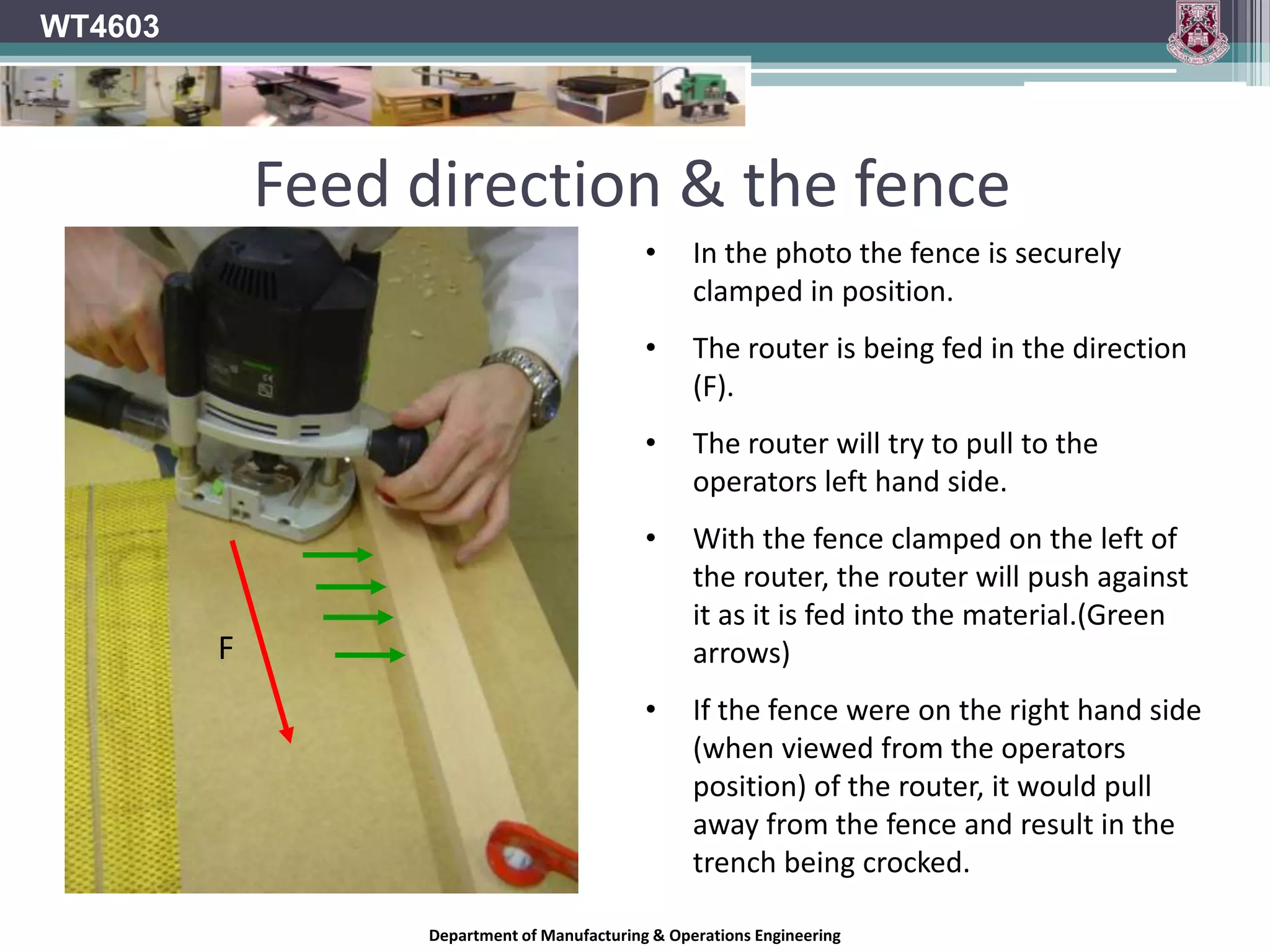
    WT4603FFeed direction &the fenceIn the photo the fence is securely clamped in position.
  • 102.
    The router isbeing fed in the direction (F).
  • 103.
    The router willtry to pull to the operators left hand side.
  • 104.
    With the fenceclamped on the left of the router, the router will push against it as it is fed into the material.(Green arrows)
  • 105.
    If the fencewere on the right hand side (when viewed from the operators position) of the router, it would pull away from the fence and result in the trench being crocked.Department of Manufacturing & Operations Engineering
  • 106.
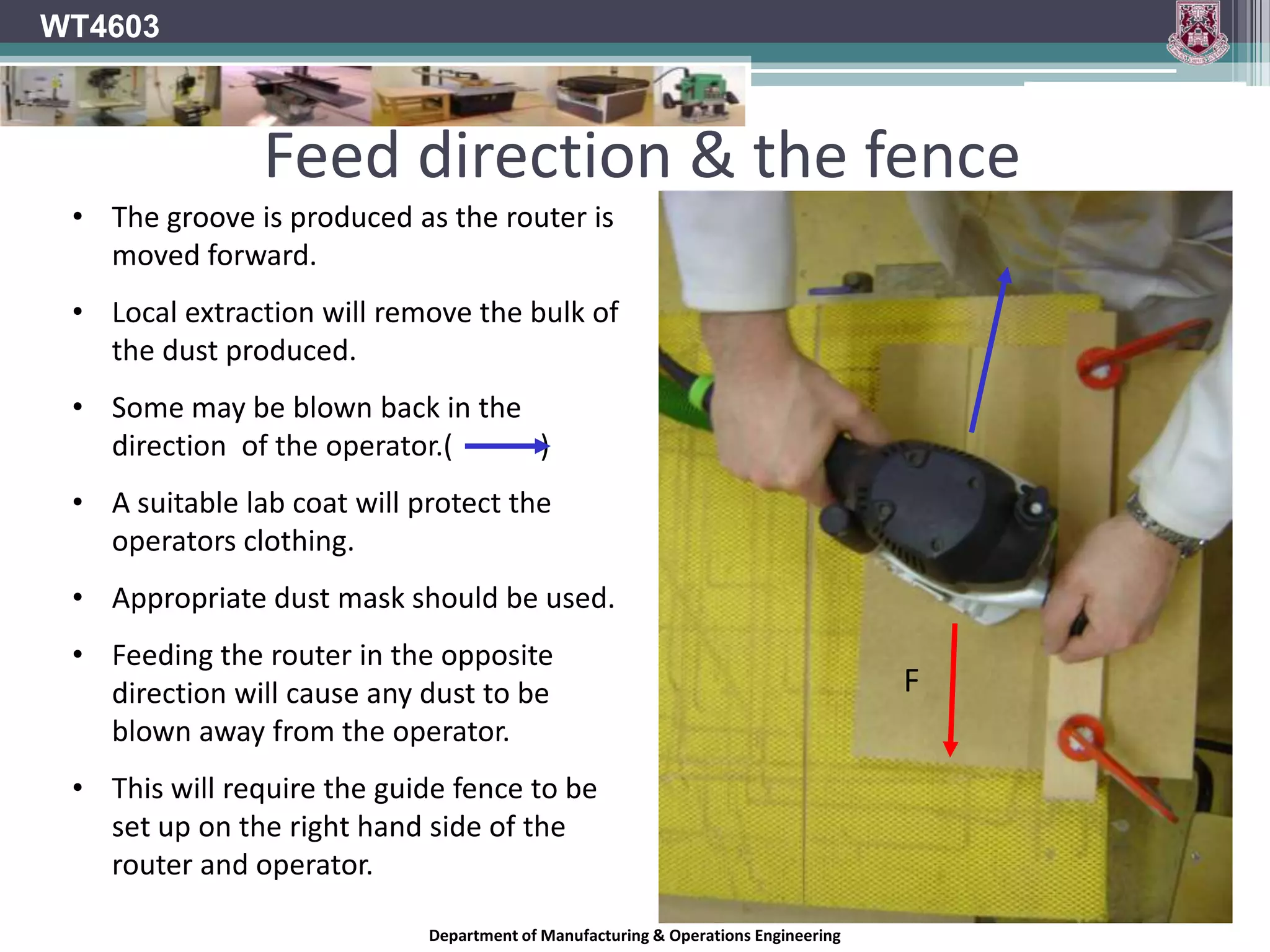
    WT4603The groove isproduced as the router is moved forward.
  • 107.
    Local extraction willremove the bulk of the dust produced.
  • 108.
    Some may beblown back in the direction of the operator.( )
  • 109.
    A suitable labcoat will protect the operators clothing.
  • 110.
    Appropriate dust maskshould be used.
  • 111.
    Feeding the routerin the opposite direction will cause any dust to be blown away from the operator.
  • 112.
    This will requirethe guide fence to be set up on the right hand side of the router and operator. FFeed direction & the fenceDepartment of Manufacturing & Operations Engineering
  • 113.
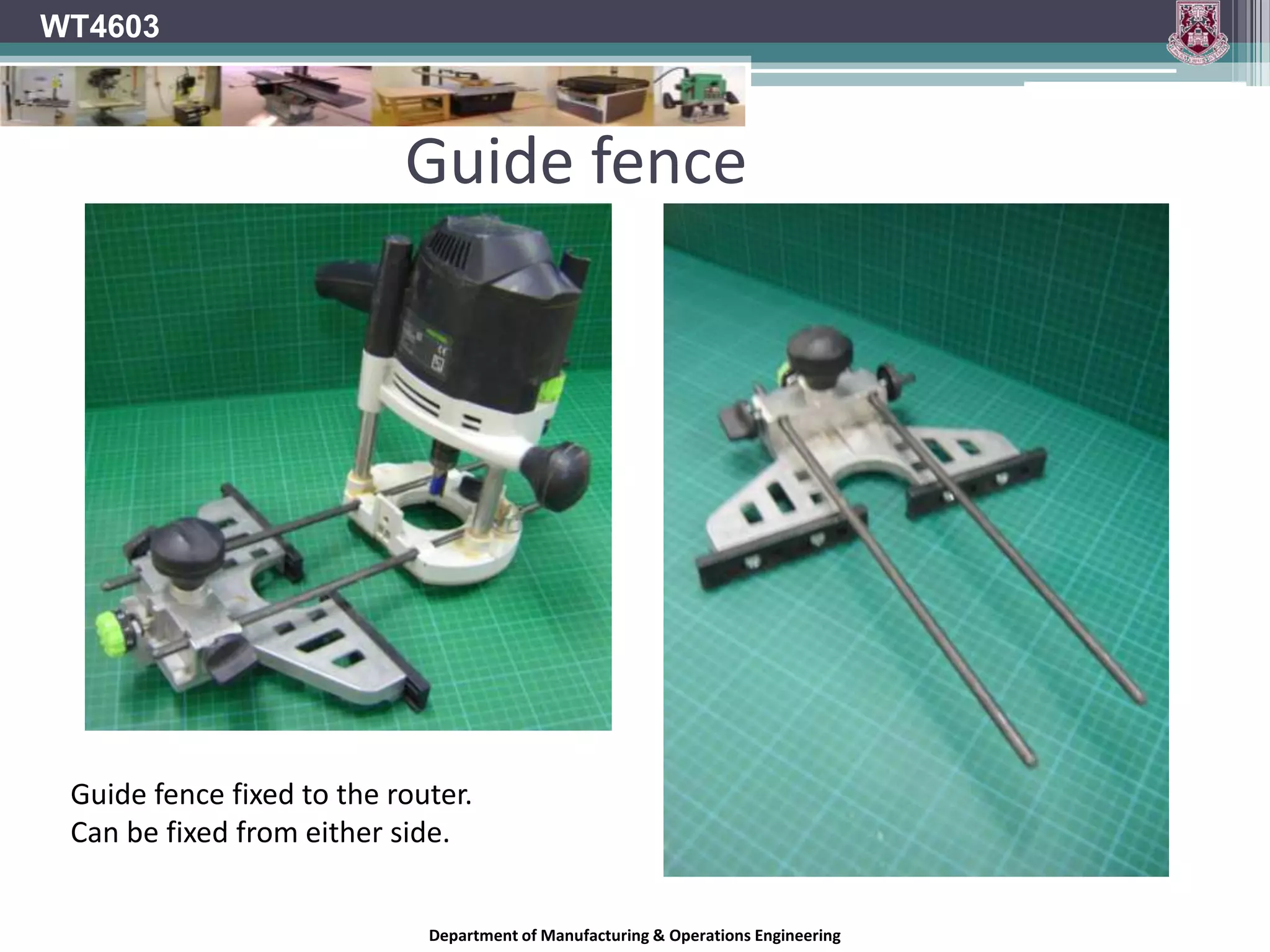
    WT4603Guide fenceGuide fencefixed to the router.Can be fixed from either side.Department of Manufacturing & Operations Engineering
  • 114.
    WT4603FPUsing the guidefenceWhen feeding the router forward (F) the router will tend to pull to the operators left hand side.The fence should be set on the right hand side of the router.When the cutter engages in the material it will pull to the left as indicated by the green arrow (P) and keep the fence tight against the materials edge.Material should be securely calmped or placed on a non-slip router mat.Department of Manufacturing & Operations Engineering
  • 115.
    WT4603Profiles can beprocessed on material using templates.Templates can have the required profile as an internal shape or an external profile.To process the section marked (A)In the photo an internal template can be used to guide the router to produce the profile.Feed direction can be established using the right hand rule.Department of Manufacturing & Operations Engineering
  • 116.
    WT4603Department of Manufacturing& Operations Engineering
  • 117.
    WT4603Using the templateguide Fit the template guide to the router base plate.Set cutter plunge depth.Place over template at the starting position (A).Switch on the router and then plunge to depth (B).Feed router in a clockwise direction.Department of Manufacturing & Operations Engineering
  • 118.
    WT4603ROUTER PULLS TOTHE LEFTFENCE PULLED TOWARDS WORKPIECEFEEDDIRECTIONRouter Station 1Carry out the following operations:Isolate the router. Select V- groove cutting bit.Fit the bit in the router securely.Set the depth of the cut to 3mm.Machine the profile shown on the drawing using the guide fence. (Note: Guide fence is set. Do not adjust.)Isolate the router.Remove the cutter from the router.Department of Manufacturing & Operations Engineering
  • 119.
    WT4603Router Station 3Carryout the following operations:Isolate the router.Select Ø 6mm cutting bit.Fit the bit in the router securely.Set the depth of the cut to 5mm.Set the depth turret to machine to a depth of 10mm on the second pass.Fit the guide fence to the router.Set the guide fence to the dimension shown on the drawing.Machine the profile shown on the drawing using the guide fence.Isolate the router.Remove the guide fence and Ø 6mm cutting bit from the router.Department of Manufacturing & Operations Engineering
  • 120.
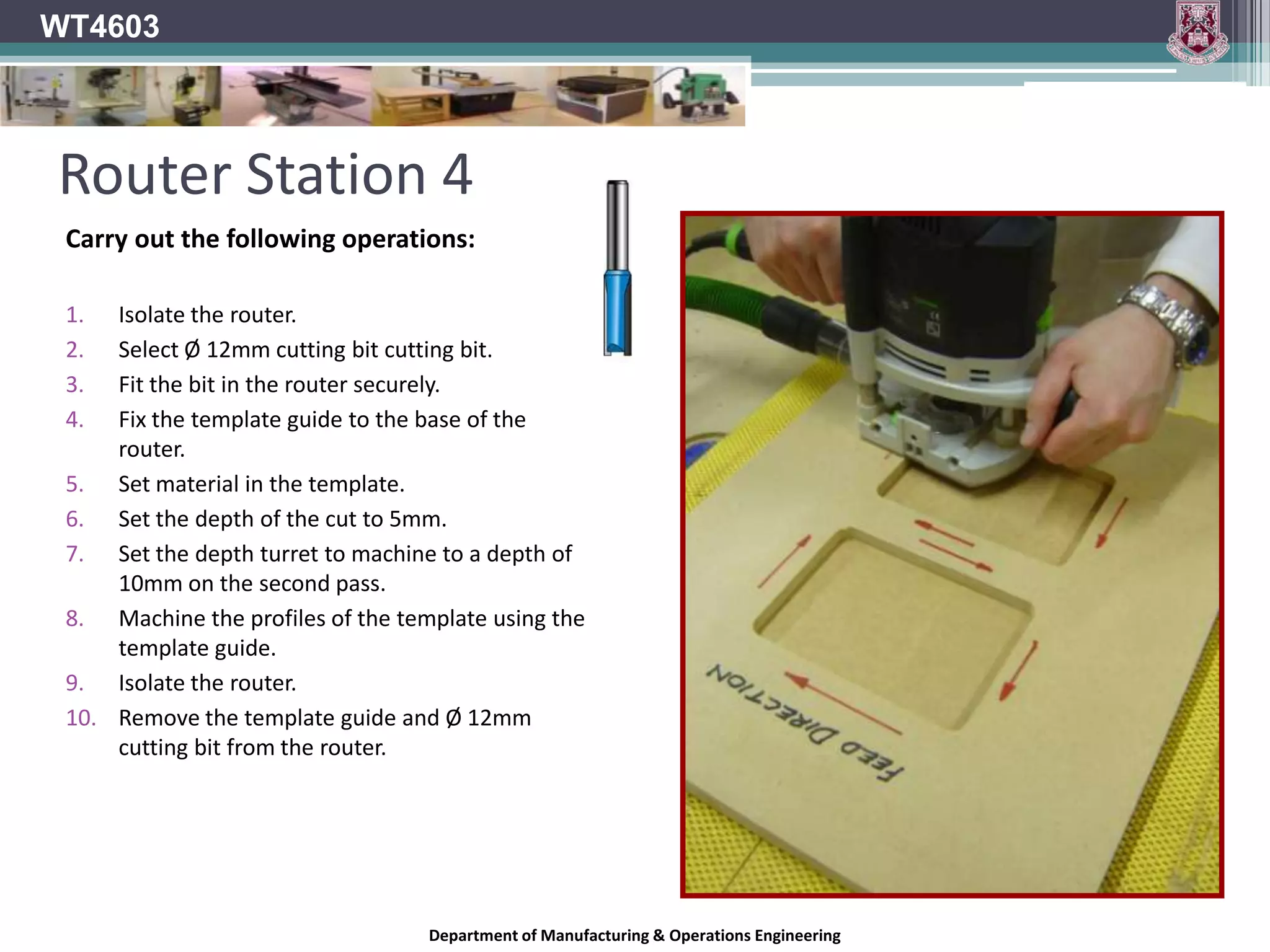
    WT4603Router Station 4Carryout the following operations:Isolate the router.Select Ø 12mm cutting bit cutting bit.Fit the bit in the router securely.Fix the template guide to the base of the router.Set material in the template.Set the depth of the cut to 5mm.Set the depth turret to machine to a depth of 10mm on the second pass.Machine the profiles of the template using the template guide.Isolate the router.Remove the template guide and Ø 12mm cutting bit from the router.Department of Manufacturing & Operations Engineering
  • 121.
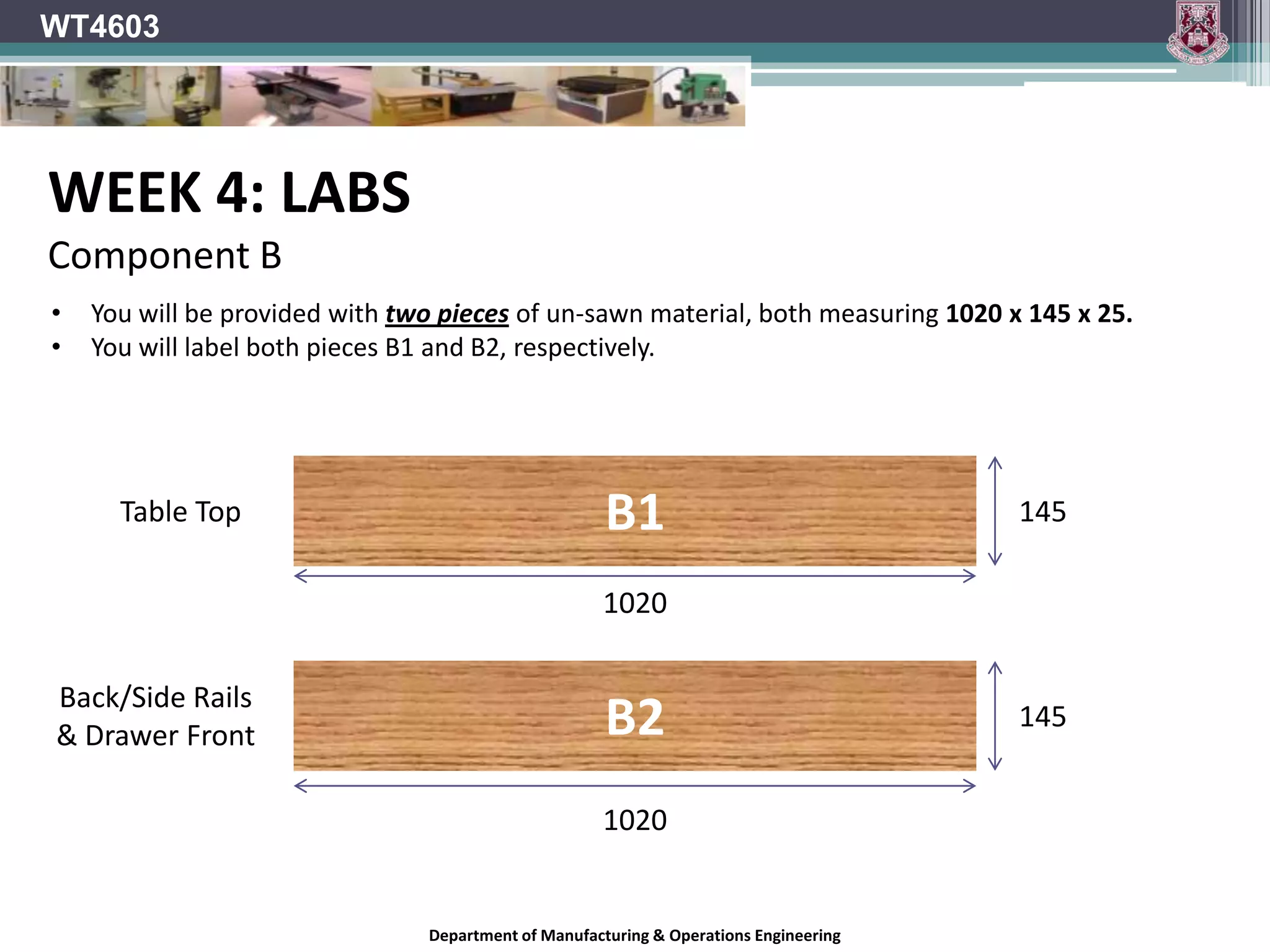
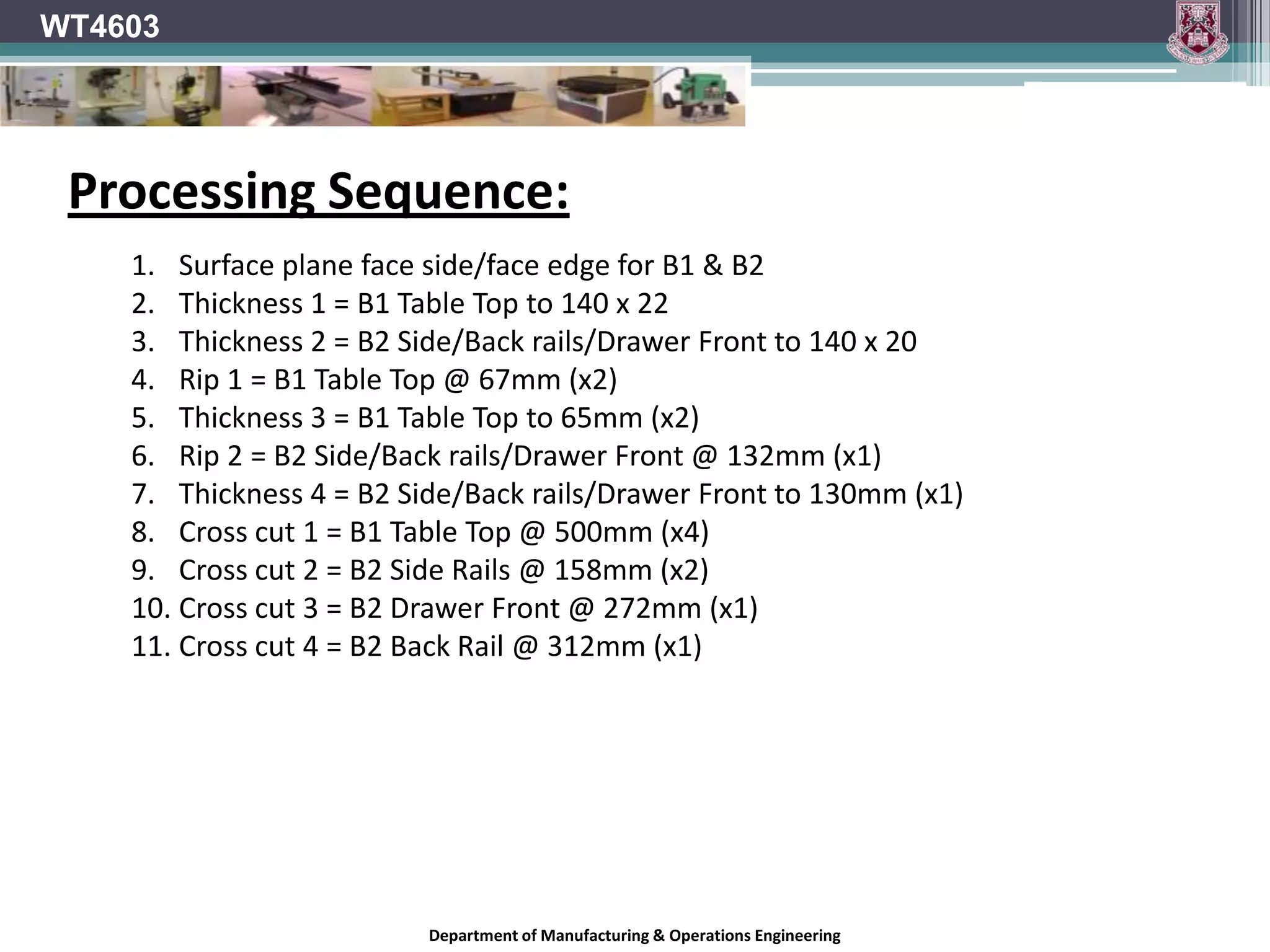
    WT4603WEEK 4: LABSComponentBYou will be provided with two pieces of un-sawn material, both measuring 1020 x 145 x 25.
  • 122.
    You will labelboth pieces B1 and B2, respectively.B1Table Top1451020Back/Side Rails & Drawer FrontB21451020Department of Manufacturing & Operations Engineering
  • 123.
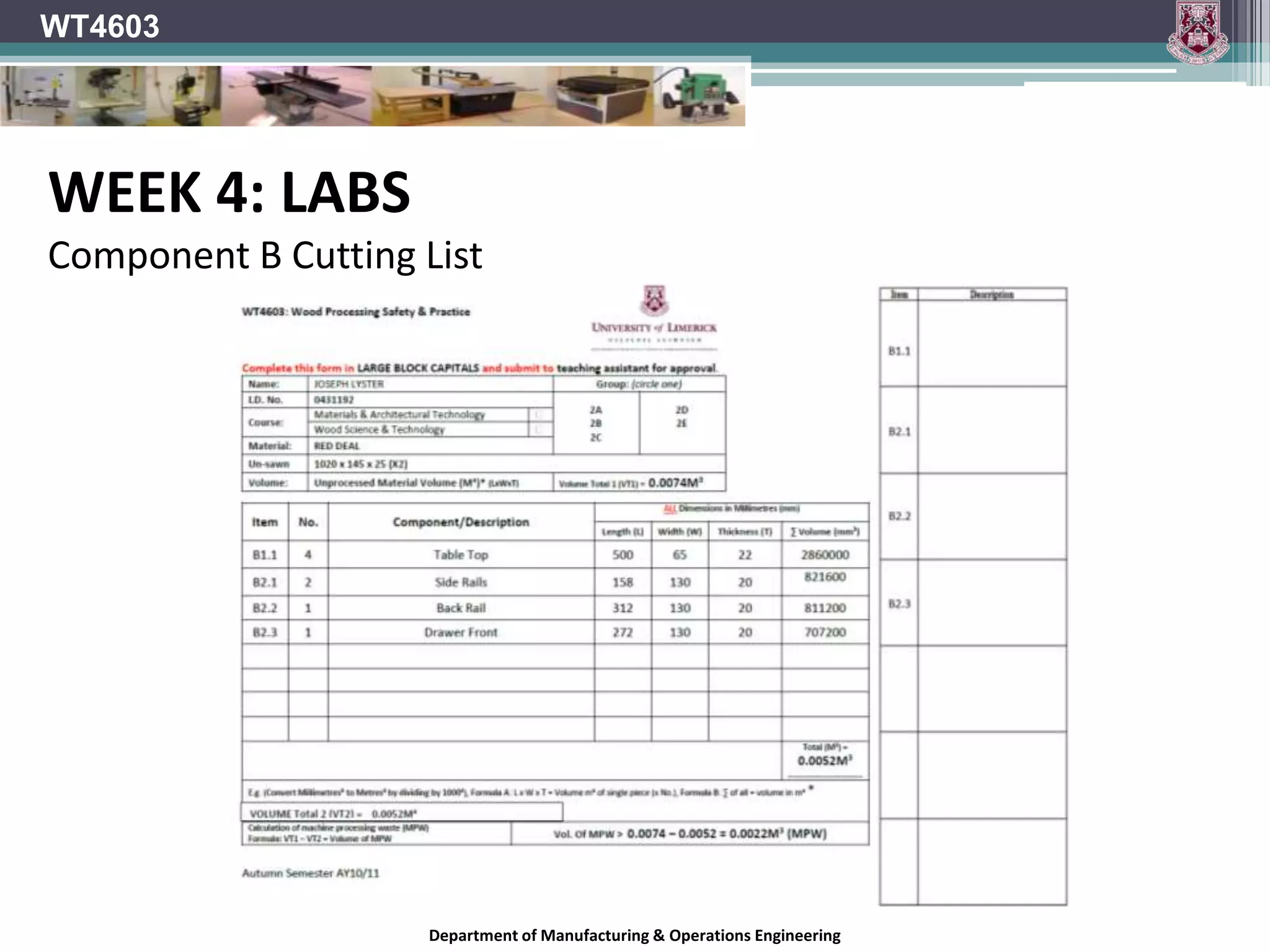
    WT4603WEEK 4: LABSComponentB Cutting ListDepartment of Manufacturing & Operations Engineering
  • 124.
    WT4603B1 = TableTopB1 must be planed all round (P.A.R) to 1020 x 140 x 22
  • 125.
    The process forB1 will involve the following:
  • 126.
  • 127.
    Rip B1 @67mm (x2)
  • 128.
  • 129.
    Cross cut to500mm (x4)Department of Manufacturing & Operations Engineering
  • 130.
    WT4603B2 = Backand Side RailsB2 must be planed all round (P.A.R) to 1020 x 140 x 20
  • 131.
    The process forB2 will involve the following:
  • 132.
  • 133.
    Rip B2 @132mm (x1)
  • 134.
  • 135.
    Cross cut 1= Side Rails @ 158mm (x2)
  • 136.
    Cross cut 2= Drawer Front @ 272mm (x1)
  • 137.
    Cross cut 3= Back Rail @ 312mm (x1)Department of Manufacturing & Operations Engineering
  • 138.
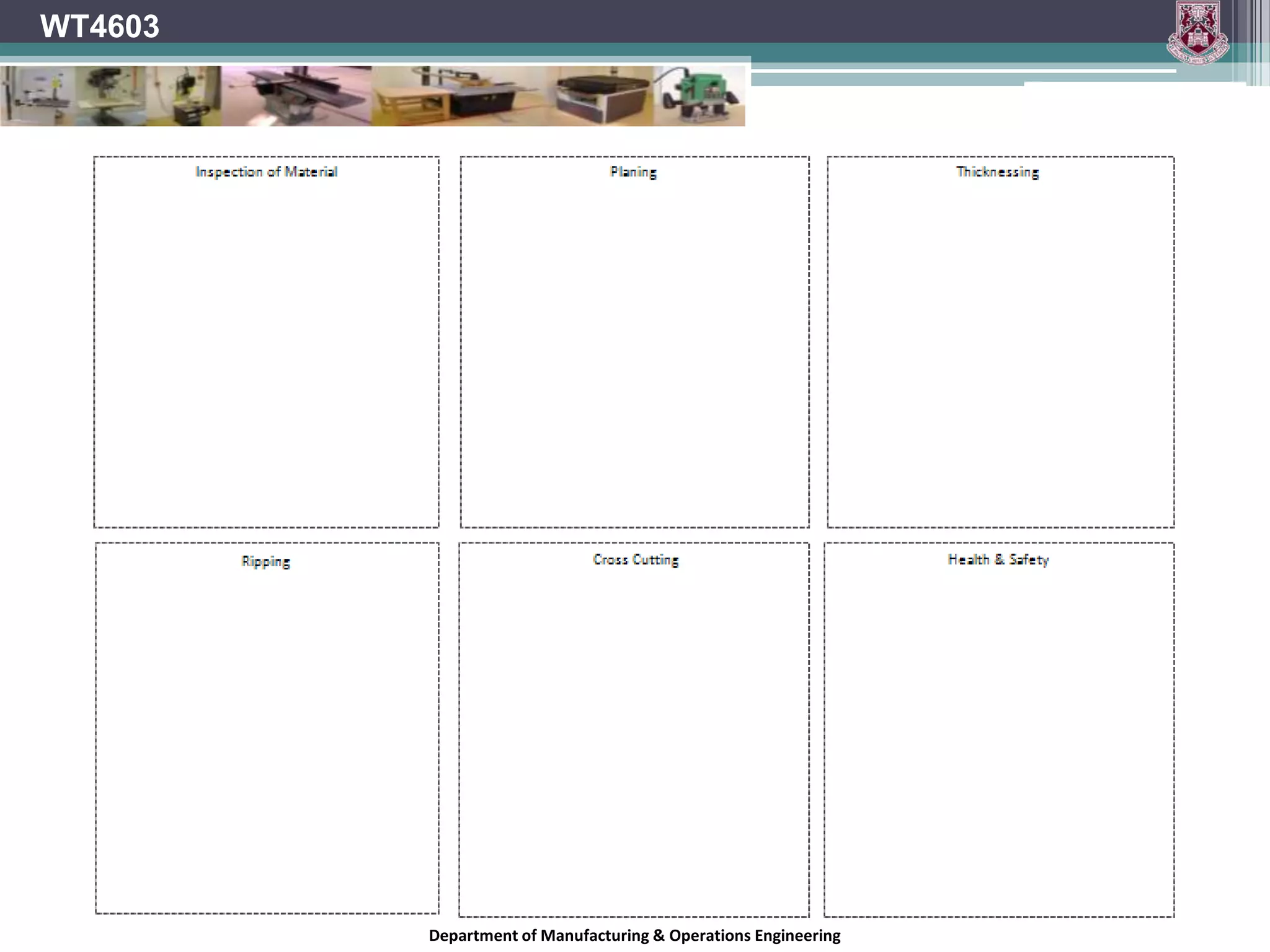
    WT4603Processing Sequence:Surface planeface side/face edge for B1 & B2Thickness 1 = B1 Table Top to 140 x 22Thickness 2 = B2 Side/Back rails/Drawer Front to 140 x 20Rip 1 = B1 Table Top @ 67mm (x2)Thickness 3 = B1 Table Top to 65mm (x2)Rip 2 = B2 Side/Back rails/Drawer Front @ 132mm (x1)Thickness 4 = B2 Side/Back rails/Drawer Front to 130mm (x1)Cross cut 1 = B1 Table Top @ 500mm (x4)Cross cut 2 = B2 Side Rails @ 158mm (x2)Cross cut 3 = B2 Drawer Front @ 272mm (x1)Cross cut 4 = B2 Back Rail @ 312mm (x1)Department of Manufacturing & Operations Engineering
  • 139.
    WT4603Department of Manufacturing& Operations Engineering
  • 140.
    WT4603Department of Manufacturing& Operations Engineering