Gully blocking & revegetation:
Exploring the evidence
Mark Reed, Jim Rouquette and Dylan Young
1 Introduction
Purpose
• Explore evidence re: effects of undertaking Peatland
Code projects on different ecosystem services
• Stimulate discussion and inform decisions about
what might be a fair price to charge for undertaking
Peatland Code projects
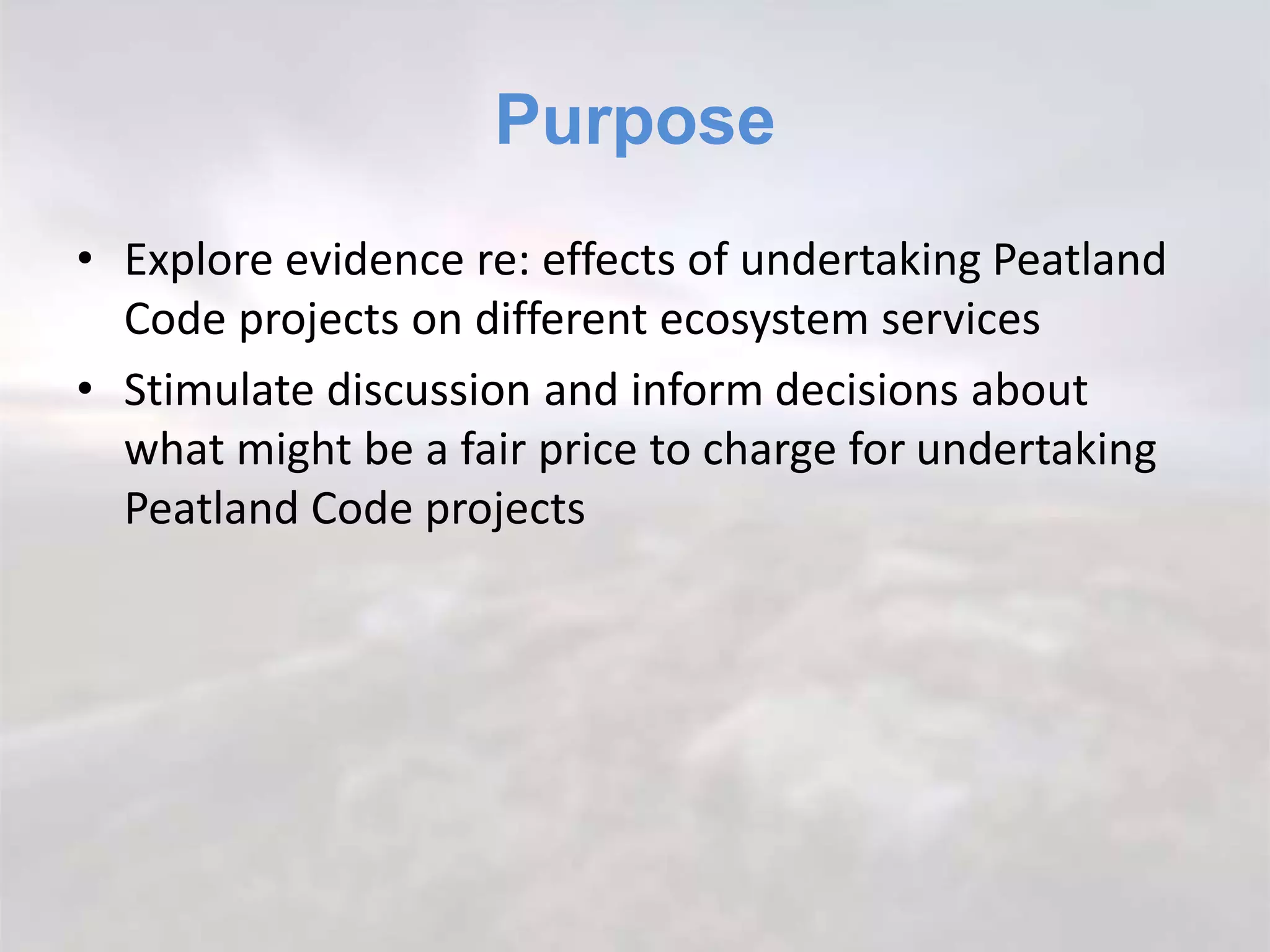
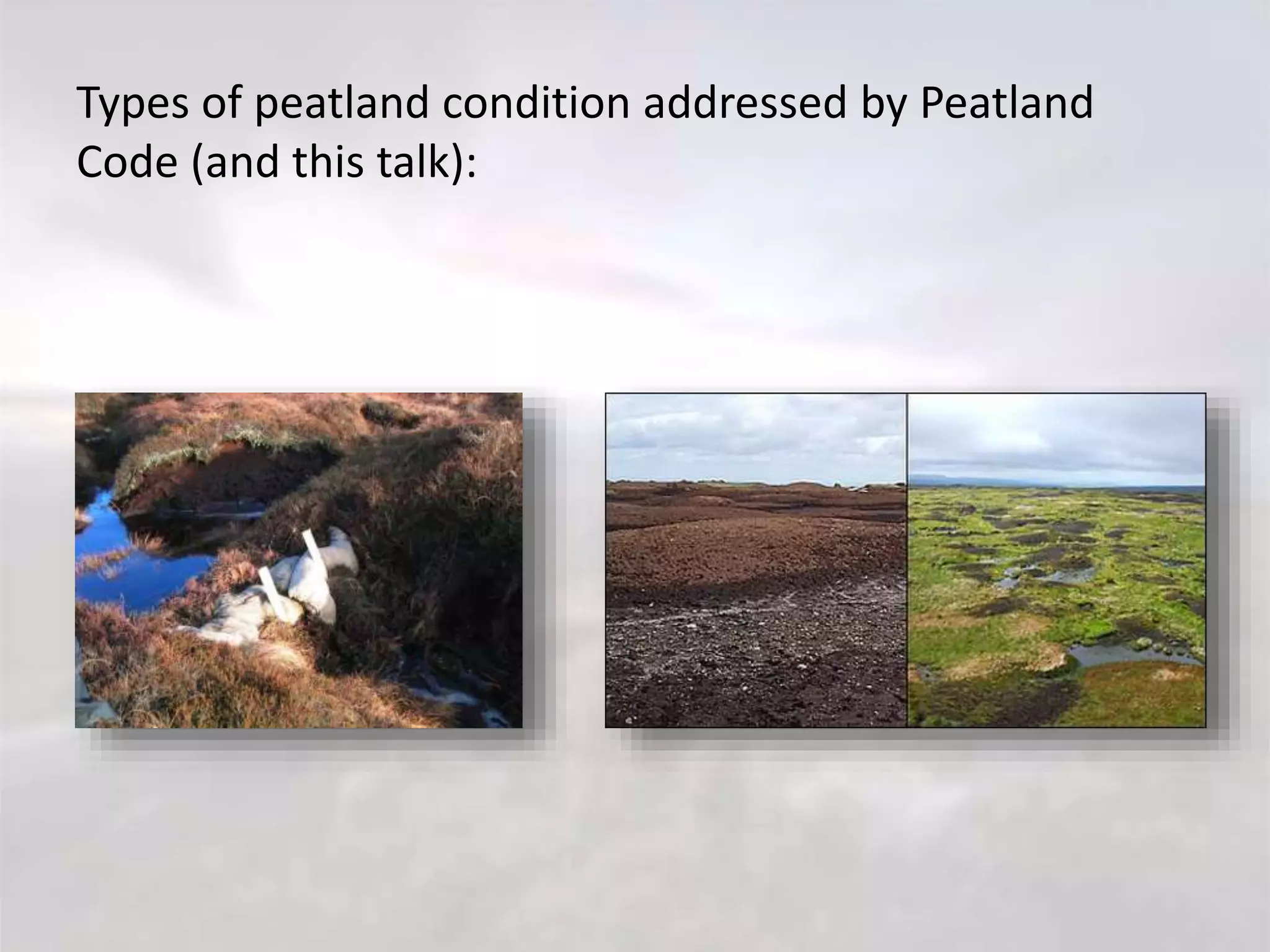
Types of peatland condition addressed by Peatland
Code (and this talk):
2 Changes in ecosystem services
(based on perceptions of previous workshop participants)
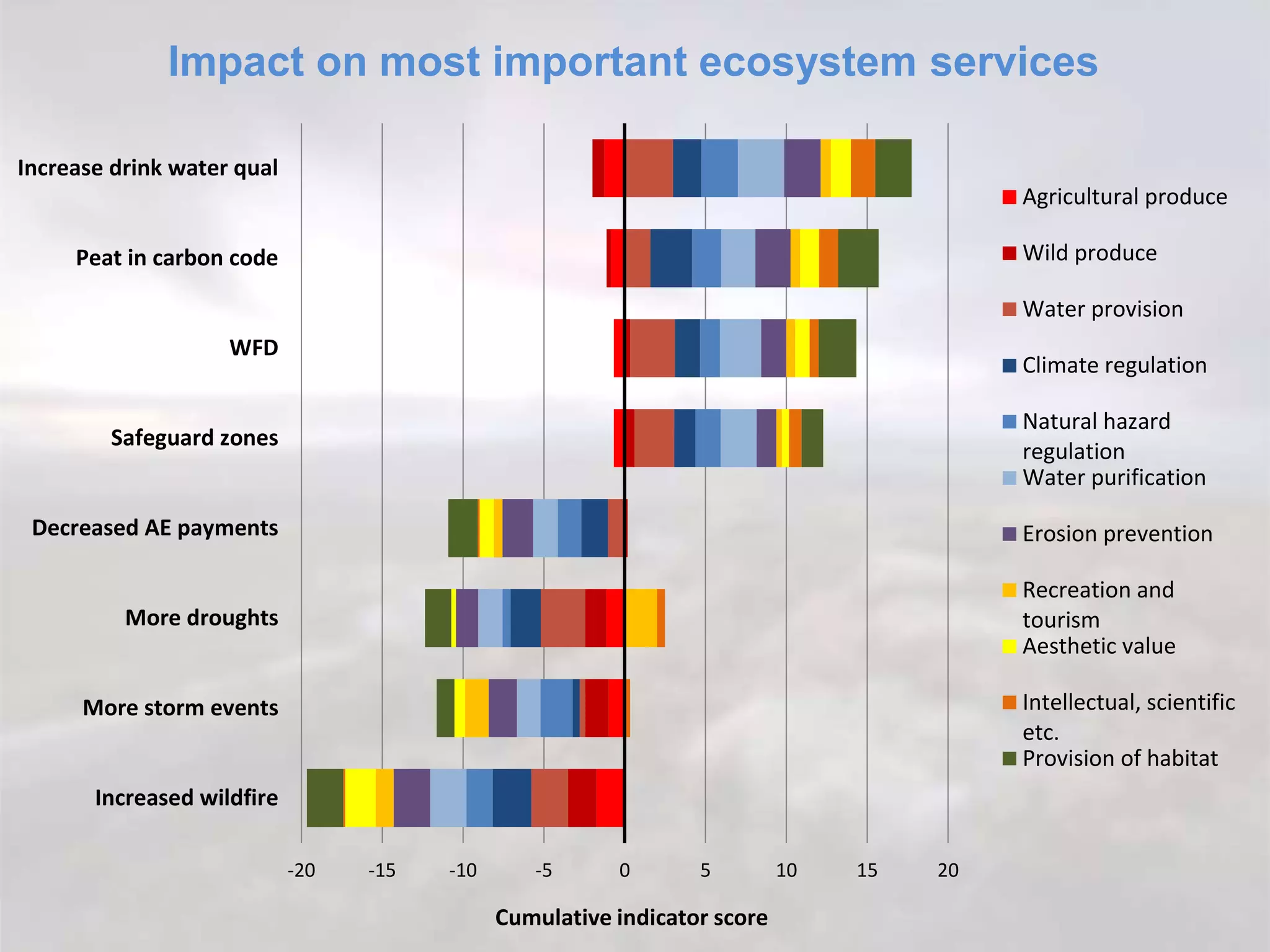
-20 -15 -10 -5 0 5 10 15 20
Increase drink water qual
Peat in carbon code
WFD
Safeguard zones
Decreased AE payments
More droughts
More storm events
Increased wildfire
Cumulative indicator score
Agricultural produce
Wild produce
Water provision
Climate regulation
Natural hazard
regulation
Water purification
Erosion prevention
Recreation and
tourism
Aesthetic value
Intellectual, scientific
etc.
Provision of habitat
Impact on most important ecosystem services
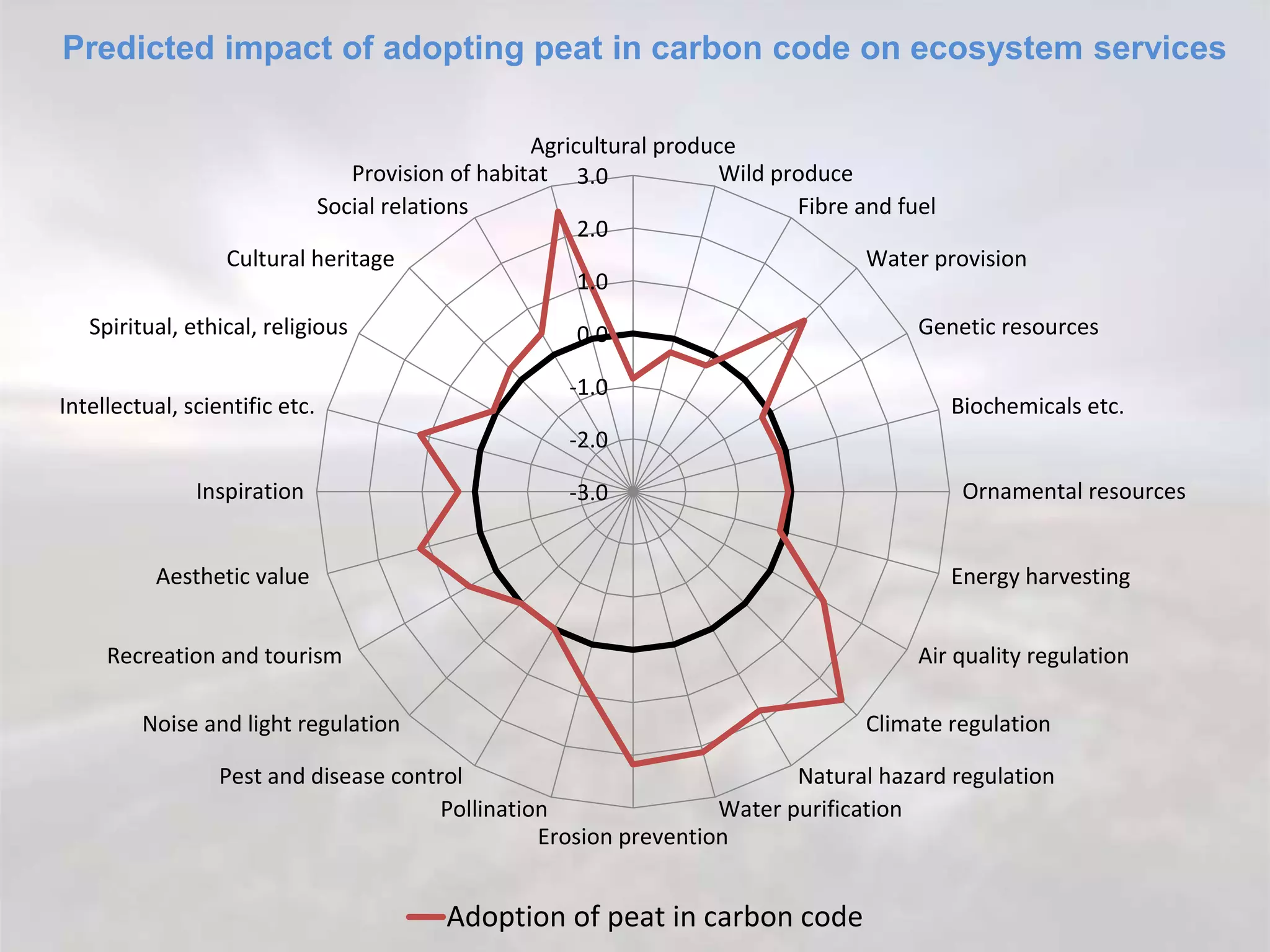
-3.0
-2.0
-1.0
0.0
1.0
2.0
3.0
Agricultural produce
Wild produce
Fibre and fuel
Water provision
Genetic resources
Biochemicals etc.
Ornamental resources
Energy harvesting
Air quality regulation
Climate regulation
Natural hazard regulation
Water purification
Erosion prevention
Pollination
Pest and disease control
Noise and light regulation
Recreation and tourism
Aesthetic value
Inspiration
Intellectual, scientific etc.
Spiritual, ethical, religious
Cultural heritage
Social relations
Provision of habitat
Adoption of peat in carbon code
Predicted impact of adopting peat in carbon code on ecosystem services
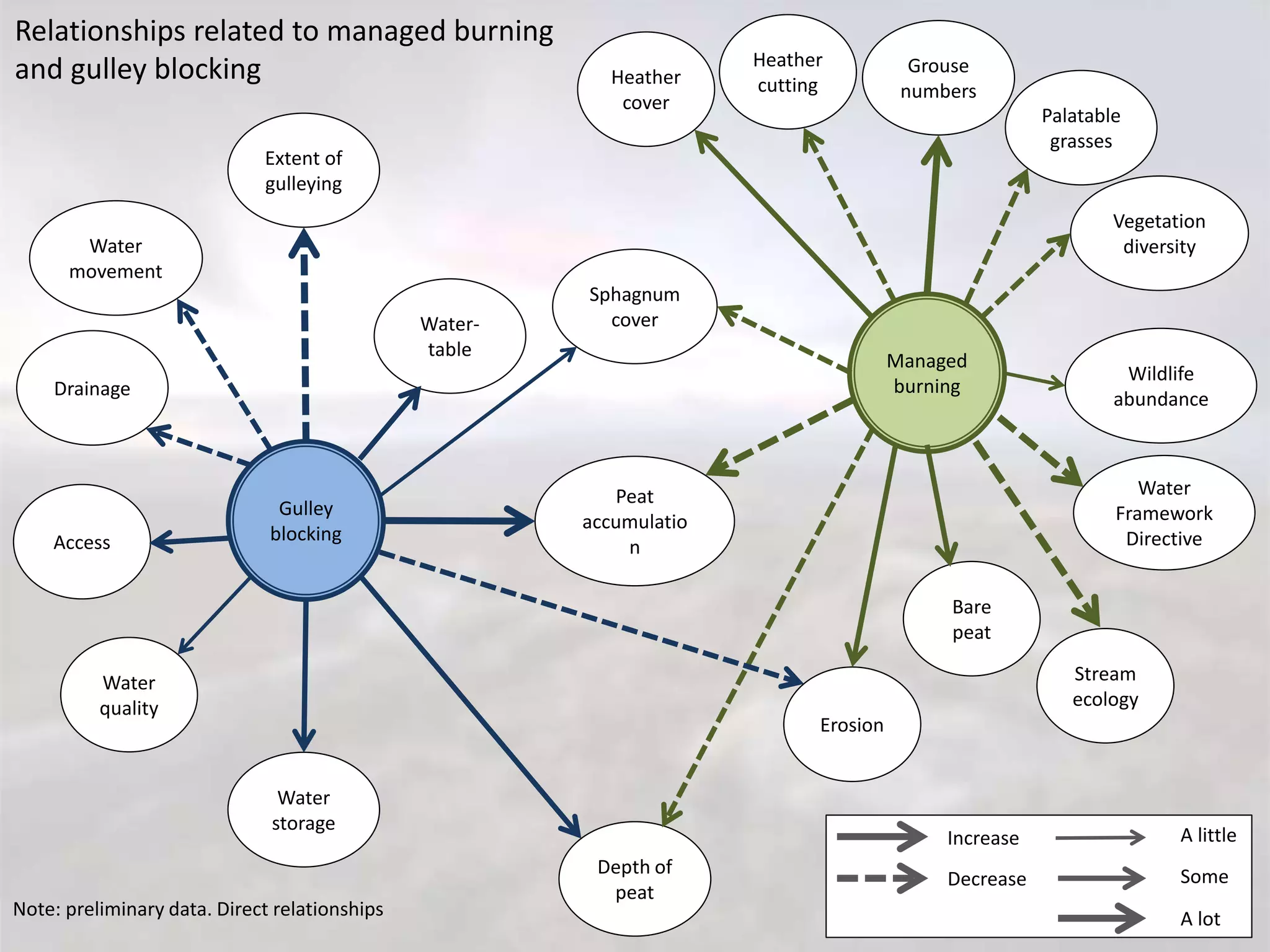
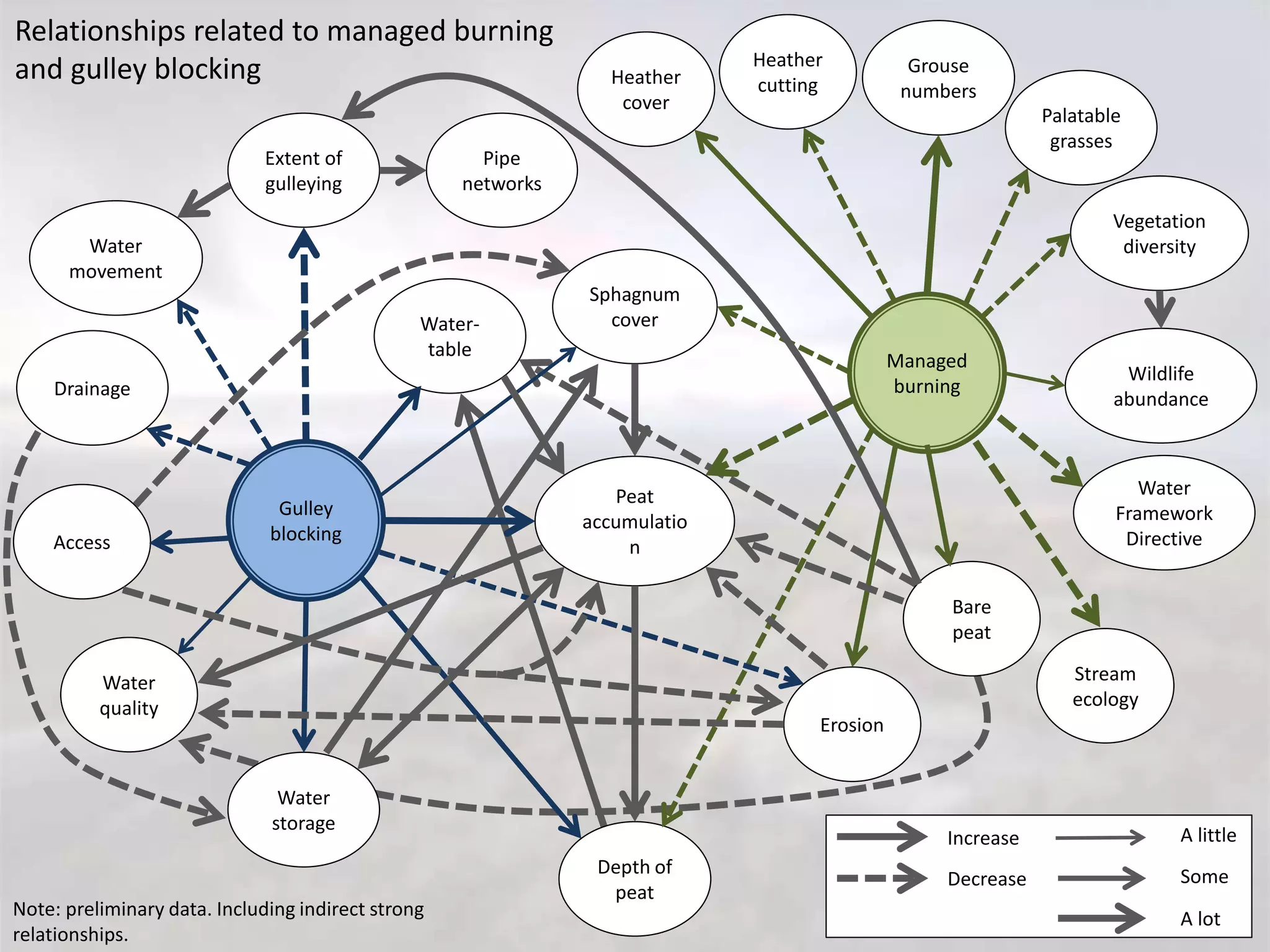
3 Effects of gully blocking & revegetation
(based on perceptions of previous workshop participants)
Managed
burning
Grouse
numbers
Stream
ecology
Heather
cover
Water
Framework
Directive
Sphagnum
cover
Water
storage
Depth of
peat
Extent of
gulleying
Water-
table
Wildlife
abundance
Peat
accumulatio
n
Water
movement
Palatable
grasses
Vegetation
diversity
Erosion
Gulley
blocking
Water
quality
Bare
peat
Access
Drainage
Increase
Decrease
A little
Some
A lot
Relationships related to managed burning
and gulley blocking
Note: preliminary data. Direct relationships
Heather
cutting
Managed
burning
Grouse
numbers
Stream
ecology
Heather
cover
Water
Framework
Directive
Sphagnum
cover
Water
storage
Depth of
peat
Extent of
gulleying
Water-
table
Wildlife
abundance
Peat
accumulatio
n
Water
movement
Palatable
grasses
Vegetation
diversity
Erosion
Gulley
blocking
Water
quality
Bare
peat
Access
Drainage
Increase
Decrease
A little
Some
A lot
Relationships related to managed burning
and gulley blocking
Note: preliminary data. Including indirect strong
relationships.
Heather
cutting
Pipe
networks
4 Other evidence
(based on published literature)
A brief overview
Based on:
• Recent evidence reviews: IUCN Commission of
Inquiry; Natural England Upland Evidence Review
• Peak District projects: Defra’s Ecosystem Services of
Peat project; Sustainable Uplands project; Making
Space for Water
• Other peer-reviewed sources of evidence
A brief overview
Evidence for effects of peatland restoration on
ecosystem services
• Greenhouse Gas emissions
• Water
• Biodiversity
• Other benefits
Note: contested evidence over effects of burning
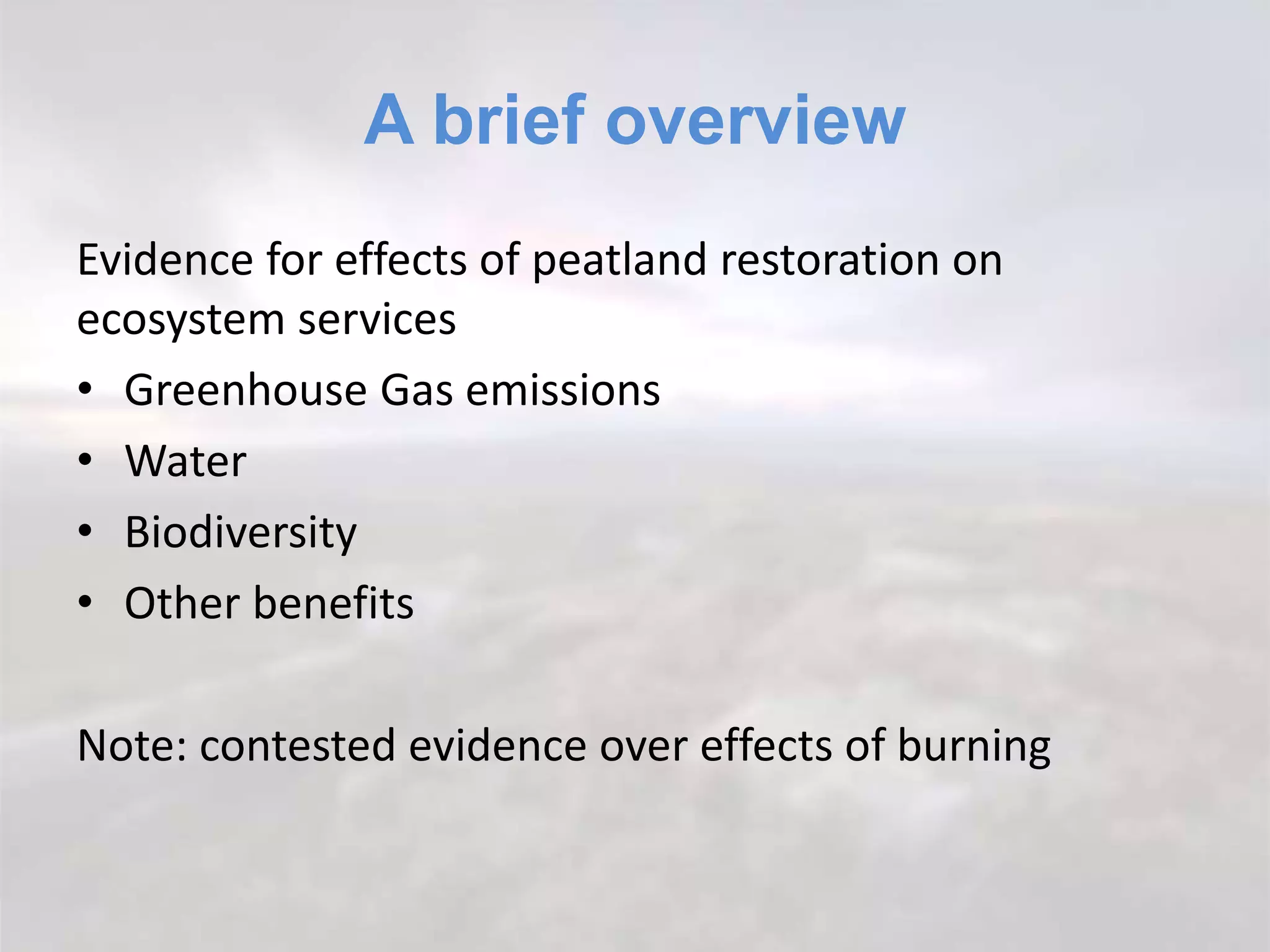
Burning
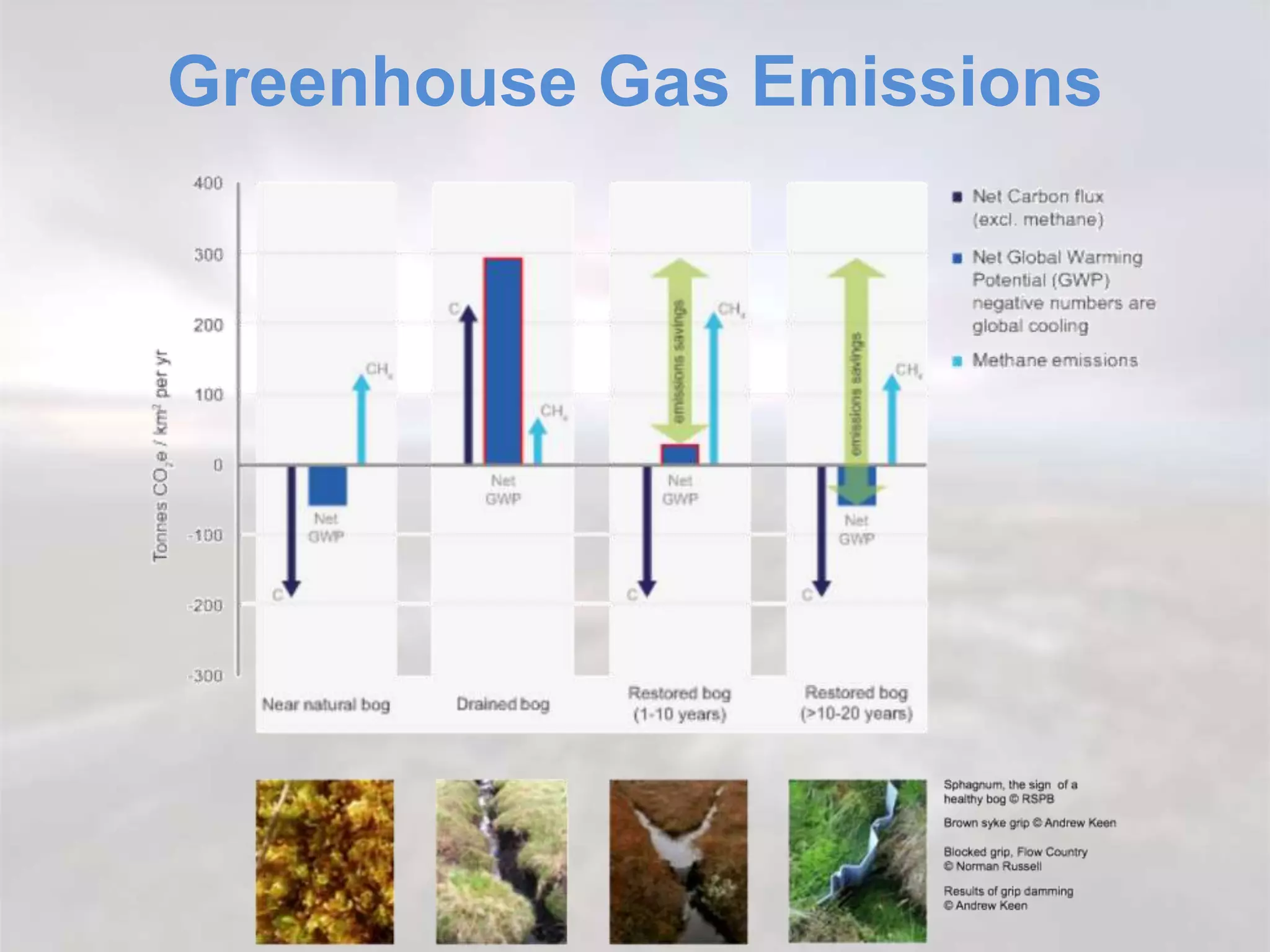
Greenhouse Gas Emissions
Bare soil & revegetation Drains
Cutting
Gullies
Courtesy of Fred Worrall, University of Durham
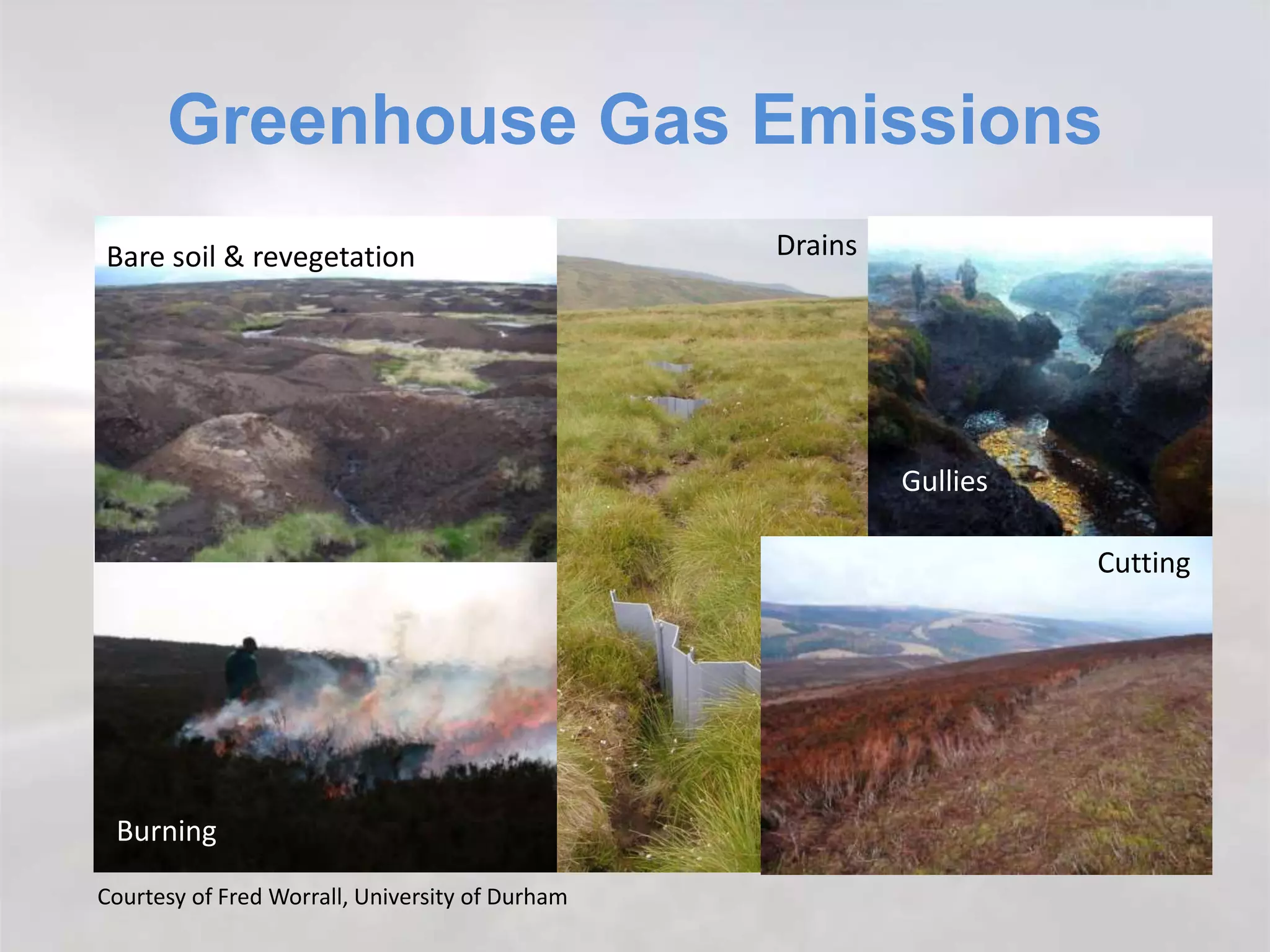
Greenhouse Gas Emissions
Heather Grasses Mosses
Forest
Sedge
Courtesy of Fred Worrall, University of Durham
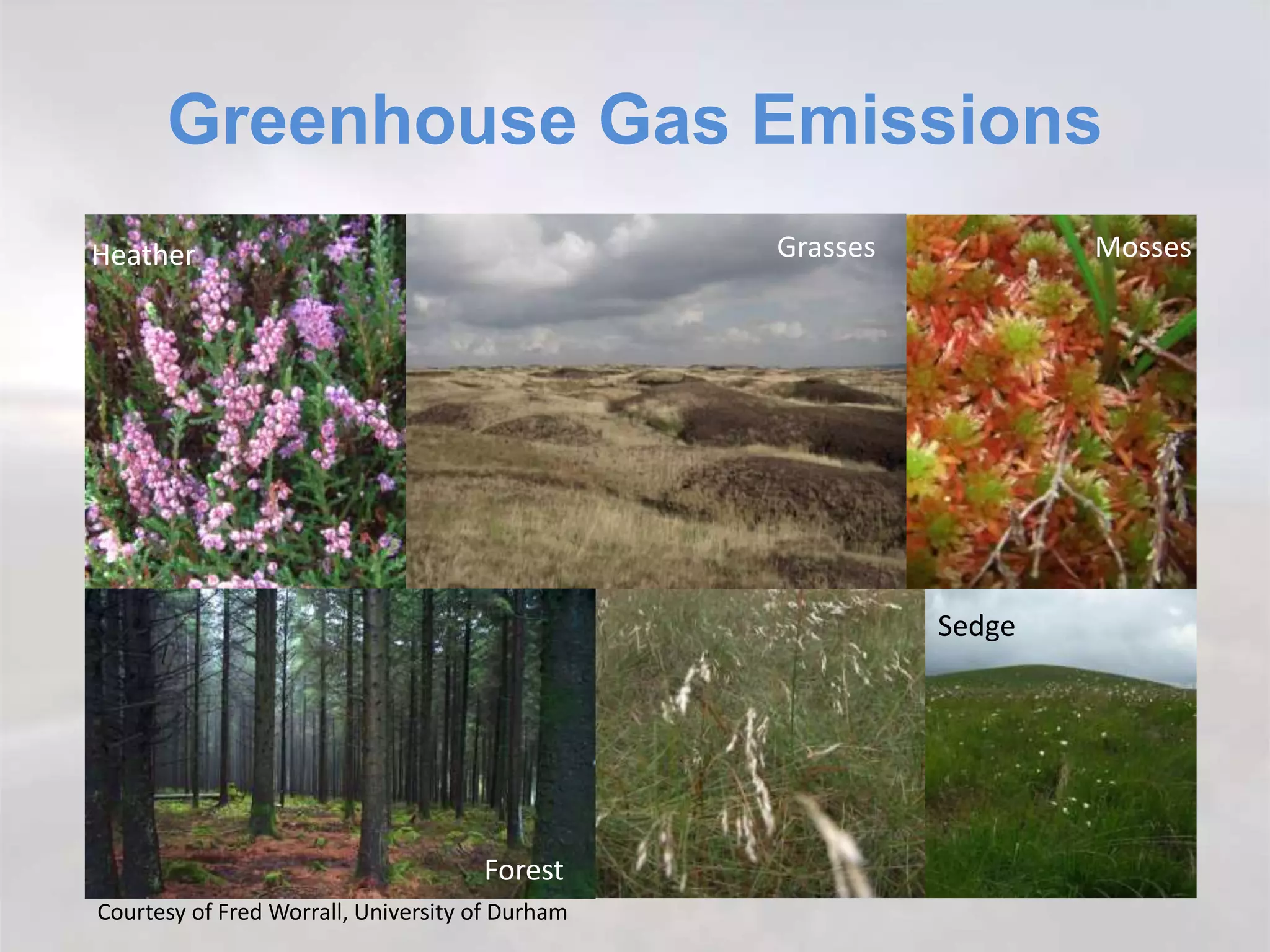
Greenhouse Gas Emissions
Current GHG emissions 2030 emissions with- 2030 emissions with
out grazing/burning targeted burning/grazing
cessation, gully blocking
and revegetation
Reed et al. (2013) Anticipating and managing future trade-offs and complementarities between ecosystem
services. Ecology & Society 18(1): 5 http://dx.doi.org/10.5751/ES-04924-180105
Greenhouse Gas Emissions
Take home message:
• Look over appropriate time-horizons
• Targeted action, following best practice – different
measures in different places
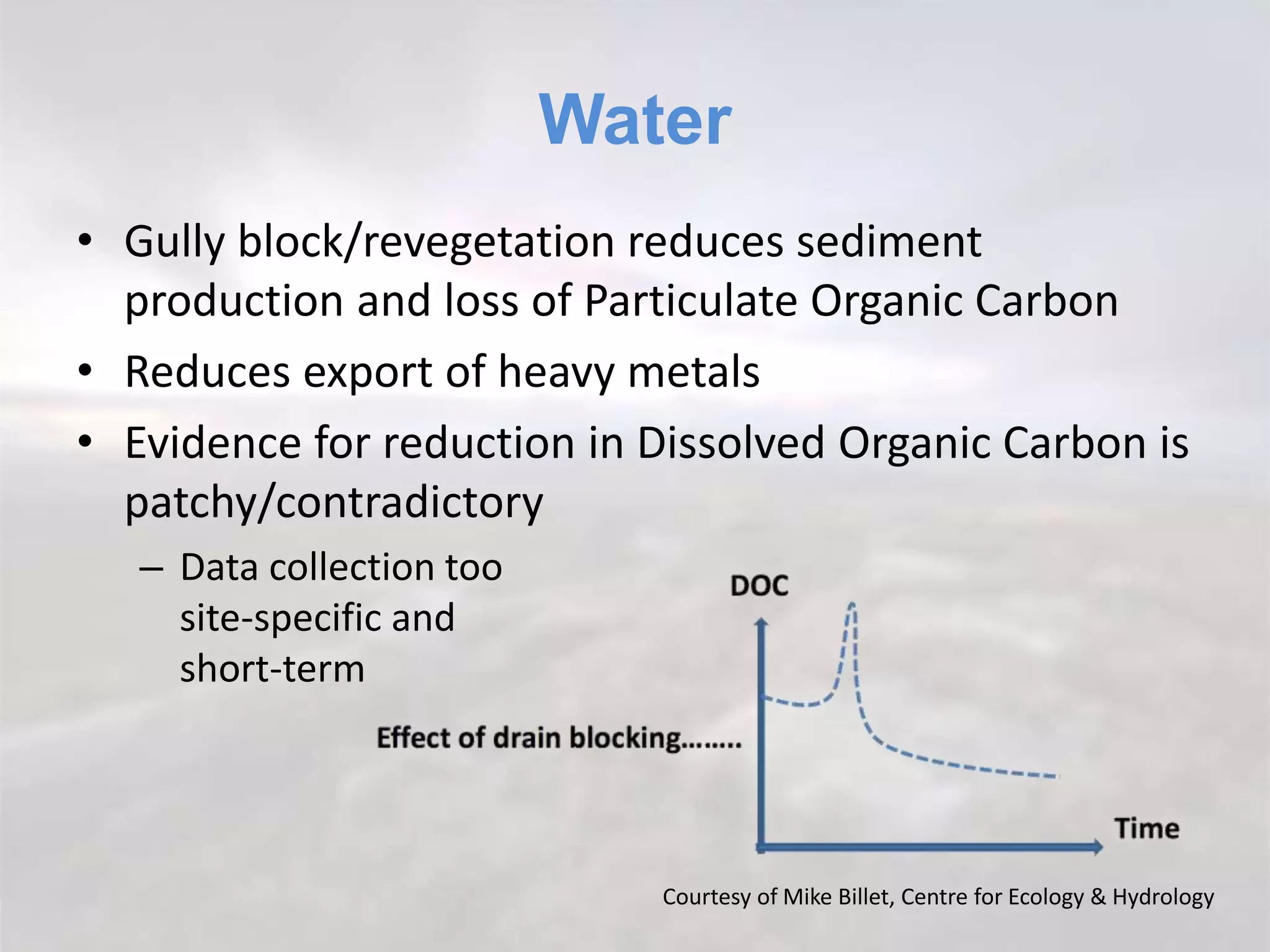
Water
• Gully block/revegetation reduces sediment
production and loss of Particulate Organic Carbon
• Reduces export of heavy metals
• Evidence for reduction in Dissolved Organic Carbon is
patchy/contradictory
– Data collection too
site-specific and
short-term
Courtesy of Mike Billet, Centre for Ecology & Hydrology
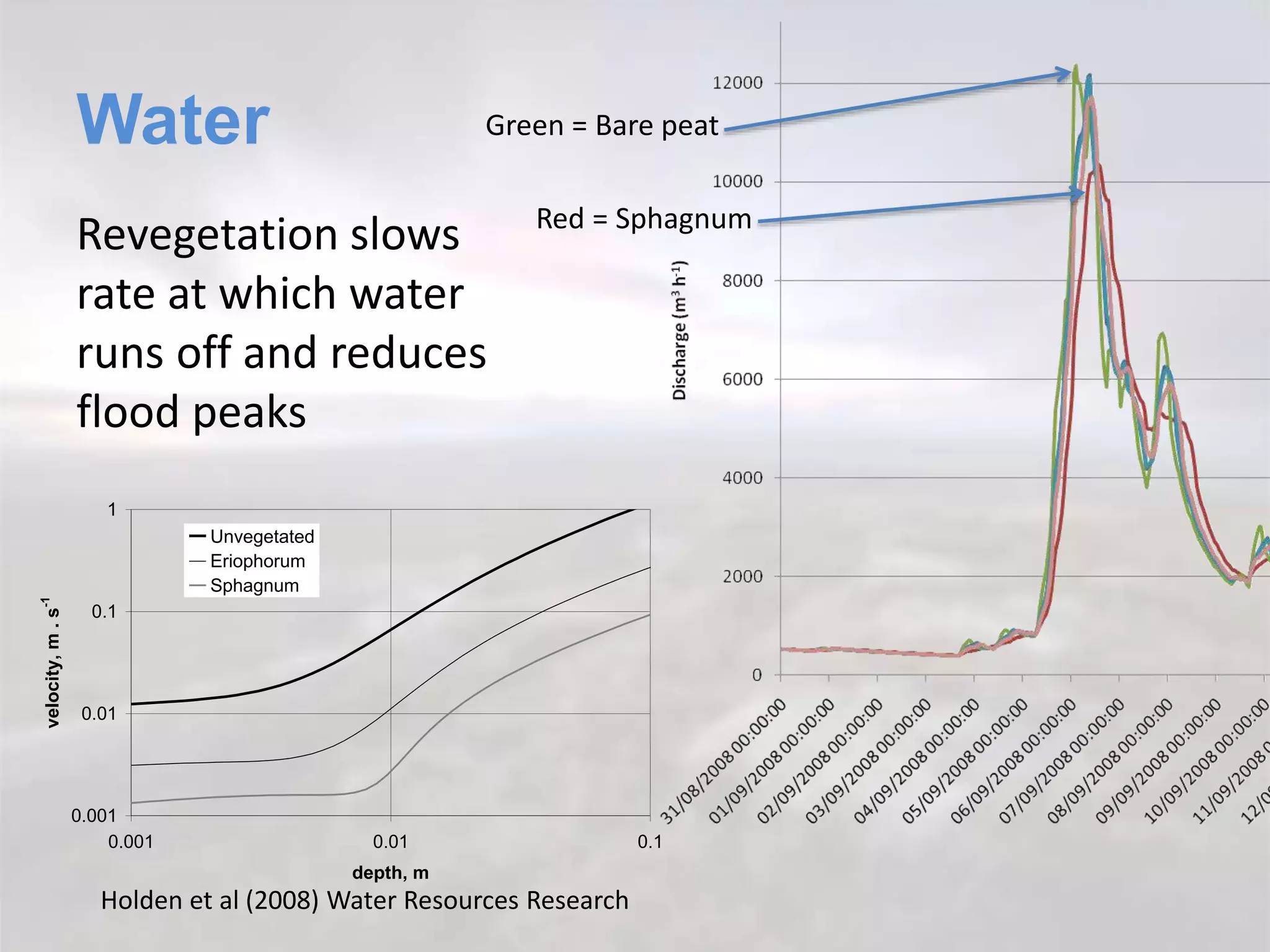
Water
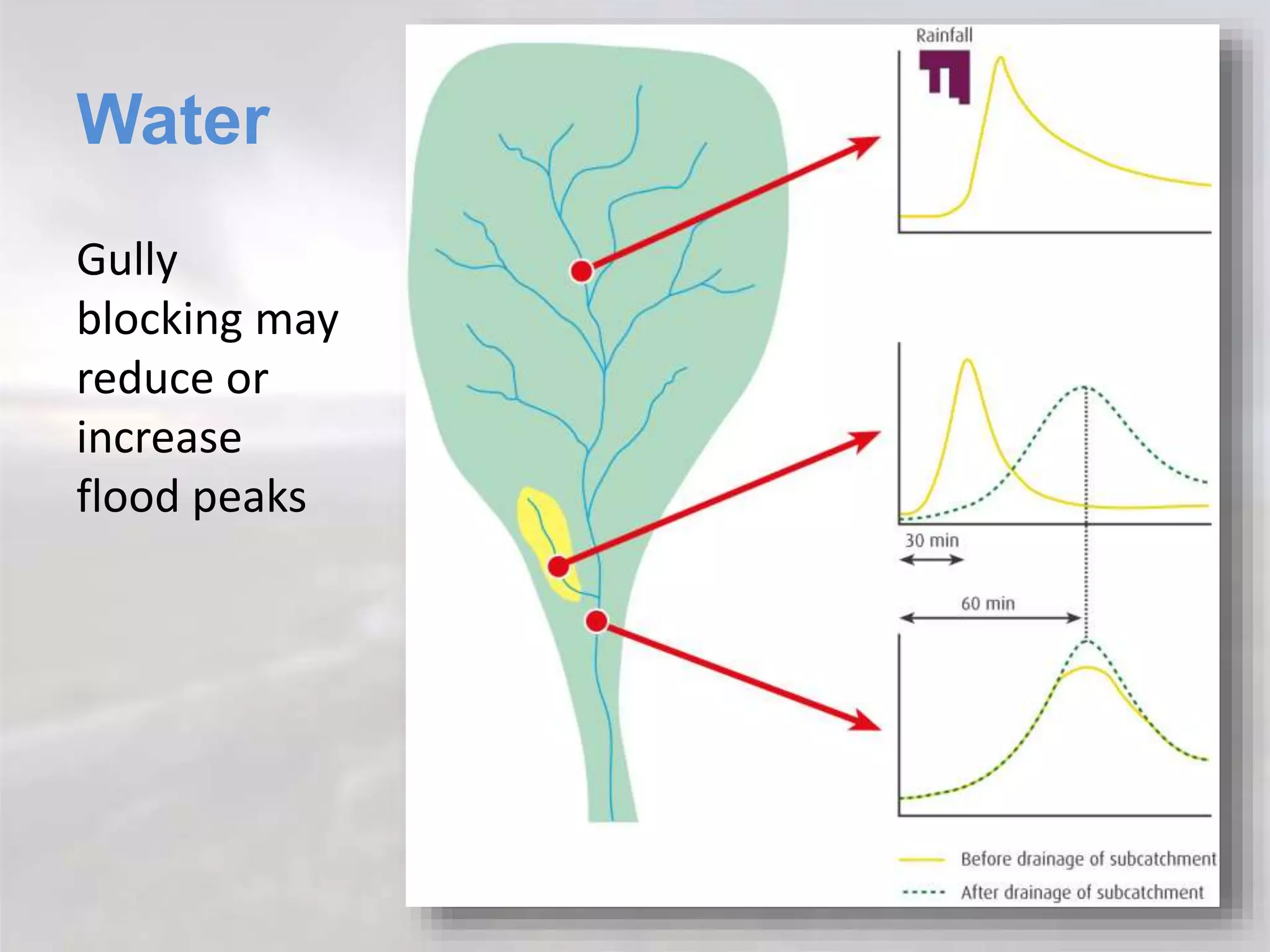
Revegetation slows
rate at which water
runs off and reduces
flood peaks
0.001
0.01
0.1
1
0.001 0.01 0.1
depth, m
velocity,m.s-1
Unvegetated
Eriophorum
Sphagnum
Holden et al (2008) Water Resources Research
Green = Bare peat
Red = Sphagnum
Water
Gully
blocking may
reduce or
increase
flood peaks
Biodiversity
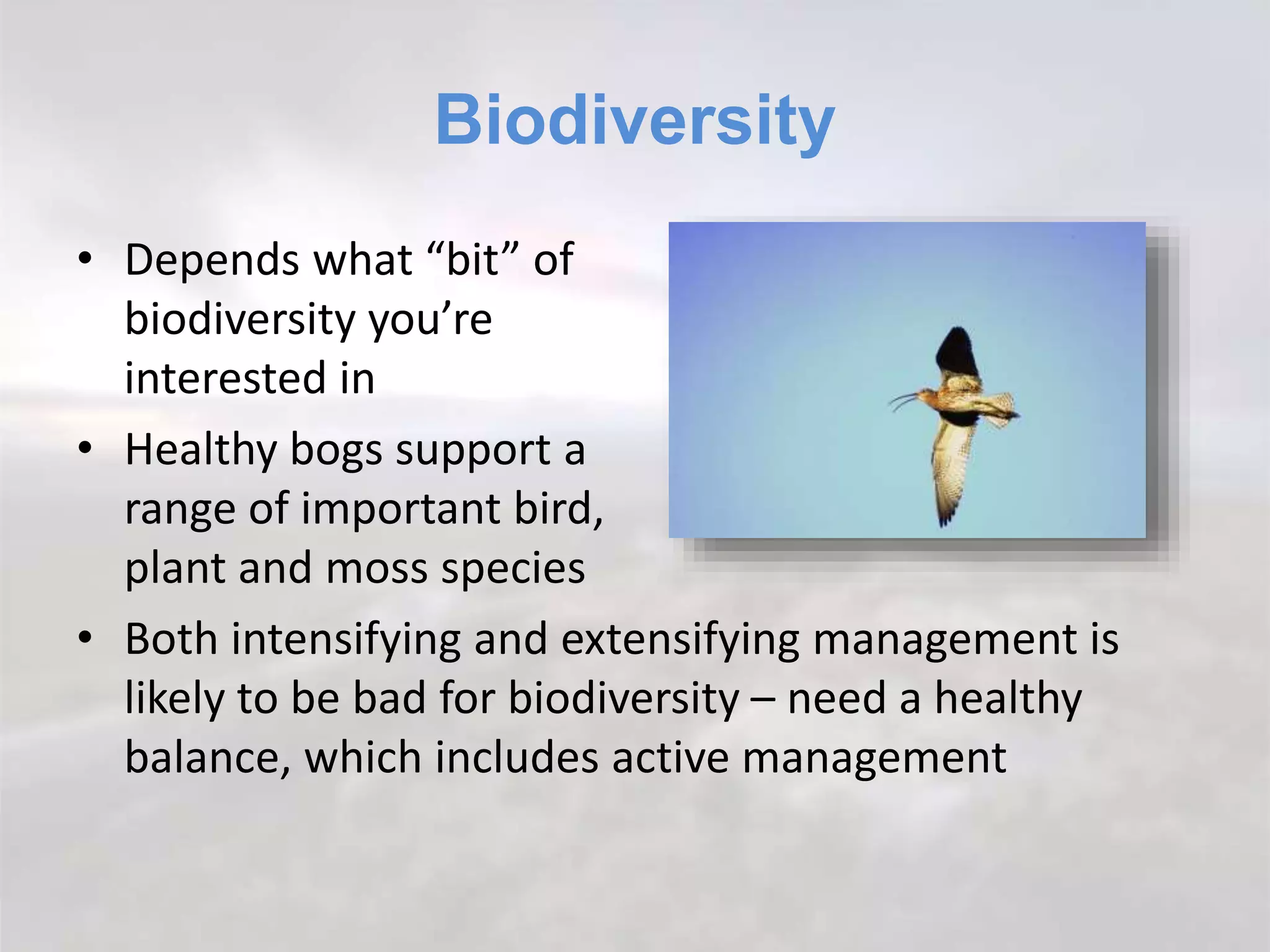
• Depends what “bit” of
biodiversity you’re
interested in
• Healthy bogs support a
range of important bird,
plant and moss species
• Both intensifying and extensifying management is
likely to be bad for biodiversity – need a healthy
balance, which includes active management
Other benefits
• Accessibility and aesthetic
benefits of blocking gullies
and revegetating bare and
eroding peat for
recreation/tourism
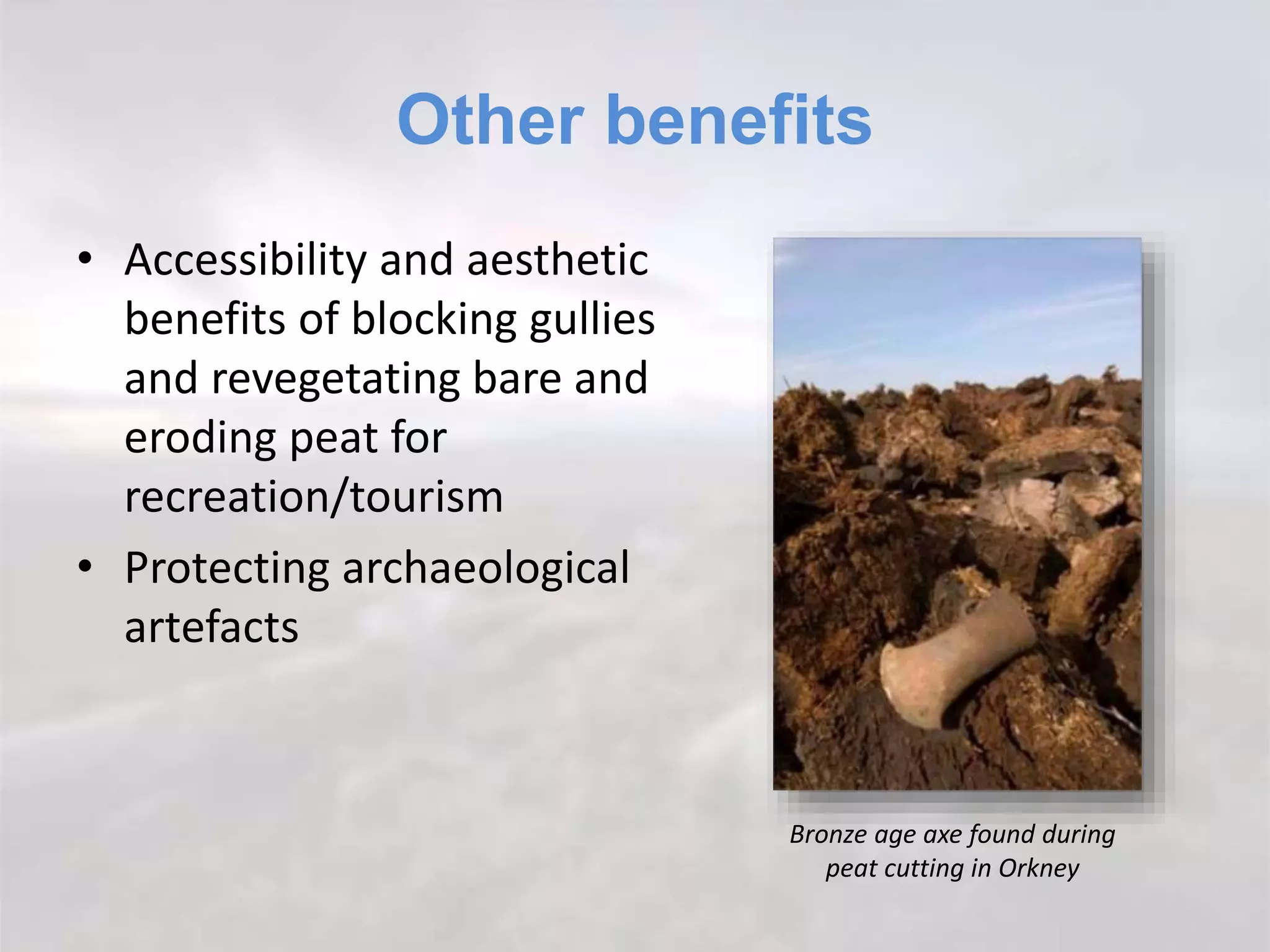
• Protecting archaeological
artefacts
Bronze age axe found during
peat cutting in Orkney
Burning
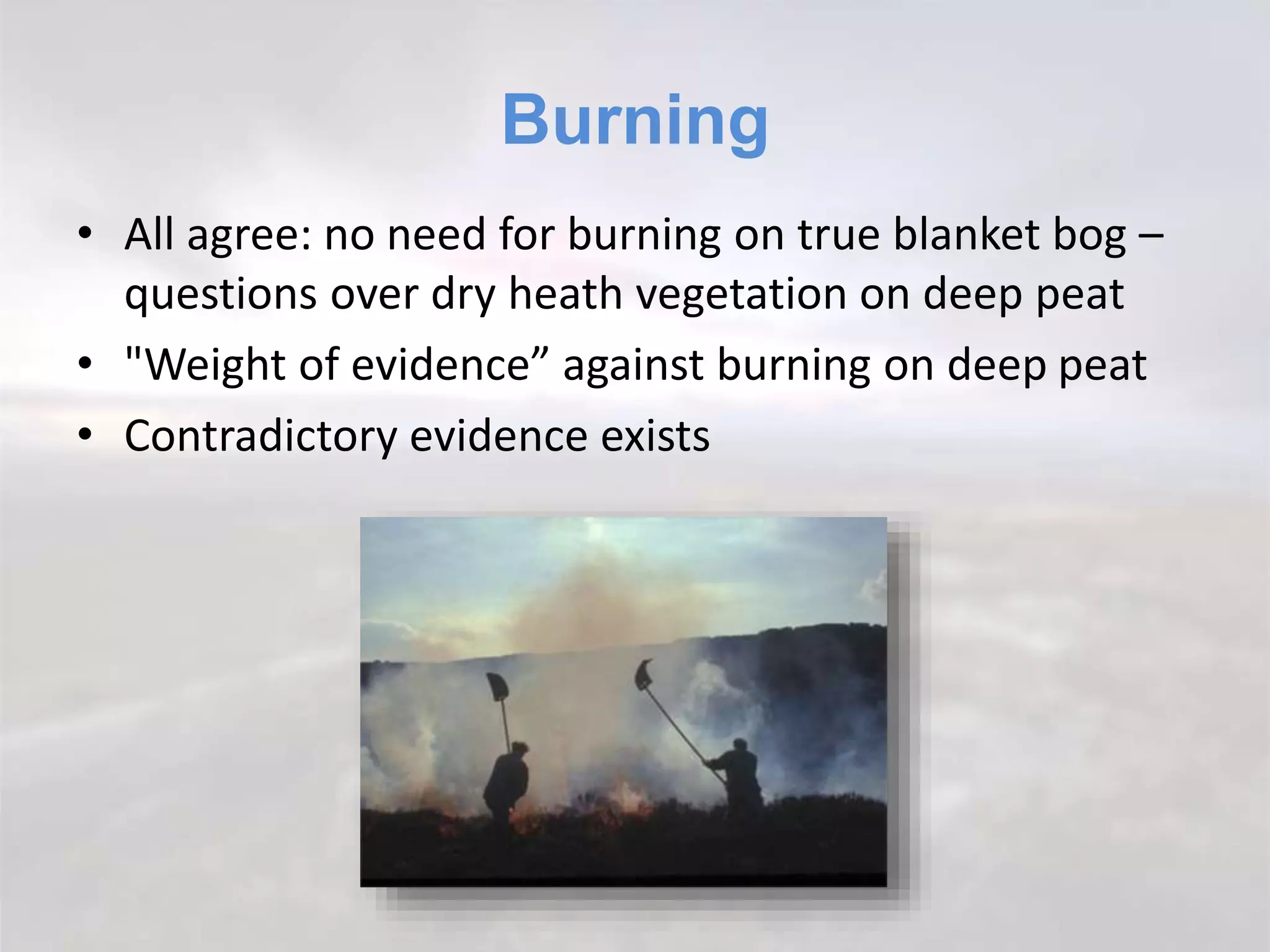
• All agree: no need for burning on true blanket bog –
questions over dry heath vegetation on deep peat
• "Weight of evidence” against burning on deep peat
• Contradictory evidence exists
Next steps
• Best practice restoration guidelines being developed
as part of Peatland Code pilot phase – online
consultation later this year
– Menu approach, avoiding being too prescriptive where
possible
– Will include guidance on burning
• Need to work with the landowning community
• Need to generate evidence
– e.g. experimental track under Peatland Code?
– e.g. in this workshop on the effects of proscribing burning
on likely prices charged by landowners

Gully blocking & revegetation of bare and eroding peat: exploring the evidence