
Presenting 
with impact
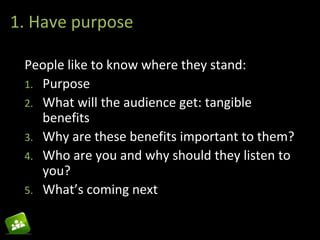
1. Have purpose 
People like to know where they stand: 
1. Purpose 
2. What will the audience get: tangible 
benefits 
3. Why are these benefits important to them? 
4. Who are you and why should they listen to 
you? 
5. What’s coming next
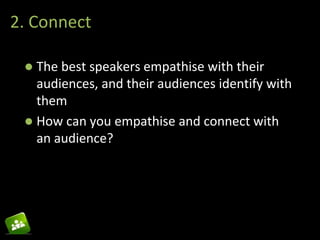
2. Connect 
 The best speakers empathise with their 
audiences, and their audiences identify with 
them 
 How can you empathise and connect with 
an audience?
2. Connect 
 Know your audience 
 If you don’t, start off getting to know them 
 What concerns and motivates them most? 
 The power of stories 
 Stories with impact are personal, unexpected, 
visual, visceral 
 Ask “you-focused” questions, for example: 
 What would you do if… 
 Use your body language: 
 Open & approachable; positive & energised 
 Your audience will mirror you emotionally
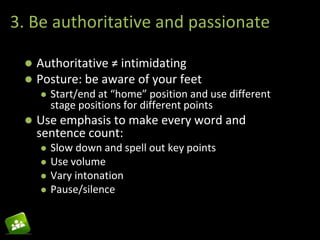
3. Be authoritative and passionate 
 Authoritative ≠ intimidating 
 Posture: be aware of your feet 
 Start/end at “home” position and use different 
stage positions for different points 
 Use emphasis to make every word and 
sentence count: 
 Slow down and spell out key points 
 Use volume 
 Vary intonation 
 Pause/silence
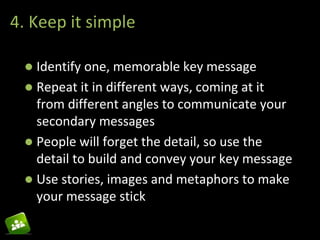
4. Keep it simple 
 Identify one, memorable key message 
 Repeat it in different ways, coming at it 
from different angles to communicate your 
secondary messages 
 People will forget the detail, so use the 
detail to build and convey your key message 
 Use stories, images and metaphors to make 
your message stick
5. Polish 
 Practice and practice again 
 Record yourself, get feedback, identify bad 
habits and practice breaking them 
 Speaking too fast, pacing, verbal fillers 
 Use your visual aids to add impact to your 
message, not as your notes
Ella aged 2 wearing 
mum’s shoes 
Ella aged 22 
Put yourself in their shoes: have purpose, connect, be 
authoritative & passionate, keep it simple, and polish your shoes 
regularly
Increasing impact through 
knowledge 
exchange 
9 
www.markreed.webeden.co.uk 
http://sustainable-learning.org/training/

Presenting with impact

  • 1.
  • 2.
    1. Have purpose People like to know where they stand: 1. Purpose 2. What will the audience get: tangible benefits 3. Why are these benefits important to them? 4. Who are you and why should they listen to you? 5. What’s coming next
  • 3.
    2. Connect The best speakers empathise with their audiences, and their audiences identify with them  How can you empathise and connect with an audience?
  • 4.
    2. Connect Know your audience  If you don’t, start off getting to know them  What concerns and motivates them most?  The power of stories  Stories with impact are personal, unexpected, visual, visceral  Ask “you-focused” questions, for example:  What would you do if…  Use your body language:  Open & approachable; positive & energised  Your audience will mirror you emotionally
  • 5.
    3. Be authoritativeand passionate  Authoritative ≠ intimidating  Posture: be aware of your feet  Start/end at “home” position and use different stage positions for different points  Use emphasis to make every word and sentence count:  Slow down and spell out key points  Use volume  Vary intonation  Pause/silence
  • 6.
    4. Keep itsimple  Identify one, memorable key message  Repeat it in different ways, coming at it from different angles to communicate your secondary messages  People will forget the detail, so use the detail to build and convey your key message  Use stories, images and metaphors to make your message stick
  • 7.
    5. Polish Practice and practice again  Record yourself, get feedback, identify bad habits and practice breaking them  Speaking too fast, pacing, verbal fillers  Use your visual aids to add impact to your message, not as your notes
  • 8.
    Ella aged 2wearing mum’s shoes Ella aged 22 Put yourself in their shoes: have purpose, connect, be authoritative & passionate, keep it simple, and polish your shoes regularly
  • 9.
    Increasing impact through knowledge exchange 9 www.markreed.webeden.co.uk http://sustainable-learning.org/training/

Editor's Notes

  • #3 ----- Substantial value can be derived for many stakeholders after projects have been completed, through on-going communication and interpretation of findings. Where possible, ‘legacy arrangements’ can support continued engagement between researchers and research users, to extract and augment value from the previous research through interpretation activities and supplementary analysis. It can help if the time-scale over which engagement needs to be sustained is considered from the outset. For example, if a project plans to develop a network that will have the potential to work together beyond the time-frame of the initial project, it will be necessary to forge collaborations with organisations who share this goal, but who can also fund or administer such a network long after the project has ended.
  • #4 ----- Substantial value can be derived for many stakeholders after projects have been completed, through on-going communication and interpretation of findings. Where possible, ‘legacy arrangements’ can support continued engagement between researchers and research users, to extract and augment value from the previous research through interpretation activities and supplementary analysis. It can help if the time-scale over which engagement needs to be sustained is considered from the outset. For example, if a project plans to develop a network that will have the potential to work together beyond the time-frame of the initial project, it will be necessary to forge collaborations with organisations who share this goal, but who can also fund or administer such a network long after the project has ended.
  • #5 ----- Substantial value can be derived for many stakeholders after projects have been completed, through on-going communication and interpretation of findings. Where possible, ‘legacy arrangements’ can support continued engagement between researchers and research users, to extract and augment value from the previous research through interpretation activities and supplementary analysis. It can help if the time-scale over which engagement needs to be sustained is considered from the outset. For example, if a project plans to develop a network that will have the potential to work together beyond the time-frame of the initial project, it will be necessary to forge collaborations with organisations who share this goal, but who can also fund or administer such a network long after the project has ended.
  • #6 ----- Substantial value can be derived for many stakeholders after projects have been completed, through on-going communication and interpretation of findings. Where possible, ‘legacy arrangements’ can support continued engagement between researchers and research users, to extract and augment value from the previous research through interpretation activities and supplementary analysis. It can help if the time-scale over which engagement needs to be sustained is considered from the outset. For example, if a project plans to develop a network that will have the potential to work together beyond the time-frame of the initial project, it will be necessary to forge collaborations with organisations who share this goal, but who can also fund or administer such a network long after the project has ended.
  • #7 ----- Substantial value can be derived for many stakeholders after projects have been completed, through on-going communication and interpretation of findings. Where possible, ‘legacy arrangements’ can support continued engagement between researchers and research users, to extract and augment value from the previous research through interpretation activities and supplementary analysis. It can help if the time-scale over which engagement needs to be sustained is considered from the outset. For example, if a project plans to develop a network that will have the potential to work together beyond the time-frame of the initial project, it will be necessary to forge collaborations with organisations who share this goal, but who can also fund or administer such a network long after the project has ended.
  • #8 ----- Substantial value can be derived for many stakeholders after projects have been completed, through on-going communication and interpretation of findings. Where possible, ‘legacy arrangements’ can support continued engagement between researchers and research users, to extract and augment value from the previous research through interpretation activities and supplementary analysis. It can help if the time-scale over which engagement needs to be sustained is considered from the outset. For example, if a project plans to develop a network that will have the potential to work together beyond the time-frame of the initial project, it will be necessary to forge collaborations with organisations who share this goal, but who can also fund or administer such a network long after the project has ended.
  • #9 ----- Substantial value can be derived for many stakeholders after projects have been completed, through on-going communication and interpretation of findings. Where possible, ‘legacy arrangements’ can support continued engagement between researchers and research users, to extract and augment value from the previous research through interpretation activities and supplementary analysis. It can help if the time-scale over which engagement needs to be sustained is considered from the outset. For example, if a project plans to develop a network that will have the potential to work together beyond the time-frame of the initial project, it will be necessary to forge collaborations with organisations who share this goal, but who can also fund or administer such a network long after the project has ended.