Cost Effectiveness of peatland
 management & restoration

           Andrew Moxey

   “VNN workshop on assessing &
 valuing peatland ecosystem services”
  Presentation on 18/01/2012, Leeds
Basic premise: marbles in jars
• Carbon storage in peatlands is significant

• Degradation leads to emissions

• Avoid emissions by avoiding/repairing degradation

• Also maintain/enhance sequestration (+ co-benefits)

• Reduce need for other mitigation activities
But, not costless exercises
• Up-front capital costs of restoration

• On-going management (& monitoring) costs

• Displaced activities: opportunity costs

• (Possibly) land acquisition costs

• Cost-effectiveness vs. other mitigation options?
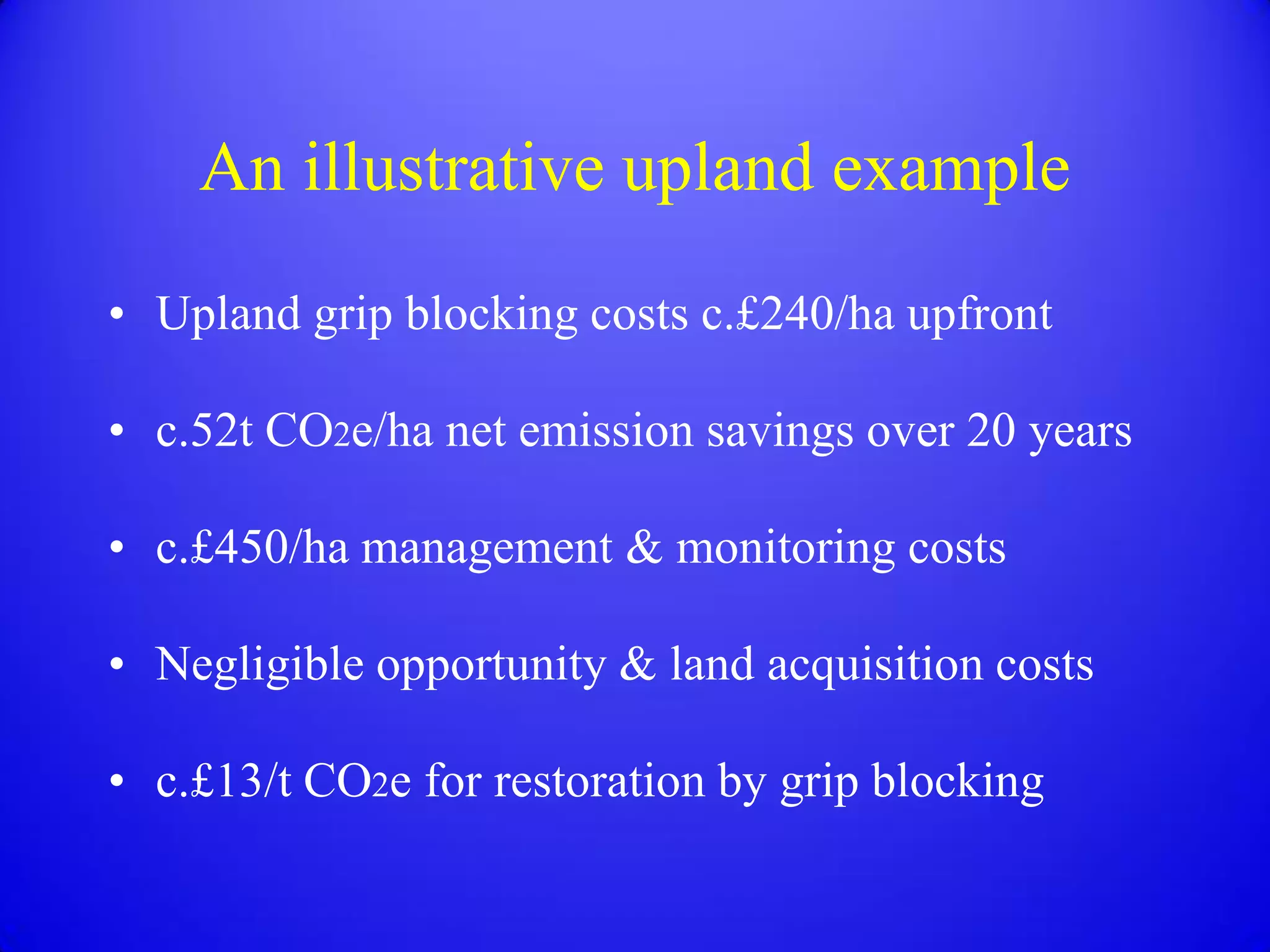
An illustrative upland example
• Upland grip blocking costs c.£240/ha upfront

• c.52t CO2e/ha net emission savings over 20 years

• c.£450/ha management & monitoring costs

• Negligible opportunity & land acquisition costs

• c.£13/t CO2e for restoration by grip blocking
Another illustrative upland example
• Conservation of near-natural upland site

• c.72t CO2e/ha net emission savings over 20 years

• c.£450/ha management & monitoring costs

• Negligible opportunity & land acquisition costs

• c.£6/t CO2e for maintaining a near-natural site
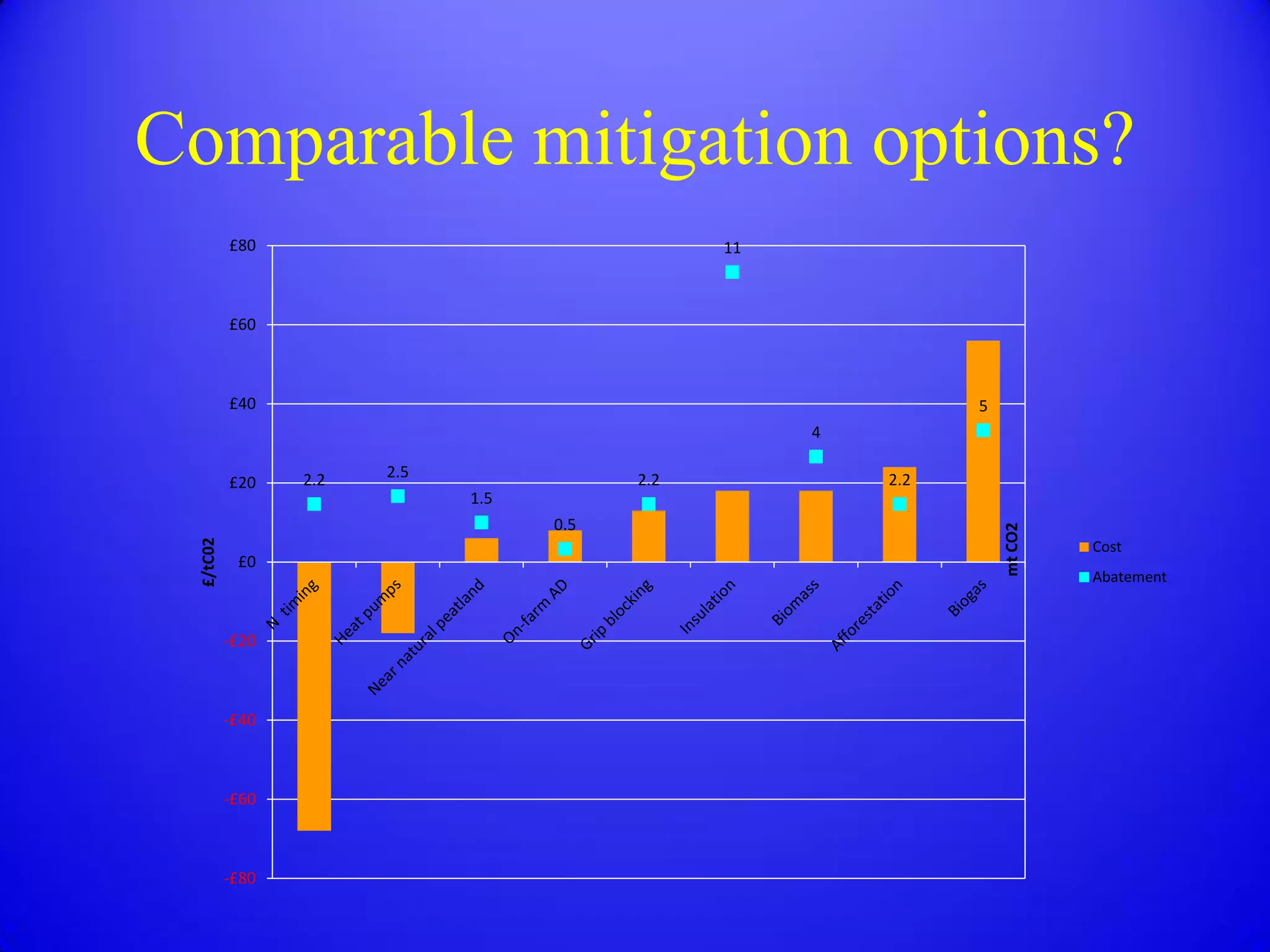
Comparable mitigation options?
          £80                                  11


          £60


          £40                                                 5
                                                    4

                 2.2   2.5               2.2            2.2
          £20
                             1.5
                                   0.5


                                                                  mt CO2
 £/tC02


                                                                           Cost
           £0
                                                                           Abatement


          -£20


          -£40


          -£60


          -£80
Costs of inaction?
• e.g. Not grip-blocking    c.2.2mt to address

•    Greater reliance on other mitigation options

• £/t CO2e cost difference depends on options used

•    e.g. c.+£20m if forestry, c.+£90m if biogas?

• But: capacity of other options? missed targets?
But, assumption-dependent
• Net emissions from:
   – a near-natural site?
   – a degraded site?
   – a restored site?

• Temporal profile and duration of net emissions?

• Spatial variation of costs across sites?

• Uptake?
Restoration effectiveness & costs
• Generalisable or always site-specific?

• Different site conditions

• Different techniques & management requirements

• Scale and halo effects of size of area considered

• Non-negligible opportunity costs?
Opportunity costs
• Currently generally low for upland agriculture

• Higher for lowland agriculture/horticulture

• But , vary with:
   –   Site conditions
   –   Farming structure
   –   Policy support (e.g. subsidies, regulatory criteria e.g. “active farmer”?)
   –   Market conditions


• Forestry? Renewables? Recreation?
What’s needed?
• Monitoring to establish baseline conditions
     (likely to be expensive unless proxy indicators used)

• Collate conservation & restoration trial data
     (difficult given spatial variation & time-lags)

• More detailed assessment of opportunity costs
     (cost-effectiveness sums; incentive design issues)

• Consideration of place in mitigation tool-kit
     (relative cost-effectiveness; costs of inaction)
Conclusions
• Upland marble jars probably cost-effective
     (...relative position in tool-kit & costs of inaction)

• But, likely to vary spatially & temporally

• So, targeting needs better geographic data on:
   – net emissions before & after degradation/restoration
   – costs of restoration & maintenance (& monitoring)
   – timing & duration of actions and effects

Towards a framework for peatland PES

  • 1.
    Cost Effectiveness ofpeatland management & restoration Andrew Moxey “VNN workshop on assessing & valuing peatland ecosystem services” Presentation on 18/01/2012, Leeds
  • 2.
    Basic premise: marblesin jars • Carbon storage in peatlands is significant • Degradation leads to emissions • Avoid emissions by avoiding/repairing degradation • Also maintain/enhance sequestration (+ co-benefits) • Reduce need for other mitigation activities
  • 3.
    But, not costlessexercises • Up-front capital costs of restoration • On-going management (& monitoring) costs • Displaced activities: opportunity costs • (Possibly) land acquisition costs • Cost-effectiveness vs. other mitigation options?
  • 4.
    An illustrative uplandexample • Upland grip blocking costs c.£240/ha upfront • c.52t CO2e/ha net emission savings over 20 years • c.£450/ha management & monitoring costs • Negligible opportunity & land acquisition costs • c.£13/t CO2e for restoration by grip blocking
  • 5.
    Another illustrative uplandexample • Conservation of near-natural upland site • c.72t CO2e/ha net emission savings over 20 years • c.£450/ha management & monitoring costs • Negligible opportunity & land acquisition costs • c.£6/t CO2e for maintaining a near-natural site
  • 6.
    Comparable mitigation options? £80 11 £60 £40 5 4 2.2 2.5 2.2 2.2 £20 1.5 0.5 mt CO2 £/tC02 Cost £0 Abatement -£20 -£40 -£60 -£80
  • 7.
    Costs of inaction? •e.g. Not grip-blocking c.2.2mt to address • Greater reliance on other mitigation options • £/t CO2e cost difference depends on options used • e.g. c.+£20m if forestry, c.+£90m if biogas? • But: capacity of other options? missed targets?
  • 8.
    But, assumption-dependent • Netemissions from: – a near-natural site? – a degraded site? – a restored site? • Temporal profile and duration of net emissions? • Spatial variation of costs across sites? • Uptake?
  • 9.
    Restoration effectiveness &costs • Generalisable or always site-specific? • Different site conditions • Different techniques & management requirements • Scale and halo effects of size of area considered • Non-negligible opportunity costs?
  • 10.
    Opportunity costs • Currentlygenerally low for upland agriculture • Higher for lowland agriculture/horticulture • But , vary with: – Site conditions – Farming structure – Policy support (e.g. subsidies, regulatory criteria e.g. “active farmer”?) – Market conditions • Forestry? Renewables? Recreation?
  • 11.
    What’s needed? • Monitoringto establish baseline conditions (likely to be expensive unless proxy indicators used) • Collate conservation & restoration trial data (difficult given spatial variation & time-lags) • More detailed assessment of opportunity costs (cost-effectiveness sums; incentive design issues) • Consideration of place in mitigation tool-kit (relative cost-effectiveness; costs of inaction)
  • 12.
    Conclusions • Upland marblejars probably cost-effective (...relative position in tool-kit & costs of inaction) • But, likely to vary spatially & temporally • So, targeting needs better geographic data on: – net emissions before & after degradation/restoration – costs of restoration & maintenance (& monitoring) – timing & duration of actions and effects