WHAT IS
READING?
READING AND WRITING SKILLS
IMPORTANCE OF READING
• Learning to read is about listening and
understanding as well as working out as printed
on the page.
• Through hearing stories, children are exposed to
a wide range of words. This helps them build
their own vocabulary and improve their
understanding when they listen, which is vital as
they start to read.
Research shows that
regular reading:
✔ Improves brain
connectivity.
✔ Increases your vocabulary
and comprehension.
✔ Empowers you to
empathize with other
people.
✔ Aids in sleep readiness.
✔ Reduces stress.
✔ Lowers blood pressure
and heart rate.
✔ Fights depression
symptoms.
✔ Prevents cognitive
decline as you age.
❑ The more one individual reads, the more his understanding and
comprehending skills improve.
❑ Better a reader, the easier it becomes for him to complete an assigned work.
❑ Reading books help children develop language and listening skills and
prepares them to understand the written word.
CRITICAL READING
- Means that a reader applies certain processes, models, questions,
and theories that result in enhanced clarity and comprehension.
- There is more involved, both in effort and understanding, in a
critical reading than in a mere “skimming” of the text.
CRITICAL
READING
STRATEGIES
Annotating. One of the first
strategies to begin with is
annotating a text…
Contextualizing…
Reflecting on challenges to your
beliefs and values…
Paraphrasing…
Outlining…
Summarizing…
Exploring the figurative
language…
Looking for patterns of
opposition.
Book
title
7 CRITICAL
READING
STRATEGIES
(AMBER
WENZ)
PREVIEWING,
CONTEXTUALIZING,
QUESTIONING,
REFLECTING,
OUTLINING,
SUMMARIZING,
EVALUATING,
COMPARING,
CONTRASTING.
ACTIVE READING
- Is reading with the conscious
intention to understand, integrate
and evaluate the information you’re
reading.
- Simply means reading something
with a determination to understand
and evaluate it for its relevance to
your needs.
01
You can be an active reader by:
❑ Reading with a specific focus. Keep in
mind what information you are looking for
as you read…
❑ Breaking the text up into portions. Do not
feel you have to read the whole text in one
sitting…
❑ Questioning the text as you read. Did the
author get everything right?...
❑ Taking notes as you read.
IMPORTANCE OF ACTIVE READING
• By actively and independently reading text, students
simultaneously can build their word identification,
fluency, vocabulary, and text-dependent
comprehension skills.
PASSIVE READING
- Is where you just take the words in.
- Simply reading through the words on the
page without any expectation that they
should understand and make meaning
from those words in some coherent way.
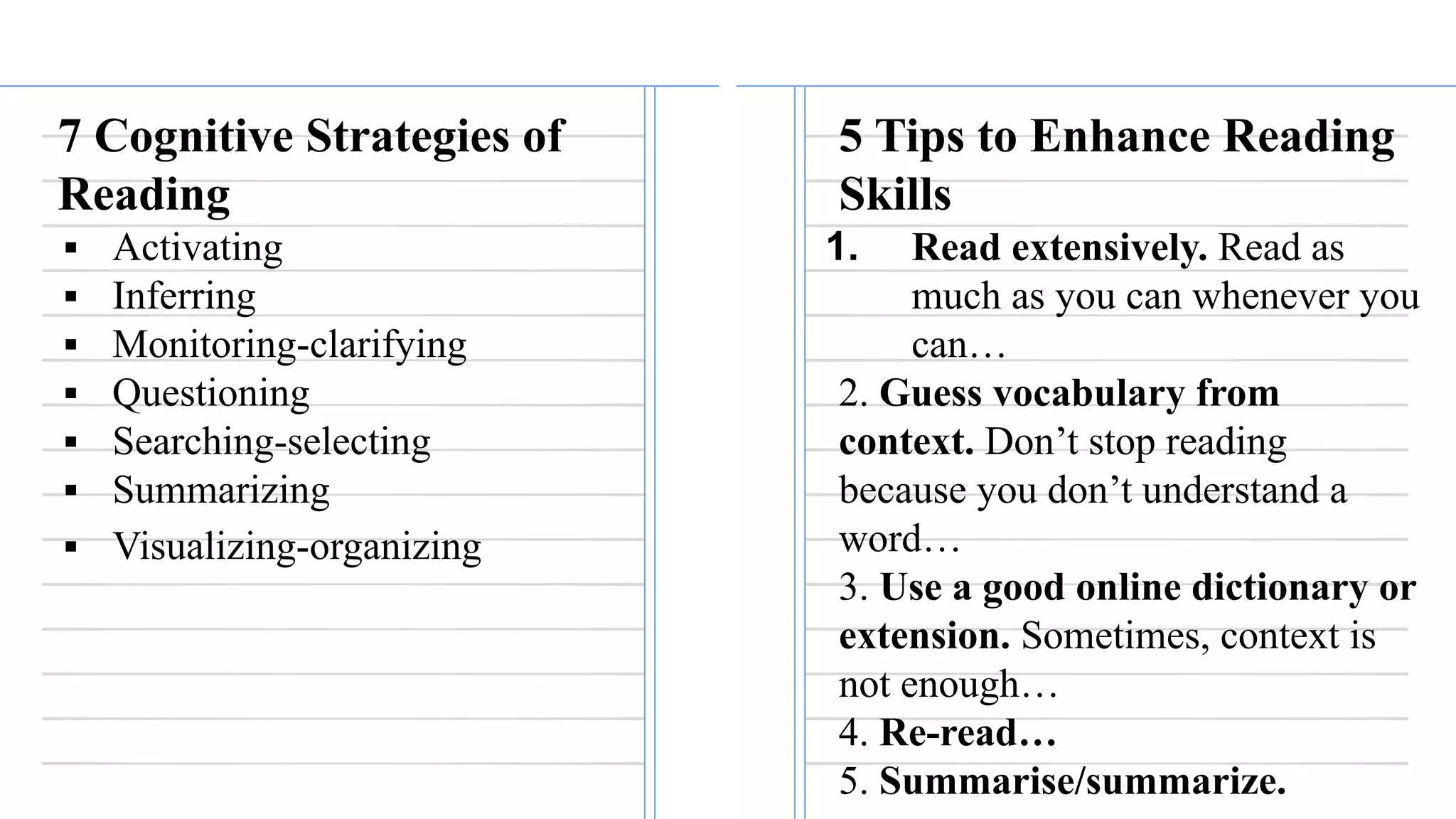
7 Cognitive Strategies of
Reading
▪ Activating
▪ Inferring
▪ Monitoring-clarifying
▪ Questioning
▪ Searching-selecting
▪ Summarizing
▪ Visualizing-organizing
5 Tips to Enhance Reading
Skills
1. Read extensively. Read as
much as you can whenever you
can…
2. Guess vocabulary from
context. Don’t stop reading
because you don’t understand a
word…
3. Use a good online dictionary or
extension. Sometimes, context is
not enough…
4. Re-read…
5. Summarise/summarize.
SQ3R
- Is a reading comprehension method named for its five steps:
❖ Remember, the information you gain from reading is
important.
❖ SQ3R means:
✔ S – survey
✔ Q – question
✔ R – read
✔ R – recite
✔ R – review
❖ Active reading involves these steps:
Preparing > Reading > Capturing the key ideas > Reviewing
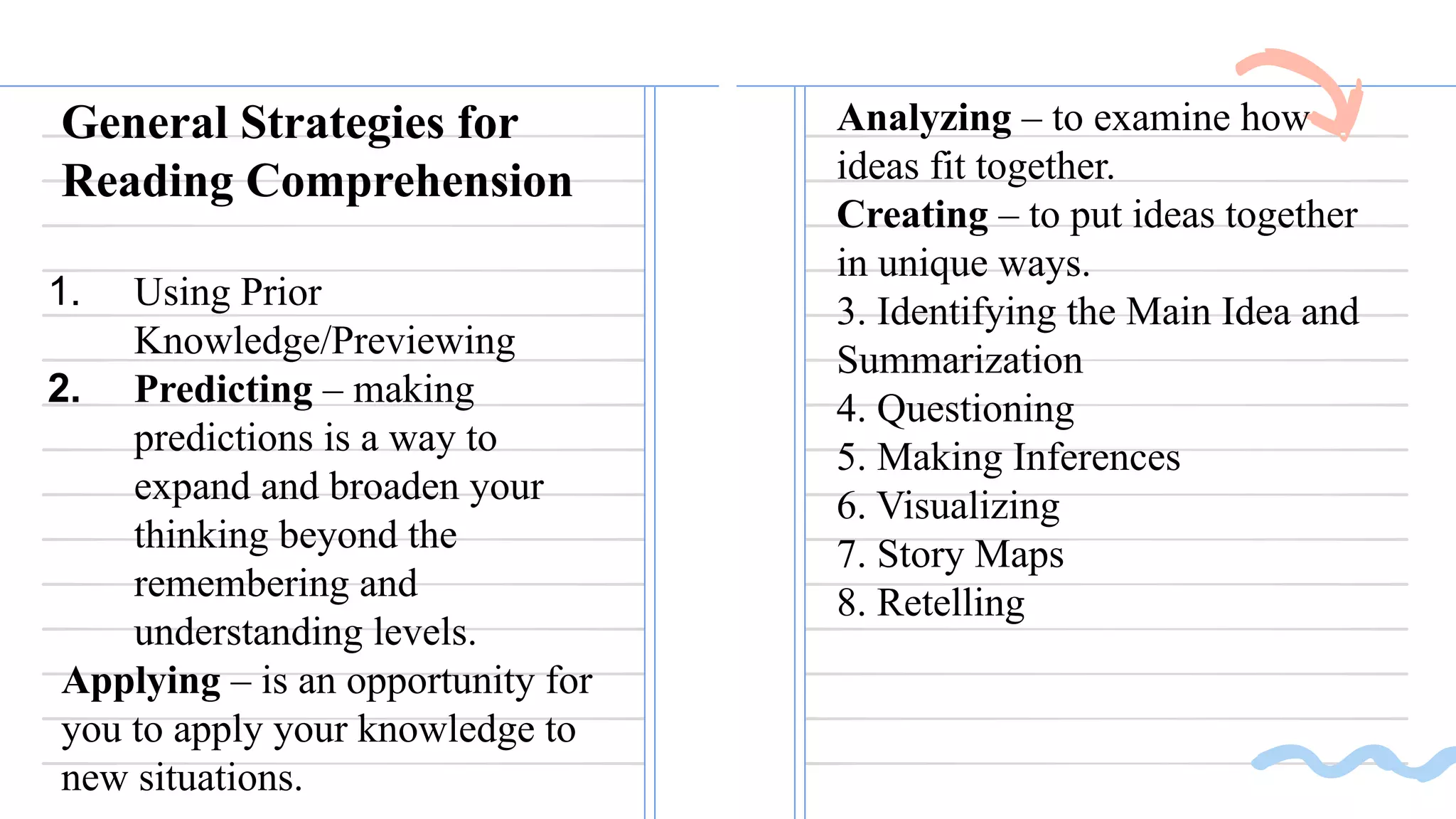
General Strategies for
Reading Comprehension
1. Using Prior
Knowledge/Previewing
2. Predicting – making
predictions is a way to
expand and broaden your
thinking beyond the
remembering and
understanding levels.
Applying – is an opportunity for
you to apply your knowledge to
new situations.
Analyzing – to examine how
ideas fit together.
Creating – to put ideas together
in unique ways.
3. Identifying the Main Idea and
Summarization
4. Questioning
5. Making Inferences
6. Visualizing
7. Story Maps
8. Retelling
Reading Comprehension Strategies
1. Re-read. This is one that most readers want to skip.
2. Read out loud. Sometimes it just helps to hear
yourself read out loud.
3. Use context clues.
4. Look up a word you don’t know.
5. Ask questions.
6. Think about what you’ve already read.
7. Make connections.
8. Slow down.
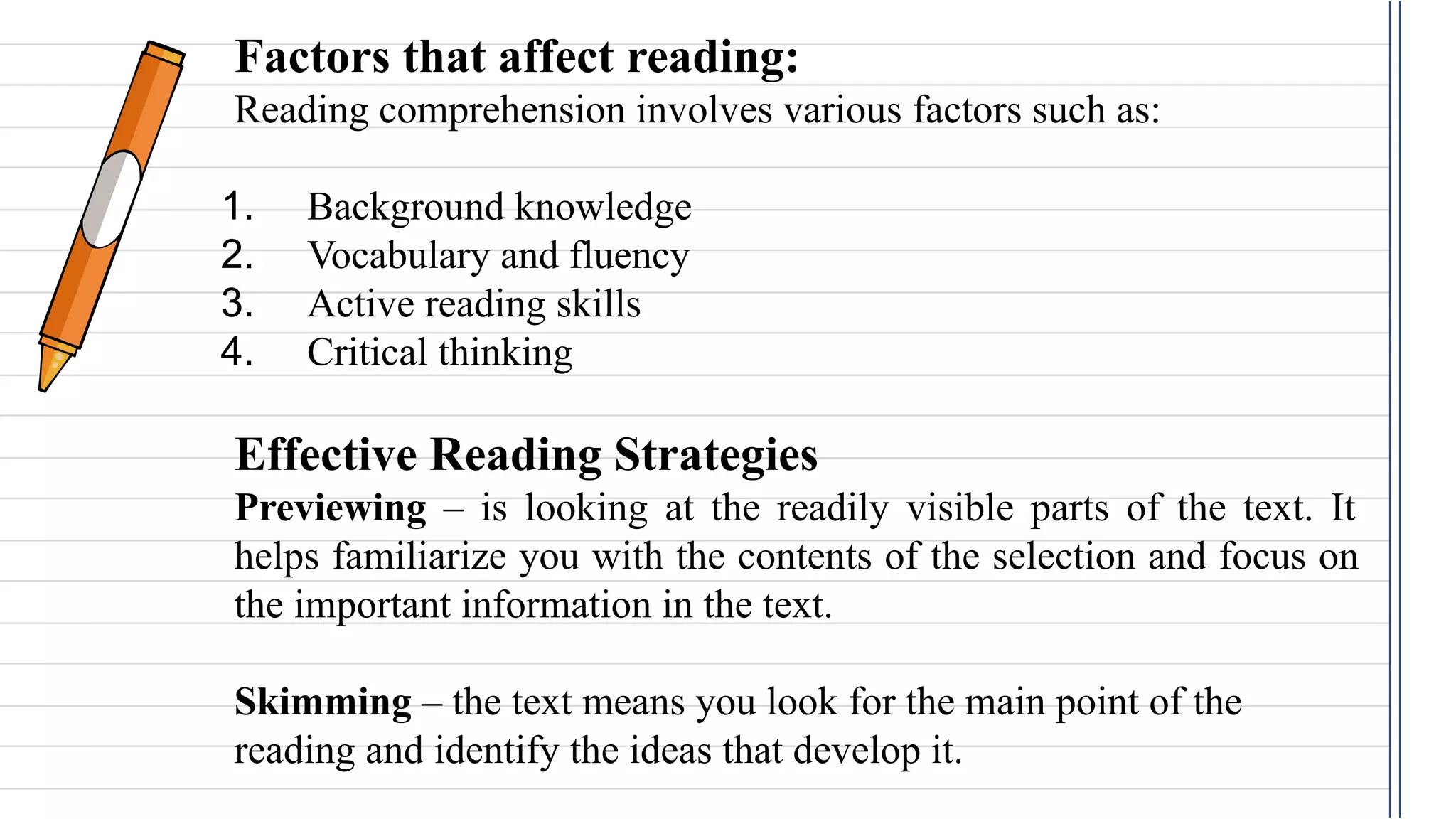
Factors that affect reading:
Reading comprehension involves various factors such as:
1. Background knowledge
2. Vocabulary and fluency
3. Active reading skills
4. Critical thinking
Effective Reading Strategies
Previewing – is looking at the readily visible parts of the text. It
helps familiarize you with the contents of the selection and focus on
the important information in the text.
Skimming – the text means you look for the main point of the
reading and identify the ideas that develop it.
Scanning – often refers to the way in which one
reads at a faster rate to gain the general idea about
the text without paying heed to the intentional and
detailed meaning of the text.
Ex. when one reads the text only in order to
understand the thesis statement, in one or two lines.
Another Terms for Skimming:
❑ Scanning
❑ Flipping
❑ Riffling
❑ Flipping through
❑ Leafing through
❑ Thumbing
❑ Leafing
❑ Flicking through
❑ Glancing
❑ Thumbing through
Skimming – is the process of quickly viewing a section of text to get a general
impression of the author’s main argument, themes or ideas.
Three types of Skimming:
1. Preview
2. Overview
3. Review
Skimming
• Is useful when you want to survey a text to get a
general idea of what it is about. In skimming, you
ignore the details and look for the main ideas.
Main ideas are usually found in the first sentences
of each paragraph and in the first and last
paragraph.
• Is reading a text quickly to get a general idea of
meaning. It can be contrasted with scanning,
which is reading in order to find specific
information, e.g. figures or names.
• Skimming is a specific reading skill which is
common in reading newspapers, messages and
e-mails.
Scanning
• Scanning the reading is looking for specific
information. This strategy involves physically
moving your eyes quickly along the lines of
text.
• Scanning is a reading technique to be used
when you want to find specific information
quickly. In scanning, you have a question in
your mind and you read a passage only to find
the answer while ignoring unrelated
information.
• How to scan: State the specific
information you are looking for.
• To scan text: after gaining an
overview and skimming, identify the
section(s) of the text that you
probably need to read. Start scanning
the text by allowing your eyes (or
finger) to move quickly over a page,
as soon as your eye catches an
important word or phrase, stop
reading.
BENEFITS OF SKIMMING AND
SCANNING
• Both tools can help improve efficiency and
productivity.
• Add flexibility and speed.
SIMILARITY OF SKIMMING AND
SCANNING
• You are taking in information when you are
scanning or skimming.
• Skimming is trying to get a feel for what the
piece of text is about.
• Scanning is looking for specific information
within the text.
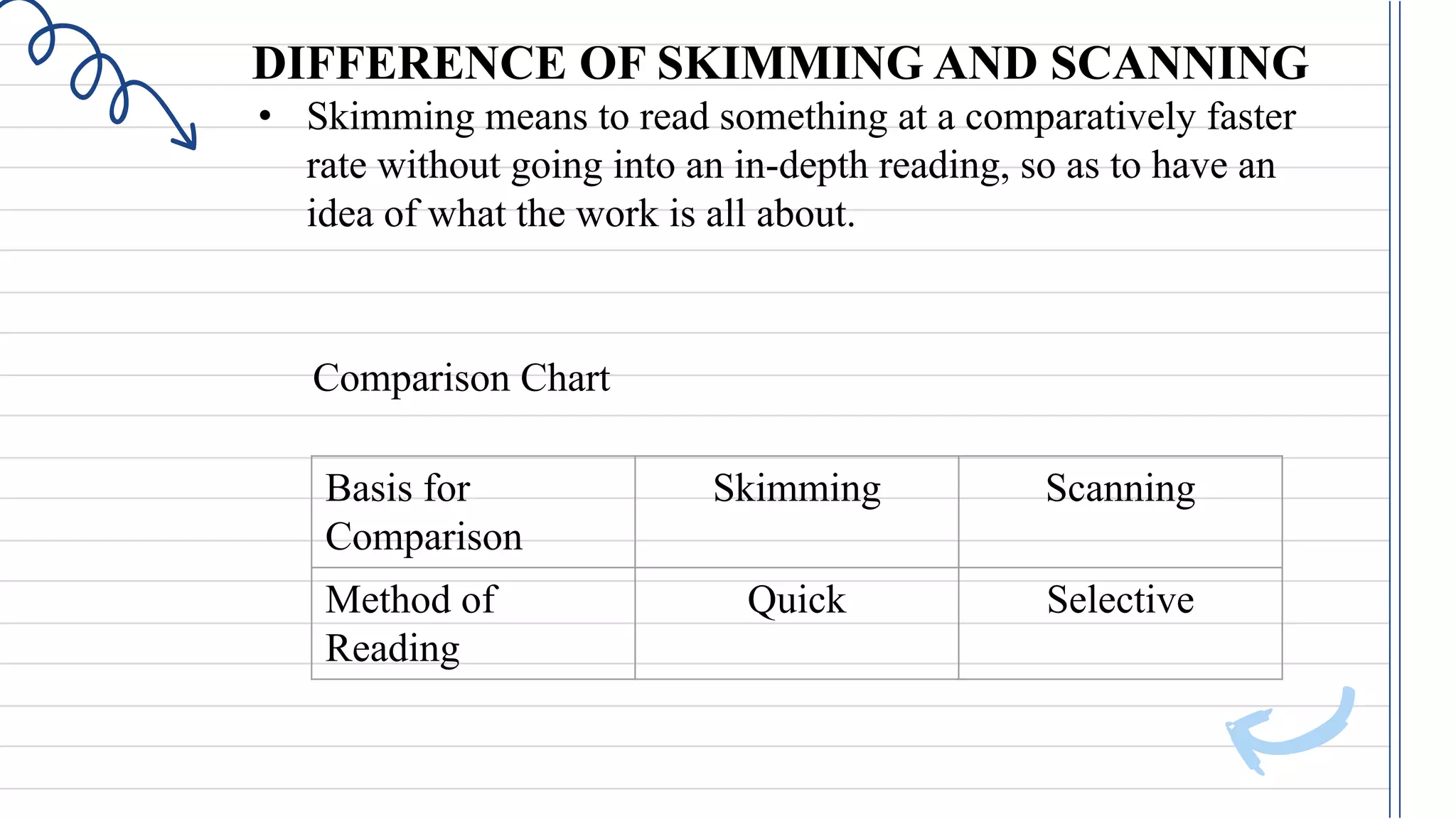
DIFFERENCE OF SKIMMING AND SCANNING
• Skimming means to read something at a comparatively faster
rate without going into an in-depth reading, so as to have an
idea of what the work is all about.
Basis for
Comparison
Skimming Scanning
Method of
Reading
Quick Selective
Comparison Chart
THANK YOU FOR
LISTENING!
HAVE A GREAT
DAY!

PPT FOR READING & WRITING SKILLS.pptx.pdf

  • 1.
  • 2.
    IMPORTANCE OF READING •Learning to read is about listening and understanding as well as working out as printed on the page. • Through hearing stories, children are exposed to a wide range of words. This helps them build their own vocabulary and improve their understanding when they listen, which is vital as they start to read.
  • 3.
    Research shows that regularreading: ✔ Improves brain connectivity. ✔ Increases your vocabulary and comprehension. ✔ Empowers you to empathize with other people. ✔ Aids in sleep readiness. ✔ Reduces stress. ✔ Lowers blood pressure and heart rate. ✔ Fights depression symptoms. ✔ Prevents cognitive decline as you age.
  • 4.
    ❑ The moreone individual reads, the more his understanding and comprehending skills improve. ❑ Better a reader, the easier it becomes for him to complete an assigned work. ❑ Reading books help children develop language and listening skills and prepares them to understand the written word. CRITICAL READING - Means that a reader applies certain processes, models, questions, and theories that result in enhanced clarity and comprehension. - There is more involved, both in effort and understanding, in a critical reading than in a mere “skimming” of the text.
  • 5.
  • 6.
    Annotating. One ofthe first strategies to begin with is annotating a text… Contextualizing… Reflecting on challenges to your beliefs and values… Paraphrasing… Outlining… Summarizing… Exploring the figurative language… Looking for patterns of opposition.
  • 7.
  • 8.
  • 9.
    ACTIVE READING - Isreading with the conscious intention to understand, integrate and evaluate the information you’re reading. - Simply means reading something with a determination to understand and evaluate it for its relevance to your needs.
  • 10.
    01 You can bean active reader by: ❑ Reading with a specific focus. Keep in mind what information you are looking for as you read… ❑ Breaking the text up into portions. Do not feel you have to read the whole text in one sitting… ❑ Questioning the text as you read. Did the author get everything right?... ❑ Taking notes as you read.
  • 11.
    IMPORTANCE OF ACTIVEREADING • By actively and independently reading text, students simultaneously can build their word identification, fluency, vocabulary, and text-dependent comprehension skills.
  • 12.
    PASSIVE READING - Iswhere you just take the words in. - Simply reading through the words on the page without any expectation that they should understand and make meaning from those words in some coherent way.
  • 13.
    7 Cognitive Strategiesof Reading ▪ Activating ▪ Inferring ▪ Monitoring-clarifying ▪ Questioning ▪ Searching-selecting ▪ Summarizing ▪ Visualizing-organizing 5 Tips to Enhance Reading Skills 1. Read extensively. Read as much as you can whenever you can… 2. Guess vocabulary from context. Don’t stop reading because you don’t understand a word… 3. Use a good online dictionary or extension. Sometimes, context is not enough… 4. Re-read… 5. Summarise/summarize.
  • 14.
    SQ3R - Is areading comprehension method named for its five steps: ❖ Remember, the information you gain from reading is important. ❖ SQ3R means: ✔ S – survey ✔ Q – question ✔ R – read ✔ R – recite ✔ R – review ❖ Active reading involves these steps: Preparing > Reading > Capturing the key ideas > Reviewing
  • 15.
    General Strategies for ReadingComprehension 1. Using Prior Knowledge/Previewing 2. Predicting – making predictions is a way to expand and broaden your thinking beyond the remembering and understanding levels. Applying – is an opportunity for you to apply your knowledge to new situations. Analyzing – to examine how ideas fit together. Creating – to put ideas together in unique ways. 3. Identifying the Main Idea and Summarization 4. Questioning 5. Making Inferences 6. Visualizing 7. Story Maps 8. Retelling
  • 16.
    Reading Comprehension Strategies 1.Re-read. This is one that most readers want to skip. 2. Read out loud. Sometimes it just helps to hear yourself read out loud. 3. Use context clues. 4. Look up a word you don’t know. 5. Ask questions. 6. Think about what you’ve already read. 7. Make connections. 8. Slow down.
  • 17.
    Factors that affectreading: Reading comprehension involves various factors such as: 1. Background knowledge 2. Vocabulary and fluency 3. Active reading skills 4. Critical thinking Effective Reading Strategies Previewing – is looking at the readily visible parts of the text. It helps familiarize you with the contents of the selection and focus on the important information in the text. Skimming – the text means you look for the main point of the reading and identify the ideas that develop it.
  • 18.
    Scanning – oftenrefers to the way in which one reads at a faster rate to gain the general idea about the text without paying heed to the intentional and detailed meaning of the text. Ex. when one reads the text only in order to understand the thesis statement, in one or two lines. Another Terms for Skimming: ❑ Scanning ❑ Flipping ❑ Riffling ❑ Flipping through ❑ Leafing through
  • 19.
    ❑ Thumbing ❑ Leafing ❑Flicking through ❑ Glancing ❑ Thumbing through Skimming – is the process of quickly viewing a section of text to get a general impression of the author’s main argument, themes or ideas. Three types of Skimming: 1. Preview 2. Overview 3. Review
  • 20.
    Skimming • Is usefulwhen you want to survey a text to get a general idea of what it is about. In skimming, you ignore the details and look for the main ideas. Main ideas are usually found in the first sentences of each paragraph and in the first and last paragraph. • Is reading a text quickly to get a general idea of meaning. It can be contrasted with scanning, which is reading in order to find specific information, e.g. figures or names.
  • 21.
    • Skimming isa specific reading skill which is common in reading newspapers, messages and e-mails. Scanning • Scanning the reading is looking for specific information. This strategy involves physically moving your eyes quickly along the lines of text. • Scanning is a reading technique to be used when you want to find specific information quickly. In scanning, you have a question in your mind and you read a passage only to find the answer while ignoring unrelated information.
  • 22.
    • How toscan: State the specific information you are looking for. • To scan text: after gaining an overview and skimming, identify the section(s) of the text that you probably need to read. Start scanning the text by allowing your eyes (or finger) to move quickly over a page, as soon as your eye catches an important word or phrase, stop reading.
  • 23.
    BENEFITS OF SKIMMINGAND SCANNING • Both tools can help improve efficiency and productivity. • Add flexibility and speed. SIMILARITY OF SKIMMING AND SCANNING • You are taking in information when you are scanning or skimming. • Skimming is trying to get a feel for what the piece of text is about. • Scanning is looking for specific information within the text.
  • 24.
    DIFFERENCE OF SKIMMINGAND SCANNING • Skimming means to read something at a comparatively faster rate without going into an in-depth reading, so as to have an idea of what the work is all about. Basis for Comparison Skimming Scanning Method of Reading Quick Selective Comparison Chart
  • 25.