Chapter 4 ofa quantitative
research design is typically
ranging from 15-25 pages
and should focus on the
results of statistical tests
rather than lengthy
narratives.
4.
Purposes of Chapter4
1. Provides the product of your
analytic process.
2. Provides Findings or results
should connect to the literature
review and especially your
conceptual framework.
3. Answers the SOPs.
1. Introduction
Explain itspurpose, which is to
present and analyze the data
you collected during your
research. Mention the research
questions or objectives that
guided your study to give
readers a clear context.
8.
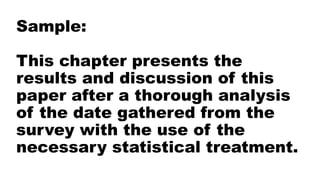
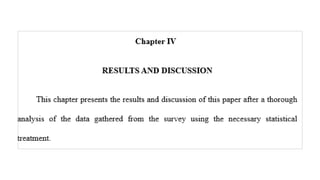
Sample:
This chapter presentsthe
results and discussion of this
paper after a thorough analysis
of the date gathered from the
survey with the use of the
necessary statistical treatment.
10.
2. Results andDiscussion
a. Data Presentation
- Present the data in an organized and
systematic manner. Use appropriate tables,
charts, graphs, or other visual aids to
effectively represent your data.
Ensure that the presentation is clear and
easy to understand. Label and title each
figure or table appropriately and refer to
them in the text.
12.
b. Descriptive Analysis
-Begin the analysis section by describing
the key characteristics of the data.
This may include summarizing the
demographic information of participants,
variables measured, or any other relevant
details. Use descriptive statistics (e.g.,
means, percentages, frequencies) to
present a clear overview of the data.
14.
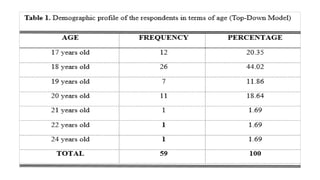
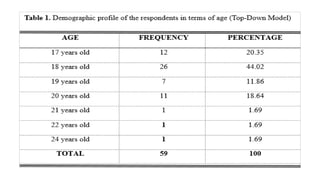
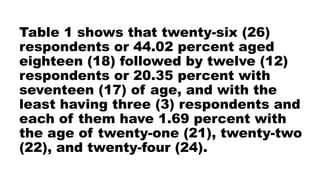
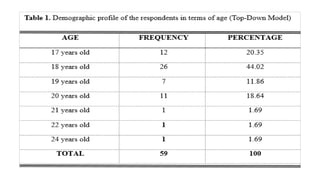
Table 1 showsthat twenty-six (26)
respondents or 44.02 percent aged
eighteen (18) followed by twelve (12)
respondents or 20.35 percent with
seventeen (17) of age, and with the
least having three (3) respondents and
each of them have 1.69 percent with
the age of twenty-one (21), twenty-two
(22), and twenty-four (24).
15.
C. Comparison withExisting Literature
(Analysis)
- Compare your findings with previous
studies or existing literature in your field.
Identify similarities, differences, or
contradiction between your results and
those of other researchers. Explain how
your study contributes to the existing body
of knowledge or how it supports or
challenges previous research.
17.
It is obviousthat age really influence the reading comprehension of a person as stated
by Megan F.C. et al. (2019, April 29) reading comprehension has been found to be
impacted by age. Certain comprehension-related skills like recalling new text material,
drawing conclusions, and combining past knowledge with new information may
deteriorate in older persons.
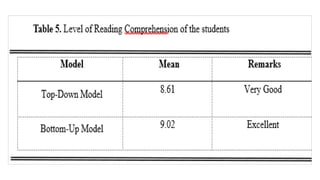
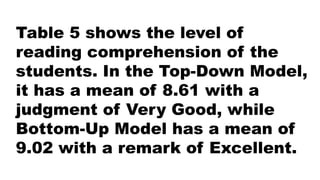
Table 5 showsthe level of
reading comprehension of the
students. In the Top-Down Model,
it has a mean of 8.61 with a
judgment of Very Good, while
Bottom-Up Model has a mean of
9.02 with a remark of Excellent.
22.
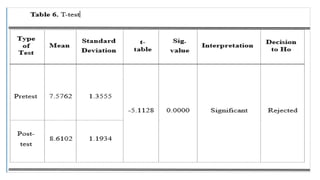
Table 6 showsthe t-test findings for
paired samples. After the top-down
intervention was implemented, it was
determined that there was a significant
difference in the students' (n = 59) pre-
and post-test scores, with a t-value of -
5.1128 and a corresponding probability
value of 0.000, which is less than a =
0.05. The null hypothesis is thus
rejected.
23.
CHAPTER 5
SUMMARY OFFINDINGS,
CONCLUSION, AND
RECOMMENDATION
ENGL100: LANGUAGE EDUCATIONAL RESEARCH
MR. MICHAEL E. ALBA, LPT, MACand
24.
Writing Chapter 5of a research
paper, often called the Conclusion
or Discussion chapter, is essential
for summarizing the research
findings, discussing their
implications, and offering
recommendations for future studies.
Summary of Findings– In this discussion, assert
that you have answered your research
questions.
Summarize Findings: Provide a concise summary
of the main findings from your research.
Highlight the key results and outcomes that
emerged from your data analysis in Chapter 4.
Be objective and avoid introducing any new
information or interpretations.
27.
Conclusions - Summarizethe main
points discussed in Chapter 5.
Restate the significance of your
research and its contribution to the
field. Emphasize the key takeaways
and implications of your findings.
28.
Recommendations - Basedon your
research findings, propose
recommendations for future studies or
actions. Identify areas that require
further investigation or where additional
research could build upon your work.
Consider any potential limitations or
unanswered questions that could guide
future research
The abstract isthe
first and sometimes
only representation
during a search
process.
31.
Guidelines for completingthe abstract are as follows:
• State the theoretical framework
• State the purpose of the study and relevant research
questions
• Describe the methods employed in the study by
including:
1. Participants
2. Research design
3. Data collection
4. Data analysis
• Describe the study’s general findings
• Describe implications and conclusions
32.
Be Specific andQuantitative:
Whenever possible, include
specific details and quantitative
information in your abstract. Use
numbers, percentages, or other
measurable data to support your
findings. This helps provide a more
precise understanding of your
research.












![Getting Started with Apache Spark: Big Data Made Simple [Free Meetup]](https://cdn.slidesharecdn.com/ss_thumbnails/apachesparkgettingstarted-260203175547-8361bcc3-thumbnail.jpg?width=640&height=640&fit=bounds)


