✅ What toinclude:
•Tables, graphs, or charts to show
quantitative data
•Themes or categories (qualitative research)
•Results for each research question or
hypothesis
•Descriptive statistics (mean, percentage,
frequency, etc.)
•Statistical test results (e.g., t-test, ANOVA,
Chi-square) if applicable
4.
This section explainsand interprets
the data. You connect your findings
to your research objectives, prior
studies, and theoretical framework.
2. Discussion of Results
5.
What to include:
•Interpretationof key findings
•Comparison with previous
studies
•Explanation for unexpected
results
•Implications for education, policy,
practice, or future research
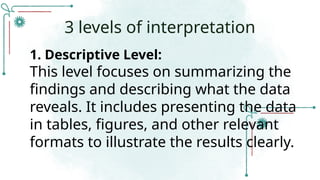
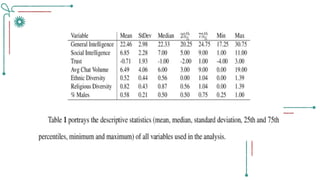
1. Descriptive Level:
Thislevel focuses on summarizing the
findings and describing what the data
reveals. It includes presenting the data
in tables, figures, and other relevant
formats to illustrate the results clearly.
3 levels of interpretation
2. Theoretical Level:
Discusshow the results contribute to or
challenge existing knowledge in the field,
propose possible explanations for their
findings, and suggest directions for future
research based on their conclusions.
3 levels of interpretation
13.
3. Critical/Contextual Level:
“Whyis this result important?”
“How does this relate to what others
have found?”
“What are the implications for practice
or future research?”
3 levels of interpretation
14.
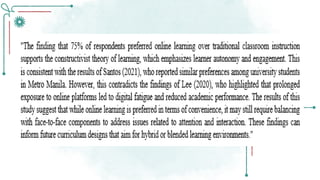
Critical/Contextual Level:
• Connectsyour results to previous research
or theory
• Explains agreement or disagreement with
past findings
• Shows implications for future research,
policy, or practice
• Discusses broader meaning or real-world
impact
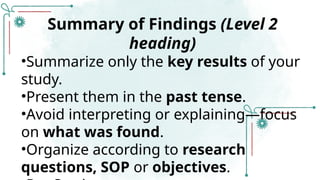
Summary of Findings(Level 2
heading)
•Summarize only the key results of your
study.
•Present them in the past tense.
•Avoid interpreting or explaining—focus
on what was found.
•Organize according to research
questions, SOP or objectives.
19.
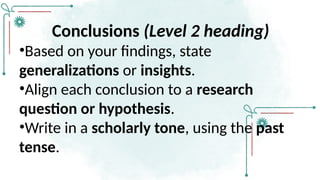
Conclusions (Level 2heading)
•Based on your findings, state
generalizations or insights.
•Align each conclusion to a research
question or hypothesis.
•Write in a scholarly tone, using the past
tense.
20.
Recommendations (Level 2heading)
•Provide actionable suggestions based
on findings and conclusions.
•Address recommendations to specific
stakeholders (e.g., teachers, school
administrators, future researchers).
•Include practical, feasible, and
research-grounded suggestions.
Editor's Notes
#1 Chapter 4 is one of the most critical parts of your research. It presents your findings and interprets what they mean in light of your research questions or hypotheses.
#12 Theoretical Level: At this highest level of interpretation, researchers connect their findings to existing theories or frameworks.
Implication
Why does it matter?
#13 Theoretical Level: At this highest level of interpretation, researchers connect their findings to existing theories or frameworks.
Implication
Why does it matter?
#14 Theoretical Level: At this highest level of interpretation, researchers connect their findings to existing theories or frameworks.
Implication
An implication in research refers to the possible effects, consequences, or applications of the findings of a study. It explains what the results mean in the real world and how they can be used or applied.
Why does it matter?
#15 Theoretical Level: At this highest level of interpretation, researchers connect their findings to existing theories or frameworks.
Implication
Why does it matter?
#16 Theoretical Level: At this highest level of interpretation, researchers connect their findings to existing theories or frameworks.
Implication
Why does it matter?
#17 Chapter 4 is one of the most critical parts of your research. It presents your findings and interprets what they mean in light of your research questions or hypotheses.
#18 ✅ Level 1 Heading
Format: Centered, Bold, Title Case
Text begins as a new paragraph (indented on the next line).
Used for main sections like Method, Results, Discussion, etc.
✅ Level 2 Heading
Format: Flush Left, Bold, Title Case
Text begins as a new paragraph (indented on the next line).
Used for subsections under Level 1 headings.
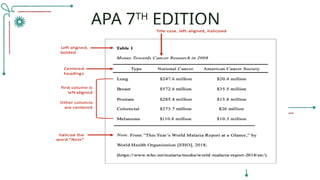
#19 Avoid new information not discussed previously.
In NUMBERS
#20 ✅ APA Tips:
Do not include "wishful thinking" or personal opinions.
Recommendations for future research must be realistic and derived from study limitations.






![Chapter_8.Research_Report_Writing_and_Presentation[1].pptx](https://cdn.slidesharecdn.com/ss_thumbnails/chapter8-260131073202-f187735f-thumbnail.jpg?width=640&height=640&fit=bounds)


