Writing a Resolution


            The War Room
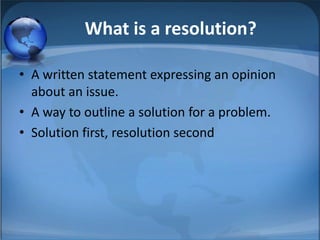
What is a resolution?

• A written statement expressing an opinion
  about an issue.
• A way to outline a solution for a problem.
• Solution first, resolution second
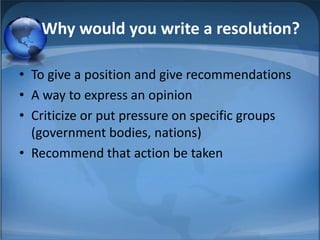
Why would you write a resolution?

• To give a position and give recommendations
• A way to express an opinion
• Criticize or put pressure on specific groups
  (government bodies, nations)
• Recommend that action be taken
Who writes a resolution

• A specific organization or group of
  policymakers
• A single country
• A group of countriesthat share the same ideas
  on an issue
Format

• One long sentence sparated by commas (,)
  and semi-colons );)
• A period (.) only appears at the very END of
  the WHOLE RESOLUTION
• 3 main parts:
• Heading
• Preamble
• Operative clauses
The heading

•   A way to identify the resolution
•   Contains 3 things:
•   Where the resolution will be submitted
•   What the topic is
•   Who the author is
•   Format: On separate lines at the top left hand
    corner of the document.
Example Heading

• Committee: General Assembly
• Topic: Raising health standards throughout
  the world
• Sponsor: Brazil
The Preamble

• Describes why your resolution is important.
• We can include:
• U.N. Charter
• Other resolutions
• What the UN has said about issue
• Other groups working on problem
• Do research! This information comes from your
  Foreign Policy Report
• Format: eAch phrase followed by a comma (,); Last
  clause followed by a colon (:)
Example of a preamble:

• Taking into account that many people are
  living n poverty,
• Noting with approval the steps taken by the
  General Assembly in dealing with this problem
• Alarmed by the standard of living in many
  countries,
• Seeking to increase health standards
  throughout the world:
Example of words for the
                preamble:
• Acknowledging, alarmed
  by, appreciating, aware, concerned, keeping in
  mind, recognizing, taking nto consideration
Operative Clauses

• Describe what action should be taken
• They are reasonable solutions that the
  government can enforce
• Format:
• Begin each phrase with
• End each with a semi-colon (;) and the last with a
  period
• Number each phrase
• Underline the operative
Examples of Operative Clauses

• Calls upon member states to increase economic
  aid to countries with poor health standards;
• Trusts that he Economic and Social council will
  address this issue accordingly
• Invites the World Bank and the International
  Monetary Fund to work on this problem;
• Encourages the use of non-governmental
  organizations in solving this problem
Examples of words in operative
                  clauses
•   Decides
•   Declares
•   Directs
•   Encourages
•   Recommends
•   Reminds
•   Requests
•   Suggests
•   Supports
Sample Resolution

• The General Assembly,
• Recognizing that China s a permanent member of
  the security council,
• Taking into account that China has threatened
  war with Tawan
• Urges the Nations of the world to consider
  sanctions against China;
• Condems China usng live ammunition in its
  military exercises
How to Write a Resolution

DOS AND DON’TS OF RESOLUTION
WRITING
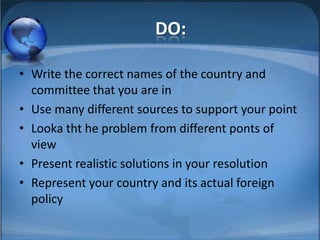
DO:

• Write the correct names of the country and
  committee that you are in
• Use many different sources to support your point
• Looka tht he problem from different ponts of
  view
• Present realistic solutions in your resolution
• Represent your country and its actual foreign
  policy
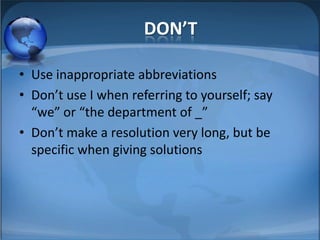
DON’T

• Use inappropriate abbreviations
• Don’t use I when referring to yourself; say
  “we” or “the department of _”
• Don’t make a resolution very long, but be
  specific when giving solutions
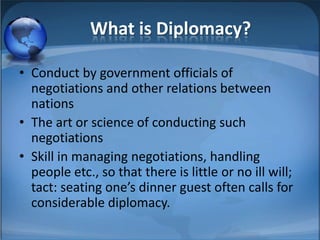
What is Diplomacy?

• Conduct by government officials of
  negotiations and other relations between
  nations
• The art or science of conducting such
  negotiations
• Skill in managing negotiations, handling
  people etc., so that there is little or no ill will;
  tact: seating one’s dinner guest often calls for
  considerable diplomacy.
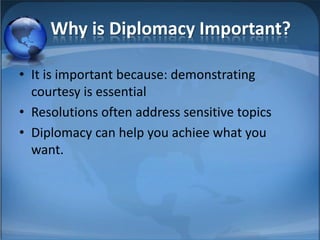
Why is Diplomacy Important?

• It is important because: demonstrating
  courtesy is essential
• Resolutions often address sensitive topics
• Diplomacy can help you achiee what you
  want.
Additional Resources are linked
            below:


                      Happ

Writing a Resolution

  • 1.
  • 2.
    What is aresolution? • A written statement expressing an opinion about an issue. • A way to outline a solution for a problem. • Solution first, resolution second
  • 3.
    Why would youwrite a resolution? • To give a position and give recommendations • A way to express an opinion • Criticize or put pressure on specific groups (government bodies, nations) • Recommend that action be taken
  • 4.
    Who writes aresolution • A specific organization or group of policymakers • A single country • A group of countriesthat share the same ideas on an issue
  • 5.
    Format • One longsentence sparated by commas (,) and semi-colons );) • A period (.) only appears at the very END of the WHOLE RESOLUTION • 3 main parts: • Heading • Preamble • Operative clauses
  • 6.
    The heading • A way to identify the resolution • Contains 3 things: • Where the resolution will be submitted • What the topic is • Who the author is • Format: On separate lines at the top left hand corner of the document.
  • 7.
    Example Heading • Committee:General Assembly • Topic: Raising health standards throughout the world • Sponsor: Brazil
  • 8.
    The Preamble • Describeswhy your resolution is important. • We can include: • U.N. Charter • Other resolutions • What the UN has said about issue • Other groups working on problem • Do research! This information comes from your Foreign Policy Report • Format: eAch phrase followed by a comma (,); Last clause followed by a colon (:)
  • 9.
    Example of apreamble: • Taking into account that many people are living n poverty, • Noting with approval the steps taken by the General Assembly in dealing with this problem • Alarmed by the standard of living in many countries, • Seeking to increase health standards throughout the world:
  • 10.
    Example of wordsfor the preamble: • Acknowledging, alarmed by, appreciating, aware, concerned, keeping in mind, recognizing, taking nto consideration
  • 11.
    Operative Clauses • Describewhat action should be taken • They are reasonable solutions that the government can enforce • Format: • Begin each phrase with • End each with a semi-colon (;) and the last with a period • Number each phrase • Underline the operative
  • 12.
    Examples of OperativeClauses • Calls upon member states to increase economic aid to countries with poor health standards; • Trusts that he Economic and Social council will address this issue accordingly • Invites the World Bank and the International Monetary Fund to work on this problem; • Encourages the use of non-governmental organizations in solving this problem
  • 13.
    Examples of wordsin operative clauses • Decides • Declares • Directs • Encourages • Recommends • Reminds • Requests • Suggests • Supports
  • 14.
    Sample Resolution • TheGeneral Assembly, • Recognizing that China s a permanent member of the security council, • Taking into account that China has threatened war with Tawan • Urges the Nations of the world to consider sanctions against China; • Condems China usng live ammunition in its military exercises
  • 15.
    How to Writea Resolution DOS AND DON’TS OF RESOLUTION WRITING
  • 16.
    DO: • Write thecorrect names of the country and committee that you are in • Use many different sources to support your point • Looka tht he problem from different ponts of view • Present realistic solutions in your resolution • Represent your country and its actual foreign policy
  • 17.
    DON’T • Use inappropriateabbreviations • Don’t use I when referring to yourself; say “we” or “the department of _” • Don’t make a resolution very long, but be specific when giving solutions
  • 18.
    What is Diplomacy? •Conduct by government officials of negotiations and other relations between nations • The art or science of conducting such negotiations • Skill in managing negotiations, handling people etc., so that there is little or no ill will; tact: seating one’s dinner guest often calls for considerable diplomacy.
  • 19.
    Why is DiplomacyImportant? • It is important because: demonstrating courtesy is essential • Resolutions often address sensitive topics • Diplomacy can help you achiee what you want.
  • 20.
    Additional Resources arelinked below: Happ