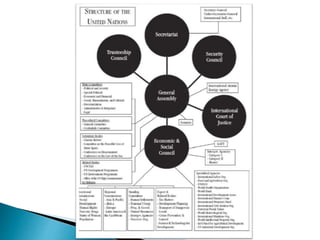
The United Nations (UN) is an international
organization, made up of most independent
countries in the world, whose stated aims are
facilitating cooperation in international
law, international security, economic
development, social progress, human rights, and
achievement of world peace.
The UN was founded in 1945 after World War II to
replace the League of Nations, to stop wars
between countries, and to provide a platform for
dialogue. It contains multiple subsidiary
organizations to carry out its missions.
Model United Nations is an academic
simulation of the United Nations that aims to
educate participants about civics, current
events, and diplomacy. Students form teams,
are assigned and research a country, take on
roles as diplomats, investigate international
issues, debate, and develop solutions to
world problems.
Model United Nations Handbook
Before the conference starts:
1. You get a country assigned
2. Do research
3. Write a position paper
During the conference:
1. General Assembly
2. Committees
1. Speakers list
2. Drafting resolutions
3. Lobbying
4. Speakers list
5. Voting on resolutions
1. Amendments
Model United Nations - The Movie
(instructional video)
Model United Nations Overview
(instructional video)
 Background of the topic
◦ From your country’s perspective, what are the main aspects of the problem?
◦ What are the roots of the problem?
◦ What has the UN done to address this problem in the past? Did your country support
them
 History of given topic in your country
 Official position of given topic in your country
◦ What are your country’s national interests in the situation?
◦ What are you country’s policies on the topic?
◦ What steps would your country like to see taken on the matter to deal with the
problem? What is the proposal?
◦ What past actions have your country’s government taken to address the issue?
 Justification of your countries position
◦ What are your countries main reasons for supporting these steps?
◦ What do you predict will be the main opposition to your country’s proposal?
◦ How do the positions of other countries affect your country’s position
 Researching positions of key countries (opponents and allies)
Example of a topic: Cyber
crime
1. Roll Call: Announce each country’s name and
receive an answer of “Present” or “Present and
Voting”
2. Set the Agenda:
1. The Chairperson will entertain motions to open (or
close) the Speaker’s List
2. The Chairperson may set time limits on speeches or
may entertain a motion from the
3. Committee to set time limits on speeches
1. The Chairperson will entertain motions to Set the
Agenda
What happens during a MUN meeting?
4. Debate:
1. Formal Debate:
1. Based on the Speaker’s List
2. Draft resolutions may be discussed
3. Amendments may be presented
2. Informal Debate
1. A motion for moderated caucus
2. A motion for unmoderated caucus
5. Close of Debate: After the Speaker’s List has been exhausted
and all Caucuses completed, debate is closed and the
committee automatically moves to voting
6. Voting:
1. Amendments are voted on first, Resolutions are voted on second
2. Once all Resolution related to a single topic have been voted on, the
Committee moves to the next topic
What happens during a MUN meeting?
Motion Is Debate Requried/Allowed? Decision
Motion to Open and Close the
Speakers List
Not Allowed Simple Majority
Motion for Unmoderated Caucus Allowed Simple Majority
Motion to Moderated Caucus Allowed Simple Majority
Motion to be Added to the Speakers
List
Not Allowed Chair
Point of Order Not Allowed Chair
Motion to Reply (in written form) Not Allowed Chair
Point of Information Not Allowed Chair
Point of Inquiry Not Allowed Chair
Point of Personal Privilege Not Allowed Chair
List of motions 1
List of motions 2
Motion Is Debate Requried/Allowed? Decision
Motion to Move into Open Debate Required Simple Majority
Motion to Move into Closed Debate Required Simple Majority
Motion to Extend Time For/Against Allowed Simple Majority
Motion to Move into Time
For/Against
Allowed Simple Majority
Motion to Table the Topic Required Overwhelming Majority
Motion to Reconsider Allowed Overwhelming Majority
Motion to Adopt by Consensus Not Allowed Requires no Objections
Motion to Introduce a Friendly
Amendment
Not Allowed Requires no Objections
Motion to Introduce an Unfriendly
Amendment
Not Allowed Chair
Motion to Divide the House Allowed Chair
Motion to Divide the Issue Required Chair
Motion to Appeal the Decision of
the Chair
Required Simple Majority
Motion to Evict Allowed Overwhelming Majority
List of motions 1
List of motions 2
1. Limited time (same time for speaking and
answering POIs)
2. Yielding the floor…
1. …to a speaker
2. …to the chair
3. At the end of your speech, state if you are
open to questions or not.
1. Thank the presiding official by saying "Thank
you Mr./ Madame/ Honorable Chair/
President…“
2. Begin by providing a brief history on the issue
as it relates to your country.
3. Provide your country's position on the issue.
Include an explanation for your country’s
stance, such as economic or security concerns
or political or religious ideology.
4. Give an explanation of how your country's
position relates to the positions of other
member states such as the major powers or
countries in your regional bloc.
5. Discuss some of the past actions taken by
the UN, member states and NGOs to address
the issue.
6. Talk about the role that NGOs or regional
organizations have to play in addressing the
issue.
7. Indicate to the committee members whether
your country is willing to negotiate.
8. Present ideas for a resolution, stressing your
country’s objectives for the resolution.
1. Thank the presiding official by saying "Thank
you Mr./ Madame/ Honorable Chair/
President…"
2. Encourage collaboration among member states
by proposing ways that your country would be
willing to work with other member states.
3. By referencing what other delegates have said,
you can show support for your allies or indicate
which proposals your country does not favor.
4. Present ideas for draft resolutions.
5. Explain why your country does or does not
support other draft resolutions.
1. Prepare in advance
2. Practice your speech
3. Take notes
4. Bluffing (what to do if you lack a piece of
info)
5. Style and presentation
1. Quotations
2. Research facts
3. Analogies
4. Stories
Example topic: Prevention of drug abuse
1. Quotation: “Anyway, no drug, not even alcohol,
causes the fundamental ills of society. If we're
looking for the source of our troubles, we
shouldn't test people for drugs, we should test
them for stupidity, ignorance, greed and love of
power.” ~P.J. O'Rourke
Example topic: Prevention of drug abuse
2. Research facts: The number of drug-related
emergency department (ED) visits involving
Ecstasy increased significantly from 10,220 visits
in 2004 to 17,865 visits in 2008, a 74.8 percent
increase. In 2008, most of these visits (69.3
percent) were made by patients aged 18 to 29.
Example topic: Prevention of drug abuse
3. Analogy: Is it better to restrain a dog before it
bites or let it bite and then treat the injury?
Example topic: Prevention of drug abuse
4. Stories: “That one line of meth started me on a
path of getting high at school and then eventually
dropping out all together. Classes interfered with
my drug life. What I thought was normal behavior
was not normal at all. I was 17, out of control,
addicted to drugs. . .”
Your goal is to pass a resolution – you have
get a consensus – every single person in the
Committee votes for your resolution – or at
least a majority – an minimum of 51% of the
people in the Committee vote for your
resolution. You will have to talk to other
people to get them to vote for your
resolution.
 Working papers are written solutions to the
problems presented by the topics in the
Committees.
 Sponsors = delegates who have written the
resolution
 Signatories (1/5 of the members, but does
not require a vote) = delegates who have
signed the resolution
 Motion to introduce a draft resolution
Sample Resolution (go to pages 20-21)
1. Approach people quickly
2. Quid pro quo (something for
something)
3. Be nice and polite
4. Be persistent
1. Stay in role
2. Respect the dress code
3. Stay active
4. Stay relevant
5. Be nice and polite
Model United Nations Do's and Don'ts
(instructional video)
Model United Nations - The Movie
(instructional video)
Model United Nations Overview
(instructional video)
What happens during a MUN meeting?
List of motions 1
List of motions 2
Sample Resolution (go to pages 20-21)
Model United Nations Do's and Don'ts
(instructional video)

Modelunitednations 110504191242-phpapp01

  • 2.
    The United Nations(UN) is an international organization, made up of most independent countries in the world, whose stated aims are facilitating cooperation in international law, international security, economic development, social progress, human rights, and achievement of world peace. The UN was founded in 1945 after World War II to replace the League of Nations, to stop wars between countries, and to provide a platform for dialogue. It contains multiple subsidiary organizations to carry out its missions.
  • 4.
    Model United Nationsis an academic simulation of the United Nations that aims to educate participants about civics, current events, and diplomacy. Students form teams, are assigned and research a country, take on roles as diplomats, investigate international issues, debate, and develop solutions to world problems. Model United Nations Handbook
  • 6.
    Before the conferencestarts: 1. You get a country assigned 2. Do research 3. Write a position paper During the conference: 1. General Assembly 2. Committees 1. Speakers list 2. Drafting resolutions 3. Lobbying 4. Speakers list 5. Voting on resolutions 1. Amendments Model United Nations - The Movie (instructional video) Model United Nations Overview (instructional video)
  • 7.
     Background ofthe topic ◦ From your country’s perspective, what are the main aspects of the problem? ◦ What are the roots of the problem? ◦ What has the UN done to address this problem in the past? Did your country support them  History of given topic in your country  Official position of given topic in your country ◦ What are your country’s national interests in the situation? ◦ What are you country’s policies on the topic? ◦ What steps would your country like to see taken on the matter to deal with the problem? What is the proposal? ◦ What past actions have your country’s government taken to address the issue?  Justification of your countries position ◦ What are your countries main reasons for supporting these steps? ◦ What do you predict will be the main opposition to your country’s proposal? ◦ How do the positions of other countries affect your country’s position  Researching positions of key countries (opponents and allies)
  • 8.
    Example of atopic: Cyber crime
  • 9.
    1. Roll Call:Announce each country’s name and receive an answer of “Present” or “Present and Voting” 2. Set the Agenda: 1. The Chairperson will entertain motions to open (or close) the Speaker’s List 2. The Chairperson may set time limits on speeches or may entertain a motion from the 3. Committee to set time limits on speeches 1. The Chairperson will entertain motions to Set the Agenda What happens during a MUN meeting?
  • 10.
    4. Debate: 1. FormalDebate: 1. Based on the Speaker’s List 2. Draft resolutions may be discussed 3. Amendments may be presented 2. Informal Debate 1. A motion for moderated caucus 2. A motion for unmoderated caucus 5. Close of Debate: After the Speaker’s List has been exhausted and all Caucuses completed, debate is closed and the committee automatically moves to voting 6. Voting: 1. Amendments are voted on first, Resolutions are voted on second 2. Once all Resolution related to a single topic have been voted on, the Committee moves to the next topic What happens during a MUN meeting?
  • 11.
    Motion Is DebateRequried/Allowed? Decision Motion to Open and Close the Speakers List Not Allowed Simple Majority Motion for Unmoderated Caucus Allowed Simple Majority Motion to Moderated Caucus Allowed Simple Majority Motion to be Added to the Speakers List Not Allowed Chair Point of Order Not Allowed Chair Motion to Reply (in written form) Not Allowed Chair Point of Information Not Allowed Chair Point of Inquiry Not Allowed Chair Point of Personal Privilege Not Allowed Chair List of motions 1 List of motions 2
  • 12.
    Motion Is DebateRequried/Allowed? Decision Motion to Move into Open Debate Required Simple Majority Motion to Move into Closed Debate Required Simple Majority Motion to Extend Time For/Against Allowed Simple Majority Motion to Move into Time For/Against Allowed Simple Majority Motion to Table the Topic Required Overwhelming Majority Motion to Reconsider Allowed Overwhelming Majority Motion to Adopt by Consensus Not Allowed Requires no Objections Motion to Introduce a Friendly Amendment Not Allowed Requires no Objections Motion to Introduce an Unfriendly Amendment Not Allowed Chair Motion to Divide the House Allowed Chair Motion to Divide the Issue Required Chair Motion to Appeal the Decision of the Chair Required Simple Majority Motion to Evict Allowed Overwhelming Majority List of motions 1 List of motions 2
  • 13.
    1. Limited time(same time for speaking and answering POIs) 2. Yielding the floor… 1. …to a speaker 2. …to the chair 3. At the end of your speech, state if you are open to questions or not.
  • 14.
    1. Thank thepresiding official by saying "Thank you Mr./ Madame/ Honorable Chair/ President…“ 2. Begin by providing a brief history on the issue as it relates to your country. 3. Provide your country's position on the issue. Include an explanation for your country’s stance, such as economic or security concerns or political or religious ideology. 4. Give an explanation of how your country's position relates to the positions of other member states such as the major powers or countries in your regional bloc.
  • 15.
    5. Discuss someof the past actions taken by the UN, member states and NGOs to address the issue. 6. Talk about the role that NGOs or regional organizations have to play in addressing the issue. 7. Indicate to the committee members whether your country is willing to negotiate. 8. Present ideas for a resolution, stressing your country’s objectives for the resolution.
  • 16.
    1. Thank thepresiding official by saying "Thank you Mr./ Madame/ Honorable Chair/ President…" 2. Encourage collaboration among member states by proposing ways that your country would be willing to work with other member states. 3. By referencing what other delegates have said, you can show support for your allies or indicate which proposals your country does not favor. 4. Present ideas for draft resolutions. 5. Explain why your country does or does not support other draft resolutions.
  • 17.
    1. Prepare inadvance 2. Practice your speech 3. Take notes 4. Bluffing (what to do if you lack a piece of info) 5. Style and presentation 1. Quotations 2. Research facts 3. Analogies 4. Stories
  • 18.
    Example topic: Preventionof drug abuse 1. Quotation: “Anyway, no drug, not even alcohol, causes the fundamental ills of society. If we're looking for the source of our troubles, we shouldn't test people for drugs, we should test them for stupidity, ignorance, greed and love of power.” ~P.J. O'Rourke
  • 19.
    Example topic: Preventionof drug abuse 2. Research facts: The number of drug-related emergency department (ED) visits involving Ecstasy increased significantly from 10,220 visits in 2004 to 17,865 visits in 2008, a 74.8 percent increase. In 2008, most of these visits (69.3 percent) were made by patients aged 18 to 29.
  • 20.
    Example topic: Preventionof drug abuse 3. Analogy: Is it better to restrain a dog before it bites or let it bite and then treat the injury?
  • 21.
    Example topic: Preventionof drug abuse 4. Stories: “That one line of meth started me on a path of getting high at school and then eventually dropping out all together. Classes interfered with my drug life. What I thought was normal behavior was not normal at all. I was 17, out of control, addicted to drugs. . .”
  • 22.
    Your goal isto pass a resolution – you have get a consensus – every single person in the Committee votes for your resolution – or at least a majority – an minimum of 51% of the people in the Committee vote for your resolution. You will have to talk to other people to get them to vote for your resolution.
  • 23.
     Working papersare written solutions to the problems presented by the topics in the Committees.  Sponsors = delegates who have written the resolution  Signatories (1/5 of the members, but does not require a vote) = delegates who have signed the resolution  Motion to introduce a draft resolution Sample Resolution (go to pages 20-21)
  • 24.
    1. Approach peoplequickly 2. Quid pro quo (something for something) 3. Be nice and polite 4. Be persistent
  • 25.
    1. Stay inrole 2. Respect the dress code 3. Stay active 4. Stay relevant 5. Be nice and polite Model United Nations Do's and Don'ts (instructional video)
  • 26.
    Model United Nations- The Movie (instructional video) Model United Nations Overview (instructional video) What happens during a MUN meeting? List of motions 1 List of motions 2 Sample Resolution (go to pages 20-21) Model United Nations Do's and Don'ts (instructional video)