1
Scientific Method
Problem Statement
2
What is a Problem Statement?
 The question that you select for
your investigation – the basis of
your experiment.
 The research and experiment
you will be conducting center
around finding an answer to the
question or problem statement.
5
A Good Problem Statement
(or Purpose)
 The problem statement only needs to be
one sentence long.
 The problem statement is always in the
form of a question.
 Should be open-ended (not answered by
yes or no)
 A problem statement includes what is
changed (independent variable) and what
is measured (dependent variable).
6
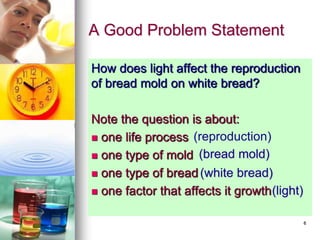
A Good Problem Statement
How does light affect the reproduction
of bread mold on white bread?
Note the question is about:
 one life process
 one type of mold
 one type of bread
 one factor that affects it growth
(reproduction)
(bread mold)
(white bread)
(light)
7
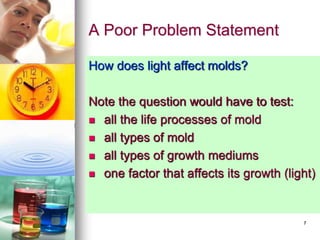
A Poor Problem Statement
How does light affect molds?
Note the question would have to test:
 all the life processes of mold
 all types of mold
 all types of growth mediums
 one factor that affects its growth (light)
8
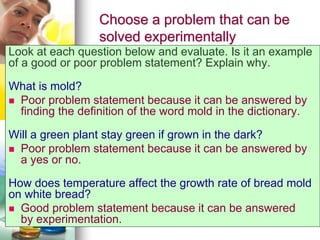
Choose a problem that can be
solved experimentally
Look at each question below and evaluate. Is it an example
of a good or poor problem statement? Explain why.
What is mold?
 Poor problem statement because it can be answered by
finding the definition of the word mold in the dictionary.
Will a green plant stay green if grown in the dark?
 Poor problem statement because it can be answered by
a yes or no.
How does temperature affect the growth rate of bread mold
on white bread?
 Good problem statement because it can be answered
by experimentation.
13
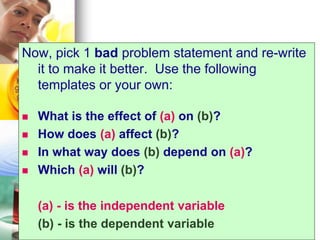
Now, pick 1 bad problem statement and re-write
it to make it better. Use the following
templates or your own:
 What is the effect of (a) on (b)?
 How does (a) affect (b)?
 In what way does (b) depend on (a)?
 Which (a) will (b)?
(a) - is the independent variable
(b) - is the dependent variable

Writing a Good Purpose Statement (Problem Statement)

  • 1.
  • 2.
    2 What is aProblem Statement?  The question that you select for your investigation – the basis of your experiment.  The research and experiment you will be conducting center around finding an answer to the question or problem statement.
  • 3.
    5 A Good ProblemStatement (or Purpose)  The problem statement only needs to be one sentence long.  The problem statement is always in the form of a question.  Should be open-ended (not answered by yes or no)  A problem statement includes what is changed (independent variable) and what is measured (dependent variable).
  • 4.
    6 A Good ProblemStatement How does light affect the reproduction of bread mold on white bread? Note the question is about:  one life process  one type of mold  one type of bread  one factor that affects it growth (reproduction) (bread mold) (white bread) (light)
  • 5.
    7 A Poor ProblemStatement How does light affect molds? Note the question would have to test:  all the life processes of mold  all types of mold  all types of growth mediums  one factor that affects its growth (light)
  • 6.
    8 Choose a problemthat can be solved experimentally Look at each question below and evaluate. Is it an example of a good or poor problem statement? Explain why. What is mold?  Poor problem statement because it can be answered by finding the definition of the word mold in the dictionary. Will a green plant stay green if grown in the dark?  Poor problem statement because it can be answered by a yes or no. How does temperature affect the growth rate of bread mold on white bread?  Good problem statement because it can be answered by experimentation.
  • 7.
    13 Now, pick 1bad problem statement and re-write it to make it better. Use the following templates or your own:  What is the effect of (a) on (b)?  How does (a) affect (b)?  In what way does (b) depend on (a)?  Which (a) will (b)? (a) - is the independent variable (b) - is the dependent variable