The image part with relationship ID rId20 was not found in the file.The image part with relationship ID rId2 was not found in the file.
Writing a clear communications
strategy
How to set your focus and make sure you get there
Natasha Roe, Red Pencil
The image part with relationship ID rId20 was not found in the file.
Who has an organisational strategy?
The image part with relationship ID rId20 was not found in the file.
Why do you need a comms strategy?
¡ Everyone thinks everything is ‘communications’
¡ No-one understands what communications is!
¡ Everything goes across the comms desk – how do we know what’s
most important?
¡ Yet, you need a communications strategy to help deliver your charity’s
objectives.
¡ And the most successful charities don’t just communicate the changes
they make – they communicate to make change happen.
The image part with relationship ID rId20 was not found in the file.
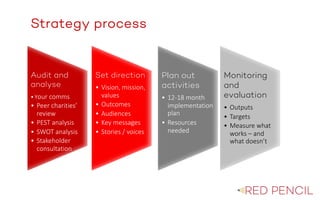
Strategy process
Audit and
analyse
•Your comms
• Peer charities’
review
• PEST analysis
• SWOT analysis
• Stakeholder
consultation
Set direction
• Vision, mission,
values
• Outcomes
• Audiences
• Key messages
• Stories / voices
Plan out
activities
• 12-18 month
implementation
plan
• Resources
needed
Monitoring
and
evaluation
• Outputs
• Targets
• Measure what
works – and
what doesn’t
The image part with relationship ID rId20 was not found in the file.
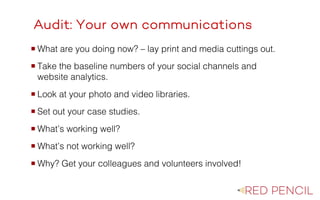
Audit: Your own communications
¡ What are you doing now? – lay print and media cuttings out.
¡ Take the baseline numbers of your social channels and
website analytics.
¡ Look at your photo and video libraries.
¡ Set out your case studies.
¡ What’s working well?
¡ What’s not working well?
¡ Why? Get your colleagues and volunteers involved!
The image part with relationship ID rId20 was not found in the file.
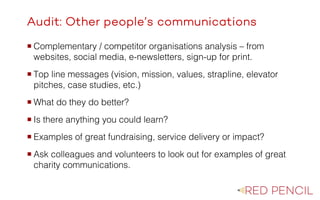
Audit: Other people’s communications
¡ Complementary / competitor organisations analysis – from
websites, social media, e-newsletters, sign-up for print.
¡ Top line messages (vision, mission, values, strapline, elevator
pitches, case studies, etc.)
¡ What do they do better?
¡ Is there anything you could learn?
¡ Examples of great fundraising, service delivery or impact?
¡ Ask colleagues and volunteers to look out for examples of great
charity communications.
The image part with relationship ID rId20 was not found in the file.
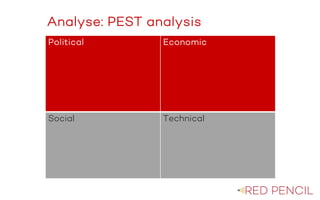
Analyse: PEST analysis
Political Economic
Social Technical
The image part with relationship ID rId20 was not found in the file.
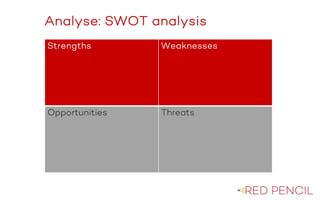
Analyse: SWOT analysis
Strengths Weaknesses
Opportunities Threats
The image part with relationship ID rId20 was not found in the file.
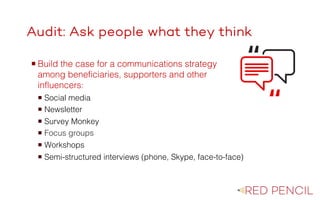
Audit: Ask people what they think
¡ Build the case for a communications strategy
among beneficiaries, supporters and other
influencers:
¡ Social media
¡ Newsletter
¡ Survey Monkey
¡ Focus groups
¡ Workshops
¡ Semi-structured interviews (phone, Skype, face-to-face)
The image part with relationship ID rId20 was not found in the file.
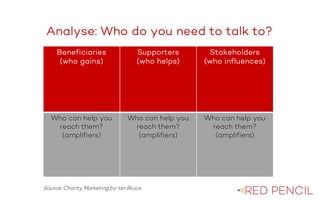
Analyse: Who do you need to talk to?
Beneficiaries
(who gains)
Supporters
(who helps)
Stakeholders
(who influences)
Who can help you
reach them?
(amplifiers)
Who can help you
reach them?
(amplifiers)
Who can help you
reach them?
(amplifiers)
Source: Charity Marketing by Ian Bruce
The image part with relationship ID rId20 was not found in the file.
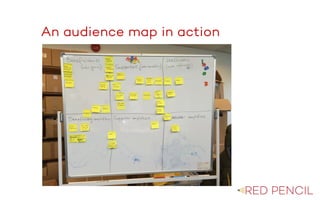
An audience map in action
The image part with relationship ID rId20 was not found in the file.
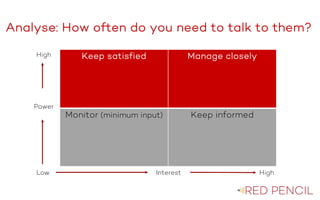
Analyse: How often do you need to talk to them?
Keep satisfied Manage closely
Monitor (minimum input) Keep informed
Power
InterestLow
High
High
The image part with relationship ID rId20 was not found in the file.
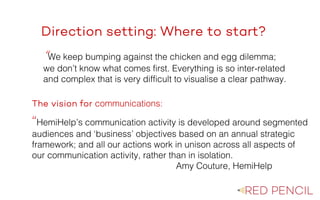
Direction setting: Where to start?
“We keep bumping against the chicken and egg dilemma;
we don’t know what comes first. Everything is so inter-related
and complex that is very difficult to visualise a clear pathway.
“HemiHelp’s communication activity is developed around segmented
audiences and ‘business’ objectives based on an annual strategic
framework; and all our actions work in unison across all aspects of
our communication activity, rather than in isolation.
Amy Couture, HemiHelp
The vision for communications:
The image part with relationship ID rId20 was not found in the file.
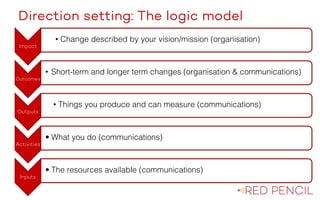
Direction setting: The logic model
Impact
• Change described by your vision/mission (organisation)
Outcomes
• Short-term and longer term changes (organisation & communications)
Outputs
• Things you produce and can measure (communications)
Activities
• What you do (communications)
Inputs
• The resources available (communications)
The image part with relationship ID rId20 was not found in the file.
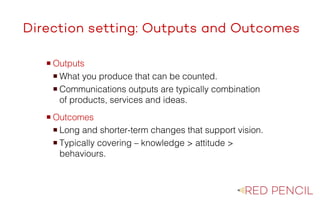
Direction setting: Outputs and Outcomes
¡ Outputs
¡ What you produce that can be counted.
¡ Communications outputs are typically combination
of products, services and ideas.
¡ Outcomes
¡ Long and shorter-term changes that support vision.
¡ Typically covering – knowledge > attitude >
behaviours.
The image part with relationship ID rId20 was not found in the file.
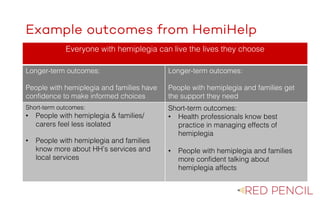
Example outcomes from HemiHelp
Everyone with hemiplegia can live the lives they choose
Longer-term outcomes:
People with hemiplegia and families have
confidence to make informed choices
Longer-term outcomes:
People with hemiplegia and families get
the support they need
Short-term outcomes:
• People with hemiplegia & families/
carers feel less isolated
• People with hemiplegia and families
know more about HH’s services and
local services
Short-term outcomes:
• Health professionals know best
practice in managing effects of
hemiplegia
• People with hemiplegia and families
more confident talking about
hemiplegia affects
The image part with relationship ID rId20 was not found in the file.
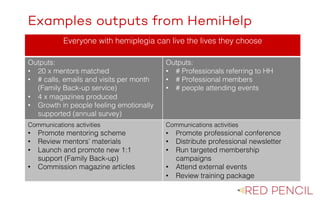
Examples outputs from HemiHelp
Everyone with hemiplegia can live the lives they choose
Outputs:
• 20 x mentors matched
• # calls, emails and visits per month
(Family Back-up service)
• 4 x magazines produced
• Growth in people feeling emotionally
supported (annual survey)
Outputs:
• # Professionals referring to HH
• # Professional members
• # people attending events
Communications activities
• Promote mentoring scheme
• Review mentors’ materials
• Launch and promote new 1:1
support (Family Back-up)
• Commission magazine articles
Communications activities
• Promote professional conference
• Distribute professional newsletter
• Run targeted membership
campaigns
• Attend external events
• Review training package
The image part with relationship ID rId20 was not found in the file.
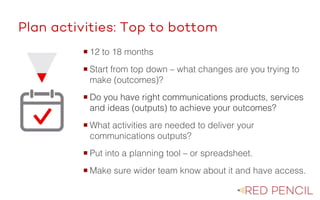
Plan activities: Top to bottom
¡ 12 to 18 months
¡ Start from top down – what changes are you trying to
make (outcomes)?
¡ Do you have right communications products, services
and ideas (outputs) to achieve your outcomes?
¡ What activities are needed to deliver your
communications outputs?
¡ Put into a planning tool – or spreadsheet.
¡ Make sure wider team know about it and have access.
The image part with relationship ID rId20 was not found in the file.
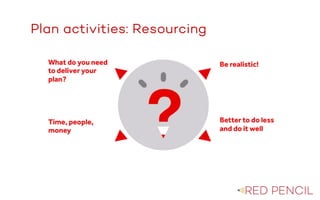
Plan activities: Resourcing
The image part with relationship ID rId20 was not found in the file.
Monitoring & evaluation: Remember to measure
¡ Check what’s working – and what’s not.
¡ If something is not helping deliver your goals and
achieve your vision – stop doing it!
¡ Find out what’s working by counting numbers, monitoring
and using analytics to plan your communications
activities.
¡ Ask questions to test people’s knowledge, attitudes and
behaviours – annual surveys are great for this!
The image part with relationship ID rId20 was not found in the file.
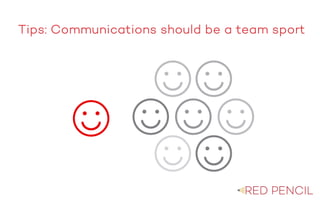
Tips: Communications should be a team sport
The image part with relationship ID rId20 was not found in the file.
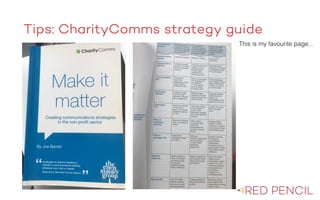
Tips: CharityComms strategy guide
This is my favourite page…
The image part with relationship ID rId20 was not found in the file.
Tips: Who can help?
¡ CharityComms, Media Trust, Small Charities Coalition, NCVO’s
Knowhow Nonprofit
¡ Third Sector PR and Comms Network Facebook page
¡ Charity communications people - @JudeHabib @GoreckiDawn
@madlinsudn @magnetoGaby @GemmaPettmanPR @LondonKirsty
@SarahatSelf
¡ Network events – Institute of Fundraising regional and SIG
meetings, Chartered Institute of Marketing charity events,
#CharityMeetup etc.
The image part with relationship ID rId20 was not found in the file.
Key take aways…
1. Planning, planning, planning (audit > analysis > consult)
2. Start from vision
3. Break changes into one, three, five years (outcomes)
4. Agree communications products, services & ideas
(outputs) to deliver outcomes
5. Plan activities and check resources
6. Remember to measure
The image part with relationship ID rId20 was not found in the file.
Question time
The image part with relationship ID rId20 was not found in the file.
Staying in touch
¡natasha@redpencil.co.uk
¡@Redpencil_
¡redpencil.co.uk
¡Facebook/RedPencilSE22

Writing a clear communications strategy

  • 1.
    The image partwith relationship ID rId20 was not found in the file.The image part with relationship ID rId2 was not found in the file. Writing a clear communications strategy How to set your focus and make sure you get there Natasha Roe, Red Pencil
  • 2.
    The image partwith relationship ID rId20 was not found in the file. Who has an organisational strategy?
  • 3.
    The image partwith relationship ID rId20 was not found in the file. Why do you need a comms strategy? ¡ Everyone thinks everything is ‘communications’ ¡ No-one understands what communications is! ¡ Everything goes across the comms desk – how do we know what’s most important? ¡ Yet, you need a communications strategy to help deliver your charity’s objectives. ¡ And the most successful charities don’t just communicate the changes they make – they communicate to make change happen.
  • 4.
    The image partwith relationship ID rId20 was not found in the file. Strategy process Audit and analyse •Your comms • Peer charities’ review • PEST analysis • SWOT analysis • Stakeholder consultation Set direction • Vision, mission, values • Outcomes • Audiences • Key messages • Stories / voices Plan out activities • 12-18 month implementation plan • Resources needed Monitoring and evaluation • Outputs • Targets • Measure what works – and what doesn’t
  • 5.
    The image partwith relationship ID rId20 was not found in the file. Audit: Your own communications ¡ What are you doing now? – lay print and media cuttings out. ¡ Take the baseline numbers of your social channels and website analytics. ¡ Look at your photo and video libraries. ¡ Set out your case studies. ¡ What’s working well? ¡ What’s not working well? ¡ Why? Get your colleagues and volunteers involved!
  • 6.
    The image partwith relationship ID rId20 was not found in the file. Audit: Other people’s communications ¡ Complementary / competitor organisations analysis – from websites, social media, e-newsletters, sign-up for print. ¡ Top line messages (vision, mission, values, strapline, elevator pitches, case studies, etc.) ¡ What do they do better? ¡ Is there anything you could learn? ¡ Examples of great fundraising, service delivery or impact? ¡ Ask colleagues and volunteers to look out for examples of great charity communications.
  • 7.
    The image partwith relationship ID rId20 was not found in the file. Analyse: PEST analysis Political Economic Social Technical
  • 8.
    The image partwith relationship ID rId20 was not found in the file. Analyse: SWOT analysis Strengths Weaknesses Opportunities Threats
  • 9.
    The image partwith relationship ID rId20 was not found in the file. Audit: Ask people what they think ¡ Build the case for a communications strategy among beneficiaries, supporters and other influencers: ¡ Social media ¡ Newsletter ¡ Survey Monkey ¡ Focus groups ¡ Workshops ¡ Semi-structured interviews (phone, Skype, face-to-face)
  • 10.
    The image partwith relationship ID rId20 was not found in the file. Analyse: Who do you need to talk to? Beneficiaries (who gains) Supporters (who helps) Stakeholders (who influences) Who can help you reach them? (amplifiers) Who can help you reach them? (amplifiers) Who can help you reach them? (amplifiers) Source: Charity Marketing by Ian Bruce
  • 11.
    The image partwith relationship ID rId20 was not found in the file. An audience map in action
  • 12.
    The image partwith relationship ID rId20 was not found in the file. Analyse: How often do you need to talk to them? Keep satisfied Manage closely Monitor (minimum input) Keep informed Power InterestLow High High
  • 13.
    The image partwith relationship ID rId20 was not found in the file. Direction setting: Where to start? “We keep bumping against the chicken and egg dilemma; we don’t know what comes first. Everything is so inter-related and complex that is very difficult to visualise a clear pathway. “HemiHelp’s communication activity is developed around segmented audiences and ‘business’ objectives based on an annual strategic framework; and all our actions work in unison across all aspects of our communication activity, rather than in isolation. Amy Couture, HemiHelp The vision for communications:
  • 14.
    The image partwith relationship ID rId20 was not found in the file. Direction setting: The logic model Impact • Change described by your vision/mission (organisation) Outcomes • Short-term and longer term changes (organisation & communications) Outputs • Things you produce and can measure (communications) Activities • What you do (communications) Inputs • The resources available (communications)
  • 15.
    The image partwith relationship ID rId20 was not found in the file. Direction setting: Outputs and Outcomes ¡ Outputs ¡ What you produce that can be counted. ¡ Communications outputs are typically combination of products, services and ideas. ¡ Outcomes ¡ Long and shorter-term changes that support vision. ¡ Typically covering – knowledge > attitude > behaviours.
  • 16.
    The image partwith relationship ID rId20 was not found in the file. Example outcomes from HemiHelp Everyone with hemiplegia can live the lives they choose Longer-term outcomes: People with hemiplegia and families have confidence to make informed choices Longer-term outcomes: People with hemiplegia and families get the support they need Short-term outcomes: • People with hemiplegia & families/ carers feel less isolated • People with hemiplegia and families know more about HH’s services and local services Short-term outcomes: • Health professionals know best practice in managing effects of hemiplegia • People with hemiplegia and families more confident talking about hemiplegia affects
  • 17.
    The image partwith relationship ID rId20 was not found in the file. Examples outputs from HemiHelp Everyone with hemiplegia can live the lives they choose Outputs: • 20 x mentors matched • # calls, emails and visits per month (Family Back-up service) • 4 x magazines produced • Growth in people feeling emotionally supported (annual survey) Outputs: • # Professionals referring to HH • # Professional members • # people attending events Communications activities • Promote mentoring scheme • Review mentors’ materials • Launch and promote new 1:1 support (Family Back-up) • Commission magazine articles Communications activities • Promote professional conference • Distribute professional newsletter • Run targeted membership campaigns • Attend external events • Review training package
  • 18.
    The image partwith relationship ID rId20 was not found in the file. Plan activities: Top to bottom ¡ 12 to 18 months ¡ Start from top down – what changes are you trying to make (outcomes)? ¡ Do you have right communications products, services and ideas (outputs) to achieve your outcomes? ¡ What activities are needed to deliver your communications outputs? ¡ Put into a planning tool – or spreadsheet. ¡ Make sure wider team know about it and have access.
  • 19.
    The image partwith relationship ID rId20 was not found in the file. Plan activities: Resourcing
  • 20.
    The image partwith relationship ID rId20 was not found in the file. Monitoring & evaluation: Remember to measure ¡ Check what’s working – and what’s not. ¡ If something is not helping deliver your goals and achieve your vision – stop doing it! ¡ Find out what’s working by counting numbers, monitoring and using analytics to plan your communications activities. ¡ Ask questions to test people’s knowledge, attitudes and behaviours – annual surveys are great for this!
  • 21.
    The image partwith relationship ID rId20 was not found in the file. Tips: Communications should be a team sport
  • 22.
    The image partwith relationship ID rId20 was not found in the file. Tips: CharityComms strategy guide This is my favourite page…
  • 23.
    The image partwith relationship ID rId20 was not found in the file. Tips: Who can help? ¡ CharityComms, Media Trust, Small Charities Coalition, NCVO’s Knowhow Nonprofit ¡ Third Sector PR and Comms Network Facebook page ¡ Charity communications people - @JudeHabib @GoreckiDawn @madlinsudn @magnetoGaby @GemmaPettmanPR @LondonKirsty @SarahatSelf ¡ Network events – Institute of Fundraising regional and SIG meetings, Chartered Institute of Marketing charity events, #CharityMeetup etc.
  • 24.
    The image partwith relationship ID rId20 was not found in the file. Key take aways… 1. Planning, planning, planning (audit > analysis > consult) 2. Start from vision 3. Break changes into one, three, five years (outcomes) 4. Agree communications products, services & ideas (outputs) to deliver outcomes 5. Plan activities and check resources 6. Remember to measure
  • 25.
    The image partwith relationship ID rId20 was not found in the file. Question time
  • 26.
    The image partwith relationship ID rId20 was not found in the file. Staying in touch ¡natasha@redpencil.co.uk ¡@Redpencil_ ¡redpencil.co.uk ¡Facebook/RedPencilSE22