How To Help Employees Socialize Your Brand: Preparing For The Opportunities and PitfallsShabbir J. Imber Safdar10+ year digital agency veteranwww.safdaranalytics.comTwitter: @ShabbirSafdarConference hashtag: #GIIEvents
Author / Presenter BackgroundFounder of The Safdar Group (2010), a web agency with an expertise in nonprofit web analytics.Founder of Virilion Inc (1997), a digital agency in Washington DC, Boston, NYC, & Austin specializing in online public affairs and nonprofit campaigns.Frequent speaker on online crisis communications, web analytics, social media measurement, and online strategy.Free ebook:  “3 Fundraising Metrics For Your Nonprofit Website” (October 2009)Free ebook:  “Is Your Nonprofit Facebook Page Worth It?  Analytics and Measurement Techniques” (April 2010)Ebooks available at www.safdaranalytics.com
What are you here for?I am a marketing or communications staffer with some responsibility for creating a social presence for the organization and guiding my colleagues.88 of 166 Goodwills are using social media (Source: GII)
We’re going to coverA tiny tutorial on “how to” get more social.The policies you should have in place to do so and guide your team and your non-communications-savvy colleagues.How to develop measurable goals for your social media work
Can a modern nonprofit ignore social media?  No.Your supporters and detractors will use it to talk about you, whether you want them to or not.Your competitors are using it to drive attention to their efforts.  Can you afford to cede all that attention to them?Sooner or later, someone in your organization with responsibility who can’t take it anymore will start an initiative.
Can we set it up and lock it down?  No.It’s not social if you’re using it to broadcast press releases written in the third person, and you’ll suffer from either:a crisis caused by a tin ear (not likely), or a complete lack of effectiveness (likely).
What is required for success?A commitment throughout the organization to transparency, listening, and storytelling;Guidance in the form of policies both for staff and for you web visitors;Well-understood organizational and PR goals; andA commitment to measure the results and learn from them.
Transparency, why?There are no secrets online.The details that make your passion authentic are not big, polished, infrequent stories.They are tiny details.Show prospective supporters frequently that you “sweat the small stuff.”
Why do we listen?We need feedback: positive, negative, and disinterest.Positive feedback is deceptive: we don’t want to be told we’re great, but what is resonant.Negative feedback is passion at odds with expectation (not to be confused with trolls)Disinterest is the worst of all.
How do we listen?Avoid “tool obsession”Crank up Google Alerts and HootSuite for Twitter search using:Your organization’s nameYour nearest competitor’s nameKey phrases around your missionDon’t worry about “centralizing” listening in your organization.
StorytellingLittle details of your work in the context of the organization’s missionExamples:“I’m eating soup.” (Poor)“Having lunch with Joe from the Career center.  He runs the weekly career seminars”“Three laid off auto workers from the Numi plant in tonight’s career seminar.  Three families suffered in that layoff.”
It’s a process, not an answerSpeakListenAdjustRepeat
More infoBeth Kanter’s blog: http://www.bethkanter.orgAllison Fine’s blog: http://afine2.wordpress.com/
Policies for staffYou need policies in place for staff because they need guidance.Many of them, especially the digital natives, aren’t public relations natives.Guidelines:Be honest.Be nice.Don’t talk out of school.
A great social media policyEnvironmental Defense Fund’sKey points:Nothing online is secretEverything online exists forever; nothing can be deletedThere’s no such thing as a personal controversial opinion; your job is always a part of youAlso see the story behind this policy
Goodwill Social Media PoliciesTacoma, WA and Greater New York – New JerseyKey points:Be polishedBe respectfulBe relevantDon’t talk out of schoolArlene has a social media policy available for Goodwill’s to adapt for your own use.Note that policies should ideally cover people blogging on company time about their work, as well as people sharing online on their own time.
Who answers what?At large organizations it gets pushed to the experts, away from communications.In small organizations it probably comes back to the communications or marketing person who learns about everything you do.
What new roles does this create?Communications and Marketing needs to take on:Listening on behalf of the whole organization; andMeasurement of results.
Red Cross Personal Online Communications GuidelinesDon’tReveal confidential informationLink to guidelinesDoUse disclaimersBe transparentBe accurateBe considerateRespect copyrightTell us about your blogBe generousBe a good bloggerRespect work commitmentsUphold the Fundamental Principles
Handbooks and GuidelinesApart from a policy, you also want to give guidance in the specifics of your missionGuidance for logo usage, specifics tips about tools, and common pitfalls that people working within your mission might encounter (privacy issues, for example)Read the Red Cross social media guidelines designed to bring chapters up to speed on social media.
Common Pitfalls OnlineThinking what you post is “hidden” by a password or “privacy settings”.Thinking that because you don’t identify your place of employment, nobody will know.Once you type it into a computer connected to the Internet, it’s fair game to wind up on CNN someday.
Questions so far?Have you had an incident?Are you listening?
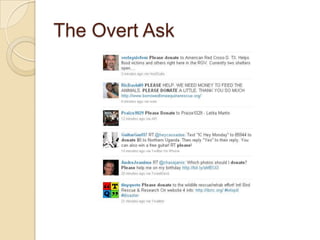
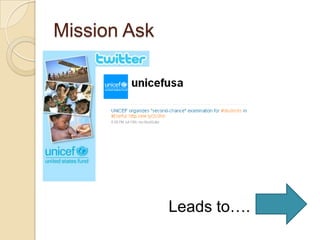
Measurement of social mediaRealize that social media today is where email fundraising was in 2000.Your goal is to engage in a conversation with supporters about your work.Incorporate their feedback, both overt and subtle.  It will change you, and invest them in your mission.Your “asks” both overt and subtle, will be measurably more effective over time.
The Overt Ask
Mission AskLeads to….
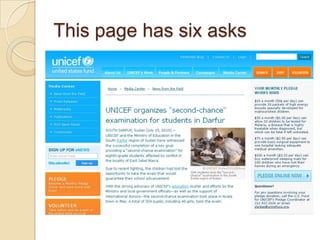
This page has six asks
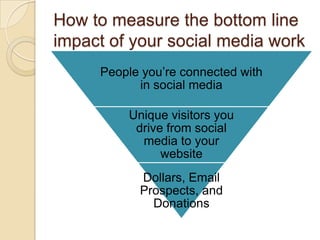
How to measure the bottom line impact of your social media work
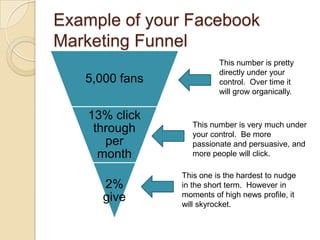
Example of your Facebook Marketing FunnelThis number is pretty directly under your control.  Over time it will grow organically.This number is very much under your control.  Be more passionate and persuasive, and more people will click.This one is the hardest to nudge in the short term.  However in moments of high news profile, it will skyrocket.
Why bother to measure it?Your staff deserves to have the results of their work connected to a bottom line organizational goal.You don’t want them to fall into the PR-trap of working hard at something without measurable impact.If you ever hope to get better at anything, you need to assess your progress along the way.
What will I learn when I review my data bi-weekly?What events and activities drive fan growth?What social media updates drive the most click thru traffic?What events cause people to give more?
Getting startedGet Google Analytics (free) deployed on your system correctly (not free, but not expensive).  Start keeping track of three metrics:Social media reachClick-thru rateGift/Volunteer conversion rateSet moderate, incremental goals for your social media staffReview bi-weekly to learn what your audience likes
Questions so far?Who looks at their analytics?Does anyone measure their social media for results?Is anyone connecting online actions to in-store donations?
Managing online crisesSooner or later, this is likely to happenThe solutions seem easy, but there are a million ways to do it wrong.
Scenario #1The New Republic has had a long running beef with Goodwill.  A headquarters employee for your area discovered that many of the nearby stores have donated issues of the New Republic on their shelves.  They’ve sent out an email asking staff in each store to remove all copies from the shelves.  A reporter got a hold of this email and is calling for comment on a story you know isn’t going to look good for you.  What do you do?
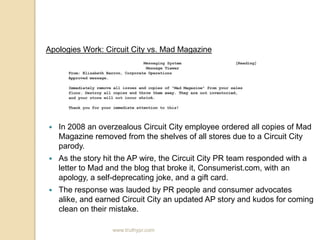
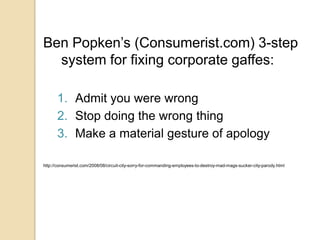
Apologies Work: Circuit City vs. Mad MagazineIn 2008 an overzealous Circuit City employee ordered all copies of Mad Magazine removed from the shelves of all stores due to a Circuit City parody.As the story hit the AP wire, the Circuit City PR team responded with a letter to Mad and the blog that broke it, Consumerist.com, with an apology, a self-deprecating joke, and a gift card.The response was lauded by PR people and consumer advocates alike, and earned Circuit City an updated AP story and kudos for coming clean on their mistake.www.truthypr.com
Ben Popken’s (Consumerist.com) 3-step system for fixing corporate gaffes:Admit you were wrongStop doing the wrong thingMake a material gesture of apologyhttp://consumerist.com/2008/08/circuit-city-sorry-for-commanding-employees-to-destroy-mad-mags-sucker-city-parody.html
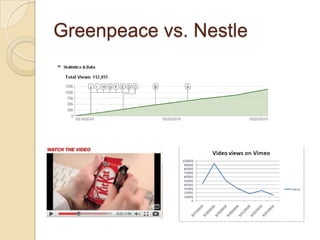
Scenario #2A critic with a beef of your organization has made a homemade video that liberally uses your trademark.  The video has been posted to YouTube.  Your legal counsel tells you that he can send a quick letter to YouTube and have it taken down.  What do you do?
Greenpeace vs. Nestle
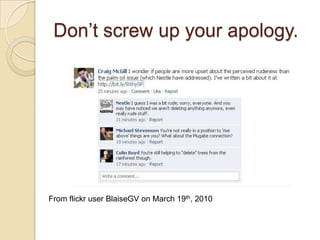
Don’t screw up your apology.From flickr user BlaiseGV on March 19th, 2010
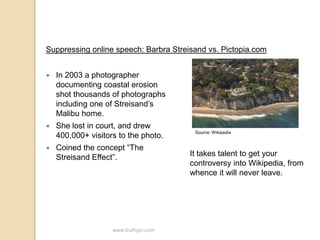
Suppressing online speech: Barbra Streisand vs. Pictopia.com In 2003 a photographer documenting coastal erosion shot thousands of photographs including one of Streisand’s Malibu home.She lost in court, and drew 400,000+ visitors to the photo.Coined the concept “The Streisand Effect”.Source: WikipediaIt takes talent to get your controversy into Wikipedia, from whence it will never leave.www.truthypr.com
Scenario #3An employee’s work is subpar and is asked to leave your organization.  A more senior employee who managed them on a few projects (but was uninvolved in their termination) gives them a glowing review on LinkedIn.Problem?
Scenario #4You have a job opening and have narrowed the search down to two candidates who have been in for second interviews.  Out of curiosity you Google both and notice that one of them has a Facebook profile that indicates they have a baby on the way and attend a Mormon church.You close your browser and never tell anyone what you found.  You hire the other candidateProblem?
FollowupThese slides are available on slideshare for download as well as the Goodwill conference extranet.   Also at www.safdaranalytics.comFor more information about setting up measurement for social media, contact Shabbir Safdar at 415-683-7526 or shabbir@safdaranalytics.comEbooks available at www.safdaranalytics.com

Help Employees Socialize Your Brand

  • 1.
    How To HelpEmployees Socialize Your Brand: Preparing For The Opportunities and PitfallsShabbir J. Imber Safdar10+ year digital agency veteranwww.safdaranalytics.comTwitter: @ShabbirSafdarConference hashtag: #GIIEvents
  • 2.
    Author / PresenterBackgroundFounder of The Safdar Group (2010), a web agency with an expertise in nonprofit web analytics.Founder of Virilion Inc (1997), a digital agency in Washington DC, Boston, NYC, & Austin specializing in online public affairs and nonprofit campaigns.Frequent speaker on online crisis communications, web analytics, social media measurement, and online strategy.Free ebook: “3 Fundraising Metrics For Your Nonprofit Website” (October 2009)Free ebook: “Is Your Nonprofit Facebook Page Worth It? Analytics and Measurement Techniques” (April 2010)Ebooks available at www.safdaranalytics.com
  • 3.
    What are youhere for?I am a marketing or communications staffer with some responsibility for creating a social presence for the organization and guiding my colleagues.88 of 166 Goodwills are using social media (Source: GII)
  • 4.
    We’re going tocoverA tiny tutorial on “how to” get more social.The policies you should have in place to do so and guide your team and your non-communications-savvy colleagues.How to develop measurable goals for your social media work
  • 5.
    Can a modernnonprofit ignore social media? No.Your supporters and detractors will use it to talk about you, whether you want them to or not.Your competitors are using it to drive attention to their efforts. Can you afford to cede all that attention to them?Sooner or later, someone in your organization with responsibility who can’t take it anymore will start an initiative.
  • 6.
    Can we setit up and lock it down? No.It’s not social if you’re using it to broadcast press releases written in the third person, and you’ll suffer from either:a crisis caused by a tin ear (not likely), or a complete lack of effectiveness (likely).
  • 7.
    What is requiredfor success?A commitment throughout the organization to transparency, listening, and storytelling;Guidance in the form of policies both for staff and for you web visitors;Well-understood organizational and PR goals; andA commitment to measure the results and learn from them.
  • 8.
    Transparency, why?There areno secrets online.The details that make your passion authentic are not big, polished, infrequent stories.They are tiny details.Show prospective supporters frequently that you “sweat the small stuff.”
  • 9.
    Why do welisten?We need feedback: positive, negative, and disinterest.Positive feedback is deceptive: we don’t want to be told we’re great, but what is resonant.Negative feedback is passion at odds with expectation (not to be confused with trolls)Disinterest is the worst of all.
  • 10.
    How do welisten?Avoid “tool obsession”Crank up Google Alerts and HootSuite for Twitter search using:Your organization’s nameYour nearest competitor’s nameKey phrases around your missionDon’t worry about “centralizing” listening in your organization.
  • 11.
    StorytellingLittle details ofyour work in the context of the organization’s missionExamples:“I’m eating soup.” (Poor)“Having lunch with Joe from the Career center. He runs the weekly career seminars”“Three laid off auto workers from the Numi plant in tonight’s career seminar. Three families suffered in that layoff.”
  • 12.
    It’s a process,not an answerSpeakListenAdjustRepeat
  • 13.
    More infoBeth Kanter’sblog: http://www.bethkanter.orgAllison Fine’s blog: http://afine2.wordpress.com/
  • 14.
    Policies for staffYouneed policies in place for staff because they need guidance.Many of them, especially the digital natives, aren’t public relations natives.Guidelines:Be honest.Be nice.Don’t talk out of school.
  • 15.
    A great socialmedia policyEnvironmental Defense Fund’sKey points:Nothing online is secretEverything online exists forever; nothing can be deletedThere’s no such thing as a personal controversial opinion; your job is always a part of youAlso see the story behind this policy
  • 16.
    Goodwill Social MediaPoliciesTacoma, WA and Greater New York – New JerseyKey points:Be polishedBe respectfulBe relevantDon’t talk out of schoolArlene has a social media policy available for Goodwill’s to adapt for your own use.Note that policies should ideally cover people blogging on company time about their work, as well as people sharing online on their own time.
  • 17.
    Who answers what?Atlarge organizations it gets pushed to the experts, away from communications.In small organizations it probably comes back to the communications or marketing person who learns about everything you do.
  • 18.
    What new rolesdoes this create?Communications and Marketing needs to take on:Listening on behalf of the whole organization; andMeasurement of results.
  • 19.
    Red Cross PersonalOnline Communications GuidelinesDon’tReveal confidential informationLink to guidelinesDoUse disclaimersBe transparentBe accurateBe considerateRespect copyrightTell us about your blogBe generousBe a good bloggerRespect work commitmentsUphold the Fundamental Principles
  • 20.
    Handbooks and GuidelinesApartfrom a policy, you also want to give guidance in the specifics of your missionGuidance for logo usage, specifics tips about tools, and common pitfalls that people working within your mission might encounter (privacy issues, for example)Read the Red Cross social media guidelines designed to bring chapters up to speed on social media.
  • 21.
    Common Pitfalls OnlineThinkingwhat you post is “hidden” by a password or “privacy settings”.Thinking that because you don’t identify your place of employment, nobody will know.Once you type it into a computer connected to the Internet, it’s fair game to wind up on CNN someday.
  • 22.
    Questions so far?Haveyou had an incident?Are you listening?
  • 23.
    Measurement of socialmediaRealize that social media today is where email fundraising was in 2000.Your goal is to engage in a conversation with supporters about your work.Incorporate their feedback, both overt and subtle. It will change you, and invest them in your mission.Your “asks” both overt and subtle, will be measurably more effective over time.
  • 24.
  • 25.
  • 26.
  • 27.
    How to measurethe bottom line impact of your social media work
  • 28.
    Example of yourFacebook Marketing FunnelThis number is pretty directly under your control. Over time it will grow organically.This number is very much under your control. Be more passionate and persuasive, and more people will click.This one is the hardest to nudge in the short term. However in moments of high news profile, it will skyrocket.
  • 29.
    Why bother tomeasure it?Your staff deserves to have the results of their work connected to a bottom line organizational goal.You don’t want them to fall into the PR-trap of working hard at something without measurable impact.If you ever hope to get better at anything, you need to assess your progress along the way.
  • 30.
    What will Ilearn when I review my data bi-weekly?What events and activities drive fan growth?What social media updates drive the most click thru traffic?What events cause people to give more?
  • 31.
    Getting startedGet GoogleAnalytics (free) deployed on your system correctly (not free, but not expensive). Start keeping track of three metrics:Social media reachClick-thru rateGift/Volunteer conversion rateSet moderate, incremental goals for your social media staffReview bi-weekly to learn what your audience likes
  • 32.
    Questions so far?Wholooks at their analytics?Does anyone measure their social media for results?Is anyone connecting online actions to in-store donations?
  • 33.
    Managing online crisesSooneror later, this is likely to happenThe solutions seem easy, but there are a million ways to do it wrong.
  • 34.
    Scenario #1The NewRepublic has had a long running beef with Goodwill. A headquarters employee for your area discovered that many of the nearby stores have donated issues of the New Republic on their shelves. They’ve sent out an email asking staff in each store to remove all copies from the shelves. A reporter got a hold of this email and is calling for comment on a story you know isn’t going to look good for you. What do you do?
  • 35.
    Apologies Work: CircuitCity vs. Mad MagazineIn 2008 an overzealous Circuit City employee ordered all copies of Mad Magazine removed from the shelves of all stores due to a Circuit City parody.As the story hit the AP wire, the Circuit City PR team responded with a letter to Mad and the blog that broke it, Consumerist.com, with an apology, a self-deprecating joke, and a gift card.The response was lauded by PR people and consumer advocates alike, and earned Circuit City an updated AP story and kudos for coming clean on their mistake.www.truthypr.com
  • 36.
    Ben Popken’s (Consumerist.com)3-step system for fixing corporate gaffes:Admit you were wrongStop doing the wrong thingMake a material gesture of apologyhttp://consumerist.com/2008/08/circuit-city-sorry-for-commanding-employees-to-destroy-mad-mags-sucker-city-parody.html
  • 37.
    Scenario #2A criticwith a beef of your organization has made a homemade video that liberally uses your trademark. The video has been posted to YouTube. Your legal counsel tells you that he can send a quick letter to YouTube and have it taken down. What do you do?
  • 38.
  • 39.
    Don’t screw upyour apology.From flickr user BlaiseGV on March 19th, 2010
  • 40.
    Suppressing online speech:Barbra Streisand vs. Pictopia.com In 2003 a photographer documenting coastal erosion shot thousands of photographs including one of Streisand’s Malibu home.She lost in court, and drew 400,000+ visitors to the photo.Coined the concept “The Streisand Effect”.Source: WikipediaIt takes talent to get your controversy into Wikipedia, from whence it will never leave.www.truthypr.com
  • 41.
    Scenario #3An employee’swork is subpar and is asked to leave your organization. A more senior employee who managed them on a few projects (but was uninvolved in their termination) gives them a glowing review on LinkedIn.Problem?
  • 42.
    Scenario #4You havea job opening and have narrowed the search down to two candidates who have been in for second interviews. Out of curiosity you Google both and notice that one of them has a Facebook profile that indicates they have a baby on the way and attend a Mormon church.You close your browser and never tell anyone what you found. You hire the other candidateProblem?
  • 43.
    FollowupThese slides areavailable on slideshare for download as well as the Goodwill conference extranet. Also at www.safdaranalytics.comFor more information about setting up measurement for social media, contact Shabbir Safdar at 415-683-7526 or shabbir@safdaranalytics.comEbooks available at www.safdaranalytics.com