Making comms
indispensable
Julie Kangisser
10th July 2019
Intro
WARNING - DON’T WAIT FOR A STRATEGIC
REVIEW TO HAPPEN TO YOU
THE PROBLEM
MAY BE
BIGGER THAN
YOU THINK
Our CEO values comms 85%
Our organisation respects comms 59%
Our trustees understand the value of comms 54%
[Charity Comms Comms Benchmark 2017]
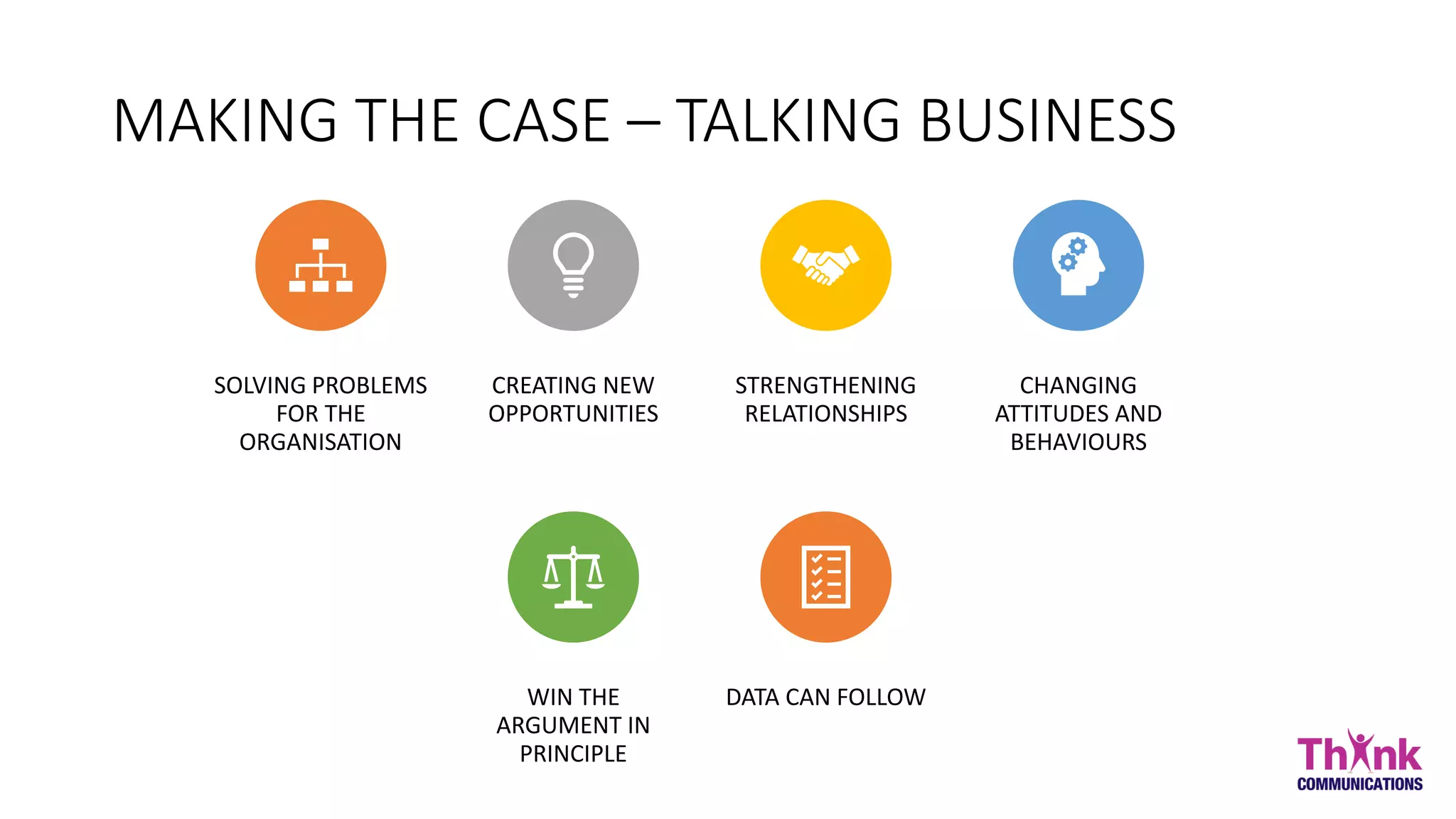
MAKING THE CASE – TALKING BUSINESS
SOLVING PROBLEMS
FOR THE
ORGANISATION
CREATING NEW
OPPORTUNITIES
STRENGTHENING
RELATIONSHIPS
CHANGING
ATTITUDES AND
BEHAVIOURS
WIN THE
ARGUMENT IN
PRINCIPLE
DATA CAN FOLLOW
Small Charity Leaders Insight Report 18/19
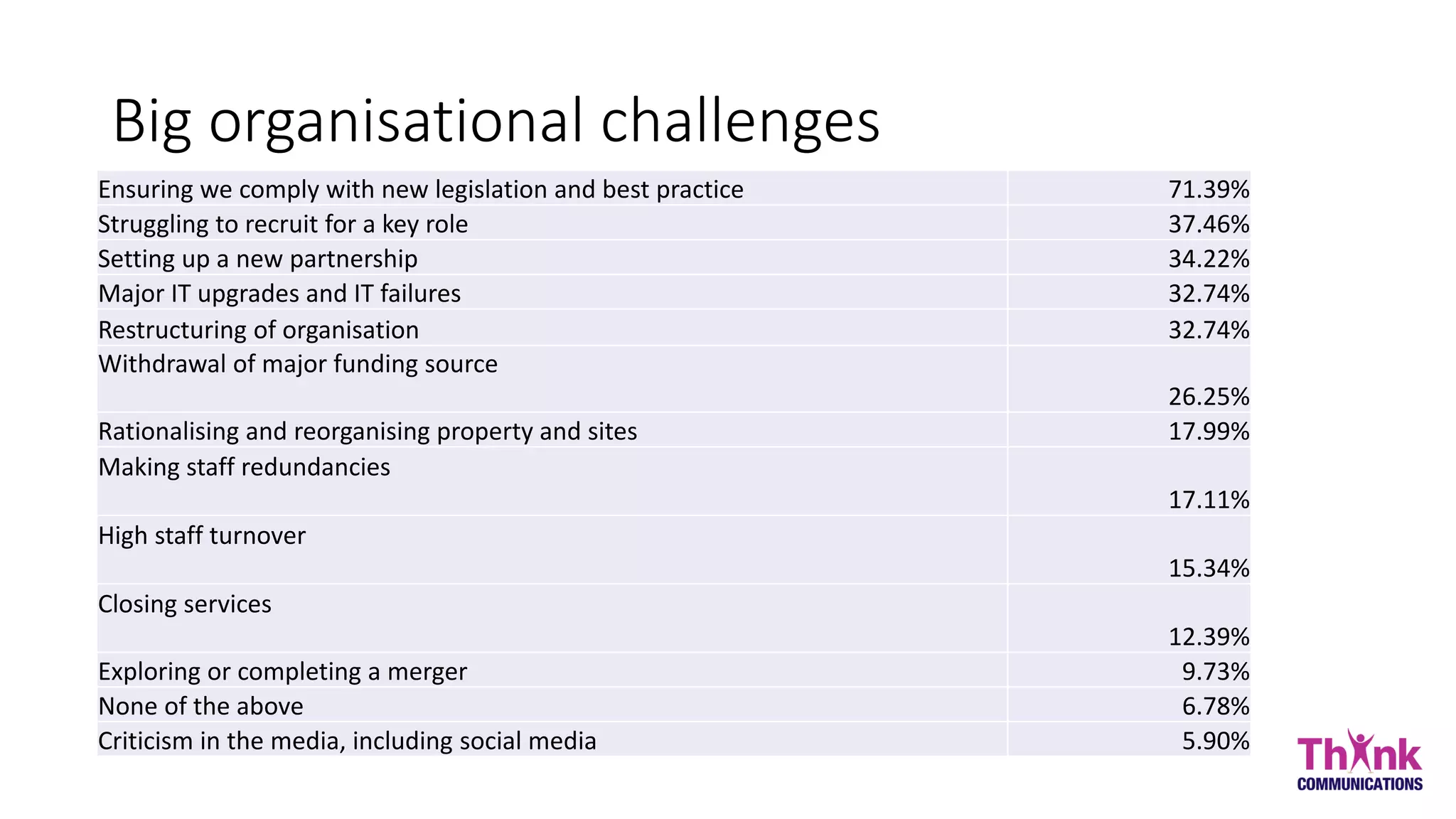
Big organisational challenges
Ensuring we comply with new legislation and best practice 71.39%
Struggling to recruit for a key role 37.46%
Setting up a new partnership 34.22%
Major IT upgrades and IT failures 32.74%
Restructuring of organisation 32.74%
Withdrawal of major funding source
26.25%
Rationalising and reorganising property and sites 17.99%
Making staff redundancies
17.11%
High staff turnover
15.34%
Closing services
12.39%
Exploring or completing a merger 9.73%
None of the above 6.78%
Criticism in the media, including social media 5.90%
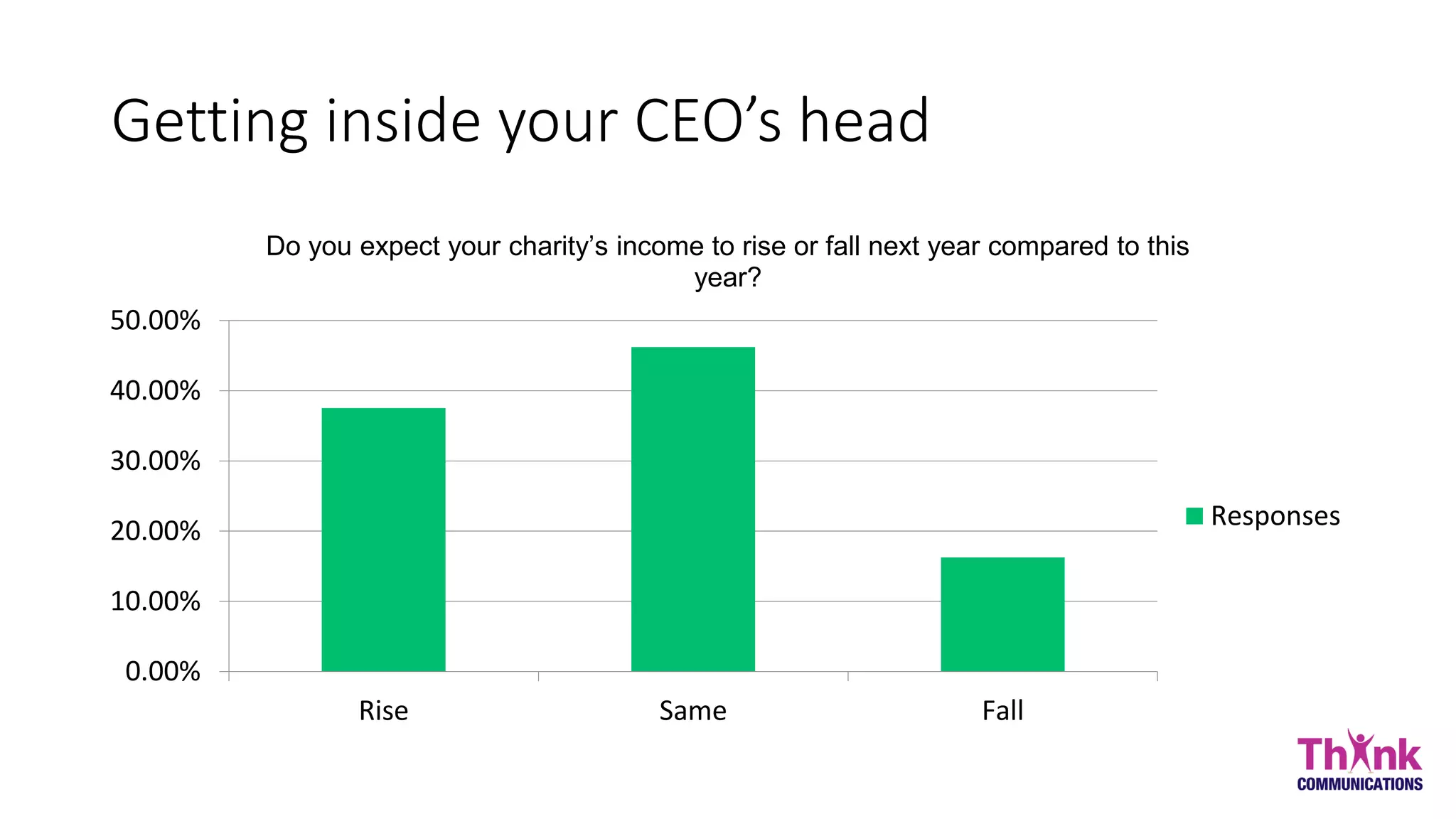
Getting inside your CEO’s head
Rise Same Fall
0.00%
10.00%
20.00%
30.00%
40.00%
50.00%
Do you expect your charity’s income to rise or fall next year compared to this
year?
Responses
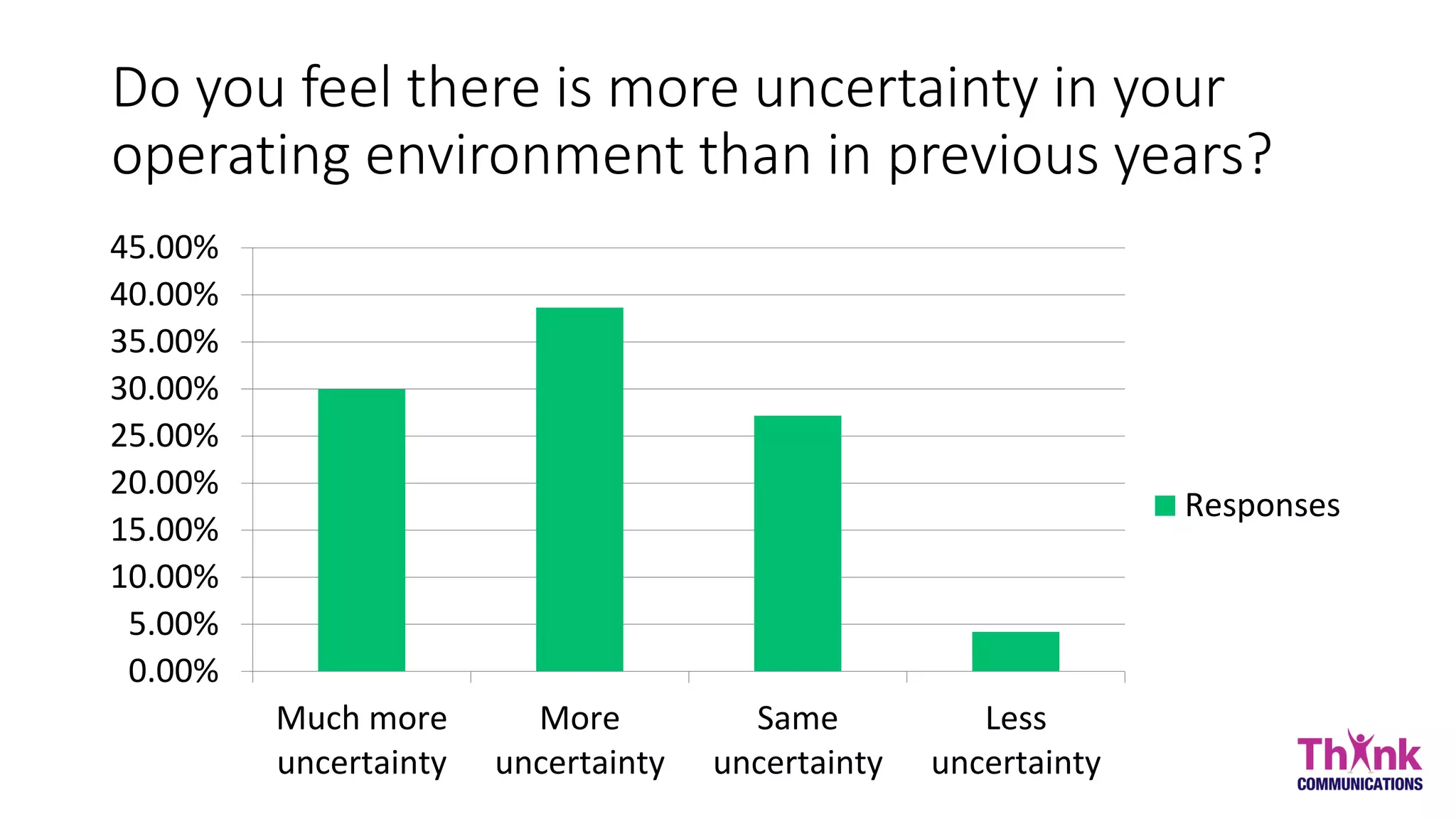
Do you feel there is more uncertainty in your
operating environment than in previous years?
Much more
uncertainty
More
uncertainty
Same
uncertainty
Less
uncertainty
0.00%
5.00%
10.00%
15.00%
20.00%
25.00%
30.00%
35.00%
40.00%
45.00%
Responses
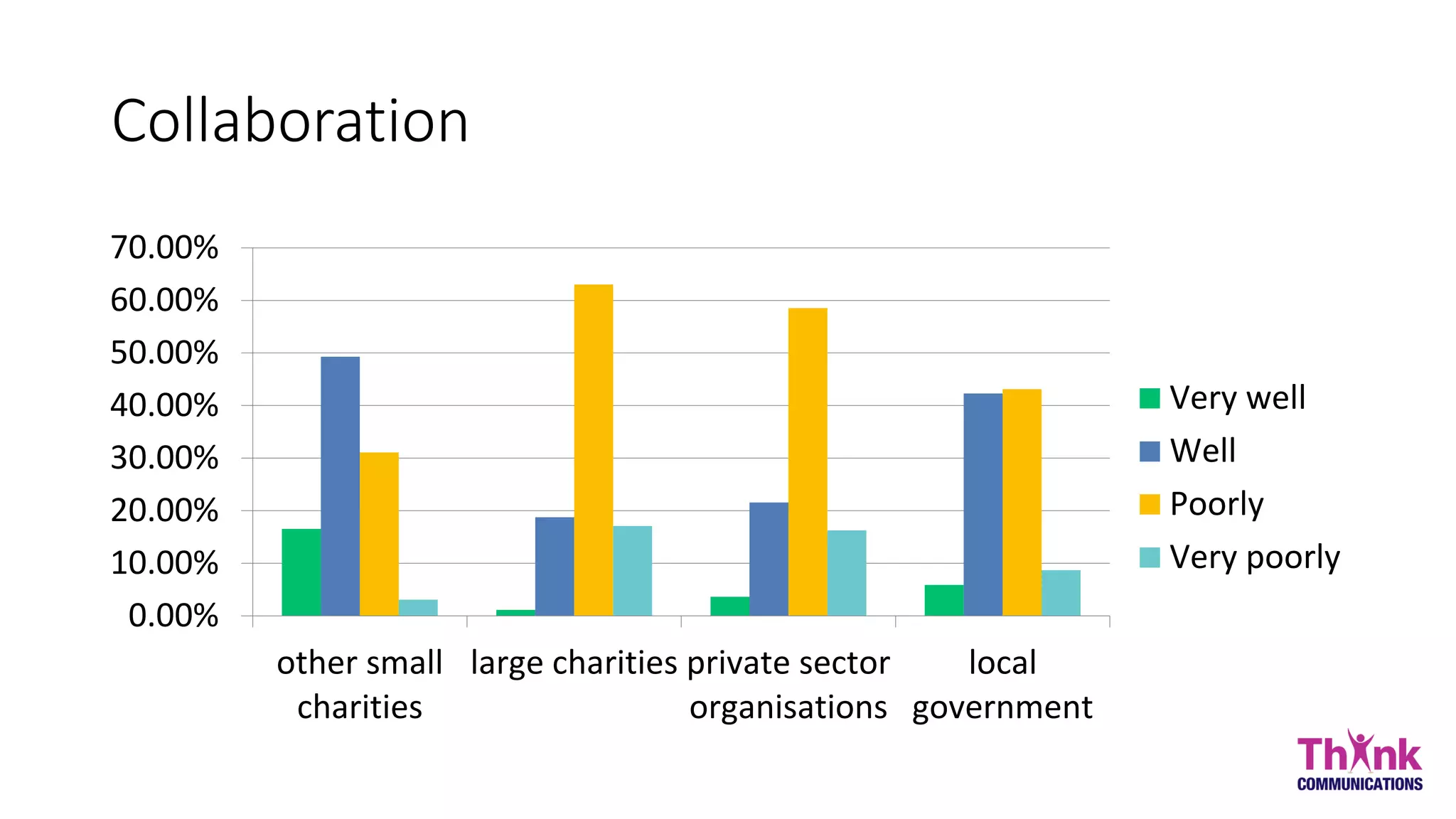
Collaboration
other small
charities
large charities private sector
organisations
local
government
0.00%
10.00%
20.00%
30.00%
40.00%
50.00%
60.00%
70.00%
Very well
Well
Poorly
Very poorly
Stakeholder support
local people local
businesses
local
government
central
government
0.00%
10.00%
20.00%
30.00%
40.00%
50.00%
60.00%
70.00%
80.00%
Level of support
Excellent. We get the support we need.
Good. But we need more.
We don’t get the support we need.
N/A we don't need their support
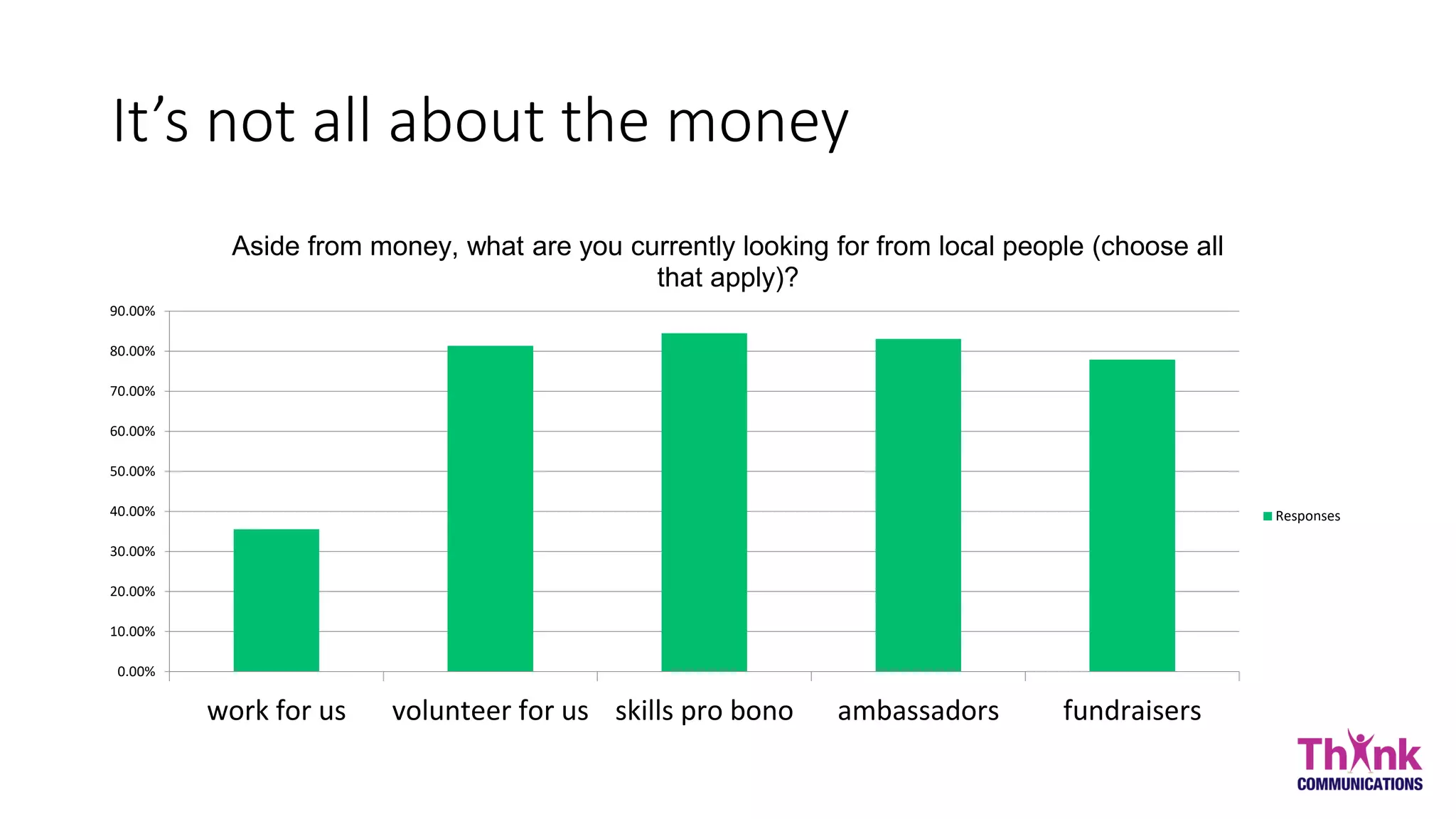
It’s not all about the money
work for us volunteer for us skills pro bono ambassadors fundraisers
0.00%
10.00%
20.00%
30.00%
40.00%
50.00%
60.00%
70.00%
80.00%
90.00%
Aside from money, what are you currently looking for from local people (choose all
that apply)?
Responses
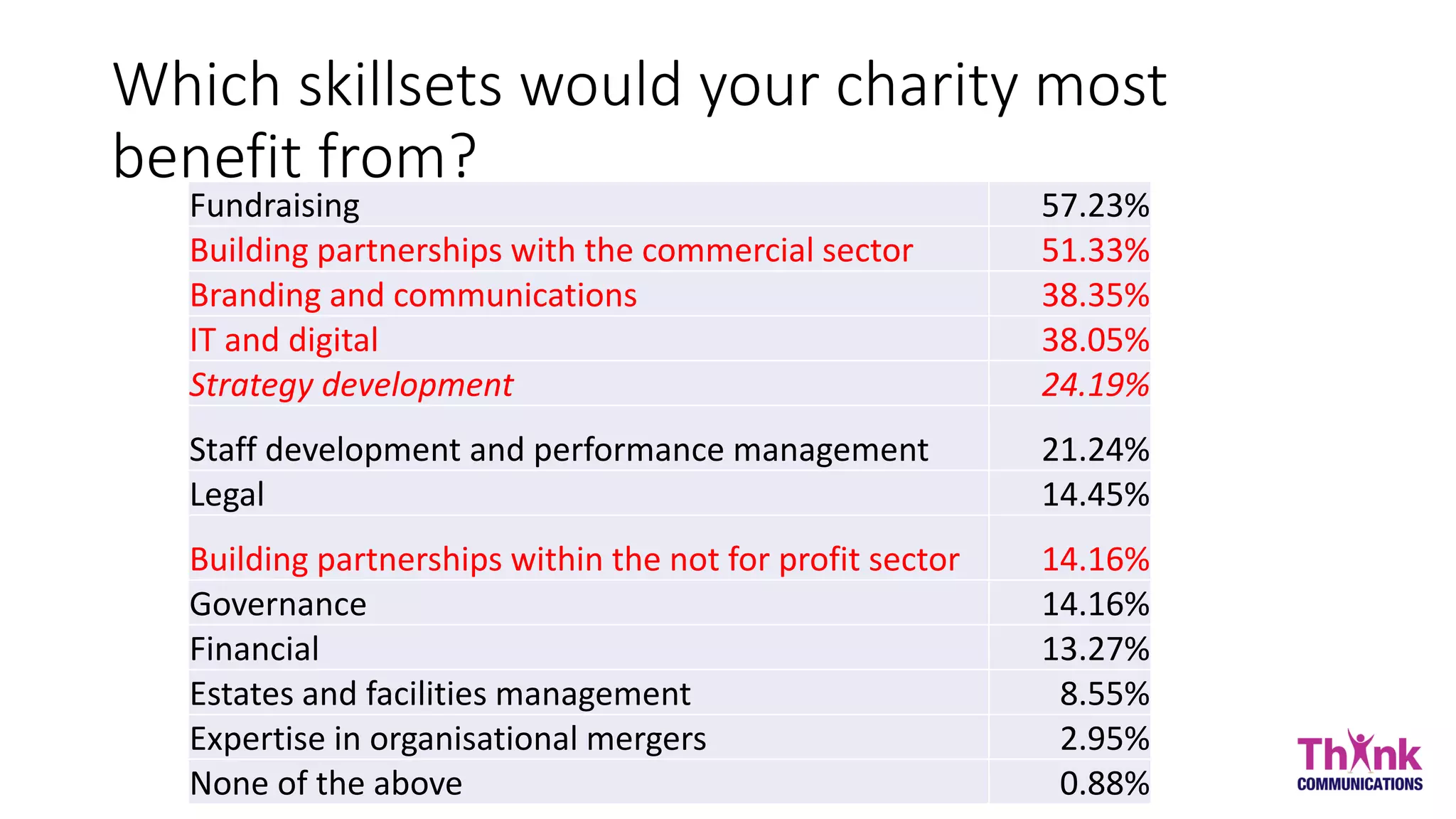
Which skillsets would your charity most
benefit from?
Fundraising 57.23%
Building partnerships with the commercial sector 51.33%
Branding and communications 38.35%
IT and digital 38.05%
Strategy development 24.19%
Staff development and performance management 21.24%
Legal 14.45%
Building partnerships within the not for profit sector 14.16%
Governance 14.16%
Financial 13.27%
Estates and facilities management 8.55%
Expertise in organisational mergers 2.95%
None of the above 0.88%
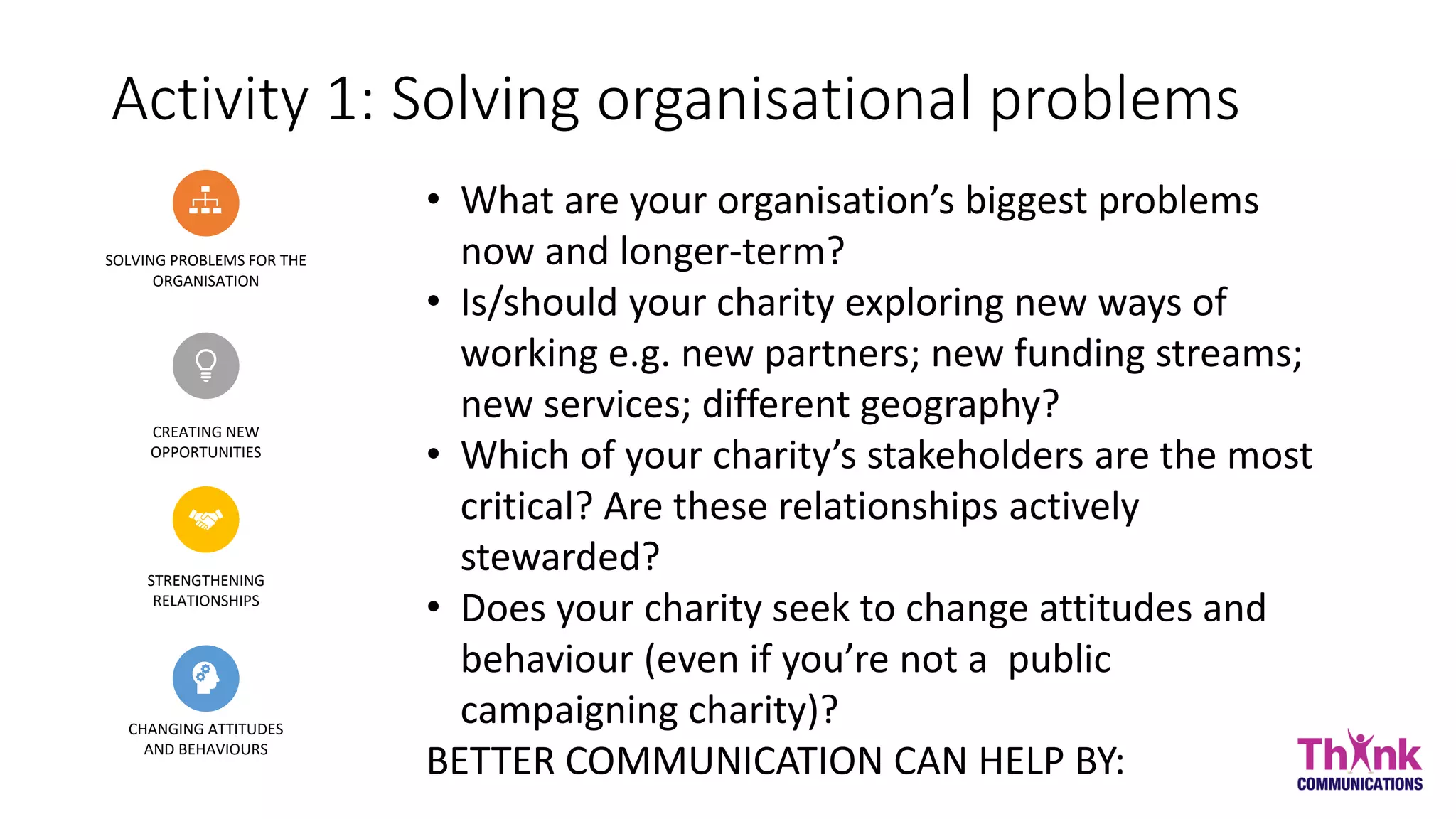
Activity 1: Solving organisational problems
SOLVING PROBLEMS FOR THE
ORGANISATION
CREATING NEW
OPPORTUNITIES
STRENGTHENING
RELATIONSHIPS
CHANGING ATTITUDES
AND BEHAVIOURS
• What are your organisation’s biggest problems
now and longer-term?
• Is/should your charity exploring new ways of
working e.g. new partners; new funding streams;
new services; different geography?
• Which of your charity’s stakeholders are the most
critical? Are these relationships actively
stewarded?
• Does your charity seek to change attitudes and
behaviour (even if you’re not a public
campaigning charity)?
BETTER COMMUNICATION CAN HELP BY:
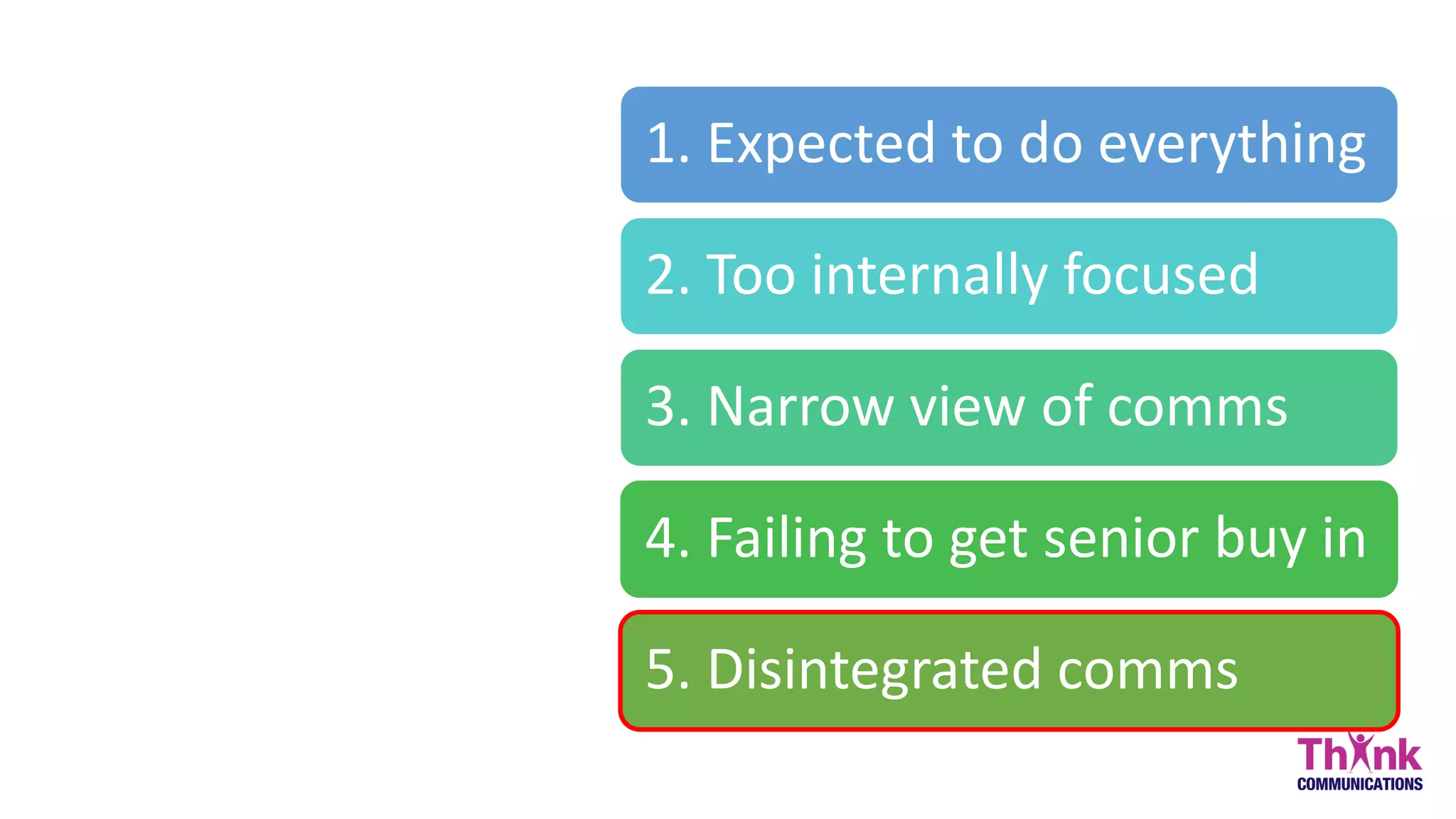
ORGANISATIONAL
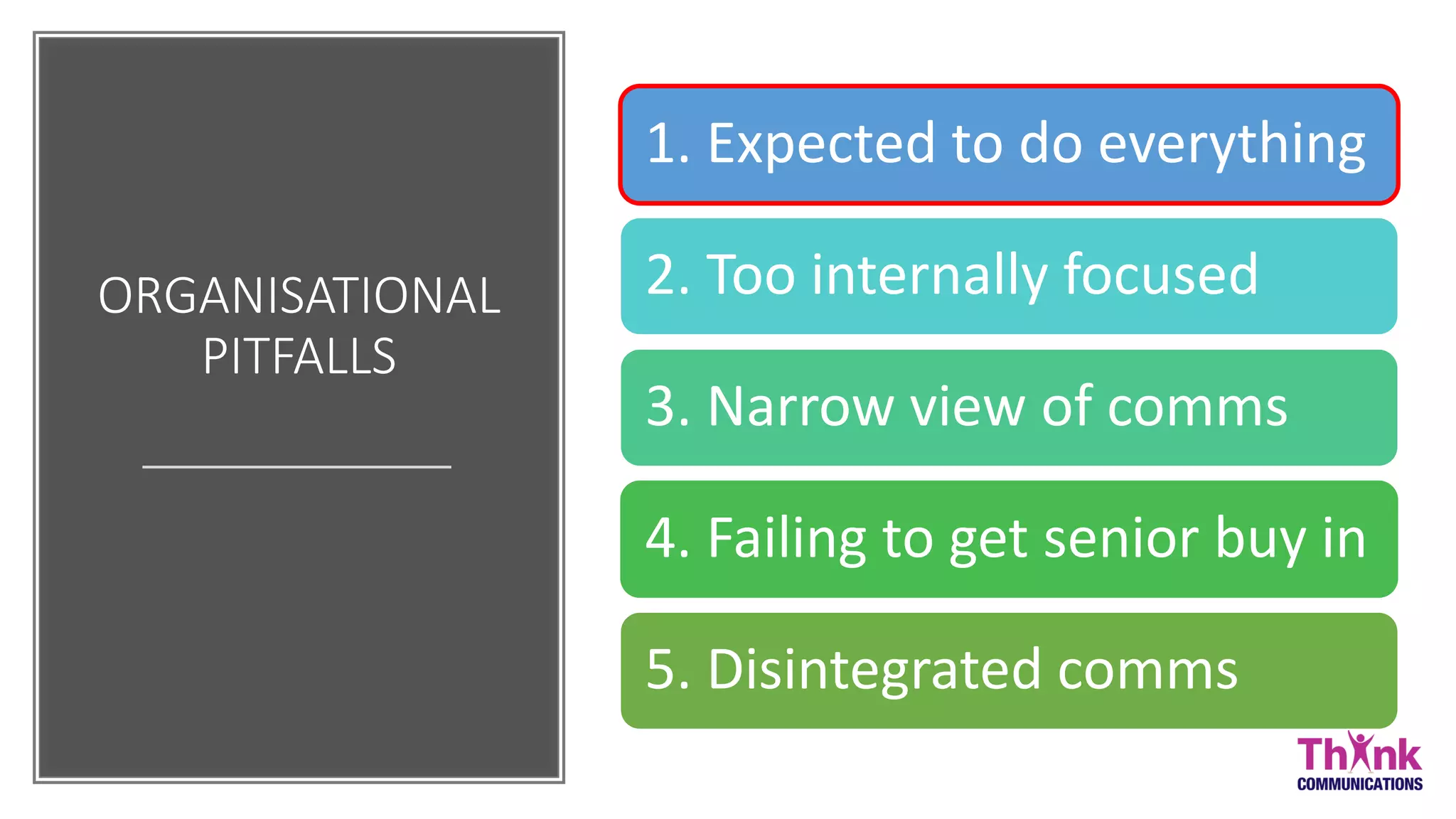
PITFALLS
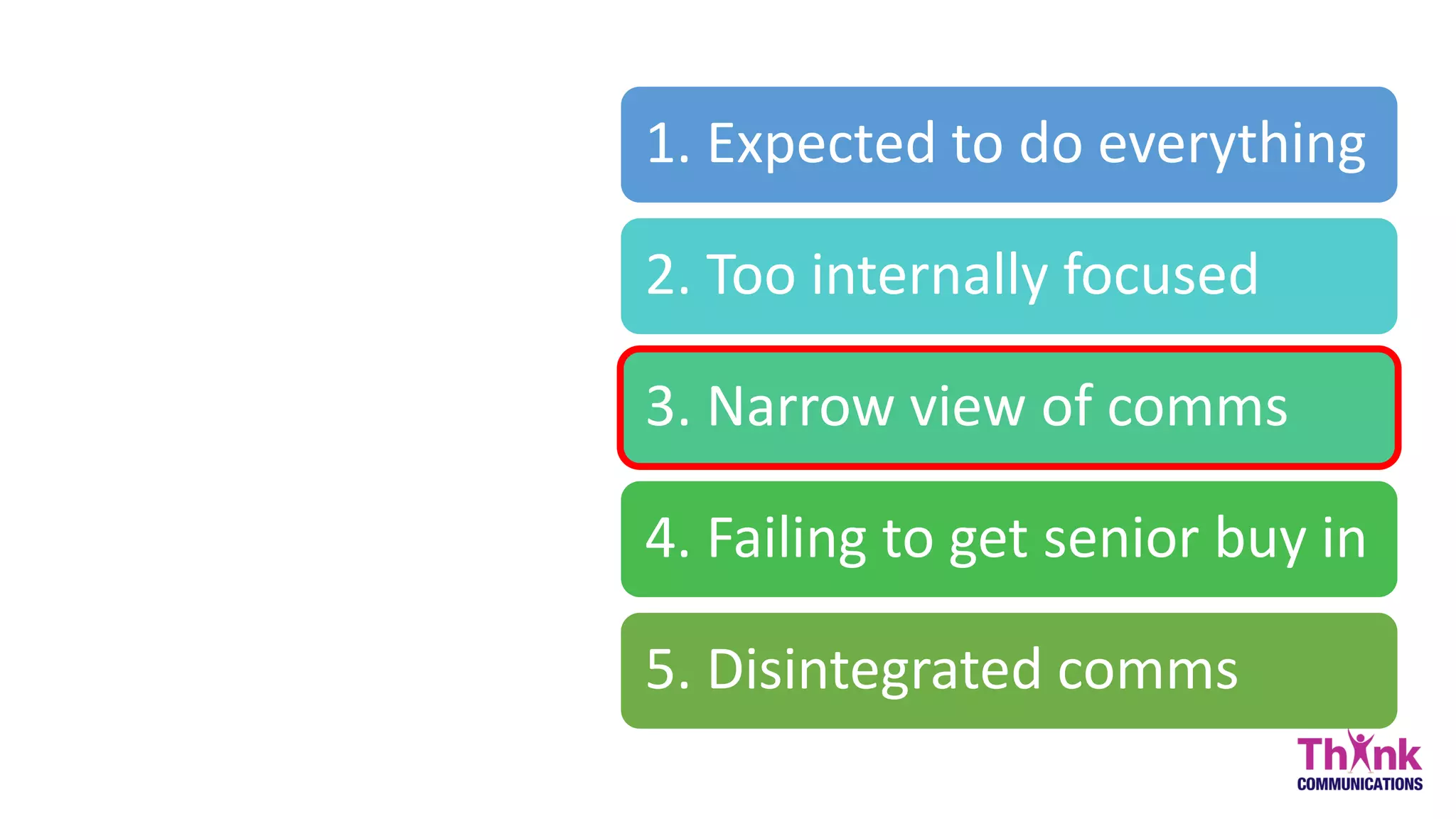
1. Expected to do everything
2. Too internally focused
3. Narrow view of comms
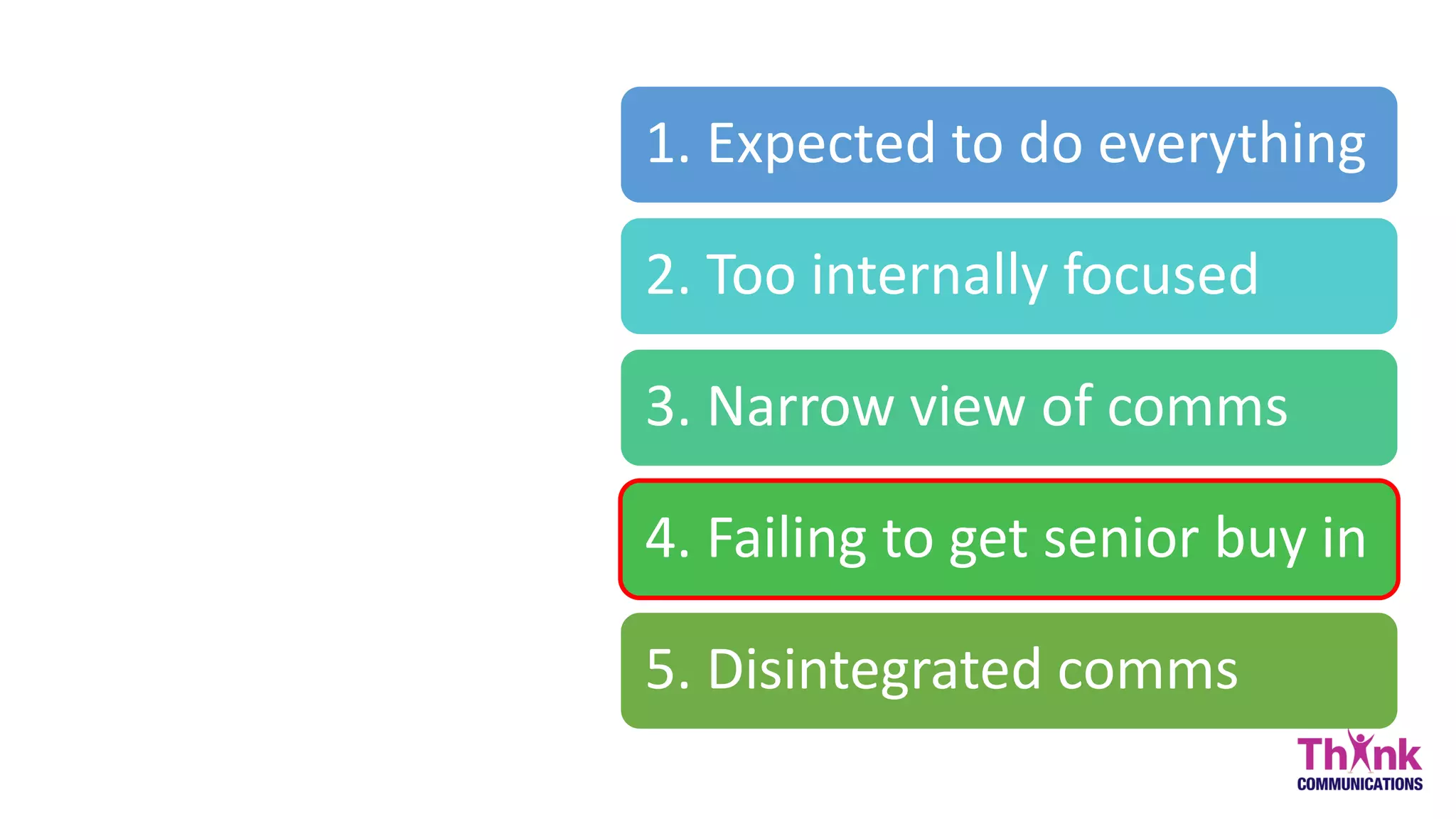
4. Failing to get senior buy in
5. Disintegrated comms
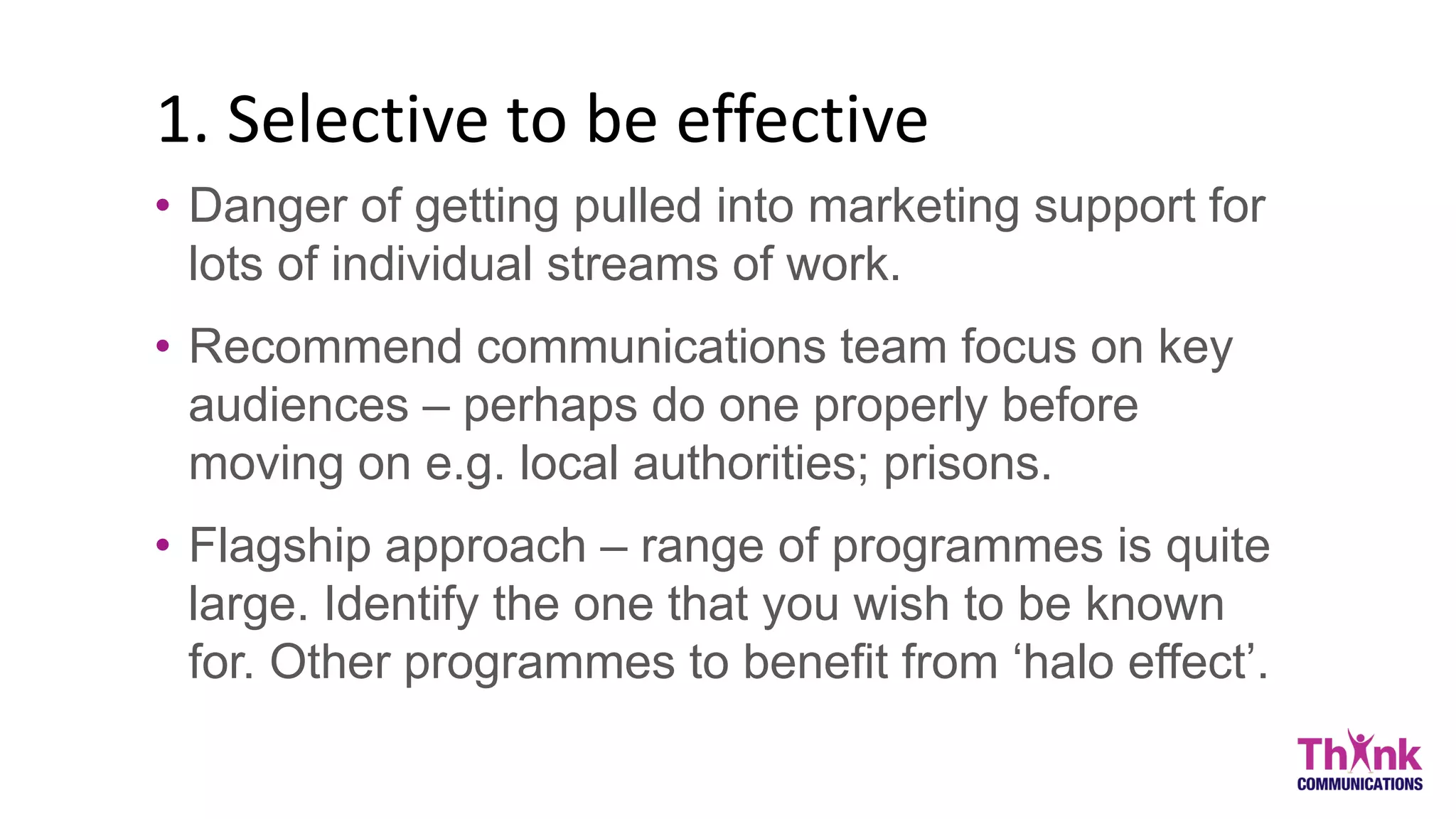
1. Selective to be effective
• Danger of getting pulled into marketing support for
lots of individual streams of work.
• Recommend communications team focus on key
audiences – perhaps do one properly before
moving on e.g. local authorities; prisons.
• Flagship approach – range of programmes is quite
large. Identify the one that you wish to be known
for. Other programmes to benefit from ‘halo effect’.
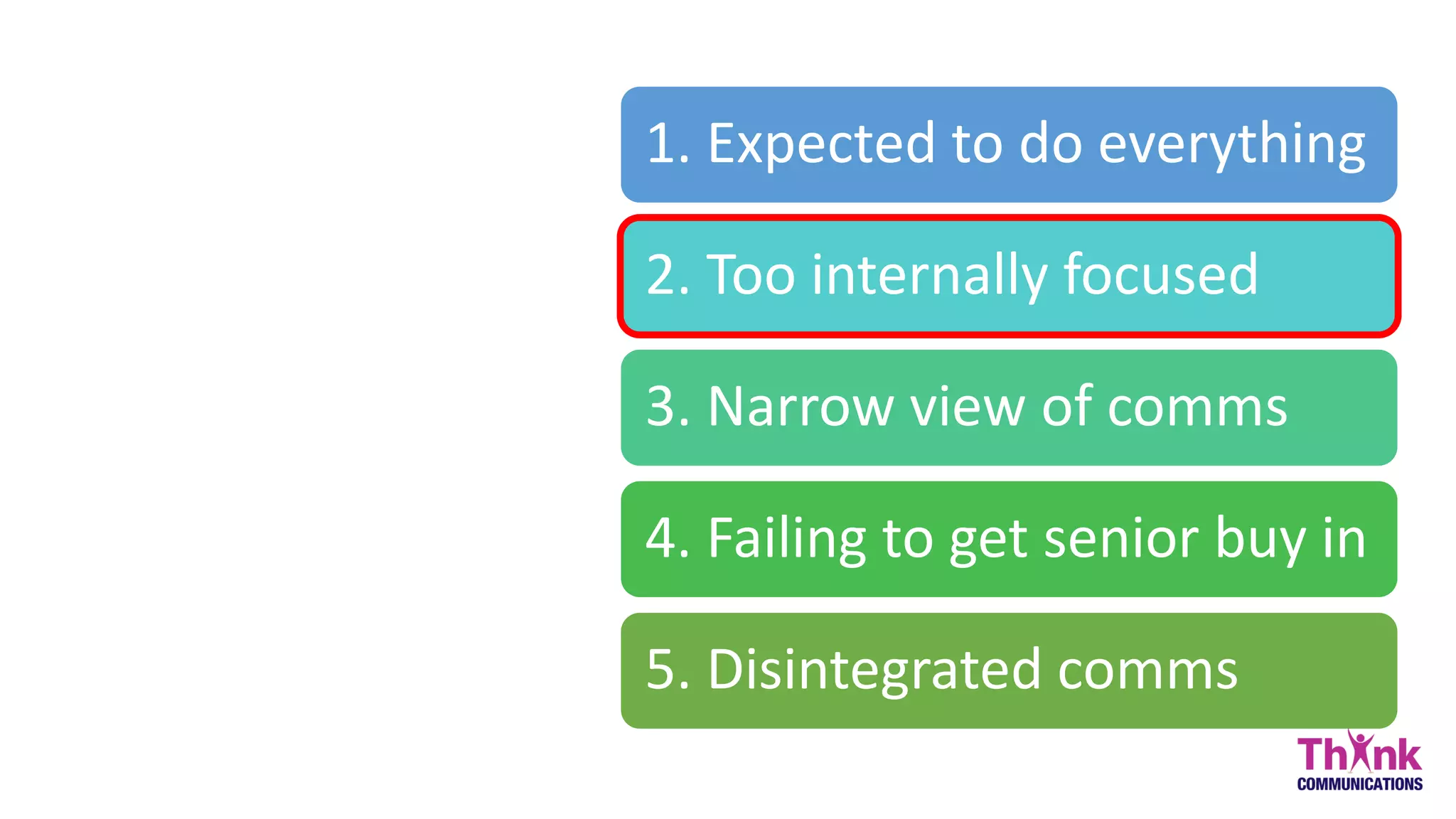
ORGANISATIONAL
PITFALLS
1. Expected to do everything
2. Too internally focused
3. Narrow view of comms
4. Failing to get senior buy in
5. Disintegrated comms
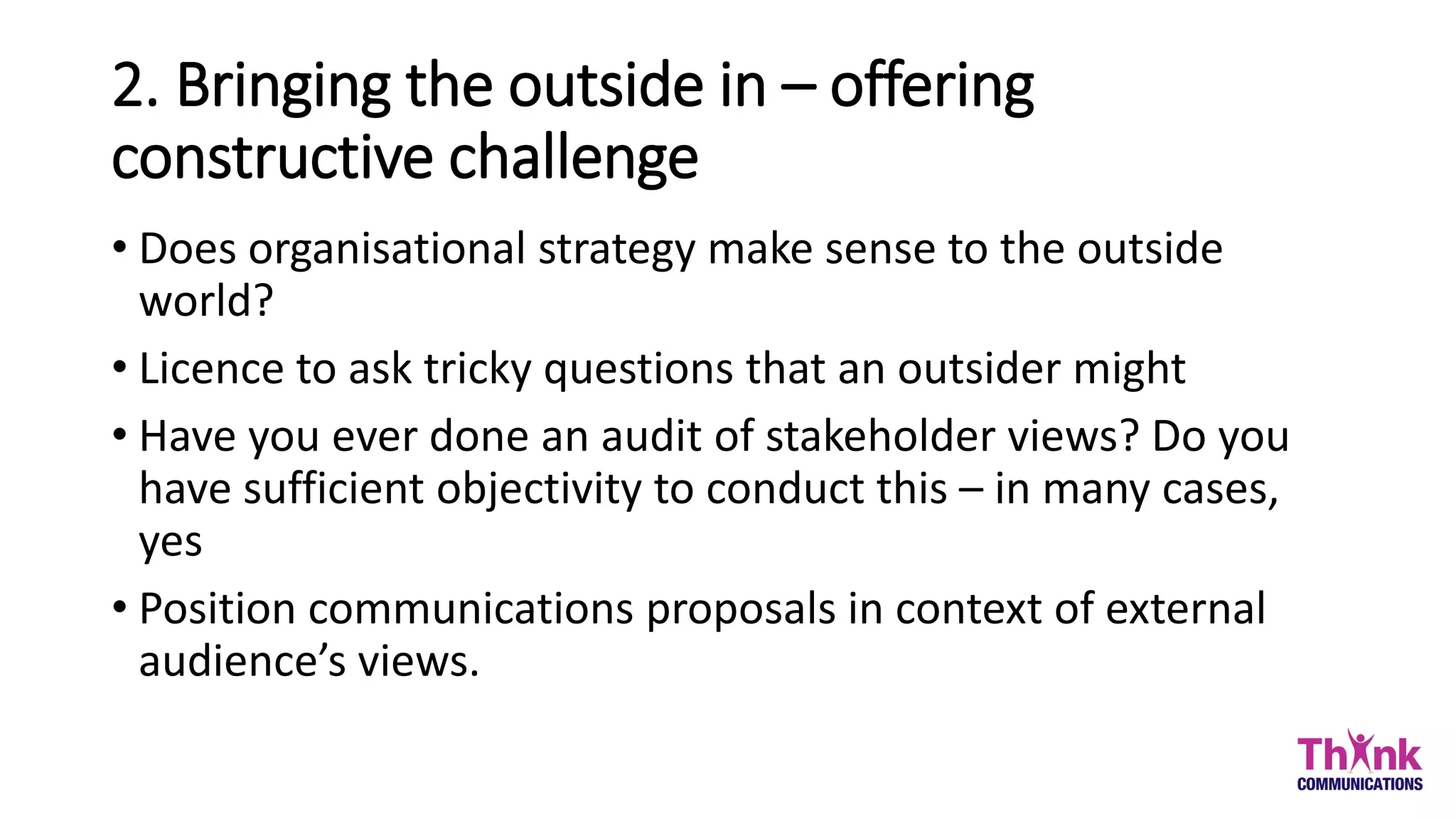
2. Bringing the outside in – offering
constructive challenge
• Does organisational strategy make sense to the outside
world?
• Licence to ask tricky questions that an outsider might
• Have you ever done an audit of stakeholder views? Do you
have sufficient objectivity to conduct this – in many cases,
yes
• Position communications proposals in context of external
audience’s views.
ORGANISATIONAL
PITFALLS
1. Expected to do everything
2. Too internally focused
3. Narrow view of comms
4. Failing to get senior buy in
5. Disintegrated comms
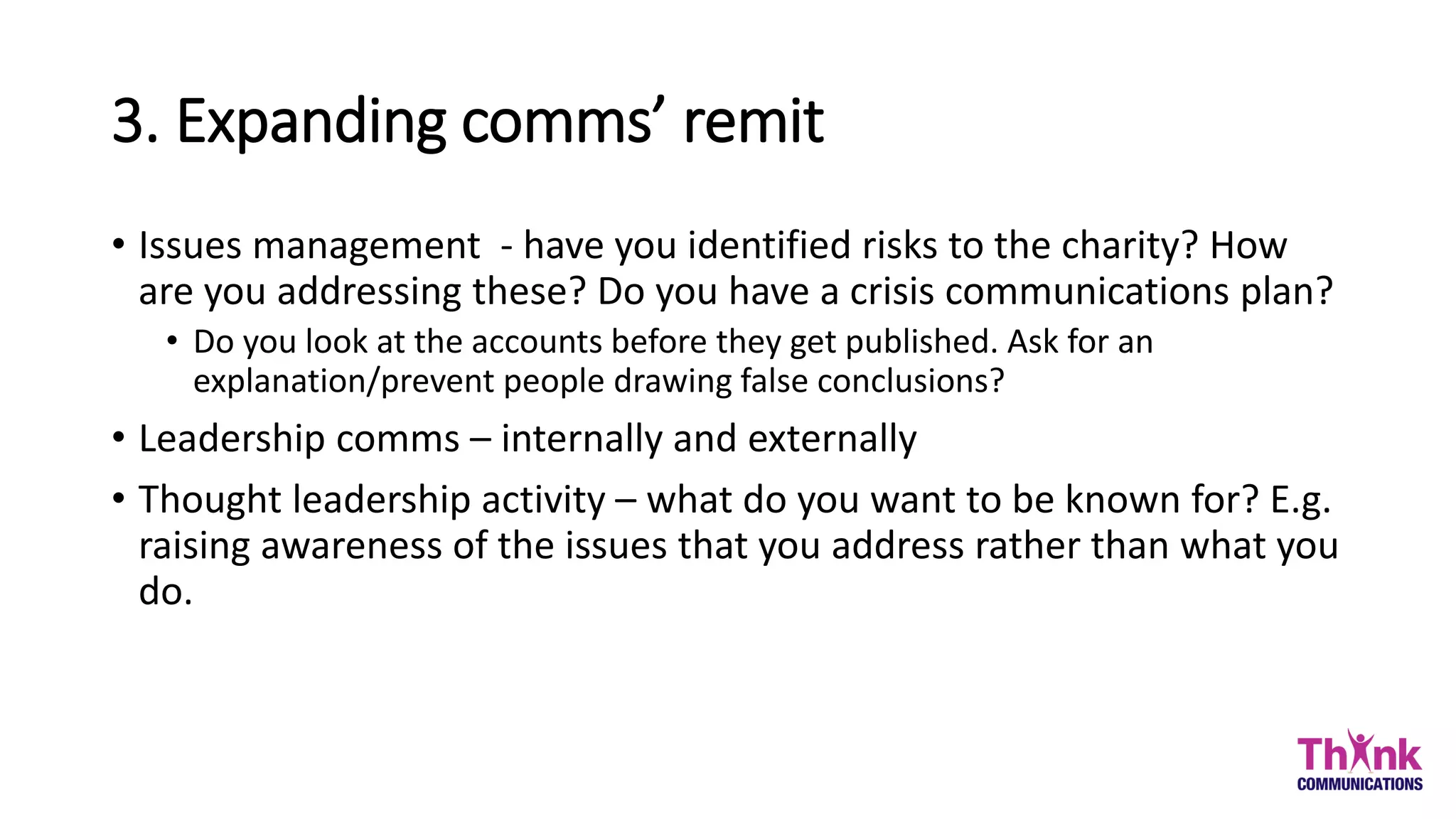
3. Expanding comms’ remit
• Issues management - have you identified risks to the charity? How
are you addressing these? Do you have a crisis communications plan?
• Do you look at the accounts before they get published. Ask for an
explanation/prevent people drawing false conclusions?
• Leadership comms – internally and externally
• Thought leadership activity – what do you want to be known for? E.g.
raising awareness of the issues that you address rather than what you
do.
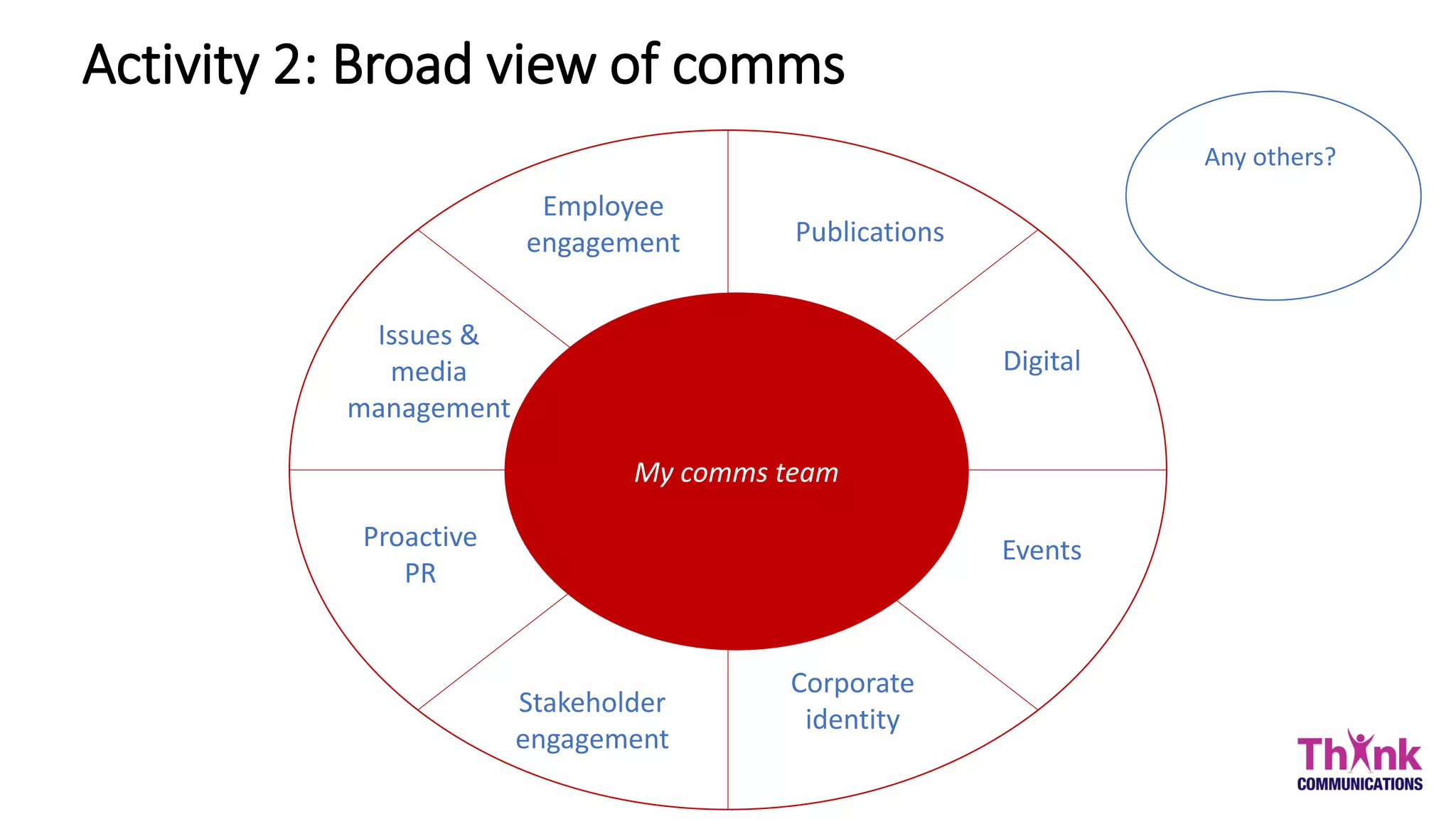
Employee
engagement
Issues &
media
management
Proactive
PR
Stakeholder
engagement
Publications
Digital
Events
Corporate
identity
My comms team
Activity 2: Broad view of comms
Any others?
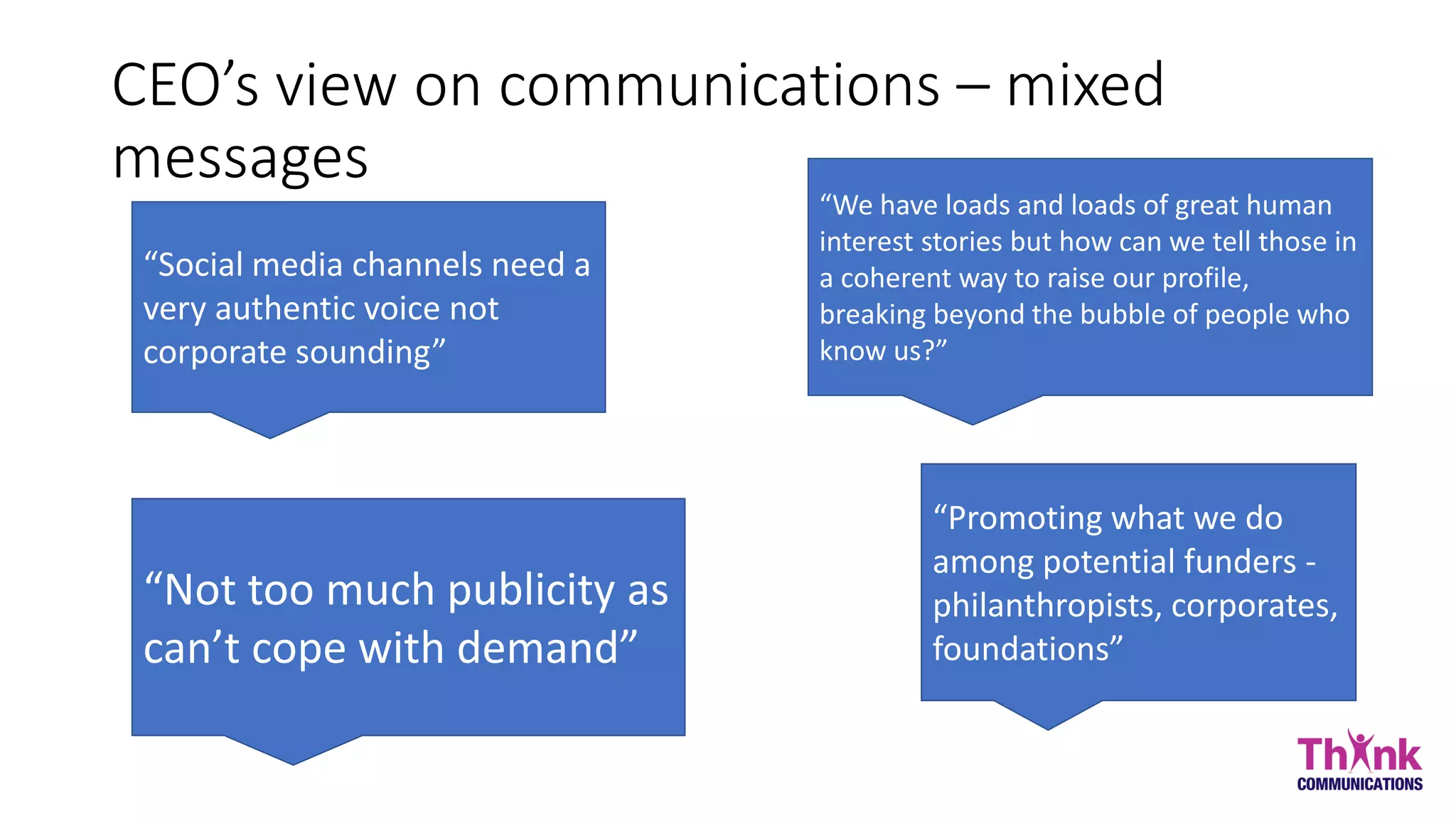
CEO’s view on communications – mixed
messages
“Promoting what we do
among potential funders -
philanthropists, corporates,
foundations”
“We have loads and loads of great human
interest stories but how can we tell those in
a coherent way to raise our profile,
breaking beyond the bubble of people who
know us?”
“Social media channels need a
very authentic voice not
corporate sounding”
“Not too much publicity as
can’t cope with demand”
CEO’s views
“Reaching new
volunteers and
keeping them
engaged”
“thoughtful work engaging with
deaf communities around their
needs”
“Being in the right place at the right
time to comment on emerging
trends and being able to be part of
that conversation, keeping our name
out there.”
“Someone to work at a
community-level, we don’t do
very well at shouting what we
do and demonstrating our
impact”
ORGANISATIONAL
PITFALLS
1. Expected to do everything
2. Too internally focused
3. Narrow view of comms
4. Failing to get senior buy in
5. Disintegrated comms
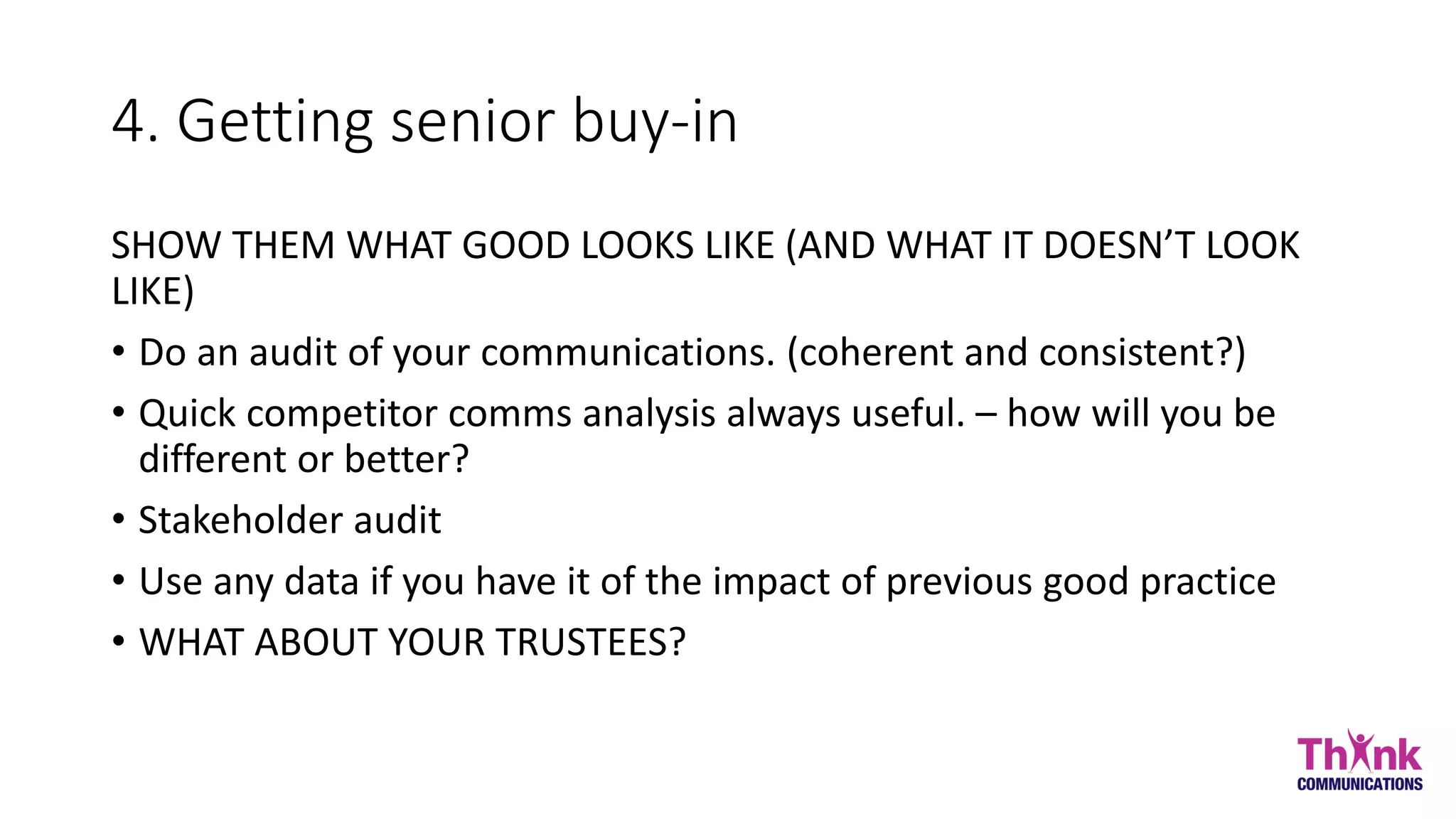
4. Getting senior buy-in
SHOW THEM WHAT GOOD LOOKS LIKE (AND WHAT IT DOESN’T LOOK
LIKE)
• Do an audit of your communications. (coherent and consistent?)
• Quick competitor comms analysis always useful. – how will you be
different or better?
• Stakeholder audit
• Use any data if you have it of the impact of previous good practice
• WHAT ABOUT YOUR TRUSTEES?
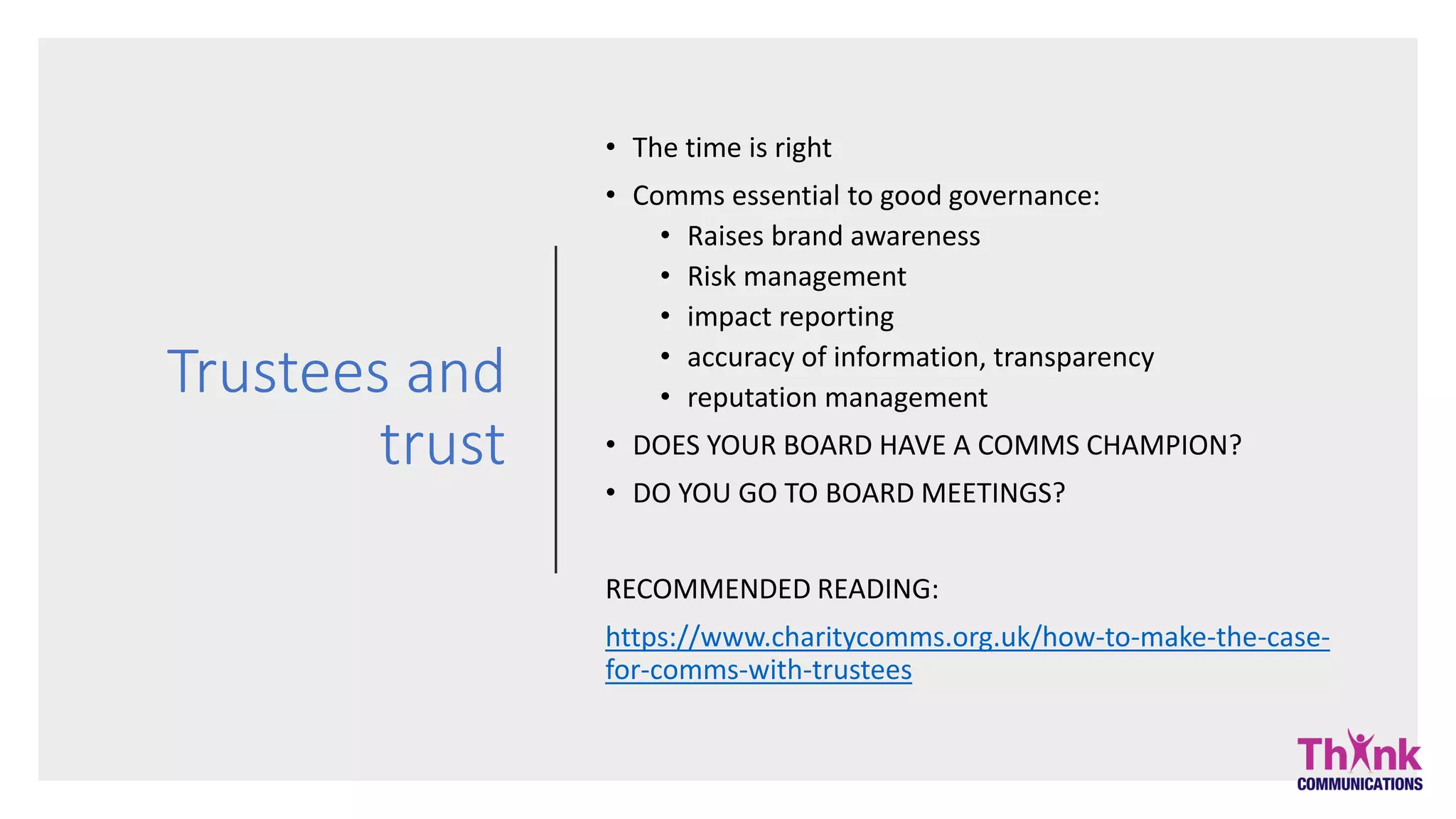
Trustees and
trust
• The time is right
• Comms essential to good governance:
• Raises brand awareness
• Risk management
• impact reporting
• accuracy of information, transparency
• reputation management
• DOES YOUR BOARD HAVE A COMMS CHAMPION?
• DO YOU GO TO BOARD MEETINGS?
RECOMMENDED READING:
https://www.charitycomms.org.uk/how-to-make-the-case-
for-comms-with-trustees
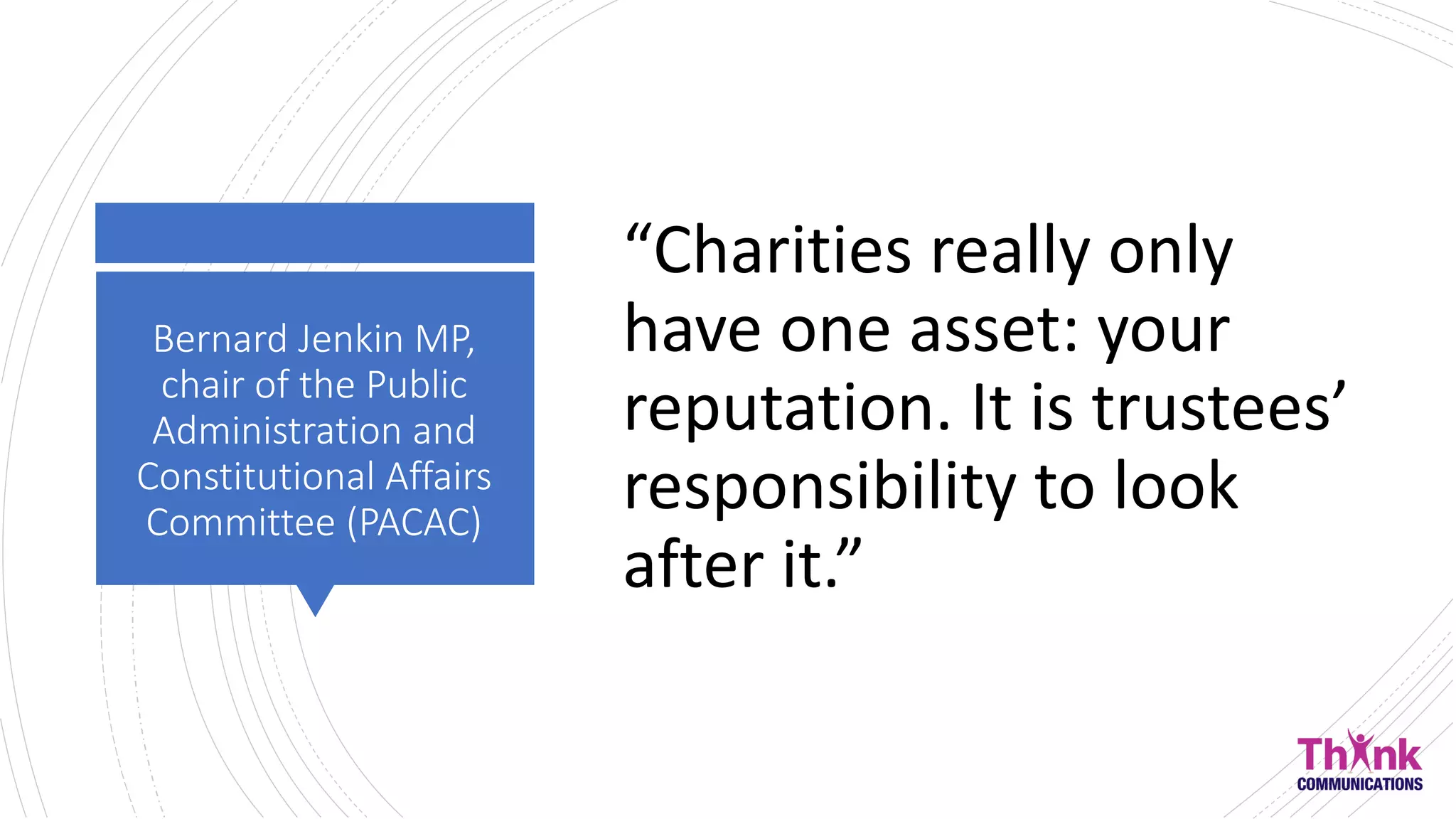
Bernard Jenkin MP,
chair of the Public
Administration and
Constitutional Affairs
Committee (PACAC)
“Charities really only
have one asset: your
reputation. It is trustees’
responsibility to look
after it.”
Not just strategic nous – some quick tactical
wins
• Over a third of small charity trustees’ annual reports and accounts
fail to meet the Charity Commission’s basic benchmark [Sept 2018]
• tools to be effective and consistent
• Messaging card for SLT and trustees
• Profiles/case studies of beneficiaries
ORGANISATIONAL
PITFALLS
1. Expected to do everything
2. Too internally focused
3. Narrow view of comms
4. Failing to get senior buy in
5. Disintegrated comms
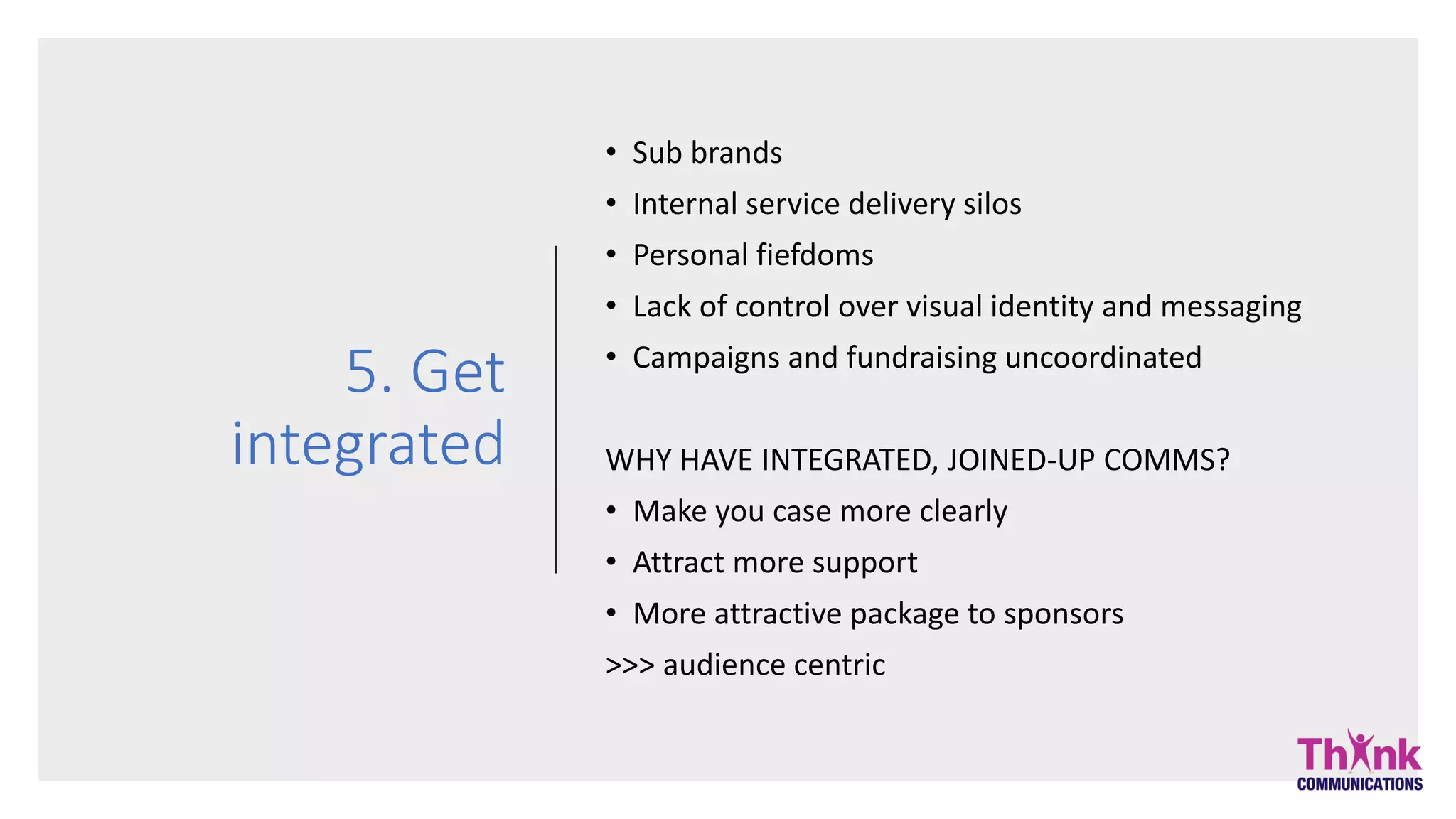
5. Get
integrated
• Sub brands
• Internal service delivery silos
• Personal fiefdoms
• Lack of control over visual identity and messaging
• Campaigns and fundraising uncoordinated
WHY HAVE INTEGRATED, JOINED-UP COMMS?
• Make you case more clearly
• Attract more support
• More attractive package to sponsors
>>> audience centric
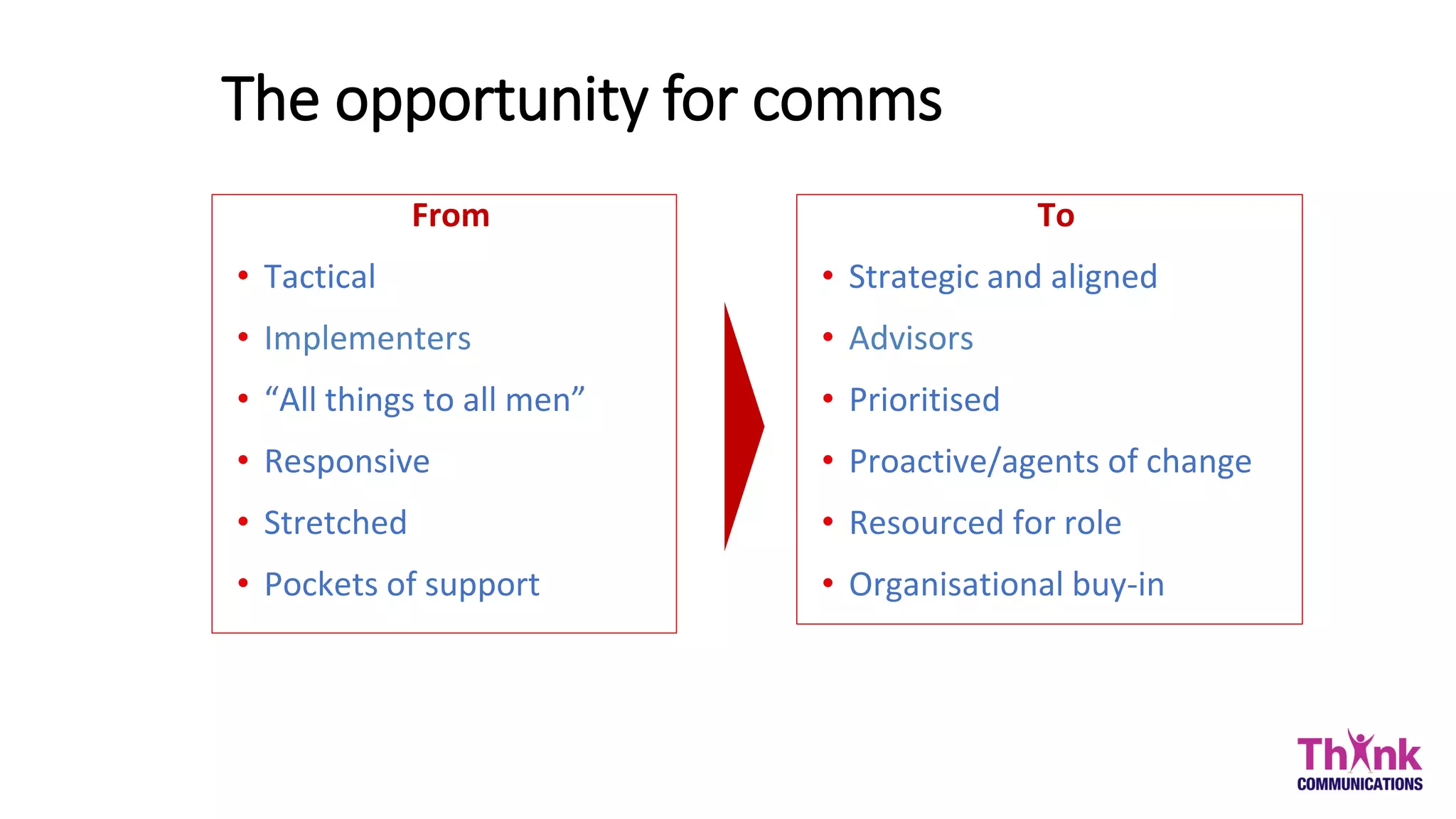
The opportunity for comms
From
• Tactical
• Implementers
• “All things to all men”
• Responsive
• Stretched
• Pockets of support
To
• Strategic and aligned
• Advisors
• Prioritised
• Proactive/agents of change
• Resourced for role
• Organisational buy-in
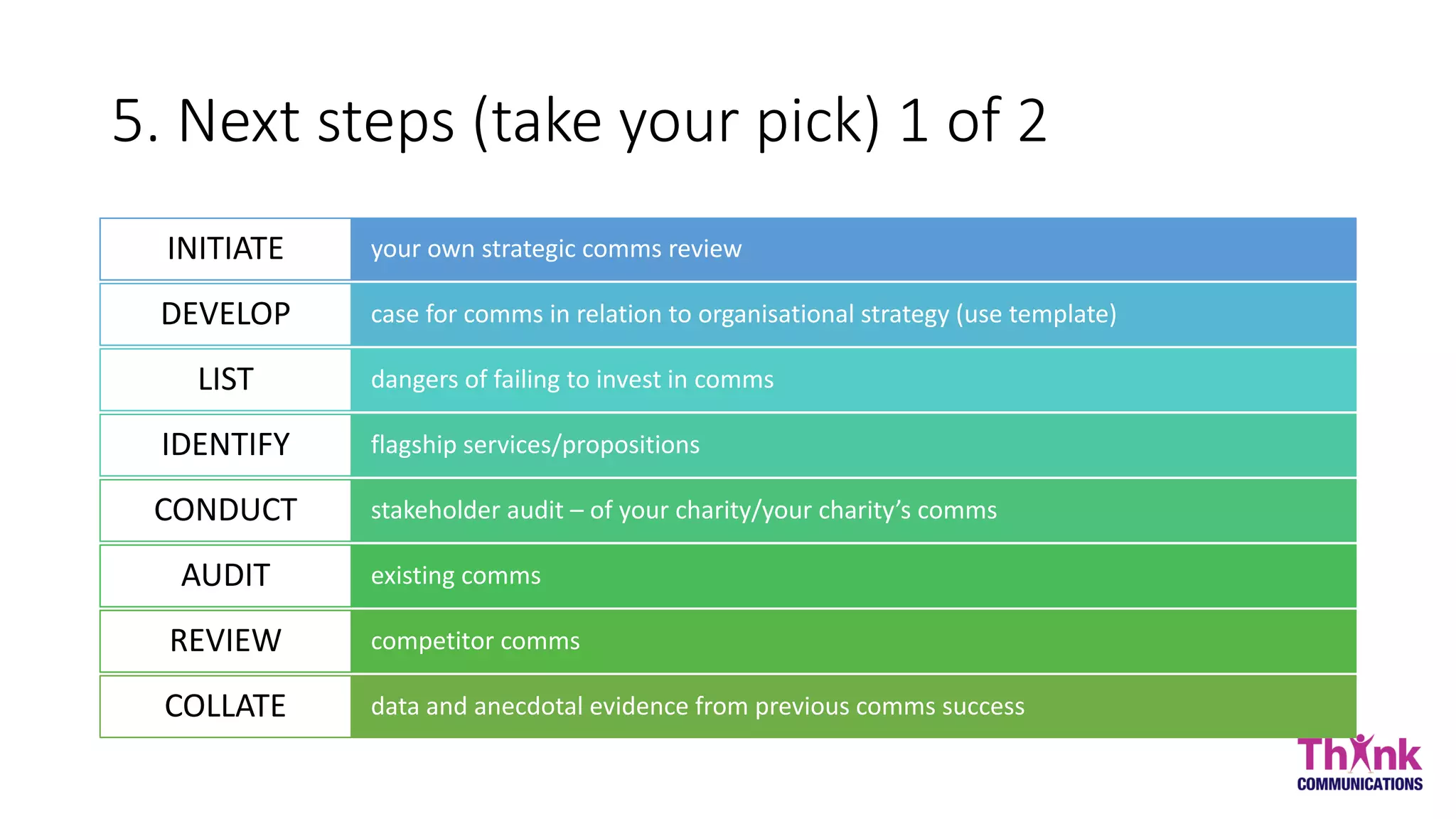
5. Next steps (take your pick) 1 of 2
your own strategic comms reviewINITIATE
case for comms in relation to organisational strategy (use template)DEVELOP
dangers of failing to invest in commsLIST
flagship services/propositionsIDENTIFY
stakeholder audit – of your charity/your charity’s commsCONDUCT
existing commsAUDIT
competitor commsREVIEW
data and anecdotal evidence from previous comms successCOLLATE
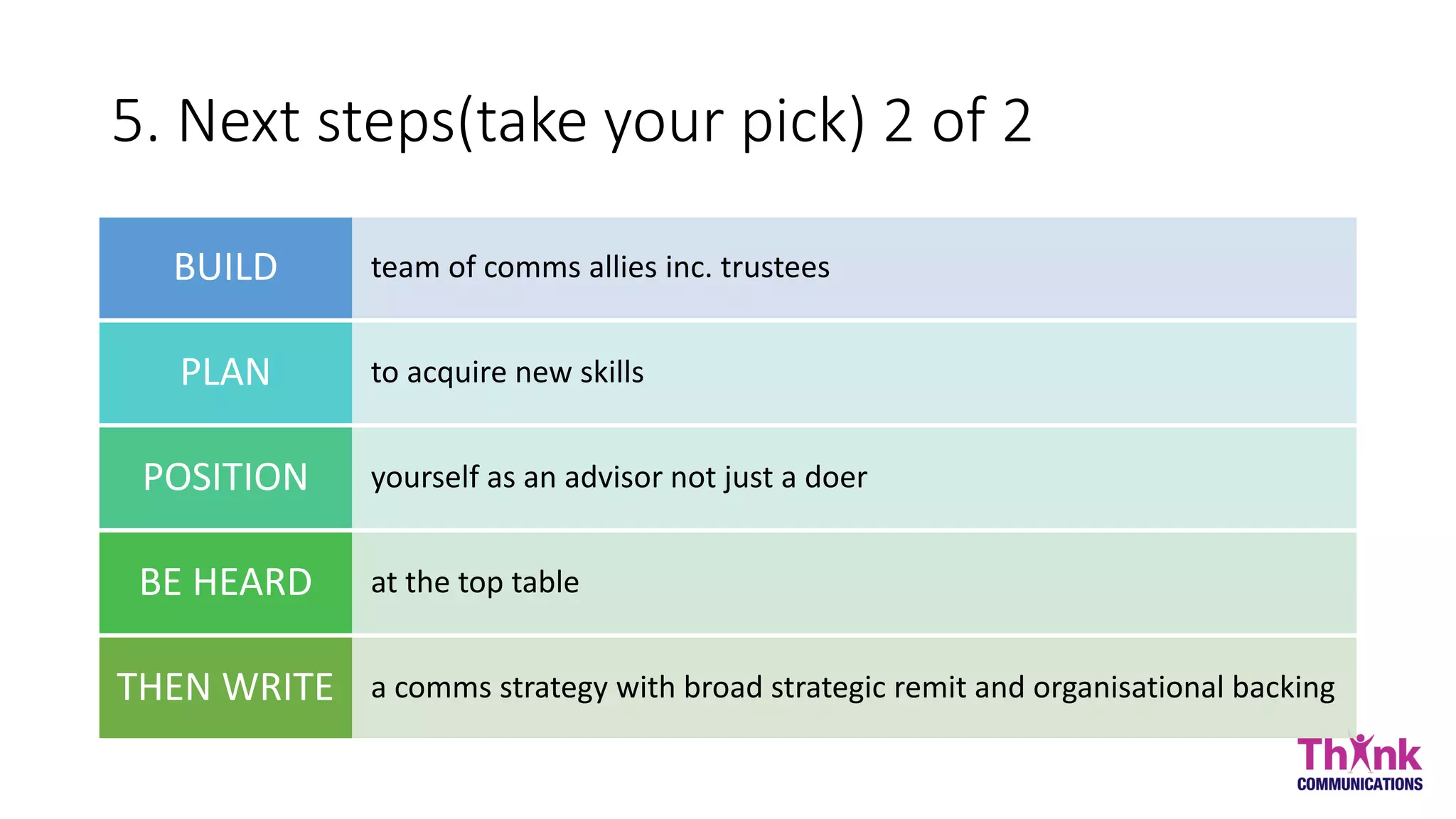
5. Next steps(take your pick) 2 of 2
team of comms allies inc. trusteesBUILD
to acquire new skillsPLAN
yourself as an advisor not just a doerPOSITION
at the top tableBE HEARD
a comms strategy with broad strategic remit and organisational backingTHEN WRITE
Any questions?
Thank you.
SOLVING PROBLEMS FOR THE
ORGANISATION
CREATING NEW
OPPORTUNITIES
STRENGTHENING
RELATIONSHIPS
CHANGING ATTITUDES
AND BEHAVIOURS
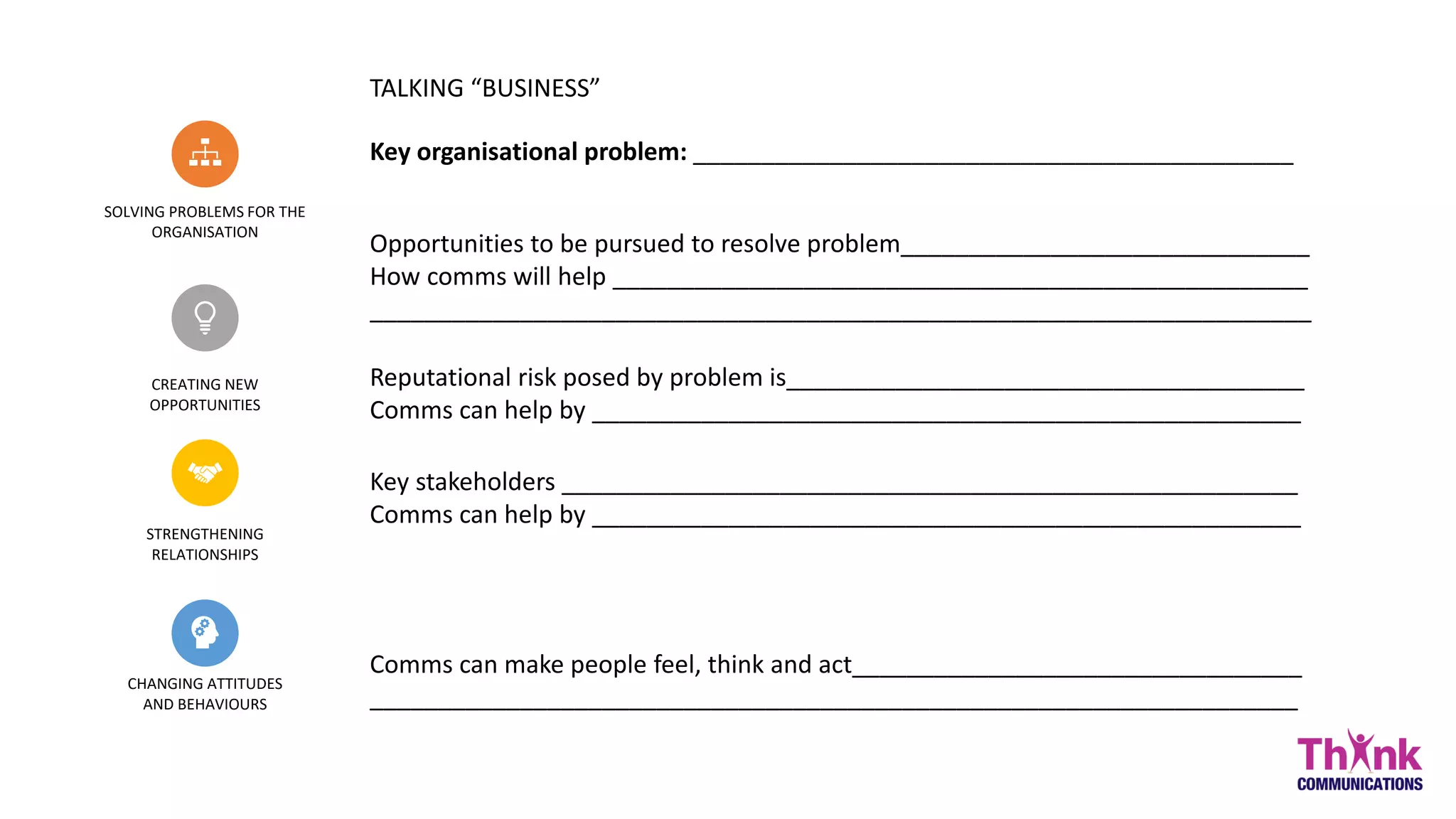
Key organisational problem: ____________________________________________
Opportunities to be pursued to resolve problem______________________________
How comms will help ___________________________________________________
_____________________________________________________________________
Key stakeholders ______________________________________________________
Comms can help by ____________________________________________________
Comms can make people feel, think and act_________________________________
____________________________________________________________________
TALKING “BUSINESS”
Reputational risk posed by problem is______________________________________
Comms can help by ____________________________________________________
Making the case for comms in your organisation
Seminar Room 6
How is ‘communications’ perceived in your charity? And where does it sit in the organisational
structure? Small charity leaders recognise the need for strong communications support, yet often
identify a shortage of these skills in their organisations. In this interactive session Julie will draw on
research and experience working with small charity leaders through the Pilotlight programme, to help
you identify steps you can take to ensure the importance of comms is recognised in top-level decision-
making, and that your comms skills are deployed by your charity as a strategic asset, rather than an
on-demand service.
Julie Kangisser
director, Think Communications

Making the case for comms in your organisation

  • 1.
  • 2.
  • 3.
    WARNING - DON’TWAIT FOR A STRATEGIC REVIEW TO HAPPEN TO YOU
  • 6.
    THE PROBLEM MAY BE BIGGERTHAN YOU THINK Our CEO values comms 85% Our organisation respects comms 59% Our trustees understand the value of comms 54% [Charity Comms Comms Benchmark 2017]
  • 7.
    MAKING THE CASE– TALKING BUSINESS SOLVING PROBLEMS FOR THE ORGANISATION CREATING NEW OPPORTUNITIES STRENGTHENING RELATIONSHIPS CHANGING ATTITUDES AND BEHAVIOURS WIN THE ARGUMENT IN PRINCIPLE DATA CAN FOLLOW
  • 8.
    Small Charity LeadersInsight Report 18/19
  • 9.
    Big organisational challenges Ensuringwe comply with new legislation and best practice 71.39% Struggling to recruit for a key role 37.46% Setting up a new partnership 34.22% Major IT upgrades and IT failures 32.74% Restructuring of organisation 32.74% Withdrawal of major funding source 26.25% Rationalising and reorganising property and sites 17.99% Making staff redundancies 17.11% High staff turnover 15.34% Closing services 12.39% Exploring or completing a merger 9.73% None of the above 6.78% Criticism in the media, including social media 5.90%
  • 10.
    Getting inside yourCEO’s head Rise Same Fall 0.00% 10.00% 20.00% 30.00% 40.00% 50.00% Do you expect your charity’s income to rise or fall next year compared to this year? Responses
  • 11.
    Do you feelthere is more uncertainty in your operating environment than in previous years? Much more uncertainty More uncertainty Same uncertainty Less uncertainty 0.00% 5.00% 10.00% 15.00% 20.00% 25.00% 30.00% 35.00% 40.00% 45.00% Responses
  • 12.
    Collaboration other small charities large charitiesprivate sector organisations local government 0.00% 10.00% 20.00% 30.00% 40.00% 50.00% 60.00% 70.00% Very well Well Poorly Very poorly
  • 13.
    Stakeholder support local peoplelocal businesses local government central government 0.00% 10.00% 20.00% 30.00% 40.00% 50.00% 60.00% 70.00% 80.00% Level of support Excellent. We get the support we need. Good. But we need more. We don’t get the support we need. N/A we don't need their support
  • 14.
    It’s not allabout the money work for us volunteer for us skills pro bono ambassadors fundraisers 0.00% 10.00% 20.00% 30.00% 40.00% 50.00% 60.00% 70.00% 80.00% 90.00% Aside from money, what are you currently looking for from local people (choose all that apply)? Responses
  • 15.
    Which skillsets wouldyour charity most benefit from? Fundraising 57.23% Building partnerships with the commercial sector 51.33% Branding and communications 38.35% IT and digital 38.05% Strategy development 24.19% Staff development and performance management 21.24% Legal 14.45% Building partnerships within the not for profit sector 14.16% Governance 14.16% Financial 13.27% Estates and facilities management 8.55% Expertise in organisational mergers 2.95% None of the above 0.88%
  • 16.
    Activity 1: Solvingorganisational problems SOLVING PROBLEMS FOR THE ORGANISATION CREATING NEW OPPORTUNITIES STRENGTHENING RELATIONSHIPS CHANGING ATTITUDES AND BEHAVIOURS • What are your organisation’s biggest problems now and longer-term? • Is/should your charity exploring new ways of working e.g. new partners; new funding streams; new services; different geography? • Which of your charity’s stakeholders are the most critical? Are these relationships actively stewarded? • Does your charity seek to change attitudes and behaviour (even if you’re not a public campaigning charity)? BETTER COMMUNICATION CAN HELP BY:
  • 17.
    ORGANISATIONAL PITFALLS 1. Expected todo everything 2. Too internally focused 3. Narrow view of comms 4. Failing to get senior buy in 5. Disintegrated comms
  • 18.
    1. Selective tobe effective • Danger of getting pulled into marketing support for lots of individual streams of work. • Recommend communications team focus on key audiences – perhaps do one properly before moving on e.g. local authorities; prisons. • Flagship approach – range of programmes is quite large. Identify the one that you wish to be known for. Other programmes to benefit from ‘halo effect’.
  • 19.
    ORGANISATIONAL PITFALLS 1. Expected todo everything 2. Too internally focused 3. Narrow view of comms 4. Failing to get senior buy in 5. Disintegrated comms
  • 20.
    2. Bringing theoutside in – offering constructive challenge • Does organisational strategy make sense to the outside world? • Licence to ask tricky questions that an outsider might • Have you ever done an audit of stakeholder views? Do you have sufficient objectivity to conduct this – in many cases, yes • Position communications proposals in context of external audience’s views.
  • 21.
    ORGANISATIONAL PITFALLS 1. Expected todo everything 2. Too internally focused 3. Narrow view of comms 4. Failing to get senior buy in 5. Disintegrated comms
  • 22.
    3. Expanding comms’remit • Issues management - have you identified risks to the charity? How are you addressing these? Do you have a crisis communications plan? • Do you look at the accounts before they get published. Ask for an explanation/prevent people drawing false conclusions? • Leadership comms – internally and externally • Thought leadership activity – what do you want to be known for? E.g. raising awareness of the issues that you address rather than what you do.
  • 23.
  • 24.
    CEO’s view oncommunications – mixed messages “Promoting what we do among potential funders - philanthropists, corporates, foundations” “We have loads and loads of great human interest stories but how can we tell those in a coherent way to raise our profile, breaking beyond the bubble of people who know us?” “Social media channels need a very authentic voice not corporate sounding” “Not too much publicity as can’t cope with demand”
  • 25.
    CEO’s views “Reaching new volunteersand keeping them engaged” “thoughtful work engaging with deaf communities around their needs” “Being in the right place at the right time to comment on emerging trends and being able to be part of that conversation, keeping our name out there.” “Someone to work at a community-level, we don’t do very well at shouting what we do and demonstrating our impact”
  • 26.
    ORGANISATIONAL PITFALLS 1. Expected todo everything 2. Too internally focused 3. Narrow view of comms 4. Failing to get senior buy in 5. Disintegrated comms
  • 27.
    4. Getting seniorbuy-in SHOW THEM WHAT GOOD LOOKS LIKE (AND WHAT IT DOESN’T LOOK LIKE) • Do an audit of your communications. (coherent and consistent?) • Quick competitor comms analysis always useful. – how will you be different or better? • Stakeholder audit • Use any data if you have it of the impact of previous good practice • WHAT ABOUT YOUR TRUSTEES?
  • 28.
    Trustees and trust • Thetime is right • Comms essential to good governance: • Raises brand awareness • Risk management • impact reporting • accuracy of information, transparency • reputation management • DOES YOUR BOARD HAVE A COMMS CHAMPION? • DO YOU GO TO BOARD MEETINGS? RECOMMENDED READING: https://www.charitycomms.org.uk/how-to-make-the-case- for-comms-with-trustees
  • 29.
    Bernard Jenkin MP, chairof the Public Administration and Constitutional Affairs Committee (PACAC) “Charities really only have one asset: your reputation. It is trustees’ responsibility to look after it.”
  • 30.
    Not just strategicnous – some quick tactical wins • Over a third of small charity trustees’ annual reports and accounts fail to meet the Charity Commission’s basic benchmark [Sept 2018] • tools to be effective and consistent • Messaging card for SLT and trustees • Profiles/case studies of beneficiaries
  • 31.
    ORGANISATIONAL PITFALLS 1. Expected todo everything 2. Too internally focused 3. Narrow view of comms 4. Failing to get senior buy in 5. Disintegrated comms
  • 32.
    5. Get integrated • Subbrands • Internal service delivery silos • Personal fiefdoms • Lack of control over visual identity and messaging • Campaigns and fundraising uncoordinated WHY HAVE INTEGRATED, JOINED-UP COMMS? • Make you case more clearly • Attract more support • More attractive package to sponsors >>> audience centric
  • 33.
    The opportunity forcomms From • Tactical • Implementers • “All things to all men” • Responsive • Stretched • Pockets of support To • Strategic and aligned • Advisors • Prioritised • Proactive/agents of change • Resourced for role • Organisational buy-in
  • 34.
    5. Next steps(take your pick) 1 of 2 your own strategic comms reviewINITIATE case for comms in relation to organisational strategy (use template)DEVELOP dangers of failing to invest in commsLIST flagship services/propositionsIDENTIFY stakeholder audit – of your charity/your charity’s commsCONDUCT existing commsAUDIT competitor commsREVIEW data and anecdotal evidence from previous comms successCOLLATE
  • 35.
    5. Next steps(takeyour pick) 2 of 2 team of comms allies inc. trusteesBUILD to acquire new skillsPLAN yourself as an advisor not just a doerPOSITION at the top tableBE HEARD a comms strategy with broad strategic remit and organisational backingTHEN WRITE
  • 36.
  • 37.
    SOLVING PROBLEMS FORTHE ORGANISATION CREATING NEW OPPORTUNITIES STRENGTHENING RELATIONSHIPS CHANGING ATTITUDES AND BEHAVIOURS Key organisational problem: ____________________________________________ Opportunities to be pursued to resolve problem______________________________ How comms will help ___________________________________________________ _____________________________________________________________________ Key stakeholders ______________________________________________________ Comms can help by ____________________________________________________ Comms can make people feel, think and act_________________________________ ____________________________________________________________________ TALKING “BUSINESS” Reputational risk posed by problem is______________________________________ Comms can help by ____________________________________________________
  • 38.
    Making the casefor comms in your organisation Seminar Room 6 How is ‘communications’ perceived in your charity? And where does it sit in the organisational structure? Small charity leaders recognise the need for strong communications support, yet often identify a shortage of these skills in their organisations. In this interactive session Julie will draw on research and experience working with small charity leaders through the Pilotlight programme, to help you identify steps you can take to ensure the importance of comms is recognised in top-level decision- making, and that your comms skills are deployed by your charity as a strategic asset, rather than an on-demand service. Julie Kangisser director, Think Communications