Writer’s EffectPaper 2 – Question 2
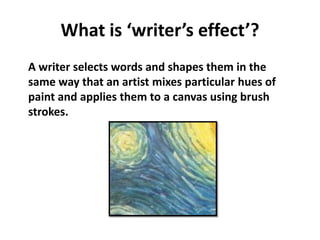
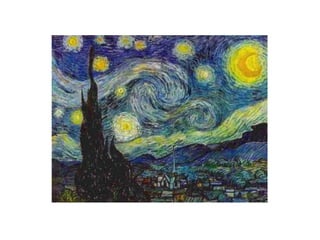
What is ‘writer’s effect’?A writer selects words and shapes them in the same way that an artist mixes particular hues of paint and applies them to a canvas using brush strokes.
What effect can words have?ReinforceModifyContrastContradictCharacters / relationshipsSettingsThemesAtmosphere / tone
The exam taskTo select words / phrases from two named paragraphs in a ‘literary’ extract and explain the meaning and effect of those language choices and why therefore the writer might have chosen to use them.The exam question is worth 10 marksYou will have approximately 25 minutes to answer
The skills neededTo recognise, understand and explain the meaning of a range of vocabulary.To demonstrate an awareness that words have layers of meaning rather than just a literal meaning.To be able to articulate an understanding of the how language choices can purposefully impact the interpretation of a text.
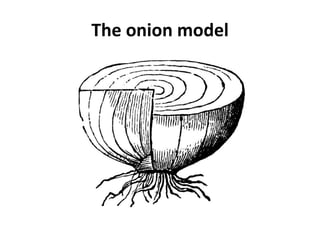
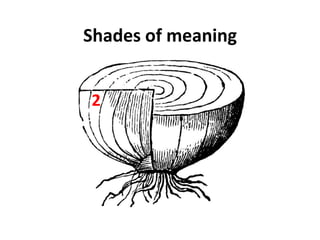
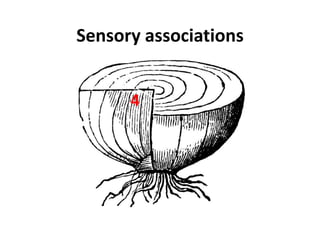
The onion model
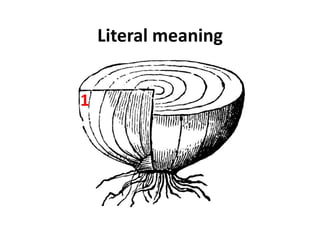
Literal meaning1
How rich is your vocabulary?
Shades of meaning2
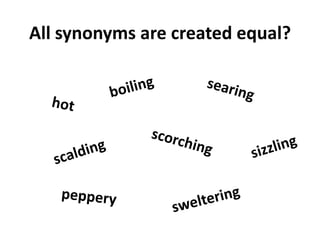
All synonyms are created equal?boilingsearinghotscorchingsizzlingscaldingpepperysweltering
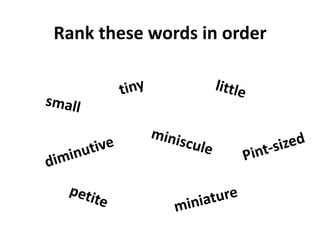
Rank these words in ordertinylittlesmallminisculePint-sizeddiminutivepetiteminiature
Now insert this word into your ranked order:tiny
Rank these words and explain the subtle differences between themShackHutBarnHouseMansionHovel
Write as many variations of this sentence as you can by changing the highlighted words while retaining the same literal meaning – notice how the nuances of meaning can change:The horse looked at me.
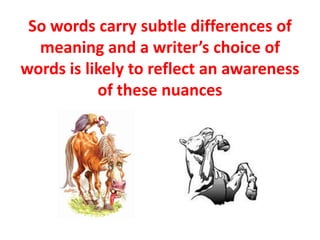
So words carry subtle differences of meaning and a writer’s choice of words is likely to reflect an awareness of these nuances
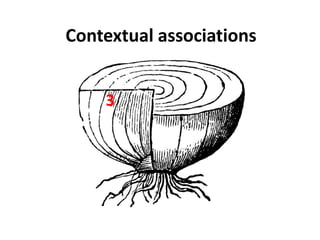
Contextual associations3
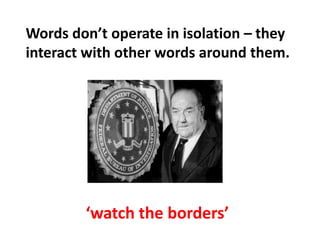
Words don’t operate in isolation – they interact with other words around them.‘watch the borders’
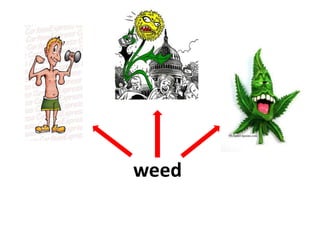
weed
Here is a word which has been taken out of its context:scarlet
On the next slide is a mini saga with the word ‘scarlet’ placed in context – notice how the rest of the story adds a significant layer of meaning to the word ‘scarlet’
Erik’s clothes clashed like a pile of Smarties.  Ties became legends.  Criticisms bypassed his balding head.Eric’s office held a ‘Bad Taste Fancy Dress Night’.  Colleagues conspicuously reproduced his outfits.  He smiled.Next morning, Erik wore a grey suit.  He tidied his desk, then hanged himself with a scarlet tie.
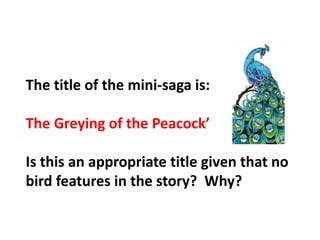
The title of the mini-saga is:The Greying of the Peacock’Is this an appropriate title given that no bird features in the story?  Why?
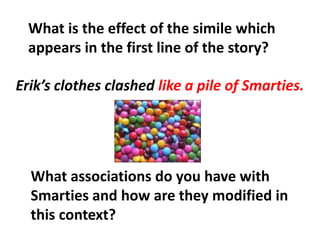
What is the effect of the simile which appears in the first line of the story?Erik’s clothes clashed like a pile of Smarties.What associations do you have with Smarties and how are they modified in this context?
Figurative language is based upon the associations we are invited to make between the items being compared.Analogical thinking is always associative.Finish the following phrase in as many ways as you can and notice how the choice of simile shifts the underlying meaning which is implied:
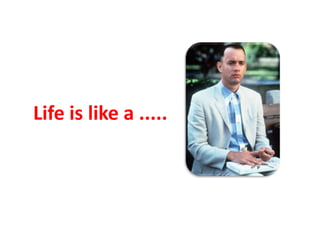
Life is like a .....
Sensory associations4
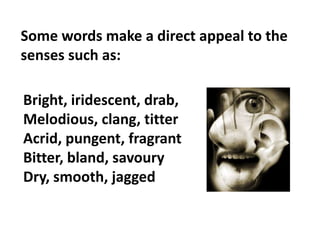
Some words make a direct appeal to the senses such as:Bright, iridescent, drab, Melodious, clang, titterAcrid, pungent, fragrantBitter, bland, savouryDry, smooth, jagged
Others do not have a primary meaning which is rooted in the senses but, nonetheless they can carry associations which may imply sensory details:The bird’s plumage shimmered in the dawn light.The soldier sank, ankle deep into the thick mud and struggled to free himself.
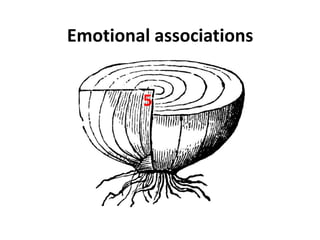
Emotional associations5
Some words are also selected by writers because they carry emotional weight:The small child dragged his satchel behind him, his head hung down and his shoulders were slumped.
Notice how each of the word choices highlighted here combine – the emotional tone of the sentence emerges out of the collective effect of the language choices made.The small child dragged his satchel behind him, his head hung down and his shoulders were slumped.
Here are three possibilities for the next sentence – how does this additional information modify or develop your understanding of the school boy’s emotional state?
He stabbed his toe at a discarded coke can which tumbled into the road.The School gates loomed ahead of him and he noticed that his hands were trembling.The crumpled pink letter was still clutched tightly in his left hand.
Putting it all togetherWords carry a literal meaningWords often also carry shades of meaning and are relationalWords may be modified by their contextWords may carry sensory associationsWords may carry emotional associations
MeetingsTesting your understanding of the onion model
They locked eyes upon one another and stood like statues, rooted to the spot.  Several moments passed.  The air about them crackled with tension and then, suddenly the two men surged forwards.  The dust billowed around them, their leather sandals tearing great scars across the parched arena.
She came to stand behind the crumpled form and tentatively reached out a trembling hand.  The blanched band of skin circling her finger stood out like a guilty secret as she touched his shoulder.  He didn’t look up.  For what seemed an age, they stood there framed against the dying light until all the guests had made their excuses and left.
David lurched forward, knocking people to left and right until he had a clear line of sight.  There could be no mistake, it was her.  He wanted to shout out, turn circles, dance a jig, but instead a bashful grin spread across his face.  She turned her head towards him and beamed.  The crowd, the grating tannoy, the glare of the strip lighting all faded away until just the two of them were held in the crystal snow-globe perfection of the moment.

Writer’s Effect 1

  • 1.
  • 2.
    What is ‘writer’seffect’?A writer selects words and shapes them in the same way that an artist mixes particular hues of paint and applies them to a canvas using brush strokes.
  • 4.
    What effect canwords have?ReinforceModifyContrastContradictCharacters / relationshipsSettingsThemesAtmosphere / tone
  • 5.
    The exam taskToselect words / phrases from two named paragraphs in a ‘literary’ extract and explain the meaning and effect of those language choices and why therefore the writer might have chosen to use them.The exam question is worth 10 marksYou will have approximately 25 minutes to answer
  • 6.
    The skills neededTorecognise, understand and explain the meaning of a range of vocabulary.To demonstrate an awareness that words have layers of meaning rather than just a literal meaning.To be able to articulate an understanding of the how language choices can purposefully impact the interpretation of a text.
  • 7.
  • 8.
  • 9.
    How rich isyour vocabulary?
  • 10.
  • 11.
    All synonyms arecreated equal?boilingsearinghotscorchingsizzlingscaldingpepperysweltering
  • 12.
    Rank these wordsin ordertinylittlesmallminisculePint-sizeddiminutivepetiteminiature
  • 13.
    Now insert thisword into your ranked order:tiny
  • 14.
    Rank these wordsand explain the subtle differences between themShackHutBarnHouseMansionHovel
  • 15.
    Write as manyvariations of this sentence as you can by changing the highlighted words while retaining the same literal meaning – notice how the nuances of meaning can change:The horse looked at me.
  • 16.
    So words carrysubtle differences of meaning and a writer’s choice of words is likely to reflect an awareness of these nuances
  • 17.
  • 18.
    Words don’t operatein isolation – they interact with other words around them.‘watch the borders’
  • 19.
  • 20.
    Here is aword which has been taken out of its context:scarlet
  • 21.
    On the nextslide is a mini saga with the word ‘scarlet’ placed in context – notice how the rest of the story adds a significant layer of meaning to the word ‘scarlet’
  • 22.
    Erik’s clothes clashedlike a pile of Smarties. Ties became legends. Criticisms bypassed his balding head.Eric’s office held a ‘Bad Taste Fancy Dress Night’. Colleagues conspicuously reproduced his outfits. He smiled.Next morning, Erik wore a grey suit. He tidied his desk, then hanged himself with a scarlet tie.
  • 23.
    The title ofthe mini-saga is:The Greying of the Peacock’Is this an appropriate title given that no bird features in the story? Why?
  • 24.
    What is theeffect of the simile which appears in the first line of the story?Erik’s clothes clashed like a pile of Smarties.What associations do you have with Smarties and how are they modified in this context?
  • 25.
    Figurative language isbased upon the associations we are invited to make between the items being compared.Analogical thinking is always associative.Finish the following phrase in as many ways as you can and notice how the choice of simile shifts the underlying meaning which is implied:
  • 26.
  • 27.
  • 28.
    Some words makea direct appeal to the senses such as:Bright, iridescent, drab, Melodious, clang, titterAcrid, pungent, fragrantBitter, bland, savouryDry, smooth, jagged
  • 29.
    Others do nothave a primary meaning which is rooted in the senses but, nonetheless they can carry associations which may imply sensory details:The bird’s plumage shimmered in the dawn light.The soldier sank, ankle deep into the thick mud and struggled to free himself.
  • 30.
  • 31.
    Some words arealso selected by writers because they carry emotional weight:The small child dragged his satchel behind him, his head hung down and his shoulders were slumped.
  • 32.
    Notice how eachof the word choices highlighted here combine – the emotional tone of the sentence emerges out of the collective effect of the language choices made.The small child dragged his satchel behind him, his head hung down and his shoulders were slumped.
  • 33.
    Here are threepossibilities for the next sentence – how does this additional information modify or develop your understanding of the school boy’s emotional state?
  • 34.
    He stabbed histoe at a discarded coke can which tumbled into the road.The School gates loomed ahead of him and he noticed that his hands were trembling.The crumpled pink letter was still clutched tightly in his left hand.
  • 35.
    Putting it alltogetherWords carry a literal meaningWords often also carry shades of meaning and are relationalWords may be modified by their contextWords may carry sensory associationsWords may carry emotional associations
  • 36.
  • 37.
    They locked eyesupon one another and stood like statues, rooted to the spot. Several moments passed. The air about them crackled with tension and then, suddenly the two men surged forwards. The dust billowed around them, their leather sandals tearing great scars across the parched arena.
  • 38.
    She came tostand behind the crumpled form and tentatively reached out a trembling hand. The blanched band of skin circling her finger stood out like a guilty secret as she touched his shoulder. He didn’t look up. For what seemed an age, they stood there framed against the dying light until all the guests had made their excuses and left.
  • 39.
    David lurched forward,knocking people to left and right until he had a clear line of sight. There could be no mistake, it was her. He wanted to shout out, turn circles, dance a jig, but instead a bashful grin spread across his face. She turned her head towards him and beamed. The crowd, the grating tannoy, the glare of the strip lighting all faded away until just the two of them were held in the crystal snow-globe perfection of the moment.