1Wednesday, 2 April 14
Pairing with Designers
to create a seamless
user experience
2Wednesday, 2 April 14
Intro
3Wednesday, 2 April 14
• Atlassian has a very strong Design team
• Traditionally, tech writing has played a very traditional
role
• There was opportunity to work together, as these
teams have the same basic goals
Some background
4Wednesday, 2 April 14
Bringing UX to docs
5Wednesday, 2 April 14
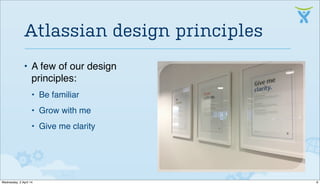
Atlassian design principles
• A few of our design
principles:
• Be familiar
• Grow with me
• Give me clarity
6Wednesday, 2 April 14
• Almost any UX principle you encounter can be
applied to documentation
• Android
• Mac OSX
• Facebook
• Designers are great at working toward UX principles,
so they can be helpful in evaluating how well a
document meets them too
Looking at the docs as part of
UX
7Wednesday, 2 April 14
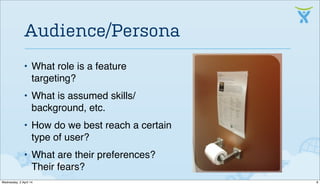
• What role is a feature
targeting?
• What is assumed skills/
background, etc.
• How do we best reach a certain
type of user?
• What are their preferences?
Their fears?
Audience/Persona
8Wednesday, 2 April 14
Data and measures
9Wednesday, 2 April 14
• Realization! Designers have access to lots of customer
information!
• Customer interviews & site visits
• Usability tests
• Usage information on existing features
• Long-term roadmap
Leveraging siloed data
10Wednesday, 2 April 14
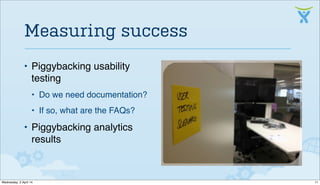
• Piggybacking usability
testing
• Do we need documentation?
• If so, what are the FAQs?
• Piggybacking analytics
results
Measuring success
11Wednesday, 2 April 14
Borrowing design
techniques
12Wednesday, 2 April 14
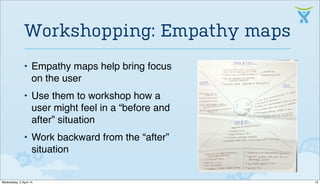
• Empathy maps help bring focus
on the user
• Use them to workshop how a
user might feel in a “before and
after” situation
• Work backward from the “after”
situation
Workshopping: Empathy maps
13Wednesday, 2 April 14
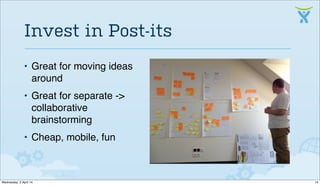
• Great for moving ideas
around
• Great for separate ->
collaborative
brainstorming
• Cheap, mobile, fun
Invest in Post-its
14Wednesday, 2 April 14
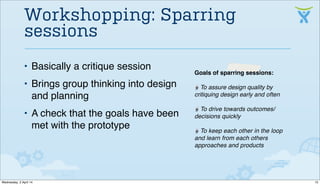
• Basically a critique session
• Brings group thinking into design
and planning
• A check that the goals have been
met with the prototype
Workshopping: Sparring
sessions
Goals of sparring sessions:
To assure design quality by
critiquing design early and often
To drive towards outcomes/
decisions quickly
To keep each other in the loop
and learn from each others
approaches and products
15Wednesday, 2 April 14
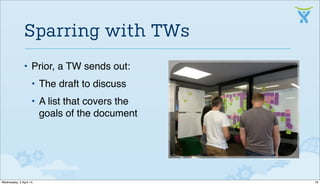
• Prior, a TW sends out:
• The draft to discuss
• A list that covers the
goals of the document
Sparring with TWs
16Wednesday, 2 April 14
• Timebox, timebox, timebox!
• If your team is given to negativity, try a positives-only 5
minutes
• Try to make sure everyone is heard - using a checklist
or give everyone 1 minute to list feedback
• Leave with at least 3 action items
Tips for running a sparring session
17Wednesday, 2 April 14
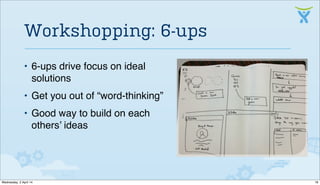
• 6-ups drive focus on ideal
solutions
• Get you out of “word-thinking”
• Good way to build on each
others’ ideas
Workshopping: 6-ups
18Wednesday, 2 April 14
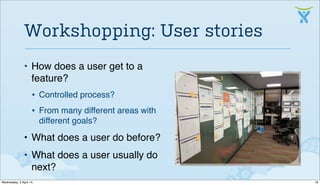
• How does a user get to a
feature?
• Controlled process?
• From many different areas with
different goals?
• What does a user do before?
• What does a user usually do
next?
Workshopping: User stories
19Wednesday, 2 April 14
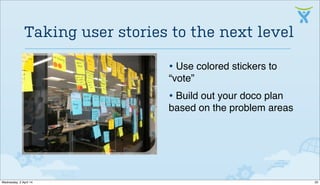
• Use colored stickers to
“vote”
• Build out your doco plan
based on the problem areas
Taking user stories to the next level
20Wednesday, 2 April 14
How we made this
happen
21Wednesday, 2 April 14
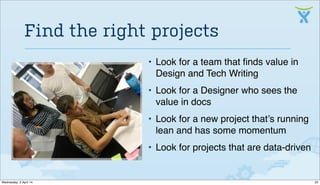
• Look for a team that finds value in
Design and Tech Writing
• Look for a Designer who sees the
value in docs
• Look for a new project that’s running
lean and has some momentum
• Look for projects that are data-driven
Find the right projects
22Wednesday, 2 April 14
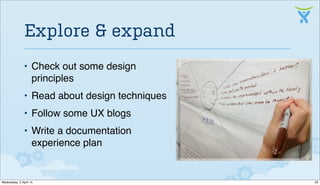
• Check out some design
principles
• Read about design techniques
• Follow some UX blogs
• Write a documentation
experience plan
Explore & expand
23Wednesday, 2 April 14
• cburwinkle@atlassian.com
• Christine Burwinkle on LinkedIn
Contact me
24Wednesday, 2 April 14

Write the Docs 2014, EU

  • 1.
  • 2.
    Pairing with Designers tocreate a seamless user experience 2Wednesday, 2 April 14
  • 3.
  • 4.
    • Atlassian hasa very strong Design team • Traditionally, tech writing has played a very traditional role • There was opportunity to work together, as these teams have the same basic goals Some background 4Wednesday, 2 April 14
  • 5.
    Bringing UX todocs 5Wednesday, 2 April 14
  • 6.
    Atlassian design principles •A few of our design principles: • Be familiar • Grow with me • Give me clarity 6Wednesday, 2 April 14
  • 7.
    • Almost anyUX principle you encounter can be applied to documentation • Android • Mac OSX • Facebook • Designers are great at working toward UX principles, so they can be helpful in evaluating how well a document meets them too Looking at the docs as part of UX 7Wednesday, 2 April 14
  • 8.
    • What roleis a feature targeting? • What is assumed skills/ background, etc. • How do we best reach a certain type of user? • What are their preferences? Their fears? Audience/Persona 8Wednesday, 2 April 14
  • 9.
  • 10.
    • Realization! Designershave access to lots of customer information! • Customer interviews & site visits • Usability tests • Usage information on existing features • Long-term roadmap Leveraging siloed data 10Wednesday, 2 April 14
  • 11.
    • Piggybacking usability testing •Do we need documentation? • If so, what are the FAQs? • Piggybacking analytics results Measuring success 11Wednesday, 2 April 14
  • 12.
  • 13.
    • Empathy mapshelp bring focus on the user • Use them to workshop how a user might feel in a “before and after” situation • Work backward from the “after” situation Workshopping: Empathy maps 13Wednesday, 2 April 14
  • 14.
    • Great formoving ideas around • Great for separate -> collaborative brainstorming • Cheap, mobile, fun Invest in Post-its 14Wednesday, 2 April 14
  • 15.
    • Basically acritique session • Brings group thinking into design and planning • A check that the goals have been met with the prototype Workshopping: Sparring sessions Goals of sparring sessions: To assure design quality by critiquing design early and often To drive towards outcomes/ decisions quickly To keep each other in the loop and learn from each others approaches and products 15Wednesday, 2 April 14
  • 16.
    • Prior, aTW sends out: • The draft to discuss • A list that covers the goals of the document Sparring with TWs 16Wednesday, 2 April 14
  • 17.
    • Timebox, timebox,timebox! • If your team is given to negativity, try a positives-only 5 minutes • Try to make sure everyone is heard - using a checklist or give everyone 1 minute to list feedback • Leave with at least 3 action items Tips for running a sparring session 17Wednesday, 2 April 14
  • 18.
    • 6-ups drivefocus on ideal solutions • Get you out of “word-thinking” • Good way to build on each others’ ideas Workshopping: 6-ups 18Wednesday, 2 April 14
  • 19.
    • How doesa user get to a feature? • Controlled process? • From many different areas with different goals? • What does a user do before? • What does a user usually do next? Workshopping: User stories 19Wednesday, 2 April 14
  • 20.
    • Use coloredstickers to “vote” • Build out your doco plan based on the problem areas Taking user stories to the next level 20Wednesday, 2 April 14
  • 21.
    How we madethis happen 21Wednesday, 2 April 14
  • 22.
    • Look fora team that finds value in Design and Tech Writing • Look for a Designer who sees the value in docs • Look for a new project that’s running lean and has some momentum • Look for projects that are data-driven Find the right projects 22Wednesday, 2 April 14
  • 23.
    • Check outsome design principles • Read about design techniques • Follow some UX blogs • Write a documentation experience plan Explore & expand 23Wednesday, 2 April 14
  • 24.
    • cburwinkle@atlassian.com • ChristineBurwinkle on LinkedIn Contact me 24Wednesday, 2 April 14