Fizz buzz in tensorflow
Joel Grus
Research Engineer, AI2
@joelgrus
About me
Research engineer at AI2
we're hiring!
(in Seattle)
(where normal people can afford to buy a house)
(sort of)
Previously SWE at Google, data science at
VoloMetrix, Decide, Farecast/Microsoft
Wrote a book ------->
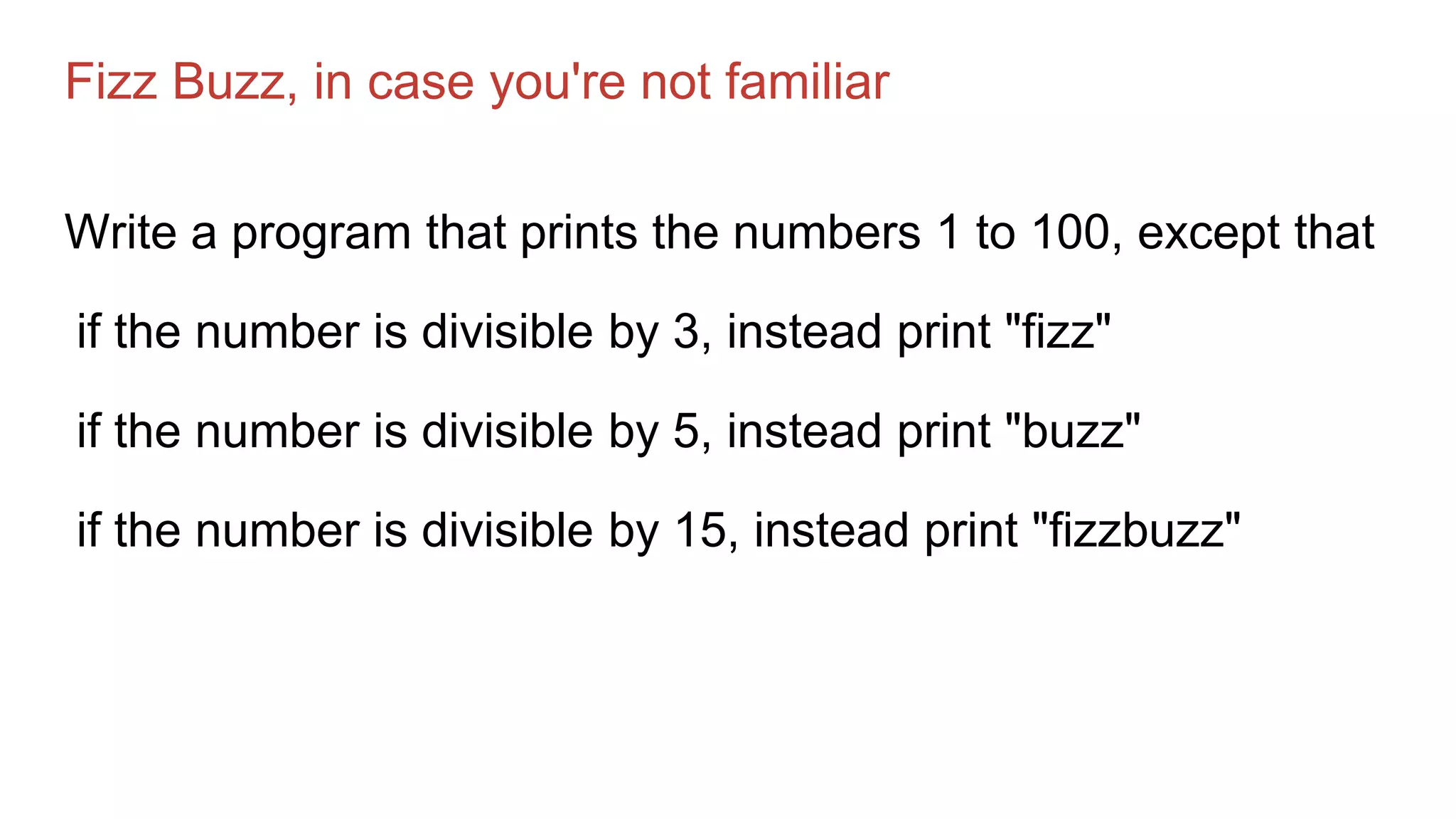
Fizz Buzz, in case you're not familiar
Write a program that prints the numbers 1 to 100, except that
if the number is divisible by 3, instead print "fizz"
if the number is divisible by 5, instead print "buzz"
if the number is divisible by 15, instead print "fizzbuzz"
weed-out problem
the backstory
Saw an online discussion about the stupidest way to solve fizz buzz
Thought, "I bet I can come up with a stupider way"
Came up with a stupider way
Blog post went viral
Sort of a frivolous thing to use up my 15 minutes of fame on, but so
be it
super simple solution
haskell
fizzBuzz :: Integer -> String
fizzBuzz i
| i `mod` 15 == 0 = "fizzbuzz"
| i `mod` 5 == 0 = "buzz"
| i `mod` 3 == 0 = "fizz"
| otherwise = show i
mapM_ (putStrLn . fizzBuzz) [1..100]
ok, then python
def fizz_buzz(i):
if i % 15 == 0: return "fizzbuzz"
elif i % 5 == 0: return "buzz"
elif i % 3 == 0: return "fizz"
else: return str(i)
for i in range(1, 101):
print(fizz_buzz(i))
taking on
fizz buzz as a
machine
learning problem
outputs
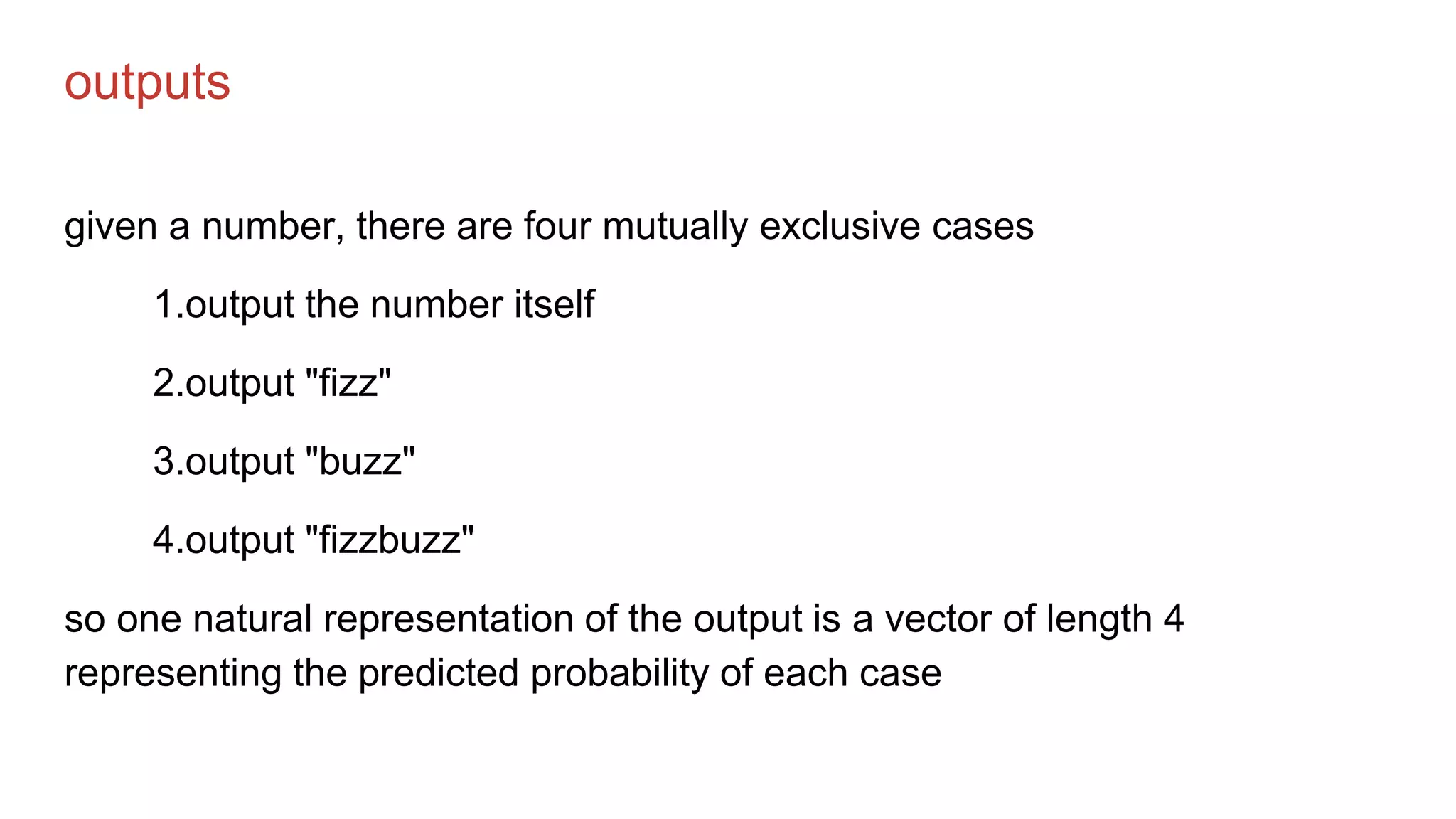
given a number, there are four mutually exclusive cases
1.output the number itself
2.output "fizz"
3.output "buzz"
4.output "fizzbuzz"
so one natural representation of the output is a vector of length 4
representing the predicted probability of each case
ground truth
def fizz_buzz_encode(i):
if i % 15 == 0: return np.array([0, 0, 0, 1])
elif i % 5 == 0: return np.array([0, 0, 1, 0])
elif i % 3 == 0: return np.array([0, 1, 0, 0])
else: return np.array([1, 0, 0, 0])
feature selection - Cheating
feature selection - cheating clever
def x(i):
return np.array([1, i % 3 == 0, i % 5 == 0])
def predict(x):
return np.dot(x, np.array([[ 1, 0, 0, -1],
[-1, 1, -1, 1],
[-1, -1, 1, 1]]))
for i in range(1, 101):
prediction = np.argmax(predict(x(i)))
print([i, "fizz", "buzz", "fizzbuzz"][prediction])
It's hard to
imagine an
interviewer
who wouldn't
be impressed
by even this
simple
solution.
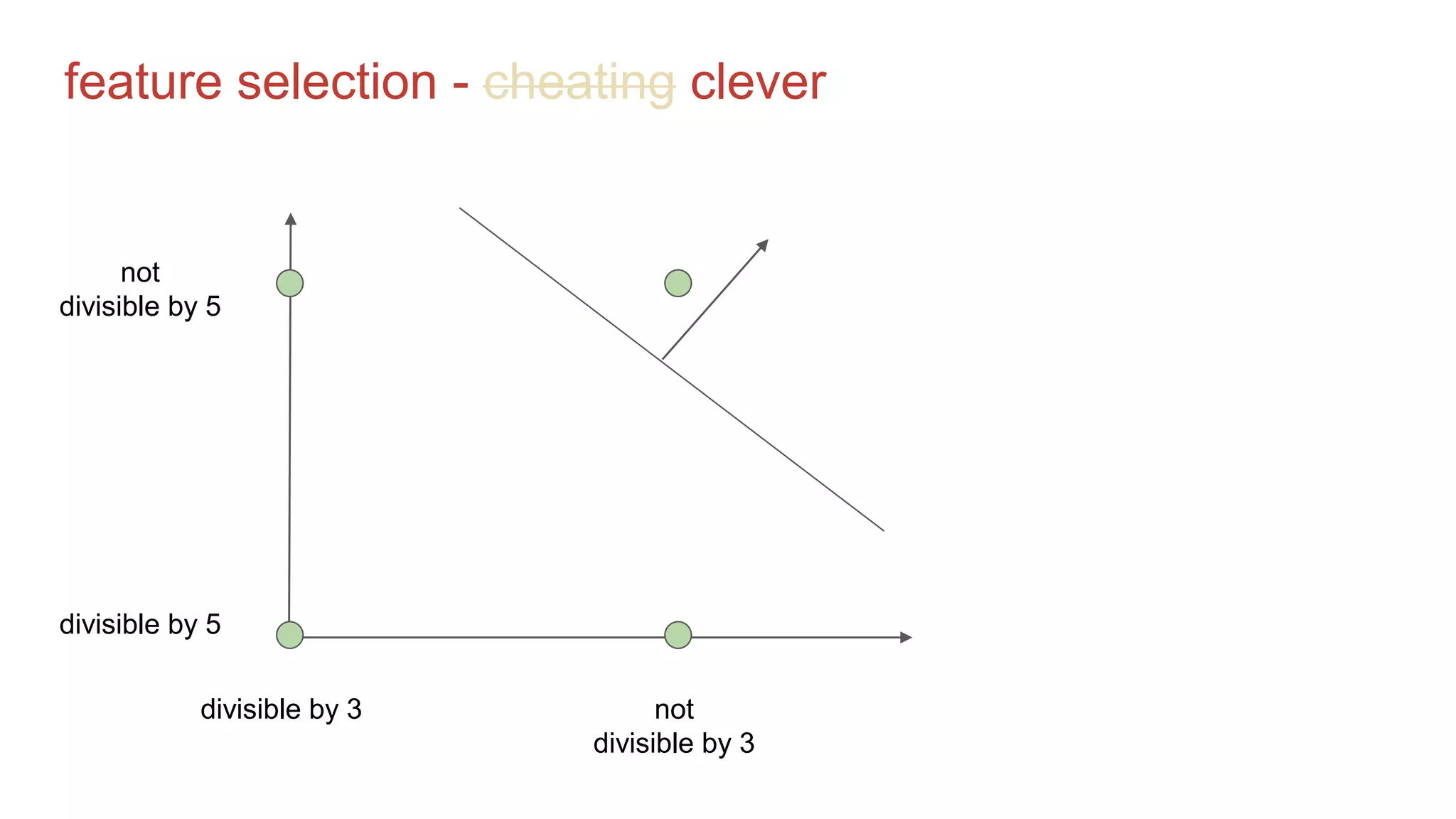
feature selection - cheating clever
divisible by 3 not
divisible by 3
divisible by 5
not
divisible by 5
what if we aren't that clever?
binary encoding, say 10
digits (up to 1023)
1 -> [1, 0, 0, 0, 0, 0, 0, 0, 0, 0]
2 -> [0, 1, 0, 0, 0, 0, 0, 0, 0, 0]
3 -> [1, 1, 0, 0, 0, 0, 0, 0, 0, 0]
and so on
in comments, someone
suggested one-hot decimal
encoding the digits, say up to
999
315 -> [0, 0, 0, 1, 0, 0, 0, 0, 0, 0,
0, 1, 0, 0, 0, 0, 0, 0, 0, 0,
0, 0, 0, 0, 0, 1, 0, 0, 0, 0]
and so on
training data
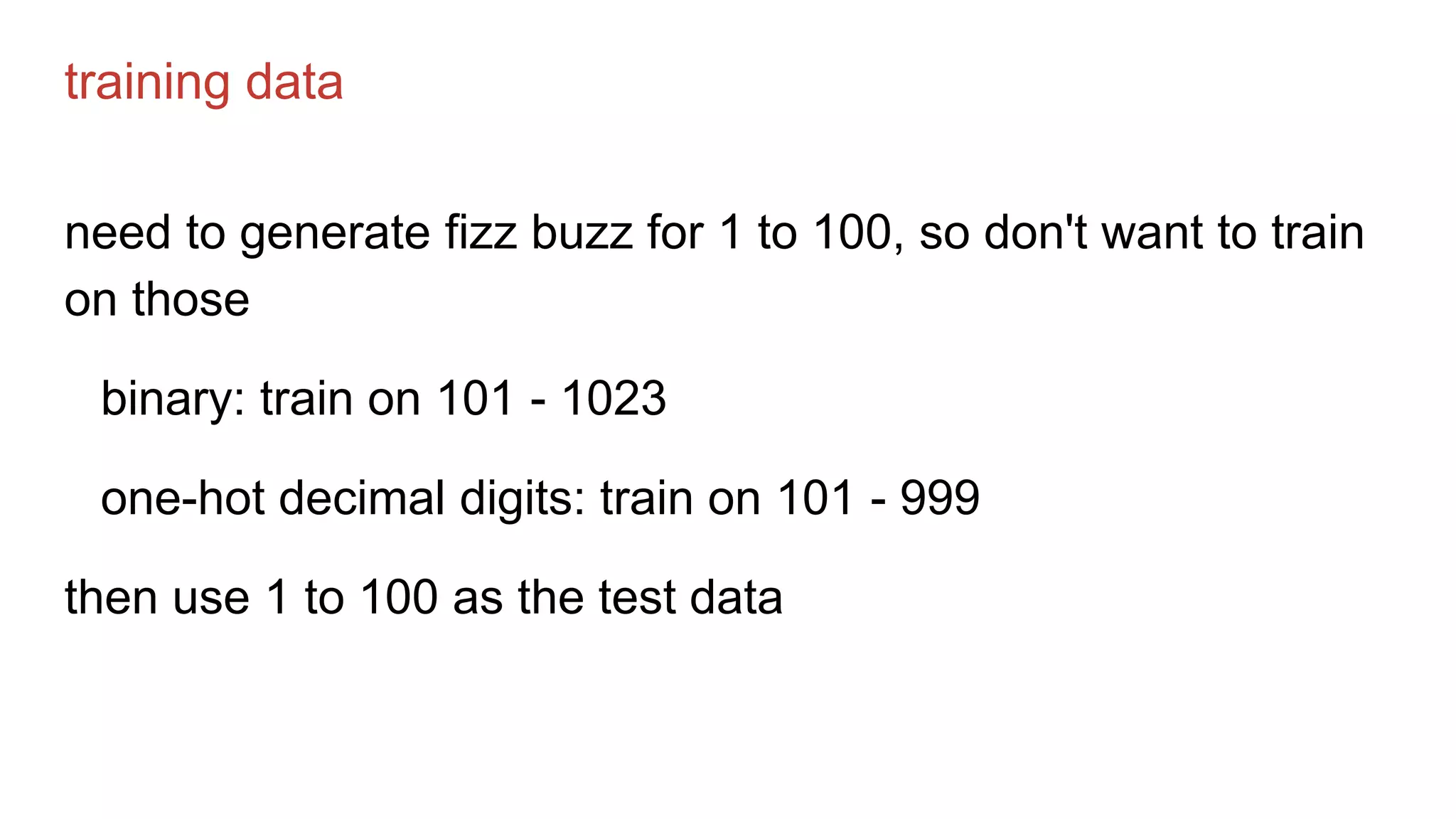
need to generate fizz buzz for 1 to 100, so don't want to train
on those
binary: train on 101 - 1023
one-hot decimal digits: train on 101 - 999
then use 1 to 100 as the test data
tensorflow in one slide
import numpy as np
import tensorflow as tf
X = tf.placeholder("float", [None, input_dim])
Y = tf.placeholder("float", [None, output_dim])
beta = tf.Variable(tf.random_normal(beta_shape, stddev=0.01))
def model(X, beta):
# some function of X and beta
p_yx = model(X, beta)
cost = some_cost_function(p_yx, Y)
train_op = tf.train.SomeOptimizer.minimize(cost)
with tf.Session() as sess:
sess.run(tf.initialize_all_variables())
for _ in range(num_epochs):
sess.run(train_op, feed_dict={X: trX, Y: trY})
the extent of what I know
about
standard
imports
placeholders for our
data
parameters to
learn
some parametric
model
applied to the symbolic
variables
train by minimizing some cost
function
create session and initialize
variables
train using
data
Visualizing the results (a hard problem by itself)
1 100correct "11"
incorrect "buzz"
actual "fizzbuzz"
correct "fizz"
black + red = predictions
black + tan = actuals
predicted "fizz"
actual "buzz"
[[30, 11, 6, 2],
[12, 8, 4, 1],
[ 4, 3, 2, 3],
[ 4, 2, 0, 0]]
linear regression
def model(X, w, b):
return tf.matmul(X, w) + b
py_x = model(data.X, w, b)
cost = tf.reduce_mean(tf.pow(py_x - data.Y, 2))
train_op = tf.train.GradientDescentOptimizer(0.05).minimize(cost)
binary
decimal
[[54, 27, 14, 6],
[ 0, 0, 0, 0],
[ 0, 0, 0, 0],
[ 0, 0, 0, 0]]
[[54, 27, 0, 0],
[ 0, 0, 0, 0],
[ 0, 0, 14, 6],
[ 0, 0, 0, 0]]
black + red = predictions
black + tan = actuals
logistic regression
def model(X, w, b):
return tf.matmul(X, w) + b
py_x = model(data.X, w, b)
cost = tf.reduce_mean(tf.nn.softmax_cross_entropy_with_logits(py_x, data.Y))
train_op = tf.train.GradientDescentOptimizer(0.05).minimize(cost)
binary
[[54, 27, 14, 6],
[ 0, 0, 0, 0],
[ 0, 0, 0, 0],
[ 0, 0, 0, 0]]
[[54, 27, 0, 0],
[ 0, 0, 0, 0],
[ 0, 0, 14, 6],
[ 0, 0, 0, 0]]
decimal
black + red = predictions
black + tan = actuals
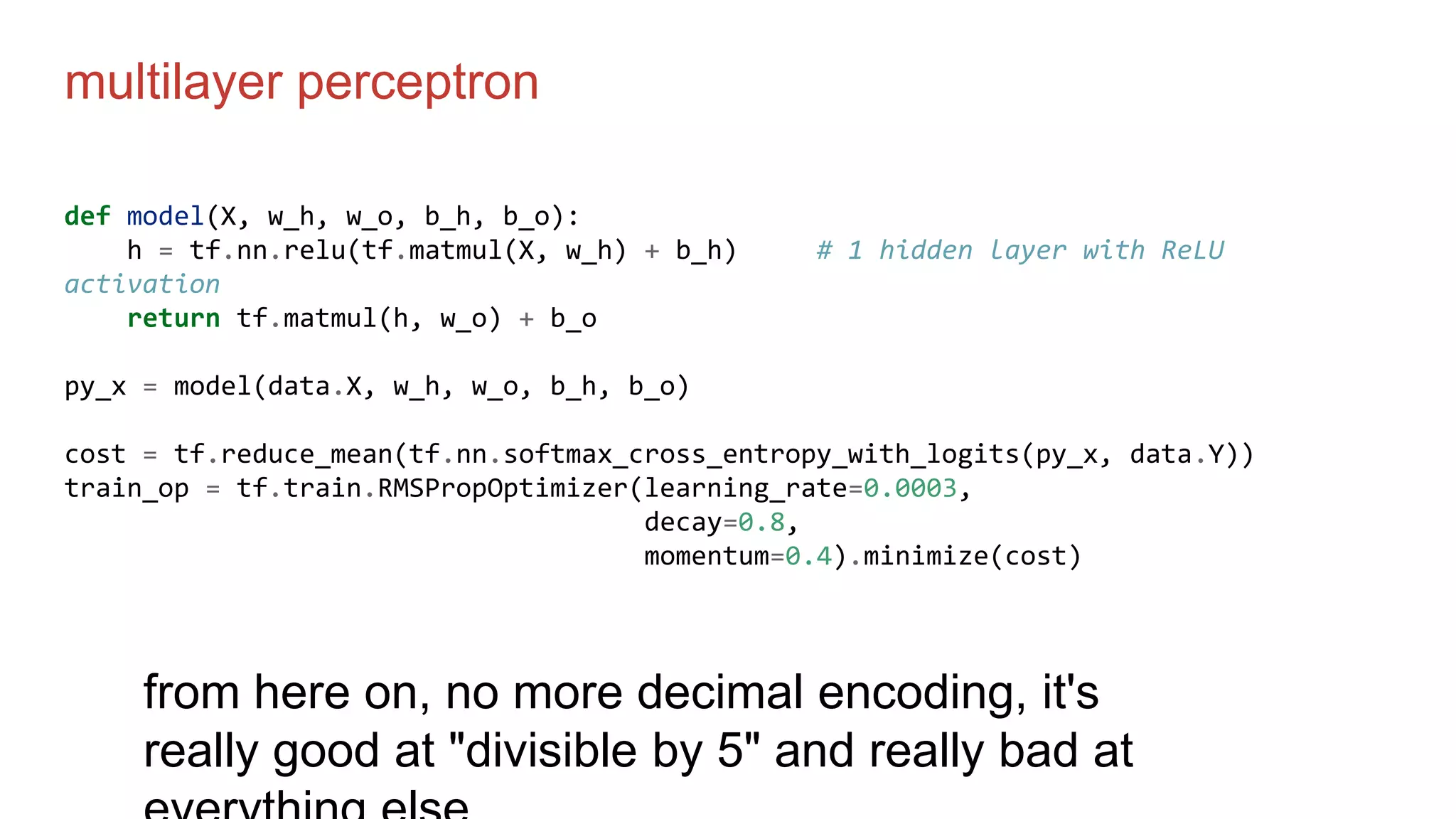
multilayer perceptron
def model(X, w_h, w_o, b_h, b_o):
h = tf.nn.relu(tf.matmul(X, w_h) + b_h) # 1 hidden layer with ReLU
activation
return tf.matmul(h, w_o) + b_o
py_x = model(data.X, w_h, w_o, b_h, b_o)
cost = tf.reduce_mean(tf.nn.softmax_cross_entropy_with_logits(py_x, data.Y))
train_op = tf.train.RMSPropOptimizer(learning_rate=0.0003,
decay=0.8,
momentum=0.4).minimize(cost)
from here on, no more decimal encoding, it's
really good at "divisible by 5" and really bad at
by # of hidden units (after 1000's of epochs)
5
10
25
50
100
200
[[52, 2, 1, 0],
[ 0, 25, 0, 0],
[ 1, 0, 13, 0],
[ 0, 0, 0, 6]]
[[45, 16, 3, 0],
[ 8, 11, 1, 0],
[ 0, 0, 10, 0],
[ 0, 0, 0, 6]]
black + red = predictions
black + tan = actuals
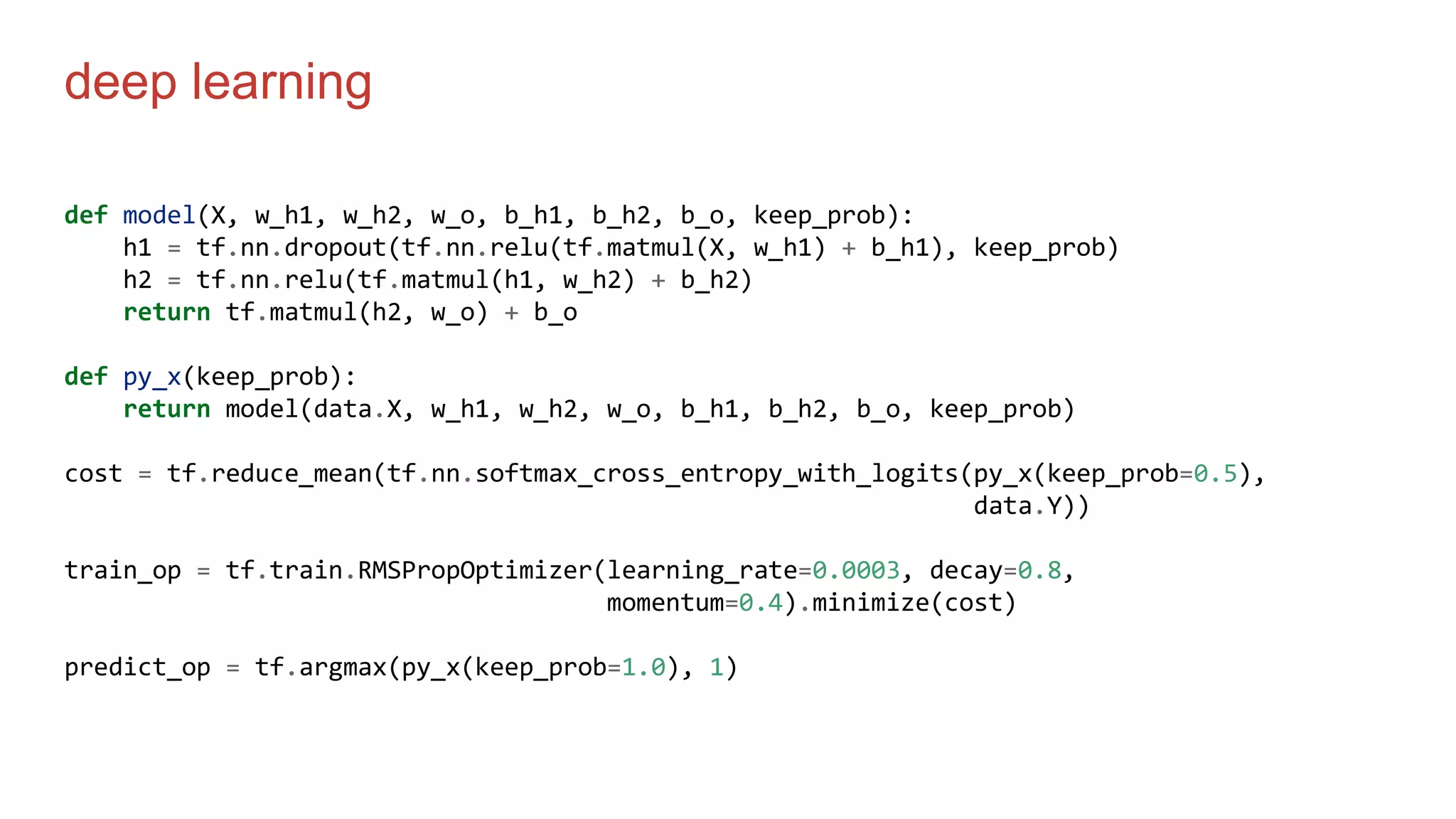
deep learning
def model(X, w_h1, w_h2, w_o, b_h1, b_h2, b_o, keep_prob):
h1 = tf.nn.dropout(tf.nn.relu(tf.matmul(X, w_h1) + b_h1), keep_prob)
h2 = tf.nn.relu(tf.matmul(h1, w_h2) + b_h2)
return tf.matmul(h2, w_o) + b_o
def py_x(keep_prob):
return model(data.X, w_h1, w_h2, w_o, b_h1, b_h2, b_o, keep_prob)
cost = tf.reduce_mean(tf.nn.softmax_cross_entropy_with_logits(py_x(keep_prob=0.5),
data.Y))
train_op = tf.train.RMSPropOptimizer(learning_rate=0.0003, decay=0.8,
momentum=0.4).minimize(cost)
predict_op = tf.argmax(py_x(keep_prob=1.0), 1)
HIDDEN LAYERS (50% dropout in 1st hidden layer)
[100, 100]
will sometimes get it 100% right, but not reliably
[2000, 2000]
seems to get it exactly right every time (in ~200 epochs)
black + red = predictions
black + tan = actuals
But how does it work?
25-hidden-neuron shallow net was simplest interesting model
in particular, it gets all the "divisible by 15" exactly right
not obvious to me how to learn "divisible by 15" from binary
[[45, 16, 3, 0],
[ 8, 11, 1, 0],
[ 0, 0, 10, 0],
[ 0, 0, 0, 6]]
black + red = predictions
black + tan = actuals
which inputs produce largest "fizz buzz" values?
(120, array([ -4.51552565, -11.66495565, -17.10086776, 0.32237191])),
(240, array([ -5.04136949, -12.02974626, -17.35017639, 0.07112655])),
(90, array([ -4.52364648, -11.48799399, -16.91179542, -0.20747044])),
(465, array([ -4.95231711, -11.88604214, -17.5155363 , -0.34996536])),
(210, array([ -5.04364677, -11.85627498, -17.17183826, -0.4049097 ])),
(720, array([ -4.98066528, -11.68684173, -17.01117473, -0.46671827])),
(345, array([ -4.49738021, -11.34621705, -16.88004503, -0.4713167 ])),
(600, array([ -4.48999048, -11.30909995, -16.70980522, -0.53889132])),
(360, array([ -9.32991992, -15.18924931, -17.8993147 , -4.35817601])),
(480, array([ -9.79430086, -15.72038142, -18.51560547, -4.38727747])),
(450, array([ -9.80194752, -15.54985676, -18.32664509, -4.89815184])),
(330, array([ -9.34660544, -15.01537882, -17.69651957, -4.95658813])),
(960, array([ -9.74109305, -15.37921101, -18.16552369, -4.95677615])),
(840, array([ -9.31266483, -14.83212949, -17.49181923, -5.26606825])),
(105, array([ -8.73320381, -11.08279653, -9.31921242, -5.52620068])),
(225, array([ -9.22702329, -11.50045288, -9.64725618, -5.76014854])),
(585, array([ -8.62907369, -10.84616688, -9.23592859, -5.79517941])),
(705, array([ -9.12030976, -11.2651869 , -9.56738927, -6.02974533])),
last column only needs
to be larger than the
other columns but in
this case it works out --
these are all divisible
by 15
notice that they cluster
into similar outputs
notice also that we
have pairs of numbers
that differ by 120
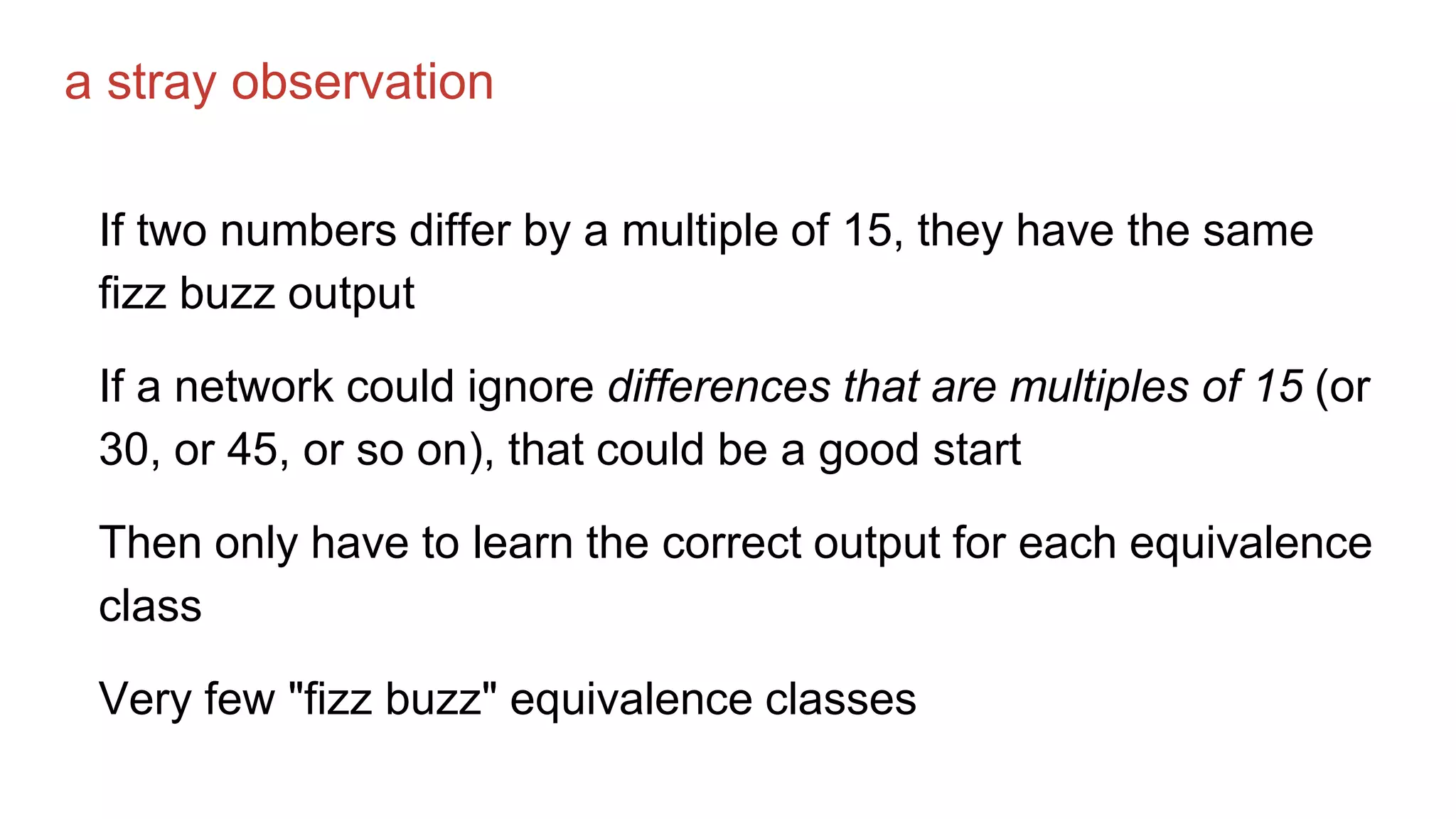
a stray observation
If two numbers differ by a multiple of 15, they have the same
fizz buzz output
If a network could ignore differences that are multiples of 15 (or
30, or 45, or so on), that could be a good start
Then only have to learn the correct output for each equivalence
class
Very few "fizz buzz" equivalence classes
two-bit SWAPS that are congruent mod 15
-8 +128 = +120
120 [0 0 0 1 1 1 1 0 0 0]
240 [0 0 0 0 1 1 1 1 0 0]
+2 -32 = -30 (from 120/240)
90 [0 1 0 1 1 0 1 0 0 0]
210 [0 1 0 0 1 0 1 1 0 0]
-32 +512 = +480 (from 120/240)
600 [0 0 0 1 1 0 1 0 0 1]
720 [0 0 0 0 1 0 1 1 0 1]
+1 -256 = -255 (from 600/720)
345 [1 0 0 1 1 0 1 0 1 0]
465 [1 0 0 0 1 0 1 1 1 0]
two-bit SWAPS that are congruent mod 15
-8 +128 = +120
120 [0 0 0 1 1 1 1 0 0 0]
240 [0 0 0 0 1 1 1 1 0 0]
+2 -32 = -30
90 [0 1 0 1 1 0 1 0 0 0]
210 [0 1 0 0 1 0 1 1 0 0]
-32 +512 = +480
600 [0 0 0 1 1 0 1 0 0 1]
720 [0 0 0 0 1 0 1 1 0 1]
+1 -256 = -255
345 [1 0 0 1 1 0 1 0 1 0]
465 [1 0 0 0 1 0 1 1 1 0]
-8 +128
360 [0 0 0 1 0 1 1 0 1 0]
480 [0 0 0 0 0 1 1 1 1 0]
330 [0 1 0 1 0 0 1 0 1 0]
450 [0 1 0 0 0 0 1 1 1 0]
840 [0 0 0 1 0 0 1 0 1 1]
960 [0 0 0 0 0 0 1 1 1 1]
two-bit SWAPS that are congruent mod 15
-8 +128 = +120
120 [0 0 0 1 1 1 1 0 0 0]
240 [0 0 0 0 1 1 1 1 0 0]
+2 -32 = -30
90 [0 1 0 1 1 0 1 0 0 0]
210 [0 1 0 0 1 0 1 1 0 0]
-32 +512 = +480
600 [0 0 0 1 1 0 1 0 0 1]
720 [0 0 0 0 1 0 1 1 0 1]
+1 -256 = -255
345 [1 0 0 1 1 0 1 0 1 0]
465 [1 0 0 0 1 0 1 1 1 0]
-8 +128
360 [0 0 0 1 0 1 1 0 1 0]
480 [0 0 0 0 0 1 1 1 1 0]
330 [0 1 0 1 0 0 1 0 1 0]
450 [0 1 0 0 0 0 1 1 1 0]
840 [0 0 0 1 0 0 1 0 1 1]
960 [0 0 0 0 0 0 1 1 1 1]
105 [1 0 0 1 0 1 1 0 0 0]
225 [1 0 0 0 0 1 1 1 0 0]
-32 +512
585 [1 0 0 1 0 0 1 0 0 1]
705 [1 0 0 0 0 0 1 1 0 1]
any neuron with the same weight on those
two inputs will produce the same outcome
if they're swapped
if you want to drive yourself mad, spend a
few hours staring at the neuron weights
themselves!
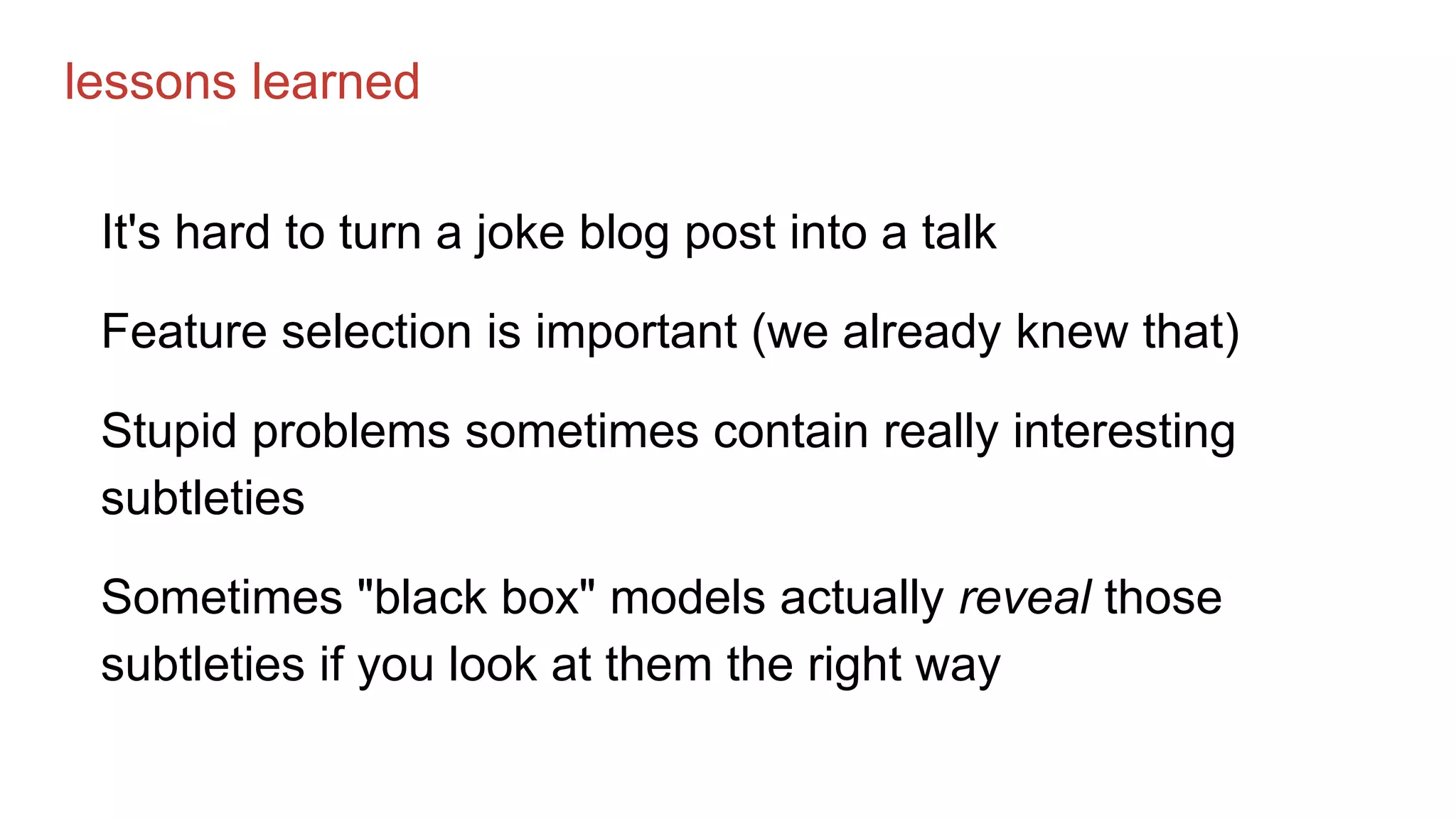
lessons learned
It's hard to turn a joke blog post into a talk
Feature selection is important (we already knew that)
Stupid problems sometimes contain really interesting
subtleties
Sometimes "black box" models actually reveal those
subtleties if you look at them the right way
sorry for
not being
just a joke
talk!
thanks!
code: github.com/joelgrus
blog: joelgrus.com
twitter: @joelgrus
(will tweet out link to slides, so go follow!)
book: --------------------------->
(might add a chapter about slides, so go
buy just in case!)

Wrangle 2016: (Lightning Talk) FizzBuzz in TensorFlow

  • 1.
    Fizz buzz intensorflow Joel Grus Research Engineer, AI2 @joelgrus
  • 3.
    About me Research engineerat AI2 we're hiring! (in Seattle) (where normal people can afford to buy a house) (sort of) Previously SWE at Google, data science at VoloMetrix, Decide, Farecast/Microsoft Wrote a book ------->
  • 4.
    Fizz Buzz, incase you're not familiar Write a program that prints the numbers 1 to 100, except that if the number is divisible by 3, instead print "fizz" if the number is divisible by 5, instead print "buzz" if the number is divisible by 15, instead print "fizzbuzz"
  • 5.
  • 7.
    the backstory Saw anonline discussion about the stupidest way to solve fizz buzz Thought, "I bet I can come up with a stupider way" Came up with a stupider way Blog post went viral Sort of a frivolous thing to use up my 15 minutes of fame on, but so be it
  • 10.
    super simple solution haskell fizzBuzz:: Integer -> String fizzBuzz i | i `mod` 15 == 0 = "fizzbuzz" | i `mod` 5 == 0 = "buzz" | i `mod` 3 == 0 = "fizz" | otherwise = show i mapM_ (putStrLn . fizzBuzz) [1..100] ok, then python def fizz_buzz(i): if i % 15 == 0: return "fizzbuzz" elif i % 5 == 0: return "buzz" elif i % 3 == 0: return "fizz" else: return str(i) for i in range(1, 101): print(fizz_buzz(i))
  • 11.
    taking on fizz buzzas a machine learning problem
  • 12.
    outputs given a number,there are four mutually exclusive cases 1.output the number itself 2.output "fizz" 3.output "buzz" 4.output "fizzbuzz" so one natural representation of the output is a vector of length 4 representing the predicted probability of each case
  • 13.
    ground truth def fizz_buzz_encode(i): ifi % 15 == 0: return np.array([0, 0, 0, 1]) elif i % 5 == 0: return np.array([0, 0, 1, 0]) elif i % 3 == 0: return np.array([0, 1, 0, 0]) else: return np.array([1, 0, 0, 0])
  • 14.
  • 16.
    feature selection -cheating clever def x(i): return np.array([1, i % 3 == 0, i % 5 == 0]) def predict(x): return np.dot(x, np.array([[ 1, 0, 0, -1], [-1, 1, -1, 1], [-1, -1, 1, 1]])) for i in range(1, 101): prediction = np.argmax(predict(x(i))) print([i, "fizz", "buzz", "fizzbuzz"][prediction]) It's hard to imagine an interviewer who wouldn't be impressed by even this simple solution.
  • 17.
    feature selection -cheating clever divisible by 3 not divisible by 3 divisible by 5 not divisible by 5
  • 18.
    what if wearen't that clever? binary encoding, say 10 digits (up to 1023) 1 -> [1, 0, 0, 0, 0, 0, 0, 0, 0, 0] 2 -> [0, 1, 0, 0, 0, 0, 0, 0, 0, 0] 3 -> [1, 1, 0, 0, 0, 0, 0, 0, 0, 0] and so on in comments, someone suggested one-hot decimal encoding the digits, say up to 999 315 -> [0, 0, 0, 1, 0, 0, 0, 0, 0, 0, 0, 1, 0, 0, 0, 0, 0, 0, 0, 0, 0, 0, 0, 0, 0, 1, 0, 0, 0, 0] and so on
  • 19.
    training data need togenerate fizz buzz for 1 to 100, so don't want to train on those binary: train on 101 - 1023 one-hot decimal digits: train on 101 - 999 then use 1 to 100 as the test data
  • 20.
    tensorflow in oneslide import numpy as np import tensorflow as tf X = tf.placeholder("float", [None, input_dim]) Y = tf.placeholder("float", [None, output_dim]) beta = tf.Variable(tf.random_normal(beta_shape, stddev=0.01)) def model(X, beta): # some function of X and beta p_yx = model(X, beta) cost = some_cost_function(p_yx, Y) train_op = tf.train.SomeOptimizer.minimize(cost) with tf.Session() as sess: sess.run(tf.initialize_all_variables()) for _ in range(num_epochs): sess.run(train_op, feed_dict={X: trX, Y: trY}) the extent of what I know about standard imports placeholders for our data parameters to learn some parametric model applied to the symbolic variables train by minimizing some cost function create session and initialize variables train using data
  • 21.
    Visualizing the results(a hard problem by itself) 1 100correct "11" incorrect "buzz" actual "fizzbuzz" correct "fizz" black + red = predictions black + tan = actuals predicted "fizz" actual "buzz" [[30, 11, 6, 2], [12, 8, 4, 1], [ 4, 3, 2, 3], [ 4, 2, 0, 0]]
  • 22.
    linear regression def model(X,w, b): return tf.matmul(X, w) + b py_x = model(data.X, w, b) cost = tf.reduce_mean(tf.pow(py_x - data.Y, 2)) train_op = tf.train.GradientDescentOptimizer(0.05).minimize(cost) binary decimal [[54, 27, 14, 6], [ 0, 0, 0, 0], [ 0, 0, 0, 0], [ 0, 0, 0, 0]] [[54, 27, 0, 0], [ 0, 0, 0, 0], [ 0, 0, 14, 6], [ 0, 0, 0, 0]] black + red = predictions black + tan = actuals
  • 23.
    logistic regression def model(X,w, b): return tf.matmul(X, w) + b py_x = model(data.X, w, b) cost = tf.reduce_mean(tf.nn.softmax_cross_entropy_with_logits(py_x, data.Y)) train_op = tf.train.GradientDescentOptimizer(0.05).minimize(cost) binary [[54, 27, 14, 6], [ 0, 0, 0, 0], [ 0, 0, 0, 0], [ 0, 0, 0, 0]] [[54, 27, 0, 0], [ 0, 0, 0, 0], [ 0, 0, 14, 6], [ 0, 0, 0, 0]] decimal black + red = predictions black + tan = actuals
  • 24.
    multilayer perceptron def model(X,w_h, w_o, b_h, b_o): h = tf.nn.relu(tf.matmul(X, w_h) + b_h) # 1 hidden layer with ReLU activation return tf.matmul(h, w_o) + b_o py_x = model(data.X, w_h, w_o, b_h, b_o) cost = tf.reduce_mean(tf.nn.softmax_cross_entropy_with_logits(py_x, data.Y)) train_op = tf.train.RMSPropOptimizer(learning_rate=0.0003, decay=0.8, momentum=0.4).minimize(cost) from here on, no more decimal encoding, it's really good at "divisible by 5" and really bad at
  • 25.
    by # ofhidden units (after 1000's of epochs) 5 10 25 50 100 200 [[52, 2, 1, 0], [ 0, 25, 0, 0], [ 1, 0, 13, 0], [ 0, 0, 0, 6]] [[45, 16, 3, 0], [ 8, 11, 1, 0], [ 0, 0, 10, 0], [ 0, 0, 0, 6]] black + red = predictions black + tan = actuals
  • 26.
    deep learning def model(X,w_h1, w_h2, w_o, b_h1, b_h2, b_o, keep_prob): h1 = tf.nn.dropout(tf.nn.relu(tf.matmul(X, w_h1) + b_h1), keep_prob) h2 = tf.nn.relu(tf.matmul(h1, w_h2) + b_h2) return tf.matmul(h2, w_o) + b_o def py_x(keep_prob): return model(data.X, w_h1, w_h2, w_o, b_h1, b_h2, b_o, keep_prob) cost = tf.reduce_mean(tf.nn.softmax_cross_entropy_with_logits(py_x(keep_prob=0.5), data.Y)) train_op = tf.train.RMSPropOptimizer(learning_rate=0.0003, decay=0.8, momentum=0.4).minimize(cost) predict_op = tf.argmax(py_x(keep_prob=1.0), 1)
  • 27.
    HIDDEN LAYERS (50%dropout in 1st hidden layer) [100, 100] will sometimes get it 100% right, but not reliably [2000, 2000] seems to get it exactly right every time (in ~200 epochs) black + red = predictions black + tan = actuals
  • 28.
    But how doesit work? 25-hidden-neuron shallow net was simplest interesting model in particular, it gets all the "divisible by 15" exactly right not obvious to me how to learn "divisible by 15" from binary [[45, 16, 3, 0], [ 8, 11, 1, 0], [ 0, 0, 10, 0], [ 0, 0, 0, 6]] black + red = predictions black + tan = actuals
  • 29.
    which inputs producelargest "fizz buzz" values? (120, array([ -4.51552565, -11.66495565, -17.10086776, 0.32237191])), (240, array([ -5.04136949, -12.02974626, -17.35017639, 0.07112655])), (90, array([ -4.52364648, -11.48799399, -16.91179542, -0.20747044])), (465, array([ -4.95231711, -11.88604214, -17.5155363 , -0.34996536])), (210, array([ -5.04364677, -11.85627498, -17.17183826, -0.4049097 ])), (720, array([ -4.98066528, -11.68684173, -17.01117473, -0.46671827])), (345, array([ -4.49738021, -11.34621705, -16.88004503, -0.4713167 ])), (600, array([ -4.48999048, -11.30909995, -16.70980522, -0.53889132])), (360, array([ -9.32991992, -15.18924931, -17.8993147 , -4.35817601])), (480, array([ -9.79430086, -15.72038142, -18.51560547, -4.38727747])), (450, array([ -9.80194752, -15.54985676, -18.32664509, -4.89815184])), (330, array([ -9.34660544, -15.01537882, -17.69651957, -4.95658813])), (960, array([ -9.74109305, -15.37921101, -18.16552369, -4.95677615])), (840, array([ -9.31266483, -14.83212949, -17.49181923, -5.26606825])), (105, array([ -8.73320381, -11.08279653, -9.31921242, -5.52620068])), (225, array([ -9.22702329, -11.50045288, -9.64725618, -5.76014854])), (585, array([ -8.62907369, -10.84616688, -9.23592859, -5.79517941])), (705, array([ -9.12030976, -11.2651869 , -9.56738927, -6.02974533])), last column only needs to be larger than the other columns but in this case it works out -- these are all divisible by 15 notice that they cluster into similar outputs notice also that we have pairs of numbers that differ by 120
  • 30.
    a stray observation Iftwo numbers differ by a multiple of 15, they have the same fizz buzz output If a network could ignore differences that are multiples of 15 (or 30, or 45, or so on), that could be a good start Then only have to learn the correct output for each equivalence class Very few "fizz buzz" equivalence classes
  • 31.
    two-bit SWAPS thatare congruent mod 15 -8 +128 = +120 120 [0 0 0 1 1 1 1 0 0 0] 240 [0 0 0 0 1 1 1 1 0 0] +2 -32 = -30 (from 120/240) 90 [0 1 0 1 1 0 1 0 0 0] 210 [0 1 0 0 1 0 1 1 0 0] -32 +512 = +480 (from 120/240) 600 [0 0 0 1 1 0 1 0 0 1] 720 [0 0 0 0 1 0 1 1 0 1] +1 -256 = -255 (from 600/720) 345 [1 0 0 1 1 0 1 0 1 0] 465 [1 0 0 0 1 0 1 1 1 0]
  • 32.
    two-bit SWAPS thatare congruent mod 15 -8 +128 = +120 120 [0 0 0 1 1 1 1 0 0 0] 240 [0 0 0 0 1 1 1 1 0 0] +2 -32 = -30 90 [0 1 0 1 1 0 1 0 0 0] 210 [0 1 0 0 1 0 1 1 0 0] -32 +512 = +480 600 [0 0 0 1 1 0 1 0 0 1] 720 [0 0 0 0 1 0 1 1 0 1] +1 -256 = -255 345 [1 0 0 1 1 0 1 0 1 0] 465 [1 0 0 0 1 0 1 1 1 0] -8 +128 360 [0 0 0 1 0 1 1 0 1 0] 480 [0 0 0 0 0 1 1 1 1 0] 330 [0 1 0 1 0 0 1 0 1 0] 450 [0 1 0 0 0 0 1 1 1 0] 840 [0 0 0 1 0 0 1 0 1 1] 960 [0 0 0 0 0 0 1 1 1 1]
  • 33.
    two-bit SWAPS thatare congruent mod 15 -8 +128 = +120 120 [0 0 0 1 1 1 1 0 0 0] 240 [0 0 0 0 1 1 1 1 0 0] +2 -32 = -30 90 [0 1 0 1 1 0 1 0 0 0] 210 [0 1 0 0 1 0 1 1 0 0] -32 +512 = +480 600 [0 0 0 1 1 0 1 0 0 1] 720 [0 0 0 0 1 0 1 1 0 1] +1 -256 = -255 345 [1 0 0 1 1 0 1 0 1 0] 465 [1 0 0 0 1 0 1 1 1 0] -8 +128 360 [0 0 0 1 0 1 1 0 1 0] 480 [0 0 0 0 0 1 1 1 1 0] 330 [0 1 0 1 0 0 1 0 1 0] 450 [0 1 0 0 0 0 1 1 1 0] 840 [0 0 0 1 0 0 1 0 1 1] 960 [0 0 0 0 0 0 1 1 1 1] 105 [1 0 0 1 0 1 1 0 0 0] 225 [1 0 0 0 0 1 1 1 0 0] -32 +512 585 [1 0 0 1 0 0 1 0 0 1] 705 [1 0 0 0 0 0 1 1 0 1] any neuron with the same weight on those two inputs will produce the same outcome if they're swapped if you want to drive yourself mad, spend a few hours staring at the neuron weights themselves!
  • 34.
    lessons learned It's hardto turn a joke blog post into a talk Feature selection is important (we already knew that) Stupid problems sometimes contain really interesting subtleties Sometimes "black box" models actually reveal those subtleties if you look at them the right way
  • 35.
  • 36.
    thanks! code: github.com/joelgrus blog: joelgrus.com twitter:@joelgrus (will tweet out link to slides, so go follow!) book: ---------------------------> (might add a chapter about slides, so go buy just in case!)