WOUND HEALING
Dr Avijit Banerjee
South Eastern Railway Hospital,Kolkata
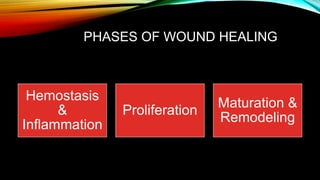
PHASES OF WOUND HEALING
Hemostasis
&
Inflammation
Proliferation
Maturation &
Remodeling
HAEMOSTASIS AND
INFLAMMATION
• Wounding disrupts tissue integrity
• Division of blood vessels and direct exposure of ECM to platelets
• Platelet aggregation,degranulation and activation of coagulation cascade
• Platelet alpha granules release 1.PDGF 2.TGF-B 3.PAF 4.FIBRONECTIN
5.SEROTONIN
• Fibrin clot leads to hemostasis & scaffolding for migration into wound of
inflammatory cells {PMNs,monocytes}
1ST 24-48HRS-----PMN
• Due to Increased vascular permeability + local PG + COMPLEMENT + IL-1 + TNF-a
+ TGF-b + PF-4
• Phagocytosis of bacteria & tissue debris
• Release cytokines esp. TNF a
• TNF a CAUSE ANGIOGENESIS AND COLLAGEN SYNTHESIS
• Do not play a role in collagen deposition or acquisition of mechanical wound
strength rather neutrophil factors delay epithelial closure of wounds
2ND GROUP[48-96HRS]------
MACROPHAGES
• Essential to successful healing[derived from circulating monocytes]
• Remain till healing is complete
• Phagocytosis + microbial stasis via o2 radical & NO synthesis
• Activation & recruitment of other cells via cytokines + GF+ cell to cell adhesions and
ICAM
• Release TGF-b, VEGF, IGF, EGF,LACTATE
• Macrophages play significant role in regulating angiogenesis + matrix deposition &
remodeling
PEAKING AT 1 WEEK----------
T-LYMPHOCYTES
• Active role in modulation of wound environment
• If CD8 SUPPRESSOR decrease then better wound healing
• If wound T lymphocytes decrease then wound strength and collagen content
decrease
• If CD4HELPER decrease there is no effect on wound
• Direct cell-cell contact between lymphocytes & fibroblast is also essential
PROLIFERATION
• 4-12 days
• Tissue continuity is re established
• Fibroblast + Endothelial cells are last cell populations to infiltrate
FIBROBLASTS
• Strongest chemo tactic factor for its release is PDGF
• Cause matrix synthesis and remodeling
• To function needs to proliferate and get activated by macrophages
• Synthesize more collagen from wound site than non wound site
• LACTATE[-10mmol] IS A POTENT REGULATOR OF COLLAGEN SYNTHESIS
THROUGH A MECHANISM OF ADP- ribosylation
ENDOTHELIAL CELLS
• Activated by TNF-a TGF b VEGF
• CAUSE ANGIOGENESIS
MATRIX SYNTHESIS
• By collagen type 1[major component of ECM in skin] & type 3[important in repair process]
• Collagen has glycine in every 3rd position,2nd by proline or lysine
• 1000aa = protocollagen, goes to E.R where hydroxylation of proline & lysine take place
• Hydroxylation of proline by prolyl hydroxylase-1>o2 & Fe as cofactors
2>a-KG AS co substrate
3>Vitamin C as electron donor
• Protocollagen in ER is glycosylated by GAL & GLU
• Protocollagen is hydroxylated and glycosylated to form procollagen(a-helix)
• Registration peptides are present in the terminal ends
• Then there is extracellular crosslinking to form collagen
PROTEOGLYCAN SYNTHESIS
• The polysaccharide chain is made up of repeating disaccharide units of glucuronic
& iduronic acid & a hexose(sulphated)
• GAG in wounds = Dermatan sulphate & chondroitin sulphate
• Fibroblasts synthesize these products during 1st 3 weeks of healing
MATURATION & REMODELLING
• Begins in the fibroblastic phase
• Collagen is broken down by MMPs
• Deposition of matrix = fibronectin & collagen 3
• GAG + proteoglycans form the next significant matrix components
• Collagen 1 is present in the final matrix
• Fibril formation & cross linking is by 1.decreased collagen solubility2. increased
strength and 3.increased resistance to enzymatic degradation
• Scar remodelling takes 6-12 months
• TGFb cause increased collagen transcription and decreased collagen breakdown
EPITHELIALIZATION
• Start from day 1
• Thickening of epidermis
• Marginal basal cells at edge migrate
• Fixed basal cells cause rapid division and migrate by leap frog fashion
• Result in layering and keratinization
• Re-epithelization takes less than 48 hours in incised wounds
• Stimuli remains the same though incompletely defined
WOUND CONTRACTION
• All wounds undergo some degree of contraction
• If wounds are not approximated = 2’ intention
• Myofibroblasts are the reason for contraction
• Differ from fibroblasts in having a cytoskeletal structure
• Contain aSmooth muscle actin in thick bundles called stress fibres, which are
undetectable in first 6 days, then increase in next 15 days
• In 4 weeks expression fades and undergo apoptosis
CLASSIFICATION OF WOUNDS
acute
• Predictable nature
• Definitive time frame of healing
• Less complications
chronic
• Failed to proceed through orderly
process
• Proceeded through repair process
without producing adequate anatomic
and functional result
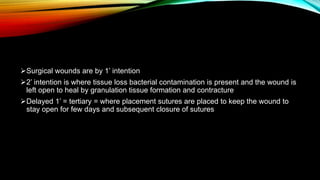
Surgical wounds are by 1’ intention
2’ intention is where tissue loss bacterial contamination is present and the wound is
left open to heal by granulation tissue formation and contracture
Delayed 1’ = tertiary = where placement sutures are placed to keep the wound to
stay open for few days and subsequent closure of sutures
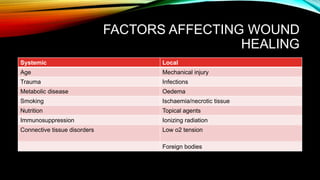
FACTORS AFFECTING WOUND
HEALING
Systemic Local
Age Mechanical injury
Trauma Infections
Metabolic disease Oedema
Smoking Ischaemia/necrotic tissue
Nutrition Topical agents
Immunosuppression Ionizing radiation
Connective tissue disorders Low o2 tension
Foreign bodies
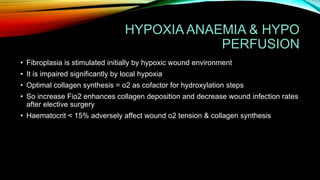
HYPOXIA ANAEMIA & HYPO
PERFUSION
• Fibroplasia is stimulated initially by hypoxic wound environment
• It is impaired significantly by local hypoxia
• Optimal collagen synthesis = o2 as cofactor for hydroxylation steps
• So increase Fio2 enhances collagen deposition and decrease wound infection rates
after elective surgery
• Haematocrit < 15% adversely affect wound o2 tension & collagen synthesis
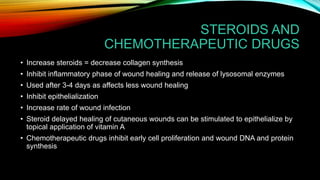
STEROIDS AND
CHEMOTHERAPEUTIC DRUGS
• Increase steroids = decrease collagen synthesis
• Inhibit inflammatory phase of wound healing and release of lysosomal enzymes
• Used after 3-4 days as affects less wound healing
• Inhibit epithelialization
• Increase rate of wound infection
• Steroid delayed healing of cutaneous wounds can be stimulated to epithelialize by
topical application of vitamin A
• Chemotherapeutic drugs inhibit early cell proliferation and wound DNA and protein
synthesis
METABOLIC DISORDERS
• DM = increase wound infection and impaired healing
• Uncontrolled DM cause decreased inflammation angiogenesis and collagen
synthesis
• T1DM cause decrease wound collagen accumulation in wound independent of
degree of glycaemic control
• T2DM has no affect on collagen accretion
• Uraemia cause disordered wound healing
NUTRITION
• Index of collagen deposition is hydroxyproline accumulation in S.C implanted PTFE
tubes comparison with a control subject
• In malnutrition = increased wound complications , increased wound failure, impaired
healing response , decreased CMI phagocytosis and intracellular killing
• Arginine = most active in terms of enhancing wound fibroplasia
• Vitamin C = collagen synthesis, RDA = 60 mg
• In severely injured / extensively burned patient = 2gm daily
• Vitamin A = increased macrophage influx and collagen synthesis
• In severely injured = 25k-1lac IU/day
• Zinc =cofactor enzymes(no effect on supplementation)
INFECTIONS
• Major medical problem
• Antibiotic prophylaxis is most effective when adequate concentrations of antibiotic are
present in the tissues at the time of incision
• The source of pathogens for infection is usually endogenous flora of patients skin, mucous
membranes, or from hollow organs
• STAPH.>CONS>ENTEROCOCCI>E.COLI
• Based on level of infection class of wounds
• I-clean(lap,Bx,eye Sx)
• II-clean contaminated(opened to remove FB,ear Sx,gynae Sx)
• III-contaminated(spillage from GI Sx)
• IV-dirty(infected, exposed to pus/faecal matter)
• Most surgical wound infections become apparent within 7-10 days postoperatively
• Mere presence of bacteria in open wound does not constitute an infection, because
large number can be present normally.
CHRONIC WOUNDS
• That have not healed in 3 months
• Skin ulcers(ISCHAEMIC ARTERIAL ULCERS,VENOUS STASIS ULCERS,DIABETIC
WOUNDS,DECUBITUS/PRESSURE ULCERSPERITONEAL SCARRING)
• Repeated trauma, poor perfusion or oxygenation, and/or excessive inflammation is the
aetiology
• Fibroblasts here have decreased proliferative potential
• Unresponsiveness to normal regulatory signals = predictive of chronic wounds
• Malignant transformation of chronic ulcer in any long standing wound = MARJOLIN ULCER
• Bx taken from edge of the wound
• Cancers rising de novo in chronic wounds can be squamous cell carcinoma or basal cell
carcinoma
TREATMENT OF WOUNDS
local care
Irrigation + debridement +/- L.A
Antibiotics + T.T
L.A- 0.5-1% lidocaine or 0.25-0.5% bupivacaine +/- 1:100000-1:200000
epinephrine(not to be given in fingers,toes,ears,nose,penis(areas of terminal
arteriole vasospasm on application))
I2 ,povidone I2, hydrogen peroxide, organic antibacterial prep = impair wound
healing as they injure wound neutrophils and macrophages so should not be used
directly on wound bed
N.S should be used
• Bleeding stopped by cautery or ligature
• Removal of F.B
• Fresh edge for reapproximation( special care for wounds that cross vermilion
border, eyebrows or hairline)
• Non absorbable /slowly absorbing monofilament sutures for deep fascial
layers(abdominal wall)
• Subcutaneous sutures by braided absorbable sutures ,avoid placement in fat
TISSUE LOSS
• Use of rotation flaps or free flaps
• In case of significant superficial loss = STSG ( helps formation of intact epithelial
barrier to fluid loss and infection)
• Haemostasis before STSG as haematoma prevents graft from taking
• In acute contaminated wounds with skin loss = porcine xenografts or cadaveric
allografts
• Failure to remove sutures/staples prior to 7-10days(3-5 for face) after repair will
result in cosmetically inferior wound
• Intradermal absorbable/ skin tapes are available
• Octyl-cyanoacrylate tissue glues = simple, linear wounds with viable skin edges
• Studies show it is suitable for use in contaminated situations without significant risk
of infection
ANTIBIOTICS
• Specific or for multiple organisms
• Location of wound and quality of tissue perfusion are 2 factors on which its action
depends
• Topical antibiotics have more questionable efficacy
DRESSING
• Provide environment for wound healing
• Compression for haemostasis and decreases oedema
• Occlusion control level of hydration and o2 tension, limiting tissue desiccation
• C/I in infected wounds and exudative wounds
• Absorbent dressing = cotton , wool, sponge
• Non-adherent dressing = paraffin, petroleum jelly, water soluble jelly
• Occlusive and semi-occlusive dressings = used in clean minimally exudative
wounds, waterproof and impervious to microbes
• Hydrocolloid and hydrogel dressings = helps in atraumatic removal of dressing and
helps in wound hydration
• Alginates = mannuronic and glucuronic acid, ion exchange in presence of wound
exudates. Used in open surgical wounds with medium exudation &/or full thickness
chronic wounds
• Medicated dressings = benzoyl peroxide,ZnO,neomycin & bacitracin-zinc
WOUND DRAINAGE
• 1-2ml/day= semi-occlusive/absorbent nonadherent
• 3-5ml/day = non-adherent 1’ + absorbent 2’+ occlusive
• >5ml/day = highly absorbent 2nd layer
• Mechanical devices = VAC(VACUUM ASSISTED CLOSURE) for chronic open
wounds, acute and traumatic wounds, flaps and grafts and subacute wounds
• Skin replacements = autograft,allograft,xenograft
• Skin substitutes = acellular = native collagen or CEAs(cultured epithelial
autografts)(they are keratinocytes harvested from a biopsy . Their size is of a
postage stamp)
viable fibroblasts grown on bioabsorable/non-bioabsorable meshes
• Growth factor therapy = only platelet derived G.Fs are approved bt FDA for diabetic
foot ulcers
“
”
INJURY ALONE HAS IN ALL CASES A TENDENCY
TO PRODUCE THE DISPOSITION AND MEANS OF A
CURE
JOHN HUNTER
THANK YOU

Wound healing

  • 1.
    WOUND HEALING Dr AvijitBanerjee South Eastern Railway Hospital,Kolkata
  • 2.
    PHASES OF WOUNDHEALING Hemostasis & Inflammation Proliferation Maturation & Remodeling
  • 3.
    HAEMOSTASIS AND INFLAMMATION • Woundingdisrupts tissue integrity • Division of blood vessels and direct exposure of ECM to platelets • Platelet aggregation,degranulation and activation of coagulation cascade • Platelet alpha granules release 1.PDGF 2.TGF-B 3.PAF 4.FIBRONECTIN 5.SEROTONIN • Fibrin clot leads to hemostasis & scaffolding for migration into wound of inflammatory cells {PMNs,monocytes}
  • 4.
    1ST 24-48HRS-----PMN • Dueto Increased vascular permeability + local PG + COMPLEMENT + IL-1 + TNF-a + TGF-b + PF-4 • Phagocytosis of bacteria & tissue debris • Release cytokines esp. TNF a • TNF a CAUSE ANGIOGENESIS AND COLLAGEN SYNTHESIS • Do not play a role in collagen deposition or acquisition of mechanical wound strength rather neutrophil factors delay epithelial closure of wounds
  • 5.
    2ND GROUP[48-96HRS]------ MACROPHAGES • Essentialto successful healing[derived from circulating monocytes] • Remain till healing is complete • Phagocytosis + microbial stasis via o2 radical & NO synthesis • Activation & recruitment of other cells via cytokines + GF+ cell to cell adhesions and ICAM • Release TGF-b, VEGF, IGF, EGF,LACTATE • Macrophages play significant role in regulating angiogenesis + matrix deposition & remodeling
  • 6.
    PEAKING AT 1WEEK---------- T-LYMPHOCYTES • Active role in modulation of wound environment • If CD8 SUPPRESSOR decrease then better wound healing • If wound T lymphocytes decrease then wound strength and collagen content decrease • If CD4HELPER decrease there is no effect on wound • Direct cell-cell contact between lymphocytes & fibroblast is also essential
  • 7.
    PROLIFERATION • 4-12 days •Tissue continuity is re established • Fibroblast + Endothelial cells are last cell populations to infiltrate
  • 8.
    FIBROBLASTS • Strongest chemotactic factor for its release is PDGF • Cause matrix synthesis and remodeling • To function needs to proliferate and get activated by macrophages • Synthesize more collagen from wound site than non wound site • LACTATE[-10mmol] IS A POTENT REGULATOR OF COLLAGEN SYNTHESIS THROUGH A MECHANISM OF ADP- ribosylation
  • 9.
    ENDOTHELIAL CELLS • Activatedby TNF-a TGF b VEGF • CAUSE ANGIOGENESIS
  • 10.
    MATRIX SYNTHESIS • Bycollagen type 1[major component of ECM in skin] & type 3[important in repair process] • Collagen has glycine in every 3rd position,2nd by proline or lysine • 1000aa = protocollagen, goes to E.R where hydroxylation of proline & lysine take place • Hydroxylation of proline by prolyl hydroxylase-1>o2 & Fe as cofactors 2>a-KG AS co substrate 3>Vitamin C as electron donor • Protocollagen in ER is glycosylated by GAL & GLU • Protocollagen is hydroxylated and glycosylated to form procollagen(a-helix) • Registration peptides are present in the terminal ends • Then there is extracellular crosslinking to form collagen
  • 11.
    PROTEOGLYCAN SYNTHESIS • Thepolysaccharide chain is made up of repeating disaccharide units of glucuronic & iduronic acid & a hexose(sulphated) • GAG in wounds = Dermatan sulphate & chondroitin sulphate • Fibroblasts synthesize these products during 1st 3 weeks of healing
  • 12.
    MATURATION & REMODELLING •Begins in the fibroblastic phase • Collagen is broken down by MMPs • Deposition of matrix = fibronectin & collagen 3 • GAG + proteoglycans form the next significant matrix components • Collagen 1 is present in the final matrix • Fibril formation & cross linking is by 1.decreased collagen solubility2. increased strength and 3.increased resistance to enzymatic degradation • Scar remodelling takes 6-12 months • TGFb cause increased collagen transcription and decreased collagen breakdown
  • 13.
    EPITHELIALIZATION • Start fromday 1 • Thickening of epidermis • Marginal basal cells at edge migrate • Fixed basal cells cause rapid division and migrate by leap frog fashion • Result in layering and keratinization • Re-epithelization takes less than 48 hours in incised wounds • Stimuli remains the same though incompletely defined
  • 14.
    WOUND CONTRACTION • Allwounds undergo some degree of contraction • If wounds are not approximated = 2’ intention • Myofibroblasts are the reason for contraction • Differ from fibroblasts in having a cytoskeletal structure • Contain aSmooth muscle actin in thick bundles called stress fibres, which are undetectable in first 6 days, then increase in next 15 days • In 4 weeks expression fades and undergo apoptosis
  • 15.
    CLASSIFICATION OF WOUNDS acute •Predictable nature • Definitive time frame of healing • Less complications chronic • Failed to proceed through orderly process • Proceeded through repair process without producing adequate anatomic and functional result
  • 16.
    Surgical wounds areby 1’ intention 2’ intention is where tissue loss bacterial contamination is present and the wound is left open to heal by granulation tissue formation and contracture Delayed 1’ = tertiary = where placement sutures are placed to keep the wound to stay open for few days and subsequent closure of sutures
  • 17.
    FACTORS AFFECTING WOUND HEALING SystemicLocal Age Mechanical injury Trauma Infections Metabolic disease Oedema Smoking Ischaemia/necrotic tissue Nutrition Topical agents Immunosuppression Ionizing radiation Connective tissue disorders Low o2 tension Foreign bodies
  • 18.
    HYPOXIA ANAEMIA &HYPO PERFUSION • Fibroplasia is stimulated initially by hypoxic wound environment • It is impaired significantly by local hypoxia • Optimal collagen synthesis = o2 as cofactor for hydroxylation steps • So increase Fio2 enhances collagen deposition and decrease wound infection rates after elective surgery • Haematocrit < 15% adversely affect wound o2 tension & collagen synthesis
  • 19.
    STEROIDS AND CHEMOTHERAPEUTIC DRUGS •Increase steroids = decrease collagen synthesis • Inhibit inflammatory phase of wound healing and release of lysosomal enzymes • Used after 3-4 days as affects less wound healing • Inhibit epithelialization • Increase rate of wound infection • Steroid delayed healing of cutaneous wounds can be stimulated to epithelialize by topical application of vitamin A • Chemotherapeutic drugs inhibit early cell proliferation and wound DNA and protein synthesis
  • 20.
    METABOLIC DISORDERS • DM= increase wound infection and impaired healing • Uncontrolled DM cause decreased inflammation angiogenesis and collagen synthesis • T1DM cause decrease wound collagen accumulation in wound independent of degree of glycaemic control • T2DM has no affect on collagen accretion • Uraemia cause disordered wound healing
  • 21.
    NUTRITION • Index ofcollagen deposition is hydroxyproline accumulation in S.C implanted PTFE tubes comparison with a control subject • In malnutrition = increased wound complications , increased wound failure, impaired healing response , decreased CMI phagocytosis and intracellular killing • Arginine = most active in terms of enhancing wound fibroplasia • Vitamin C = collagen synthesis, RDA = 60 mg • In severely injured / extensively burned patient = 2gm daily • Vitamin A = increased macrophage influx and collagen synthesis • In severely injured = 25k-1lac IU/day • Zinc =cofactor enzymes(no effect on supplementation)
  • 22.
    INFECTIONS • Major medicalproblem • Antibiotic prophylaxis is most effective when adequate concentrations of antibiotic are present in the tissues at the time of incision • The source of pathogens for infection is usually endogenous flora of patients skin, mucous membranes, or from hollow organs • STAPH.>CONS>ENTEROCOCCI>E.COLI • Based on level of infection class of wounds • I-clean(lap,Bx,eye Sx) • II-clean contaminated(opened to remove FB,ear Sx,gynae Sx) • III-contaminated(spillage from GI Sx) • IV-dirty(infected, exposed to pus/faecal matter)
  • 23.
    • Most surgicalwound infections become apparent within 7-10 days postoperatively • Mere presence of bacteria in open wound does not constitute an infection, because large number can be present normally.
  • 24.
    CHRONIC WOUNDS • Thathave not healed in 3 months • Skin ulcers(ISCHAEMIC ARTERIAL ULCERS,VENOUS STASIS ULCERS,DIABETIC WOUNDS,DECUBITUS/PRESSURE ULCERSPERITONEAL SCARRING) • Repeated trauma, poor perfusion or oxygenation, and/or excessive inflammation is the aetiology • Fibroblasts here have decreased proliferative potential • Unresponsiveness to normal regulatory signals = predictive of chronic wounds • Malignant transformation of chronic ulcer in any long standing wound = MARJOLIN ULCER • Bx taken from edge of the wound • Cancers rising de novo in chronic wounds can be squamous cell carcinoma or basal cell carcinoma
  • 25.
    TREATMENT OF WOUNDS localcare Irrigation + debridement +/- L.A Antibiotics + T.T L.A- 0.5-1% lidocaine or 0.25-0.5% bupivacaine +/- 1:100000-1:200000 epinephrine(not to be given in fingers,toes,ears,nose,penis(areas of terminal arteriole vasospasm on application)) I2 ,povidone I2, hydrogen peroxide, organic antibacterial prep = impair wound healing as they injure wound neutrophils and macrophages so should not be used directly on wound bed N.S should be used
  • 26.
    • Bleeding stoppedby cautery or ligature • Removal of F.B • Fresh edge for reapproximation( special care for wounds that cross vermilion border, eyebrows or hairline) • Non absorbable /slowly absorbing monofilament sutures for deep fascial layers(abdominal wall) • Subcutaneous sutures by braided absorbable sutures ,avoid placement in fat
  • 27.
    TISSUE LOSS • Useof rotation flaps or free flaps • In case of significant superficial loss = STSG ( helps formation of intact epithelial barrier to fluid loss and infection) • Haemostasis before STSG as haematoma prevents graft from taking • In acute contaminated wounds with skin loss = porcine xenografts or cadaveric allografts
  • 28.
    • Failure toremove sutures/staples prior to 7-10days(3-5 for face) after repair will result in cosmetically inferior wound • Intradermal absorbable/ skin tapes are available • Octyl-cyanoacrylate tissue glues = simple, linear wounds with viable skin edges • Studies show it is suitable for use in contaminated situations without significant risk of infection
  • 29.
    ANTIBIOTICS • Specific orfor multiple organisms • Location of wound and quality of tissue perfusion are 2 factors on which its action depends • Topical antibiotics have more questionable efficacy
  • 30.
    DRESSING • Provide environmentfor wound healing • Compression for haemostasis and decreases oedema • Occlusion control level of hydration and o2 tension, limiting tissue desiccation • C/I in infected wounds and exudative wounds
  • 31.
    • Absorbent dressing= cotton , wool, sponge • Non-adherent dressing = paraffin, petroleum jelly, water soluble jelly • Occlusive and semi-occlusive dressings = used in clean minimally exudative wounds, waterproof and impervious to microbes • Hydrocolloid and hydrogel dressings = helps in atraumatic removal of dressing and helps in wound hydration • Alginates = mannuronic and glucuronic acid, ion exchange in presence of wound exudates. Used in open surgical wounds with medium exudation &/or full thickness chronic wounds • Medicated dressings = benzoyl peroxide,ZnO,neomycin & bacitracin-zinc
  • 32.
    WOUND DRAINAGE • 1-2ml/day=semi-occlusive/absorbent nonadherent • 3-5ml/day = non-adherent 1’ + absorbent 2’+ occlusive • >5ml/day = highly absorbent 2nd layer
  • 33.
    • Mechanical devices= VAC(VACUUM ASSISTED CLOSURE) for chronic open wounds, acute and traumatic wounds, flaps and grafts and subacute wounds • Skin replacements = autograft,allograft,xenograft • Skin substitutes = acellular = native collagen or CEAs(cultured epithelial autografts)(they are keratinocytes harvested from a biopsy . Their size is of a postage stamp) viable fibroblasts grown on bioabsorable/non-bioabsorable meshes • Growth factor therapy = only platelet derived G.Fs are approved bt FDA for diabetic foot ulcers
  • 34.
    “ ” INJURY ALONE HASIN ALL CASES A TENDENCY TO PRODUCE THE DISPOSITION AND MEANS OF A CURE JOHN HUNTER THANK YOU