   In your groups come up with 3 or 4 points that
    your country would want for the treaty after
    the war.
   Reflect upon the hardships that your country
    faced.
After the carnage of WWI.
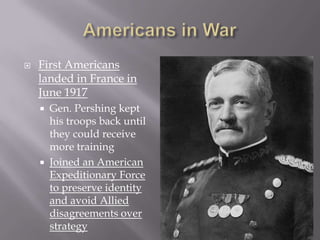
   First Americans
    landed in France in
    June 1917
       Gen. Pershing kept
        his troops back until
        they could receive
        more training
       Joined an American
        Expeditionary Force
        to preserve identity
        and avoid Allied
        disagreements over
        strategy
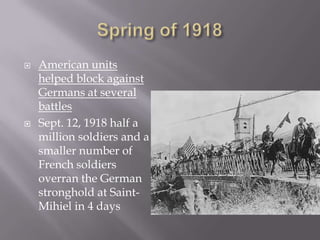
   American units
    helped block against
    Germans at several
    battles
   Sept. 12, 1918 half a
    million soldiers and a
    smaller number of
    French soldiers
    overran the German
    stronghold at Saint-
    Mihiel in 4 days
   French offensive stalled
       Mutinies and desertions
   Flanders
       British offensive, but Germans pushed them back
        further from where started
   Southern Front
       Italians lost morale and started to desert
   Spring of 1918 allied troops under French General
    Ferdinand Foch
       The Germans mounted their offensive
          wanted to split the Allies and drive the British to the sea
          came to within 37 miles of Paris before being stopped by the
           Allies
          they were low on reserves and morale
   the Allies had high morale and high reserves
    because of the US entering the war
       the Allied forces pushed the Germans back and slowly one
        by one the resistance of the Central Powers fell
          November 11 at 11am the Germans signed the Armistice
           The Germans had lost the war while its troops still held
            territory from France to the Crimean Peninsula
   Europe is shattered
       Millions dead, more wounded
       Country boundaries changed
       People looked to President Woodrow Wilson for
        hope
   Germany saw that          Fourteen Points
    their time had come           Peace plan whose
    and they wanted an             terms included
    armistice                      international
   They hoped that                recognition of
    Woodrow Wilson’s 14            freedom of the seas
                                   and trade, limitations
    points would be used
                                   of arms, an end to all
                                   secret alliances
                                  Settlements of
                                   colonial claims
                                  General assembly of
                                   nations created
   Germany thought that the 14 points would be
    used in the peace process with them
         Britain wanted control of the seas, didn’t want freedom
          of the seas
         France wanted reparations (payment for damages) to
          be included in any and all peace settlements
   Allied leaders didn’t want them (14 points)
       French Premier Clemenceau “President Wilson and
        his 14 points bore me. Even God Almighty has only
        10.”
   116,500 Americans died
   2.2 million Germans died
   1.7 million Russians died
   1.4 million French died
   1.2 million Austro-Hungarians died
   1 million British died
   Influenza Pandemic of 1918-1919
       Victims literally died in their own bodily fluids
       1/50 died, generally ages 20-34 years of age
       25 million died world wide
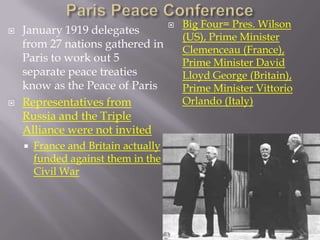
   Big Four= Pres. Wilson
   January 1919 delegates
                                          (US), Prime Minister
    from 27 nations gathered in           Clemenceau (France),
    Paris to work out 5                   Prime Minister David
    separate peace treaties               Lloyd George (Britain),
    know as the Peace of Paris            Prime Minister Vittorio
   Representatives from                  Orlando (Italy)
    Russia and the Triple
    Alliance were not invited
       France and Britain actually
        funded against them in the
        Civil War
   The Germans had surrendered on the basis of
    Wilson’s 14 points, not knowing that the other
    sides had already divided Germany up in
    secret treaties
       When Wilson threatened to negotiate peace on his
        own, finally Allies agreed to terms
   Britain refused to hear anything about freedom
    of seas, only Germany had to disarm, and a
    “guilt clause” made the Germans responsible
    to pay off all war debts
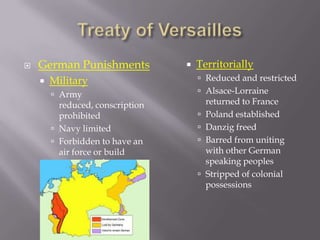
   German Punishments               Territorially
       Military                       Reduced and restricted
         Army                         Alsace-Lorraine
          reduced, conscription           returned to France
          prohibited                     Poland established
         Navy limited                   Danzig freed
         Forbidden to have an           Barred from uniting
          air force or build              with other German
          weapons of aggression           speaking peoples
                                         Stripped of colonial
                                          possessions
   Economically
         Pay property damages, costs of the war and soldiers
          pensions of the French and British
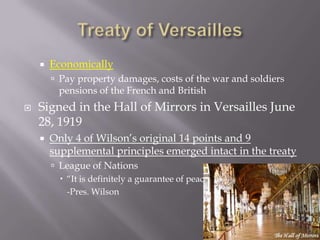
   Signed in the Hall of Mirrors in Versailles June
    28, 1919
       Only 4 of Wilson’s original 14 points and 9
        supplemental principles emerged intact in the treaty
         League of Nations
           “It is definitely a guarantee of peace”
            -Pres. Wilson
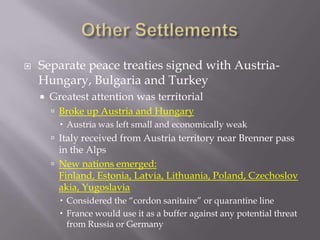
   Separate peace treaties signed with Austria-
    Hungary, Bulgaria and Turkey
       Greatest attention was territorial
         Broke up Austria and Hungary
           Austria was left small and economically weak
         Italy received from Austria territory near Brenner pass
          in the Alps
         New nations emerged:
          Finland, Estonia, Latvia, Lithuania, Poland, Czechoslov
          akia, Yugoslavia
           Considered the “cordon sanitaire” or quarantine line
           France would use it as a buffer against any potential threat
            from Russia or Germany
   While most Americans favored the League of
    nations, Wilson’s rival (Henry Cabot Lodge)
    was against it
       He was afraid the LON would force American to
        bend to the will of other nations
   March 3, 1919 Henry Cabot Lodge was able to
    get enough signatures to block the treaty
       Wilson’s only hope was compromise
         He went on campaign across the nation to tell people
          why it was necessary
         In 1919 he gave the best speech of his life, then had a
          stroke from which he never fully recovered
   One of the major arguing points was Article X
    to aid League members, but Wilson refused to
    accept any changes
   March 1920 enough Democrats broke from the
    president to produce a majority, but not a
    required 2/3
   The Treaty of Versailles was dead in the US.
    Not until July 1921 did Congress enact a joint
    resolution ending the war
       The US which had fought separately from the allies,
        made separate peace as well
   Settlement left Europe and the world troubled
   Those who fought became the “lost generation”
   Peace settlements failed to heal old wounds
    and opened new ones as well
   No freedom of the seas
   Economic barriers not lowered
   Only defeated powers were required to disarm
   Provisions against Germany were too harsh to
    expect reconciliation with Britain and France,
    but not harsh enough to destroy Germany
    completely
   How did/does your country feel as a result of
    the treaties?
   Were there any common goals?
   Were compromises made?
   Which country was most pleased with how the
    negotiations turned out? Most displeased?
   Does your country feel it achieved its most
    important goals?
   Were there any particular impasses or
    impediments to agreements?
   May Day 1919 six months after the war ended
    mobs in a dozen cities broke up socialist
    parades, injured hundreds and killed 3 people
   Many Americans believed they were under
    attack by homegrown and foreign-sponsored
    radicals
       Menace of radicalism was overblown
   Radicals hoped that the success of the Russian
    Revolution would lead to better feelings in the
    US
       Most Americans found the idea of Bolsheviks
        threatening
   1919 the left split
       Radical socialists formed the Communist Labor
        party
       Slavic radicals created a separate Communist party
       Together they had no more than 40,000 members
   April 28, 1919 Mayor Hanson received a small
    parcel which he thought was from an admirer
    of his tough patriotism
       Homemade bomb
         20 such packages were sent (including to J. D.
         Rockafeller, Oliver Wendell Holmes, and the
         postmaster general )
   June 2 bombs exploded simultaneously in 8
    different cities
       One demolished the front porch of A. Mitchell
        Palmer, the attorney general of the US
       Bomb thrower was blown to bits but enough of him
        remained for identification
         Italian anarchist from Philadelphia
       Americans assumed that an organized conspiracy
        was being mounted to overthrow the government
   In response to the bombing he launched raids
    in over 30 cities
       Invaded private homes, meeting halls, pool parlors
        taking several thousand alleged communists into
        custody without warrants and beating those who
        resisted
       Placed prisoners in jail and over 200 (with no
        criminal records) were deported to the USSR
   NY expelled 5 duly elected Socialists in 1919
       Many people denounced the action
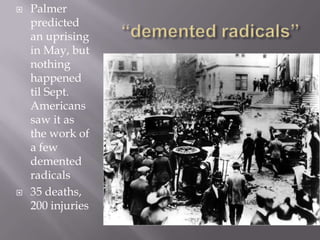
   Palmer
    predicted
    an uprising
    in May, but
    nothing
    happened
    til Sept.
    Americans
    saw it as
    the work of
    a few
    demented
    radicals
   35 deaths,
    200 injuries

World War One. Conclusions and Restoring Peace

  • 1.
    In your groups come up with 3 or 4 points that your country would want for the treaty after the war.  Reflect upon the hardships that your country faced.
  • 2.
  • 3.
    First Americans landed in France in June 1917  Gen. Pershing kept his troops back until they could receive more training  Joined an American Expeditionary Force to preserve identity and avoid Allied disagreements over strategy
  • 4.
    American units helped block against Germans at several battles  Sept. 12, 1918 half a million soldiers and a smaller number of French soldiers overran the German stronghold at Saint- Mihiel in 4 days
  • 5.
    French offensive stalled  Mutinies and desertions  Flanders  British offensive, but Germans pushed them back further from where started  Southern Front  Italians lost morale and started to desert
  • 6.
    Spring of 1918 allied troops under French General Ferdinand Foch  The Germans mounted their offensive  wanted to split the Allies and drive the British to the sea  came to within 37 miles of Paris before being stopped by the Allies  they were low on reserves and morale  the Allies had high morale and high reserves because of the US entering the war  the Allied forces pushed the Germans back and slowly one by one the resistance of the Central Powers fell  November 11 at 11am the Germans signed the Armistice  The Germans had lost the war while its troops still held territory from France to the Crimean Peninsula
  • 7.
    Europe is shattered  Millions dead, more wounded  Country boundaries changed  People looked to President Woodrow Wilson for hope
  • 8.
    Germany saw that  Fourteen Points their time had come  Peace plan whose and they wanted an terms included armistice international  They hoped that recognition of Woodrow Wilson’s 14 freedom of the seas and trade, limitations points would be used of arms, an end to all secret alliances  Settlements of colonial claims  General assembly of nations created
  • 9.
    Germany thought that the 14 points would be used in the peace process with them  Britain wanted control of the seas, didn’t want freedom of the seas  France wanted reparations (payment for damages) to be included in any and all peace settlements  Allied leaders didn’t want them (14 points)  French Premier Clemenceau “President Wilson and his 14 points bore me. Even God Almighty has only 10.”
  • 10.
    116,500 Americans died  2.2 million Germans died  1.7 million Russians died  1.4 million French died  1.2 million Austro-Hungarians died  1 million British died  Influenza Pandemic of 1918-1919  Victims literally died in their own bodily fluids  1/50 died, generally ages 20-34 years of age  25 million died world wide
  • 11.
    Big Four= Pres. Wilson  January 1919 delegates (US), Prime Minister from 27 nations gathered in Clemenceau (France), Paris to work out 5 Prime Minister David separate peace treaties Lloyd George (Britain), know as the Peace of Paris Prime Minister Vittorio  Representatives from Orlando (Italy) Russia and the Triple Alliance were not invited  France and Britain actually funded against them in the Civil War
  • 12.
    The Germans had surrendered on the basis of Wilson’s 14 points, not knowing that the other sides had already divided Germany up in secret treaties  When Wilson threatened to negotiate peace on his own, finally Allies agreed to terms  Britain refused to hear anything about freedom of seas, only Germany had to disarm, and a “guilt clause” made the Germans responsible to pay off all war debts
  • 13.
    German Punishments  Territorially  Military  Reduced and restricted  Army  Alsace-Lorraine reduced, conscription returned to France prohibited  Poland established  Navy limited  Danzig freed  Forbidden to have an  Barred from uniting air force or build with other German weapons of aggression speaking peoples  Stripped of colonial possessions
  • 14.
    Economically  Pay property damages, costs of the war and soldiers pensions of the French and British  Signed in the Hall of Mirrors in Versailles June 28, 1919  Only 4 of Wilson’s original 14 points and 9 supplemental principles emerged intact in the treaty  League of Nations  “It is definitely a guarantee of peace” -Pres. Wilson
  • 15.
    Separate peace treaties signed with Austria- Hungary, Bulgaria and Turkey  Greatest attention was territorial  Broke up Austria and Hungary  Austria was left small and economically weak  Italy received from Austria territory near Brenner pass in the Alps  New nations emerged: Finland, Estonia, Latvia, Lithuania, Poland, Czechoslov akia, Yugoslavia  Considered the “cordon sanitaire” or quarantine line  France would use it as a buffer against any potential threat from Russia or Germany
  • 16.
    While most Americans favored the League of nations, Wilson’s rival (Henry Cabot Lodge) was against it  He was afraid the LON would force American to bend to the will of other nations  March 3, 1919 Henry Cabot Lodge was able to get enough signatures to block the treaty  Wilson’s only hope was compromise  He went on campaign across the nation to tell people why it was necessary  In 1919 he gave the best speech of his life, then had a stroke from which he never fully recovered
  • 17.
    One of the major arguing points was Article X to aid League members, but Wilson refused to accept any changes  March 1920 enough Democrats broke from the president to produce a majority, but not a required 2/3  The Treaty of Versailles was dead in the US. Not until July 1921 did Congress enact a joint resolution ending the war  The US which had fought separately from the allies, made separate peace as well
  • 18.
    Settlement left Europe and the world troubled  Those who fought became the “lost generation”  Peace settlements failed to heal old wounds and opened new ones as well  No freedom of the seas  Economic barriers not lowered  Only defeated powers were required to disarm  Provisions against Germany were too harsh to expect reconciliation with Britain and France, but not harsh enough to destroy Germany completely
  • 19.
    How did/does your country feel as a result of the treaties?  Were there any common goals?  Were compromises made?  Which country was most pleased with how the negotiations turned out? Most displeased?  Does your country feel it achieved its most important goals?  Were there any particular impasses or impediments to agreements?
  • 20.
    May Day 1919 six months after the war ended mobs in a dozen cities broke up socialist parades, injured hundreds and killed 3 people  Many Americans believed they were under attack by homegrown and foreign-sponsored radicals  Menace of radicalism was overblown  Radicals hoped that the success of the Russian Revolution would lead to better feelings in the US  Most Americans found the idea of Bolsheviks threatening
  • 21.
    1919 the left split  Radical socialists formed the Communist Labor party  Slavic radicals created a separate Communist party  Together they had no more than 40,000 members  April 28, 1919 Mayor Hanson received a small parcel which he thought was from an admirer of his tough patriotism  Homemade bomb  20 such packages were sent (including to J. D. Rockafeller, Oliver Wendell Holmes, and the postmaster general )
  • 22.
    June 2 bombs exploded simultaneously in 8 different cities  One demolished the front porch of A. Mitchell Palmer, the attorney general of the US  Bomb thrower was blown to bits but enough of him remained for identification  Italian anarchist from Philadelphia  Americans assumed that an organized conspiracy was being mounted to overthrow the government
  • 23.
    In response to the bombing he launched raids in over 30 cities  Invaded private homes, meeting halls, pool parlors taking several thousand alleged communists into custody without warrants and beating those who resisted  Placed prisoners in jail and over 200 (with no criminal records) were deported to the USSR  NY expelled 5 duly elected Socialists in 1919  Many people denounced the action
  • 24.
    Palmer predicted an uprising in May, but nothing happened til Sept. Americans saw it as the work of a few demented radicals  35 deaths, 200 injuries