Were the treaties of 1919-23
fair?
High hopes for peace
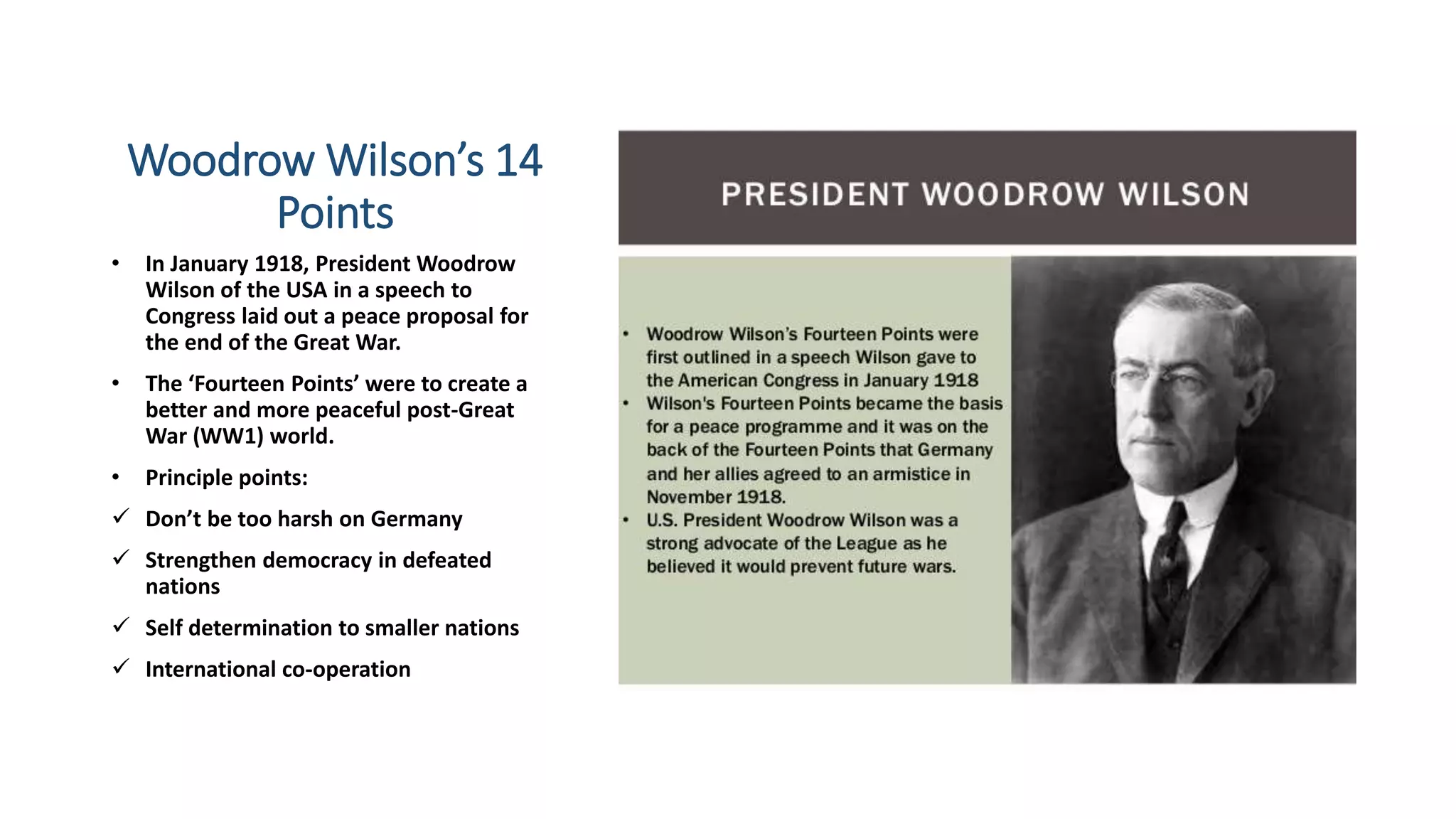
Woodrow Wilson’s 14
Points
• In January 1918, President Woodrow
Wilson of the USA in a speech to
Congress laid out a peace proposal for
the end of the Great War.
• The ‘Fourteen Points’ were to create a
better and more peaceful post-Great
War (WW1) world.
• Principle points:
 Don’t be too harsh on Germany
 Strengthen democracy in defeated
nations
 Self determination to smaller nations
 International co-operation
David Lloyd
George
• In public, DLG praised Wilson’s ideas.
• In private he complained that Wilson
was a missionary to rescue Europe.
• He agreed on lesser punishment for
Germany.
• He disagreed on the idea of ‘self-
determination’ for smaller nations due
to the fact it would affect the colonies of
the Empire.
• He was also afraid of a communist
revolution in Germany, as was Wilson.
• He wanted to return to trading with a
resurging Germany.
• He wanted Germany to lose its navy and
colonies as it threatened the Empire.
Georges
Clemenceau
• Clemenceau saw the treaty as a path to
cripple Germany.
• He saw this as an opportunity never to
allow Germany to attack France again.
• He wanted Germany to pay for the
devastation of Eastern France and the
loss of so many young men.
• He supported the idea of Wilson’s 14
points but said ‘Even God only created
10 Commandment’!
• Clemenceau was a realist and knew he
would have to compromise on some
issues.
Treaty of
Versailles
• The treaty was principally discussed by
the leaders and delegates of 32 nations.
• It was soon evident that not everyone
could be consulted.
• Wilson, Clemenceau and Lloyd George
often clashed.
• Terms:
 War guilt clause
 Reparations
 German territories and colonies
 Germany’s armed forces
 League of Nations
German
response
• Political violence from Right-wing
opponents of the Ebert Weimar
government:
- November criminals.
- Kapp Putsch
- Adolph Hitler Munich Putsch
• Conflict on the Ruhr.
• 1922 no reparation payment
• The Treaty did cause genuine problems,
but Germans blamed it for other
problems.
• Resentment led to extreme groups
gaining influence.
How was the Treaty
seen at the time?
• Fair/unfair!
• None of the Big Three was happy with
the treaty.
• Many diplomats who helped shape the
Treaty were dissatisfied.
• Peacemakers were seen as blind and
selfish.
• Keynes wrote a book on the economic
consequences.
• German complaints fell on deaf ears –
they were not allowed to participate.
• Some people believed that the treaty
was not harsh enough.
How was the Treaty
seen in hindsight
• It created an unstable Germany which
enabled the Nazis to come to power
• It enabled World War 2
• Peacemakers had a tough time formulating
a just result
• According to some historians and the press,
some people saw the Treaty as too soft.
Some saw it as too harsh.
• It failed to reduce Germany to a weak
second rate power.
• The fall of the Tzar in Russia and the
collapse of the Austro-Hungarian Empire
left Germany in a strong position.
• The Treaty failed to solve the problem of
punishment and conciliation.
• Peacemakers were not able to consolidate
their aims nor were they competent enough
to solve this unique problem at the time.
• Many critics in 1919 were able to provide e
better possible outcome even before the
Treaty was published. They were ignored
Other peace settlements
Treaty of St Germain – Austria 1919.
• Army limited to 30 000
• Austro-Hungarian Empire dismembered
• Austria economically crippled
• Royal family exiled
Treaty of Sevres – Turkey 1920.
• Lost land to Bulgaria, Italy, Greece.
• Lost Ottoman Empire in Middle East and North
Africa
• Armed forces limited to 50 000 men, virtually
no navy and no air force.
• Treaty later renegotiated - Treaty of Lausanne
Treaty of Neuilly – Bulgaria 1919
• Lost land to Greece, Romania and the new
Yugoslavia.
• Army limited to 20 000.
• Reparations of £10 million.
• Treated less harshly than Germanys other allies
Treaty of Trianon – Hungary 1920
• Lost territory to Romania, Czechoslovakia,
Yugoslavia.
• Due to pay reparations, but unable to due to
weak economy and never did

Were the Treaties Fair?

  • 1.
    Were the treatiesof 1919-23 fair? High hopes for peace
  • 2.
    Woodrow Wilson’s 14 Points •In January 1918, President Woodrow Wilson of the USA in a speech to Congress laid out a peace proposal for the end of the Great War. • The ‘Fourteen Points’ were to create a better and more peaceful post-Great War (WW1) world. • Principle points:  Don’t be too harsh on Germany  Strengthen democracy in defeated nations  Self determination to smaller nations  International co-operation
  • 3.
    David Lloyd George • Inpublic, DLG praised Wilson’s ideas. • In private he complained that Wilson was a missionary to rescue Europe. • He agreed on lesser punishment for Germany. • He disagreed on the idea of ‘self- determination’ for smaller nations due to the fact it would affect the colonies of the Empire. • He was also afraid of a communist revolution in Germany, as was Wilson. • He wanted to return to trading with a resurging Germany. • He wanted Germany to lose its navy and colonies as it threatened the Empire.
  • 4.
    Georges Clemenceau • Clemenceau sawthe treaty as a path to cripple Germany. • He saw this as an opportunity never to allow Germany to attack France again. • He wanted Germany to pay for the devastation of Eastern France and the loss of so many young men. • He supported the idea of Wilson’s 14 points but said ‘Even God only created 10 Commandment’! • Clemenceau was a realist and knew he would have to compromise on some issues.
  • 5.
    Treaty of Versailles • Thetreaty was principally discussed by the leaders and delegates of 32 nations. • It was soon evident that not everyone could be consulted. • Wilson, Clemenceau and Lloyd George often clashed. • Terms:  War guilt clause  Reparations  German territories and colonies  Germany’s armed forces  League of Nations
  • 6.
    German response • Political violencefrom Right-wing opponents of the Ebert Weimar government: - November criminals. - Kapp Putsch - Adolph Hitler Munich Putsch • Conflict on the Ruhr. • 1922 no reparation payment • The Treaty did cause genuine problems, but Germans blamed it for other problems. • Resentment led to extreme groups gaining influence.
  • 7.
    How was theTreaty seen at the time? • Fair/unfair! • None of the Big Three was happy with the treaty. • Many diplomats who helped shape the Treaty were dissatisfied. • Peacemakers were seen as blind and selfish. • Keynes wrote a book on the economic consequences. • German complaints fell on deaf ears – they were not allowed to participate. • Some people believed that the treaty was not harsh enough.
  • 8.
    How was theTreaty seen in hindsight • It created an unstable Germany which enabled the Nazis to come to power • It enabled World War 2 • Peacemakers had a tough time formulating a just result • According to some historians and the press, some people saw the Treaty as too soft. Some saw it as too harsh. • It failed to reduce Germany to a weak second rate power. • The fall of the Tzar in Russia and the collapse of the Austro-Hungarian Empire left Germany in a strong position. • The Treaty failed to solve the problem of punishment and conciliation. • Peacemakers were not able to consolidate their aims nor were they competent enough to solve this unique problem at the time. • Many critics in 1919 were able to provide e better possible outcome even before the Treaty was published. They were ignored
  • 9.
    Other peace settlements Treatyof St Germain – Austria 1919. • Army limited to 30 000 • Austro-Hungarian Empire dismembered • Austria economically crippled • Royal family exiled Treaty of Sevres – Turkey 1920. • Lost land to Bulgaria, Italy, Greece. • Lost Ottoman Empire in Middle East and North Africa • Armed forces limited to 50 000 men, virtually no navy and no air force. • Treaty later renegotiated - Treaty of Lausanne Treaty of Neuilly – Bulgaria 1919 • Lost land to Greece, Romania and the new Yugoslavia. • Army limited to 20 000. • Reparations of £10 million. • Treated less harshly than Germanys other allies Treaty of Trianon – Hungary 1920 • Lost territory to Romania, Czechoslovakia, Yugoslavia. • Due to pay reparations, but unable to due to weak economy and never did