The End of World War I
Stalemate By 1917 both sides fighting defensive war Neither could put together a massive attack Defeatism in England, France Mutinies in French, British armies
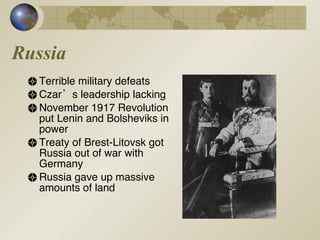
Russia Terrible military defeats Czar’s leadership lacking November 1917 Revolution put Lenin and Bolsheviks in power  Treaty of Brest-Litovsk got Russia out of war with Germany Russia gave up massive amounts of land
Germany’s Last Chance Russia Surrenders to Germany, German troops move from Eastern to Western Front. March 1918: MASSIVE frontal assault breaks through Allied trenches with specialized “Strosstuppen”
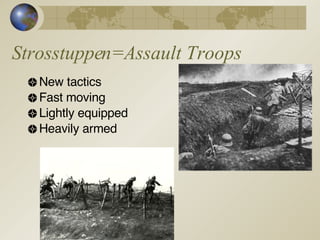
Strosstuppen=Assault Troops New tactics Fast moving Lightly equipped Heavily armed
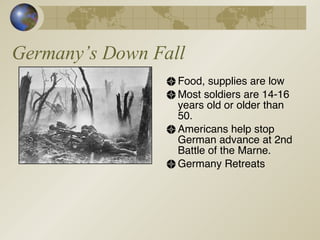
Germany’s Down Fall Food, supplies are low Most soldiers are 14-16 years old or older than 50. Americans help stop German advance at 2nd Battle of the Marne. Germany Retreats
Armistice An agreement to stop fighting before a formal treaty is reached The 11th hour, of the 11th day, on the 11th month.  (Nov 11th) Germany agrees to surrender if  President Wilson used his 14 Points to negotiate peace treaty
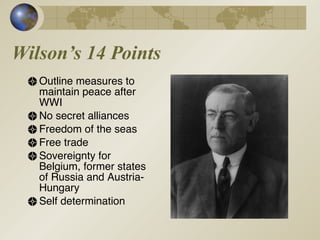
Wilson’s 14 Points Outline measures to maintain peace after WWI No secret alliances Freedom of the seas Free trade Sovereignty for Belgium, former states of Russia and Austria-Hungary Self determination
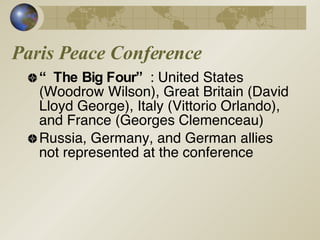
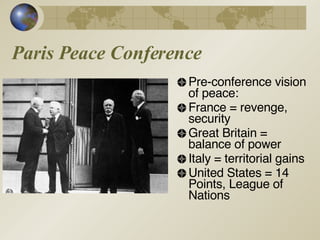
Paris Peace Conference “ The Big Four” : United States (Woodrow Wilson), Great Britain (David Lloyd George), Italy (Vittorio Orlando), and France (Georges Clemenceau) Russia, Germany, and German allies not represented at the conference
Paris Peace Conference Pre-conference vision of peace: France = revenge, security Great Britain = balance of power Italy = territorial gains United States = 14 Points, League of Nations
Treaty of Versailles Signed June 28, 1919 Germany forced to pay the Allies $33 billion in reparations over 30 years Article 231  (“war guilt” clause) = sole responsibility for the war is placed on Germany’s shoulders Germany returns Allasace-Lorraine to France; French border extended to the west bank of the Rhine River Germany surrenders all of its overseas colonies in Africa and the Pacific
Treaty of Versailles Germany is (a) forbidden to build or buy submarines or have an air force, (b) prohibited from importing or manufacturing weapons or war material, and (c) army is limited in size Creation of a League of Nations to settle international disputes
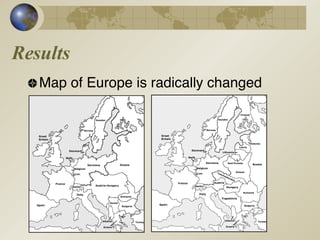
Results Map of Europe is radically changed
Results Germany, Italy, Russian and Japan feel cheated by the terms of the final peace United States turns away from international affairs (isolationism), refuses to join the League of Nations Dissatisfaction with the treaty and worldwide depression in the 1930s sets the stage for a 2nd World War

End Of War

  • 1.
    The End ofWorld War I
  • 2.
    Stalemate By 1917both sides fighting defensive war Neither could put together a massive attack Defeatism in England, France Mutinies in French, British armies
  • 3.
    Russia Terrible militarydefeats Czar’s leadership lacking November 1917 Revolution put Lenin and Bolsheviks in power Treaty of Brest-Litovsk got Russia out of war with Germany Russia gave up massive amounts of land
  • 4.
    Germany’s Last ChanceRussia Surrenders to Germany, German troops move from Eastern to Western Front. March 1918: MASSIVE frontal assault breaks through Allied trenches with specialized “Strosstuppen”
  • 5.
    Strosstuppen=Assault Troops Newtactics Fast moving Lightly equipped Heavily armed
  • 6.
    Germany’s Down FallFood, supplies are low Most soldiers are 14-16 years old or older than 50. Americans help stop German advance at 2nd Battle of the Marne. Germany Retreats
  • 7.
    Armistice An agreementto stop fighting before a formal treaty is reached The 11th hour, of the 11th day, on the 11th month. (Nov 11th) Germany agrees to surrender if President Wilson used his 14 Points to negotiate peace treaty
  • 8.
    Wilson’s 14 PointsOutline measures to maintain peace after WWI No secret alliances Freedom of the seas Free trade Sovereignty for Belgium, former states of Russia and Austria-Hungary Self determination
  • 9.
    Paris Peace Conference“ The Big Four” : United States (Woodrow Wilson), Great Britain (David Lloyd George), Italy (Vittorio Orlando), and France (Georges Clemenceau) Russia, Germany, and German allies not represented at the conference
  • 10.
    Paris Peace ConferencePre-conference vision of peace: France = revenge, security Great Britain = balance of power Italy = territorial gains United States = 14 Points, League of Nations
  • 11.
    Treaty of VersaillesSigned June 28, 1919 Germany forced to pay the Allies $33 billion in reparations over 30 years Article 231 (“war guilt” clause) = sole responsibility for the war is placed on Germany’s shoulders Germany returns Allasace-Lorraine to France; French border extended to the west bank of the Rhine River Germany surrenders all of its overseas colonies in Africa and the Pacific
  • 12.
    Treaty of VersaillesGermany is (a) forbidden to build or buy submarines or have an air force, (b) prohibited from importing or manufacturing weapons or war material, and (c) army is limited in size Creation of a League of Nations to settle international disputes
  • 13.
    Results Map ofEurope is radically changed
  • 14.
    Results Germany, Italy,Russian and Japan feel cheated by the terms of the final peace United States turns away from international affairs (isolationism), refuses to join the League of Nations Dissatisfaction with the treaty and worldwide depression in the 1930s sets the stage for a 2nd World War