World War II
Leaders
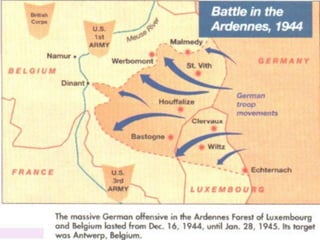
Battles
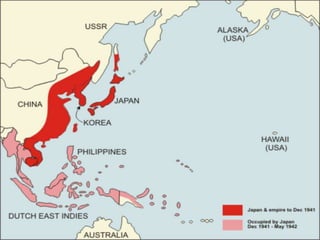
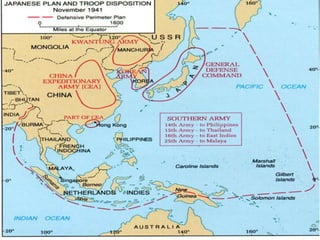
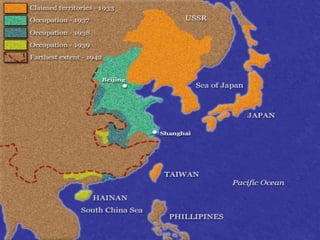
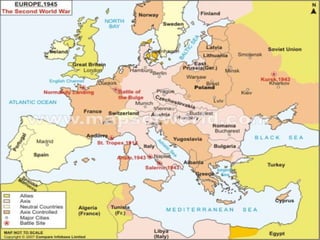
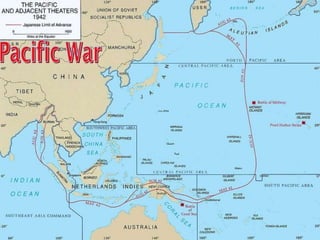
Maps
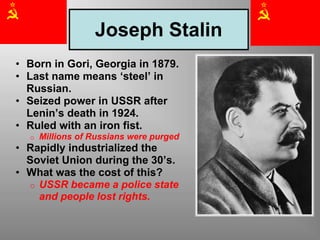
Joseph Stalin
• Born in Gori, Georgia in 1879.
• Last name means ‘steel’ in
Russian.
• Seized power in USSR after
Lenin’s death in 1924.
• Ruled with an iron fist.
o Millions of Russians were purged
• Rapidly industrialized the
Soviet Union during the 30’s.
• What was the cost of this?
o USSR became a police state
and people lost rights.
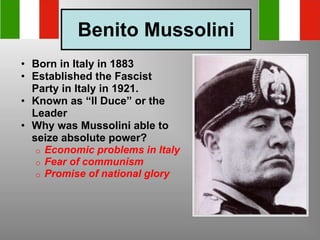
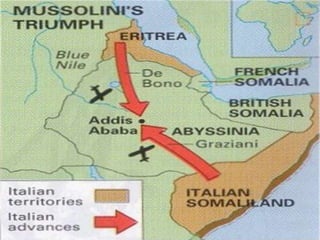
Benito Mussolini
• Born in Italy in 1883
• Established the Fascist
Party in Italy in 1921.
• Known as “Il Duce” or the
Leader
• Why was Mussolini able to
seize absolute power?
o Economic problems in Italy
o Fear of communism
o Promise of national glory
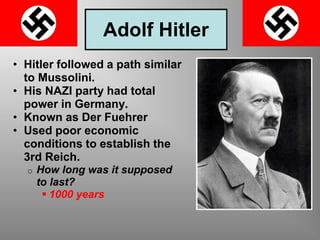
Adolf Hitler
• Hitler followed a path similar
to Mussolini.
• His NAZI party had total
power in Germany.
• Known as Der Fuehrer
• Used poor economic
conditions to establish the
3rd Reich.
o How long was it supposed
to last?
 1000 years
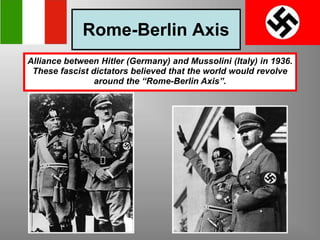
Rome-Berlin Axis
Alliance between Hitler (Germany) and Mussolini (Italy) in 1936.
These fascist dictators believed that the world would revolve
around the “Rome-Berlin Axis”.
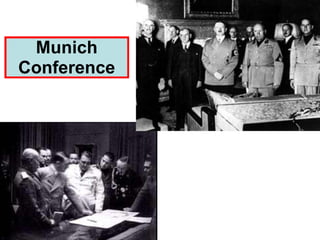
Munich
Conference
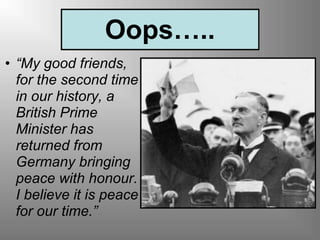
Oops…..
• “My good friends,
for the second time
in our history, a
British Prime
Minister has
returned from
Germany bringing
peace with honour.
I believe it is peace
for our time.”
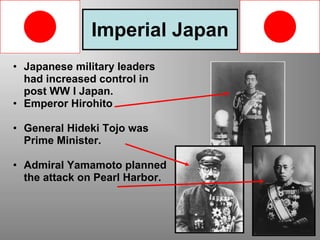
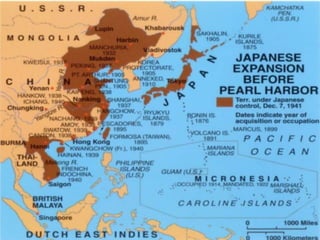
Imperial Japan
• Japanese military leaders
had increased control in
post WW I Japan.
• Emperor Hirohito
• General Hideki Tojo was
Prime Minister.
• Admiral Yamamoto planned
the attack on Pearl Harbor.
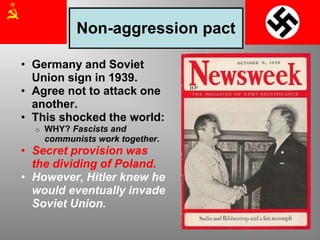
Non-aggression pact
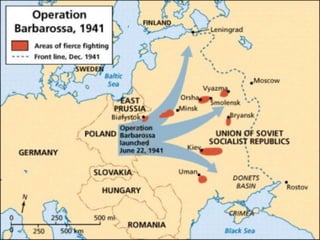
• Germany and Soviet
Union sign in 1939.
• Agree not to attack one
another.
• This shocked the world:
o WHY? Fascists and
communists work together.
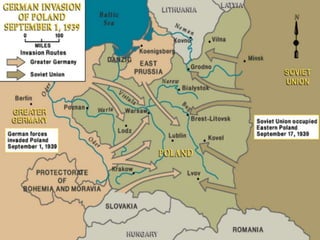
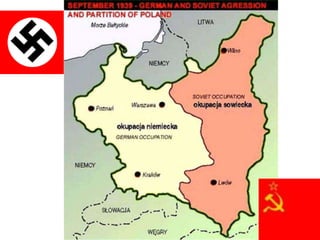
• Secret provision was
the dividing of Poland.
• However, Hitler knew he
would eventually invade
Soviet Union.
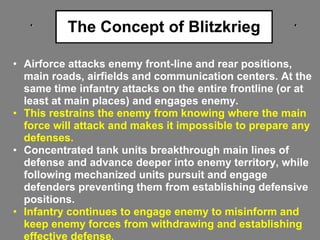
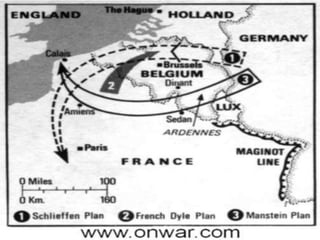
The Concept of Blitzkrieg
• Airforce attacks enemy front-line and rear positions,
main roads, airfields and communication centers. At the
same time infantry attacks on the entire frontline (or at
least at main places) and engages enemy.
• This restrains the enemy from knowing where the main
force will attack and makes it impossible to prepare any
defenses.
• Concentrated tank units breakthrough main lines of
defense and advance deeper into enemy territory, while
following mechanized units pursuit and engage
defenders preventing them from establishing defensive
positions.
• Infantry continues to engage enemy to misinform and
keep enemy forces from withdrawing and establishing
effective defense.
• Infantry and other support units attack
enemy flanks in order to link up with other
groups to complete the attack and
eventually encircle the enemy and/or
capture strategic position.
• Mechanized groups spearhead deeper into
the enemy territory outflanking the enemy
positions and paralyzing the rear preventing
withdrawing troops and defenders from
establishing effective defensive positions.
• Main force links up with other units
encircling and cutting off and killing the
enemy
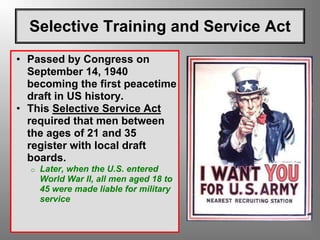
Selective Training and Service Act
• Passed by Congress on
September 14, 1940
becoming the first peacetime
draft in US history.
• This Selective Service Act
required that men between
the ages of 21 and 35
register with local draft
boards.
o Later, when the U.S. entered
World War II, all men aged 18 to
45 were made liable for military
service
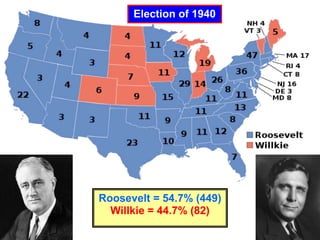
Election of 1940
Roosevelt = 54.7% (449)
Willkie = 44.7% (82)
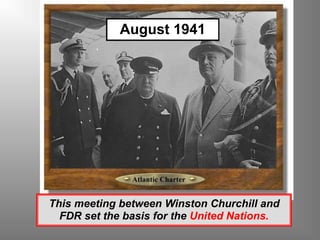
August 1941
This meeting between Winston Churchill and
FDR set the basis for the United Nations.
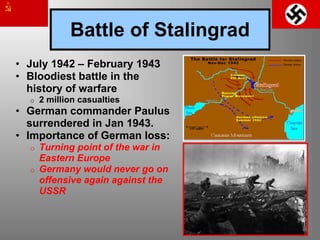
Battle of Stalingrad
• July 1942 – February 1943
• Bloodiest battle in the
history of warfare
o 2 million casualties
• German commander Paulus
surrendered in Jan 1943.
• Importance of German loss:
o Turning point of the war in
Eastern Europe
o Germany would never go on
offensive again against the
USSR
Important Generals
Operation Torch
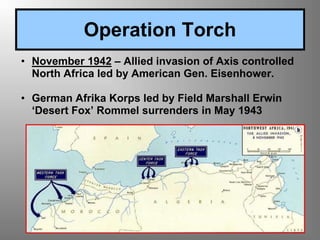
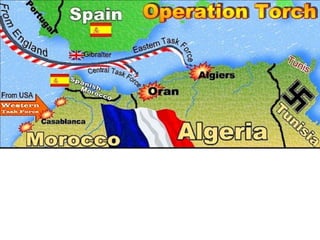
• November 1942 – Allied invasion of Axis controlled
North Africa led by American Gen. Eisenhower.
• German Afrika Korps led by Field Marshall Erwin
‘Desert Fox’ Rommel surrenders in May 1943
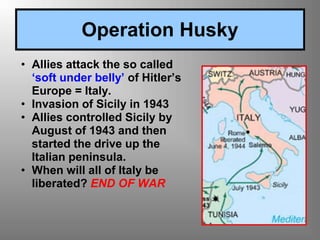
• Allies attack the so called
‘soft under belly’ of Hitler’s
Europe = Italy.
• Invasion of Sicily in 1943
• Allies controlled Sicily by
August of 1943 and then
started the drive up the
Italian peninsula.
• When will all of Italy be
liberated? END OF WAR
Operation Husky
Tuskegee Airmen
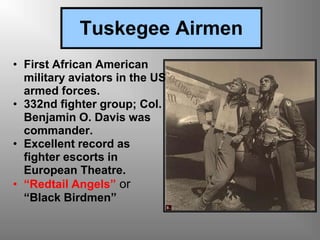
• First African American
military aviators in the US
armed forces.
• 332nd fighter group; Col.
Benjamin O. Davis was
commander.
• Excellent record as
fighter escorts in
European Theatre.
• “Redtail Angels” or
“Black Birdmen”
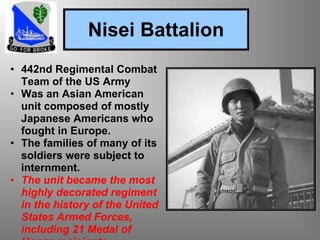
Nisei Battalion
• 442nd Regimental Combat
Team of the US Army
• Was an Asian American
unit composed of mostly
Japanese Americans who
fought in Europe.
• The families of many of its
soldiers were subject to
internment.
• The unit became the most
highly decorated regiment
in the history of the United
States Armed Forces,
including 21 Medal of
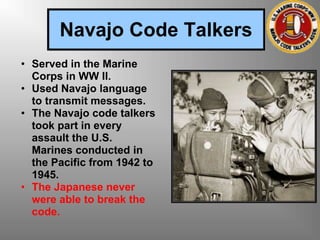
Navajo Code Talkers
• Served in the Marine
Corps in WW II.
• Used Navajo language
to transmit messages.
• The Navajo code talkers
took part in every
assault the U.S.
Marines conducted in
the Pacific from 1942 to
1945.
• The Japanese never
were able to break the
code.
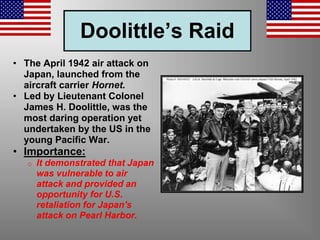
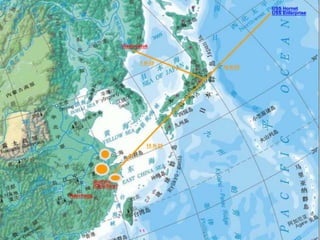
Doolittle’s Raid
• The April 1942 air attack on
Japan, launched from the
aircraft carrier Hornet.
• Led by Lieutenant Colonel
James H. Doolittle, was the
most daring operation yet
undertaken by the US in the
young Pacific War.
• Importance:
o It demonstrated that Japan
was vulnerable to air
attack and provided an
opportunity for U.S.
retaliation for Japan's
attack on Pearl Harbor.
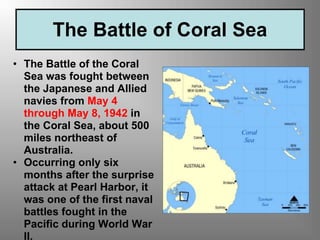
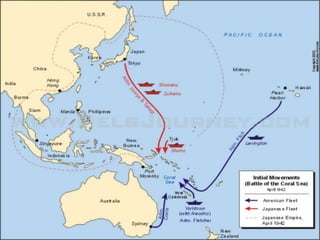
The Battle of Coral Sea
• The Battle of the Coral
Sea was fought between
the Japanese and Allied
navies from May 4
through May 8, 1942 in
the Coral Sea, about 500
miles northeast of
Australia.
• Occurring only six
months after the surprise
attack at Pearl Harbor, it
was one of the first naval
battles fought in the
Pacific during World War
II.
The Battle…..
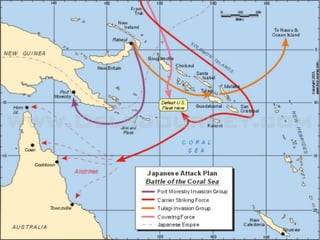
• In the spring of 1942, Japanese
forces planned to invade
southern New Guinea, a move
designed to knock Australia
and New Zealand out of the
war.
• The Allies, including the United
States, Australia, and Great
Britain, gathered a large fleet to
thwart the invasion.
• That evening, with the battle
roughly a draw, both sides
retreated but would meet again
a month later at the decisive
Battle of Midway, 3,000 miles
away in the Hawaiian Islands.
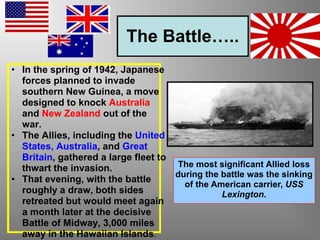
The most significant Allied loss
during the battle was the sinking
of the American carrier, USS
Lexington.
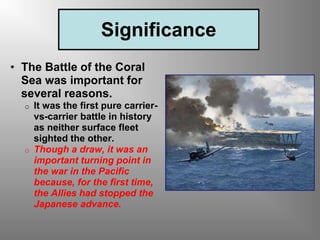
Significance
• The Battle of the Coral
Sea was important for
several reasons.
o It was the first pure carrier-
vs-carrier battle in history
as neither surface fleet
sighted the other.
o Though a draw, it was an
important turning point in
the war in the Pacific
because, for the first time,
the Allies had stopped the
Japanese advance.
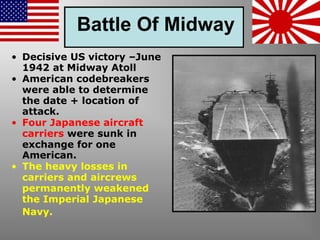
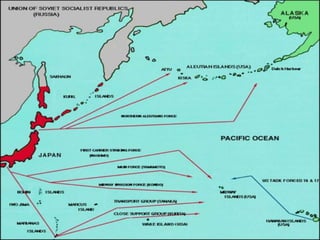
Battle Of Midway
• Decisive US victory –June
1942 at Midway Atoll
• American codebreakers
were able to determine
the date + location of
attack.
• Four Japanese aircraft
carriers were sunk in
exchange for one
American.
• The heavy losses in
carriers and aircrews
permanently weakened
the Imperial Japanese
Navy.
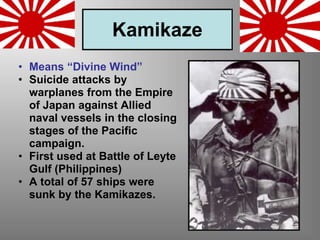
Kamikaze
• Means “Divine Wind”
• Suicide attacks by
warplanes from the Empire
of Japan against Allied
naval vessels in the closing
stages of the Pacific
campaign.
• First used at Battle of Leyte
Gulf (Philippines)
• A total of 57 ships were
sunk by the Kamikazes.
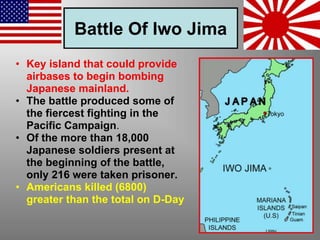
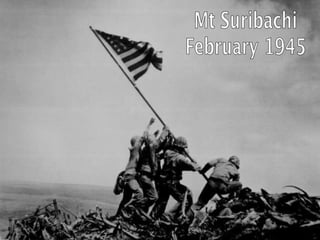
Battle Of Iwo Jima
• Key island that could provide
airbases to begin bombing
Japanese mainland.
• The battle produced some of
the fiercest fighting in the
Pacific Campaign.
• Of the more than 18,000
Japanese soldiers present at
the beginning of the battle,
only 216 were taken prisoner.
• Americans killed (6800)
greater than the total on D-Day
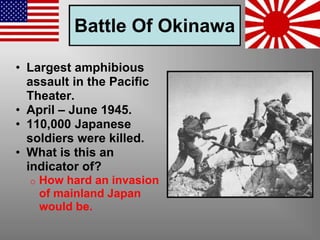
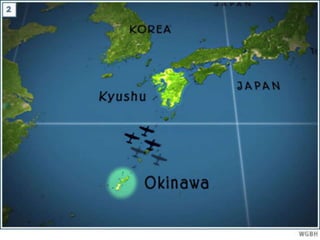
Battle Of Okinawa
• Largest amphibious
assault in the Pacific
Theater.
• April – June 1945.
• 110,000 Japanese
soldiers were killed.
• What is this an
indicator of?
o How hard an invasion
of mainland Japan
would be.
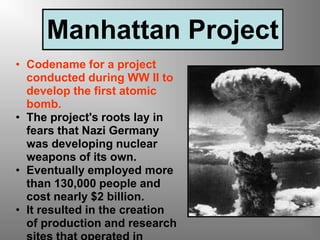
Manhattan Project
• Codename for a project
conducted during WW II to
develop the first atomic
bomb.
• The project's roots lay in
fears that Nazi Germany
was developing nuclear
weapons of its own.
• Eventually employed more
than 130,000 people and
cost nearly $2 billion.
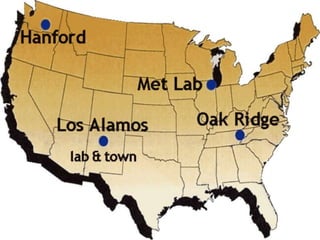
• It resulted in the creation
of production and research
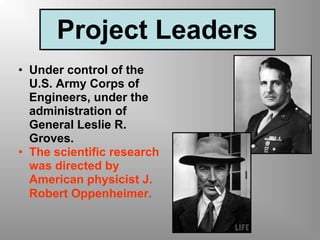
Project Leaders
• Under control of the
U.S. Army Corps of
Engineers, under the
administration of
General Leslie R.
Groves.
• The scientific research
was directed by
American physicist J.
Robert Oppenheimer.
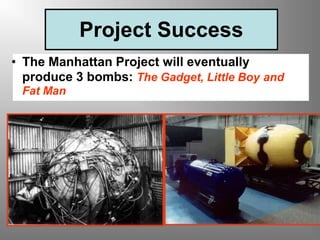
Project Success
• The Manhattan Project will eventually
produce 3 bombs: The Gadget, Little Boy and
Fat Man
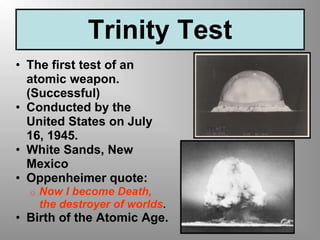
Trinity Test
• The first test of an
atomic weapon.
(Successful)
• Conducted by the
United States on July
16, 1945.
• White Sands, New
Mexico
• Oppenheimer quote:
o Now I become Death,
the destroyer of worlds.
• Birth of the Atomic Age.
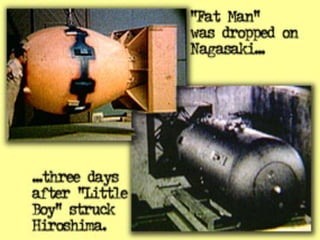
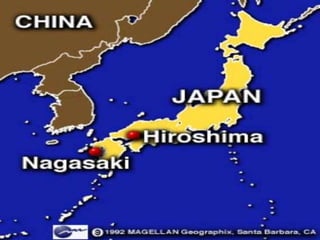
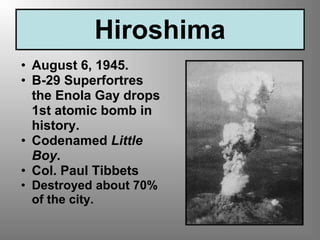
Hiroshima
• August 6, 1945.
• B-29 Superfortres
the Enola Gay drops
1st atomic bomb in
history.
• Codenamed Little
Boy.
• Col. Paul Tibbets
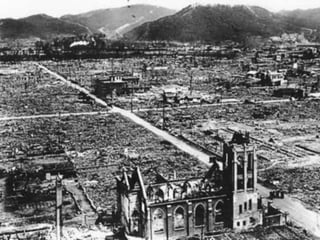
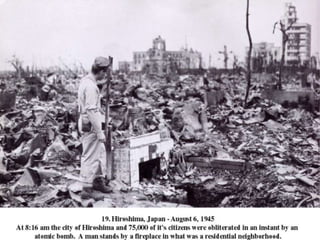
• Destroyed about 70%
of the city.
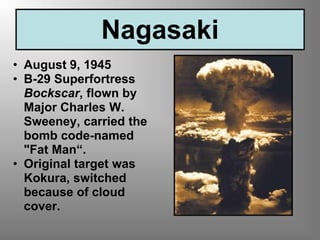
Nagasaki
• August 9, 1945
• B-29 Superfortress
Bockscar, flown by
Major Charles W.
Sweeney, carried the
bomb code-named
"Fat Man“.
• Original target was
Kokura, switched
because of cloud
cover.
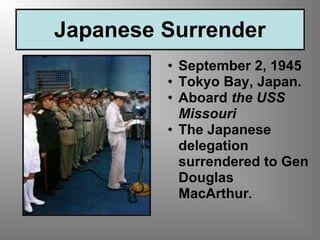
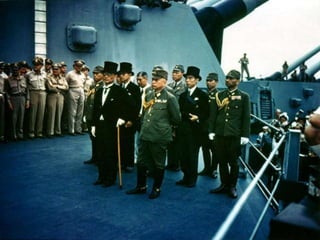
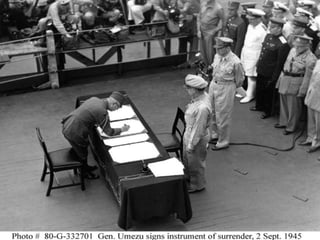
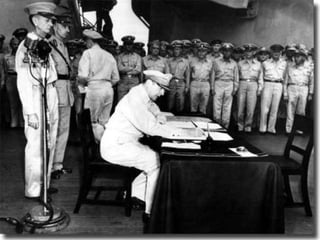
Japanese Surrender
• September 2, 1945
• Tokyo Bay, Japan.
• Aboard the USS
Missouri
• The Japanese
delegation
surrendered to Gen
Douglas
MacArthur.
World War II
World War II
World War II

World War II

  • 1.
  • 2.
    Joseph Stalin • Bornin Gori, Georgia in 1879. • Last name means ‘steel’ in Russian. • Seized power in USSR after Lenin’s death in 1924. • Ruled with an iron fist. o Millions of Russians were purged • Rapidly industrialized the Soviet Union during the 30’s. • What was the cost of this? o USSR became a police state and people lost rights.
  • 3.
    Benito Mussolini • Bornin Italy in 1883 • Established the Fascist Party in Italy in 1921. • Known as “Il Duce” or the Leader • Why was Mussolini able to seize absolute power? o Economic problems in Italy o Fear of communism o Promise of national glory
  • 5.
    Adolf Hitler • Hitlerfollowed a path similar to Mussolini. • His NAZI party had total power in Germany. • Known as Der Fuehrer • Used poor economic conditions to establish the 3rd Reich. o How long was it supposed to last?  1000 years
  • 6.
    Rome-Berlin Axis Alliance betweenHitler (Germany) and Mussolini (Italy) in 1936. These fascist dictators believed that the world would revolve around the “Rome-Berlin Axis”.
  • 9.
  • 10.
    Oops….. • “My goodfriends, for the second time in our history, a British Prime Minister has returned from Germany bringing peace with honour. I believe it is peace for our time.”
  • 11.
    Imperial Japan • Japanesemilitary leaders had increased control in post WW I Japan. • Emperor Hirohito • General Hideki Tojo was Prime Minister. • Admiral Yamamoto planned the attack on Pearl Harbor.
  • 16.
    Non-aggression pact • Germanyand Soviet Union sign in 1939. • Agree not to attack one another. • This shocked the world: o WHY? Fascists and communists work together. • Secret provision was the dividing of Poland. • However, Hitler knew he would eventually invade Soviet Union.
  • 19.
    The Concept ofBlitzkrieg • Airforce attacks enemy front-line and rear positions, main roads, airfields and communication centers. At the same time infantry attacks on the entire frontline (or at least at main places) and engages enemy. • This restrains the enemy from knowing where the main force will attack and makes it impossible to prepare any defenses. • Concentrated tank units breakthrough main lines of defense and advance deeper into enemy territory, while following mechanized units pursuit and engage defenders preventing them from establishing defensive positions. • Infantry continues to engage enemy to misinform and keep enemy forces from withdrawing and establishing effective defense.
  • 20.
    • Infantry andother support units attack enemy flanks in order to link up with other groups to complete the attack and eventually encircle the enemy and/or capture strategic position. • Mechanized groups spearhead deeper into the enemy territory outflanking the enemy positions and paralyzing the rear preventing withdrawing troops and defenders from establishing effective defensive positions. • Main force links up with other units encircling and cutting off and killing the enemy
  • 23.
    Selective Training andService Act • Passed by Congress on September 14, 1940 becoming the first peacetime draft in US history. • This Selective Service Act required that men between the ages of 21 and 35 register with local draft boards. o Later, when the U.S. entered World War II, all men aged 18 to 45 were made liable for military service
  • 24.
    Election of 1940 Roosevelt= 54.7% (449) Willkie = 44.7% (82)
  • 26.
    August 1941 This meetingbetween Winston Churchill and FDR set the basis for the United Nations.
  • 30.
    Battle of Stalingrad •July 1942 – February 1943 • Bloodiest battle in the history of warfare o 2 million casualties • German commander Paulus surrendered in Jan 1943. • Importance of German loss: o Turning point of the war in Eastern Europe o Germany would never go on offensive again against the USSR
  • 31.
  • 32.
    Operation Torch • November1942 – Allied invasion of Axis controlled North Africa led by American Gen. Eisenhower. • German Afrika Korps led by Field Marshall Erwin ‘Desert Fox’ Rommel surrenders in May 1943
  • 34.
    • Allies attackthe so called ‘soft under belly’ of Hitler’s Europe = Italy. • Invasion of Sicily in 1943 • Allies controlled Sicily by August of 1943 and then started the drive up the Italian peninsula. • When will all of Italy be liberated? END OF WAR Operation Husky
  • 35.
    Tuskegee Airmen • FirstAfrican American military aviators in the US armed forces. • 332nd fighter group; Col. Benjamin O. Davis was commander. • Excellent record as fighter escorts in European Theatre. • “Redtail Angels” or “Black Birdmen”
  • 36.
    Nisei Battalion • 442ndRegimental Combat Team of the US Army • Was an Asian American unit composed of mostly Japanese Americans who fought in Europe. • The families of many of its soldiers were subject to internment. • The unit became the most highly decorated regiment in the history of the United States Armed Forces, including 21 Medal of
  • 37.
    Navajo Code Talkers •Served in the Marine Corps in WW II. • Used Navajo language to transmit messages. • The Navajo code talkers took part in every assault the U.S. Marines conducted in the Pacific from 1942 to 1945. • The Japanese never were able to break the code.
  • 46.
    Doolittle’s Raid • TheApril 1942 air attack on Japan, launched from the aircraft carrier Hornet. • Led by Lieutenant Colonel James H. Doolittle, was the most daring operation yet undertaken by the US in the young Pacific War. • Importance: o It demonstrated that Japan was vulnerable to air attack and provided an opportunity for U.S. retaliation for Japan's attack on Pearl Harbor.
  • 48.
    The Battle ofCoral Sea • The Battle of the Coral Sea was fought between the Japanese and Allied navies from May 4 through May 8, 1942 in the Coral Sea, about 500 miles northeast of Australia. • Occurring only six months after the surprise attack at Pearl Harbor, it was one of the first naval battles fought in the Pacific during World War II.
  • 50.
    The Battle….. • Inthe spring of 1942, Japanese forces planned to invade southern New Guinea, a move designed to knock Australia and New Zealand out of the war. • The Allies, including the United States, Australia, and Great Britain, gathered a large fleet to thwart the invasion. • That evening, with the battle roughly a draw, both sides retreated but would meet again a month later at the decisive Battle of Midway, 3,000 miles away in the Hawaiian Islands. The most significant Allied loss during the battle was the sinking of the American carrier, USS Lexington.
  • 52.
    Significance • The Battleof the Coral Sea was important for several reasons. o It was the first pure carrier- vs-carrier battle in history as neither surface fleet sighted the other. o Though a draw, it was an important turning point in the war in the Pacific because, for the first time, the Allies had stopped the Japanese advance.
  • 53.
    Battle Of Midway •Decisive US victory –June 1942 at Midway Atoll • American codebreakers were able to determine the date + location of attack. • Four Japanese aircraft carriers were sunk in exchange for one American. • The heavy losses in carriers and aircrews permanently weakened the Imperial Japanese Navy.
  • 55.
    Kamikaze • Means “DivineWind” • Suicide attacks by warplanes from the Empire of Japan against Allied naval vessels in the closing stages of the Pacific campaign. • First used at Battle of Leyte Gulf (Philippines) • A total of 57 ships were sunk by the Kamikazes.
  • 56.
    Battle Of IwoJima • Key island that could provide airbases to begin bombing Japanese mainland. • The battle produced some of the fiercest fighting in the Pacific Campaign. • Of the more than 18,000 Japanese soldiers present at the beginning of the battle, only 216 were taken prisoner. • Americans killed (6800) greater than the total on D-Day
  • 58.
    Battle Of Okinawa •Largest amphibious assault in the Pacific Theater. • April – June 1945. • 110,000 Japanese soldiers were killed. • What is this an indicator of? o How hard an invasion of mainland Japan would be.
  • 60.
    Manhattan Project • Codenamefor a project conducted during WW II to develop the first atomic bomb. • The project's roots lay in fears that Nazi Germany was developing nuclear weapons of its own. • Eventually employed more than 130,000 people and cost nearly $2 billion. • It resulted in the creation of production and research
  • 62.
    Project Leaders • Undercontrol of the U.S. Army Corps of Engineers, under the administration of General Leslie R. Groves. • The scientific research was directed by American physicist J. Robert Oppenheimer.
  • 63.
    Project Success • TheManhattan Project will eventually produce 3 bombs: The Gadget, Little Boy and Fat Man
  • 64.
    Trinity Test • Thefirst test of an atomic weapon. (Successful) • Conducted by the United States on July 16, 1945. • White Sands, New Mexico • Oppenheimer quote: o Now I become Death, the destroyer of worlds. • Birth of the Atomic Age.
  • 67.
    Hiroshima • August 6,1945. • B-29 Superfortres the Enola Gay drops 1st atomic bomb in history. • Codenamed Little Boy. • Col. Paul Tibbets • Destroyed about 70% of the city.
  • 69.
    Nagasaki • August 9,1945 • B-29 Superfortress Bockscar, flown by Major Charles W. Sweeney, carried the bomb code-named "Fat Man“. • Original target was Kokura, switched because of cloud cover.
  • 71.
    Japanese Surrender • September2, 1945 • Tokyo Bay, Japan. • Aboard the USS Missouri • The Japanese delegation surrendered to Gen Douglas MacArthur.