1-Muzammil Hussain
2- Umair Niazi
3-Zamin Haider
4-Hassan Raza
5-C.Muhammad
6-Aqeel Hamza
Umair Khan
World War 2
World War II, also known asthe Second
World War, wasaglobal war that lasted
from 1939 to1945.
Nearly every country wasinvolved in this
war from USAtill Japan.So that’s why it
wasaworldwar.
It is also known as Global WarAnd Total War
Because it include not army only but also
local people too.
Causes of WW2
•Communism
Apolitical system where the
government controls the nations’
wealth and where private
ownership is very limited.
Treaty of Versailles
 War Guilt Clause – Germany should accept the blame for starting World War One
 Reparations – Germany had to pay 6,600 million pounds for the damage caused
by the war
 Disarmament – Germany was only allowed to have a small army and six naval
ships. No tanks, no airforce and no submarines were allowed. The Rhineland area
was to be de-militarised.
 Territorial Clauses – Land was taken away from Germany and given to other
countries. Anschluss (union with Austria) was forbidden.
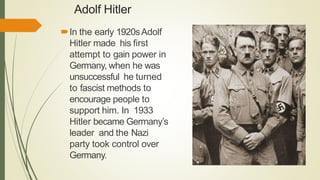
Adolf Hitler
In the early 1920sAdolf
Hitler made his first
attempt to gain power in
Germany, when he was
unsuccessful he turned
to fascist methods to
encourage people to
support him. In 1933
Hitler became Germany’s
leader and the Nazi
party took control over
Germany.
Thetwo AlliancesofWW2
Axis powers
(Germany, Italy, Japan,
Hungary, Romania,
Bulgaria)
 Allies
(U.S., Britain, France, USSR,
Australia, Belgium, Brazil,
Canada, China, Denmark,
Greece, Netherlands, New
Zealand, Norway, Poland,
South Africa, Yugoslavia).
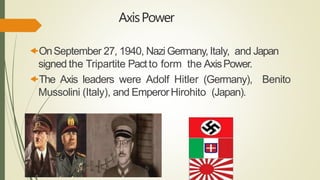
AxisPower
OnSeptember 27, 1940, Nazi Germany,Italy, and Japan
signed the Tripartite Pactto form the AxisPower.
The Axis leaders were Adolf Hitler (Germany), Benito
Mussolini (Italy), and EmperorHirohito (Japan).
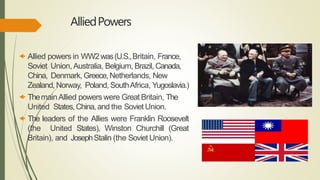
AlliedPowers
 Allied powers in WW2was(U.S.,Britain, France,
Soviet Union, Australia, Belgium, Brazil, Canada,
China, Denmark, Greece,Netherlands, New
Zealand, Norway, Poland, SouthAfrica, Yugoslavia.)
 ThemainAllied powers were Great Britain, The
United States,China,and the Soviet Union.
 The leaders of the Allies were Franklin Roosevelt
(the United States), Winston Churchill (Great
Britain), and JosephStalin (the Soviet Union).
Muzammil Hussain
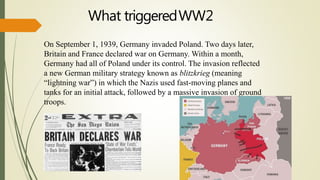
On September 1, 1939, Germany invaded Poland. Two days later,
Britain and France declared war on Germany. Within a month,
Germany had all of Poland under its control. The invasion reflected
a new German military strategy known as blitzkrieg (meaning
“lightning war”) in which the Nazis used fast-moving planes and
tanks for an initial attack, followed by a massive invasion of ground
troops.
What triggeredWW2
Germany Takes France
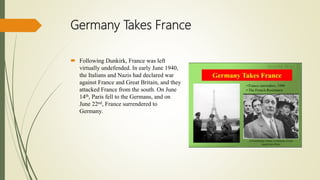
 Following Dunkirk, France was left
virtually undefended. In early June 1940,
the Italians and Nazis had declared war
against France and Great Britain, and they
attacked France from the south. On June
14th, Paris fell to the Germans, and on
June 22nd, France surrendered to
Germany.
The Battle of Britain
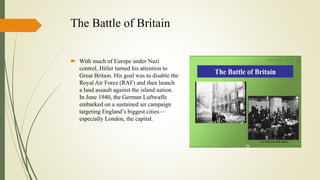
 With much of Europe under Nazi
control, Hitler turned his attention to
Great Britain. His goal was to disable the
Royal Air Force (RAF) and then launch
a land assault against the island nation.
In June 1940, the German Luftwaffe
embarked on a sustained air campaign
targeting England’s biggest cities—
especially London, the capital.
The Battle of Britain lasted until May 1941. Many civilians died
and hundreds of buildings were reduced to rubble, but the
British eventually prevailed because of several factors:
•The development of radar, a new technology, allowed the
British to know the number, speed, and direction of incoming
enemy warplanes. British antiaircraft guns inflicted heavy losses
on the Luftwaffe.
•The skill of the RAF in defending the country kept losses from
being more severe. British fighters ultimately managed to
overcome their German counterparts.
In the Battle of Britain, the German Luftwaffe lost a
total of 1733 aircraft, while the RAF only lost 915
aircraft. Between September 1940 and May 1941,
Germany dropped more than 35,000 tons of bombs.
London alone was attacked 19 times with over 18,800
tons of bombs. When it became clear that Britain could
not be subdued by bombing alone, Hitler changed his
focus to Eastern Europe and the Mediterranean.
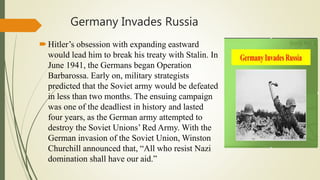
Germany Invades Russia
Hitler’s obsession with expanding eastward
would lead him to break his treaty with Stalin. In
June 1941, the Germans began Operation
Barbarossa. Early on, military strategists
predicted that the Soviet army would be defeated
in less than two months. The ensuing campaign
was one of the deadliest in history and lasted
four years, as the German army attempted to
destroy the Soviet Unions’ Red Army. With the
German invasion of the Soviet Union, Winston
Churchill announced that, “All who resist Nazi
domination shall have our aid.”
Hassan Raza
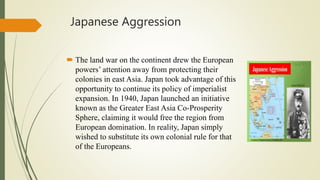
Japanese Aggression
 The land war on the continent drew the European
powers’ attention away from protecting their
colonies in east Asia. Japan took advantage of this
opportunity to continue its policy of imperialist
expansion. In 1940, Japan launched an initiative
known as the Greater East Asia Co-Prosperity
Sphere, claiming it would free the region from
European domination. In reality, Japan simply
wished to substitute its own colonial rule for that
of the Europeans.
President Roosevelt had been alarmed by Japanese expansion
in east Asia and the Pacific and took moves to slow Japan’s
efforts. In 1940, he ended sales of steel and scrap iron to
Japan; after Japan conquered French Indochina in 1941, he
cut off oil shipments to Japan and froze Japanese assets in
U.S. banks. Both countries realized they were heading down
the road to war. Japanese and American diplomats held
meetings in 1941 trying to find a way to avoid conflict.
Behind the scenes, however, Japan was already planning an
attack. General Hideki Tojo, who advocated going to war
with the U.S., became Japanese Prime Minister in October
1940. In late November, Japan began moving a fleet across
the Pacific toward Hawaii.
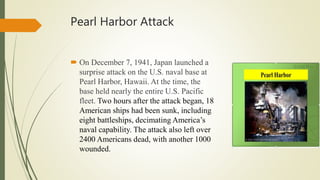
Pearl Harbor Attack
 On December 7, 1941, Japan launched a
surprise attack on the U.S. naval base at
Pearl Harbor, Hawaii. At the time, the
base held nearly the entire U.S. Pacific
fleet. Two hours after the attack began, 18
American ships had been sunk, including
eight battleships, decimating America’s
naval capability. The attack also left over
2400 Americans dead, with another 1000
wounded.
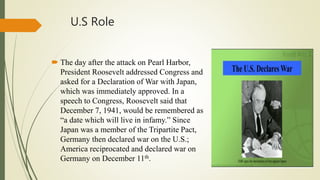
U.S Role
 The day after the attack on Pearl Harbor,
President Roosevelt addressed Congress and
asked for a Declaration of War with Japan,
which was immediately approved. In a
speech to Congress, Roosevelt said that
December 7, 1941, would be remembered as
“a date which will live in infamy.” Since
Japan was a member of the Tripartite Pact,
Germany then declared war on the U.S.;
America reciprocated and declared war on
Germany on December 11th.
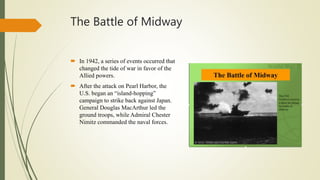
The Battle of Midway
 In 1942, a series of events occurred that
changed the tide of war in favor of the
Allied powers.
 After the attack on Pearl Harbor, the
U.S. began an “island-hopping”
campaign to strike back against Japan.
General Douglas MacArthur led the
ground troops, while Admiral Chester
Nimitz commanded the naval forces.
Early in the summer of 1942, the Japanese set up a plan to
draw in American ships to the island of Midway and
ambush them there. The U.S., however, had decoded secret
messages that revealed the Japanese plan. The U.S. decided
to set up an ambush of its own: Admiral Nimitz would have
his carriers ready and waiting at Midway for the Japanese.
Though both sides sustained heavy losses in the ensuing
battle, Japan suffered far more than the U.S., losing four
aircraft carriers. After this decisive U.S. naval victory, the
remainder of the Japanese fleet had to retreat. The United
States had claimed the offensive and began to act more
aggressively to secure island after island in the Pacific.
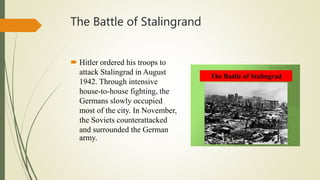
The Battle of Stalingrand
 Hitler ordered his troops to
attack Stalingrad in August
1942. Through intensive
house-to-house fighting, the
Germans slowly occupied
most of the city. In November,
the Soviets counterattacked
and surrounded the German
army.
As supplies ran low and the harsh Russian winter set
in, the German army suffered a slow attrition, losing
thousands of troops to the cold and starvation.
Running out of ammunition, the Germans were forced
to surrender in January 1943. The human toll of this
siege was enormous—an estimated 500,000 Soviets
died along with 150,000 Germans. The battle marked
a turning point in the war on the eastern front. Just as
in the Pacific, the Axis armies were on the defensive,
and Soviet troops pushed them back toward Germany.
Chaudhry Muhammad
North Africa
 In 1940, Mussolini had ordered his North African army to move against the British in
Egypt. After initial successes, the Italians were forced back by an attacking British
army. The Italians were routed. In response, Hitler sent General Erwin Rommel to
command a new tank corps and take Egypt from the British. On November 4, 1942,
after months of back-and-forth fighting, the British Army stopped the Germans at El
Alamein in Egypt; by March 1943, the Allies had North Africa under their control
and began to plan for an invasion of Sicily.
 The goal was to regain control of much of the Mediterranean and to force Hitler to
redirect a large number of his troops to the western front, thus easing the fighting on
the eastern front for the Soviets.
 Basing their operations in North Africa, the Allies invaded and captured Sicily in the
summer of 1943, forcing Mussolini out of power.
Italy Surrenders
 In 1943, Mussolini was removed from office by the Fascist
Grand Council. He was imprisoned, but Hitler had him
rescued and set him up as head of an Italian government in
German-occupied northern Italy.
 On June 4, 1944, the Allies entered Rome. They continued to
push north and gained control of all of Italy by April 1945.
While attempting to escape to Switzerland, Mussolini was
captured by partisans and executed. With a Soviet victory
almost certain in the east and Italy’s surrender in the west, the
Allies began to prepare for an invasion of France. They
hoped that once they had secured France, they could push
forward into Germany from two fronts.
The D-Day Invasion
 On June 6, 1944, combined British and American forces landed on the
beaches of Normandy in what would be the greatest naval invasion in
history. Within a hundred days, more than two million troops and a
half-million vehicles were making their way inland. By late July, the
Allies, led by General George Patton, had pushed past the German
defenses.
 “Operation Overlord,” as the invasion was called, was successful at the
estimated cost of 10,000 Allied casualties; German losses have been
estimated at between 4000 to 9000.

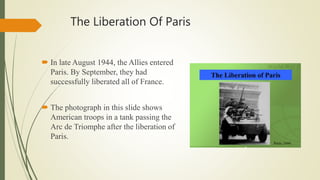
The Liberation Of Paris
 In late August 1944, the Allies entered
Paris. By September, they had
successfully liberated all of France.
 The photograph in this slide shows
American troops in a tank passing the
Arc de Triomphe after the liberation of
Paris.
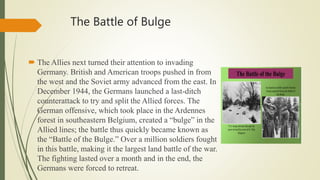
The Battle of Bulge
 The Allies next turned their attention to invading
Germany. British and American troops pushed in from
the west and the Soviet army advanced from the east. In
December 1944, the Germans launched a last-ditch
counterattack to try and split the Allied forces. The
German offensive, which took place in the Ardennes
forest in southeastern Belgium, created a “bulge” in the
Allied lines; the battle thus quickly became known as
the “Battle of the Bulge.” Over a million soldiers fought
in this battle, making it the largest land battle of the war.
The fighting lasted over a month and in the end, the
Germans were forced to retreat.
The Firebombing of Dresden
 As the Allies pushed to end
the war in Europe, U.S. and
British planes began to bomb
communication centers in
eastern Germany in order to
aid the Soviet advance on
Berlin. Dozens of cities were
destroyed as a result, including
the German city of Dresden—
an event which remains
controversial to this day.
Dresden was a cultural center that had no significant military
or industrial areas. It was renowned for the fine china that had
been produced there for hundreds of years. Over the course of
three days in February 1945, the RAF and then the U.S. Air
Force dropped load after load of bombs on Dresden, starting a
firestorm that quickly engulfed the city. When the flames
finally died down, there was virtually nothing left. Statistics
show that of 28,410 houses in the inner city, 24,866 were
destroyed. Estimates of the number killed range from 25,000
to 135,000.
Zamin Haider
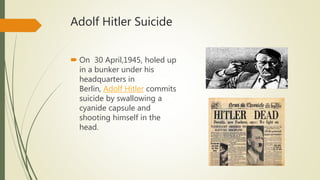
Adolf Hitler Suicide
 On 30 April,1945, holed up
in a bunker under his
headquarters in
Berlin, Adolf Hitler commits
suicide by swallowing a
cyanide capsule and
shooting himself in the
head.
Germany Surrender
 By March 1945, it had become clear
that Germany would soon be in Allied
hands. Facing certain defeat, Hitler
took his own life in April of that year.
With Hitler dead and the city of
Berlin surrounded, the Nazis
surrendered on May 7, 1945, to
General Dwight Eisenhower.
V-E Day
On May 8, 1945, the Allied
powers celebrated V-E Day:
Victory in Europe Day.
Tom Fletcher, a civilian living in
England at the time described V-E
Day,
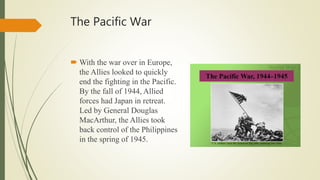
The Pacific War
 With the war over in Europe,
the Allies looked to quickly
end the fighting in the Pacific.
By the fall of 1944, Allied
forces had Japan in retreat.
Led by General Douglas
MacArthur, the Allies took
back control of the Philippines
in the spring of 1945.
Atomic Bomb
 The battles for Iwo Jima and Okinawa demonstrated Japan’s “fight-to-the-death”
attitude and unwillingness to surrender, no matter the costs. The Allies knew that
using ground troops to subdue Japan would be difficult and result in a huge number
of casualties: some estimated that nearly a million Allied soldiers would die in the
operation. Yet, there was an alternative. Prior to the beginning of the war, President
Roosevelt had approved a program called the “Manhattan Project” that had the goal
of building an atomic bomb. Top scientists from around the world—including
refugees from Germany—worked to complete the bomb before the Germans could.
On June 16, 1945, the first successful test of an atomic bomb took place in the New
Mexico desert. Truman chose to use the weapon against the Japanese in order to
bring a quick end to the war and avoid the casualties the U.S. would suffer in a
ground assault.
Hiroshima & Nagasaki
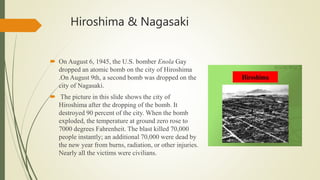
 On August 6, 1945, the U.S. bomber Enola Gay
dropped an atomic bomb on the city of Hiroshima
.On August 9th, a second bomb was dropped on the
city of Nagasaki.
 The picture in this slide shows the city of
Hiroshima after the dropping of the bomb. It
destroyed 90 percent of the city. When the bomb
exploded, the temperature at ground zero rose to
7000 degrees Fahrenheit. The blast killed 70,000
people instantly; an additional 70,000 were dead by
the new year from burns, radiation, or other injuries.
Nearly all the victims were civilians.
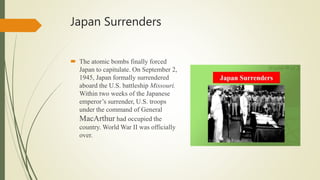
Japan Surrenders
 The atomic bombs finally forced
Japan to capitulate. On September 2,
1945, Japan formally surrendered
aboard the U.S. battleship Missouri.
Within two weeks of the Japanese
emperor’s surrender, U.S. troops
under the command of General
MacArthur had occupied the
country. World War II was officially
over.
Aqeel Hamza
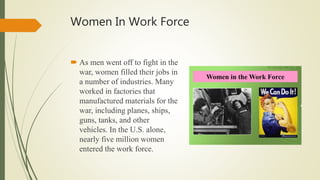
Women In Work Force
 As men went off to fight in the
war, women filled their jobs in
a number of industries. Many
worked in factories that
manufactured materials for the
war, including planes, ships,
guns, tanks, and other
vehicles. In the U.S. alone,
nearly five million women
entered the work force.
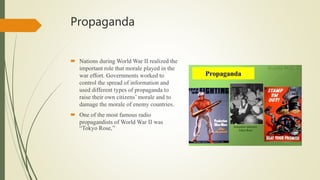
Propaganda
 Nations during World War II realized the
important role that morale played in the
war effort. Governments worked to
control the spread of information and
used different types of propaganda to
raise their own citizens’ morale and to
damage the morale of enemy countries.
 One of the most famous radio
propagandists of World War II was
“Tokyo Rose,”
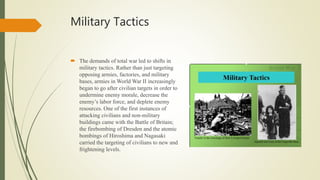
Military Tactics
 The demands of total war led to shifts in
military tactics. Rather than just targeting
opposing armies, factories, and military
bases, armies in World War II increasingly
began to go after civilian targets in order to
undermine enemy morale, decrease the
enemy’s labor force, and deplete enemy
resources. One of the first instances of
attacking civilians and non-military
buildings came with the Battle of Britain;
the firebombing of Dresden and the atomic
bombings of Hiroshima and Nagasaki
carried the targeting of civilians to new and
frightening levels.
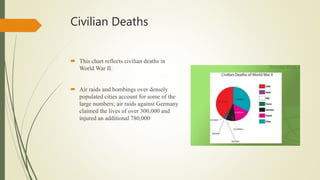
Civilian Deaths
 This chart reflects civilian deaths in
World War II.
 Air raids and bombings over densely
populated cities account for some of the
large numbers; air raids against Germany
claimed the lives of over 300,000 and
injured an additional 780,000
Dividing Germany
Problems would emerge in the future as a divided
Germany would become one of the first ideological
battlegrounds in the Cold War struggle between
American capitalism and Soviet communism.
Ultimately, the American, French, and British
zones united and formed the democratically
governed nation of West Germany; the Soviet zone
became East Germany, a communist nation under
the control of the USSR.
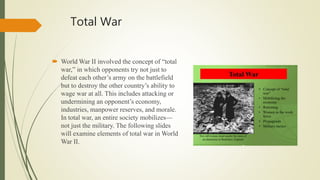
Total War
 World War II involved the concept of “total
war,” in which opponents try not just to
defeat each other’s army on the battlefield
but to destroy the other country’s ability to
wage war at all. This includes attacking or
undermining an opponent’s economy,
industries, manpower reserves, and morale.
In total war, an entire society mobilizes—
not just the military. The following slides
will examine elements of total war in World
War II.
EconomicOutcomes ofWW2
Dueto men absencefor fighting
,women took their place in manufacturing. Rosiethe
Riveter wasan icon representing the 6 mil women
working in theUSA.
Capitalism spread wide in Europeafter the soviet
invasion.
At the end of t he war, millions of people were homeless,
the Europeaneconomy had collapsed, and much of the
Europeanindustrial infrastructure had been destroyed
FactsAboutWW2
80%of Soviet males born in 1923 didn't survive World
War 2
Between 1939 and 1945 the Allies dropped 3.4 million
tons of bombs,An averageof about27,700 tons of
bombs eachmonth.
Germany lost 40-45% of their aircraft duringWorld War 2
to accidents
84 German Generals were executed by Hitler
Ww2

Ww2

  • 2.
    1-Muzammil Hussain 2- UmairNiazi 3-Zamin Haider 4-Hassan Raza 5-C.Muhammad 6-Aqeel Hamza
  • 3.
  • 4.
    World War 2 WorldWar II, also known asthe Second World War, wasaglobal war that lasted from 1939 to1945. Nearly every country wasinvolved in this war from USAtill Japan.So that’s why it wasaworldwar. It is also known as Global WarAnd Total War Because it include not army only but also local people too.
  • 5.
    Causes of WW2 •Communism Apoliticalsystem where the government controls the nations’ wealth and where private ownership is very limited.
  • 6.
    Treaty of Versailles War Guilt Clause – Germany should accept the blame for starting World War One  Reparations – Germany had to pay 6,600 million pounds for the damage caused by the war  Disarmament – Germany was only allowed to have a small army and six naval ships. No tanks, no airforce and no submarines were allowed. The Rhineland area was to be de-militarised.  Territorial Clauses – Land was taken away from Germany and given to other countries. Anschluss (union with Austria) was forbidden.
  • 7.
    Adolf Hitler In theearly 1920sAdolf Hitler made his first attempt to gain power in Germany, when he was unsuccessful he turned to fascist methods to encourage people to support him. In 1933 Hitler became Germany’s leader and the Nazi party took control over Germany.
  • 8.
    Thetwo AlliancesofWW2 Axis powers (Germany,Italy, Japan, Hungary, Romania, Bulgaria)  Allies (U.S., Britain, France, USSR, Australia, Belgium, Brazil, Canada, China, Denmark, Greece, Netherlands, New Zealand, Norway, Poland, South Africa, Yugoslavia).
  • 9.
    AxisPower OnSeptember 27, 1940,Nazi Germany,Italy, and Japan signed the Tripartite Pactto form the AxisPower. The Axis leaders were Adolf Hitler (Germany), Benito Mussolini (Italy), and EmperorHirohito (Japan).
  • 10.
    AlliedPowers  Allied powersin WW2was(U.S.,Britain, France, Soviet Union, Australia, Belgium, Brazil, Canada, China, Denmark, Greece,Netherlands, New Zealand, Norway, Poland, SouthAfrica, Yugoslavia.)  ThemainAllied powers were Great Britain, The United States,China,and the Soviet Union.  The leaders of the Allies were Franklin Roosevelt (the United States), Winston Churchill (Great Britain), and JosephStalin (the Soviet Union).
  • 11.
  • 12.
    On September 1,1939, Germany invaded Poland. Two days later, Britain and France declared war on Germany. Within a month, Germany had all of Poland under its control. The invasion reflected a new German military strategy known as blitzkrieg (meaning “lightning war”) in which the Nazis used fast-moving planes and tanks for an initial attack, followed by a massive invasion of ground troops. What triggeredWW2
  • 13.
    Germany Takes France Following Dunkirk, France was left virtually undefended. In early June 1940, the Italians and Nazis had declared war against France and Great Britain, and they attacked France from the south. On June 14th, Paris fell to the Germans, and on June 22nd, France surrendered to Germany.
  • 14.
    The Battle ofBritain  With much of Europe under Nazi control, Hitler turned his attention to Great Britain. His goal was to disable the Royal Air Force (RAF) and then launch a land assault against the island nation. In June 1940, the German Luftwaffe embarked on a sustained air campaign targeting England’s biggest cities— especially London, the capital.
  • 15.
    The Battle ofBritain lasted until May 1941. Many civilians died and hundreds of buildings were reduced to rubble, but the British eventually prevailed because of several factors: •The development of radar, a new technology, allowed the British to know the number, speed, and direction of incoming enemy warplanes. British antiaircraft guns inflicted heavy losses on the Luftwaffe. •The skill of the RAF in defending the country kept losses from being more severe. British fighters ultimately managed to overcome their German counterparts.
  • 16.
    In the Battleof Britain, the German Luftwaffe lost a total of 1733 aircraft, while the RAF only lost 915 aircraft. Between September 1940 and May 1941, Germany dropped more than 35,000 tons of bombs. London alone was attacked 19 times with over 18,800 tons of bombs. When it became clear that Britain could not be subdued by bombing alone, Hitler changed his focus to Eastern Europe and the Mediterranean.
  • 17.
    Germany Invades Russia Hitler’sobsession with expanding eastward would lead him to break his treaty with Stalin. In June 1941, the Germans began Operation Barbarossa. Early on, military strategists predicted that the Soviet army would be defeated in less than two months. The ensuing campaign was one of the deadliest in history and lasted four years, as the German army attempted to destroy the Soviet Unions’ Red Army. With the German invasion of the Soviet Union, Winston Churchill announced that, “All who resist Nazi domination shall have our aid.”
  • 18.
  • 19.
    Japanese Aggression  Theland war on the continent drew the European powers’ attention away from protecting their colonies in east Asia. Japan took advantage of this opportunity to continue its policy of imperialist expansion. In 1940, Japan launched an initiative known as the Greater East Asia Co-Prosperity Sphere, claiming it would free the region from European domination. In reality, Japan simply wished to substitute its own colonial rule for that of the Europeans.
  • 20.
    President Roosevelt hadbeen alarmed by Japanese expansion in east Asia and the Pacific and took moves to slow Japan’s efforts. In 1940, he ended sales of steel and scrap iron to Japan; after Japan conquered French Indochina in 1941, he cut off oil shipments to Japan and froze Japanese assets in U.S. banks. Both countries realized they were heading down the road to war. Japanese and American diplomats held meetings in 1941 trying to find a way to avoid conflict. Behind the scenes, however, Japan was already planning an attack. General Hideki Tojo, who advocated going to war with the U.S., became Japanese Prime Minister in October 1940. In late November, Japan began moving a fleet across the Pacific toward Hawaii.
  • 21.
    Pearl Harbor Attack On December 7, 1941, Japan launched a surprise attack on the U.S. naval base at Pearl Harbor, Hawaii. At the time, the base held nearly the entire U.S. Pacific fleet. Two hours after the attack began, 18 American ships had been sunk, including eight battleships, decimating America’s naval capability. The attack also left over 2400 Americans dead, with another 1000 wounded.
  • 22.
    U.S Role  Theday after the attack on Pearl Harbor, President Roosevelt addressed Congress and asked for a Declaration of War with Japan, which was immediately approved. In a speech to Congress, Roosevelt said that December 7, 1941, would be remembered as “a date which will live in infamy.” Since Japan was a member of the Tripartite Pact, Germany then declared war on the U.S.; America reciprocated and declared war on Germany on December 11th.
  • 23.
    The Battle ofMidway  In 1942, a series of events occurred that changed the tide of war in favor of the Allied powers.  After the attack on Pearl Harbor, the U.S. began an “island-hopping” campaign to strike back against Japan. General Douglas MacArthur led the ground troops, while Admiral Chester Nimitz commanded the naval forces.
  • 24.
    Early in thesummer of 1942, the Japanese set up a plan to draw in American ships to the island of Midway and ambush them there. The U.S., however, had decoded secret messages that revealed the Japanese plan. The U.S. decided to set up an ambush of its own: Admiral Nimitz would have his carriers ready and waiting at Midway for the Japanese. Though both sides sustained heavy losses in the ensuing battle, Japan suffered far more than the U.S., losing four aircraft carriers. After this decisive U.S. naval victory, the remainder of the Japanese fleet had to retreat. The United States had claimed the offensive and began to act more aggressively to secure island after island in the Pacific.
  • 25.
    The Battle ofStalingrand  Hitler ordered his troops to attack Stalingrad in August 1942. Through intensive house-to-house fighting, the Germans slowly occupied most of the city. In November, the Soviets counterattacked and surrounded the German army.
  • 26.
    As supplies ranlow and the harsh Russian winter set in, the German army suffered a slow attrition, losing thousands of troops to the cold and starvation. Running out of ammunition, the Germans were forced to surrender in January 1943. The human toll of this siege was enormous—an estimated 500,000 Soviets died along with 150,000 Germans. The battle marked a turning point in the war on the eastern front. Just as in the Pacific, the Axis armies were on the defensive, and Soviet troops pushed them back toward Germany.
  • 27.
  • 28.
    North Africa  In1940, Mussolini had ordered his North African army to move against the British in Egypt. After initial successes, the Italians were forced back by an attacking British army. The Italians were routed. In response, Hitler sent General Erwin Rommel to command a new tank corps and take Egypt from the British. On November 4, 1942, after months of back-and-forth fighting, the British Army stopped the Germans at El Alamein in Egypt; by March 1943, the Allies had North Africa under their control and began to plan for an invasion of Sicily.  The goal was to regain control of much of the Mediterranean and to force Hitler to redirect a large number of his troops to the western front, thus easing the fighting on the eastern front for the Soviets.  Basing their operations in North Africa, the Allies invaded and captured Sicily in the summer of 1943, forcing Mussolini out of power.
  • 29.
    Italy Surrenders  In1943, Mussolini was removed from office by the Fascist Grand Council. He was imprisoned, but Hitler had him rescued and set him up as head of an Italian government in German-occupied northern Italy.  On June 4, 1944, the Allies entered Rome. They continued to push north and gained control of all of Italy by April 1945. While attempting to escape to Switzerland, Mussolini was captured by partisans and executed. With a Soviet victory almost certain in the east and Italy’s surrender in the west, the Allies began to prepare for an invasion of France. They hoped that once they had secured France, they could push forward into Germany from two fronts.
  • 30.
    The D-Day Invasion On June 6, 1944, combined British and American forces landed on the beaches of Normandy in what would be the greatest naval invasion in history. Within a hundred days, more than two million troops and a half-million vehicles were making their way inland. By late July, the Allies, led by General George Patton, had pushed past the German defenses.  “Operation Overlord,” as the invasion was called, was successful at the estimated cost of 10,000 Allied casualties; German losses have been estimated at between 4000 to 9000. 
  • 31.
    The Liberation OfParis  In late August 1944, the Allies entered Paris. By September, they had successfully liberated all of France.  The photograph in this slide shows American troops in a tank passing the Arc de Triomphe after the liberation of Paris.
  • 32.
    The Battle ofBulge  The Allies next turned their attention to invading Germany. British and American troops pushed in from the west and the Soviet army advanced from the east. In December 1944, the Germans launched a last-ditch counterattack to try and split the Allied forces. The German offensive, which took place in the Ardennes forest in southeastern Belgium, created a “bulge” in the Allied lines; the battle thus quickly became known as the “Battle of the Bulge.” Over a million soldiers fought in this battle, making it the largest land battle of the war. The fighting lasted over a month and in the end, the Germans were forced to retreat.
  • 33.
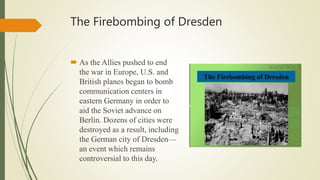
    The Firebombing ofDresden  As the Allies pushed to end the war in Europe, U.S. and British planes began to bomb communication centers in eastern Germany in order to aid the Soviet advance on Berlin. Dozens of cities were destroyed as a result, including the German city of Dresden— an event which remains controversial to this day.
  • 34.
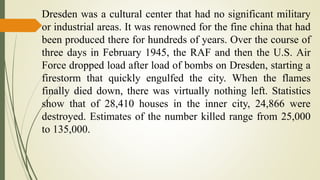
    Dresden was acultural center that had no significant military or industrial areas. It was renowned for the fine china that had been produced there for hundreds of years. Over the course of three days in February 1945, the RAF and then the U.S. Air Force dropped load after load of bombs on Dresden, starting a firestorm that quickly engulfed the city. When the flames finally died down, there was virtually nothing left. Statistics show that of 28,410 houses in the inner city, 24,866 were destroyed. Estimates of the number killed range from 25,000 to 135,000.
  • 35.
  • 36.
    Adolf Hitler Suicide On 30 April,1945, holed up in a bunker under his headquarters in Berlin, Adolf Hitler commits suicide by swallowing a cyanide capsule and shooting himself in the head.
  • 37.
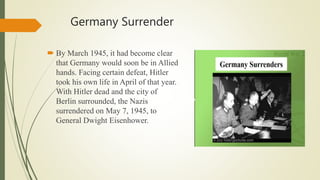
    Germany Surrender  ByMarch 1945, it had become clear that Germany would soon be in Allied hands. Facing certain defeat, Hitler took his own life in April of that year. With Hitler dead and the city of Berlin surrounded, the Nazis surrendered on May 7, 1945, to General Dwight Eisenhower.
  • 38.
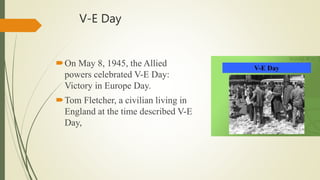
    V-E Day On May8, 1945, the Allied powers celebrated V-E Day: Victory in Europe Day. Tom Fletcher, a civilian living in England at the time described V-E Day,
  • 39.
    The Pacific War With the war over in Europe, the Allies looked to quickly end the fighting in the Pacific. By the fall of 1944, Allied forces had Japan in retreat. Led by General Douglas MacArthur, the Allies took back control of the Philippines in the spring of 1945.
  • 40.
    Atomic Bomb  Thebattles for Iwo Jima and Okinawa demonstrated Japan’s “fight-to-the-death” attitude and unwillingness to surrender, no matter the costs. The Allies knew that using ground troops to subdue Japan would be difficult and result in a huge number of casualties: some estimated that nearly a million Allied soldiers would die in the operation. Yet, there was an alternative. Prior to the beginning of the war, President Roosevelt had approved a program called the “Manhattan Project” that had the goal of building an atomic bomb. Top scientists from around the world—including refugees from Germany—worked to complete the bomb before the Germans could. On June 16, 1945, the first successful test of an atomic bomb took place in the New Mexico desert. Truman chose to use the weapon against the Japanese in order to bring a quick end to the war and avoid the casualties the U.S. would suffer in a ground assault.
  • 41.
    Hiroshima & Nagasaki On August 6, 1945, the U.S. bomber Enola Gay dropped an atomic bomb on the city of Hiroshima .On August 9th, a second bomb was dropped on the city of Nagasaki.  The picture in this slide shows the city of Hiroshima after the dropping of the bomb. It destroyed 90 percent of the city. When the bomb exploded, the temperature at ground zero rose to 7000 degrees Fahrenheit. The blast killed 70,000 people instantly; an additional 70,000 were dead by the new year from burns, radiation, or other injuries. Nearly all the victims were civilians.
  • 42.
    Japan Surrenders  Theatomic bombs finally forced Japan to capitulate. On September 2, 1945, Japan formally surrendered aboard the U.S. battleship Missouri. Within two weeks of the Japanese emperor’s surrender, U.S. troops under the command of General MacArthur had occupied the country. World War II was officially over.
  • 43.
  • 44.
    Women In WorkForce  As men went off to fight in the war, women filled their jobs in a number of industries. Many worked in factories that manufactured materials for the war, including planes, ships, guns, tanks, and other vehicles. In the U.S. alone, nearly five million women entered the work force.
  • 45.
    Propaganda  Nations duringWorld War II realized the important role that morale played in the war effort. Governments worked to control the spread of information and used different types of propaganda to raise their own citizens’ morale and to damage the morale of enemy countries.  One of the most famous radio propagandists of World War II was “Tokyo Rose,”
  • 46.
    Military Tactics  Thedemands of total war led to shifts in military tactics. Rather than just targeting opposing armies, factories, and military bases, armies in World War II increasingly began to go after civilian targets in order to undermine enemy morale, decrease the enemy’s labor force, and deplete enemy resources. One of the first instances of attacking civilians and non-military buildings came with the Battle of Britain; the firebombing of Dresden and the atomic bombings of Hiroshima and Nagasaki carried the targeting of civilians to new and frightening levels.
  • 47.
    Civilian Deaths  Thischart reflects civilian deaths in World War II.  Air raids and bombings over densely populated cities account for some of the large numbers; air raids against Germany claimed the lives of over 300,000 and injured an additional 780,000
  • 48.
    Dividing Germany Problems wouldemerge in the future as a divided Germany would become one of the first ideological battlegrounds in the Cold War struggle between American capitalism and Soviet communism. Ultimately, the American, French, and British zones united and formed the democratically governed nation of West Germany; the Soviet zone became East Germany, a communist nation under the control of the USSR.
  • 49.
    Total War  WorldWar II involved the concept of “total war,” in which opponents try not just to defeat each other’s army on the battlefield but to destroy the other country’s ability to wage war at all. This includes attacking or undermining an opponent’s economy, industries, manpower reserves, and morale. In total war, an entire society mobilizes— not just the military. The following slides will examine elements of total war in World War II.
  • 50.
    EconomicOutcomes ofWW2 Dueto menabsencefor fighting ,women took their place in manufacturing. Rosiethe Riveter wasan icon representing the 6 mil women working in theUSA. Capitalism spread wide in Europeafter the soviet invasion. At the end of t he war, millions of people were homeless, the Europeaneconomy had collapsed, and much of the Europeanindustrial infrastructure had been destroyed
  • 51.
    FactsAboutWW2 80%of Soviet malesborn in 1923 didn't survive World War 2 Between 1939 and 1945 the Allies dropped 3.4 million tons of bombs,An averageof about27,700 tons of bombs eachmonth. Germany lost 40-45% of their aircraft duringWorld War 2 to accidents 84 German Generals were executed by Hitler