Populists & Progressives
Essential QuestionTo what extent did the populists and progressives achieve their goals?
Farmers and the Populist MovementChapter 5, Section 3Video
Mary Elizabeth Lease
Farmers Unite to Address Common Problems
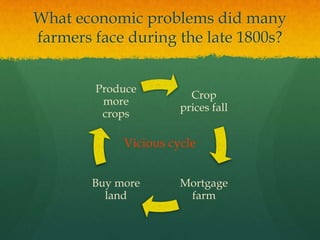
What economic problems did many farmers face during the late 1800s?Vicious cycle
What economic problems did many farmers face during the late 1800s?Good farm land becomes scarceBank foreclose on mortgagesRailroads charging excessive prices for shipping and storage
Why did farmers favor “cheap money”?Retired“greenbacks”Less $ in circulationPaid back loans with $ worth more than $ they borrowedCrop prices falling1867-1887 bushel wheat fell from $2.00 to $0.68Banks foreclosing on mortgages
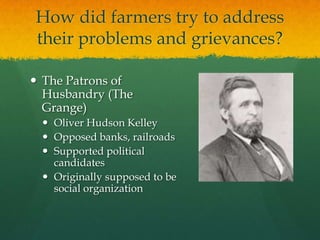
How did farmers try to address their problems and grievances?The Patrons of Husbandry (The Grange)Oliver Hudson KelleyOpposed banks, railroadsSupported political candidatesOriginally supposed to be social organization
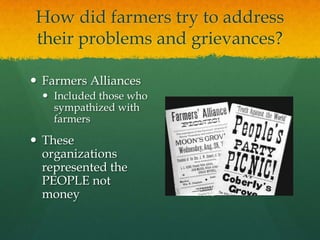
How did farmers try to address their problems and grievances?Farmers AlliancesIncluded those who sympathized with farmersThese organizations represented the PEOPLE not money
The Rise and fall of Populism
PopulismMovement of the PeopleBorn with founding of Populist Party in 1892Fought for rights of farmers and laborers and battled railroad companiesRepresented a third political party
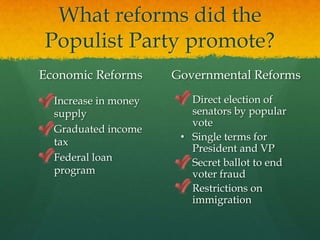
What reforms did the Populist Party promote?Economic ReformsIncrease in money supply
Graduated income tax
Federal loan programGovernmental ReformsDirect election of senators by popular vote
Single terms for President and VP
Secret ballot to end voter fraud
Restrictions on immigrationWhat reforms did the Populist Party promote?Economic ReformsIncrease in money supply
Graduated income tax
Federal loan programGovernmental ReformsDirect election of senators by popular vote
Single terms for President and VP
Secret ballot to end voter fraud
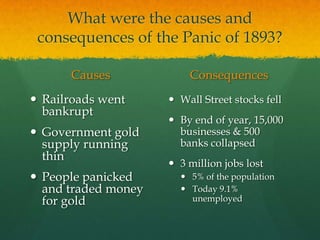
Restrictions on immigrationWhat were the causes and consequences of the Panic of 1893?CausesRailroads went bankruptGovernment gold supply running thinPeople panicked and traded money for goldConsequencesWall Street stocks fellBy end of year, 15,000 businesses & 500 banks collapsed3 million jobs lost5% of the populationToday 9.1% unemployed
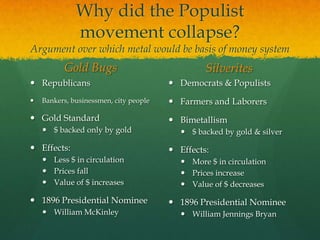
Why did the Populist movement collapse?Argument over which metal would be basis of money systemGold BugsSilveritesRepublicansBankers, businessmen, city peopleGold Standard$ backed only by goldEffects:  Less $ in circulationPrices fallValue of $ increases1896 Presidential NomineeWilliam McKinleyDemocrats & PopulistsFarmers and LaborersBimetallism$ backed by gold & silverEffects:More $ in circulationPrices increaseValue of $ decreases1896 Presidential NomineeWilliam Jennings Bryan
“Cross of Gold” speechWilliam Jennings Bryan
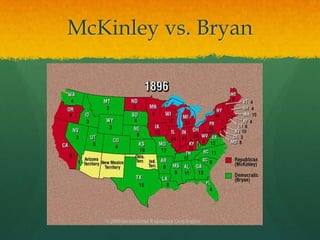
McKinley vs. Bryan
Why did the Populist movement collapse?McKinley won election of 1896McKinley carried East and Industrial MidwestBryan carried South and farmers of MidwestIndustrial Midwest elected McKinleyPopulism collapsed
Taking NotesIdentify the causes of the rise of the Populist Party and the effects the party had.Causes???Effects???
Taking NotesIdentify the causes of the rise of the Populist Party and the effects the party had.CausesFalling prices for cropsInability to repay loansExcessive railroad pricesEffectsNew ideas that later became lawPolitical forum for addressing special interestsMessage of hope to downtrodden
The Origins of ProgressivismChapter 9, Section 1
Four Goals of Progressivism
What were the four goals of progressivism?Protecting Social WelfareSocial Gospel MovementSettlement House MovementYMCASalvation ArmyFlorence KelleyAdvocate for women and childrenIllinois Factory Act of 1893Prohibited child labor/limited women’s work hrs.
What were the four goals of progressivism?Promoting Moral ImprovementProhibition – 18th Amendment (1919)Woman’s Christian Temperance Union (WCTU)Became largest woman’s group in nations historyAnti Saloon League –“the Church in action against the Saloon”
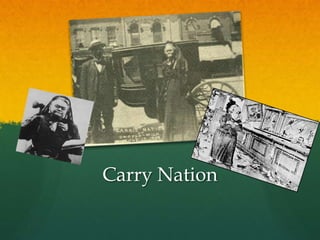
Carry Nation
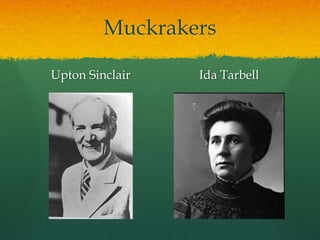
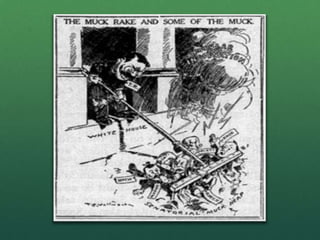
What were the four goals of progressivism?Creating Economic ReformPanic of 1893 caused some to question capitalismEugene V. Debs organized American Socialist Party in 1901MuckrakersLincoln Steffens, Ida Tarbell, Upton SinclairJournalists who wrote about corruption in business and public life
MuckrakersUpton SinclairIda Tarbell
What were the four goals of progressivism?Fostering efficiencyFaith in experts and scientific principles to make society betterScientific management studiesIntroduction of assembly lines
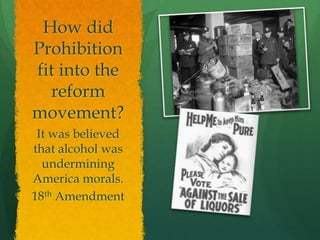
How did Prohibition fit into the reform movement?It was believed that alcohol was undermining America morals.18th Amendment
Cleaning Up Local Government
How did natural disasters help launch the movement to reform local government?1900, Galveston, TX – hurricane and tidal waveAdopted the commission idea as a form of government5 member commission of experts in charge of city departments1913, Dayton, OH – floodAdoption of council-manager form of governmentCity council make laws
How did reform mayors clean up their local governments?Hazen Pingree of Detroit, MIFairer tax structure, lowered fairs for public transportation, rooted out corruption, and set up a system of work relief for unemployedTom Johnson of Cleveland, OHConverting the utilities to publicly owned enterprises
Reform at the State Level
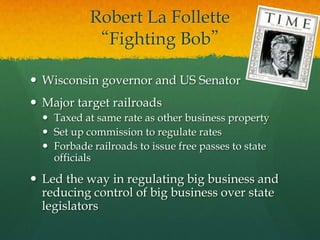
Robert La Follette“Fighting Bob”Wisconsin governor and US SenatorMajor target railroadsTaxed at same rate as other business propertySet up commission to regulate ratesForbade railroads to issue free passes to state officialsLed the way in regulating big business and reducing control of big business over state legislators
How did reforms protect children?National Child Labor Committee (1904)Gathered evidence of children working in harsh conditionsKeating-Owen Act (1916)Prohibited the transportation across state line of goods produced with child labor1918 – Supreme Court declared act unconstitutional due to inference with states’ rights
How did reform change working conditions?Muller v. Oregon (1908)Limit women to 10 hour work dayBunting v. Oregon (1917)Limit men to 10 hour work dayWorkers’ compensationAid the families of workers hurt or killed on the job
What kinds of political reforms took place at the state level?Progressive Era reform legislation provided for increased direct participation in government.Initiative – a bill originated by the people on the ballotReferendum – a vote on the initiativeRecall – enabled voters to remove public officials from elected positions by forcing them to face another electionThe Direct Primary – gave citizens a way to participate in the selection of a presidential candidateSecret Ballot – candidates are selected from a single, uniform ballot
What kinds of political reforms took place at the state level?17th AmendmentRatified 1913Direct election of senatorsVideo
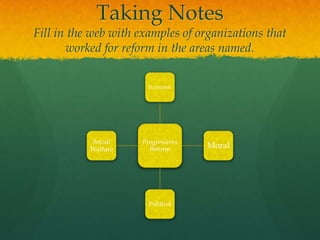
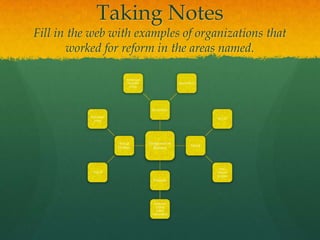
Taking NotesFill in the web with examples of organizations that worked for reform in the areas named.
Women Lead Reform
How did the opening of women’s colleges help create new opportunities for women?Marriage was no longer a woman’s only alternative.Many applied their skills to social reform
Why were there women leaders in the movements to reform social welfare, public morals, and race relations?The participation of educated women often strengthened the existing reform groups and provided leadership for new ones.
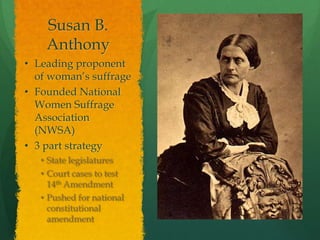
Susan B. AnthonyLeading proponent of woman’s suffrage
Founded National Women Suffrage Association (NWSA)
3 part strategy

Populists progressives

  • 1.
  • 2.
    Essential QuestionTo whatextent did the populists and progressives achieve their goals?
  • 3.
    Farmers and thePopulist MovementChapter 5, Section 3Video
  • 4.
  • 5.
    Farmers Unite toAddress Common Problems
  • 6.
    What economic problemsdid many farmers face during the late 1800s?Vicious cycle
  • 7.
    What economic problemsdid many farmers face during the late 1800s?Good farm land becomes scarceBank foreclose on mortgagesRailroads charging excessive prices for shipping and storage
  • 8.
    Why did farmersfavor “cheap money”?Retired“greenbacks”Less $ in circulationPaid back loans with $ worth more than $ they borrowedCrop prices falling1867-1887 bushel wheat fell from $2.00 to $0.68Banks foreclosing on mortgages
  • 9.
    How did farmerstry to address their problems and grievances?The Patrons of Husbandry (The Grange)Oliver Hudson KelleyOpposed banks, railroadsSupported political candidatesOriginally supposed to be social organization
  • 10.
    How did farmerstry to address their problems and grievances?Farmers AlliancesIncluded those who sympathized with farmersThese organizations represented the PEOPLE not money
  • 11.
    The Rise andfall of Populism
  • 12.
    PopulismMovement of thePeopleBorn with founding of Populist Party in 1892Fought for rights of farmers and laborers and battled railroad companiesRepresented a third political party
  • 13.
    What reforms didthe Populist Party promote?Economic ReformsIncrease in money supply
  • 14.
  • 15.
    Federal loan programGovernmentalReformsDirect election of senators by popular vote
  • 16.
    Single terms forPresident and VP
  • 17.
    Secret ballot toend voter fraud
  • 18.
    Restrictions on immigrationWhatreforms did the Populist Party promote?Economic ReformsIncrease in money supply
  • 19.
  • 20.
    Federal loan programGovernmentalReformsDirect election of senators by popular vote
  • 21.
    Single terms forPresident and VP
  • 22.
    Secret ballot toend voter fraud
  • 23.
    Restrictions on immigrationWhatwere the causes and consequences of the Panic of 1893?CausesRailroads went bankruptGovernment gold supply running thinPeople panicked and traded money for goldConsequencesWall Street stocks fellBy end of year, 15,000 businesses & 500 banks collapsed3 million jobs lost5% of the populationToday 9.1% unemployed
  • 24.
    Why did thePopulist movement collapse?Argument over which metal would be basis of money systemGold BugsSilveritesRepublicansBankers, businessmen, city peopleGold Standard$ backed only by goldEffects: Less $ in circulationPrices fallValue of $ increases1896 Presidential NomineeWilliam McKinleyDemocrats & PopulistsFarmers and LaborersBimetallism$ backed by gold & silverEffects:More $ in circulationPrices increaseValue of $ decreases1896 Presidential NomineeWilliam Jennings Bryan
  • 25.
    “Cross of Gold”speechWilliam Jennings Bryan
  • 26.
  • 27.
    Why did thePopulist movement collapse?McKinley won election of 1896McKinley carried East and Industrial MidwestBryan carried South and farmers of MidwestIndustrial Midwest elected McKinleyPopulism collapsed
  • 28.
    Taking NotesIdentify thecauses of the rise of the Populist Party and the effects the party had.Causes???Effects???
  • 29.
    Taking NotesIdentify thecauses of the rise of the Populist Party and the effects the party had.CausesFalling prices for cropsInability to repay loansExcessive railroad pricesEffectsNew ideas that later became lawPolitical forum for addressing special interestsMessage of hope to downtrodden
  • 30.
    The Origins ofProgressivismChapter 9, Section 1
  • 31.
    Four Goals ofProgressivism
  • 32.
    What were thefour goals of progressivism?Protecting Social WelfareSocial Gospel MovementSettlement House MovementYMCASalvation ArmyFlorence KelleyAdvocate for women and childrenIllinois Factory Act of 1893Prohibited child labor/limited women’s work hrs.
  • 33.
    What were thefour goals of progressivism?Promoting Moral ImprovementProhibition – 18th Amendment (1919)Woman’s Christian Temperance Union (WCTU)Became largest woman’s group in nations historyAnti Saloon League –“the Church in action against the Saloon”
  • 34.
  • 35.
    What were thefour goals of progressivism?Creating Economic ReformPanic of 1893 caused some to question capitalismEugene V. Debs organized American Socialist Party in 1901MuckrakersLincoln Steffens, Ida Tarbell, Upton SinclairJournalists who wrote about corruption in business and public life
  • 36.
  • 38.
    What were thefour goals of progressivism?Fostering efficiencyFaith in experts and scientific principles to make society betterScientific management studiesIntroduction of assembly lines
  • 39.
    How did Prohibitionfit into the reform movement?It was believed that alcohol was undermining America morals.18th Amendment
  • 40.
  • 41.
    How did naturaldisasters help launch the movement to reform local government?1900, Galveston, TX – hurricane and tidal waveAdopted the commission idea as a form of government5 member commission of experts in charge of city departments1913, Dayton, OH – floodAdoption of council-manager form of governmentCity council make laws
  • 42.
    How did reformmayors clean up their local governments?Hazen Pingree of Detroit, MIFairer tax structure, lowered fairs for public transportation, rooted out corruption, and set up a system of work relief for unemployedTom Johnson of Cleveland, OHConverting the utilities to publicly owned enterprises
  • 43.
    Reform at theState Level
  • 44.
    Robert La Follette“FightingBob”Wisconsin governor and US SenatorMajor target railroadsTaxed at same rate as other business propertySet up commission to regulate ratesForbade railroads to issue free passes to state officialsLed the way in regulating big business and reducing control of big business over state legislators
  • 45.
    How did reformsprotect children?National Child Labor Committee (1904)Gathered evidence of children working in harsh conditionsKeating-Owen Act (1916)Prohibited the transportation across state line of goods produced with child labor1918 – Supreme Court declared act unconstitutional due to inference with states’ rights
  • 46.
    How did reformchange working conditions?Muller v. Oregon (1908)Limit women to 10 hour work dayBunting v. Oregon (1917)Limit men to 10 hour work dayWorkers’ compensationAid the families of workers hurt or killed on the job
  • 47.
    What kinds ofpolitical reforms took place at the state level?Progressive Era reform legislation provided for increased direct participation in government.Initiative – a bill originated by the people on the ballotReferendum – a vote on the initiativeRecall – enabled voters to remove public officials from elected positions by forcing them to face another electionThe Direct Primary – gave citizens a way to participate in the selection of a presidential candidateSecret Ballot – candidates are selected from a single, uniform ballot
  • 48.
    What kinds ofpolitical reforms took place at the state level?17th AmendmentRatified 1913Direct election of senatorsVideo
  • 49.
    Taking NotesFill inthe web with examples of organizations that worked for reform in the areas named.
  • 50.
    Taking NotesFill inthe web with examples of organizations that worked for reform in the areas named.
  • 51.
  • 52.
    How did theopening of women’s colleges help create new opportunities for women?Marriage was no longer a woman’s only alternative.Many applied their skills to social reform
  • 53.
    Why were therewomen leaders in the movements to reform social welfare, public morals, and race relations?The participation of educated women often strengthened the existing reform groups and provided leadership for new ones.
  • 54.
    Susan B. AnthonyLeadingproponent of woman’s suffrage
  • 55.
    Founded National WomenSuffrage Association (NWSA)
  • 56.

Editor's Notes

  • #4 Video: Discovery Education “Birth of the Populist Party” (A Segment of: Just the Facts: The Emergence of Modern America: The Gilded Age) (2:21)
  • #5 Read American Lives: Mary Elizabeth LeaseTaking a Stand for Farmers’ Rights, and then discuss questions.
  • #18 Read Primary Source: from William Jennings Bryan’s “Cross of Gold” speech, and then complete Activity Options #1.
  • #19 A map showing the electoral votes in the 1896 election. Although Bryan campaigned tirelessly, carrying the popular and electoral votes for the Democrats (shown in green) in every state where the Alliances and the Populist Party were strong, the populous eastern states won the election (by 67 percent of the electoral vote) for McKinley, who became the nation's 25th president.
  • #41 Video: Discovery Education Progressives' ProgramsA Segment of: America in the 20th Century: The Progressive Era (5:35)