McGraw-Hill/Irwin Copyright © 2007 by The McGraw-Hill Companies, Inc. All rights reserved.
3
Management
of Quality
Quality Management
• What does the term quality mean?
• Quality is the ability of a product or service to
consistently meet or exceed customer
expectations.
9-2
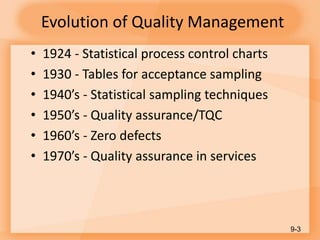
Evolution of Quality Management
• 1924 - Statistical process control charts
• 1930 - Tables for acceptance sampling
• 1940’s - Statistical sampling techniques
• 1950’s - Quality assurance/TQC
• 1960’s - Zero defects
• 1970’s - Quality assurance in services
9-3
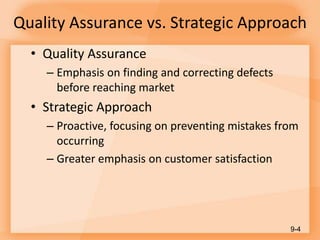
Quality Assurance vs. Strategic Approach
• Quality Assurance
– Emphasis on finding and correcting defects
before reaching market
• Strategic Approach
– Proactive, focusing on preventing mistakes from
occurring
– Greater emphasis on customer satisfaction
9-4
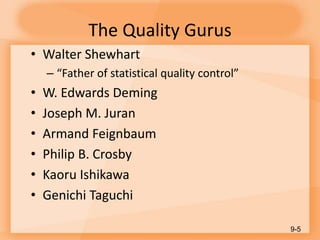
The Quality Gurus
• Walter Shewhart
– “Father of statistical quality control”
• W. Edwards Deming
• Joseph M. Juran
• Armand Feignbaum
• Philip B. Crosby
• Kaoru Ishikawa
• Genichi Taguchi
9-5
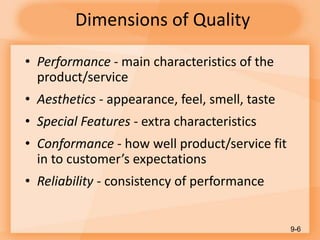
Dimensions of Quality
• Performance - main characteristics of the
product/service
• Aesthetics - appearance, feel, smell, taste
• Special Features - extra characteristics
• Conformance - how well product/service fit
in to customer’s expectations
• Reliability - consistency of performance
9-6
Dimensions of Quality (Cont’d)
• Durability - useful life of the product/service
• Perceived Quality - indirect evaluation of
quality (e.g. reputation)
• Serviceability - service after sale
9-7
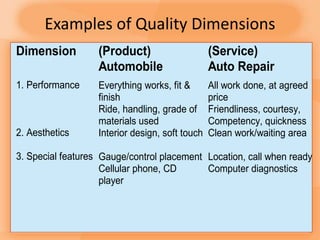
Examples of Quality Dimensions
9-8
Dimension
1. Performance
2. Aesthetics
3. Special features
(Product)
Automobile
Everything works, fit &
finish
Ride, handling, grade of
materials used
Interior design, soft touch
Gauge/control placement
Cellular phone, CD
player
(Service)
Auto Repair
All work done, at agreed
price
Friendliness, courtesy,
Competency, quickness
Clean work/waiting area
Location, call when ready
Computer diagnostics
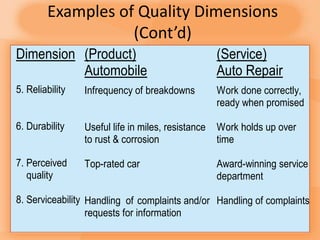
Examples of Quality Dimensions
(Cont’d)
9-9
Dimension
5. Reliability
6. Durability
7. Perceived
quality
8. Serviceability
(Product)
Automobile
Infrequency of breakdowns
Useful life in miles, resistance
to rust & corrosion
Top-rated car
Handling of complaints and/or
requests for information
(Service)
Auto Repair
Work done correctly,
ready when promised
Work holds up over
time
Award-winning service
department
Handling of complaints
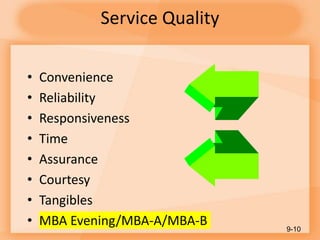
Service Quality
• Convenience
• Reliability
• Responsiveness
• Time
• Assurance
• Courtesy
• Tangibles
• MBA Evening/MBA-A/MBA-B 9-10
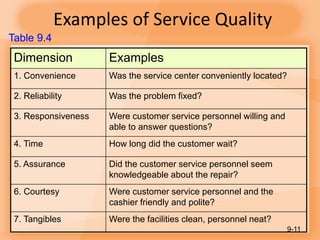
Examples of Service Quality
Dimension Examples
1. Convenience Was the service center conveniently located?
2. Reliability Was the problem fixed?
3. Responsiveness Were customer service personnel willing and
able to answer questions?
4. Time How long did the customer wait?
5. Assurance Did the customer service personnel seem
knowledgeable about the repair?
6. Courtesy Were customer service personnel and the
cashier friendly and polite?
7. Tangibles Were the facilities clean, personnel neat?
9-11
Table 9.4
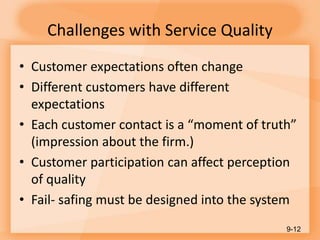
Challenges with Service Quality
• Customer expectations often change
• Different customers have different
expectations
• Each customer contact is a “moment of truth”
(impression about the firm.)
• Customer participation can affect perception
of quality
• Fail- safing must be designed into the system
9-12
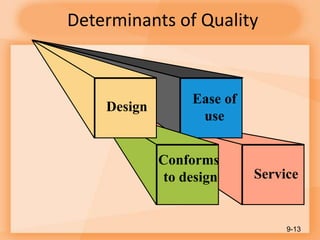
Determinants of Quality
9-13
Service
Ease of
use
Conforms
to design
Design
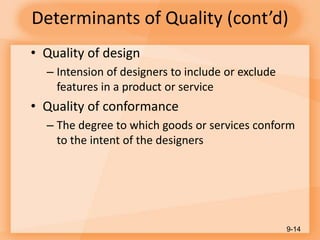
Determinants of Quality (cont’d)
• Quality of design
– Intension of designers to include or exclude
features in a product or service
• Quality of conformance
– The degree to which goods or services conform
to the intent of the designers
9-14
The Consequences of Poor Quality
• Loss of business
• Liability
• Productivity
• Costs to remedy the problems
9-15
Responsibility for Quality
• Top management
• Design
• Procurement
• Production/operations
• Quality assurance
• Packaging and shipping
• Marketing and sales
• Customer service
9-16
Costs of Quality
• Failure Costs - costs incurred by defective
parts/products or faulty services.
• Internal Failure Costs
– Costs incurred to fix problems that are detected
before the product/service is delivered to the
customer.
• External Failure Costs
– All costs incurred to fix problems that are detected
after the product/service is delivered to the
customer.
9-17
Costs of Quality (continued)
• Appraisal Costs
– Costs of activities designed to ensure quality or
uncover defects
• Prevention Costs
– All TQ training, TQ planning, customer
assessment, process control, and quality
improvement costs to prevent defects from
occurring
9-18
Ethics and Quality
• Substandard work
– Defective products
– Substandard service
– Poor designs
– Careless workmanship
– Substandard parts and materials
9-19
Having knowledge of this and failing to correct
and report it in a timely manner is unethical.
Quality Awards
9-20
Baldrige Award
Deming Prize
Malcolm Baldrige National Quality
Award
• 1.0 Leadership (125 points)
• 2.0 Strategic Planning (85 points)
• 3.0 Customer and Market Focus (85 points)
• 4.0 Information and Analysis (85 points)
• 5.0 Human Resource Focus (85 points)
• 6.0 Process Management (85 points)
• 7.0 Business Results (450 points)
9-21
Benefits of Baldrige Competition
• Financial success
• Winners share their knowledge
• The process motivates employees
• The process provides a well-designed quality
system
• The process requires obtaining data
• The process provides feedback
9-22
European Quality Award
• Prizes intended to identify role models
– Leadership
– Customer focus
– Corporate social responsibility
– People development and involvement
– Results orientation
9-23
The Deming Prize
• Honoring W. Edwards Deming
• Japan’s highly coveted award
• Main focus on statistical quality
control
9-24
Quality Certification
• ISO (International Organization for
Standardization) 9000
– Set of international standards on quality
management and quality assurance, critical to
international business
• ISO 14000
– A set of international standards for assessing a
company’s environmental performance
9-25
ISO 9000 Standards
Requirements
• System requirements
• Management
• Resource
• Realization
• Remedial
9-26
ISO 9000 Quality Management
Principles
• Customer focus
• Leadership
• People involvement
• Process approach
• A systems approach to management
• Continual improvement
• Factual approach to decision making
• Mutually beneficial supplier relationships
9-27
ISO 14000
• ISO 14000 - A set of international standards
for assessing a company’s environmental
performance
• Standards in three major areas
– Management systems
– Operations
– Environmental systems
9-28
ISO 14000
• Management systems
– Systems development and integration of
environmental responsibilities into business
planning
• Operations
– Consumption of natural resources and energy
• Environmental systems
– Measuring, assessing and managing emissions,
effluents, and other waste
9-29
Total Quality Management
A philosophy that involves everyone in an
organization in a continual effort to improve
quality and achieve customer satisfaction.
9-30
T Q M
The TQM Approach
1.Find out what the customer wants
2.Design a product or service that meets or
exceeds customer wants
3.Design processes that facilitates doing the
job right the first time
4.Keep track of results
5.Extend these concepts to suppliers
9-31
Elements of TQM
1. Continual improvement
2. Competitive benchmarking
3. Employee empowerment
4. Team approach
5. Decisions based on facts
6. Knowledge of tools
7. Supplier quality
8. Champion
9. Quality at the source
10. Suppliers 9-32
Continuous Improvement
• Philosophy that seeks to make never-ending
improvements to the process of converting
inputs into outputs.
• Kaizen: Japanese
word for continuous
improvement.
9-33
Quality at the Source
The philosophy of making each
worker responsible for the
quality of his or her work.
9-34
Six Sigma
• Statistically
– Having no more than 3.4 defects per million
– A six sigma process is one in which 99.99966% of all opportunities to
produce some feature of a part are statistically expected to be free of
defects (3.4 defective features / million opportunities)
• Conceptually
– Program designed to reduce defects
– Requires the use of certain tools and techniques
9-35
Six sigma: A business process for improving
quality, reducing costs, and increasing
customer satisfaction.
Six Sigma Programs
• Six Sigma programs
– Improve quality
– Save time
– Cut costs
• Employed in
– Design
– Production
– Service
– Inventory management
– Delivery
9-36
Six Sigma Management
• Providing strong leadership
• Defining performance metrics
• Selecting projects likely to succeed
• Selecting and training appropriate people
9-37
Six Sigma Technical
• Improving process performance
• Reducing variation
• Utilizing statistical models
• Designing a structured improvement
strategy
9-38
Six Sigma Team
• Top management
• Program champions
• Master “black belts”
• “Black belts”
• “Green belts”
9-39
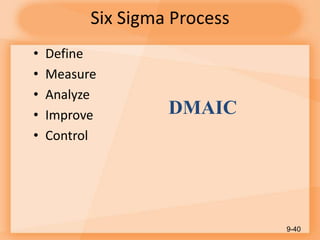
Six Sigma Process
• Define
• Measure
• Analyze
• Improve
• Control
9-40
DMAIC
Obstacles to Implementing TQM
• Lack of:
– Company-wide definition of quality
– Strategic plan for change
– Customer focus
– Real employee empowerment
– Strong motivation
– Time to devote to quality initiatives
– Leadership
9-41
Obstacles to Implementing TQM
• Poor inter-organizational communication
• View of quality as a “quick fix”
• Emphasis on short-term financial results
• Internal political and “turf” wars
9-42
Criticisms of TQM
1. Blind pursuit of TQM programs
2. Programs may not be linked to strategies
3. Quality-related decisions may not be tied to
market performance
4. Failure to carefully plan a program
9-43
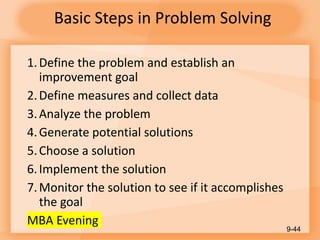
Basic Steps in Problem Solving
1.Define the problem and establish an
improvement goal
2.Define measures and collect data
3.Analyze the problem
4.Generate potential solutions
5.Choose a solution
6.Implement the solution
7.Monitor the solution to see if it accomplishes
the goal
MBA Evening
9-44
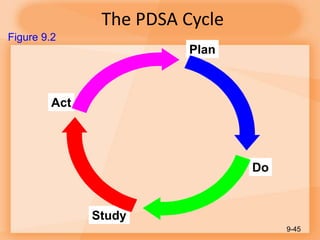
The PDSA Cycle
9-45
Plan
Do
Study
Act
Figure 9.2
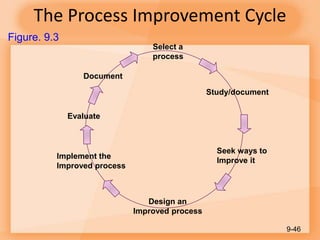
The Process Improvement Cycle
9-46
Implement the
Improved process
Select a
process
Study/document
Seek ways to
Improve it
Design an
Improved process
Evaluate
Document
Figure. 9.3
Process Improvement
• Process Improvement: A systematic
approach to improving a process
• Process mapping
• Analyze the process
• Redesign the process
9-47
Process Improvement and Tools
• Process improvement - a systematic
approach to improving a process
– Process mapping
– Analyze the process
– Redesign the process
• Tools
– There are a number of tools that can be used
for problem solving and process improvement
– Tools aid in data collection and interpretation,
and provide the basis for decision making
9-48
Basic Quality Tools
• Flowcharts
• Check sheets
• Histograms
• Pareto Charts
• Scatter diagrams
• Control charts
• Cause-and-effect diagrams
• Run charts
9-49
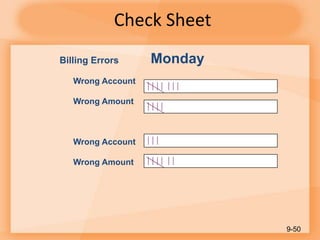
Check Sheet
9-50
Billing Errors
Wrong Account
Wrong Amount
Wrong Account
Wrong Amount
Monday
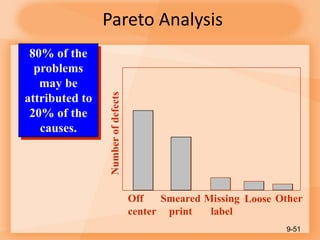
Pareto Analysis
9-51
80% of the
problems
may be
attributed to
20% of the
causes.
Smeared
print
Number
of
defects
Off
center
Missing
label
Loose Other
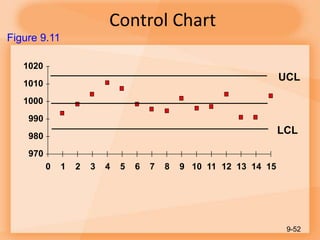
Control Chart
9-52
970
980
990
1000
1010
1020
0 1 2 3 4 5 6 7 8 9 10 11 12 13 14 15
UCL
LCL
Figure 9.11
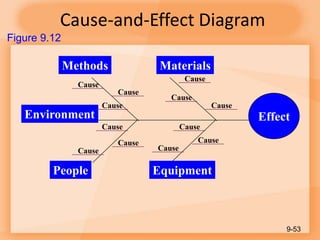
Cause-and-Effect Diagram
9-53
Figure 9.12
Effect
Materials
Methods
Equipment
People
Environment
Cause
Cause
Cause
Cause
Cause
Cause
Cause
Cause
Cause
Cause
Cause
Cause
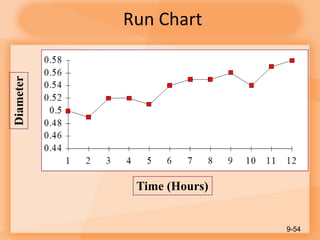
Run Chart
9-54
Time (Hours)
Diameter
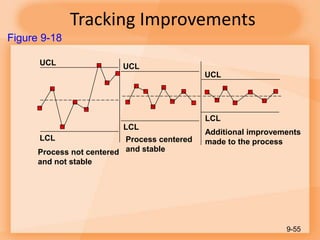
Tracking Improvements
9-55
UCL
LCL
LCL
LCL
UCL
UCL
Process not centered
and not stable
Process centered
and stable
Additional improvements
made to the process
Figure 9-18
Methods for Generating Ideas
• Brainstorming
• Quality circles
• Interviewing
• Benchmarking
9-56
Quality Circles
• Team approach
– List reduction
– Balance sheet
– Paired comparisons
9-57
Benchmarking Process
• Identify a critical process that needs
improving
• Identify an organization that excels in this
process
• Contact that organization
• Analyze the data
• Improve the critical process
9-58

Operation management and its quality management slides

  • 1.
    McGraw-Hill/Irwin Copyright ©2007 by The McGraw-Hill Companies, Inc. All rights reserved. 3 Management of Quality
  • 2.
    Quality Management • Whatdoes the term quality mean? • Quality is the ability of a product or service to consistently meet or exceed customer expectations. 9-2
  • 3.
    Evolution of QualityManagement • 1924 - Statistical process control charts • 1930 - Tables for acceptance sampling • 1940’s - Statistical sampling techniques • 1950’s - Quality assurance/TQC • 1960’s - Zero defects • 1970’s - Quality assurance in services 9-3
  • 4.
    Quality Assurance vs.Strategic Approach • Quality Assurance – Emphasis on finding and correcting defects before reaching market • Strategic Approach – Proactive, focusing on preventing mistakes from occurring – Greater emphasis on customer satisfaction 9-4
  • 5.
    The Quality Gurus •Walter Shewhart – “Father of statistical quality control” • W. Edwards Deming • Joseph M. Juran • Armand Feignbaum • Philip B. Crosby • Kaoru Ishikawa • Genichi Taguchi 9-5
  • 6.
    Dimensions of Quality •Performance - main characteristics of the product/service • Aesthetics - appearance, feel, smell, taste • Special Features - extra characteristics • Conformance - how well product/service fit in to customer’s expectations • Reliability - consistency of performance 9-6
  • 7.
    Dimensions of Quality(Cont’d) • Durability - useful life of the product/service • Perceived Quality - indirect evaluation of quality (e.g. reputation) • Serviceability - service after sale 9-7
  • 8.
    Examples of QualityDimensions 9-8 Dimension 1. Performance 2. Aesthetics 3. Special features (Product) Automobile Everything works, fit & finish Ride, handling, grade of materials used Interior design, soft touch Gauge/control placement Cellular phone, CD player (Service) Auto Repair All work done, at agreed price Friendliness, courtesy, Competency, quickness Clean work/waiting area Location, call when ready Computer diagnostics
  • 9.
    Examples of QualityDimensions (Cont’d) 9-9 Dimension 5. Reliability 6. Durability 7. Perceived quality 8. Serviceability (Product) Automobile Infrequency of breakdowns Useful life in miles, resistance to rust & corrosion Top-rated car Handling of complaints and/or requests for information (Service) Auto Repair Work done correctly, ready when promised Work holds up over time Award-winning service department Handling of complaints
  • 10.
    Service Quality • Convenience •Reliability • Responsiveness • Time • Assurance • Courtesy • Tangibles • MBA Evening/MBA-A/MBA-B 9-10
  • 11.
    Examples of ServiceQuality Dimension Examples 1. Convenience Was the service center conveniently located? 2. Reliability Was the problem fixed? 3. Responsiveness Were customer service personnel willing and able to answer questions? 4. Time How long did the customer wait? 5. Assurance Did the customer service personnel seem knowledgeable about the repair? 6. Courtesy Were customer service personnel and the cashier friendly and polite? 7. Tangibles Were the facilities clean, personnel neat? 9-11 Table 9.4
  • 12.
    Challenges with ServiceQuality • Customer expectations often change • Different customers have different expectations • Each customer contact is a “moment of truth” (impression about the firm.) • Customer participation can affect perception of quality • Fail- safing must be designed into the system 9-12
  • 13.
    Determinants of Quality 9-13 Service Easeof use Conforms to design Design
  • 14.
    Determinants of Quality(cont’d) • Quality of design – Intension of designers to include or exclude features in a product or service • Quality of conformance – The degree to which goods or services conform to the intent of the designers 9-14
  • 15.
    The Consequences ofPoor Quality • Loss of business • Liability • Productivity • Costs to remedy the problems 9-15
  • 16.
    Responsibility for Quality •Top management • Design • Procurement • Production/operations • Quality assurance • Packaging and shipping • Marketing and sales • Customer service 9-16
  • 17.
    Costs of Quality •Failure Costs - costs incurred by defective parts/products or faulty services. • Internal Failure Costs – Costs incurred to fix problems that are detected before the product/service is delivered to the customer. • External Failure Costs – All costs incurred to fix problems that are detected after the product/service is delivered to the customer. 9-17
  • 18.
    Costs of Quality(continued) • Appraisal Costs – Costs of activities designed to ensure quality or uncover defects • Prevention Costs – All TQ training, TQ planning, customer assessment, process control, and quality improvement costs to prevent defects from occurring 9-18
  • 19.
    Ethics and Quality •Substandard work – Defective products – Substandard service – Poor designs – Careless workmanship – Substandard parts and materials 9-19 Having knowledge of this and failing to correct and report it in a timely manner is unethical.
  • 20.
  • 21.
    Malcolm Baldrige NationalQuality Award • 1.0 Leadership (125 points) • 2.0 Strategic Planning (85 points) • 3.0 Customer and Market Focus (85 points) • 4.0 Information and Analysis (85 points) • 5.0 Human Resource Focus (85 points) • 6.0 Process Management (85 points) • 7.0 Business Results (450 points) 9-21
  • 22.
    Benefits of BaldrigeCompetition • Financial success • Winners share their knowledge • The process motivates employees • The process provides a well-designed quality system • The process requires obtaining data • The process provides feedback 9-22
  • 23.
    European Quality Award •Prizes intended to identify role models – Leadership – Customer focus – Corporate social responsibility – People development and involvement – Results orientation 9-23
  • 24.
    The Deming Prize •Honoring W. Edwards Deming • Japan’s highly coveted award • Main focus on statistical quality control 9-24
  • 25.
    Quality Certification • ISO(International Organization for Standardization) 9000 – Set of international standards on quality management and quality assurance, critical to international business • ISO 14000 – A set of international standards for assessing a company’s environmental performance 9-25
  • 26.
    ISO 9000 Standards Requirements •System requirements • Management • Resource • Realization • Remedial 9-26
  • 27.
    ISO 9000 QualityManagement Principles • Customer focus • Leadership • People involvement • Process approach • A systems approach to management • Continual improvement • Factual approach to decision making • Mutually beneficial supplier relationships 9-27
  • 28.
    ISO 14000 • ISO14000 - A set of international standards for assessing a company’s environmental performance • Standards in three major areas – Management systems – Operations – Environmental systems 9-28
  • 29.
    ISO 14000 • Managementsystems – Systems development and integration of environmental responsibilities into business planning • Operations – Consumption of natural resources and energy • Environmental systems – Measuring, assessing and managing emissions, effluents, and other waste 9-29
  • 30.
    Total Quality Management Aphilosophy that involves everyone in an organization in a continual effort to improve quality and achieve customer satisfaction. 9-30 T Q M
  • 31.
    The TQM Approach 1.Findout what the customer wants 2.Design a product or service that meets or exceeds customer wants 3.Design processes that facilitates doing the job right the first time 4.Keep track of results 5.Extend these concepts to suppliers 9-31
  • 32.
    Elements of TQM 1.Continual improvement 2. Competitive benchmarking 3. Employee empowerment 4. Team approach 5. Decisions based on facts 6. Knowledge of tools 7. Supplier quality 8. Champion 9. Quality at the source 10. Suppliers 9-32
  • 33.
    Continuous Improvement • Philosophythat seeks to make never-ending improvements to the process of converting inputs into outputs. • Kaizen: Japanese word for continuous improvement. 9-33
  • 34.
    Quality at theSource The philosophy of making each worker responsible for the quality of his or her work. 9-34
  • 35.
    Six Sigma • Statistically –Having no more than 3.4 defects per million – A six sigma process is one in which 99.99966% of all opportunities to produce some feature of a part are statistically expected to be free of defects (3.4 defective features / million opportunities) • Conceptually – Program designed to reduce defects – Requires the use of certain tools and techniques 9-35 Six sigma: A business process for improving quality, reducing costs, and increasing customer satisfaction.
  • 36.
    Six Sigma Programs •Six Sigma programs – Improve quality – Save time – Cut costs • Employed in – Design – Production – Service – Inventory management – Delivery 9-36
  • 37.
    Six Sigma Management •Providing strong leadership • Defining performance metrics • Selecting projects likely to succeed • Selecting and training appropriate people 9-37
  • 38.
    Six Sigma Technical •Improving process performance • Reducing variation • Utilizing statistical models • Designing a structured improvement strategy 9-38
  • 39.
    Six Sigma Team •Top management • Program champions • Master “black belts” • “Black belts” • “Green belts” 9-39
  • 40.
    Six Sigma Process •Define • Measure • Analyze • Improve • Control 9-40 DMAIC
  • 41.
    Obstacles to ImplementingTQM • Lack of: – Company-wide definition of quality – Strategic plan for change – Customer focus – Real employee empowerment – Strong motivation – Time to devote to quality initiatives – Leadership 9-41
  • 42.
    Obstacles to ImplementingTQM • Poor inter-organizational communication • View of quality as a “quick fix” • Emphasis on short-term financial results • Internal political and “turf” wars 9-42
  • 43.
    Criticisms of TQM 1.Blind pursuit of TQM programs 2. Programs may not be linked to strategies 3. Quality-related decisions may not be tied to market performance 4. Failure to carefully plan a program 9-43
  • 44.
    Basic Steps inProblem Solving 1.Define the problem and establish an improvement goal 2.Define measures and collect data 3.Analyze the problem 4.Generate potential solutions 5.Choose a solution 6.Implement the solution 7.Monitor the solution to see if it accomplishes the goal MBA Evening 9-44
  • 45.
  • 46.
    The Process ImprovementCycle 9-46 Implement the Improved process Select a process Study/document Seek ways to Improve it Design an Improved process Evaluate Document Figure. 9.3
  • 47.
    Process Improvement • ProcessImprovement: A systematic approach to improving a process • Process mapping • Analyze the process • Redesign the process 9-47
  • 48.
    Process Improvement andTools • Process improvement - a systematic approach to improving a process – Process mapping – Analyze the process – Redesign the process • Tools – There are a number of tools that can be used for problem solving and process improvement – Tools aid in data collection and interpretation, and provide the basis for decision making 9-48
  • 49.
    Basic Quality Tools •Flowcharts • Check sheets • Histograms • Pareto Charts • Scatter diagrams • Control charts • Cause-and-effect diagrams • Run charts 9-49
  • 50.
    Check Sheet 9-50 Billing Errors WrongAccount Wrong Amount Wrong Account Wrong Amount Monday
  • 51.
    Pareto Analysis 9-51 80% ofthe problems may be attributed to 20% of the causes. Smeared print Number of defects Off center Missing label Loose Other
  • 52.
    Control Chart 9-52 970 980 990 1000 1010 1020 0 12 3 4 5 6 7 8 9 10 11 12 13 14 15 UCL LCL Figure 9.11
  • 53.
  • 54.
  • 55.
    Tracking Improvements 9-55 UCL LCL LCL LCL UCL UCL Process notcentered and not stable Process centered and stable Additional improvements made to the process Figure 9-18
  • 56.
    Methods for GeneratingIdeas • Brainstorming • Quality circles • Interviewing • Benchmarking 9-56
  • 57.
    Quality Circles • Teamapproach – List reduction – Balance sheet – Paired comparisons 9-57
  • 58.
    Benchmarking Process • Identifya critical process that needs improving • Identify an organization that excels in this process • Contact that organization • Analyze the data • Improve the critical process 9-58