World Allergy Week 2014World Allergy Week 2014
ANAPHYLAXISANAPHYLAXIS
When allergies can be severe and fatalWhen allergies can be severe and fatal
Are you ready for anaphylaxis?
Welcome to World Allergy Week 2014Welcome to World Allergy Week 2014
Motohiro Ebisawa, MD, PhD
Chair, Communications Committee
In keeping with the World Allergy Week tradition of bringing attention to a specific
allergic disease each year, the World Allergy Organization has selected Anaphylaxis –Anaphylaxis –
When Allergies Can Be Severe and FatalWhen Allergies Can Be Severe and Fatal, emphasizing the great need for increased
awareness, training, and resources that lead to improved safety and quality of life.
Lanny Rosenwasser, MD
President, World Allergy Organization
The World Allergy Organization welcomes all of you to join us and all of the educators,
healthcare practitioners, policymakers, parents, patients, advocates and medical
professionals around the world to mark the fourth consecutive year of World Allergy Week
by organizing and participating in activities that bring attention to the rising global
prevalence of anaphylaxis.
World Allergy Week 2014 ChairpersonsWorld Allergy Week 2014 Chairpersons
Motohiro Ebisawa, MD and Paul Greenberger, MD
WAO Communications Committee 2014-2015
Chair: Motohiro Ebisawa (Japan)
Co-Chair: Paul Greenberger (United States)
Mona Al Ahmad (Kuwait)
Paolo Barrera Perigault (Panama)
Suwat Benjaponpitak (Thailand)
Ake Davidsson (Sweden)
Mohammad Gharagozlou (Iran)
Elham Hossny (Egypt)
Carla Irani (Lebanon)
Juan Carlos Ivancevich (Argentina)
Amir Hamzah Latiff (Malaysia)
Hae-Ran Lee (Korea)
Dilsad Mungan (Turkey)
Ruby Pawankar (Japan)
Harald Renz (Germany)
Noel Rodriguez (Mexico)
Menachem Rottem (Israel)
Glenis Scadding (United Kingdom)
Revaz Sepiashvili (Georgia)
Elopy Sibanda (Zimbabwe)
Mimi Tang (Australia)
Stephen Tilles (United States)
Richard Weber (United States)
Anaphylaxis is a hypersensitivity reaction to foreign substances
such as foods, medications, and insect bites or stings. Anaphylaxis
is a serious, life-threatening generalized or systemic
hypersensitivity reaction and a serious allergic reaction that is rapid
in onset and might cause death if untreated. Symptoms may be
throat swelling, itchy rash, and low blood pressure.
Anaphylaxis does not have to be fatal.
Anaphylaxis is a global health concern.Anaphylaxis is a global health concern.Anaphylaxis is a global health concern.
Anaphylaxis is a global public health concern.
• Data on the prevalence of anaphylaxis in the general population is limited.
• However, the recent survey in the United States indicates that the prevalence
of anaphylaxis in the general population is at least 1.6% and probably higher.1
• In contrast, a European study indicated that an estimated 0.3% (95% CI 0.1-0.5)
of the population experience anaphylaxis at some point of time in their lives.2
The rate of anaphylaxis occurrence seems to be increasing with geographic
variations.
The WAO Anaphylaxis Guidelines
published by the World Allergy
Organization in 2011 should be
disseminated to physicians throughout the
world to prevent tragedies by anaphylaxis
death.3
1. Wood RA, Camargo CA, Lieberman P, Sampson HA. Anaphylaxis in America: The prevalence and characteristics of anaphylaxis
in the United States. Journal of Allergy and Clinical Immunology 2014;133(2):461-467. Access
2. Panesar SS, Javad S, de Silva D, Nwaru BI, Lickstein L et al. The epidemiology of anaphylaxis in Europe: a systemic review Allergy
2013;68(11):1353-1361. Access
3. Simons FER, Ardusso LRF, Bilo MB, El Gamal Y, Ledford D et al. World Allergy Organization Guidelines for the assessment and
management of anaphylaxis World Allergy Organization Journal 2011; 4:13-37. Access
4. Pawankar R, Canonica GW, Holgate S, Lockey R, Blaiss M eds. WAO White Book on Allergy, Update 2013. World Allergy
Organization, 2013. Access
The WAO White Book on Allergy: Update
2013, which addresses this issue for the public,
patients and policy makers, should also be
disseminated worldwide as an important
educational and advocacy document.4
Causes of anaphylaxisCauses of anaphylaxis
When anaphylaxis can become worse or fatalWhen anaphylaxis can become worse or fatal
• The relative importance of specific anaphylaxis triggers in different age groups
appears to be universal.
• Foods are the most common trigger in children, teens and young adults.
• Insect stings and medications are relatively common triggers in middle-aged
and elderly adults.
Potential associated
factors that can
cause more severe
forms and fatal
allergies include:
•age
•physiologic state (such as pregnancy)
•concomitant diseases
―poorly controlled asthma
―cardiovascular disease
•concurrent use of medications
―Beta-adrenergic blockers
―ACE inhibitors
•amplifying co-factors
―Exercise
―non-steroidal anti-
inflammatory drugs
―Infections
―emotional stress
―peri-menstrual status
Anaphylaxis mechanisms and triggersAnaphylaxis mechanisms and triggers
Figure 2, From the
“WAO Guidelines for
the Assessment &
Management of
Anaphylaxis”
Simons FER et al. World Allergy
Organization Journal 2011; 4:13–37
http://www.waojournal.org/content/4/
Note: Use of this figure is restricted by
copyright law.
Warning: The WAO Guidelines are
intended for physician use only. All
others, please contact your physician
regarding preparation, treatment, and
prevention of anaphylaxis.
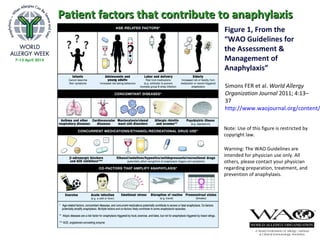
Patient factors that contribute to anaphylaxisPatient factors that contribute to anaphylaxis
Figure 1, From the
“WAO Guidelines for
the Assessment &
Management of
Anaphylaxis”
Simons FER et al. World Allergy
Organization Journal 2011; 4:13–
37
http://www.waojournal.org/content/
Note: Use of this figure is restricted by
copyright law.
Warning: The WAO Guidelines are
intended for physician use only. All
others, please contact your physician
regarding preparation, treatment, and
prevention of anaphylaxis.
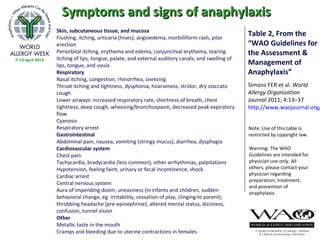
Symptoms and signs of anaphylaxisSymptoms and signs of anaphylaxis
Table 2, From the
“WAO Guidelines for
the Assessment &
Management of
Anaphylaxis”
Skin, subcutaneous tissue, and mucosa
Flushing, itching, urticaria (hives), angioedema, morbilliform rash, pilor
erection
Periorbital itching, erythema and edema, conjuncitval erythema, tearing
Itching of lips, tongue, palate, and external auditory canals; and swelling of
lips, tongue, and uvula
Respiratory
Nasal itching, congestion, rhinorrhea, sneezing
Throat itching and tightness, dysphonia, hoarseness, stridor, dry staccato
cough
Lower airways: increased respiratory rate, shortness of breath, chest
tightness, deep cough, wheezing/bronchospasm, decreased peak expiratory
flow
Cyanosis
Respiratory arrest
Gastrointestinal
Abdominal pain, nausea, vomiting (stringy mucus), diarrhea, dysphagia
Cardiovascular system
Chest pain
Tachycardia, bradycardia (less common), other arrhythmias, palpitations
Hypotension, feeling faint, urinary or fecal incontinence, shock
Cardiac arrest
Central nervous system
Aura of impending doom, uneasiness (in infants and children, sudden
behavioral change, eg. irritability, cessation of play, clinging to parent);
throbbing headache (pre-epinephrine), altered mental status, dizziness,
confusion, tunnel vision
Other
Metallic taste in the mouth
Cramps and bleeding due to uterine contractions in females
Simons FER et al. World
Allergy Organization
Journal 2011; 4:13–37
http://www.waojournal.org/
Note: Use of this table is
restricted by copyright law.
Warning: The WAO
Guidelines are intended for
physician use only. All
others, please contact your
physician regarding
preparation, treatment,
and prevention of
anaphylaxis.
Posters and laminated pocket cards
available from WAO.
Access the order form at:
http://www.worldallergy.org/UserFiles/file/Po
Clinical criteria for the diagnosis of anaphylaxisClinical criteria for the diagnosis of anaphylaxis
Figure 3, From the
“WAO Guidelines for
the Assessment &
Management of
Anaphylaxis”
Simons FER et al. World Allergy
Organization Journal 2011; 4:13–37
http://www.waojournal.org/content/4/2
Note: Use of this figure is restricted by
copyright law.
Warning: The WAO Guidelines are
intended for physician use only. All
others, please contact your physician
regarding preparation, treatment, and
prevention of anaphylaxis.
Preparing for anaphylaxis involves havingPreparing for anaphylaxis involves having
a written emergency protocol anda written emergency protocol and
rehearsing it regularly.rehearsing it regularly.
Protocol:
It is important to advise patients about the need
to have as-advised regular follow-up visits with a
physician, preferably an allergy/immunology
specialist, to:
• confirm their specific trigger(s) of
anaphylaxis)
• prevent recurrences by avoiding the specific
trigger(s)
• have an emergency action plan and
emergency medication on hand
• have support from the family members
• receive immunomodulation, where it is
clinically approved and relevant
Immunomodulation
Immunomodulation is Immunotherapy with
Hymenoptera venoms or fire ant extracts
which are effective therapies to reduce the
risk of anaphylaxis.
1. Place the patient on the back (or in a position
of comfort if there is respiratory distress
and/or vomiting.
2. Elevate the lower extremities.
3. Administer adrenaline*
4. Assess circulation, airway, breathing, and
mental status, skin, and other visual
indicators.
• It relieves the symptoms of anaphylaxis
including preventing, and relieving, airway
obstruction via Beta-2 adrenergic effects caused
by mucosal edema and smooth muscle
concentration.
• It prevents and relieves fall in blood pressure
and shock.
Adrenaline
Intramuscularly administered-adrenaline
(epinephrine) is life-saving for the treatment
of anaphylaxis.
Prevention:
Basic management of anaphylaxisBasic management of anaphylaxis
Figure 4, From the “WAO
Guidelines for the
Assessment &
Management of
Anaphylaxis”
Posters and laminated pocket cards
available from WAO.
Access the order form at:
http://www.worldallergy.org/UserFiles/file/Po
Simons FER et al. World Allergy
Organization Journal 2011; 4:13–37
http://www.waojournal.org/content/4/
Note: Use of this figure is restricted by
copyright law.
Warning: The WAO Guidelines are
intended for physician use only. All
others, please contact your physician
regarding preparation, treatment, and
prevention of anaphylaxis.
Discharge management and prevention of futureDischarge management and prevention of future
anaphylaxis recurrences in the communityanaphylaxis recurrences in the community
Figure 5, From the “WAO
Guidelines for the
Assessment &
Management of
Anaphylaxis”
Simons FER et al. World Allergy
Organization Journal 2011; 4:13–37
http://www.waojournal.org/content/4/2
Note: Use of this figure is restricted by
copyright law.
Warning: The WAO Guidelines are
intended for physician use only. All
others, please contact your physician
regarding preparation, treatment, and
prevention of anaphylaxis.
WAO White Book on Allergy Update
2013 Editors: R Pawankar, GW
Canonica, S Holgate, R Lockey, M Blaiss
http://
www.worldallergy.org/definingthespecialty/w
The WAO White Book on Allergy Update 2013The WAO White Book on Allergy Update 2013
• Epinephrine (adrenaline) at
appropriate doses, injected
intramuscularly into the mid-
anterior lateral thigh, is the drug of
choice to treat anaphylaxis.
• Anaphylaxis includes both allergic
and non-allergic etiologies.
• The term “anaphylactoid” is
outdated.
• The variability and severity of
anaphylaxis is somewhat dependent
on the route by which the allergen or
inciting agent is delivered, e.g.,
parenteral versus oral administration;
the former is commonly associated
with more severe reactions.
Section 2.5. Anaphylaxis- Key Statements
Richard F. Lockey, Stephen F. Kemp, Philip L.
Lieberman, Aziz Sheikh
To learn more about anaphylaxisTo learn more about anaphylaxis
World Allergy Organization
Resources
http://www.worldallergy.org/anaphylaxis
Anaphylaxis Canada
Helpful Info
http://www.anaphylaxis.ca/en/resources/helpful
_info.html
Anaphylaxis Ireland
Informational leaflets
http://www.anaphylaxisireland.ie/?page_id=124
Food Allergy Research & Education (FARE)
Resources
http://www.foodallergy.org/resources-for
Allergy and Anaphylaxis Australia
Fact Sheets, Allergen Specifics
http://www.allergyfacts.org.au/living-with-the-
risk/allergen-specifics
School Resources
http://www.allergyfacts.org.au/caring-for-
those-at-risk/school-resources
Anaphylaxis Campaign
Fact Sheets
http://www.anaphylaxis.org.uk/what-is-
anaphylaxis/our-factsheets
Patient Advocacy:
www.worldallergyweek.org
The World Allergy Organization is an international alliance of 95
regional and national allergy, asthma and immunology societies.
Through collaboration with its Member Societies WAO provides a
wide range of educational and outreach programs, symposia and
lectureships to allergists/immunologists around the world and
conducts initiatives related to clinical practice, service provision,
and physical training in order to better understand and address
the challenges facing allergists/immunologists worldwide.
www.worldallergy.org
About the World Allergy OrganizationAbout the World Allergy Organization
Member Societies of the World Allergy OrganizationMember Societies of the World Allergy Organization
ASIA PACIFIC
Allergy & Immunology Society of Sri Lanka
Allergy and Clinical Immunology Society (Singapore)
Allergy and Immunology Society of Thailand
Asia Pacific Association of Allergy, Asthma, and Clinical Immunology
Asia Pacific Association of Pediatric Allergy, Respirology and Immunology
Australasian Society of Clinical Immunology and Allergy
Azerbaijan Society for Asthma, Allergy and Clinical Immunology
Bangladesh Society of Allergy and Immunology
Chinese Society of Allergology
Hong Kong Institute of Allergy
Indian Academy of Allergy
Indian College of Allergy, Asthma and Clinical Immunology
Indonesian Society of Allergy and Immunology
Japanese Society of Allergology
Korean Academy of Asthma, Allergy and Clinical Immunology
Malaysian Society of Allergy and Immunology
Mongolian Society of Allergology
Taiwan Academy of Pediatric Allergy Asthma Immunology
Vietnam Association of Allergy, Asthma and Clinical Immunology
LATIN AMERICA
Argentine Association of Allergy and Immunology
Argentine Society of Allergy and Immunology
Brazilian Society of Allergy and Immunology
Chilean Society of Allergy and Immunology
Colombian Allergy, Asthma and Immunology Association
Cuban Society of Allergology
Ecuadorian Society of Allergy, Asthma, and Immunology
Guatemalan Allergy, Asthma, and Clinical Immunology Society
Honduran Society of Allergy and Clincial Immunology
Latin American Society of Allergy and Immunology
Mexican College of Allergy and Clinical Immunology (CMICA)
Mexican College of Pediatricians Specialized in Allergy and Clinical Immuno
Panamanian Association of Allergology and Clinical Immunology
Paraguayan Society of Allergy, Asthma, and Immunology
Peruvian Society of Allergy and Immunology
Philippine Society of Allergy, Asthma and Immunology
Uruguayan Society of Allergology
Venezuelan Society of Allergy, Asthma and Immunology
–continued
AFRICA AND MIDDLE EAST
Allergy Society of Kenya
Allergy Society of South Africa
Egyptian Society of Allergy and Clinical Immunology
Egyptian Society of Pediatric Allergy and Immunology
Iranian Society of Asthma and Allergy
Israel Association of Allergy and Clinical Immunology
Jordanian Society for Allergy and Clinical Immunology
Kuwait Society of Allergy & Clinical Immunology
Lebanese Society of Allergy and Immunology
Moroccan Society of Allergology and Clinical Immunology
National Association for Private Algerian Allergists
Serbian Association of Allergologists and Clinical
Immunologists
Tunisian Society of Respiratory Diseases and Allergology
Turkish National Society of Allergy and Clinical Immunology
Zimbabwe Allergy Society
Member Societies of the World Allergy OrganizationMember Societies of the World Allergy Organization
EUROPE
Albanian Society of Allergology and Clinical Immunology
Armenian Association of Immunology and Allergy
Austrian Society of Allergology and Immunology
Belarus Association of Allergology & Clinical Immunology
Belgian Society of Allergy and Clinical Immunology
British Society of Allergy and Clinical Immunology
Bulgarian National Society of Allergology
Commonwealth of Independent States Society of Allergology and
Immunology
Croatian Society of Allergology and Clinical Immunology
Czech Society of Allergology and Clinical Immunology
Danish Society for Allergology
Dutch Society of Allergology
European Academy of Allergy and Clinical Immunology (EAACI)
Finnish Society of Allergology and Clinical Immunology
French Society of Allergology and Clinical Immunology
Georgian Association of Allergology and Clinical Immunology
German Society for Allergology and Clinical Immunology
Hellenic Society of Allergology and Clinical Immunology
Hungarian Society of Allergology and Clinical Immunology
Icelandic Society of Allergy and Clinical Immunology
Italian Association of Territorial and Hospital Allergists
Italian Society of Allergology and Clinical Immunology
Latvian Association of Allergists
Moldavian Society of Allergology & Immunology
Norwegian Society of Allergology and Immunopathology
Polish Society of Allergology
Portuguese Society of Allergology and Clinical Immunology
Romanian Society of Allergology and Clinical Immunology
Russian Association of Allergology and Clinical Immunology
Slovenian Association for Allergology & Clinical Immunology
Spanish Society of Allergology and Clinical Immunology
Swedish Association for Allergology
Swiss Society of Allergology and Immunology
Ukrainian Allergists Association
Ukrainian Association of Allergologists and Clinical
Immunologists
AFFILIATE ORGANIZATIONS
British Society for Immunology
Global Allergy and Asthma European Network (GA2LEN)
International Association of Asthmology (INTERASMA)
International Primary Care Respiratory Group (IPCRG)
Southern European Allergy Societies (SEAS)
NORTH AMERICA
American Academy of Allergy, Asthma and Immunology
American College of Allergy, Asthma and Immunology
Canadian Society of Allergy and Clinical Immunology
How are you raising awareness ofHow are you raising awareness of
anaphylaxis?anaphylaxis?
Tell us about your activities for World Allergy Week 2014.
Email: info@worldallergy.org
Facebook: facebook.com/worldallergy.org
Twitter: @worldallergy
#WorldAllergyWeek
www.worldallergyweek.org
“This program is supported by an independent
educational grant from Mylan Specialty and Kaleo”

World Allergy Week 2014 Anaphylaxis - When Allergies Can Be Severe and Fatal

  • 1.
    World Allergy Week2014World Allergy Week 2014 ANAPHYLAXISANAPHYLAXIS When allergies can be severe and fatalWhen allergies can be severe and fatal Are you ready for anaphylaxis?
  • 2.
    Welcome to WorldAllergy Week 2014Welcome to World Allergy Week 2014 Motohiro Ebisawa, MD, PhD Chair, Communications Committee In keeping with the World Allergy Week tradition of bringing attention to a specific allergic disease each year, the World Allergy Organization has selected Anaphylaxis –Anaphylaxis – When Allergies Can Be Severe and FatalWhen Allergies Can Be Severe and Fatal, emphasizing the great need for increased awareness, training, and resources that lead to improved safety and quality of life. Lanny Rosenwasser, MD President, World Allergy Organization The World Allergy Organization welcomes all of you to join us and all of the educators, healthcare practitioners, policymakers, parents, patients, advocates and medical professionals around the world to mark the fourth consecutive year of World Allergy Week by organizing and participating in activities that bring attention to the rising global prevalence of anaphylaxis.
  • 3.
    World Allergy Week2014 ChairpersonsWorld Allergy Week 2014 Chairpersons Motohiro Ebisawa, MD and Paul Greenberger, MD WAO Communications Committee 2014-2015 Chair: Motohiro Ebisawa (Japan) Co-Chair: Paul Greenberger (United States) Mona Al Ahmad (Kuwait) Paolo Barrera Perigault (Panama) Suwat Benjaponpitak (Thailand) Ake Davidsson (Sweden) Mohammad Gharagozlou (Iran) Elham Hossny (Egypt) Carla Irani (Lebanon) Juan Carlos Ivancevich (Argentina) Amir Hamzah Latiff (Malaysia) Hae-Ran Lee (Korea) Dilsad Mungan (Turkey) Ruby Pawankar (Japan) Harald Renz (Germany) Noel Rodriguez (Mexico) Menachem Rottem (Israel) Glenis Scadding (United Kingdom) Revaz Sepiashvili (Georgia) Elopy Sibanda (Zimbabwe) Mimi Tang (Australia) Stephen Tilles (United States) Richard Weber (United States)
  • 4.
    Anaphylaxis is ahypersensitivity reaction to foreign substances such as foods, medications, and insect bites or stings. Anaphylaxis is a serious, life-threatening generalized or systemic hypersensitivity reaction and a serious allergic reaction that is rapid in onset and might cause death if untreated. Symptoms may be throat swelling, itchy rash, and low blood pressure. Anaphylaxis does not have to be fatal.
  • 5.
    Anaphylaxis is aglobal health concern.Anaphylaxis is a global health concern.Anaphylaxis is a global health concern. Anaphylaxis is a global public health concern. • Data on the prevalence of anaphylaxis in the general population is limited. • However, the recent survey in the United States indicates that the prevalence of anaphylaxis in the general population is at least 1.6% and probably higher.1 • In contrast, a European study indicated that an estimated 0.3% (95% CI 0.1-0.5) of the population experience anaphylaxis at some point of time in their lives.2 The rate of anaphylaxis occurrence seems to be increasing with geographic variations. The WAO Anaphylaxis Guidelines published by the World Allergy Organization in 2011 should be disseminated to physicians throughout the world to prevent tragedies by anaphylaxis death.3 1. Wood RA, Camargo CA, Lieberman P, Sampson HA. Anaphylaxis in America: The prevalence and characteristics of anaphylaxis in the United States. Journal of Allergy and Clinical Immunology 2014;133(2):461-467. Access 2. Panesar SS, Javad S, de Silva D, Nwaru BI, Lickstein L et al. The epidemiology of anaphylaxis in Europe: a systemic review Allergy 2013;68(11):1353-1361. Access 3. Simons FER, Ardusso LRF, Bilo MB, El Gamal Y, Ledford D et al. World Allergy Organization Guidelines for the assessment and management of anaphylaxis World Allergy Organization Journal 2011; 4:13-37. Access 4. Pawankar R, Canonica GW, Holgate S, Lockey R, Blaiss M eds. WAO White Book on Allergy, Update 2013. World Allergy Organization, 2013. Access The WAO White Book on Allergy: Update 2013, which addresses this issue for the public, patients and policy makers, should also be disseminated worldwide as an important educational and advocacy document.4
  • 6.
    Causes of anaphylaxisCausesof anaphylaxis When anaphylaxis can become worse or fatalWhen anaphylaxis can become worse or fatal • The relative importance of specific anaphylaxis triggers in different age groups appears to be universal. • Foods are the most common trigger in children, teens and young adults. • Insect stings and medications are relatively common triggers in middle-aged and elderly adults. Potential associated factors that can cause more severe forms and fatal allergies include: •age •physiologic state (such as pregnancy) •concomitant diseases ―poorly controlled asthma ―cardiovascular disease •concurrent use of medications ―Beta-adrenergic blockers ―ACE inhibitors •amplifying co-factors ―Exercise ―non-steroidal anti- inflammatory drugs ―Infections ―emotional stress ―peri-menstrual status
  • 7.
    Anaphylaxis mechanisms andtriggersAnaphylaxis mechanisms and triggers Figure 2, From the “WAO Guidelines for the Assessment & Management of Anaphylaxis” Simons FER et al. World Allergy Organization Journal 2011; 4:13–37 http://www.waojournal.org/content/4/ Note: Use of this figure is restricted by copyright law. Warning: The WAO Guidelines are intended for physician use only. All others, please contact your physician regarding preparation, treatment, and prevention of anaphylaxis.
  • 8.
    Patient factors thatcontribute to anaphylaxisPatient factors that contribute to anaphylaxis Figure 1, From the “WAO Guidelines for the Assessment & Management of Anaphylaxis” Simons FER et al. World Allergy Organization Journal 2011; 4:13– 37 http://www.waojournal.org/content/ Note: Use of this figure is restricted by copyright law. Warning: The WAO Guidelines are intended for physician use only. All others, please contact your physician regarding preparation, treatment, and prevention of anaphylaxis.
  • 9.
    Symptoms and signsof anaphylaxisSymptoms and signs of anaphylaxis Table 2, From the “WAO Guidelines for the Assessment & Management of Anaphylaxis” Skin, subcutaneous tissue, and mucosa Flushing, itching, urticaria (hives), angioedema, morbilliform rash, pilor erection Periorbital itching, erythema and edema, conjuncitval erythema, tearing Itching of lips, tongue, palate, and external auditory canals; and swelling of lips, tongue, and uvula Respiratory Nasal itching, congestion, rhinorrhea, sneezing Throat itching and tightness, dysphonia, hoarseness, stridor, dry staccato cough Lower airways: increased respiratory rate, shortness of breath, chest tightness, deep cough, wheezing/bronchospasm, decreased peak expiratory flow Cyanosis Respiratory arrest Gastrointestinal Abdominal pain, nausea, vomiting (stringy mucus), diarrhea, dysphagia Cardiovascular system Chest pain Tachycardia, bradycardia (less common), other arrhythmias, palpitations Hypotension, feeling faint, urinary or fecal incontinence, shock Cardiac arrest Central nervous system Aura of impending doom, uneasiness (in infants and children, sudden behavioral change, eg. irritability, cessation of play, clinging to parent); throbbing headache (pre-epinephrine), altered mental status, dizziness, confusion, tunnel vision Other Metallic taste in the mouth Cramps and bleeding due to uterine contractions in females Simons FER et al. World Allergy Organization Journal 2011; 4:13–37 http://www.waojournal.org/ Note: Use of this table is restricted by copyright law. Warning: The WAO Guidelines are intended for physician use only. All others, please contact your physician regarding preparation, treatment, and prevention of anaphylaxis.
  • 10.
    Posters and laminatedpocket cards available from WAO. Access the order form at: http://www.worldallergy.org/UserFiles/file/Po Clinical criteria for the diagnosis of anaphylaxisClinical criteria for the diagnosis of anaphylaxis Figure 3, From the “WAO Guidelines for the Assessment & Management of Anaphylaxis” Simons FER et al. World Allergy Organization Journal 2011; 4:13–37 http://www.waojournal.org/content/4/2 Note: Use of this figure is restricted by copyright law. Warning: The WAO Guidelines are intended for physician use only. All others, please contact your physician regarding preparation, treatment, and prevention of anaphylaxis.
  • 11.
    Preparing for anaphylaxisinvolves havingPreparing for anaphylaxis involves having a written emergency protocol anda written emergency protocol and rehearsing it regularly.rehearsing it regularly. Protocol: It is important to advise patients about the need to have as-advised regular follow-up visits with a physician, preferably an allergy/immunology specialist, to: • confirm their specific trigger(s) of anaphylaxis) • prevent recurrences by avoiding the specific trigger(s) • have an emergency action plan and emergency medication on hand • have support from the family members • receive immunomodulation, where it is clinically approved and relevant Immunomodulation Immunomodulation is Immunotherapy with Hymenoptera venoms or fire ant extracts which are effective therapies to reduce the risk of anaphylaxis. 1. Place the patient on the back (or in a position of comfort if there is respiratory distress and/or vomiting. 2. Elevate the lower extremities. 3. Administer adrenaline* 4. Assess circulation, airway, breathing, and mental status, skin, and other visual indicators. • It relieves the symptoms of anaphylaxis including preventing, and relieving, airway obstruction via Beta-2 adrenergic effects caused by mucosal edema and smooth muscle concentration. • It prevents and relieves fall in blood pressure and shock. Adrenaline Intramuscularly administered-adrenaline (epinephrine) is life-saving for the treatment of anaphylaxis. Prevention:
  • 12.
    Basic management ofanaphylaxisBasic management of anaphylaxis Figure 4, From the “WAO Guidelines for the Assessment & Management of Anaphylaxis” Posters and laminated pocket cards available from WAO. Access the order form at: http://www.worldallergy.org/UserFiles/file/Po Simons FER et al. World Allergy Organization Journal 2011; 4:13–37 http://www.waojournal.org/content/4/ Note: Use of this figure is restricted by copyright law. Warning: The WAO Guidelines are intended for physician use only. All others, please contact your physician regarding preparation, treatment, and prevention of anaphylaxis.
  • 13.
    Discharge management andprevention of futureDischarge management and prevention of future anaphylaxis recurrences in the communityanaphylaxis recurrences in the community Figure 5, From the “WAO Guidelines for the Assessment & Management of Anaphylaxis” Simons FER et al. World Allergy Organization Journal 2011; 4:13–37 http://www.waojournal.org/content/4/2 Note: Use of this figure is restricted by copyright law. Warning: The WAO Guidelines are intended for physician use only. All others, please contact your physician regarding preparation, treatment, and prevention of anaphylaxis.
  • 14.
    WAO White Bookon Allergy Update 2013 Editors: R Pawankar, GW Canonica, S Holgate, R Lockey, M Blaiss http:// www.worldallergy.org/definingthespecialty/w The WAO White Book on Allergy Update 2013The WAO White Book on Allergy Update 2013 • Epinephrine (adrenaline) at appropriate doses, injected intramuscularly into the mid- anterior lateral thigh, is the drug of choice to treat anaphylaxis. • Anaphylaxis includes both allergic and non-allergic etiologies. • The term “anaphylactoid” is outdated. • The variability and severity of anaphylaxis is somewhat dependent on the route by which the allergen or inciting agent is delivered, e.g., parenteral versus oral administration; the former is commonly associated with more severe reactions. Section 2.5. Anaphylaxis- Key Statements Richard F. Lockey, Stephen F. Kemp, Philip L. Lieberman, Aziz Sheikh
  • 15.
    To learn moreabout anaphylaxisTo learn more about anaphylaxis World Allergy Organization Resources http://www.worldallergy.org/anaphylaxis Anaphylaxis Canada Helpful Info http://www.anaphylaxis.ca/en/resources/helpful _info.html Anaphylaxis Ireland Informational leaflets http://www.anaphylaxisireland.ie/?page_id=124 Food Allergy Research & Education (FARE) Resources http://www.foodallergy.org/resources-for Allergy and Anaphylaxis Australia Fact Sheets, Allergen Specifics http://www.allergyfacts.org.au/living-with-the- risk/allergen-specifics School Resources http://www.allergyfacts.org.au/caring-for- those-at-risk/school-resources Anaphylaxis Campaign Fact Sheets http://www.anaphylaxis.org.uk/what-is- anaphylaxis/our-factsheets Patient Advocacy: www.worldallergyweek.org
  • 16.
    The World AllergyOrganization is an international alliance of 95 regional and national allergy, asthma and immunology societies. Through collaboration with its Member Societies WAO provides a wide range of educational and outreach programs, symposia and lectureships to allergists/immunologists around the world and conducts initiatives related to clinical practice, service provision, and physical training in order to better understand and address the challenges facing allergists/immunologists worldwide. www.worldallergy.org About the World Allergy OrganizationAbout the World Allergy Organization
  • 17.
    Member Societies ofthe World Allergy OrganizationMember Societies of the World Allergy Organization ASIA PACIFIC Allergy & Immunology Society of Sri Lanka Allergy and Clinical Immunology Society (Singapore) Allergy and Immunology Society of Thailand Asia Pacific Association of Allergy, Asthma, and Clinical Immunology Asia Pacific Association of Pediatric Allergy, Respirology and Immunology Australasian Society of Clinical Immunology and Allergy Azerbaijan Society for Asthma, Allergy and Clinical Immunology Bangladesh Society of Allergy and Immunology Chinese Society of Allergology Hong Kong Institute of Allergy Indian Academy of Allergy Indian College of Allergy, Asthma and Clinical Immunology Indonesian Society of Allergy and Immunology Japanese Society of Allergology Korean Academy of Asthma, Allergy and Clinical Immunology Malaysian Society of Allergy and Immunology Mongolian Society of Allergology Taiwan Academy of Pediatric Allergy Asthma Immunology Vietnam Association of Allergy, Asthma and Clinical Immunology LATIN AMERICA Argentine Association of Allergy and Immunology Argentine Society of Allergy and Immunology Brazilian Society of Allergy and Immunology Chilean Society of Allergy and Immunology Colombian Allergy, Asthma and Immunology Association Cuban Society of Allergology Ecuadorian Society of Allergy, Asthma, and Immunology Guatemalan Allergy, Asthma, and Clinical Immunology Society Honduran Society of Allergy and Clincial Immunology Latin American Society of Allergy and Immunology Mexican College of Allergy and Clinical Immunology (CMICA) Mexican College of Pediatricians Specialized in Allergy and Clinical Immuno Panamanian Association of Allergology and Clinical Immunology Paraguayan Society of Allergy, Asthma, and Immunology Peruvian Society of Allergy and Immunology Philippine Society of Allergy, Asthma and Immunology Uruguayan Society of Allergology Venezuelan Society of Allergy, Asthma and Immunology –continued AFRICA AND MIDDLE EAST Allergy Society of Kenya Allergy Society of South Africa Egyptian Society of Allergy and Clinical Immunology Egyptian Society of Pediatric Allergy and Immunology Iranian Society of Asthma and Allergy Israel Association of Allergy and Clinical Immunology Jordanian Society for Allergy and Clinical Immunology Kuwait Society of Allergy & Clinical Immunology Lebanese Society of Allergy and Immunology Moroccan Society of Allergology and Clinical Immunology National Association for Private Algerian Allergists Serbian Association of Allergologists and Clinical Immunologists Tunisian Society of Respiratory Diseases and Allergology Turkish National Society of Allergy and Clinical Immunology Zimbabwe Allergy Society
  • 18.
    Member Societies ofthe World Allergy OrganizationMember Societies of the World Allergy Organization EUROPE Albanian Society of Allergology and Clinical Immunology Armenian Association of Immunology and Allergy Austrian Society of Allergology and Immunology Belarus Association of Allergology & Clinical Immunology Belgian Society of Allergy and Clinical Immunology British Society of Allergy and Clinical Immunology Bulgarian National Society of Allergology Commonwealth of Independent States Society of Allergology and Immunology Croatian Society of Allergology and Clinical Immunology Czech Society of Allergology and Clinical Immunology Danish Society for Allergology Dutch Society of Allergology European Academy of Allergy and Clinical Immunology (EAACI) Finnish Society of Allergology and Clinical Immunology French Society of Allergology and Clinical Immunology Georgian Association of Allergology and Clinical Immunology German Society for Allergology and Clinical Immunology Hellenic Society of Allergology and Clinical Immunology Hungarian Society of Allergology and Clinical Immunology Icelandic Society of Allergy and Clinical Immunology Italian Association of Territorial and Hospital Allergists Italian Society of Allergology and Clinical Immunology Latvian Association of Allergists Moldavian Society of Allergology & Immunology Norwegian Society of Allergology and Immunopathology Polish Society of Allergology Portuguese Society of Allergology and Clinical Immunology Romanian Society of Allergology and Clinical Immunology Russian Association of Allergology and Clinical Immunology Slovenian Association for Allergology & Clinical Immunology Spanish Society of Allergology and Clinical Immunology Swedish Association for Allergology Swiss Society of Allergology and Immunology Ukrainian Allergists Association Ukrainian Association of Allergologists and Clinical Immunologists AFFILIATE ORGANIZATIONS British Society for Immunology Global Allergy and Asthma European Network (GA2LEN) International Association of Asthmology (INTERASMA) International Primary Care Respiratory Group (IPCRG) Southern European Allergy Societies (SEAS) NORTH AMERICA American Academy of Allergy, Asthma and Immunology American College of Allergy, Asthma and Immunology Canadian Society of Allergy and Clinical Immunology
  • 19.
    How are youraising awareness ofHow are you raising awareness of anaphylaxis?anaphylaxis? Tell us about your activities for World Allergy Week 2014. Email: info@worldallergy.org Facebook: facebook.com/worldallergy.org Twitter: @worldallergy #WorldAllergyWeek www.worldallergyweek.org “This program is supported by an independent educational grant from Mylan Specialty and Kaleo”