Anaphylaxis
Anaphylaxis
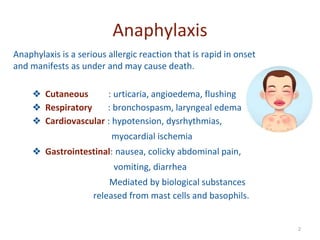
Anaphylaxis is a serious allergic reaction that is rapid in onset
and manifests as under and may cause death.
❖ Cutaneous : urticaria, angioedema, flushing
❖ Respiratory : bronchospasm, laryngeal edema
❖ Cardiovascular : hypotension, dysrhythmias,
myocardial ischemia
❖ Gastrointestinal: nausea, colicky abdominal pain,
vomiting, diarrhea
Mediated by biological substances
released from mast cells and basophils.
2
Anaphylaxis - Etymology
❖ Ancient Greek
➢ aná - intensifier
➢ phúlaxis - protection (by antibodies)
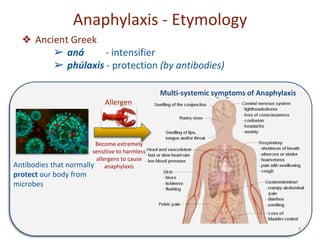
Become extremely
sensitive to harmless
allergens to cause
anaphylaxis
Antibodies that normally
protect our body from
microbes
3
Multi-systemic symptoms of Anaphylaxis
Allergen
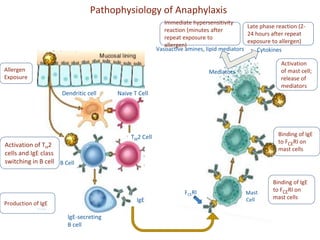
Pathophysiology of Anaphylaxis
B Cell
Immediate hypersensitivity
reaction (minutes after
repeat exposure to
allergen)
Allergen(e.g. pollen)
Allergen
Exposure
IgE-secreting
B cell
IgE
B cell
Dendritic Cell
Production of IgE
TH2 Cell
Naive T Cell
Dendritic cell
IgE
Cytokines
Activation
of mast cell;
release of
mediators
Binding of IgE
to FCƐRI on
mast cells
Late phase reaction (2-
24 hours after repeat
exposure to allergen)
Vasoactive amines, lipid mediators
Binding of IgE
to FCƐRI on
mast cells
Mediators
B Cell
Activation of TH2
cells and IgE class
switching in B cell
❖IgE-Dependent
❖Mechanism: IgE mediated reaction
➢ Allergens
■ Food : peanuts, dairy, meat, spices,fish
■ Medications : β-lactam antibiotics, ibuprofen
■ Biologic agents :
● monoclonal antibodies: infliximab, omalizumab
● allergens : challenge tests, specific immunotherapy
■ Natural rubber latex
■ Vaccines
■ Inhalants (rare) : horse or hamster dander, grass pollen
Anaphylaxis Immune Mechanisms &
Triggers
6
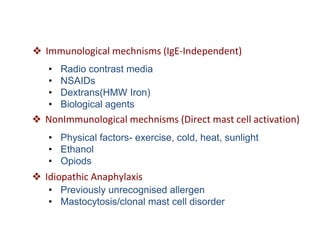
❖ Immunological mechnisms (IgE-Independent)
• Radio contrast media
• NSAIDs
• Dextrans(HMW Iron)
• Biological agents
❖ NonImmunological mechnisms (Direct mast cell activation)
• Physical factors- exercise, cold, heat, sunlight
• Ethanol
• Opiods
❖ Idiopathic Anaphylaxis
• Previously unrecognised allergen
• Mastocytosis/clonal mast cell disorder
Exercise induced anaphylaxis
(EIAn)
o Symptoms occur after physical activity.
o In one third of cases food, drugs (especially NSAID) &
change in temp, can be identified.
o When symptoms develop after food ingestion, the
condition is referred as food-dependent exercise induced
anaphylaxis (FDEIAn).
o Fasting before exercise is of utmost importance when no
precise food has been correlated with the clinical
manifestations.
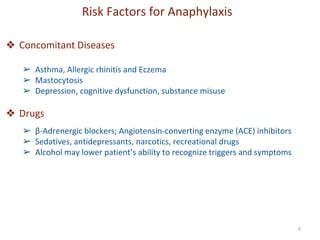
Risk Factors for Anaphylaxis
❖ Concomitant Diseases
➢ Asthma, Allergic rhinitis and Eczema
➢ Mastocytosis
➢ Depression, cognitive dysfunction, substance misuse
❖ Drugs
➢ β-Adrenergic blockers; Angiotensin-converting enzyme (ACE) inhibitors
➢ Sedatives, antidepressants, narcotics, recreational drugs
➢ Alcohol may lower patient’s ability to recognize triggers and symptoms
9
❖ Cofactors that Amplify Anaphylaxis
➢ Exercise: may be food dependent or food independent;
➢ NSAIDs
➢ Acute infection
➢ Emotional stress
➢ Disruption of routine—for example, travel, jet lag
➢ Premenstrual status in women and girls
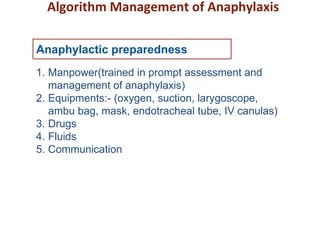
Anaphylactic preparedness
Algorithm Management of Anaphylaxis
1. Manpower(trained in prompt assessment and
management of anaphylaxis)
2. Equipments:- (oxygen, suction, larygoscope,
ambu bag, mask, endotracheal tube, IV canulas)
3. Drugs
4. Fluids
5. Communication
Initial management
Yes
• Assess airway, breathing,
circulation, mentation
• Inject epinephrine(IM)*
• Supine position
• IV access, oxygen, monitoring
No
Initial assessment supports
potential anaphylaxis?
Consider other diagnosis
*0.01ml/kg Epinephrine1:1000[IM]
Good clinical
response?
Yes
No
Recumbent position with elevation
lower extremity • Establish airway,
O2 • Repeat epinephrine injection if
indicated
• IV fluids1 if hypotensive
Consider inhaled bronchodilators2 if
wheezing
• H1 and H2 antihistamines3
• Corticosteroids4
• Observation
• Autoinjectible
epinephrine
1NS or RL-30 mL/kg in 1st hr
2 Nebulised Albuterol- (0.83 mg/mL [3 mL]) via mask with O2
3cetrizine-0.25 mg/kg up to 10 mg PO, Ranitidine-1 mg/kg up to 50 mg IV
4methylprednisolone- 1-2 mg/kg up to 125 mg IV
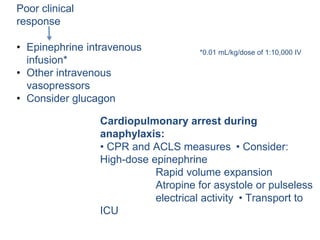
Poor clinical
response
• Epinephrine intravenous
infusion*
• Other intravenous
vasopressors
• Consider glucagon
Cardiopulmonary arrest during
anaphylaxis:
• CPR and ACLS measures • Consider:
High-dose epinephrine
Rapid volume expansion
Atropine for asystole or pulseless
electrical activity • Transport to
ICU
*0.01 mL/kg/dose of 1:10,000 IV
POSTEMERGENCY MANAGEMENT
Antihistamine-Cetirizine (5-10 mg qd) or
loratadine (5-10 mg qd) for 3 days
Corticosteroids(Optional): Oral prednisone (1 mg/kg up to 75
mg) daily for 3 days
Preventive treatment
• Prescription for epinephrine
autoinjector(Epipen) and antihistamine
• Written plan outlining patient emergency
management
• Follow-up evaluation to determine/confirm
• Thank You

Anaphylaxis.pptx

  • 1.
  • 2.
    Anaphylaxis Anaphylaxis is aserious allergic reaction that is rapid in onset and manifests as under and may cause death. ❖ Cutaneous : urticaria, angioedema, flushing ❖ Respiratory : bronchospasm, laryngeal edema ❖ Cardiovascular : hypotension, dysrhythmias, myocardial ischemia ❖ Gastrointestinal: nausea, colicky abdominal pain, vomiting, diarrhea Mediated by biological substances released from mast cells and basophils. 2
  • 3.
    Anaphylaxis - Etymology ❖Ancient Greek ➢ aná - intensifier ➢ phúlaxis - protection (by antibodies) Become extremely sensitive to harmless allergens to cause anaphylaxis Antibodies that normally protect our body from microbes 3 Multi-systemic symptoms of Anaphylaxis Allergen
  • 5.
    Pathophysiology of Anaphylaxis BCell Immediate hypersensitivity reaction (minutes after repeat exposure to allergen) Allergen(e.g. pollen) Allergen Exposure IgE-secreting B cell IgE B cell Dendritic Cell Production of IgE TH2 Cell Naive T Cell Dendritic cell IgE Cytokines Activation of mast cell; release of mediators Binding of IgE to FCƐRI on mast cells Late phase reaction (2- 24 hours after repeat exposure to allergen) Vasoactive amines, lipid mediators Binding of IgE to FCƐRI on mast cells Mediators B Cell Activation of TH2 cells and IgE class switching in B cell
  • 6.
    ❖IgE-Dependent ❖Mechanism: IgE mediatedreaction ➢ Allergens ■ Food : peanuts, dairy, meat, spices,fish ■ Medications : β-lactam antibiotics, ibuprofen ■ Biologic agents : ● monoclonal antibodies: infliximab, omalizumab ● allergens : challenge tests, specific immunotherapy ■ Natural rubber latex ■ Vaccines ■ Inhalants (rare) : horse or hamster dander, grass pollen Anaphylaxis Immune Mechanisms & Triggers 6
  • 7.
    ❖ Immunological mechnisms(IgE-Independent) • Radio contrast media • NSAIDs • Dextrans(HMW Iron) • Biological agents ❖ NonImmunological mechnisms (Direct mast cell activation) • Physical factors- exercise, cold, heat, sunlight • Ethanol • Opiods ❖ Idiopathic Anaphylaxis • Previously unrecognised allergen • Mastocytosis/clonal mast cell disorder
  • 8.
    Exercise induced anaphylaxis (EIAn) oSymptoms occur after physical activity. o In one third of cases food, drugs (especially NSAID) & change in temp, can be identified. o When symptoms develop after food ingestion, the condition is referred as food-dependent exercise induced anaphylaxis (FDEIAn). o Fasting before exercise is of utmost importance when no precise food has been correlated with the clinical manifestations.
  • 9.
    Risk Factors forAnaphylaxis ❖ Concomitant Diseases ➢ Asthma, Allergic rhinitis and Eczema ➢ Mastocytosis ➢ Depression, cognitive dysfunction, substance misuse ❖ Drugs ➢ β-Adrenergic blockers; Angiotensin-converting enzyme (ACE) inhibitors ➢ Sedatives, antidepressants, narcotics, recreational drugs ➢ Alcohol may lower patient’s ability to recognize triggers and symptoms 9
  • 10.
    ❖ Cofactors thatAmplify Anaphylaxis ➢ Exercise: may be food dependent or food independent; ➢ NSAIDs ➢ Acute infection ➢ Emotional stress ➢ Disruption of routine—for example, travel, jet lag ➢ Premenstrual status in women and girls
  • 11.
    Anaphylactic preparedness Algorithm Managementof Anaphylaxis 1. Manpower(trained in prompt assessment and management of anaphylaxis) 2. Equipments:- (oxygen, suction, larygoscope, ambu bag, mask, endotracheal tube, IV canulas) 3. Drugs 4. Fluids 5. Communication
  • 12.
    Initial management Yes • Assessairway, breathing, circulation, mentation • Inject epinephrine(IM)* • Supine position • IV access, oxygen, monitoring No Initial assessment supports potential anaphylaxis? Consider other diagnosis *0.01ml/kg Epinephrine1:1000[IM]
  • 13.
    Good clinical response? Yes No Recumbent positionwith elevation lower extremity • Establish airway, O2 • Repeat epinephrine injection if indicated • IV fluids1 if hypotensive Consider inhaled bronchodilators2 if wheezing • H1 and H2 antihistamines3 • Corticosteroids4 • Observation • Autoinjectible epinephrine 1NS or RL-30 mL/kg in 1st hr 2 Nebulised Albuterol- (0.83 mg/mL [3 mL]) via mask with O2 3cetrizine-0.25 mg/kg up to 10 mg PO, Ranitidine-1 mg/kg up to 50 mg IV 4methylprednisolone- 1-2 mg/kg up to 125 mg IV
  • 14.
    Poor clinical response • Epinephrineintravenous infusion* • Other intravenous vasopressors • Consider glucagon Cardiopulmonary arrest during anaphylaxis: • CPR and ACLS measures • Consider: High-dose epinephrine Rapid volume expansion Atropine for asystole or pulseless electrical activity • Transport to ICU *0.01 mL/kg/dose of 1:10,000 IV
  • 15.
    POSTEMERGENCY MANAGEMENT Antihistamine-Cetirizine (5-10mg qd) or loratadine (5-10 mg qd) for 3 days Corticosteroids(Optional): Oral prednisone (1 mg/kg up to 75 mg) daily for 3 days Preventive treatment • Prescription for epinephrine autoinjector(Epipen) and antihistamine • Written plan outlining patient emergency management • Follow-up evaluation to determine/confirm
  • 16.