In collaboration with the World Health Organization
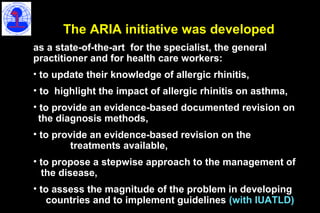
The ARIA initiative was developed
as a state-of-the-art for the specialist, the general
practitioner and for health care workers:
• to update their knowledge of allergic rhinitis,

• to highlight the impact of allergic rhinitis on asthma,
• to provide an evidence-based documented revision on
the diagnosis methods,
• to provide an evidence-based revision on the
treatments available,
• to propose a stepwise approach to the management of
the disease,
• to assess the magnitude of the problem in developing
countries and to implement guidelines (with IUATLD)
ARIA program
First phase:
• Development of evidence-based guidelines
during a workshop held at WHO in December
1999 (J Allergy Clin Immunol, suppl, Nov 2001).
• Document has been endorsed by several allergy,
respiratory, ENT and paediatric associations.
ARIA program
First phase:
•

Development of evidence-based guidelines during a workshop held
at WHO in December 1999 (J Allergy Clin Immunol, suppl, Nov 2001).

•

Document has been endorsed by several allergy, respiratory, ENT
and pediatric associations.

Second phase:
• To produce materials to help improve delivery of
care to those with rhinitis. In particular a pocket
guide
• To implement ARIA guidelines
• To update the workshop report
1- Why ARIA ?
2- New classification of rhinitis
3- Importance of nasal
inflammation
4- Treatment based on evidence
5- Impact of rhinitis on asthma
Prevalence of hay fever: 13-14 yr olds - ISAAC
Strachan et al, Pediatr Allergy Immunology 1997

≥20%
10-20%
<10%
Asthma - ISAAC (1997-8)
Source: N Aït Khaled, IUATLD

Morocco
Casablanca:12%
Rabat: 6.6%
Marrakech: 17%

Algeria
Algiers West: 4.8%
Algiers Centre: 6.6%
Tunisia
Sousse15.2%
Ethiopia
Addis Ababa: 2.8%
Jima: 2.2 %

Conakry
Guinea
10.3%
Abidjan
Ivory Coast
11.8%

Kenya
Nairobi: 15.4%
Eldoret: 6.8%
Nigeria
Ibadan: 18.4%

South Africa
Cape Town: 13.1%
“Hay fever ever” - ISAAC (1997-8)
Source: N Aït Khaled, IUATLD

Morocco
Casablanca: 27%
Rabat: 18%
Marrakech: 21%

Algeria
Algiers West: 13%
Algiers Centre: 24%
Tunisia
Sousse:15.2%
Ethiopia:2%

Guinea
Conakry:48%
Ivory Coast
Abidjan: 49%

Kenya: 12%

Nigeria
Ibadan: 40%

South Africa 15%
Increase in prevalence of rhinitis with age in
Denmark
- Study 1: children 7-17 yrs studied at 6 yr intervals
Ulrik et al, Allergy 2000

- rhinitis increased from 15 to 22%
- often linked with IgE sensitization
- Study 2: adults 15-41s yr studied at 8 yr intervals
Linneberg et al, J Allergy Clin Immunol 2000

- rhinitis increased from 25 to 32%
- often linked with IgE sensitization
SF-36 in seasonal and perennial rhinitis
Bousquet, Burtin et al J Allergy Clin Immunol 1994
Ciprandi et al, Allergy 2002
100

controls

Mean score

perennial rhinitis
75

pollen rhinitis

50

25

0

PF

SF

PA

SA

MH

EF

BP

GH
Needs for new guidelines in the
management of allergic rhinitis
• The International Consensus on Rhinitis was a

•

•

major step forward and was recently validated
for the treatment of seasonal allergic rhinitis.
However,
• it was not evidence-based
• new drugs have been available since 1995.
• it was mainly applicable to developed countries.
Moreover, the ARIA guidelines are targeting the
patient globally instead of treating each target
organ individually
Needs for guidelines in the management
of allergic rhinitis
• Allergic rhinitis is a global health problem
affecting 5 to 50 % of the population

• Its prevalence is increasing.
• Although it is not usually a severe disease,
rhinitis alters social life and affects school
performance and work productivity.

• Costs incurred by rhinitis are substantial.
• Implementation of guidelines improves the
condition of patients with allergic rhinitis.
Needs for guidelines in the management
of allergic rhinitis in developing countries
• ISAAC study: seasonal allergic rhinitis (hay

fever) affects up to 50% of adolescents in
certain developing countries: Guinea
(Conakry), Ivory Coast (Abidjan) or Nigeria
(Lagos).

• However, the validity of the questionnaire used
should be checked in these countries
• Rhinitis may be a problem in some parts of
developing countries only
• Risk factors should be understood for
preventive measures
1- Why ARIA ?
2- New classification of rhinitis
ARIA
The classification "seasonal" and
"perennial" allergic rhinitis
has been changed to
"intermittent" and "persistent"
allergic rhinitis
Pollen season in Montpellier (1990)
6000

grass
cypress

pollens/m

3

air

.

5000
4000
3000
2000
1000
0

0

10

20
weeks

30

40

threshold level
for symptoms
Concept of "minimal persistent inflammation"
Ciprandi et al, J Allergy Clin Immunol 1996

mite allergen (µg/g of dust)

Mechanisms of house dust mite induced rhinitis
100
10
.

theshold level
for symptoms

1
0,1

0

2

minimal
persistent
symptoms inflammation
inflammation

4

6

8

10

12 Months
ARIA Classification
Intermittent

Persistent

. < 4 days per week
. or < 4 weeks

. ≥ 4 days per week
. and ≥ 4 weeks

Mild

Moderate-severe

normal sleep
& no impairment of daily
activities, sport,
leisure
& normal work and
school
& no troublesome
symptoms
in untreated patients

one or more items
. abnormal sleep
. impairment of daily
activities, sport, leisure
. abnormal work and
school
. troublesome symptoms
1- Why ARIA ?
2- New classification of rhinitis
3- Importance of nasal inflammation
Persistent rhinitis

histamine
1- Why ARIA ?
2- New classification of rhinitis
3- Importance of nasal inflammation
4- Treatment based on evidence
allergen
allergen
avoidance
avoidance

indicated
indicated
when possible
when possible

pharmacotherapy
pharmacotherapy
safety
safety
effectiveness
effectiveness
easily administered
easily administered

costs

patient
patient
education
education

always indicated
always indicated

immunotherapy
immunotherapy

effectiveness
effectiveness
specialist prescription
may alter the natural
course of the disease
Statement of evidence: Strength of evidence
Shekelle et al, BMJ 1999

A directly based on randomized controlled trials
and meta-analyses
B

C

evidence from at least one controlled study without
randomization or
extrapolated recommendation from
category A evidence
evidence from at least one other type of quasiexperimental study or extrapolated
recommendation from
category A or B evidence

D evidence from expert committee reports or
opinions or clinical experience of respected
authorities, or both
Strength of evidence for treatment of rhinitis
ARIA
intervention

SAR
adult

PAR
children adult

children
oral anti-H1
intranasal anti-H1
intranasal CS
intranasal chromone
anti-leukotriene
subcutaneous SIT
sublingual / nasal SIT
allergen avoidance

A
A
A
A
A
A
A
D

A
A
A
A
A
A
A
D

A
A
A
A

A
A
A
A

A
A
D

A
D
Medications of allergic rhinitis
ARIA
sneezing

H1-antihistamines
oral
intranasal
intraocular
Corticosteroids
Chromones
intranasal
intraocular
Decongestants
intranasal
oral
Anti-cholinergics
Anti-leukotrienes

rhinorrhea

nasal
obstruction

nasal
itch

eye
symptoms

+++
++
0
+++

+++
+++
0
+++

0 to +
+
0
++

+++
++
0
++

++
0
+++
+

+
0

+
0

+
0

+
0

0
++

0
0
0
+

0
0
+++
++

++
+
0
++

0
0
0
?

0
0
0
++
Mild intermittent rhinitis
ARIA
Options (not in preferred order)
- oral or intranasal anti-H1
- intranasal decongestants
- oral decongestants (not in children)
Moderate-severe intermittent rhinitis
Mild persistent rhinitis
ARIA
Options (not in preferred order)
- oral or intranasal anti-H1
- oral anti-H1 + decongestant
- intranasal CS
- (chromones)
Patient should be re-assessed after 2-4 wks
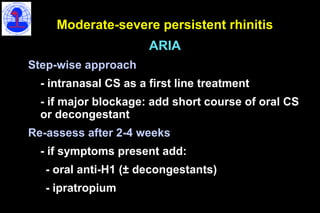
Moderate-severe persistent rhinitis
ARIA
Step-wise approach
- intranasal CS as a first line treatment
- if major blockage: add short course of oral CS
or decongestant
Re-assess after 2-4 weeks
- if symptoms present add:
- oral anti-H1 (± decongestants)
- ipratropium
Conjunctivitis rhinitis
ARIA
Options (not in preferred order)
- oral or ocular anti-H1
- ocular chromones
- saline
Do not use ocular CS without care and eye
examination
Treatment of allergic rhinitis (ARIA)
Allergic Rhinitis and its Impact on Asthma

mild
intermittent

moderate
severe
intermittent

mild
persistent

moderate
severe
persistent

intra-nasal steroid
local chromone

oral or local non-sedative H1-blocker
intra-nasal decongestant (<10 days) or oral decongestant

allergen and irritant avoidance
immunotherapy
ARIA in low-income countries

•

The rationale for treatment choice in
developing countries is based upon:
• level of efficacy
• low drug cost affordable for the majority
of patients
• inclusion in the WHO essential list of drugs:
only chlorpeniramine and BDP are listed

•

It is hoped that new drugs will be
available on this list
ARIA in low-income countries
Stepwise treatment proposed

• Mild intermittent rhinitis: oral antihistamine
• Moderate/severe intermittent rhinitis: BDP low
dose ± oral antihistamine

• Mild persistent rhinitis: oral antihistamine
or low dose BDP

• Moderate/severe persistent rhinitis: high dose
BDP. Consider adding oral antihistamine ± oral
steroids (short course)
1- Why ARIA ?
2- New classification of rhinitis
3- Importance of nasal inflammation
4- Treatment based on evidence
5- Impact of rhinitis on asthma
First description of hay fever
John Bostock, Med Chir Trans, 1819; 10: 161

"About the beginning or middle of
June in every year …..
…. A sensation of heat and fulness is
experienced in the eyes ….
…. To this succeeds irritation of the
nose producing sneezing ….
…. To the sneezings are added a
further sensation of tightness of the
chest, and a difficulty of breathing"
Links between rhinitis and asthma:
Epidemiologic evidence
1- Asthma prevalence is increased in
allergic and non-allergic rhinitis
2- Rhinitis is almost always present in
asthma
3- Rhinitis may be a risk factor for
asthma
4- Non-specific bronchial hyperreactivity
is increased in persistent rhinitis
Perennial rhinitis: an independent risk factor
for asthma
Leynaert et al, J Allergy Clin Immunol 1999

% subjects with asthma

25

controls

20

rhinitis

15
10
5
0

atopic

non-atopic
Frequency of asthma related to allergens

Frequency of asthma related
to allergens (%)

Linneberg et al, Respir Med 2001
60
50

no rhinitis
rhinitis

40
"allergy"
assessed by
questionnair
e

30
20
10
0

pollen

animal dander
allergy

mite
Early allergic rhinitis as a risk factor for
asthma
Wright et al, Pediatrics 1994
children with symptoms (%)

80

60

cough, wheeze
asthma

40

20

0
rhinitis allergic allergic non-allergic none
ND
in prick test
pos.
neg.
ND
ND
neg.
Bronchial hyperreactivity in ECHRS patients
Leynaert, Bousquet, Neukirch, Am J Respir Crit Care
Med 1997
80
- Paris + MPL

% subjects

60

- 821 adults
- 20-44 yr

40

- PC20 methacholine
≤4mg
20
0

controls seasonal perennial seasonal asthma
rhinitis
rhinitis + perennial
rhinitis
non-asthmatic
without wheeze
Eosinophils (EG2+ cells)
in biopsies of asthmatics
Bronchial mucosa

Bousquet J et al. N Engl J Med 1990

Nasal mucosa

Chanez P et al. Am J Respir Crit Care Med 1999
nose
allergens
noxious agents

epithelial
mesenchymal
trophic
unit

bronchus
allergens
noxious agents

epithelial
mesenchymal
muscular
trophic
unit
QOL in a population-based study (ECRHS)
Leynaert et al, Am J Respir Crit Care Med 2000
60

p<0.001
p<0.001

p<0.001
p<0.001

Mean score

50

allergic rhinitis (N=297)
asthma + AR (N=76)

40
30
20
10
0

controls (N=448)

Physical Summary

Mental summary
score
ARIA program
•

•
•

•

Guideline implementation in low income
developing countries in collaboration with
IUATLD
need of adaptation to the local situation as
well as to social and cultural barriers.
A joined ARIA-IUATLD program started to
assess the magnitude of allergic rhinitis in
these countries to confirm the results of
the ISAAC study using a more detailed
questionnaire.
Then, a pocket guide specifically devoted to
low income countries will be developed.
Ultimate goals of ARIA

• To translate evolving science on rhinitis into
recommendations for the management and
prevention of the disease

• To better assess the interactions between
rhinitis and asthma

• To increase awareness of rhinitis and its
public health consequences

• To make the effective treatment of rhinitis

available and affordable for every patient in
the world
Recommendations
1- Patients with persistent rhinitis should be
evaluated for asthma
2- Patients with persistent asthma should be
evaluated for rhinitis
3- A strategy should combine the treatment of
upper and lower airways in terms of
efficacy and safety

Aria

  • 1.
    In collaboration withthe World Health Organization
  • 2.
    The ARIA initiativewas developed as a state-of-the-art for the specialist, the general practitioner and for health care workers: • to update their knowledge of allergic rhinitis, • to highlight the impact of allergic rhinitis on asthma, • to provide an evidence-based documented revision on the diagnosis methods, • to provide an evidence-based revision on the treatments available, • to propose a stepwise approach to the management of the disease, • to assess the magnitude of the problem in developing countries and to implement guidelines (with IUATLD)
  • 3.
    ARIA program First phase: •Development of evidence-based guidelines during a workshop held at WHO in December 1999 (J Allergy Clin Immunol, suppl, Nov 2001). • Document has been endorsed by several allergy, respiratory, ENT and paediatric associations.
  • 5.
    ARIA program First phase: • Developmentof evidence-based guidelines during a workshop held at WHO in December 1999 (J Allergy Clin Immunol, suppl, Nov 2001). • Document has been endorsed by several allergy, respiratory, ENT and pediatric associations. Second phase: • To produce materials to help improve delivery of care to those with rhinitis. In particular a pocket guide • To implement ARIA guidelines • To update the workshop report
  • 7.
    1- Why ARIA? 2- New classification of rhinitis 3- Importance of nasal inflammation 4- Treatment based on evidence 5- Impact of rhinitis on asthma
  • 8.
    Prevalence of hayfever: 13-14 yr olds - ISAAC Strachan et al, Pediatr Allergy Immunology 1997 ≥20% 10-20% <10%
  • 9.
    Asthma - ISAAC(1997-8) Source: N Aït Khaled, IUATLD Morocco Casablanca:12% Rabat: 6.6% Marrakech: 17% Algeria Algiers West: 4.8% Algiers Centre: 6.6% Tunisia Sousse15.2% Ethiopia Addis Ababa: 2.8% Jima: 2.2 % Conakry Guinea 10.3% Abidjan Ivory Coast 11.8% Kenya Nairobi: 15.4% Eldoret: 6.8% Nigeria Ibadan: 18.4% South Africa Cape Town: 13.1%
  • 10.
    “Hay fever ever”- ISAAC (1997-8) Source: N Aït Khaled, IUATLD Morocco Casablanca: 27% Rabat: 18% Marrakech: 21% Algeria Algiers West: 13% Algiers Centre: 24% Tunisia Sousse:15.2% Ethiopia:2% Guinea Conakry:48% Ivory Coast Abidjan: 49% Kenya: 12% Nigeria Ibadan: 40% South Africa 15%
  • 11.
    Increase in prevalenceof rhinitis with age in Denmark - Study 1: children 7-17 yrs studied at 6 yr intervals Ulrik et al, Allergy 2000 - rhinitis increased from 15 to 22% - often linked with IgE sensitization - Study 2: adults 15-41s yr studied at 8 yr intervals Linneberg et al, J Allergy Clin Immunol 2000 - rhinitis increased from 25 to 32% - often linked with IgE sensitization
  • 12.
    SF-36 in seasonaland perennial rhinitis Bousquet, Burtin et al J Allergy Clin Immunol 1994 Ciprandi et al, Allergy 2002 100 controls Mean score perennial rhinitis 75 pollen rhinitis 50 25 0 PF SF PA SA MH EF BP GH
  • 13.
    Needs for newguidelines in the management of allergic rhinitis • The International Consensus on Rhinitis was a • • major step forward and was recently validated for the treatment of seasonal allergic rhinitis. However, • it was not evidence-based • new drugs have been available since 1995. • it was mainly applicable to developed countries. Moreover, the ARIA guidelines are targeting the patient globally instead of treating each target organ individually
  • 14.
    Needs for guidelinesin the management of allergic rhinitis • Allergic rhinitis is a global health problem affecting 5 to 50 % of the population • Its prevalence is increasing. • Although it is not usually a severe disease, rhinitis alters social life and affects school performance and work productivity. • Costs incurred by rhinitis are substantial. • Implementation of guidelines improves the condition of patients with allergic rhinitis.
  • 15.
    Needs for guidelinesin the management of allergic rhinitis in developing countries • ISAAC study: seasonal allergic rhinitis (hay fever) affects up to 50% of adolescents in certain developing countries: Guinea (Conakry), Ivory Coast (Abidjan) or Nigeria (Lagos). • However, the validity of the questionnaire used should be checked in these countries • Rhinitis may be a problem in some parts of developing countries only • Risk factors should be understood for preventive measures
  • 16.
    1- Why ARIA? 2- New classification of rhinitis
  • 17.
    ARIA The classification "seasonal"and "perennial" allergic rhinitis has been changed to "intermittent" and "persistent" allergic rhinitis
  • 18.
    Pollen season inMontpellier (1990) 6000 grass cypress pollens/m 3 air . 5000 4000 3000 2000 1000 0 0 10 20 weeks 30 40 threshold level for symptoms
  • 19.
    Concept of "minimalpersistent inflammation" Ciprandi et al, J Allergy Clin Immunol 1996 mite allergen (µg/g of dust) Mechanisms of house dust mite induced rhinitis 100 10 . theshold level for symptoms 1 0,1 0 2 minimal persistent symptoms inflammation inflammation 4 6 8 10 12 Months
  • 20.
    ARIA Classification Intermittent Persistent . <4 days per week . or < 4 weeks . ≥ 4 days per week . and ≥ 4 weeks Mild Moderate-severe normal sleep & no impairment of daily activities, sport, leisure & normal work and school & no troublesome symptoms in untreated patients one or more items . abnormal sleep . impairment of daily activities, sport, leisure . abnormal work and school . troublesome symptoms
  • 21.
    1- Why ARIA? 2- New classification of rhinitis 3- Importance of nasal inflammation
  • 22.
  • 23.
    1- Why ARIA? 2- New classification of rhinitis 3- Importance of nasal inflammation 4- Treatment based on evidence
  • 24.
    allergen allergen avoidance avoidance indicated indicated when possible when possible pharmacotherapy pharmacotherapy safety safety effectiveness effectiveness easilyadministered easily administered costs patient patient education education always indicated always indicated immunotherapy immunotherapy effectiveness effectiveness specialist prescription specialist prescription may alter the natural may alter the natural course of the disease course of the disease
  • 25.
    Statement of evidence:Strength of evidence Shekelle et al, BMJ 1999 A directly based on randomized controlled trials and meta-analyses B C evidence from at least one controlled study without randomization or extrapolated recommendation from category A evidence evidence from at least one other type of quasiexperimental study or extrapolated recommendation from category A or B evidence D evidence from expert committee reports or opinions or clinical experience of respected authorities, or both
  • 26.
    Strength of evidencefor treatment of rhinitis ARIA intervention SAR adult PAR children adult children oral anti-H1 intranasal anti-H1 intranasal CS intranasal chromone anti-leukotriene subcutaneous SIT sublingual / nasal SIT allergen avoidance A A A A A A A D A A A A A A A D A A A A A A A A A A D A D
  • 27.
    Medications of allergicrhinitis ARIA sneezing H1-antihistamines oral intranasal intraocular Corticosteroids Chromones intranasal intraocular Decongestants intranasal oral Anti-cholinergics Anti-leukotrienes rhinorrhea nasal obstruction nasal itch eye symptoms +++ ++ 0 +++ +++ +++ 0 +++ 0 to + + 0 ++ +++ ++ 0 ++ ++ 0 +++ + + 0 + 0 + 0 + 0 0 ++ 0 0 0 + 0 0 +++ ++ ++ + 0 ++ 0 0 0 ? 0 0 0 ++
  • 28.
    Mild intermittent rhinitis ARIA Options(not in preferred order) - oral or intranasal anti-H1 - intranasal decongestants - oral decongestants (not in children)
  • 29.
    Moderate-severe intermittent rhinitis Mildpersistent rhinitis ARIA Options (not in preferred order) - oral or intranasal anti-H1 - oral anti-H1 + decongestant - intranasal CS - (chromones) Patient should be re-assessed after 2-4 wks
  • 30.
    Moderate-severe persistent rhinitis ARIA Step-wiseapproach - intranasal CS as a first line treatment - if major blockage: add short course of oral CS or decongestant Re-assess after 2-4 weeks - if symptoms present add: - oral anti-H1 (± decongestants) - ipratropium
  • 31.
    Conjunctivitis rhinitis ARIA Options (notin preferred order) - oral or ocular anti-H1 - ocular chromones - saline Do not use ocular CS without care and eye examination
  • 32.
    Treatment of allergicrhinitis (ARIA) Allergic Rhinitis and its Impact on Asthma mild intermittent moderate severe intermittent mild persistent moderate severe persistent intra-nasal steroid local chromone oral or local non-sedative H1-blocker intra-nasal decongestant (<10 days) or oral decongestant allergen and irritant avoidance immunotherapy
  • 33.
    ARIA in low-incomecountries • The rationale for treatment choice in developing countries is based upon: • level of efficacy • low drug cost affordable for the majority of patients • inclusion in the WHO essential list of drugs: only chlorpeniramine and BDP are listed • It is hoped that new drugs will be available on this list
  • 34.
    ARIA in low-incomecountries Stepwise treatment proposed • Mild intermittent rhinitis: oral antihistamine • Moderate/severe intermittent rhinitis: BDP low dose ± oral antihistamine • Mild persistent rhinitis: oral antihistamine or low dose BDP • Moderate/severe persistent rhinitis: high dose BDP. Consider adding oral antihistamine ± oral steroids (short course)
  • 35.
    1- Why ARIA? 2- New classification of rhinitis 3- Importance of nasal inflammation 4- Treatment based on evidence 5- Impact of rhinitis on asthma
  • 36.
    First description ofhay fever John Bostock, Med Chir Trans, 1819; 10: 161 "About the beginning or middle of June in every year ….. …. A sensation of heat and fulness is experienced in the eyes …. …. To this succeeds irritation of the nose producing sneezing …. …. To the sneezings are added a further sensation of tightness of the chest, and a difficulty of breathing"
  • 37.
    Links between rhinitisand asthma: Epidemiologic evidence 1- Asthma prevalence is increased in allergic and non-allergic rhinitis 2- Rhinitis is almost always present in asthma 3- Rhinitis may be a risk factor for asthma 4- Non-specific bronchial hyperreactivity is increased in persistent rhinitis
  • 38.
    Perennial rhinitis: anindependent risk factor for asthma Leynaert et al, J Allergy Clin Immunol 1999 % subjects with asthma 25 controls 20 rhinitis 15 10 5 0 atopic non-atopic
  • 39.
    Frequency of asthmarelated to allergens Frequency of asthma related to allergens (%) Linneberg et al, Respir Med 2001 60 50 no rhinitis rhinitis 40 "allergy" assessed by questionnair e 30 20 10 0 pollen animal dander allergy mite
  • 40.
    Early allergic rhinitisas a risk factor for asthma Wright et al, Pediatrics 1994 children with symptoms (%) 80 60 cough, wheeze asthma 40 20 0 rhinitis allergic allergic non-allergic none ND in prick test pos. neg. ND ND neg.
  • 41.
    Bronchial hyperreactivity inECHRS patients Leynaert, Bousquet, Neukirch, Am J Respir Crit Care Med 1997 80 - Paris + MPL % subjects 60 - 821 adults - 20-44 yr 40 - PC20 methacholine ≤4mg 20 0 controls seasonal perennial seasonal asthma rhinitis rhinitis + perennial rhinitis non-asthmatic without wheeze
  • 43.
    Eosinophils (EG2+ cells) inbiopsies of asthmatics Bronchial mucosa Bousquet J et al. N Engl J Med 1990 Nasal mucosa Chanez P et al. Am J Respir Crit Care Med 1999
  • 52.
  • 53.
    QOL in apopulation-based study (ECRHS) Leynaert et al, Am J Respir Crit Care Med 2000 60 p<0.001 p<0.001 p<0.001 p<0.001 Mean score 50 allergic rhinitis (N=297) asthma + AR (N=76) 40 30 20 10 0 controls (N=448) Physical Summary Mental summary score
  • 55.
    ARIA program • • • • Guideline implementationin low income developing countries in collaboration with IUATLD need of adaptation to the local situation as well as to social and cultural barriers. A joined ARIA-IUATLD program started to assess the magnitude of allergic rhinitis in these countries to confirm the results of the ISAAC study using a more detailed questionnaire. Then, a pocket guide specifically devoted to low income countries will be developed.
  • 56.
    Ultimate goals ofARIA • To translate evolving science on rhinitis into recommendations for the management and prevention of the disease • To better assess the interactions between rhinitis and asthma • To increase awareness of rhinitis and its public health consequences • To make the effective treatment of rhinitis available and affordable for every patient in the world
  • 57.
    Recommendations 1- Patients withpersistent rhinitis should be evaluated for asthma 2- Patients with persistent asthma should be evaluated for rhinitis 3- A strategy should combine the treatment of upper and lower airways in terms of efficacy and safety