Workshop
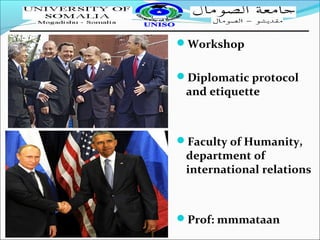
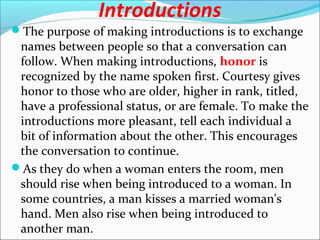
Diplomatic protocol
and etiquette
Faculty of Humanity,
department of
international relations
Prof: mmmataan
What is diplomatic protocol?
protocol refer to an international agreement that
supplements or amends a treaty.
A protocol is a rule which describes how an activity
should be performed, especially in the field of
diplomacy.
Protocols specify the proper and generally accepted
behavior in matters of state and diplomacy, such as
showing appropriate respect to a head of state, ranking
diplomats in chronological order of their accreditation.
Protocol is commonly described as a set of
international courtesy rules. These well-established and
time-honored rules have made it easier for nations and
people to live and work together.
Invitations
1. Invitation letter is sent to your guests before 10 day
2. The honor of invitation, (person’s name, or event), date,
day, and time.
3. Consultations is made between hosts and quest about time
and number of quest.
4. At the bottom of the letter, the dressing code is written
5. The quests may arrive ten minutes before, and may came late
maximum 30 minutes.
6. The hosts accompanied by his wife may stand front of the
living room to welcome the quest.
7. The number of seats must be limited to number of guest and
hosts with the same color and comfortable seats.
8. When the food is ready, the chief tells to protocol team and
they tell the hosts and hosts announce and leads the way.
Introductions
The purpose of making introductions is to exchange
names between people so that a conversation can
follow. When making introductions, honor is
recognized by the name spoken first. Courtesy gives
honor to those who are older, higher in rank, titled,
have a professional status, or are female. To make the
introductions more pleasant, tell each individual a
bit of information about the other. This encourages
the conversation to continue.
As they do when a woman enters the room, men
should rise when being introduced to a woman. In
some countries, a man kisses a married woman's
hand. Men also rise when being introduced to
another man.
Greetings
 Bend your head while doing namaskar or shaking
hands with guests and seniors
 Handshakes: hand shakes should be firm with men
and less so with ladies and do so only after they raise
their hands
 Hugging: In Arab/Muslim cultures
 Kissing in most European Countries
 In Turkey, Malaysia, Brunei, the Philippines,
women’s hands are kissed while greeting (limited to
conservative upper class), started in Eastern Europe
 Bowing: some countries use bowing as honor
greeting and you are expected to receive likewise.
Receiving/seeing off of counterpart
 Receive guest (s) generally at the entrance of your
door, may receive at the door of car/at the airport
 See off at the exit of your room, again, may
accompany the guest up to the car if he/she is of
appropriate counterpart.
 Sometimes, we may come up to the car door and see
off to give importance/special treatment
 Depending upon the importance and status of
visiting guests they may be received at the airports
as well
While Holding meeting
Start the meeting with warm welcome
Recall the earlier meetings if held before
Start and end with very positive note
Never say no while responding/reacting to a
proposal/idea expressed by the counterpart
May say, we will give thought to the matter, we may get
back on the matter in due course,
We may hold consultation with our head quarter and
come back with our appropriate response
During the meeting, only the leader to speak, others to
listen unless authorized by the leader
Dress Code
Dress, too, varies according to country and event.
Women should be particularly dress rules, such as
skirt length, low necklines, and having one's arms
covered. It is always better to be too dressed up than
too dressed down.
For men, Dark suit, dark suits in charcoal, dark grey
or navy blue are best
Good quality leather shoes/ generally laced shoes on
formal occasions,
Black socks are generally preferred
The lower button of a coat is usually left undone
Buttons must be undone while seated
Sitting postures
How to sit in front of VIPS/dignitaries
 Upright position/alert
No crossed-legged in front of VIPs/dignitaries
No leaning against the sofa
Do not spread your elbows while eating and also
do not put it on the table during dining
Always keep the guests at the right side of host
Always stay awaked, and never look sides
repeatedly.
Maintain eye contact to you talking counterparty.
Attending lunch/dinners
Seating arrangements must be carefully arranged,
Chief host and chief guest must be seated across the
table and arrangements for other delegates should
be made accordingly on the basis of seniority
Sending out invitations well in advance with date,
time, venue and dress code clearly indicated at the
card
Draw /fix appropriate menu depending on
season/guests
Punctuality for the event-reach on time and do not
get embarrassed by being undue tardy
Cont…
Light drinks before the dinner/lunch
Water, juice and other soft drinks.
If, for religious or health reasons, you absolutely cannot
try even a small portion of a particular food or drink, it is
acceptable to refuse with a short explanation
Drinks at the formal (seated) dinners include as follows:
Soup-dry sherry or Madeira
Fish/chicken
 Red meat
Vegetables
Fruits
Cont…
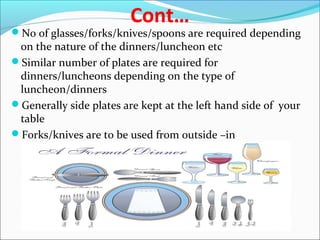
No of glasses/forks/knives/spoons are required depending
on the nature of the dinners/luncheon etc
Similar number of plates are required for
dinners/luncheons depending on the type of
luncheon/dinners
Generally side plates are kept at the left hand side of your
table
Forks/knives are to be used from outside –in
Speech/remarks dinners and luncheons
Generally short speech/remarks are made at the
official banquets/dinners/luncheons
Even in informal settings, short remarks are
made, so the main host/guest should be prepared
to speak a few words
Generally speech/remarks are made just after the
meal is over and before pudding/dessert is served
Initiate talks of common interest while on dining
table
Never ask about age, marital status or number of
children specially with ladies
Cont..
While wearing coat, the middle button is fastened
while standing if it is a three button coat, unbutton
when sitting
The upper button is fastened if it is two button coat
Don’t slurp while taking tea/coffee
Use the forks with left hand and knife with right hand
without clinking it or making unpleasant sound
No picking nose/ear during the event or make any
noise
Exchange gifts, if any, after the signing of the
minutes/agreement/MOUs etc. Gifts may be
exchanged through diplomatic missions or protocol
officer later
Do’s and don’ts
Do’s
Stand up whenever some one enters a room.
Stand up for introduction, greetings, leave taking
Hold door open for the lady, hold the chair for
her when she sits or rises from table
Help the lady in and out of her coat
Be polite and always appreciative
Give preference to you seniors
Don’tsDon’t make noises with your cutlery or waive them when
talking
Avoiding coughing, scratching, or blowing your nose
Never speak with your mouthful or ask a question to a
person sitting beside you just when the person has taken
food in the mouth.
Do not chew with your mouth open
Sip the drink without making any noise
Do not gargle while drinking water
Never tie the napkin around the neck
Do not poke your teeth with a toothpick or fingernail
Do not slurp your soup, gnaw at bones or lick your
fingers
At buffet, do not pile food on your plate, you can always
Thank You !

Workshop in protocol and etiquette

  • 1.
    Workshop Diplomatic protocol and etiquette Facultyof Humanity, department of international relations Prof: mmmataan
  • 2.
    What is diplomaticprotocol? protocol refer to an international agreement that supplements or amends a treaty. A protocol is a rule which describes how an activity should be performed, especially in the field of diplomacy. Protocols specify the proper and generally accepted behavior in matters of state and diplomacy, such as showing appropriate respect to a head of state, ranking diplomats in chronological order of their accreditation. Protocol is commonly described as a set of international courtesy rules. These well-established and time-honored rules have made it easier for nations and people to live and work together.
  • 3.
    Invitations 1. Invitation letteris sent to your guests before 10 day 2. The honor of invitation, (person’s name, or event), date, day, and time. 3. Consultations is made between hosts and quest about time and number of quest. 4. At the bottom of the letter, the dressing code is written 5. The quests may arrive ten minutes before, and may came late maximum 30 minutes. 6. The hosts accompanied by his wife may stand front of the living room to welcome the quest. 7. The number of seats must be limited to number of guest and hosts with the same color and comfortable seats. 8. When the food is ready, the chief tells to protocol team and they tell the hosts and hosts announce and leads the way.
  • 4.
    Introductions The purpose ofmaking introductions is to exchange names between people so that a conversation can follow. When making introductions, honor is recognized by the name spoken first. Courtesy gives honor to those who are older, higher in rank, titled, have a professional status, or are female. To make the introductions more pleasant, tell each individual a bit of information about the other. This encourages the conversation to continue. As they do when a woman enters the room, men should rise when being introduced to a woman. In some countries, a man kisses a married woman's hand. Men also rise when being introduced to another man.
  • 5.
    Greetings  Bend yourhead while doing namaskar or shaking hands with guests and seniors  Handshakes: hand shakes should be firm with men and less so with ladies and do so only after they raise their hands  Hugging: In Arab/Muslim cultures  Kissing in most European Countries  In Turkey, Malaysia, Brunei, the Philippines, women’s hands are kissed while greeting (limited to conservative upper class), started in Eastern Europe  Bowing: some countries use bowing as honor greeting and you are expected to receive likewise.
  • 6.
    Receiving/seeing off ofcounterpart  Receive guest (s) generally at the entrance of your door, may receive at the door of car/at the airport  See off at the exit of your room, again, may accompany the guest up to the car if he/she is of appropriate counterpart.  Sometimes, we may come up to the car door and see off to give importance/special treatment  Depending upon the importance and status of visiting guests they may be received at the airports as well
  • 7.
    While Holding meeting Startthe meeting with warm welcome Recall the earlier meetings if held before Start and end with very positive note Never say no while responding/reacting to a proposal/idea expressed by the counterpart May say, we will give thought to the matter, we may get back on the matter in due course, We may hold consultation with our head quarter and come back with our appropriate response During the meeting, only the leader to speak, others to listen unless authorized by the leader
  • 8.
    Dress Code Dress, too,varies according to country and event. Women should be particularly dress rules, such as skirt length, low necklines, and having one's arms covered. It is always better to be too dressed up than too dressed down. For men, Dark suit, dark suits in charcoal, dark grey or navy blue are best Good quality leather shoes/ generally laced shoes on formal occasions, Black socks are generally preferred The lower button of a coat is usually left undone Buttons must be undone while seated
  • 9.
    Sitting postures How tosit in front of VIPS/dignitaries  Upright position/alert No crossed-legged in front of VIPs/dignitaries No leaning against the sofa Do not spread your elbows while eating and also do not put it on the table during dining Always keep the guests at the right side of host Always stay awaked, and never look sides repeatedly. Maintain eye contact to you talking counterparty.
  • 10.
    Attending lunch/dinners Seating arrangementsmust be carefully arranged, Chief host and chief guest must be seated across the table and arrangements for other delegates should be made accordingly on the basis of seniority Sending out invitations well in advance with date, time, venue and dress code clearly indicated at the card Draw /fix appropriate menu depending on season/guests Punctuality for the event-reach on time and do not get embarrassed by being undue tardy
  • 11.
    Cont… Light drinks beforethe dinner/lunch Water, juice and other soft drinks. If, for religious or health reasons, you absolutely cannot try even a small portion of a particular food or drink, it is acceptable to refuse with a short explanation Drinks at the formal (seated) dinners include as follows: Soup-dry sherry or Madeira Fish/chicken  Red meat Vegetables Fruits
  • 12.
    Cont… No of glasses/forks/knives/spoonsare required depending on the nature of the dinners/luncheon etc Similar number of plates are required for dinners/luncheons depending on the type of luncheon/dinners Generally side plates are kept at the left hand side of your table Forks/knives are to be used from outside –in
  • 13.
    Speech/remarks dinners andluncheons Generally short speech/remarks are made at the official banquets/dinners/luncheons Even in informal settings, short remarks are made, so the main host/guest should be prepared to speak a few words Generally speech/remarks are made just after the meal is over and before pudding/dessert is served Initiate talks of common interest while on dining table Never ask about age, marital status or number of children specially with ladies
  • 14.
    Cont.. While wearing coat,the middle button is fastened while standing if it is a three button coat, unbutton when sitting The upper button is fastened if it is two button coat Don’t slurp while taking tea/coffee Use the forks with left hand and knife with right hand without clinking it or making unpleasant sound No picking nose/ear during the event or make any noise Exchange gifts, if any, after the signing of the minutes/agreement/MOUs etc. Gifts may be exchanged through diplomatic missions or protocol officer later
  • 15.
    Do’s and don’ts Do’s Standup whenever some one enters a room. Stand up for introduction, greetings, leave taking Hold door open for the lady, hold the chair for her when she sits or rises from table Help the lady in and out of her coat Be polite and always appreciative Give preference to you seniors
  • 16.
    Don’tsDon’t make noiseswith your cutlery or waive them when talking Avoiding coughing, scratching, or blowing your nose Never speak with your mouthful or ask a question to a person sitting beside you just when the person has taken food in the mouth. Do not chew with your mouth open Sip the drink without making any noise Do not gargle while drinking water Never tie the napkin around the neck Do not poke your teeth with a toothpick or fingernail Do not slurp your soup, gnaw at bones or lick your fingers At buffet, do not pile food on your plate, you can always
  • 17.

Editor's Notes

  • #5 Meeting at the host side.